
Algorithm Analysis 1182022 Programming and Data Structure 1
![Sorting integers void sort (int A[], int N) { int i, j, x; for](https://slidetodoc.com/presentation_image_h2/7dd5b6980327e1fd8c877a097f07974c/image-5.jpg "Sorting integers void sort (int A[], int N) { int i, j, x; for")
![Algorithm 1 int Max. Sub. Sum (int A[], int N) { int thissum, maxsum,](https://slidetodoc.com/presentation_image_h2/7dd5b6980327e1fd8c877a097f07974c/image-18.jpg "Algorithm 1 int Max. Sub. Sum (int A[], int N) { int thissum, maxsum,")
![Algorithm 2 int Max. Sub. Sum 2 (int A[], int N) { int thissum,](https://slidetodoc.com/presentation_image_h2/7dd5b6980327e1fd8c877a097f07974c/image-21.jpg "Algorithm 2 int Max. Sub. Sum 2 (int A[], int N) { int thissum,")
![Linear Search int search (int A[], int X, int N) { int i; for](https://slidetodoc.com/presentation_image_h2/7dd5b6980327e1fd8c877a097f07974c/image-23.jpg "Linear Search int search (int A[], int X, int N) { int i; for")
![Binary Search int Binary. Search (int A[], int X, int N) { int low,](https://slidetodoc.com/presentation_image_h2/7dd5b6980327e1fd8c877a097f07974c/image-24.jpg "Binary Search int Binary. Search (int A[], int X, int N) { int low,")
![Sorting integers void sort (int A[], int N) { int i, j, x; for](https://slidetodoc.com/presentation_image_h2/7dd5b6980327e1fd8c877a097f07974c/image-27.jpg "Sorting integers void sort (int A[], int N) { int i, j, x; for")
- Slides: 29
Algorithm Analysis 1/18/2022 Programming and Data Structure 1
What is an algorithm ? • A clearly specifiable set of instructions – to solve a problem • Given a problem – decide that the algorithm is correct • Determine how much resource the algorithm will require – Time – Space 1/18/2022 Programming and Data Structure 2
Analysis of Algorithms • How much resource is required ? • Measures for efficiency – Execution time complexity – Memory space complexity • Observation : – The larger amount of input data an algorithm has, the larger amount of resource it requires. • Complexities are functions of the amount of input data (input size). 1/18/2022 Programming and Data Structure 3
What do we use for a yardstick? • The same algorithm will run at different speeds and will require different amounts of space when run on different computers, different programming languages, different compilers. • But algorithms usually consume resources in some fashion that depends on the size of the problem they solve : n. 1/18/2022 Programming and Data Structure 4
Sorting integers void sort (int A[], int N) { int i, j, x; for (i=1; i<N; i++) { x = A[i]; for (j=i; j>0 && x<A[j-1]; j- -) A[j] = A[j-1]; A[j] = x; } } 1/18/2022 Programming and Data Structure 5
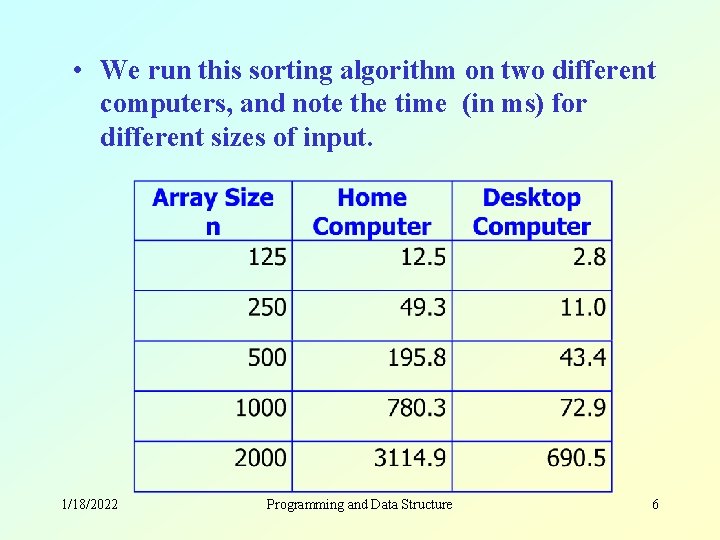
• We run this sorting algorithm on two different computers, and note the time (in ms) for different sizes of input. 1/18/2022 Programming and Data Structure 6
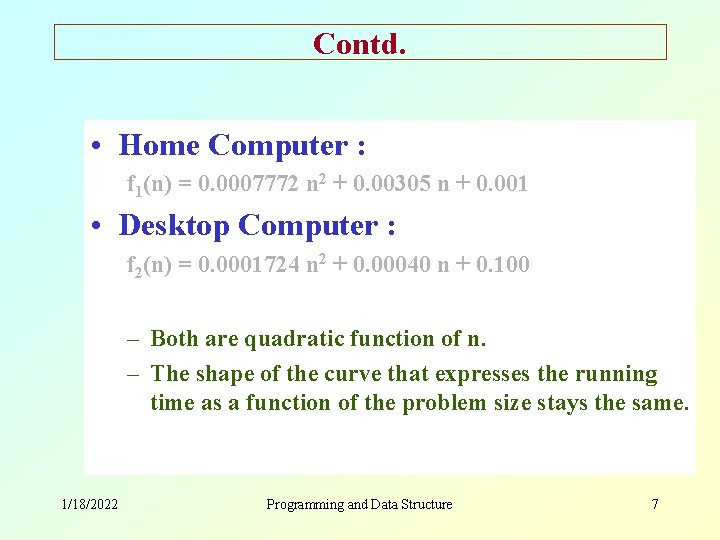
Contd. • Home Computer : f 1(n) = 0. 0007772 n 2 + 0. 00305 n + 0. 001 • Desktop Computer : f 2(n) = 0. 0001724 n 2 + 0. 00040 n + 0. 100 – Both are quadratic function of n. – The shape of the curve that expresses the running time as a function of the problem size stays the same. 1/18/2022 Programming and Data Structure 7
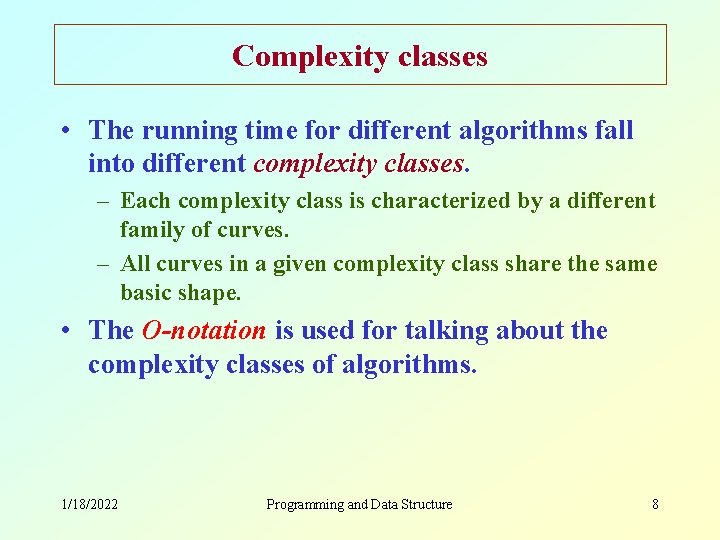
Complexity classes • The running time for different algorithms fall into different complexity classes. – Each complexity class is characterized by a different family of curves. – All curves in a given complexity class share the same basic shape. • The O-notation is used for talking about the complexity classes of algorithms. 1/18/2022 Programming and Data Structure 8
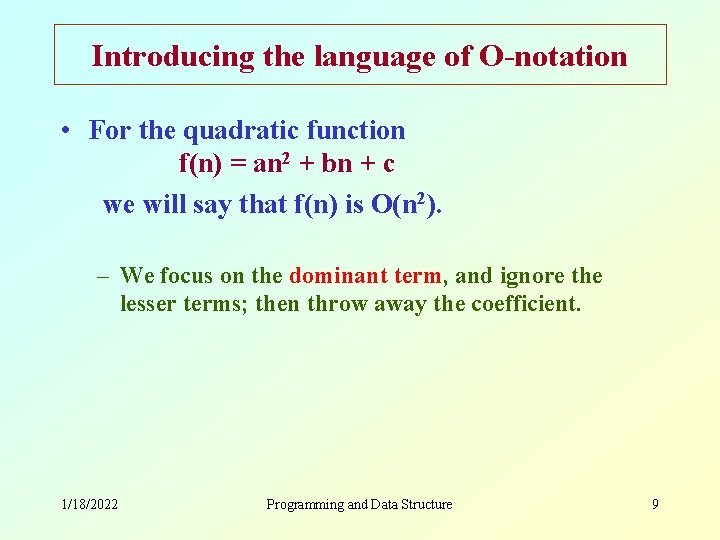
Introducing the language of O-notation • For the quadratic function f(n) = an 2 + bn + c we will say that f(n) is O(n 2). – We focus on the dominant term, and ignore the lesser terms; then throw away the coefficient. 1/18/2022 Programming and Data Structure 9
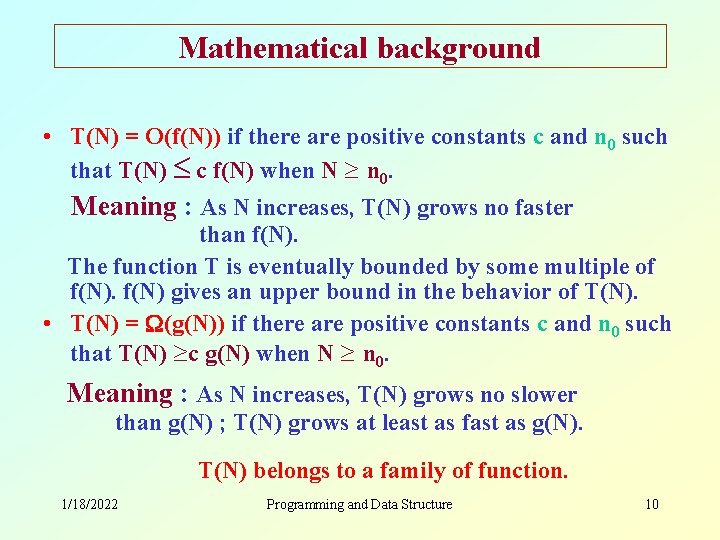
Mathematical background • T(N) = O(f(N)) if there are positive constants c and n 0 such that T(N) c f(N) when N n 0. Meaning : As N increases, T(N) grows no faster than f(N). The function T is eventually bounded by some multiple of f(N) gives an upper bound in the behavior of T(N). • T(N) = (g(N)) if there are positive constants c and n 0 such that T(N) c g(N) when N n 0. Meaning : As N increases, T(N) grows no slower than g(N) ; T(N) grows at least as fast as g(N). T(N) belongs to a family of function. 1/18/2022 Programming and Data Structure 10
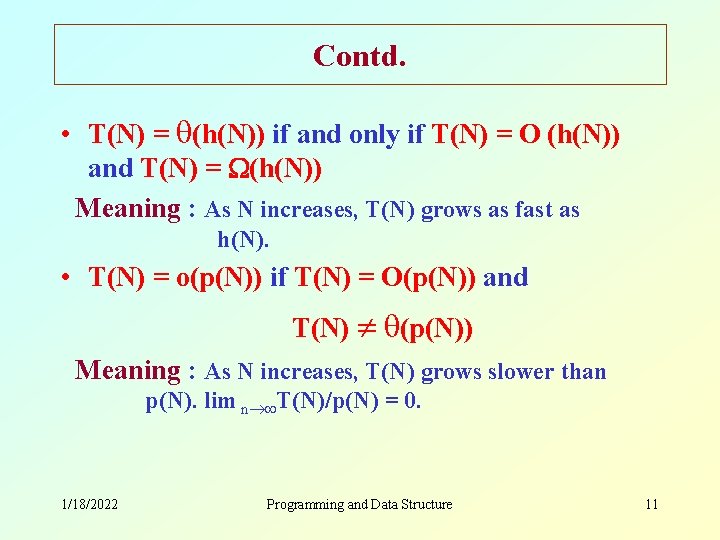
Contd. • T(N) = (h(N)) if and only if T(N) = O (h(N)) and T(N) = (h(N)) Meaning : As N increases, T(N) grows as fast as h(N). • T(N) = o(p(N)) if T(N) = O(p(N)) and T(N) (p(N)) Meaning : As N increases, T(N) grows slower than p(N). lim n T(N)/p(N) = 0. 1/18/2022 Programming and Data Structure 11
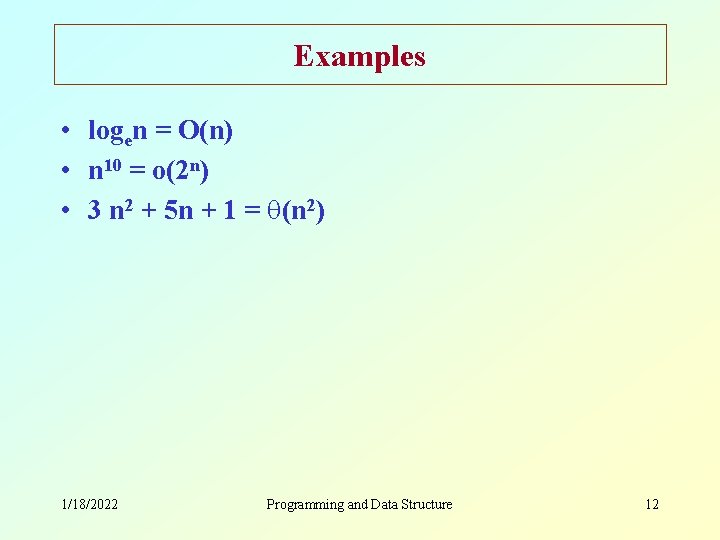
Examples • logen = O(n) • n 10 = o(2 n) • 3 n 2 + 5 n + 1 = (n 2) 1/18/2022 Programming and Data Structure 12
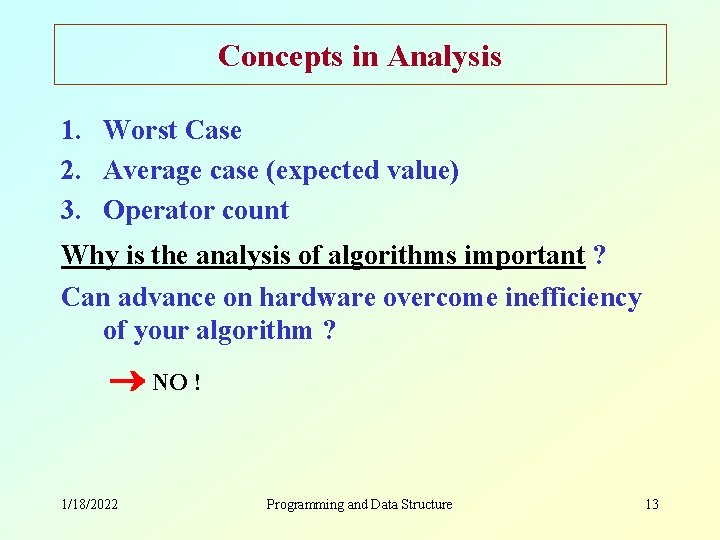
Concepts in Analysis 1. Worst Case 2. Average case (expected value) 3. Operator count Why is the analysis of algorithms important ? Can advance on hardware overcome inefficiency of your algorithm ? NO ! 1/18/2022 Programming and Data Structure 13
Model of computation • A normal computer, instructions executed sequentially. – addition, multiplication, comparison, assignment, etc. – all are assumed to take a single time unit. 1/18/2022 Programming and Data Structure 14
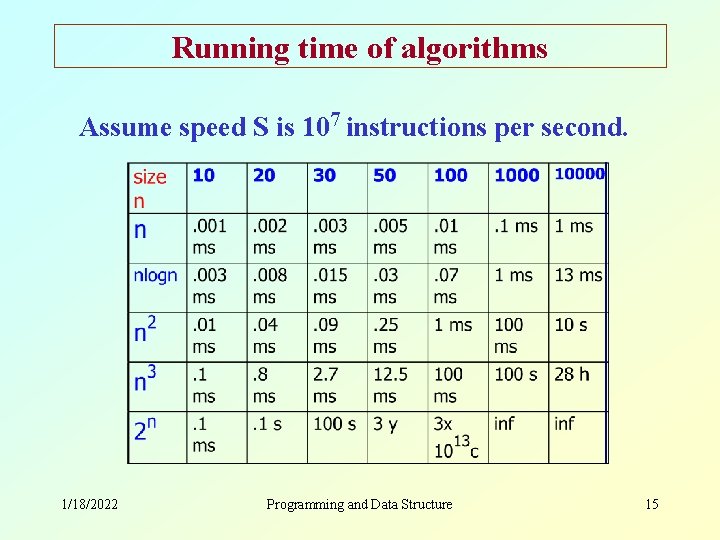
Running time of algorithms Assume speed S is 107 instructions per second. 1/18/2022 Programming and Data Structure 15
Observations • There is a big difference between polynomial time complexity and exponential time complexity • Hardware advances affect only efficient algorithms and do not help inefficient algorithms. 1/18/2022 Programming and Data Structure 16
Maximum subsequence sum problem • Given (possibly negative) integers <A 1 A 2. . . AN> find the maximum value of jk=i Ak. – For convenience, the maximum subsequence sum is considered to be 0 if all the integers are negative. • Example : – For input <-2, 11, -4, 13, -5, 2> the answer is 20 (A 2 to A 4) 1/18/2022 Programming and Data Structure 17
Algorithm 1 int Max. Sub. Sum (int A[], int N) { int thissum, maxsum, i, j, k; 1. maxsum = 0; 2. for (i=0; i<N; i++) 3. for (j=i; j<N; j++) { 4. thissum = 0; 5. for (k=i; k <= j; k++) 6. thissum += A[k]; 7. if (thissum > maxsum) 8. maxsum = thissum; } 9. return maxsum; } 1/18/2022 Programming and Data Structure 18
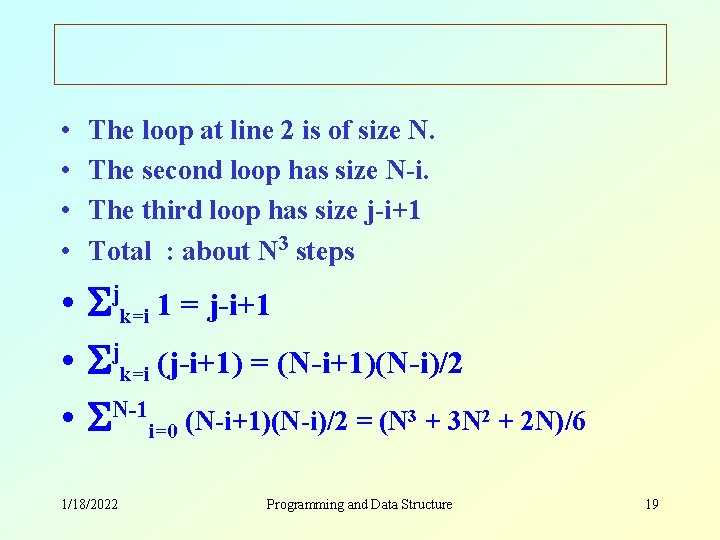
• • The loop at line 2 is of size N. The second loop has size N-i. The third loop has size j-i+1 Total : about N 3 steps • jk=i 1 = j-i+1 j • k=i (j-i+1) = (N-i+1)(N-i)/2 • N-1 i=0 (N-i+1)(N-i)/2 = (N 3 + 3 N 2 + 2 N)/6 1/18/2022 Programming and Data Structure 19
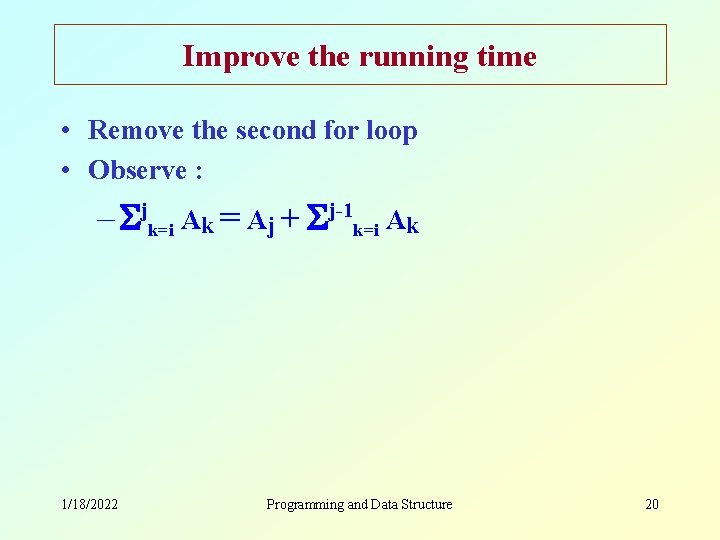
Improve the running time • Remove the second for loop • Observe : – jk=i Ak = Aj + j-1 k=i Ak 1/18/2022 Programming and Data Structure 20
Algorithm 2 int Max. Sub. Sum 2 (int A[], int N) { int thissum, maxsum, i, j; 1. maxsum = 0; 2. for (i=0; i<N; i++) 3. { 3. thissum = 0; 4. for (j=i; j < N; j++) 5. { 5. thissum += A[j]; 6. if (thissum > maxsum) 7. maxsum = thissum; } } 8. return maxsum; Complexity : O(N 2) } 1/18/2022 Programming and Data Structure 21
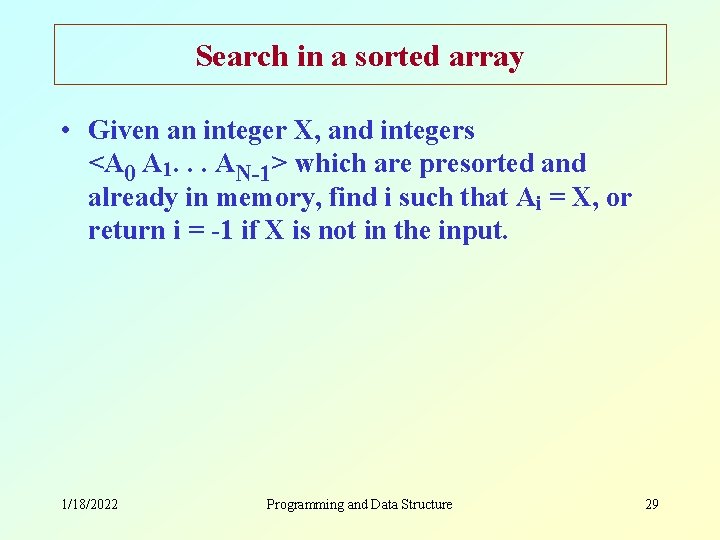
Search in a sorted array • Given an integer X, and integers <A 0 A 1. . . AN-1> which are presorted and already in memory, find i such that Ai = X, or return i = -1 if X is not in the input. 1/18/2022 Programming and Data Structure 29
Linear Search int search (int A[], int X, int N) { int i; for (i=0; i<N; i++) if (A[i] == X) return i; return -1; } 1/18/2022 Programming and Data Structure Complexity : (N) 30
Binary Search int Binary. Search (int A[], int X, int N) { int low, mid, high; while (low <= high) { mid = (low+high)/2; if (A[mid] < X) low = mid+1; else if (A[mid] > X) high = mid-1; else return mid; } return -1; } 1/18/2022 Programming and Data Structure 31
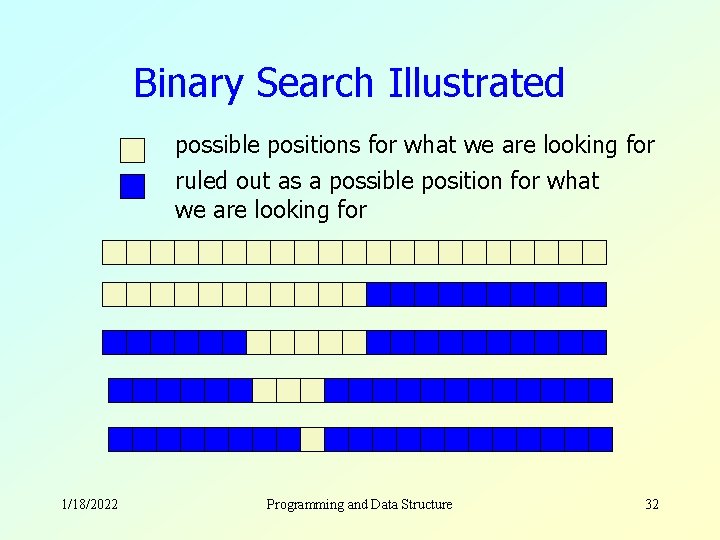
Binary Search Illustrated possible positions for what we are looking for ruled out as a possible position for what we are looking for 1/18/2022 Programming and Data Structure 32
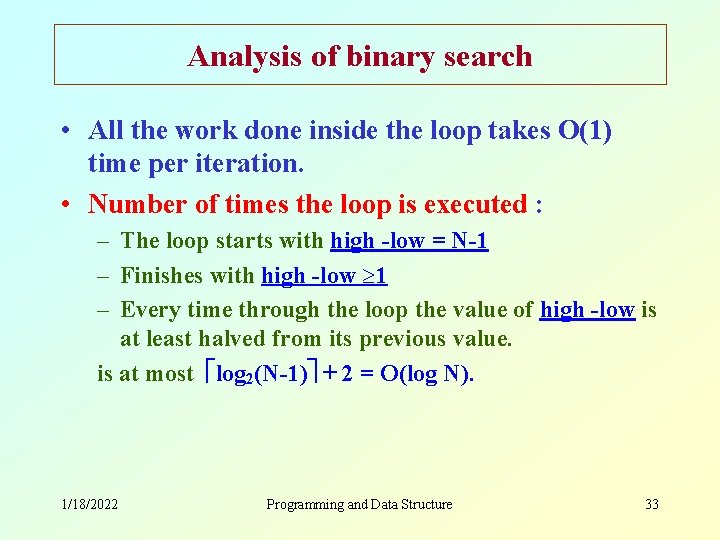
Analysis of binary search • All the work done inside the loop takes O(1) time per iteration. • Number of times the loop is executed : – The loop starts with high -low = N-1 – Finishes with high -low 1 – Every time through the loop the value of high -low is at least halved from its previous value. is at most log 2(N-1) + 2 = O(log N). 1/18/2022 Programming and Data Structure 33
Sorting integers void sort (int A[], int N) { int i, j, x; for (i=1; i<N; i++) { x = A[i]; for (j=i; j>0 && x<A[j-1]; j--) A[j] = A[j-1]; A[j] = x; } } 1/18/2022 Programming and Data Structure T(N) = 1+2+. . . + N-1 = N(N-1)/2 (N 2) 34
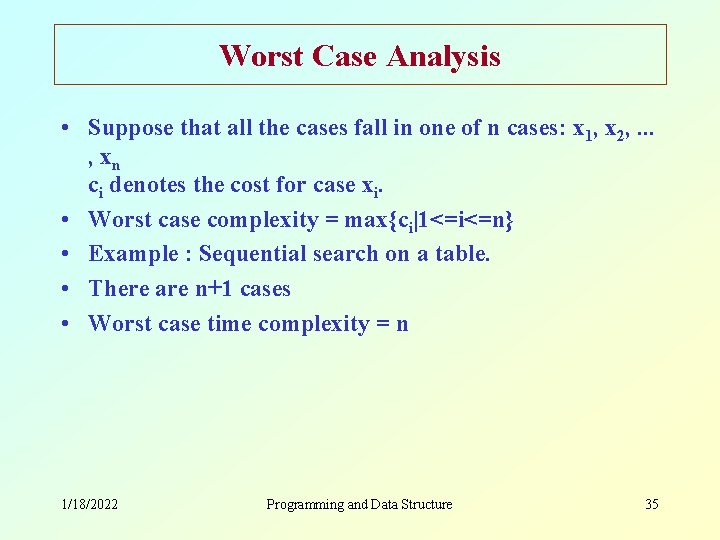
Worst Case Analysis • Suppose that all the cases fall in one of n cases: x 1, x 2, . . . , xn ci denotes the cost for case xi. • Worst case complexity = max{ci|1<=i<=n} • Example : Sequential search on a table. • There are n+1 cases • Worst case time complexity = n 1/18/2022 Programming and Data Structure 35
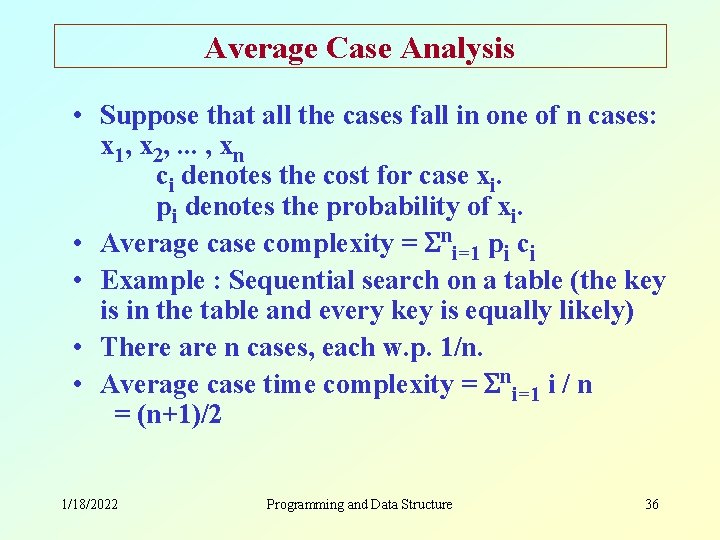
Average Case Analysis • Suppose that all the cases fall in one of n cases: x 1, x 2, . . . , xn ci denotes the cost for case xi. pi denotes the probability of xi. • Average case complexity = ni=1 pi ci • Example : Sequential search on a table (the key is in the table and every key is equally likely) • There are n cases, each w. p. 1/n. • Average case time complexity = ni=1 i / n = (n+1)/2 1/18/2022 Programming and Data Structure 36