
Algebraic Structure in a Family of Nimlike Arrays
Algebraic Structure in a Family of Nim-like Arrays Lowell Abrams The George Washington University Dena Cowen-Morton Xavier University Cana. Da. M 2009
Combinatorial Games Basics • full information • no probability • winning strategy (“ 1 st player win” vs. “ 2 nd player win”)
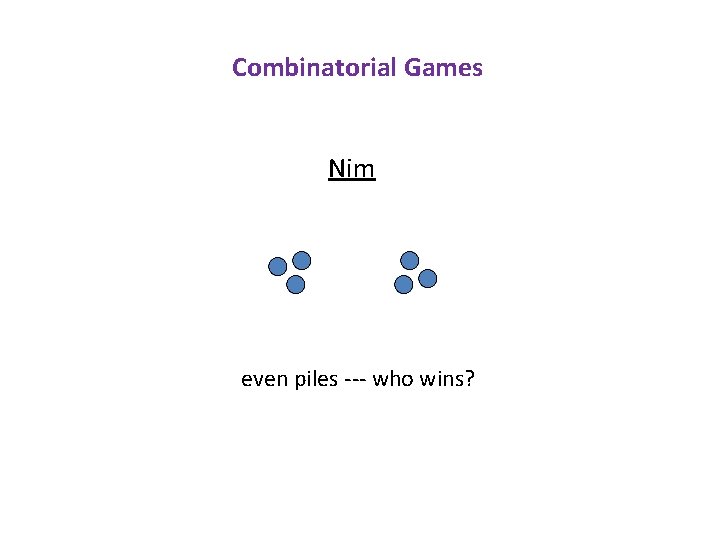
Combinatorial Games Nim even piles --- who wins?
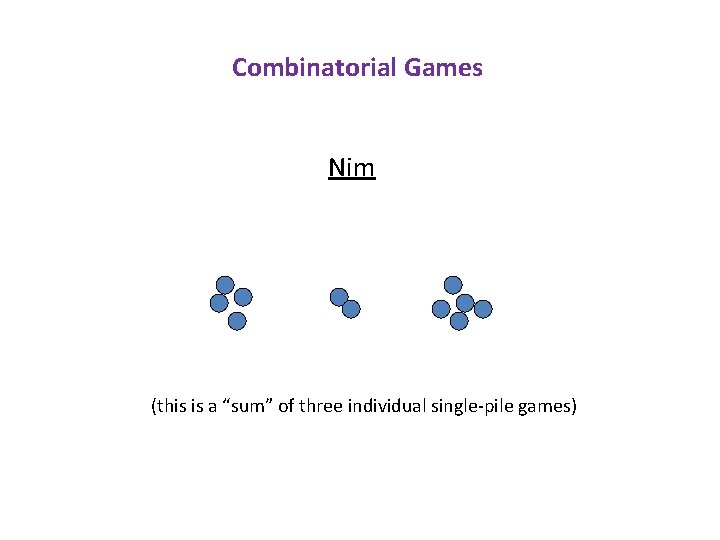
Combinatorial Games Nim (this is a “sum” of three individual single-pile games)

Combinatorial Games Nimbers and Nim addition • Nim pile with n stones has nimber n • nimber 0 means the second player wins • two side-by-side Nim piles, both with nimber n, have sum 0: n+n = 0 • if (r+s)+n = 0 (i. e. is a second player win) then r+s=n
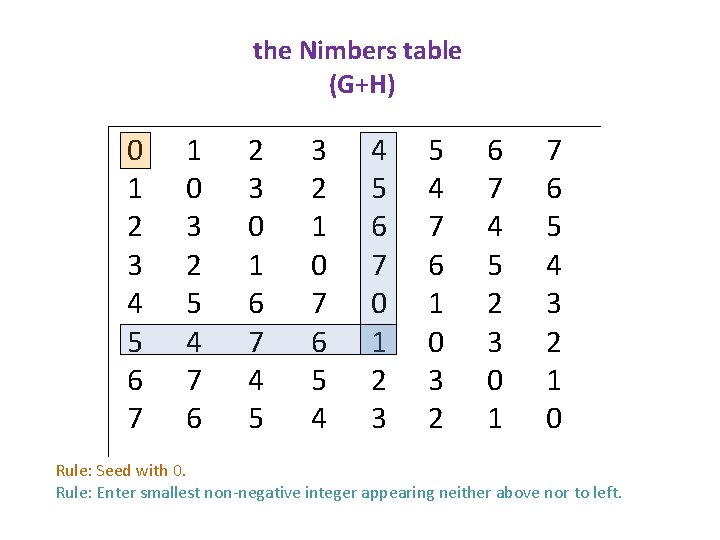
the Nimbers table (G+H) 0 1 2 3 4 5 6 7 1 0 3 2 5 4 7 6 2 3 0 1 6 7 4 5 3 2 1 0 7 6 5 4 4 5 6 7 0 1 2 3 5 4 7 6 1 0 3 2 6 7 4 5 2 3 0 1 7 6 5 4 3 2 1 0 Rule: Seed with 0. Rule: Enter smallest non-negative integer appearing neither above nor to left.
Another way to combine games • Ullman and Stromquist: sequential compound G → H • misère play: G → 1 • misère nim addition: G+H → 1 • something else: G+H → s for integer s ¸ 2
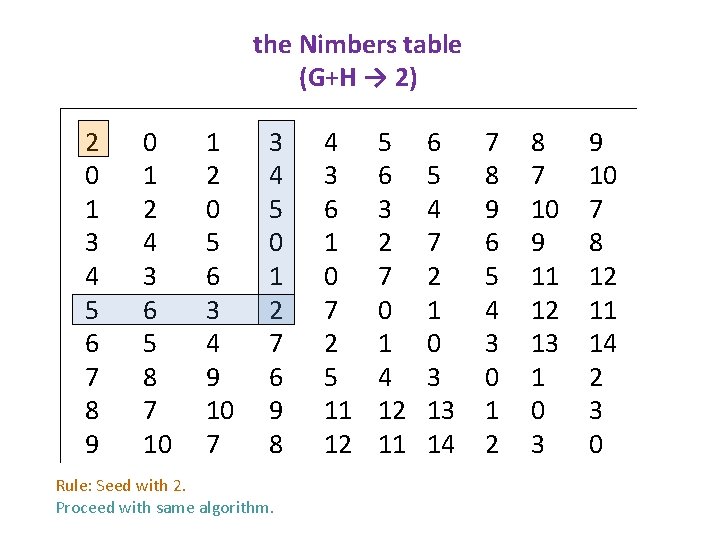
the Nimbers table (G+H → 2) 2 0 1 3 4 5 6 7 8 9 0 1 2 4 3 6 5 8 7 10 1 2 0 5 6 3 4 9 10 7 3 4 5 0 1 2 7 6 9 8 Rule: Seed with 2. Proceed with same algorithm. 4 3 6 1 0 7 2 5 11 12 5 6 3 2 7 0 1 4 12 11 6 5 4 7 2 1 0 3 13 14 7 8 9 6 5 4 3 0 1 2 8 7 10 9 11 12 13 1 0 3 9 10 7 8 12 11 14 2 3 0
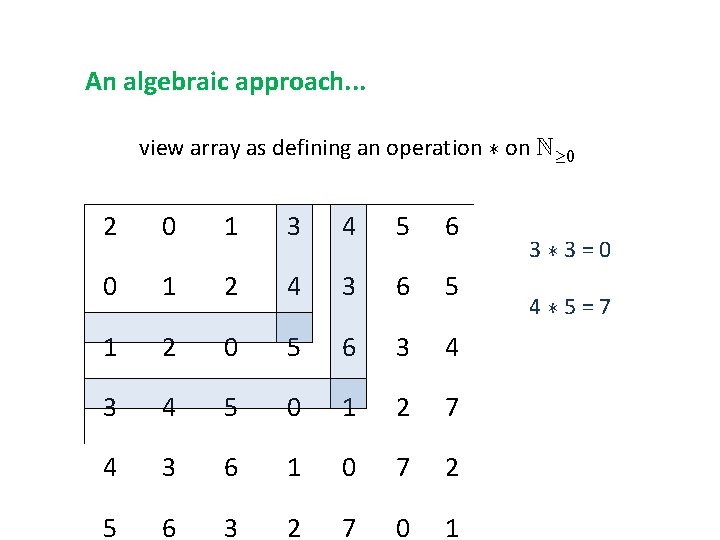
An algebraic approach. . . view array as defining an operation ¤ on N¸ 0 2 0 1 3 4 5 6 0 1 2 4 3 6 5 1 2 0 5 6 3 4 5 0 1 2 7 4 3 6 1 0 7 2 5 6 3 2 7 0 1 3¤ 3=0 4¤ 5=7
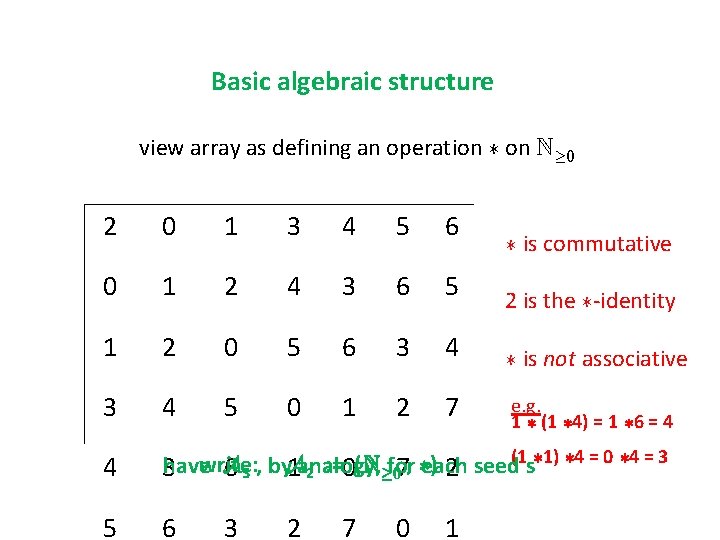
Basic algebraic structure view array as defining an operation ¤ on N¸ 0 2 0 1 3 4 5 6 0 1 2 4 3 6 5 1 2 0 5 6 3 4 5 0 1 2 7 4 (1 s¤ 1) ¤ 4 = 0 ¤ 4 = 3 write: A : = (N , ¤) have A , by analogy, for each seed 3 6 s 1 2 0 ¸ 07 2 5 6 3 2 7 0 1 ¤ is commutative 2 is the ¤-identity ¤ is not associative e. g. 1 ¤ (1 ¤ 4) = 1 ¤ 6 = 4
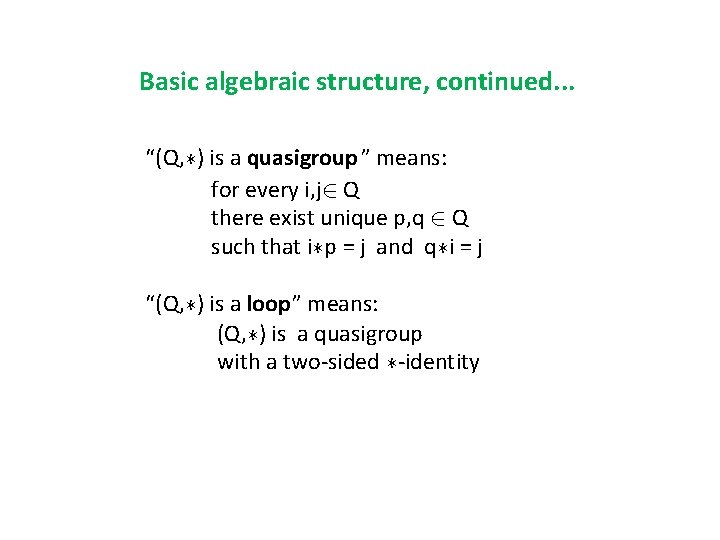
Basic algebraic structure, continued. . . “(Q, ¤) is a quasigroup ” means: for every i, j 2 Q there exist unique p, q 2 Q such that i¤p = j and q¤i = j “(Q, ¤) is a loop” means: (Q, ¤) is a quasigroup with a two-sided ¤-identity
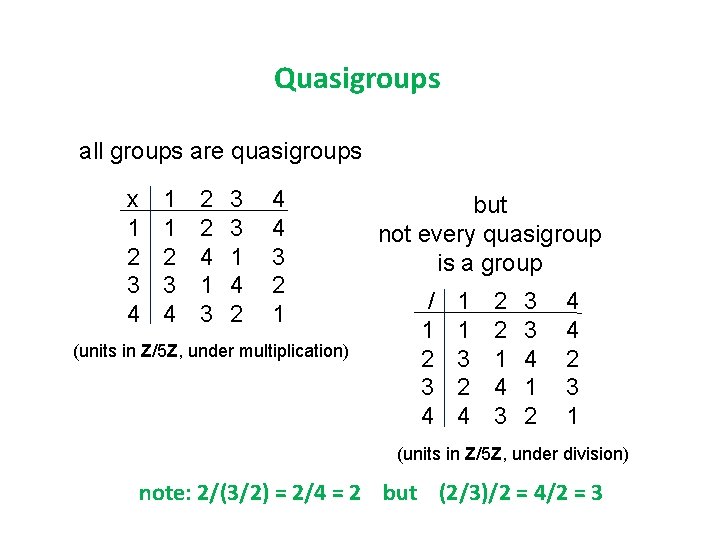
Quasigroups all groups are quasigroups x 1 2 3 4 1 1 2 3 4 2 2 4 1 3 3 3 1 4 2 4 4 3 2 1 (units in Z/5 Z, under multiplication) but not every quasigroup is a group / 1 2 3 4 1 1 3 2 4 2 2 1 4 3 3 3 4 1 2 4 4 2 3 1 (units in Z/5 Z, under division) note: 2/(3/2) = 2/4 = 2 but (2/3)/2 = 4/2 = 3
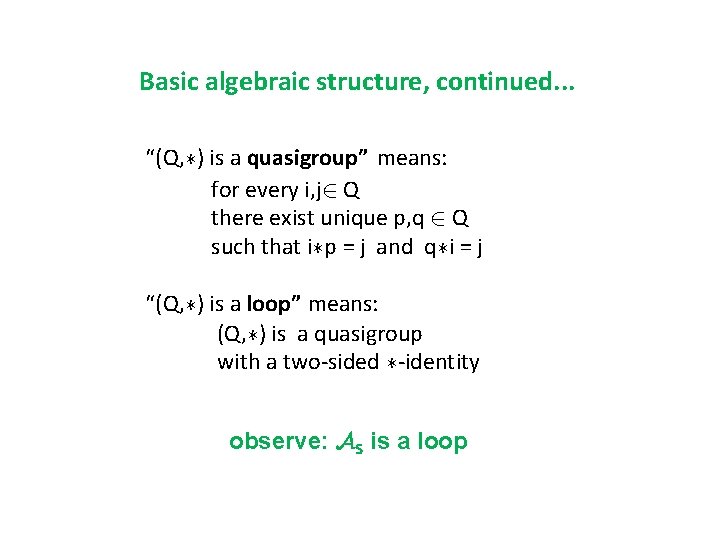
Basic algebraic structure, continued. . . “(Q, ¤) is a quasigroup” means: for every i, j 2 Q there exist unique p, q 2 Q such that i¤p = j and q¤i = j “(Q, ¤) is a loop” means: (Q, ¤) is a quasigroup with a two-sided ¤-identity observe: As is a loop
Take-Home Point: Algebraic results provide a way to encode combinatorial properties
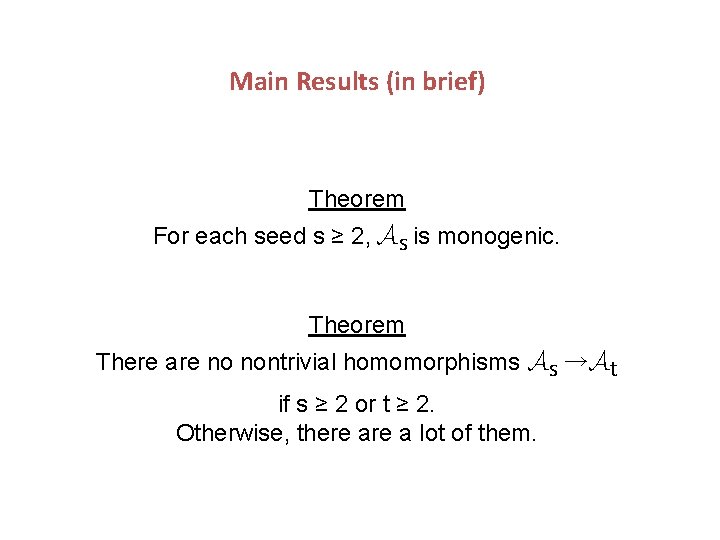
Main Results (in brief) Theorem For each seed s ≥ 2, As is monogenic. Theorem There are no nontrivial homomorphisms As →At if s ≥ 2 or t ≥ 2. Otherwise, there a lot of them.
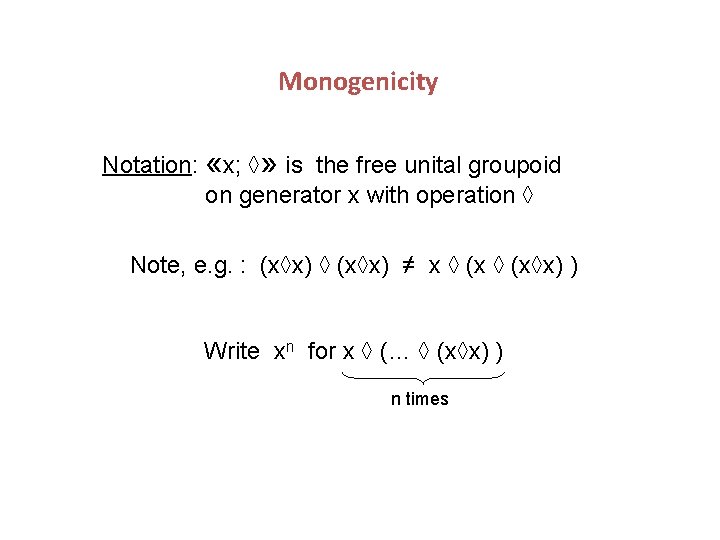
Monogenicity Notation: «x; ◊» is the free unital groupoid on generator x with operation ◊ Note, e. g. : (x◊x) ◊ (x◊x) ≠ x ◊ (x◊x) ) Write xn for x ◊ (… ◊ (x◊x) ) n times
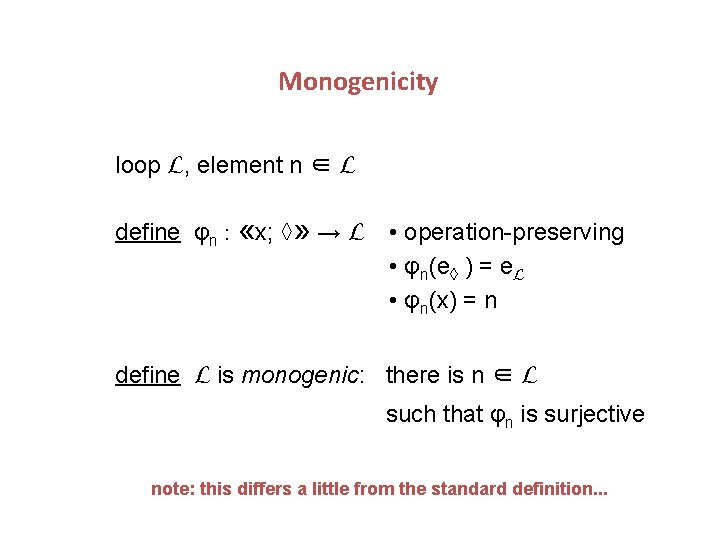
Monogenicity loop L, element n ∈ L define φn : «x; ◊» → L • operation-preserving • φn(e◊ ) = e. L • φn(x) = n define L is monogenic: there is n ∈ L such that φn is surjective note: this differs a little from the standard definition. . .
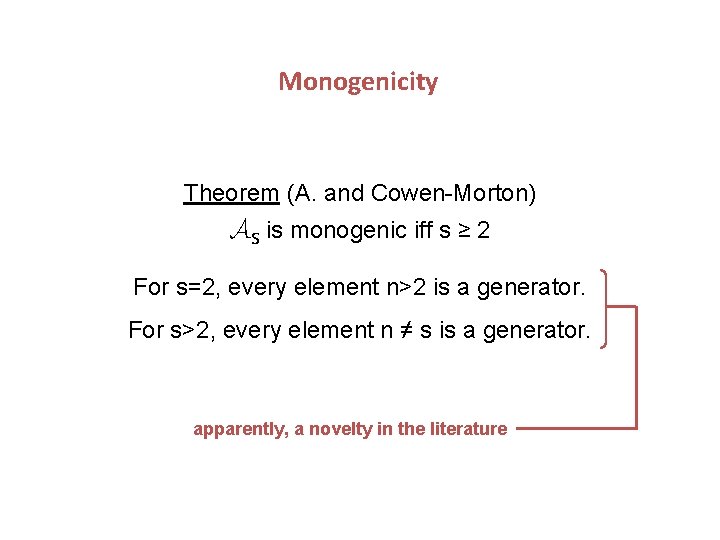
Monogenicity Theorem (A. and Cowen-Morton) As is monogenic iff s ≥ 2 For s=2, every element n>2 is a generator. For s>2, every element n ≠ s is a generator. apparently, a novelty in the literature
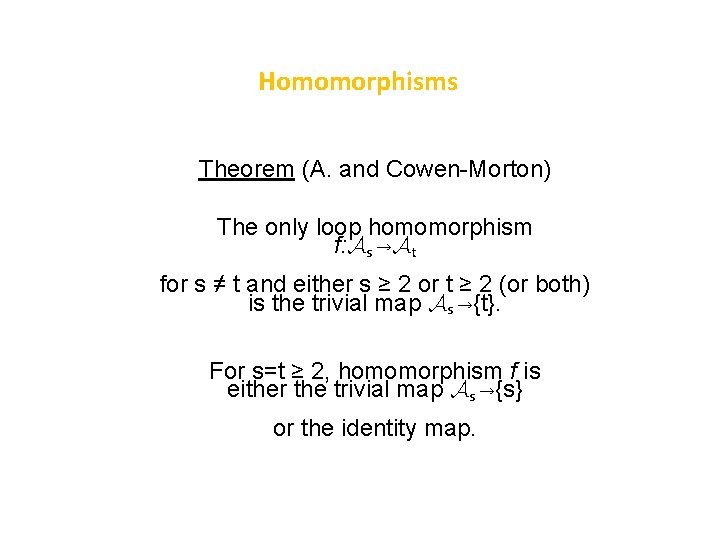
Homomorphisms Theorem (A. and Cowen-Morton) The only loop homomorphism f: As →At for s ≠ t and either s ≥ 2 or t ≥ 2 (or both) is the trivial map As →{t}. For s=t ≥ 2, homomorphism f is either the trivial map As →{s} or the identity map.
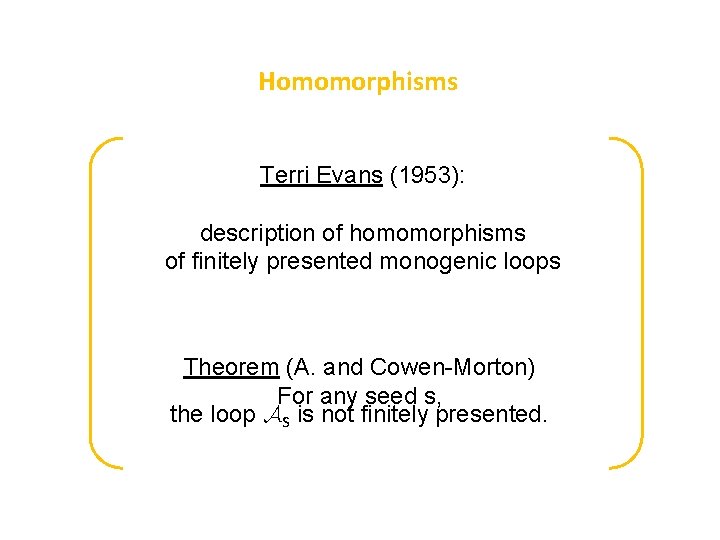
Homomorphisms Terri Evans (1953): description of homomorphisms of finitely presented monogenic loops Theorem (A. and Cowen-Morton) For any seed s, the loop As is not finitely presented.
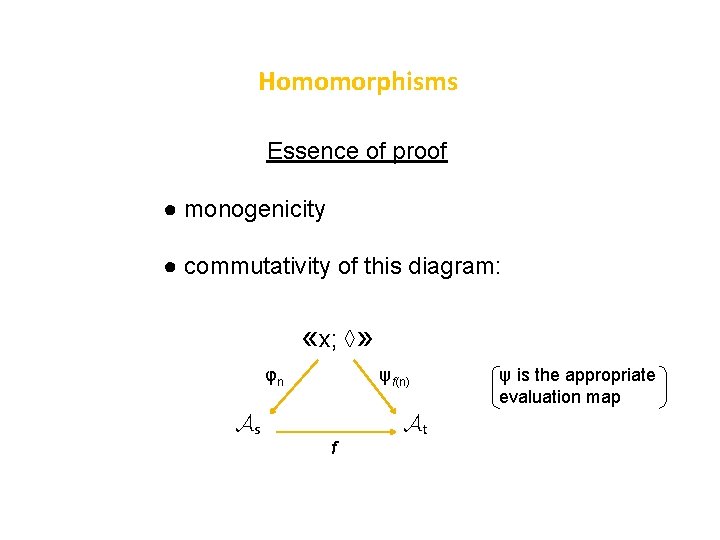
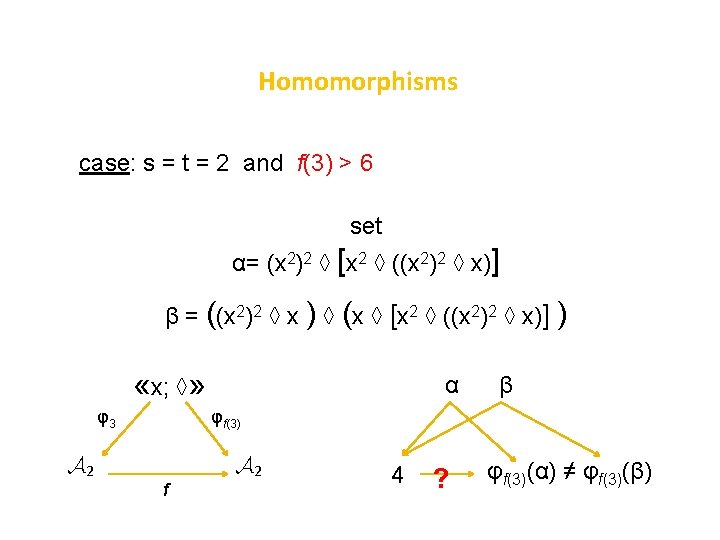
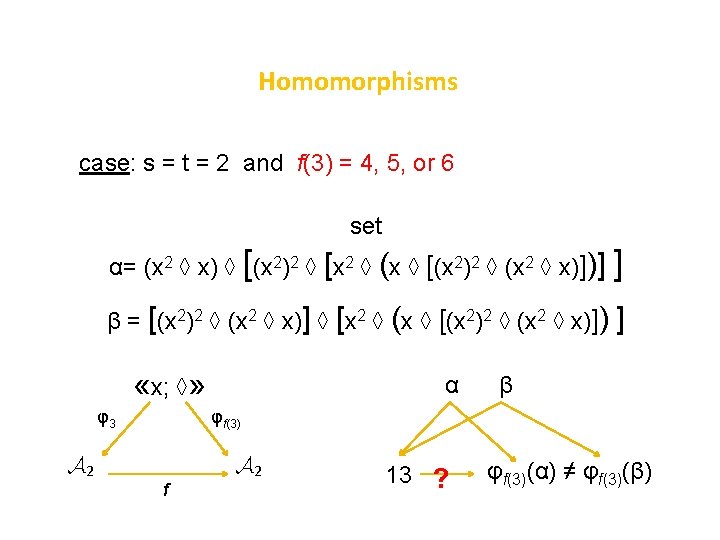
Homomorphisms Essence of proof ● monogenicity ● commutativity of this diagram: «x; ◊» φn As ψf(n) f At ψ is the appropriate evaluation map
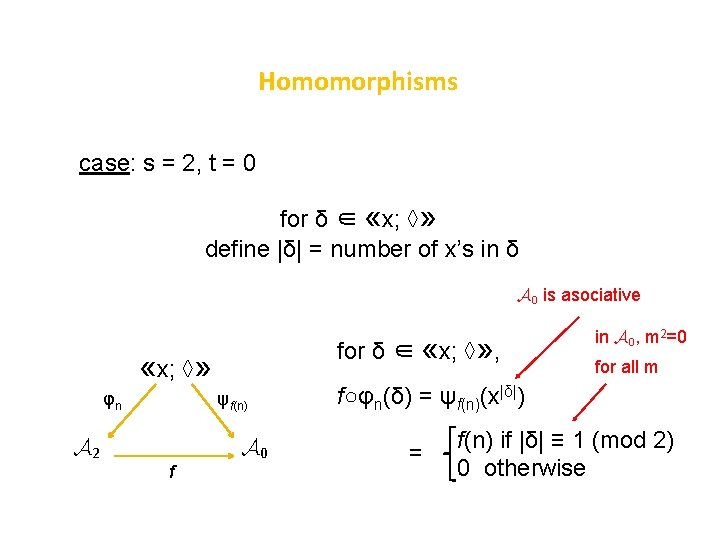
Homomorphisms case: s = 2, t = 0 for δ ∈ «x; ◊» define |δ| = number of x’s in δ A 0 is asociative for δ ∈ «x; ◊» , «x; ◊» φn A 2 ψf(n) f A 0 in A 0, m 2=0 for all m f○φn(δ) = ψf(n)(x|δ|) = f(n) if |δ| ≡ 1 (mod 2) 0 otherwise
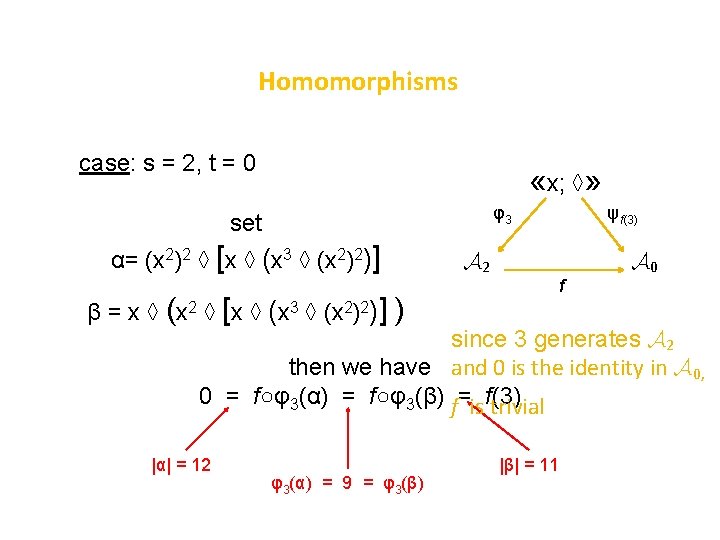
Homomorphisms case: s = 2, t = 0 «x; ◊» φ3 set α= (x 2)2 ◊ [x ◊ (x 3 ◊ (x 2)2)] β = x ◊ (x 2 ◊ [x ◊ (x 3 ◊ (x 2)2)] ) A 2 ψf(3) f A 0 since 3 generates A 2 then we have and 0 is the identity in A 0, 0 = f○φ3(α) = f○φ3(β) f=is f(3) trivial |α| = 12 φ3(α) = 9 = φ3(β) |β| = 11
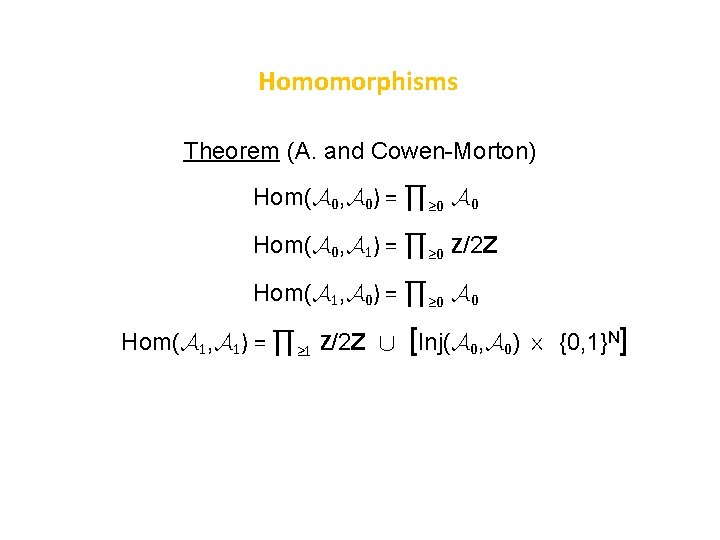
Homomorphisms Theorem (A. and Cowen-Morton) Hom(A 0, A 0) = ∏≥ 0 A 0 Hom(A 0, A 1) = ∏≥ 0 Ζ/2 Z Hom(A 1, A 0) = ∏≥ 0 A 0 Hom(A 1, A 1) = ∏≥ 1 Ζ/2 Z [ [Inj(A 0, A 0) £ {0, 1}N]
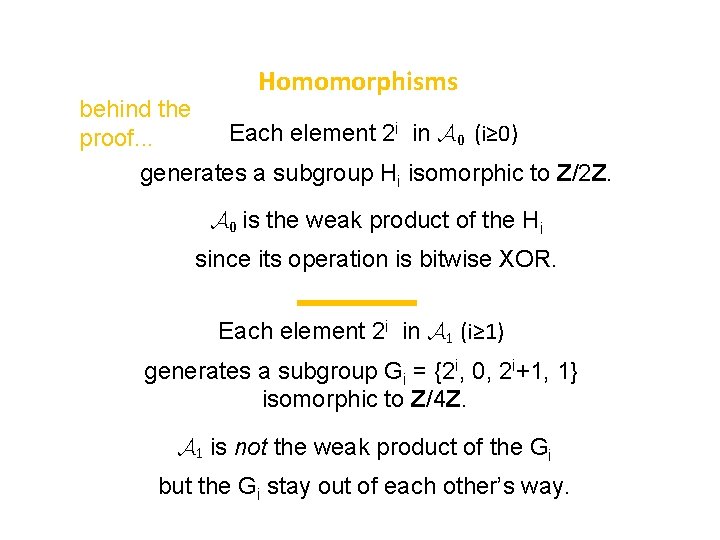
Homomorphisms behind the Each element 2 i in A 0 (i≥ 0) proof. . . generates a subgroup Hi isomorphic to Z/2 Z. A 0 is the weak product of the Hi since its operation is bitwise XOR. Each element 2 i in A 1 (i≥ 1) generates a subgroup Gi = {2 i, 0, 2 i+1, 1} isomorphic to Z/4 Z. A 1 is not the weak product of the Gi but the Gi stay out of each other’s way.
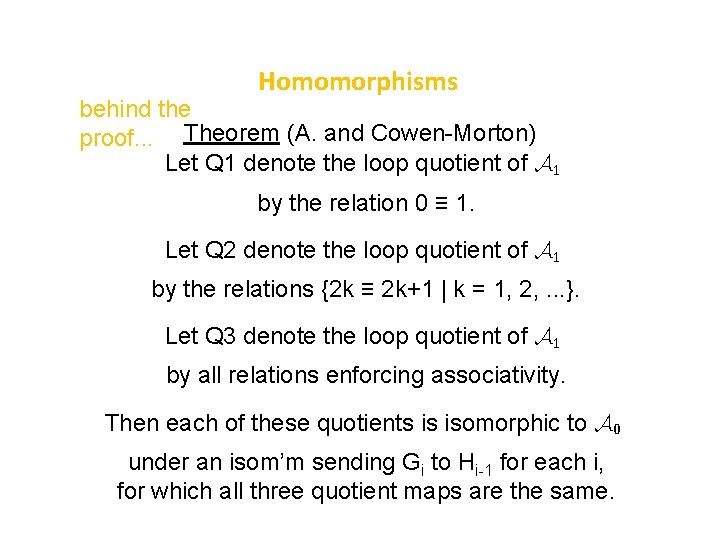
Homomorphisms behind the proof. . . Theorem (A. and Cowen-Morton) Let Q 1 denote the loop quotient of A 1 by the relation 0 ≡ 1. Let Q 2 denote the loop quotient of A 1 by the relations {2 k ≡ 2 k+1 | k = 1, 2, . . . }. Let Q 3 denote the loop quotient of A 1 by all relations enforcing associativity. Then each of these quotients is isomorphic to A 0 under an isom’m sending Gi to Hi-1 for each i, for which all three quotient maps are the same.
Homomorphisms Theorem (A. and Cowen-Morton) Hom(A 0, A 0) = ∏≥ 0 A 0 Hom(A 0, A 1) = ∏≥ 0 Ζ/2 Z Hom(A 1, A 0) = ∏≥ 0 A 0 Hom(A 1, A 1) = ∏≥ 1 Ζ/2 Z [ [Inj(A 0, A 0) £ {0, 1}N] ◄
- Slides: 29