
ALGEBRA IS GREAT FUN you get to solve
ALGEBRA IS GREAT FUN!!!! you get to solve puzzles! https: //www. mathsisfun. com/algebra/introduction. html
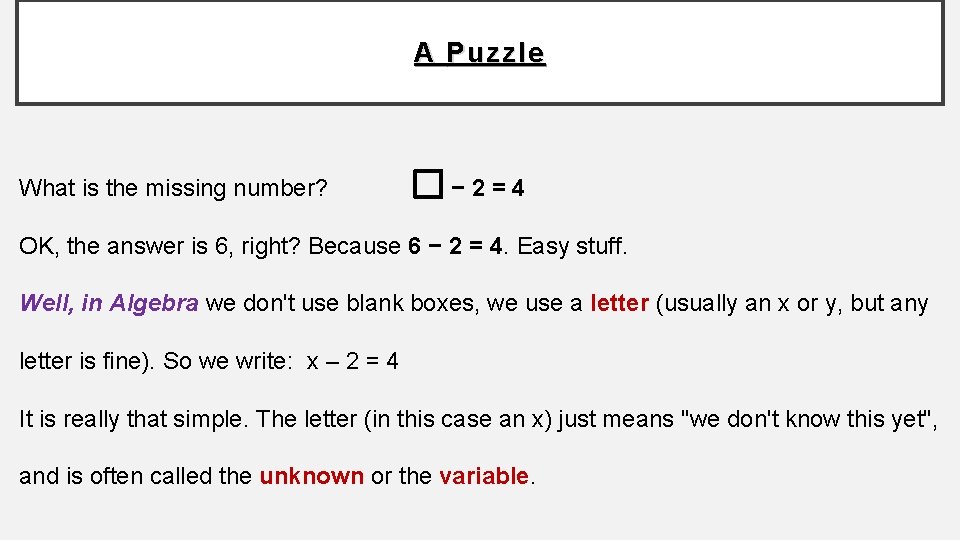
A Puzzle What is the missing number? − 2=4 OK, the answer is 6, right? Because 6 − 2 = 4. Easy stuff. Well, in Algebra we don't use blank boxes, we use a letter (usually an x or y, but any letter is fine). So we write: x – 2 = 4 It is really that simple. The letter (in this case an x) just means "we don't know this yet", and is often called the unknown or the variable.
Why Use a Letter? Because: it is easier to write "x" than drawing empty boxes (and easier to say "x" than "the empty box"). if there are several empty boxes (several "unknowns") we can use a different letter for each one. So x is simply better than having an empty box. We aren't trying to make words with it! And it doesn't have to be x, it could be y or w. . . or any letter or symbol we like.
HOW TO SOLVE Algebra is just like a puzzle where we start with something like "x − 2 = 4" and we want to end up with something like "x = 6". But instead of saying "obviously x = 6", use this neat step-by-step approach: • Work out what to remove to get "x =. . . " • Remove it by doing the opposite (adding is the opposite of subtracting) • Do that to both sides
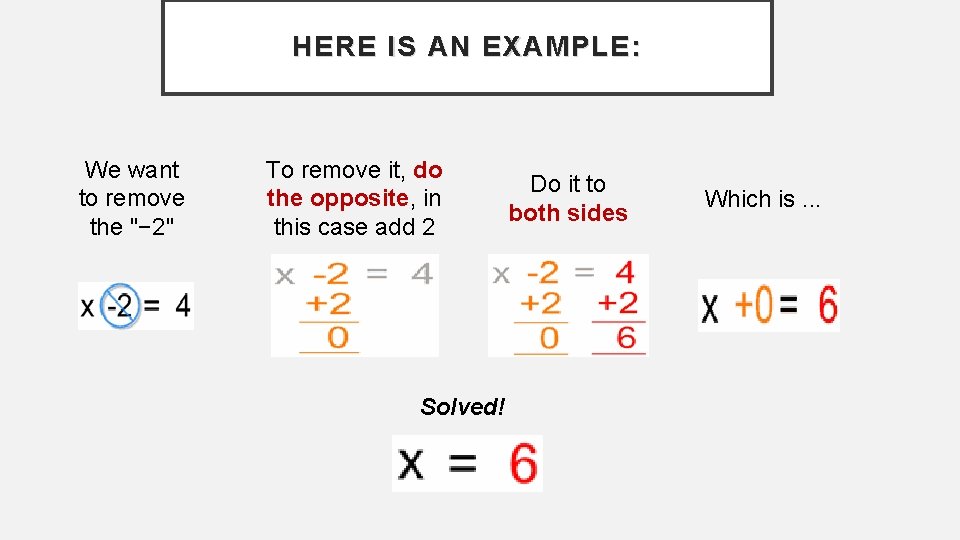
HERE IS AN EXAMPLE: We want to remove the "− 2" To remove it, do the opposite, in this case add 2 Solved! Do it to both sides Which is. . .
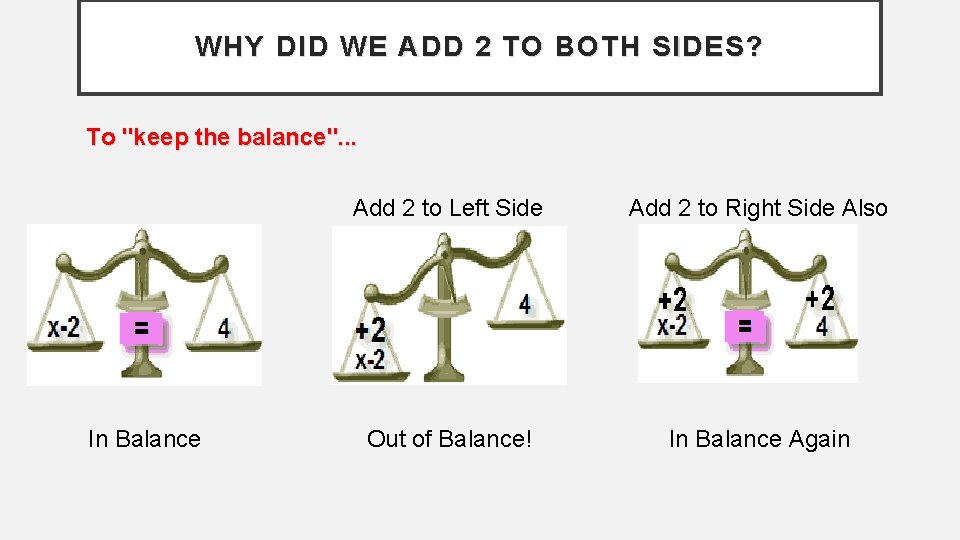
WHY DID WE ADD 2 TO BOTH SIDES? To "keep the balance". . . In Balance Add 2 to Left Side Add 2 to Right Side Also Out of Balance! In Balance Again
JUST REMEMBER THIS: To keep the balance, what we do to one side of the "=" we should also do to the other side!
ANOTHER PUZZLE • Solve this one: x + 5 = 12 What we want is an answer like "x =. . . ", but the +5 is in the way of that! We cancel out the +5 with a − 5 (because 5− 5=0) So, let us have a go at subtracting 5 from both sides: x + 5 − 5 = 12 − 5 A little arithmetic (5 − 5 = 0 and 12 − 5 = 7) becomes: x + 0 = 7 Which is just: x = 7
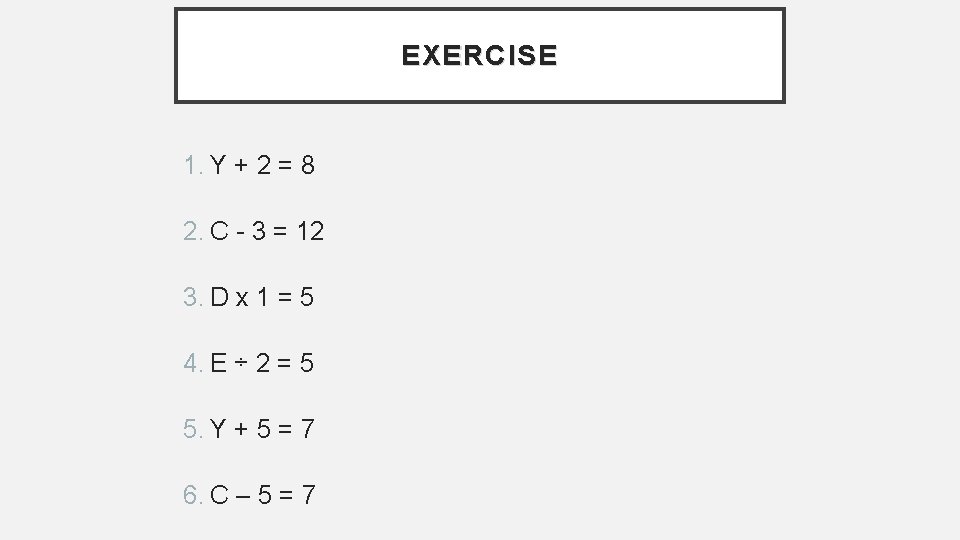
EXERCISE 1. Y + 2 = 8 2. C - 3 = 12 3. D x 1 = 5 4. E ÷ 2 = 5 5. Y + 5 = 7 6. C – 5 = 7
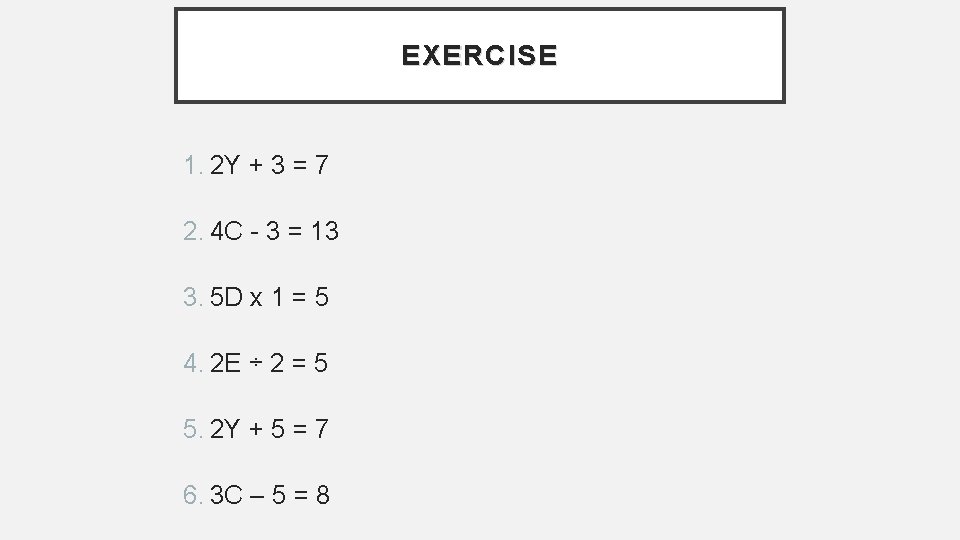
EXERCISE 1. 2 Y + 3 = 7 2. 4 C - 3 = 13 3. 5 D x 1 = 5 4. 2 E ÷ 2 = 5 5. 2 Y + 5 = 7 6. 3 C – 5 = 8
- Slides: 10