
Algebra I SECTION 2 5 PROPERTIES AND MENTAL
Algebra I SECTION 2. 5 PROPERTIES AND MENTAL COMPUTATION OBJECTIVES: STATE AND APPLY THE COMMUTATIVE, ASSOCIATIVE, DISTRIBUTIVE AND OTHER PROPERTIES.
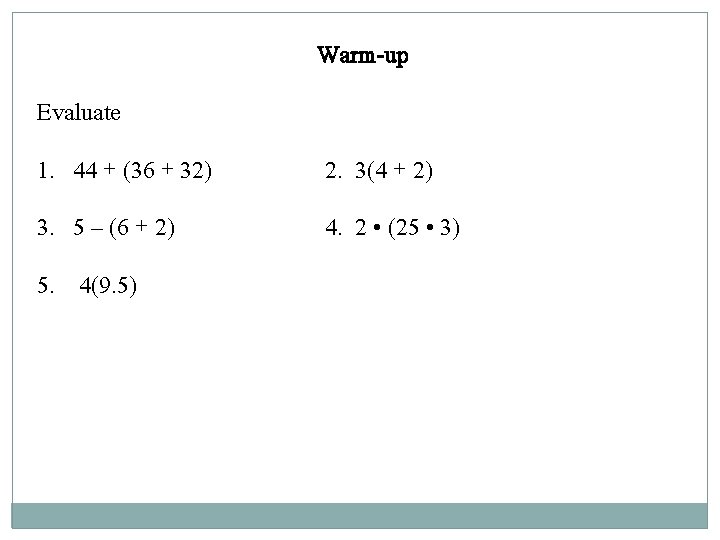
Warm-up Evaluate 1. 44 + (36 + 32) 2. 3(4 + 2) 3. 5 – (6 + 2) 4. 2 · (25 · 3) 5. 4(9. 5)
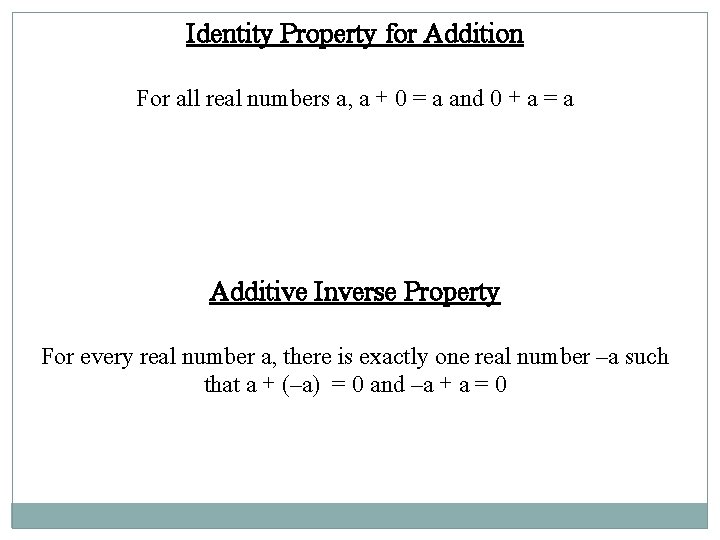
Identity Property for Addition For all real numbers a, a + 0 = a and 0 + a = a Additive Inverse Property For every real number a, there is exactly one real number –a such that a + (–a) = 0 and –a + a = 0
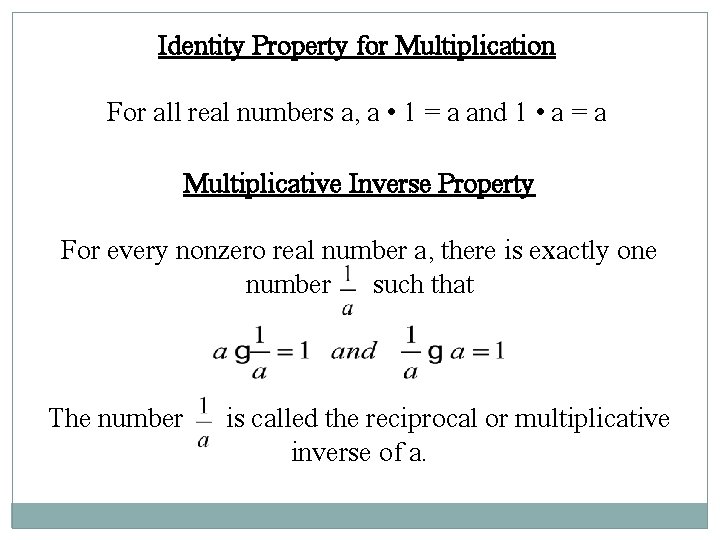
Identity Property for Multiplication For all real numbers a, a · 1 = a and 1 · a = a Multiplicative Inverse Property For every nonzero real number a, there is exactly one number such that The number is called the reciprocal or multiplicative inverse of a.
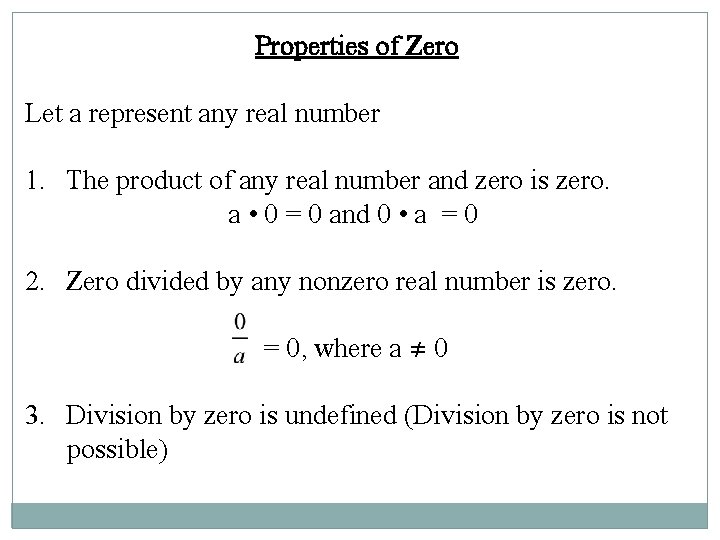
Properties of Zero Let a represent any real number 1. The product of any real number and zero is zero. a · 0 = 0 and 0 · a = 0 2. Zero divided by any nonzero real number is zero. = 0, where a ≠ 0 3. Division by zero is undefined (Division by zero is not possible)
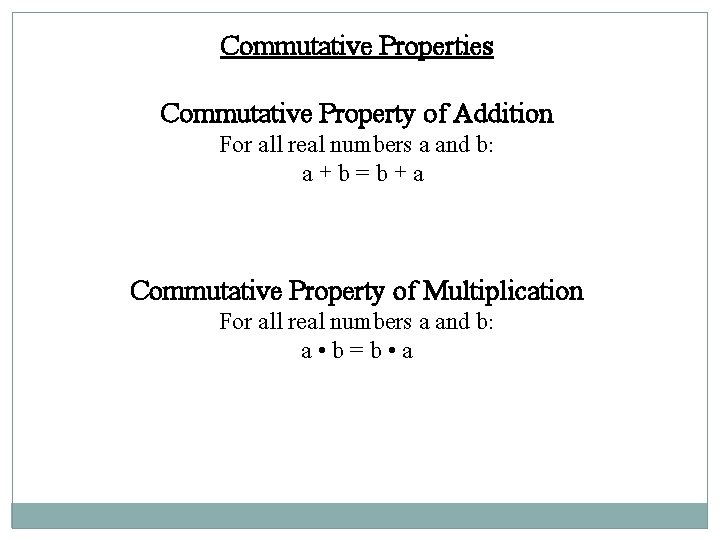
Commutative Properties Commutative Property of Addition For all real numbers a and b: a+b=b+a Commutative Property of Multiplication For all real numbers a and b: a·b=b·a
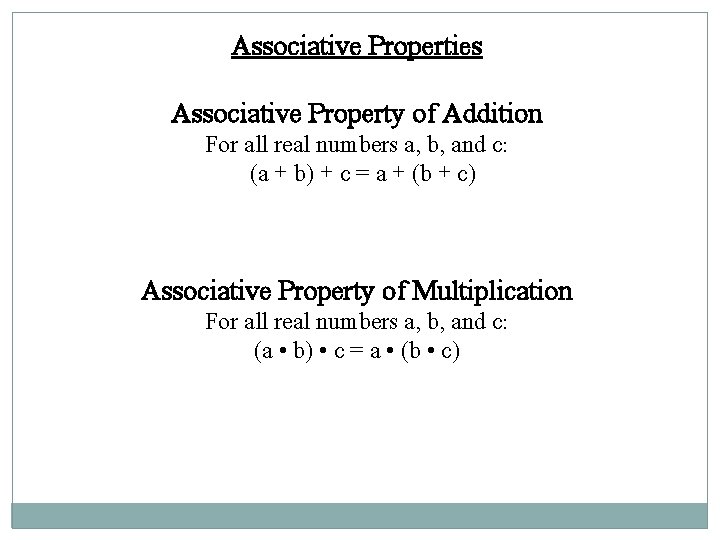
Associative Properties Associative Property of Addition For all real numbers a, b, and c: (a + b) + c = a + (b + c) Associative Property of Multiplication For all real numbers a, b, and c: (a · b) · c = a · (b · c)
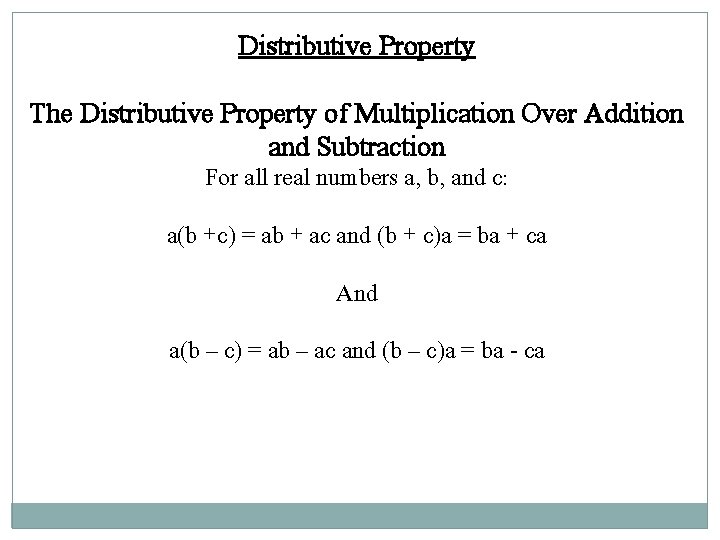
Distributive Property The Distributive Property of Multiplication Over Addition and Subtraction For all real numbers a, b, and c: a(b +c) = ab + ac and (b + c)a = ba + ca And a(b – c) = ab – ac and (b – c)a = ba - ca
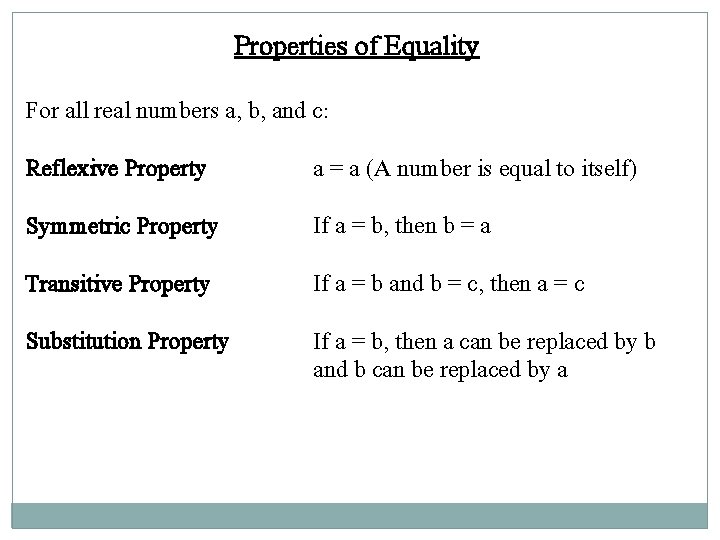
Properties of Equality For all real numbers a, b, and c: Reflexive Property a = a (A number is equal to itself) Symmetric Property If a = b, then b = a Transitive Property If a = b and b = c, then a = c Substitution Property If a = b, then a can be replaced by b and b can be replaced by a
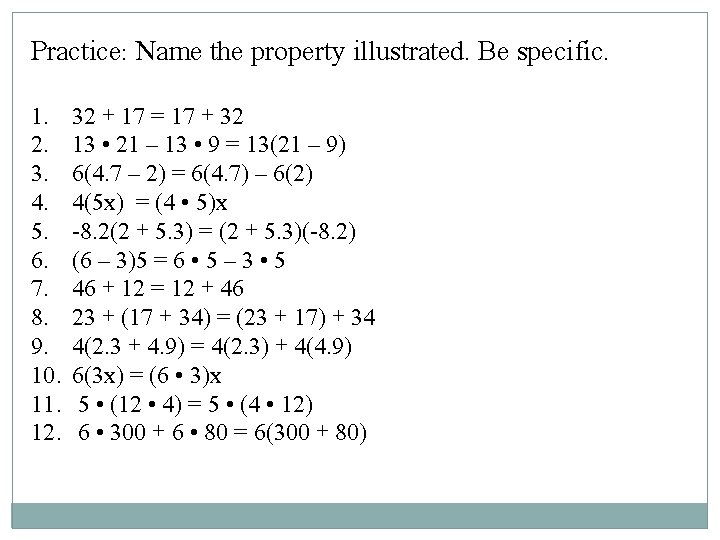
Practice: Name the property illustrated. Be specific. 1. 2. 3. 4. 5. 6. 7. 8. 9. 10. 11. 12. 32 + 17 = 17 + 32 13 · 21 – 13 · 9 = 13(21 – 9) 6(4. 7 – 2) = 6(4. 7) – 6(2) 4(5 x) = (4 · 5)x -8. 2(2 + 5. 3) = (2 + 5. 3)(-8. 2) (6 – 3)5 = 6 · 5 – 3 · 5 46 + 12 = 12 + 46 23 + (17 + 34) = (23 + 17) + 34 4(2. 3 + 4. 9) = 4(2. 3) + 4(4. 9) 6(3 x) = (6 · 3)x 5 · (12 · 4) = 5 · (4 · 12) 6 · 300 + 6 · 80 = 6(300 + 80)
- Slides: 10