
Algebra I AIR Study Guide Table of Contents

Algebra I AIR Study Guide
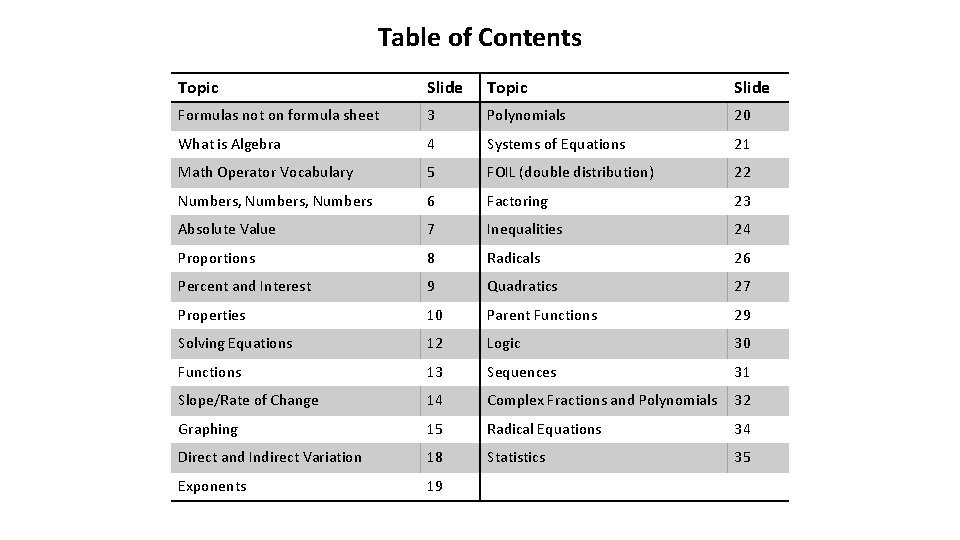
Table of Contents Topic Slide Formulas not on formula sheet 3 Polynomials 20 What is Algebra 4 Systems of Equations 21 Math Operator Vocabulary 5 FOIL (double distribution) 22 Numbers, Numbers 6 Factoring 23 Absolute Value 7 Inequalities 24 Proportions 8 Radicals 26 Percent and Interest 9 Quadratics 27 Properties 10 Parent Functions 29 Solving Equations 12 Logic 30 Functions 13 Sequences 31 Slope/Rate of Change 14 Complex Fractions and Polynomials 32 Graphing 15 Radical Equations 34 Direct and Indirect Variation 18 Statistics 35 Exponents 19
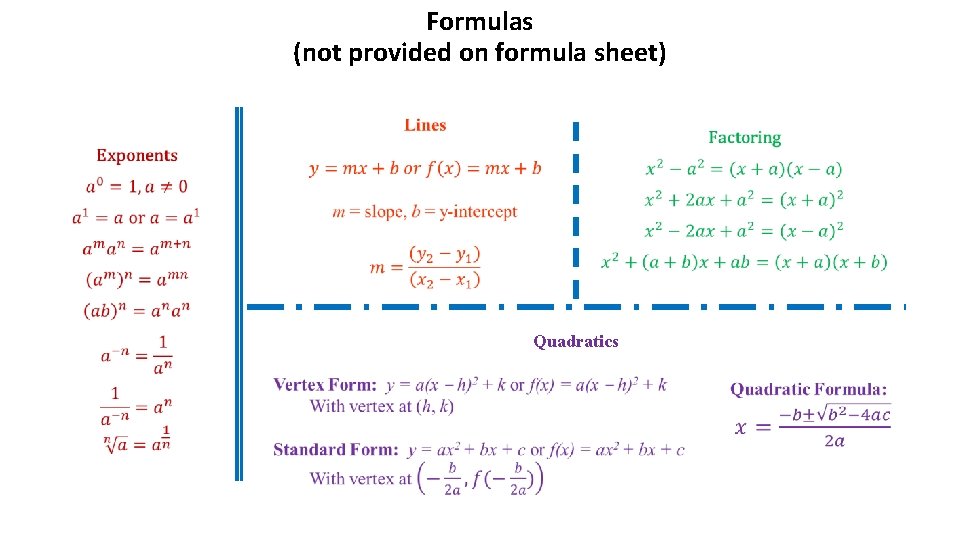
Formulas (not provided on formula sheet) Quadratics
![What is Algebra? Order of Operations Parenthesis ( ) [ ] Exponents 2 3](http://slidetodoc.com/presentation_image_h2/b7acf00d37597dfa4ac65d8dc9425e49/image-4.jpg "What is Algebra? Order of Operations Parenthesis ( ) [ ] Exponents 2 3")
What is Algebra? Order of Operations Parenthesis ( ) [ ] Exponents 2 3 Multiplication Division Addition Subtraction from LEFT to RIGHT Expressions -just about anything without = sign -vocabulary: Terms: 5 x 2, + 2 x, – 3 Constant: – 3 Variable: x Coefficients: 5, +2 * ( ) can represent multiplication when there is a number directly in front of the ( )—BEWARE!
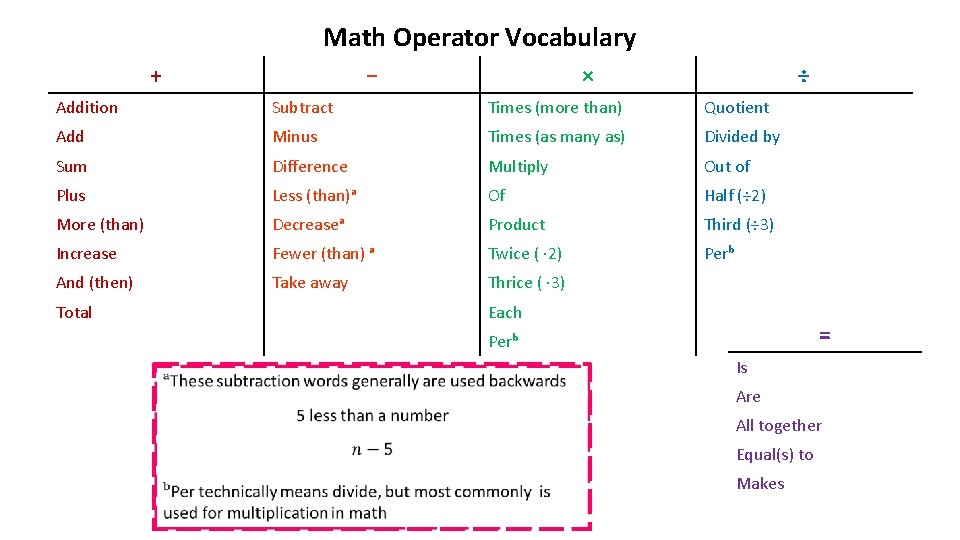
Math Operator Vocabulary + − × ÷ Addition Subtract Times (more than) Quotient Add Minus Times (as many as) Divided by Sum Difference Multiply Out of Plus Less (than)ᵃ Of Half (÷ 2) More (than) Decreaseᵃ Product Third (÷ 3) Increase Fewer (than) ᵃ Twice ( ∙ 2) Perᵇ And (then) Take away Thrice ( ∙ 3) Total Each = Perᵇ Is Are All together Equal(s) to Makes
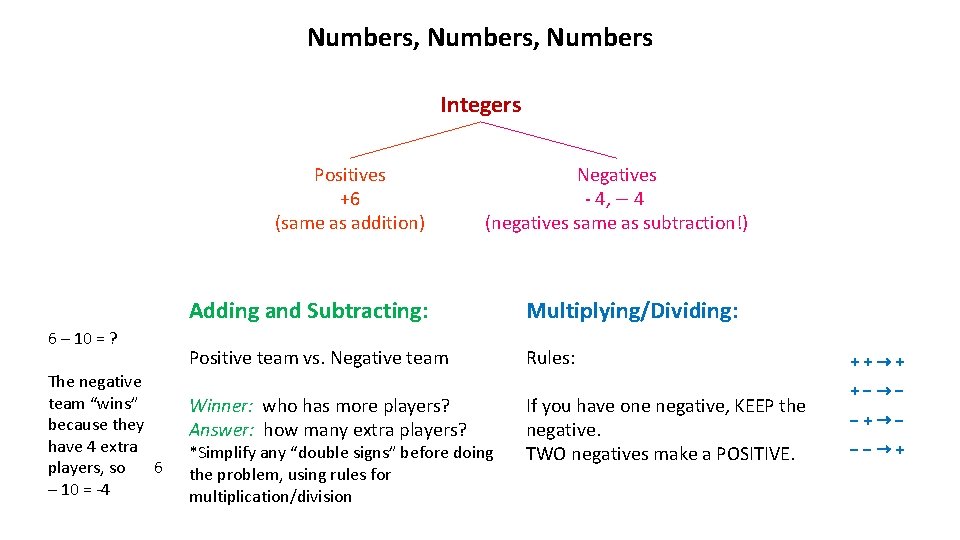
Numbers, Numbers Integers Positives +6 (same as addition) 6 – 10 = ? The negative team “wins” because they have 4 extra players, so 6 – 10 = -4 Negatives - 4, − 4 (negatives same as subtraction!) Adding and Subtracting: Multiplying/Dividing: Positive team vs. Negative team Rules: Winner: who has more players? Answer: how many extra players? *Simplify any “double signs” before doing the problem, using rules for multiplication/division If you have one negative, KEEP the negative. TWO negatives make a POSITIVE. ++→+ +−→− −+→− −−→+
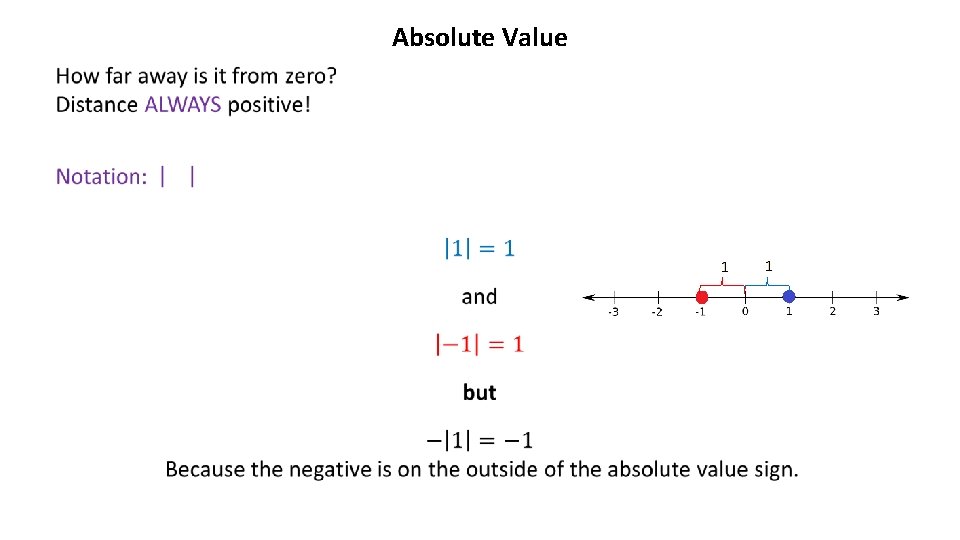
Absolute Value
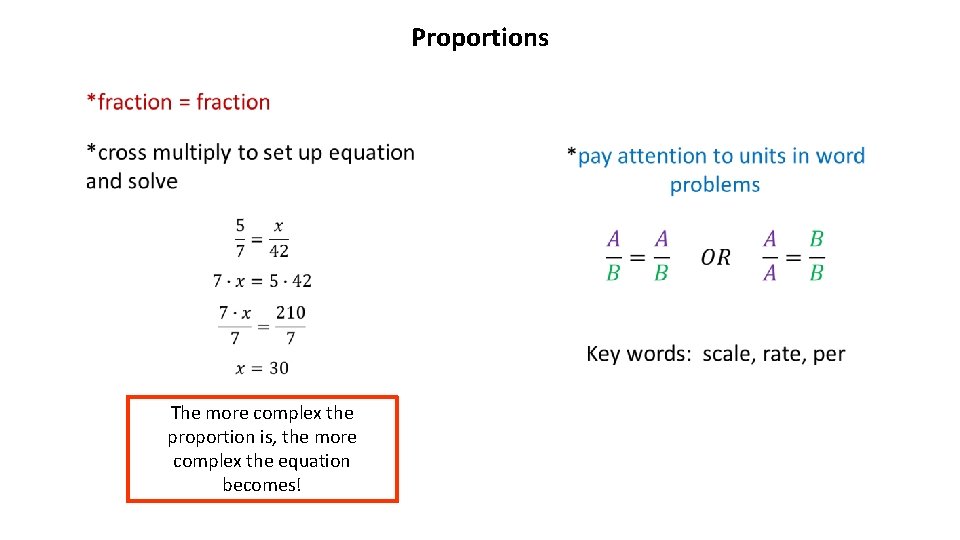
Proportions The more complex the proportion is, the more complex the equation becomes!
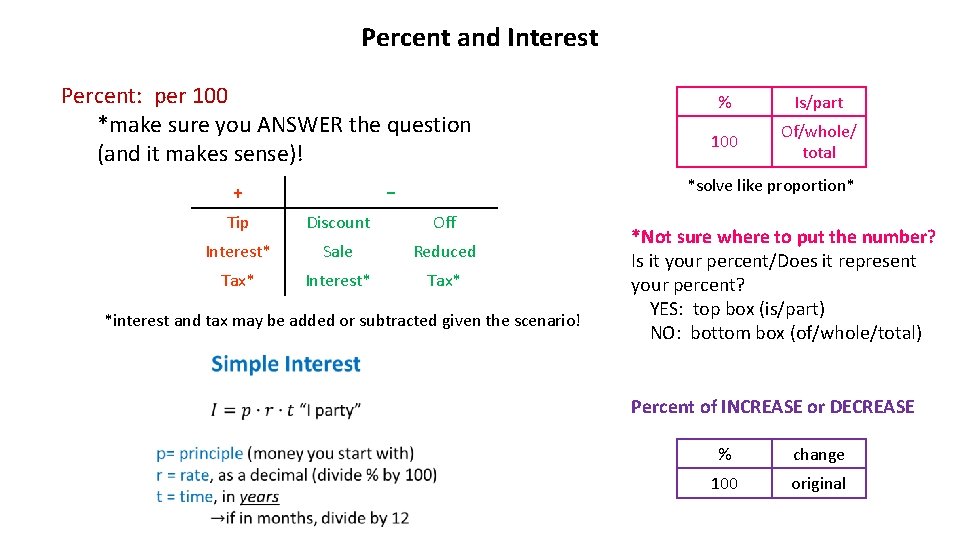
Percent and Interest Percent: per 100 *make sure you ANSWER the question (and it makes sense)! + % Is/part 100 Of/whole/ total *solve like proportion* − Tip Discount Off Interest* Sale Reduced Tax* Interest* Tax* *interest and tax may be added or subtracted given the scenario! *Not sure where to put the number? Is it your percent/Does it represent your percent? YES: top box (is/part) NO: bottom box (of/whole/total) Percent of INCREASE or DECREASE % change 100 original
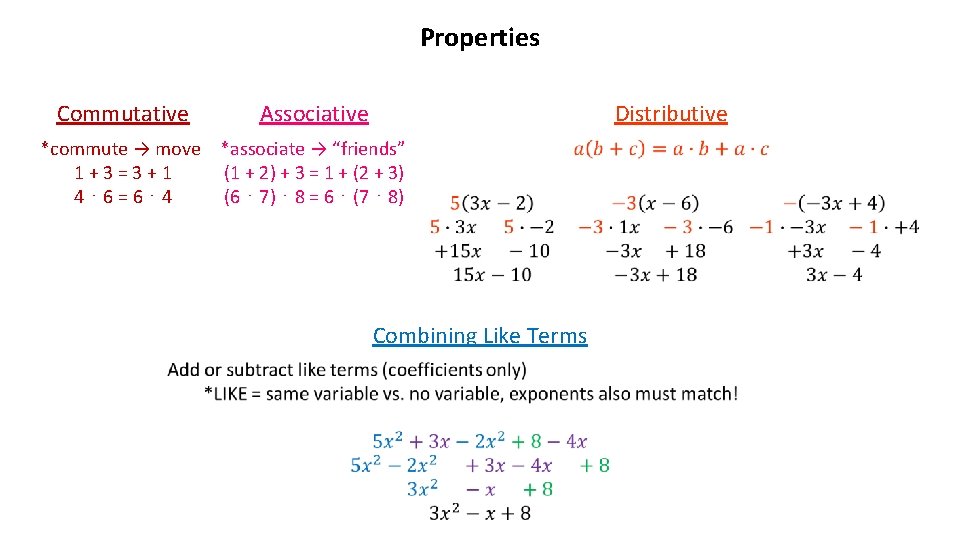
Properties Commutative Associative Distributive *commute → move *associate → “friends” 1+3=3+1 (1 + 2) + 3 = 1 + (2 + 3) 4⋅6=6⋅4 (6 ⋅ 7) ⋅ 8 = 6 ⋅ (7 ⋅ 8) Combining Like Terms

Properties, continued
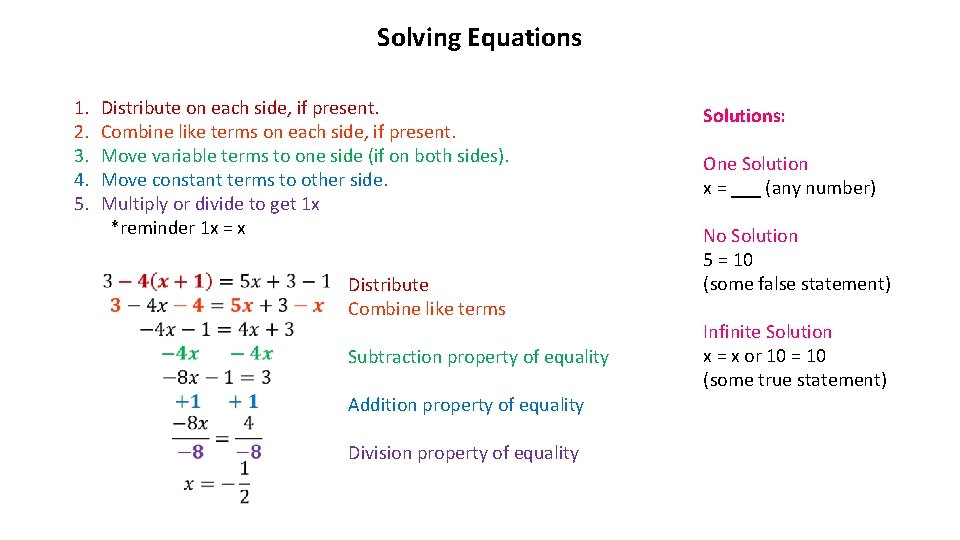
Solving Equations 1. 2. 3. 4. 5. Distribute on each side, if present. Combine like terms on each side, if present. Move variable terms to one side (if on both sides). Move constant terms to other side. Multiply or divide to get 1 x *reminder 1 x = x Distribute Combine like terms Subtraction property of equality Addition property of equality Division property of equality Solutions: One Solution x = ___ (any number) No Solution 5 = 10 (some false statement) Infinite Solution x = x or 10 = 10 (some true statement)
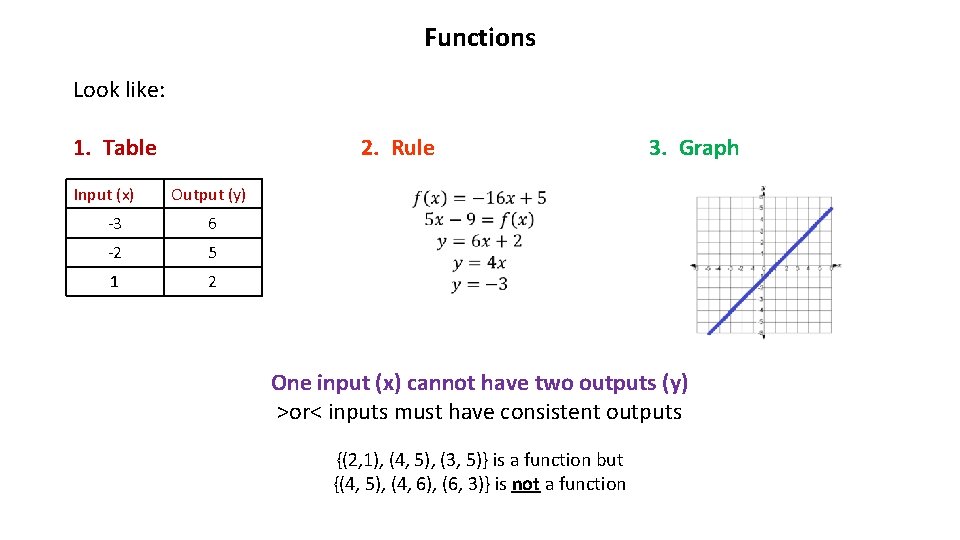
Functions Look like: 1. Table Input (x) 2. Rule 3. Graph Output (y) -3 6 -2 5 1 2 One input (x) cannot have two outputs (y) >or< inputs must have consistent outputs {(2, 1), (4, 5), (3, 5)} is a function but {(4, 5), (4, 6), (6, 3)} is not a function
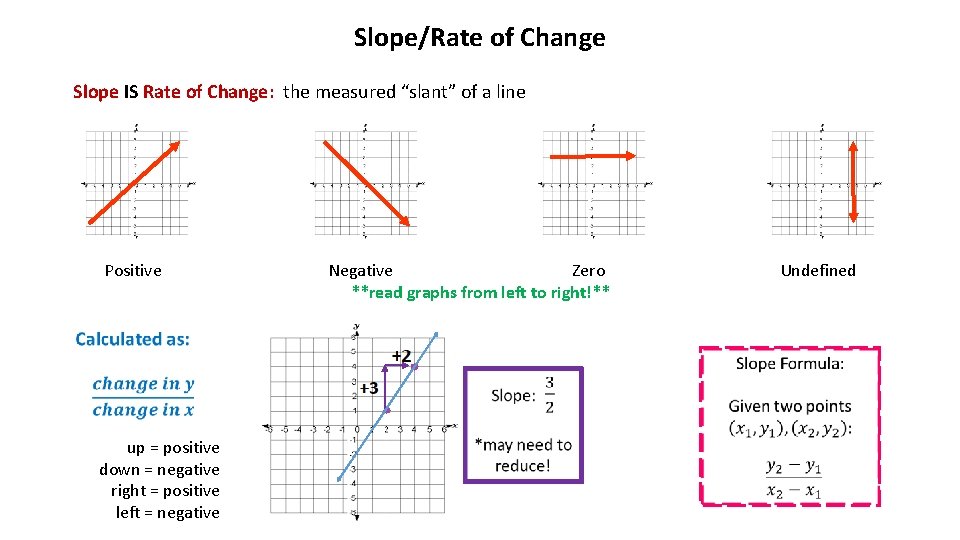
Slope/Rate of Change Slope IS Rate of Change: the measured “slant” of a line Positive up = positive down = negative right = positive left = negative Negative Zero **read graphs from left to right!** Undefined
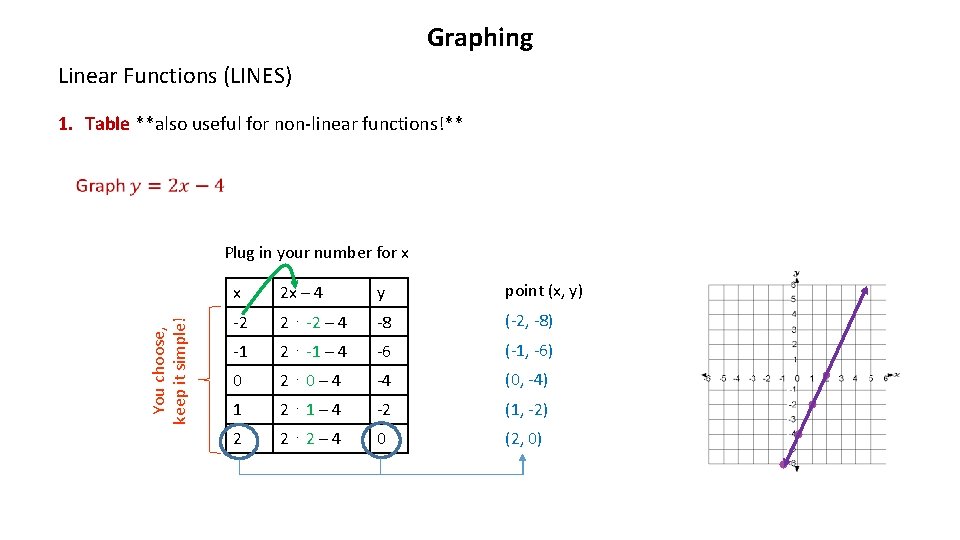
Graphing Linear Functions (LINES) 1. Table **also useful for non-linear functions!** You choose, keep it simple! Plug in your number for x x 2 x – 4 y point (x, y) -2 2 ⋅ -2 – 4 -8 (-2, -8) -1 2 ⋅ -1 – 4 -6 (-1, -6) 0 2⋅0– 4 -4 (0, -4) 1 2⋅1– 4 -2 (1, -2) 2 2⋅2– 4 0 (2, 0)
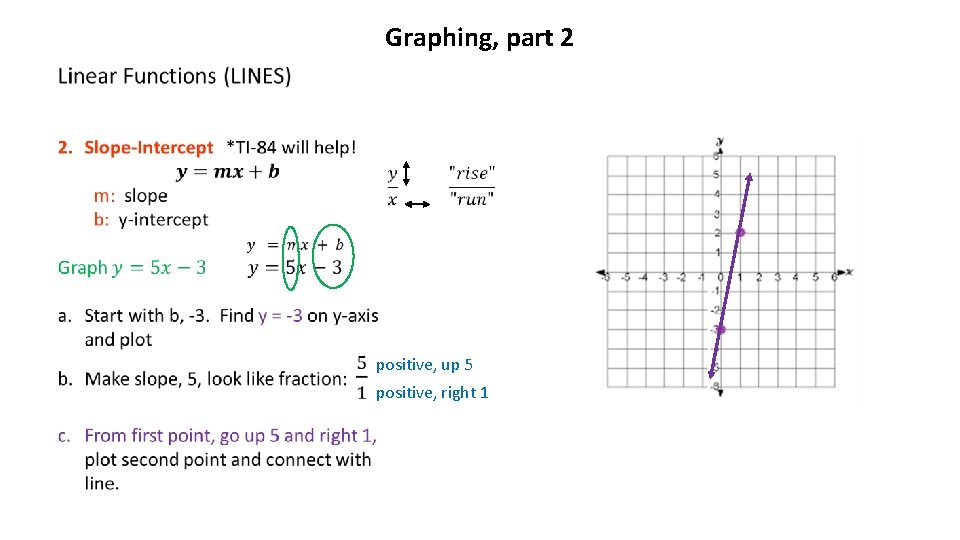
Graphing, part 2 positive, up 5 positive, right 1
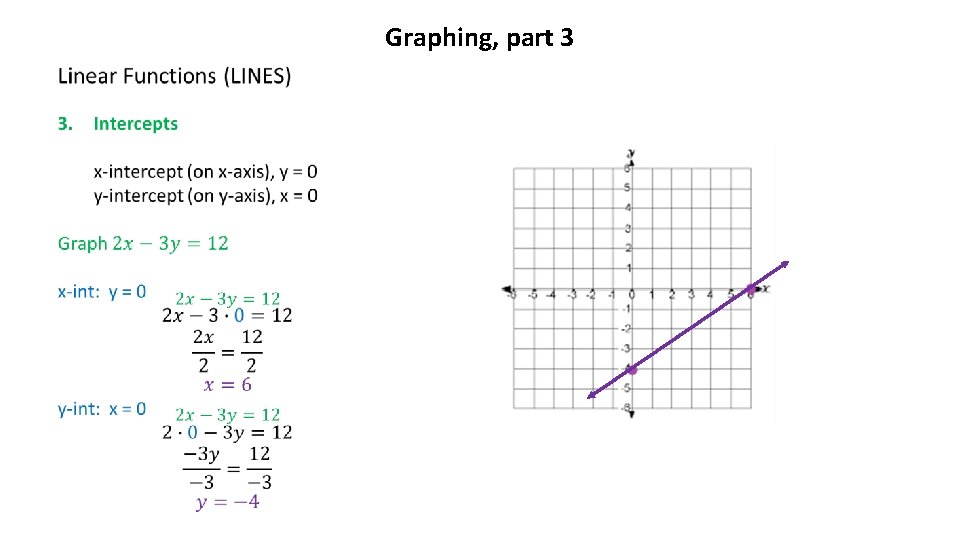
Graphing, part 3
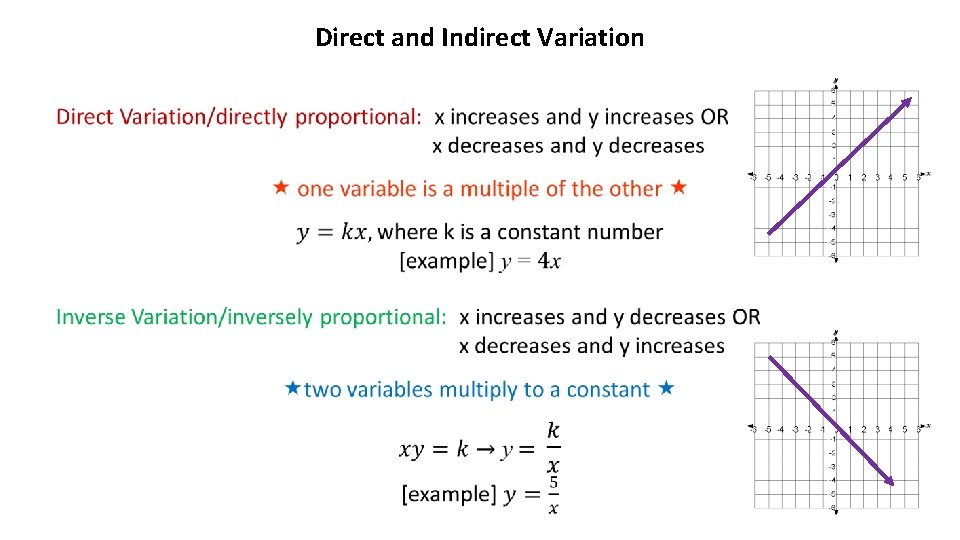
Direct and Indirect Variation
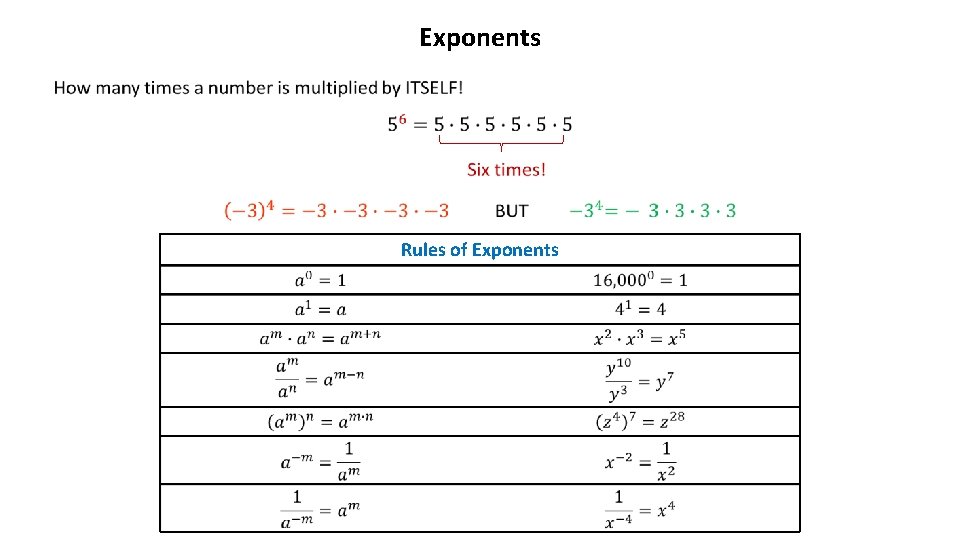
Exponents Rules of Exponents
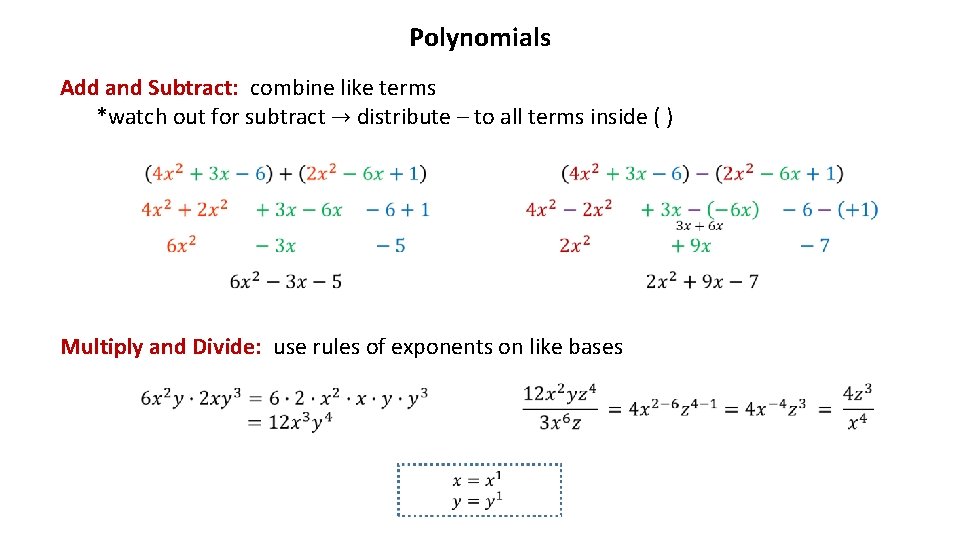
Polynomials Add and Subtract: combine like terms *watch out for subtract → distribute – to all terms inside ( ) Multiply and Divide: use rules of exponents on like bases
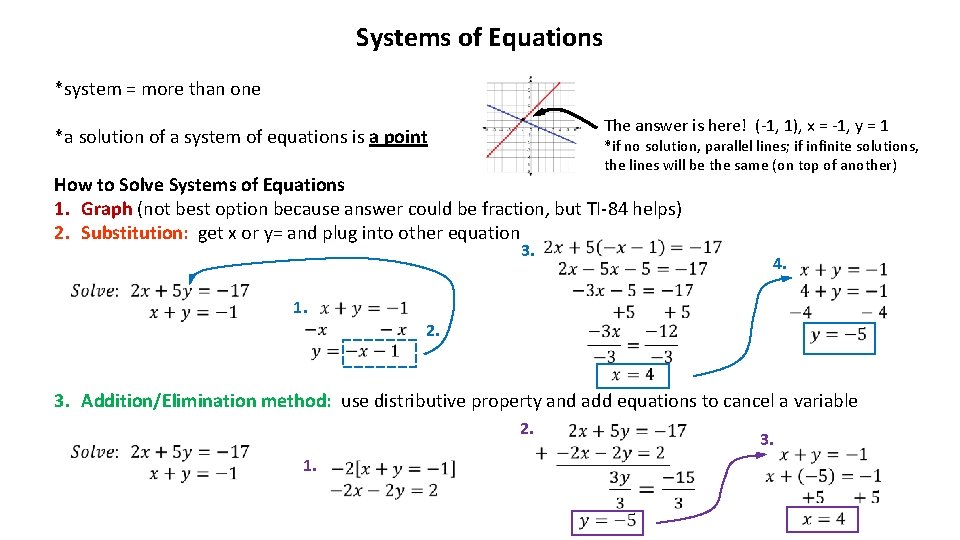
Systems of Equations *system = more than one The answer is here! (-1, 1), x = -1, y = 1 *a solution of a system of equations is a point *if no solution, parallel lines; if infinite solutions, the lines will be the same (on top of another) How to Solve Systems of Equations 1. Graph (not best option because answer could be fraction, but TI-84 helps) 2. Substitution: get x or y= and plug into other equation 3. 4. 1. 2. 3. Addition/Elimination method: use distributive property and add equations to cancel a variable 2. 1. 3.
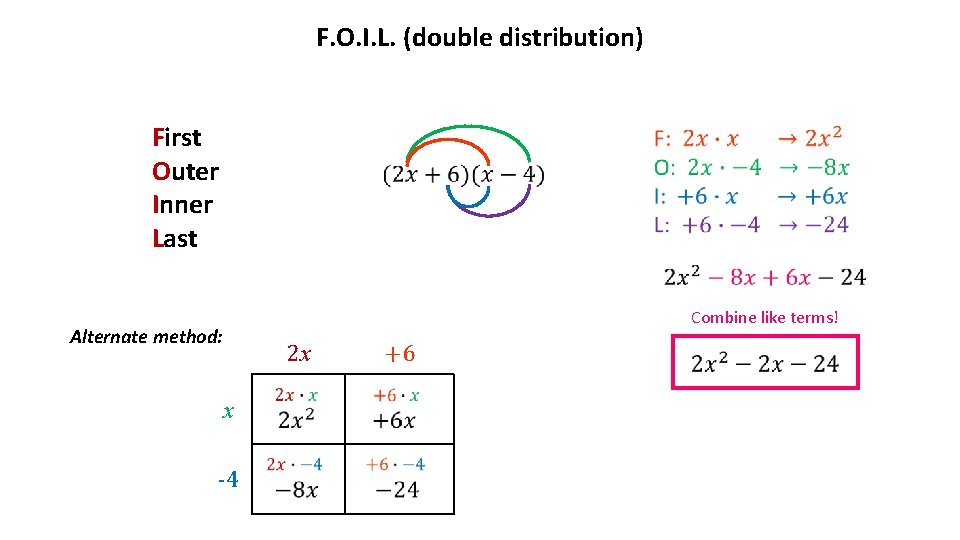
F. O. I. L. (double distribution) First Outer Inner Last Combine like terms! Alternate method: 2 x x -4 +6
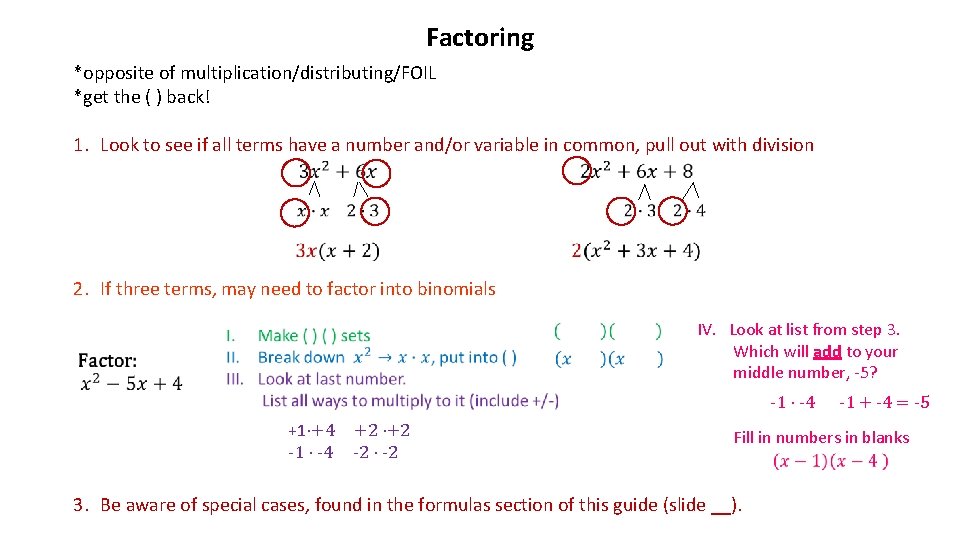
Factoring *opposite of multiplication/distributing/FOIL *get the ( ) back! 1. Look to see if all terms have a number and/or variable in common, pull out with division 2. If three terms, may need to factor into binomials IV. Look at list from step 3. Which will add to your middle number, -5? -1 ⋅ -4 +1⋅+4 -1 ⋅ -4 +2 ⋅+2 -2 ⋅ -2 -1 + -4 = -5 Fill in numbers in blanks 3. Be aware of special cases, found in the formulas section of this guide (slide __).
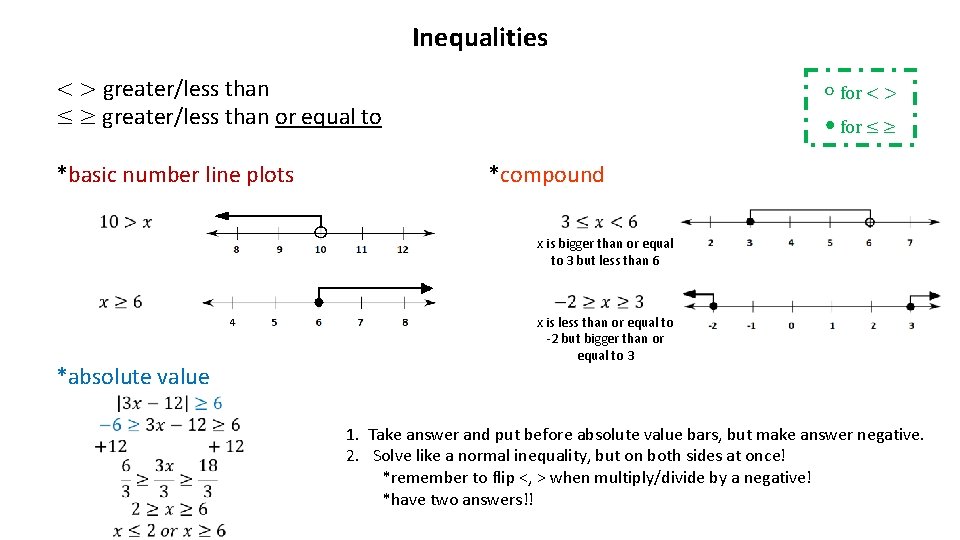
Inequalities < > greater/less than ≤ ≥ greater/less than or equal to *basic number line plots ∘ for < > ⦁ for ≤ ≥ *compound x is bigger than or equal to 3 but less than 6 *absolute value x is less than or equal to -2 but bigger than or equal to 3 1. Take answer and put before absolute value bars, but make answer negative. 2. Solve like a normal inequality, but on both sides at once! *remember to flip <, > when multiply/divide by a negative! *have two answers!!
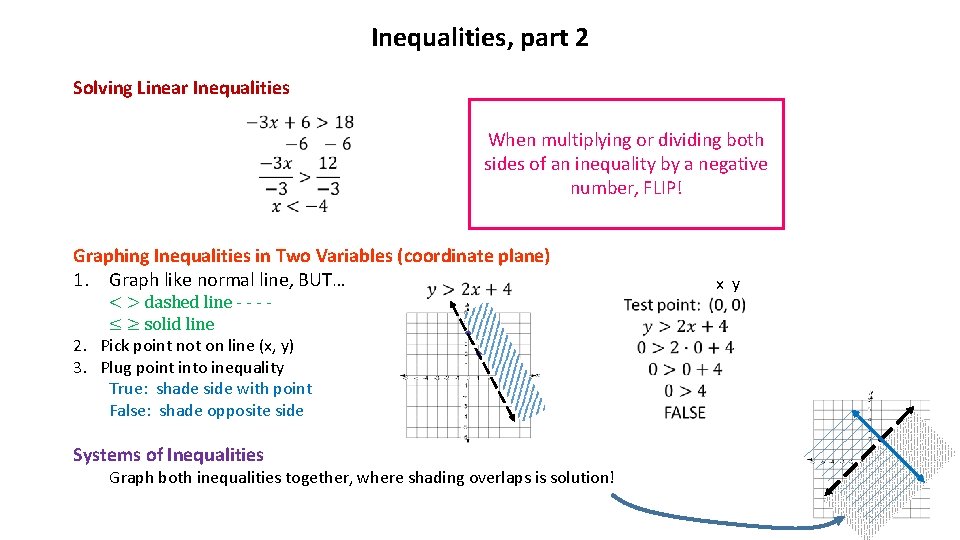
Inequalities, part 2 Solving Linear Inequalities When multiplying or dividing both sides of an inequality by a negative number, FLIP! Graphing Inequalities in Two Variables (coordinate plane) 1. Graph like normal line, BUT… < > dashed line - - - ≤ ≥ solid line 2. Pick point not on line (x, y) 3. Plug point into inequality True: shade side with point False: shade opposite side Systems of Inequalities Graph both inequalities together, where shading overlaps is solution! x y
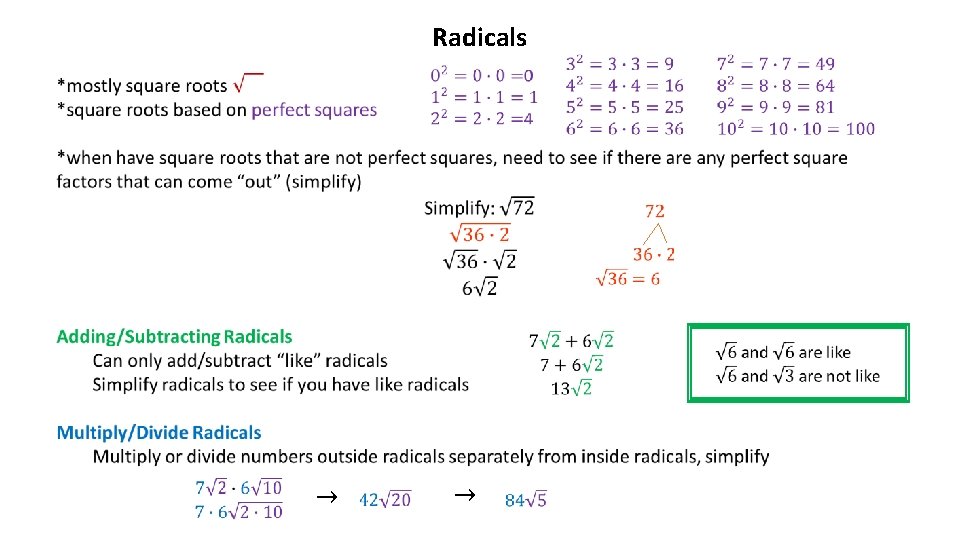
Radicals → →
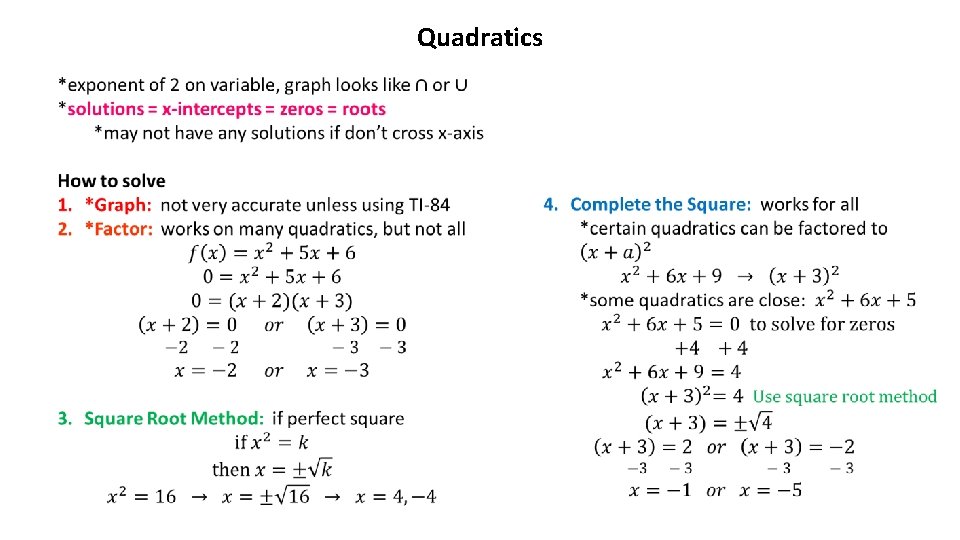
Quadratics
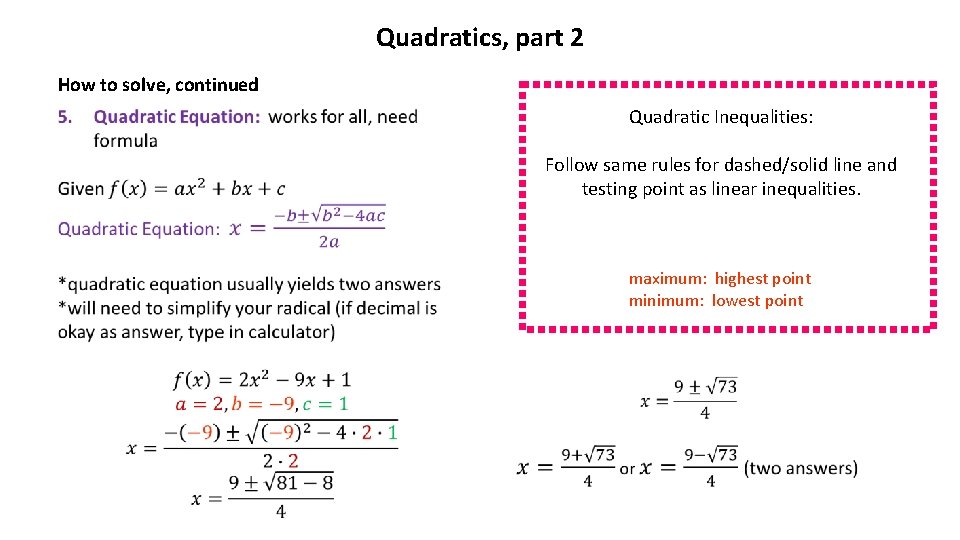
Quadratics, part 2 How to solve, continued Quadratic Inequalities: Follow same rules for dashed/solid line and testing point as linear inequalities. maximum: highest point minimum: lowest point
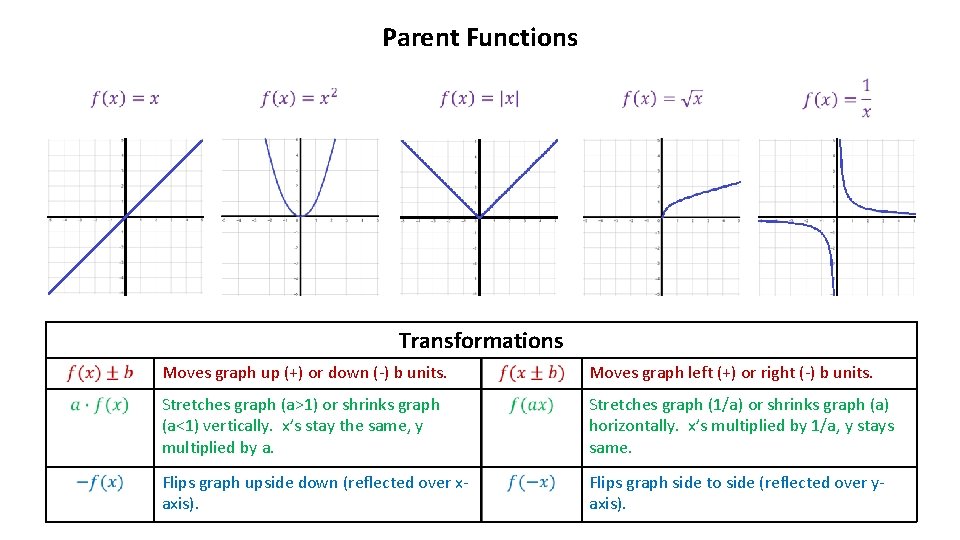
Parent Functions Transformations Moves graph up (+) or down (-) b units. Moves graph left (+) or right (-) b units. Stretches graph (a>1) or shrinks graph (a<1) vertically. x’s stay the same, y multiplied by a. Stretches graph (1/a) or shrinks graph (a) horizontally. x’s multiplied by 1/a, y stays same. Flips graph upside down (reflected over xaxis). Flips graph side to side (reflected over yaxis).
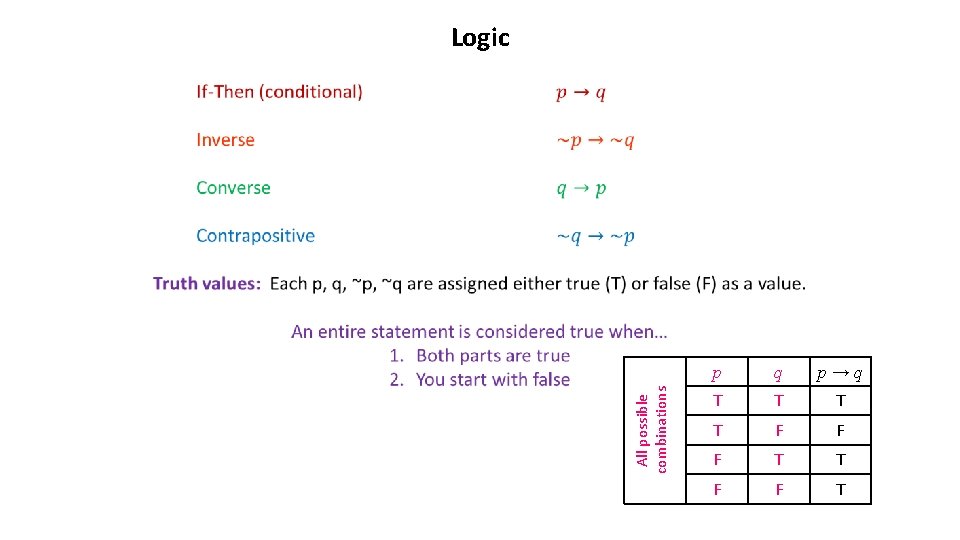
All possible combinations Logic p q p→q T T F F F T T F F T
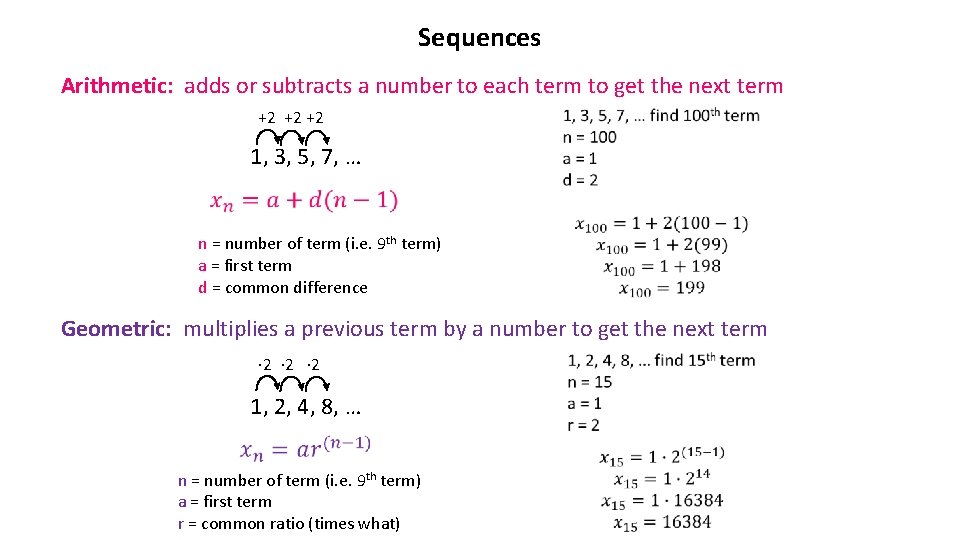
Sequences Arithmetic: adds or subtracts a number to each term to get the next term +2 +2 +2 1, 3, 5, 7, … n = number of term (i. e. 9 th term) a = first term d = common difference Geometric: multiplies a previous term by a number to get the next term ⋅2 ⋅2 ⋅2 1, 2, 4, 8, … n = number of term (i. e. 9 th term) a = first term r = common ratio (times what)
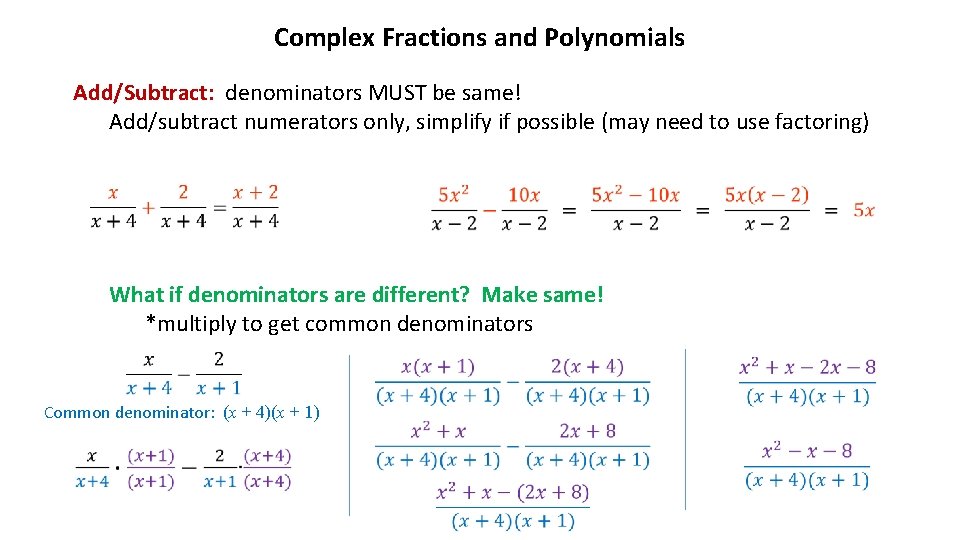
Complex Fractions and Polynomials Add/Subtract: denominators MUST be same! Add/subtract numerators only, simplify if possible (may need to use factoring) What if denominators are different? Make same! *multiply to get common denominators Common denominator: (x + 4)(x + 1)
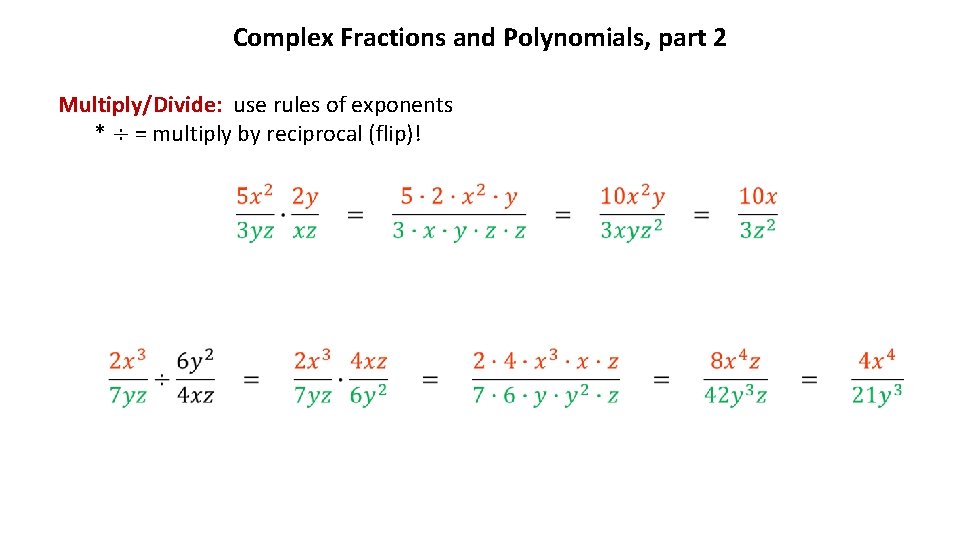
Complex Fractions and Polynomials, part 2 Multiply/Divide: use rules of exponents * ÷ = multiply by reciprocal (flip)!
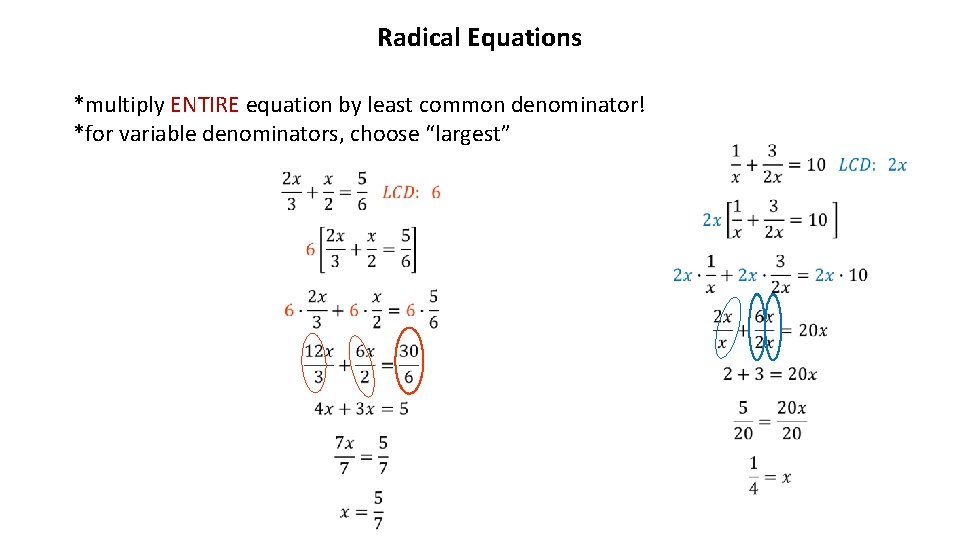
Radical Equations *multiply ENTIRE equation by least common denominator! *for variable denominators, choose “largest”
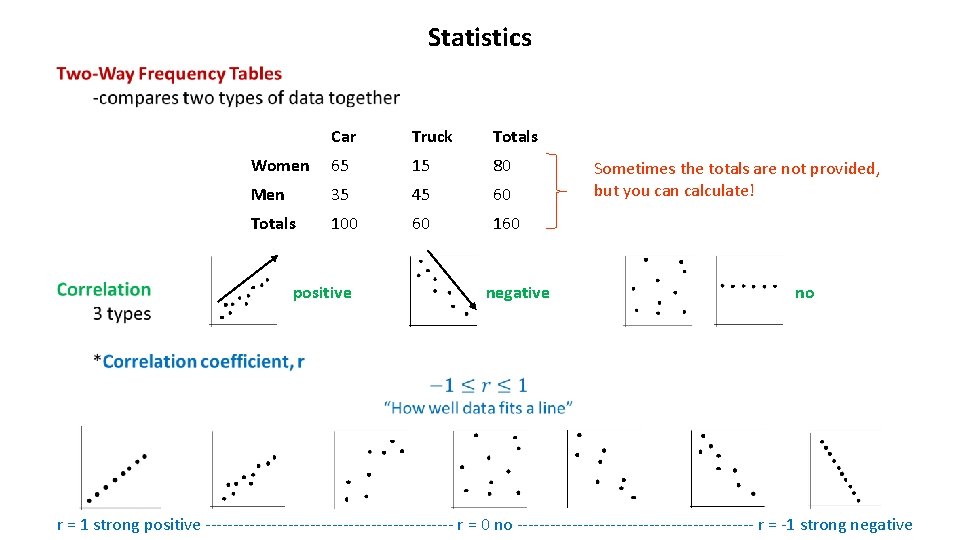
Statistics Car Truck Totals Women 65 15 80 Men 35 45 60 Totals 100 60 160 positive negative Sometimes the totals are not provided, but you can calculate! no r = 1 strong positive ----------------------- r = 0 no ---------------------- r = -1 strong negative
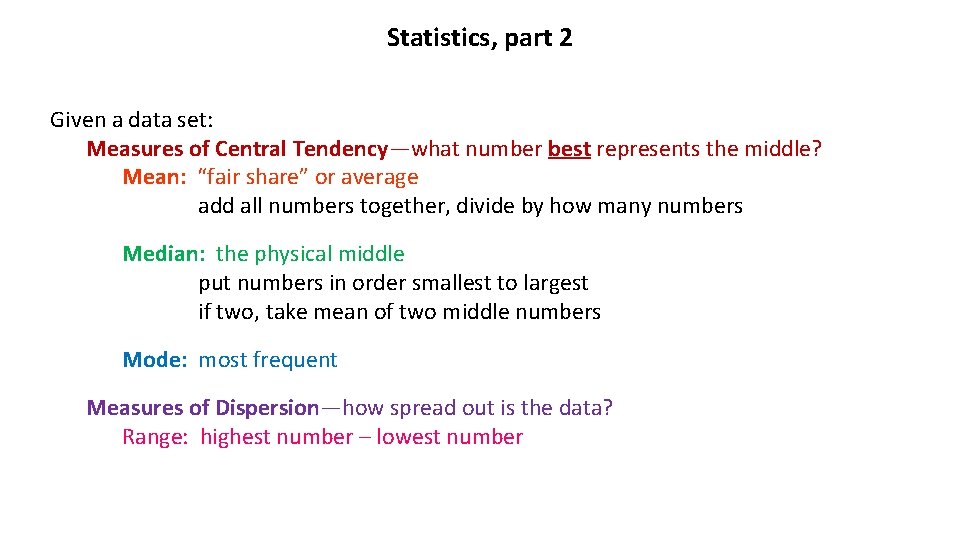
Statistics, part 2 Given a data set: Measures of Central Tendency—what number best represents the middle? Mean: “fair share” or average add all numbers together, divide by how many numbers Median: the physical middle put numbers in order smallest to largest if two, take mean of two middle numbers Mode: most frequent Measures of Dispersion—how spread out is the data? Range: highest number – lowest number
- Slides: 36