
Algebra I 2 7 Square Roots Comparing Real
Algebra I 2. 7 Square Roots & Comparing Real Numbers
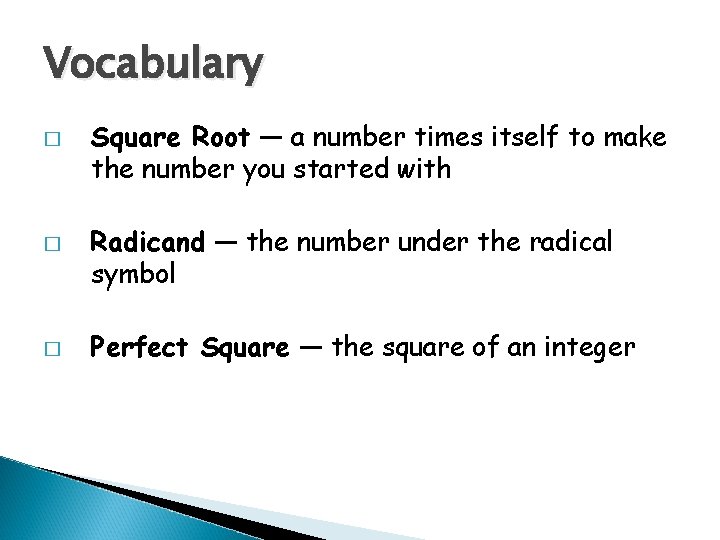
Vocabulary � � � Square Root — a number times itself to make the number you started with Radicand — the number under the radical symbol Perfect Square — the square of an integer

Vocabulary � � Irrational Number — a number that is not rational Real Number — the set of all rational and irrational numbers
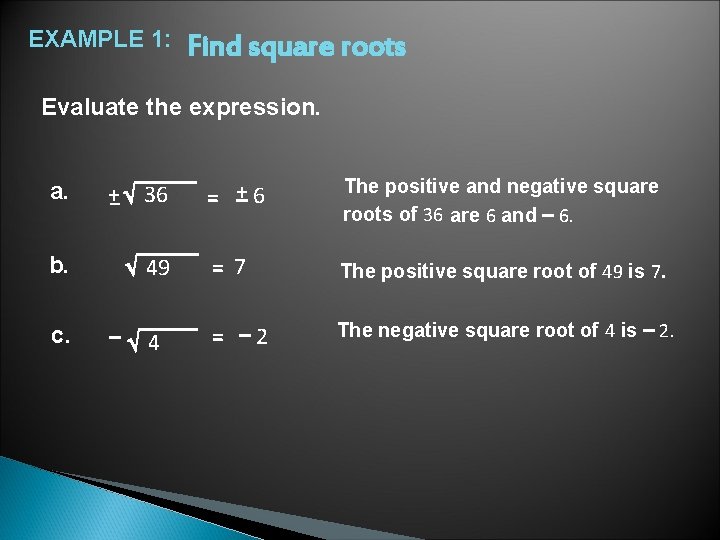
EXAMPLE 1: Find square roots Evaluate the expression. a. +– 36 b. 49 c. – 4 = +– 6 The positive and negative square roots of 36 are 6 and – 6. = 7 The positive square root of 49 is 7. = – 2 The negative square root of 4 is – 2.
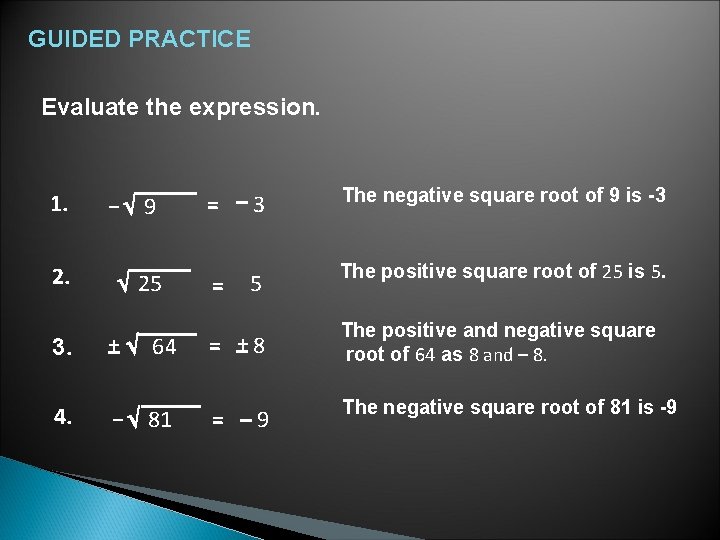
GUIDED PRACTICE Evaluate the expression. 9 = – 3 The negative square root of 9 is -3 2. 25 5 The positive square root of 25 is 5. 3. –+ 64 = –+ 8 The positive and negative square root of 64 as 8 and – 8. 4. – = – 9 The negative square root of 81 is -9 1. – 81 =

EXAMPLE 2: Approximate a square root FURNITURE The top of a folding table is a square whose area is 945 square inches. Approximate the side length of the tabletop to the nearest inch. SOLUTION You need to find the side length s of the tabletop such that 2 s = 945. This means that s is the positive square root of 945. You can use a table to determine whether 945 is a perfect square.
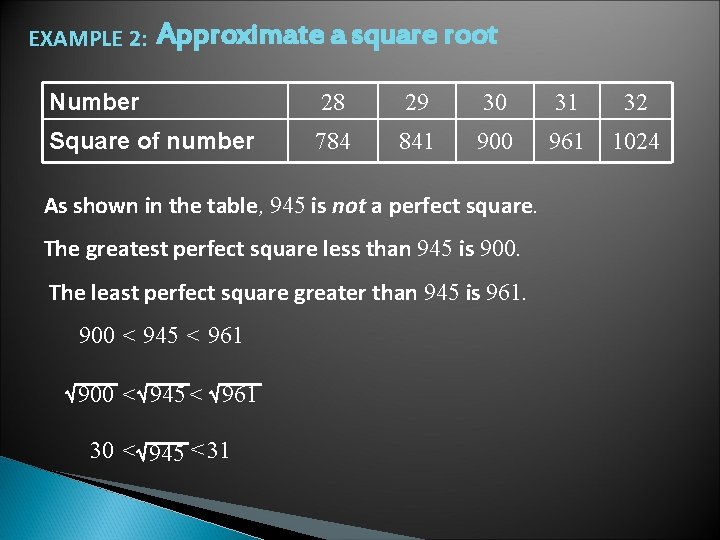
EXAMPLE 2: Approximate a square root Number 28 29 30 31 32 Square of number 784 841 900 961 1024 As shown in the table, 945 is not a perfect square. The greatest perfect square less than 945 is 900. The least perfect square greater than 945 is 961. 900 < 945 < 961 900 < 945 < 961 30 < 945 < 31

EXAMPLE 2: Approximate a square root Because 945 is closer to 961 than to 900, 945 is closer to 31 than to 30. ANSWER The side length of the tabletop is about 31 inches.

GUIDED PRACTICE Approximate the square root to the nearest integer. 1. 32 You can use a table to determine whether 32 is a perfect square. Number Square of number 5 6 7 8 25 36 49 64 As shown in the table, 32 is not a perfect square. The greatest perfect square less than 32 is 25. The least perfect square greater than 25 is 36.

GUIDED PRACTICE 25 < 32 < 36 25 < 32 < 36 5 < 32 < 6 Write a compound inequality that compares 32 with both 25 and 36. Take positive square root of each number. Find square root of each perfect square. Because 32 is closer to 36 than to 25, 32 is closer to 6 than to 5.
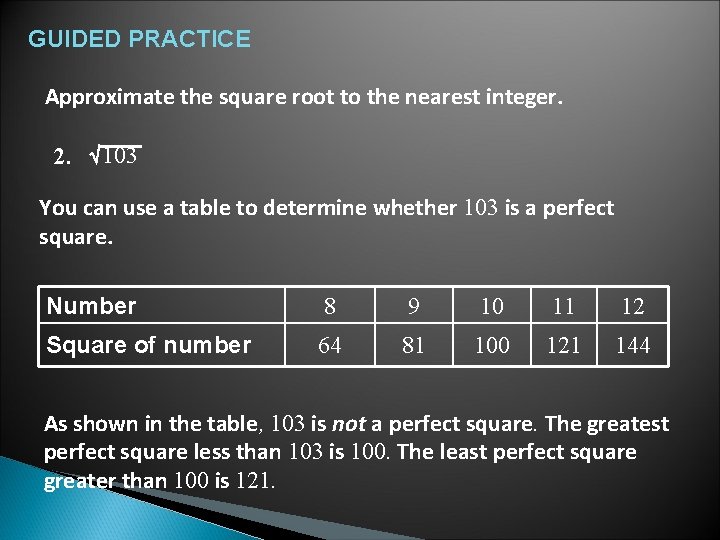
GUIDED PRACTICE Approximate the square root to the nearest integer. 2. 103 You can use a table to determine whether 103 is a perfect square. Number 8 9 10 11 12 Square of number 64 81 100 121 144 As shown in the table, 103 is not a perfect square. The greatest perfect square less than 103 is 100. The least perfect square greater than 100 is 121.
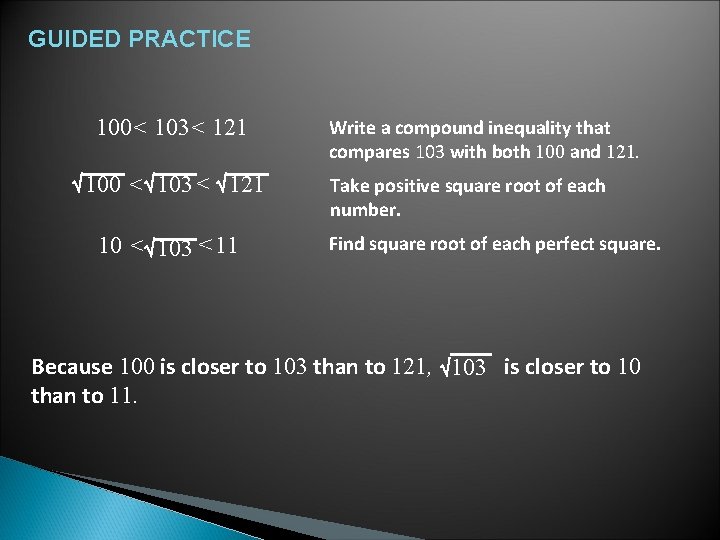
GUIDED PRACTICE 100< 103< 121 100 < 103 < 121 10 < 103 < 11 Write a compound inequality that compares 103 with both 100 and 121. Take positive square root of each number. Find square root of each perfect square. Because 100 is closer to 103 than to 121, 103 is closer to 10 than to 11.
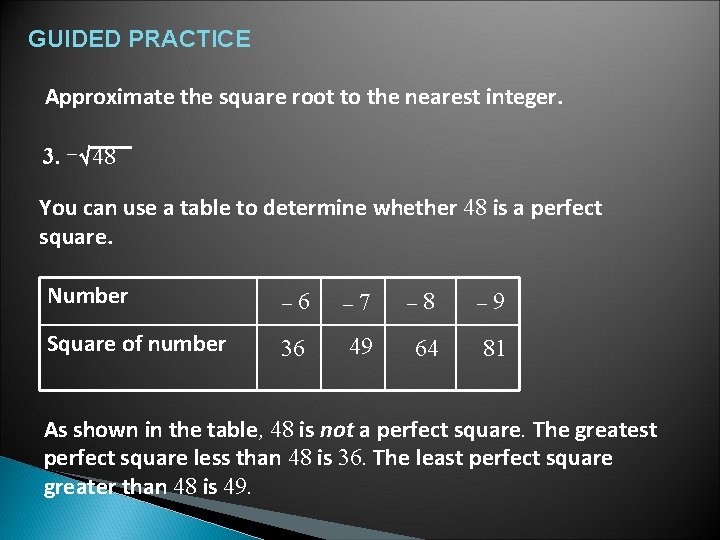
GUIDED PRACTICE Approximate the square root to the nearest integer. 3. – 48 You can use a table to determine whether 48 is a perfect square. Number – 6 – 7 – 8 – 9 Square of number 36 49 64 81 As shown in the table, 48 is not a perfect square. The greatest perfect square less than 48 is 36. The least perfect square greater than 48 is 49.
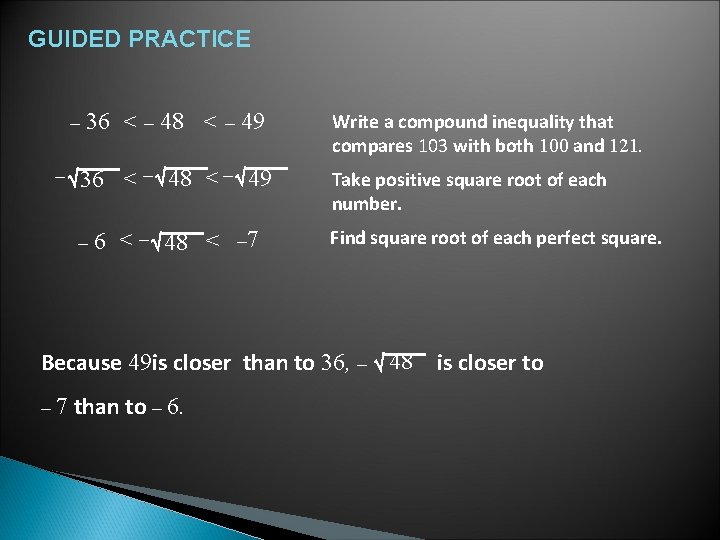
GUIDED PRACTICE – 36 – 6 < – 48 < – 49 Write a compound inequality that compares 103 with both 100 and 121. < – 48 < – 49 Take positive square root of each number. < – 48 < – 7 Find square root of each perfect square. Because 49 is closer than to 36, – 48 – 7 than to – 6. is closer to
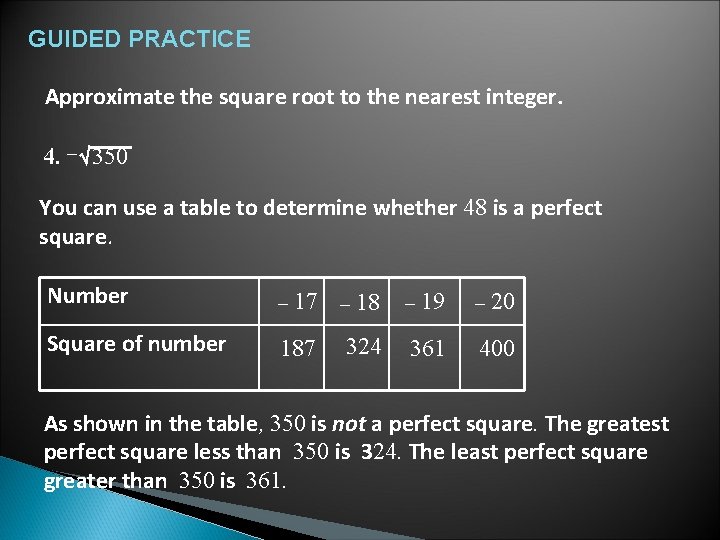
GUIDED PRACTICE Approximate the square root to the nearest integer. 4. – 350 You can use a table to determine whether 48 is a perfect square. Number – 17 – 18 – 19 – 20 Square of number 187 324 361 400 As shown in the table, 350 is not a perfect square. The greatest perfect square less than 350 is 324. The least perfect square greater than 350 is 361.
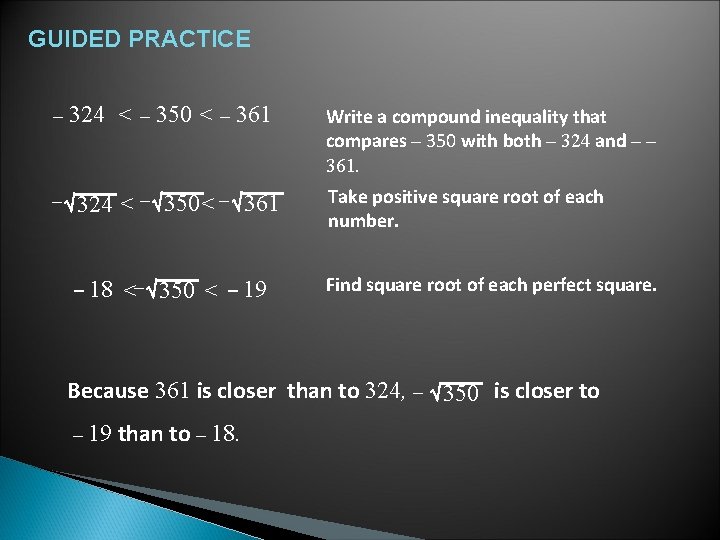
GUIDED PRACTICE – 324 < – 350 < – 361 Write a compound inequality that compares – 350 with both – 324 and – – 361. – 324 < – 350< – 361 Take positive square root of each number. <– 350 < – 19 Find square root of each perfect square. – 18 Because 361 is closer than to 324, – 350 is closer to – 19 than to – 18.
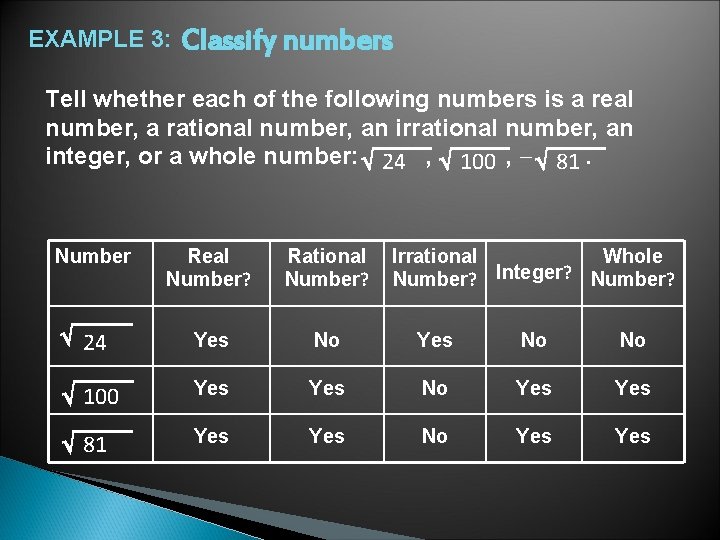
EXAMPLE 3: Classify numbers Tell whether each of the following numbers is a real number, a rational number, an irrational number, an integer, or a whole number: 24 , 100 , – 81. Real Number? Rational Number? 24 Yes No No 100 Yes No Yes 81 Yes No Yes Number Irrational Whole Number? Integer? Number?
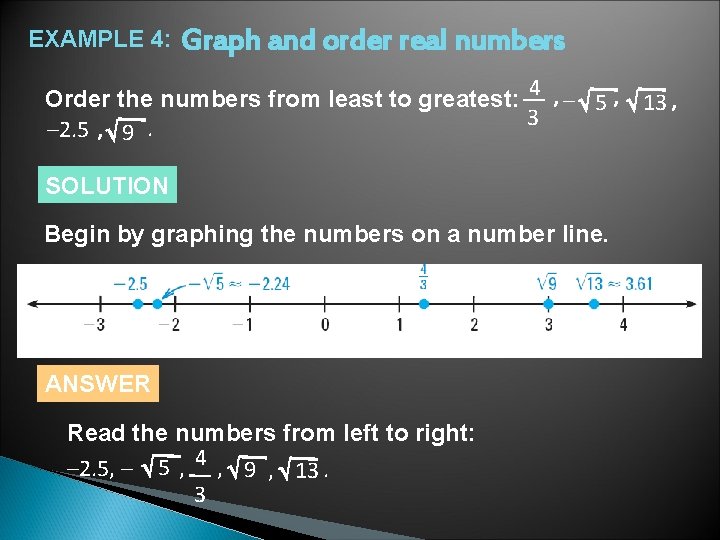
EXAMPLE 4: Graph and order real numbers Order the numbers from least to greatest: 4 , – 5 , 13 , 3 – 2. 5 , 9. SOLUTION Begin by graphing the numbers on a number line. ANSWER Read the numbers from left to right: – 2. 5, – 5 , 4 , 9 , 13. 3
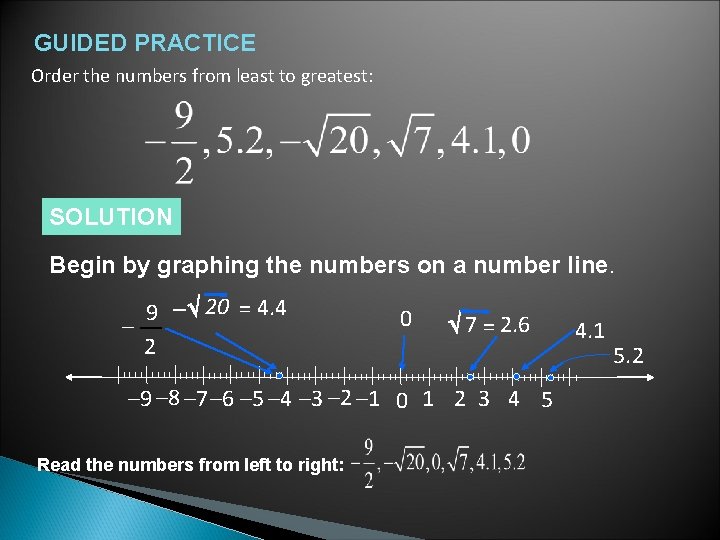
GUIDED PRACTICE Order the numbers from least to greatest: SOLUTION Begin by graphing the numbers on a number line. 9 20 = 4. 4 – 2 0 7 = 2. 6 – 9 – 8 – 7 – 6 – 5 – 4 – 3 – 2 – 1 0 1 2 3 4 5 Read the numbers from left to right: 4. 1 5. 2
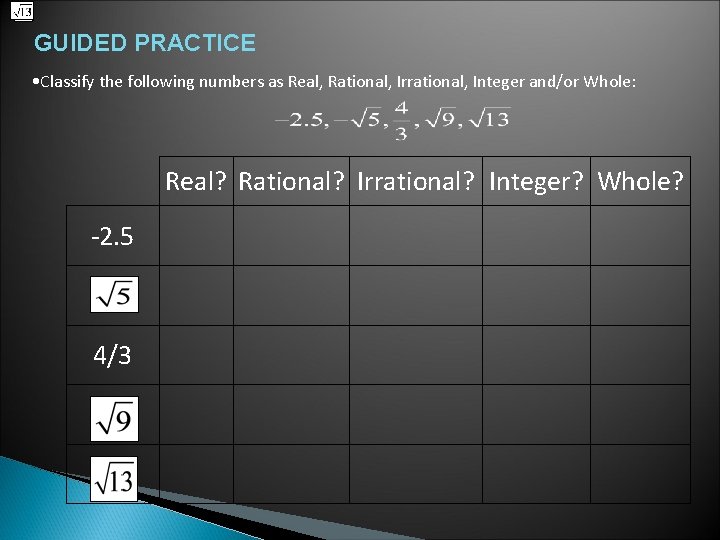
GUIDED PRACTICE • Classify the following numbers as Real, Rational, Irrational, Integer and/or Whole: Real? Rational? Irrational? Integer? Whole? -2. 5 4/3
- Slides: 20