
ALGEBRA 1 UNIT 1 Unit Essential Questions How
ALGEBRA 1 UNIT 1 Unit Essential Questions How can you represent quantities, patterns, and relationships? How are properties of real numbers related to algebra?
MACC. 912. A-SSE. A. 1 a: Interpret parts of an expression, such as terms, factors, and coefficients.
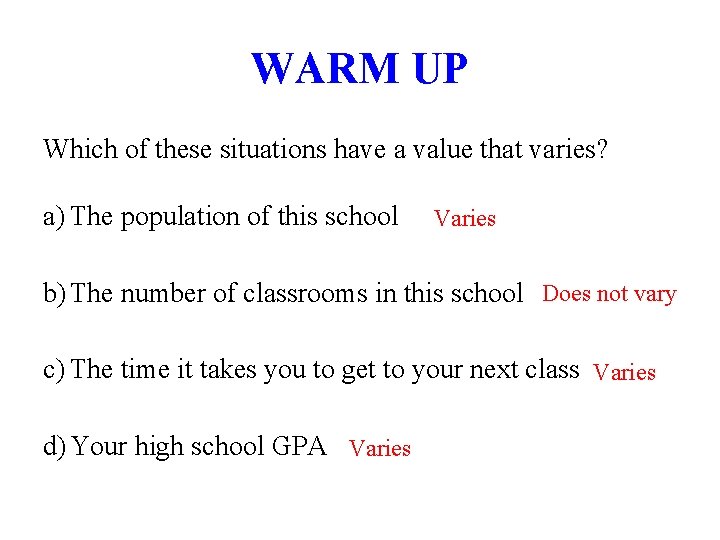
WARM UP Which of these situations have a value that varies? a) The population of this school Varies b) The number of classrooms in this school Does not vary c) The time it takes you to get to your next class Varies d) Your high school GPA Varies
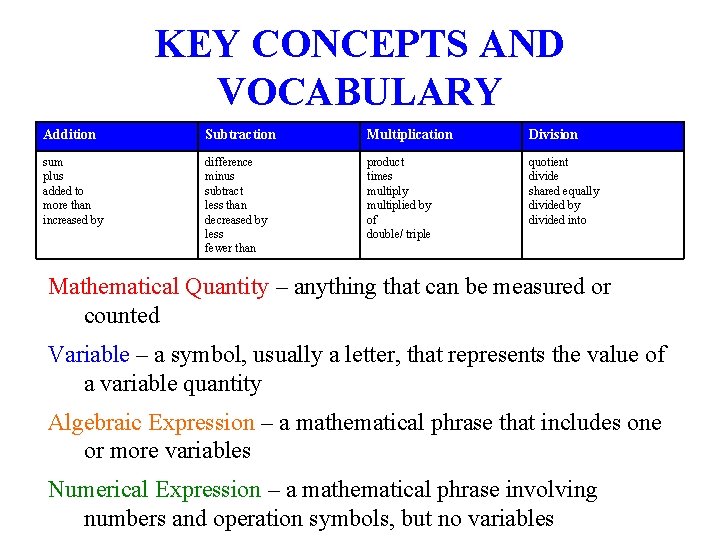
KEY CONCEPTS AND VOCABULARY Addition Subtraction Multiplication Division sum plus added to more than increased by difference minus subtract less than decreased by less fewer than product times multiply multiplied by of double/ triple quotient divide shared equally divided by divided into Mathematical Quantity – anything that can be measured or counted Variable – a symbol, usually a letter, that represents the value of a variable quantity Algebraic Expression – a mathematical phrase that includes one or more variables Numerical Expression – a mathematical phrase involving numbers and operation symbols, but no variables

EXAMPLE 1: REWRITING A WORD EXPRESSION (ADDITION OR SUBTRACTION) Write an algebraic expression for each word phrase. a) 3 more than f f+3 b) 10 less than c c – 10 c) 5 decreased by p 5–p

EXAMPLE 2: REWRITING A WORD EXPRESSION (MULTIPLICATION OR DIVISION) Write an algebraic expression for each word phrase. a) the quotient of 9 and k 9÷k b) the product of 15 and y 15 y c) r divided by 5 r÷ 5 d) twice a number s 2 s
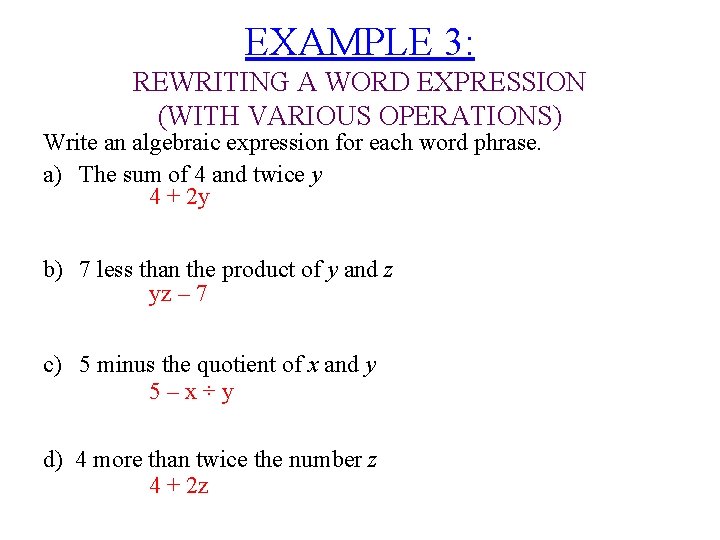
EXAMPLE 3: REWRITING A WORD EXPRESSION (WITH VARIOUS OPERATIONS) Write an algebraic expression for each word phrase. a) The sum of 4 and twice y 4 + 2 y b) 7 less than the product of y and z yz – 7 c) 5 minus the quotient of x and y 5–x÷y d) 4 more than twice the number z 4 + 2 z
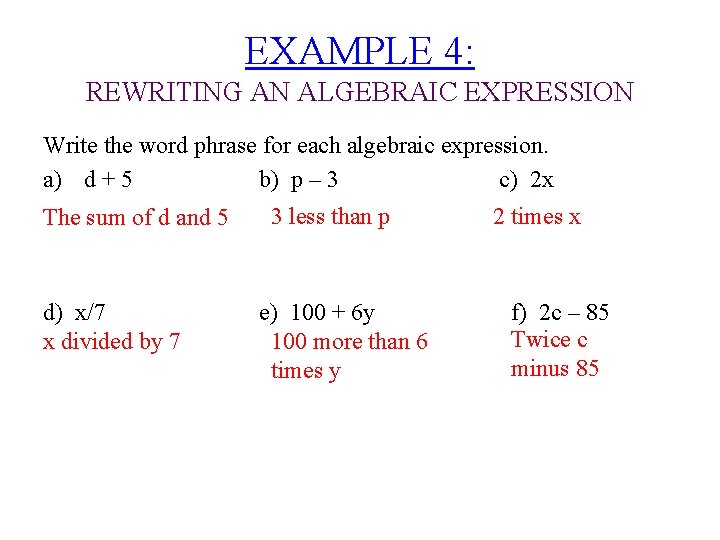
EXAMPLE 4: REWRITING AN ALGEBRAIC EXPRESSION Write the word phrase for each algebraic expression. a) d + 5 b) p – 3 c) 2 x The sum of d and 5 d) x/7 x divided by 7 3 less than p e) 100 + 6 y 100 more than 6 times y 2 times x f) 2 c – 85 Twice c minus 85
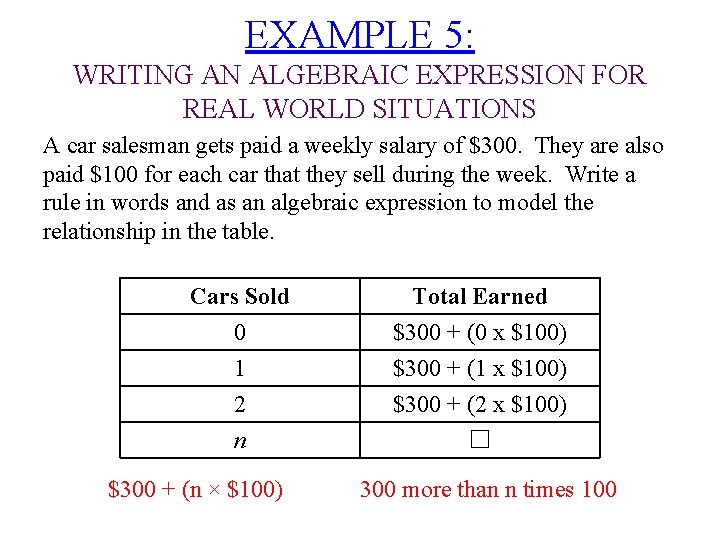
EXAMPLE 5: WRITING AN ALGEBRAIC EXPRESSION FOR REAL WORLD SITUATIONS A car salesman gets paid a weekly salary of $300. They are also paid $100 for each car that they sell during the week. Write a rule in words and as an algebraic expression to model the relationship in the table. Cars Sold 0 1 2 Total Earned $300 + (0 x $100) $300 + (1 x $100) $300 + (2 x $100) n ☐ $300 + (n × $100) 300 more than n times 100
RATE YOUR UNDERSTANDING VARIABLES AND EXPRESSIONS MACC. 912. A-SSE. A. 1 a: Interpret parts of an expression, such as terms, factors, and coefficients. RATING 4 TARGET 3 2 1 LEARNING SCALE I am able to • write algebraic expressions and apply them to real world situations or more challenging problems that I have never previously attempted I am able to • write algebraic expressions with help I am able to • understand that algebra uses symbols to represent quantities that are unknown or may vary
MACC. 912. A. SSE. A. 1. b: Interpret complicated expressions by viewing one or more of their parts as a single entity
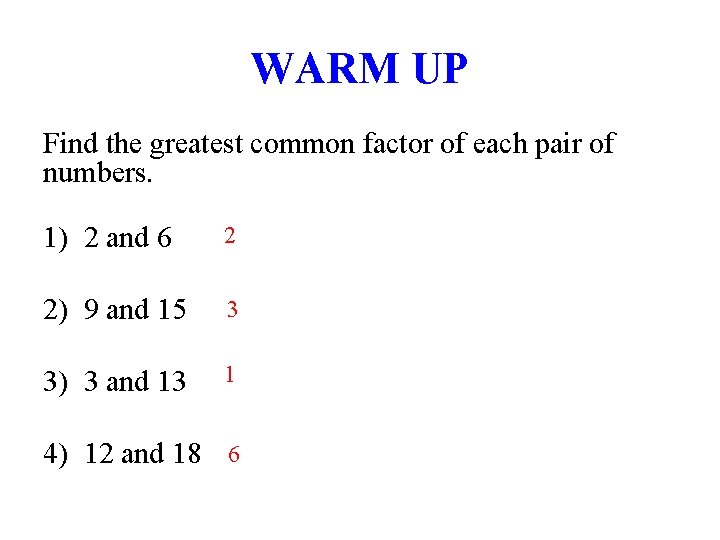
WARM UP Find the greatest common factor of each pair of numbers. 1) 2 and 6 2 2) 9 and 15 3 3) 3 and 13 1 4) 12 and 18 6

KEY CONCEPTS AND VOCABULARY Power – has two parts, base and exponent Exponent – a number that shows repeated multiplication Base – a number that is multiplied repeatedly Simplify – to replace an expression with its simplest form Evaluate – to substitute a given number for each variable, and then simplify
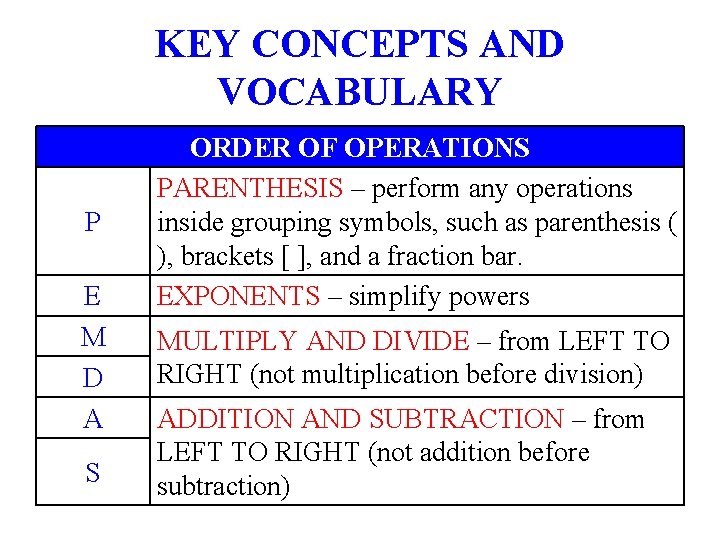
KEY CONCEPTS AND VOCABULARY P E M D A S ORDER OF OPERATIONS PARENTHESIS – perform any operations inside grouping symbols, such as parenthesis ( ), brackets [ ], and a fraction bar. EXPONENTS – simplify powers MULTIPLY AND DIVIDE – from LEFT TO RIGHT (not multiplication before division) ADDITION AND SUBTRACTION – from LEFT TO RIGHT (not addition before subtraction)
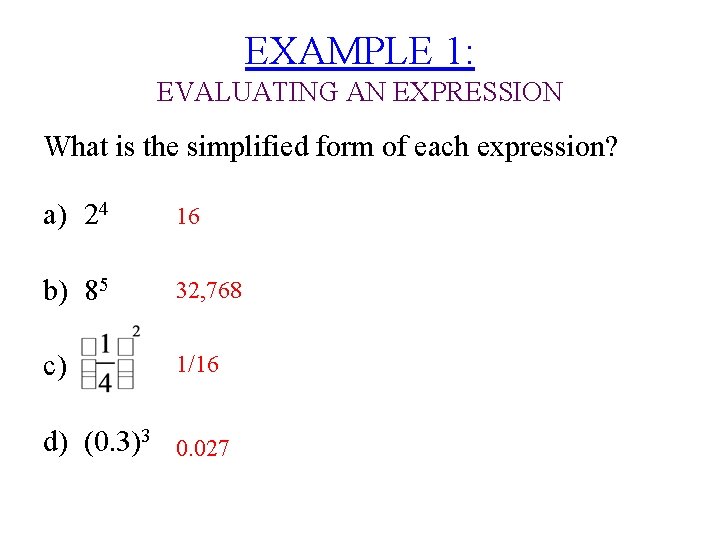
EXAMPLE 1: EVALUATING AN EXPRESSION What is the simplified form of each expression? a) 24 16 b) 85 32, 768 c) 1/16 d) (0. 3)3 0. 027
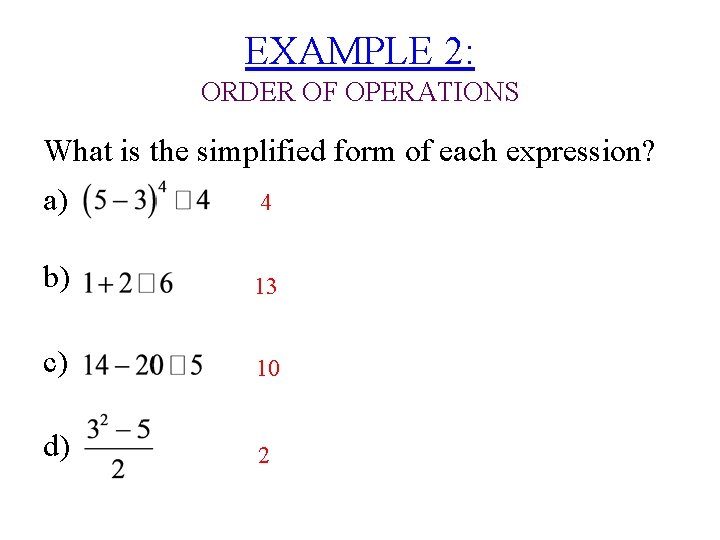
EXAMPLE 2: ORDER OF OPERATIONS What is the simplified form of each expression? a) 4 b) 13 c) 10 d) 2
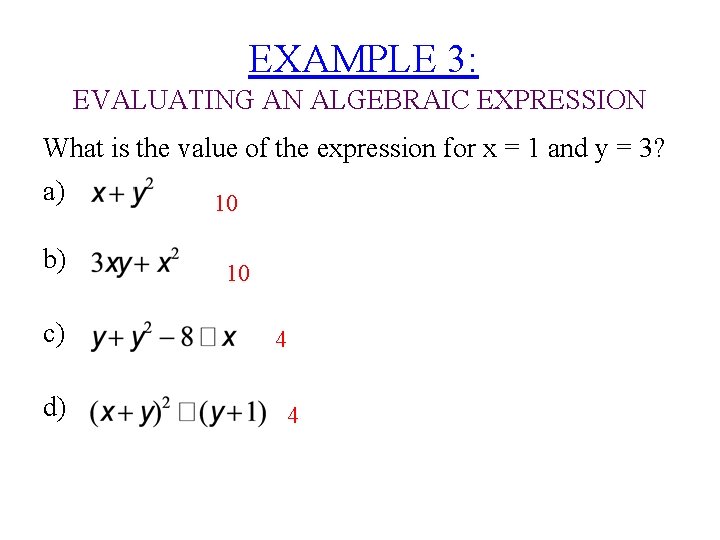
EXAMPLE 3: EVALUATING AN ALGEBRAIC EXPRESSION What is the value of the expression for x = 1 and y = 3? a) b) c) d) 10 10 4 4
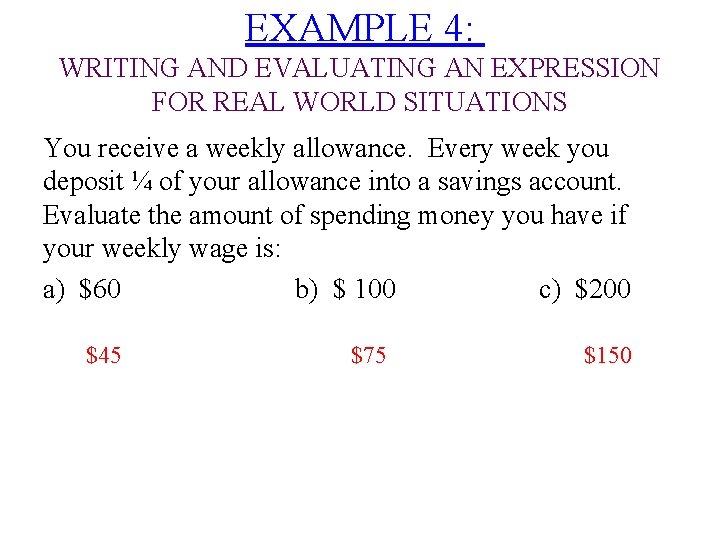
EXAMPLE 4: WRITING AND EVALUATING AN EXPRESSION FOR REAL WORLD SITUATIONS You receive a weekly allowance. Every week you deposit ¼ of your allowance into a savings account. Evaluate the amount of spending money you have if your weekly wage is: a) $60 b) $ 100 c) $200 $45 $75 $150
RATE YOUR UNDERSTANDING ORDER OF OPERATIONS MACC. 912. A. SSE. A. 1. b: Interpret complicated expressions by viewing one or more of their parts as a single entity RATING 4 TARGET 3 2 1 LEARNING SCALE I am able to • evaluate algebraic expressions and apply them to real world situations or more challenging problems that I have never previously attempted I am able to • simplify expressions involving exponents • use the order of operations to evaluate expressions I am able to • simplify expressions involving exponents with help • use the order of operations to evaluate expressions with help I am able to • understand that you can use powers to shorten how you represent repeated multiplication
MACC. 912. N-RN. B. 3: Explain why the sum or product of two rational numbers is rational; that the sum of a rational number and an irrational number is irrational; and that the product of a nonzero rational number and an irrational number is irrational.
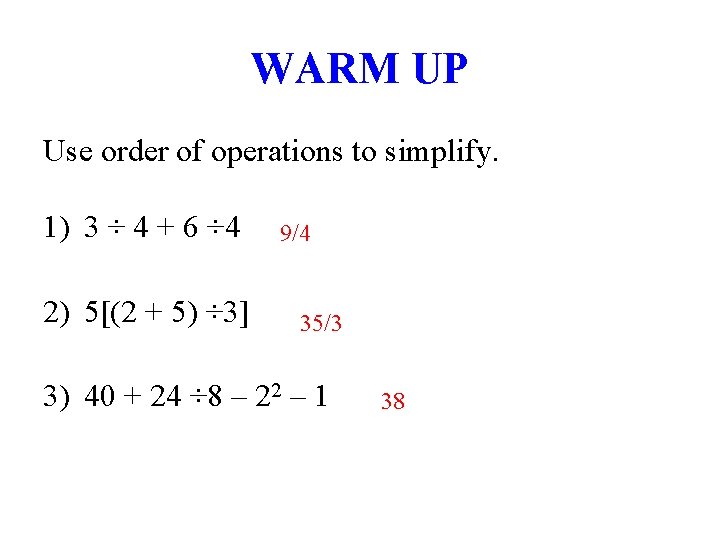
WARM UP Use order of operations to simplify. 1) 3 ÷ 4 + 6 ÷ 4 2) 5[(2 + 5) ÷ 3] 9/4 35/3 3) 40 + 24 ÷ 8 – 22 – 1 38
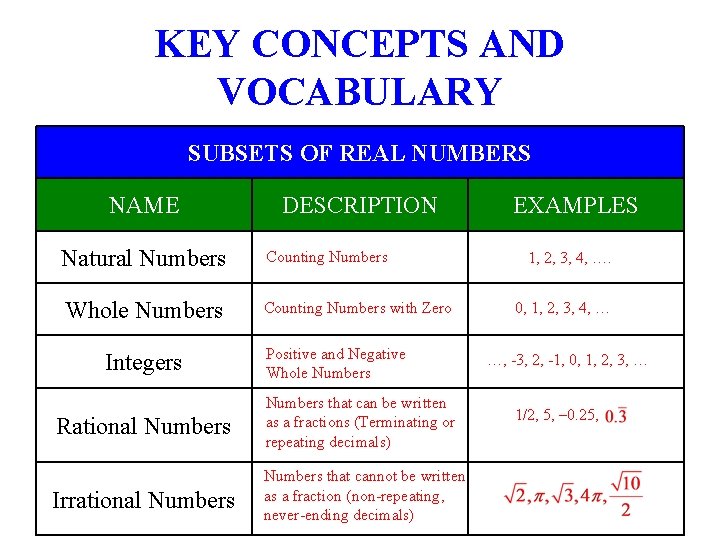
KEY CONCEPTS AND VOCABULARY SUBSETS OF REAL NUMBERS NAME DESCRIPTION Natural Numbers Counting Numbers Whole Numbers Counting Numbers with Zero Integers Positive and Negative Whole Numbers Rational Numbers that can be written as a fractions (Terminating or repeating decimals) Irrational Numbers that cannot be written as a fraction (non-repeating, never-ending decimals) EXAMPLES 1, 2, 3, 4, …. 0, 1, 2, 3, 4, … …, -3, 2, -1, 0, 1, 2, 3, … 1/2, 5, – 0. 25,
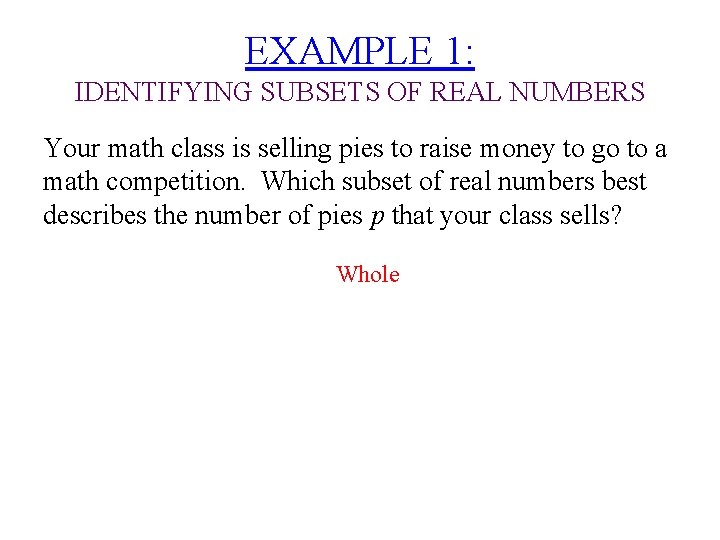
EXAMPLE 1: IDENTIFYING SUBSETS OF REAL NUMBERS Your math class is selling pies to raise money to go to a math competition. Which subset of real numbers best describes the number of pies p that your class sells? Whole
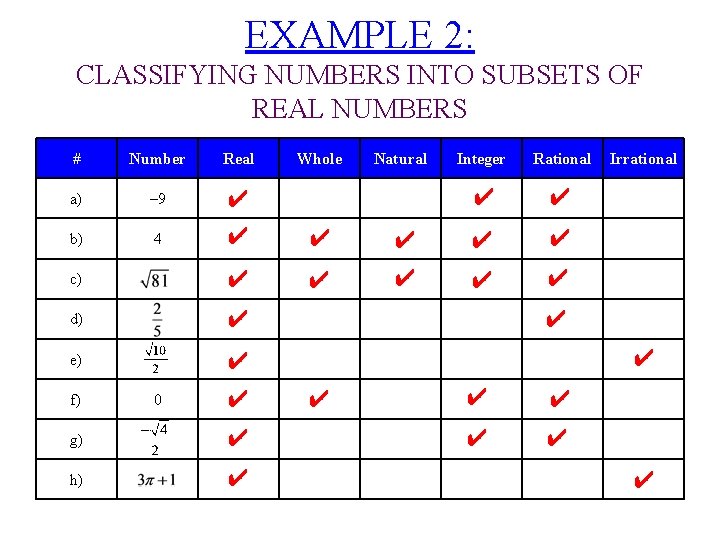
EXAMPLE 2: CLASSIFYING NUMBERS INTO SUBSETS OF REAL NUMBERS # Number Real a) – 9 ✔ b) 4 ✔ ✔ c) ✔ ✔ d) ✔ e) ✔ f) 0 ✔ g) ✔ h) ✔ Whole Natural Integer Rational ✔ ✔ ✔ ✔ Irrational ✔ ✔ ✔ ✔
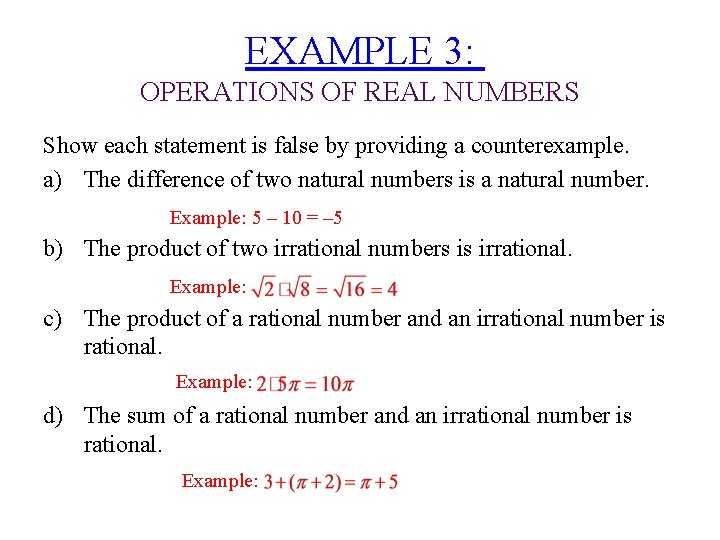
EXAMPLE 3: OPERATIONS OF REAL NUMBERS Show each statement is false by providing a counterexample. a) The difference of two natural numbers is a natural number. Example: 5 – 10 = – 5 b) The product of two irrational numbers is irrational. Example: c) The product of a rational number and an irrational number is rational. Example: d) The sum of a rational number and an irrational number is rational. Example:
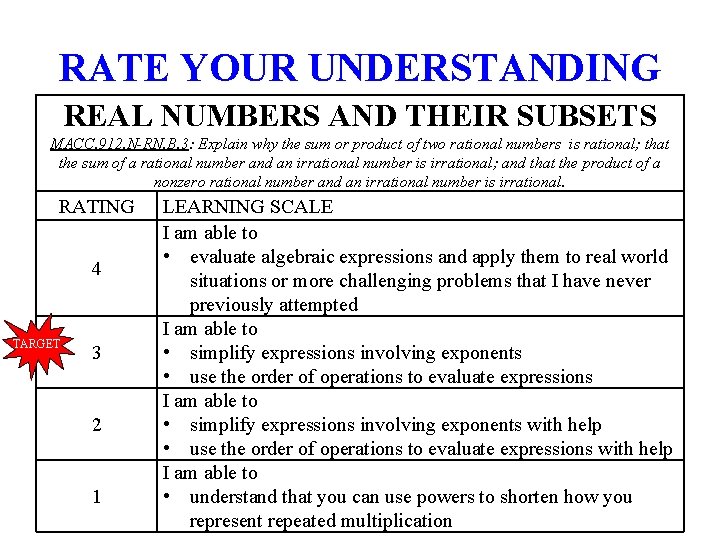
RATE YOUR UNDERSTANDING REAL NUMBERS AND THEIR SUBSETS MACC. 912. N-RN. B. 3: Explain why the sum or product of two rational numbers is rational; that the sum of a rational number and an irrational number is irrational; and that the product of a nonzero rational number and an irrational number is irrational. RATING 4 TARGET 3 2 1 LEARNING SCALE I am able to • evaluate algebraic expressions and apply them to real world situations or more challenging problems that I have never previously attempted I am able to • simplify expressions involving exponents • use the order of operations to evaluate expressions I am able to • simplify expressions involving exponents with help • use the order of operations to evaluate expressions with help I am able to • understand that you can use powers to shorten how you represent repeated multiplication
MACC. 912. A. SSE. A. 1. b: Interpret complicated expressions by viewing one or more of their parts as a single entity
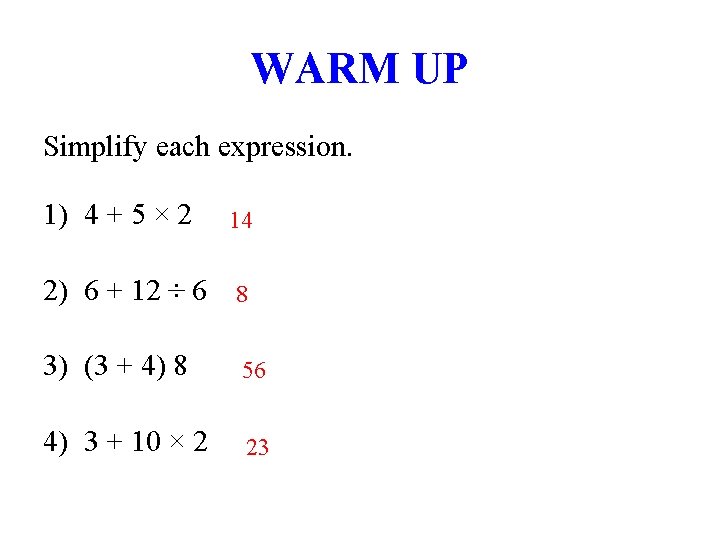
WARM UP Simplify each expression. 1) 4 + 5 × 2 14 2) 6 + 12 ÷ 6 8 3) (3 + 4) 8 56 4) 3 + 10 × 2 23
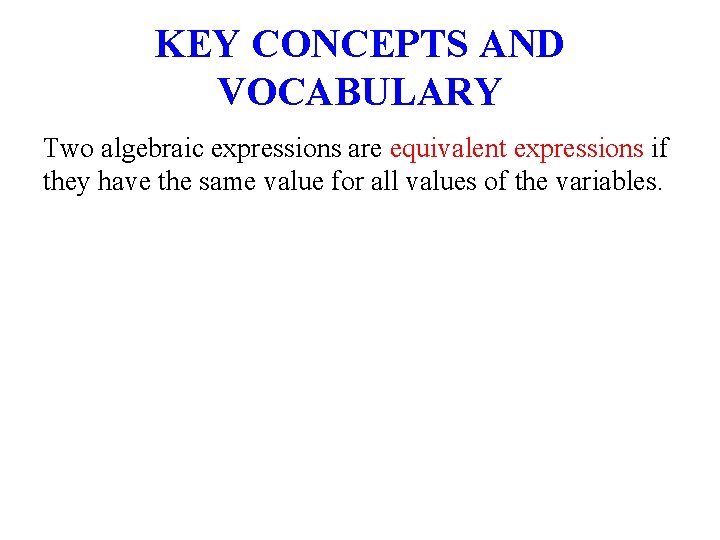
KEY CONCEPTS AND VOCABULARY Two algebraic expressions are equivalent expressions if they have the same value for all values of the variables.
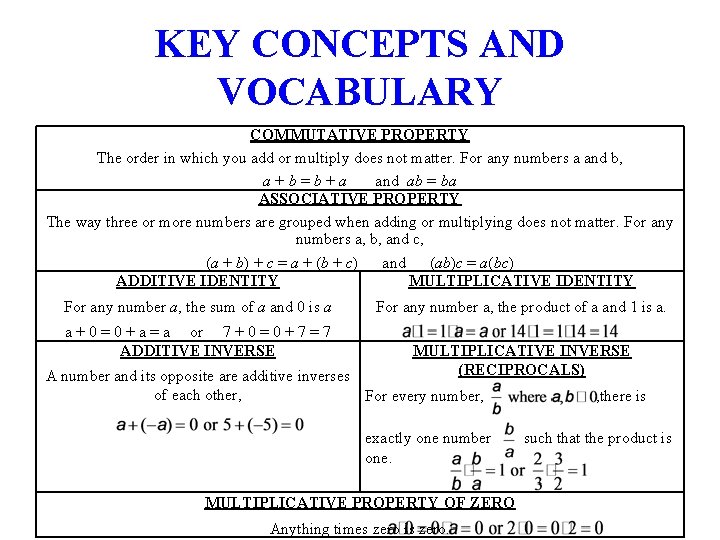
KEY CONCEPTS AND VOCABULARY COMMUTATIVE PROPERTY The order in which you add or multiply does not matter. For any numbers a and b, a+b=b+a and ab = ba ASSOCIATIVE PROPERTY The way three or more numbers are grouped when adding or multiplying does not matter. For any numbers a, b, and c, (a + b) + c = a + (b + c) and (ab)c = a(bc) ADDITIVE IDENTITY MULTIPLICATIVE IDENTITY For any number a, the sum of a and 0 is a a + 0 = 0 + a = a or 7 + 0 = 0 + 7 = 7 ADDITIVE INVERSE For any number a, the product of a and 1 is a. MULTIPLICATIVE INVERSE (RECIPROCALS) A number and its opposite are additive inverses of each other, For every number, exactly one number one. MULTIPLICATIVE PROPERTY OF ZERO Anything times zero is zero. , there is such that the product is
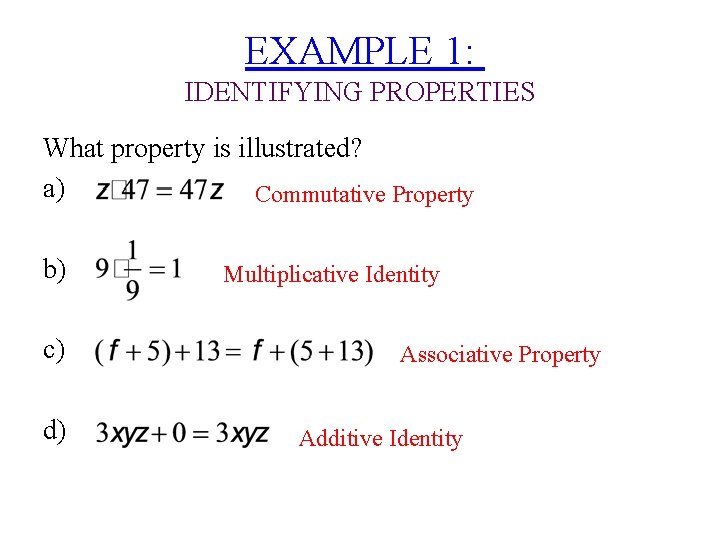
EXAMPLE 1: IDENTIFYING PROPERTIES What property is illustrated? a) Commutative Property b) c) d) Multiplicative Identity Associative Property Additive Identity
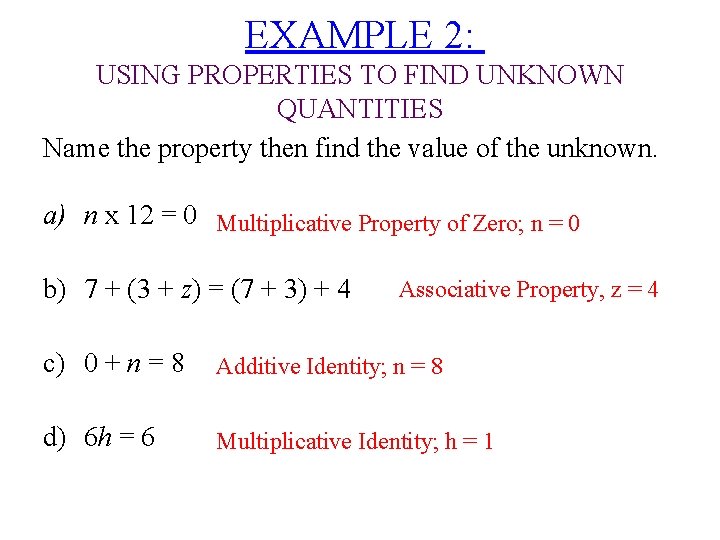
EXAMPLE 2: USING PROPERTIES TO FIND UNKNOWN QUANTITIES Name the property then find the value of the unknown. a) n x 12 = 0 Multiplicative Property of Zero; n = 0 b) 7 + (3 + z) = (7 + 3) + 4 Associative Property, z = 4 c) 0 + n = 8 Additive Identity; n = 8 d) 6 h = 6 Multiplicative Identity; h = 1
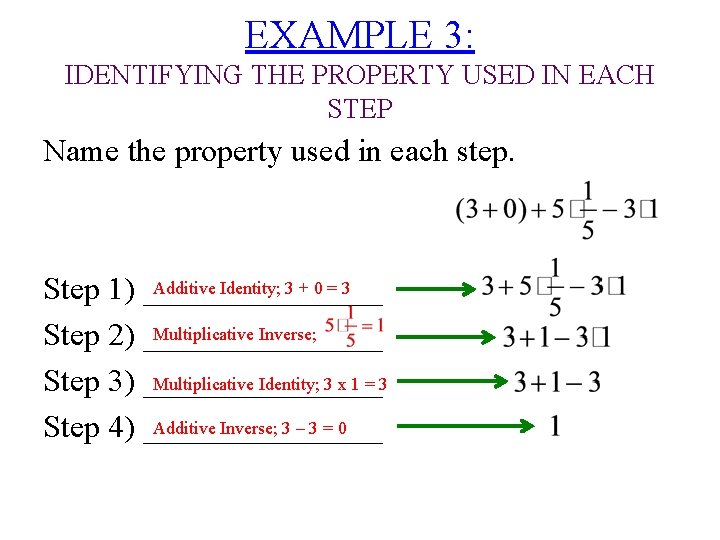
EXAMPLE 3: IDENTIFYING THE PROPERTY USED IN EACH STEP Name the property used in each step. Additive Identity; 3 + 0 = 3 Step 1) ________ Multiplicative Inverse; Step 2) ________ Multiplicative Identity; 3 x 1 = 3 Step 3) ________ Additive Inverse; 3 – 3 = 0 Step 4) ________
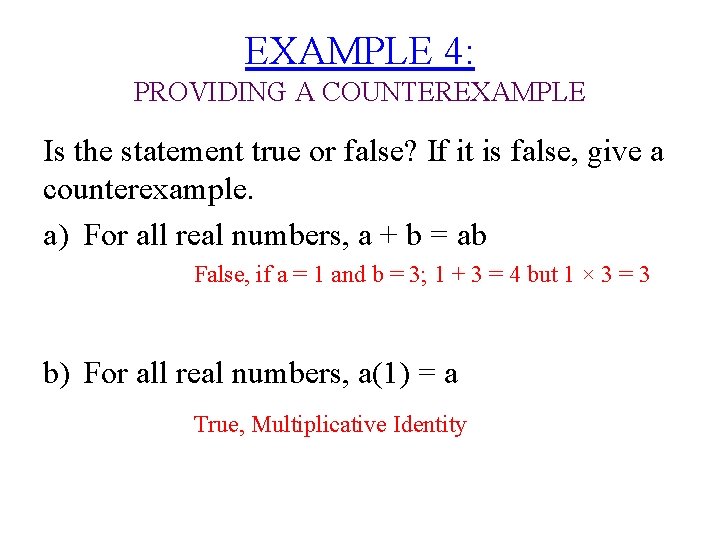
EXAMPLE 4: PROVIDING A COUNTEREXAMPLE Is the statement true or false? If it is false, give a counterexample. a) For all real numbers, a + b = ab False, if a = 1 and b = 3; 1 + 3 = 4 but 1 × 3 = 3 b) For all real numbers, a(1) = a True, Multiplicative Identity
RATE YOUR UNDERSTANDING PROPERTIES OF REAL NUMBERS MACC. 912. A. SSE. A. 1. b: Interpret complicated expressions by viewing one or more of their parts as a single entity RATING 4 TARGET 3 2 1 LEARNING SCALE I am able to • use properties of real numbers to provide counterexamples or solve more challenging problems that I have never previously attempted I am able to • identify and use properties of real numbers with help I am able to • understand that relationships that are always true for real numbers are called properties
MACC. 912. A-SSE. A. 1 a: Interpret parts of an expression, such as terms, factors, and coefficients.
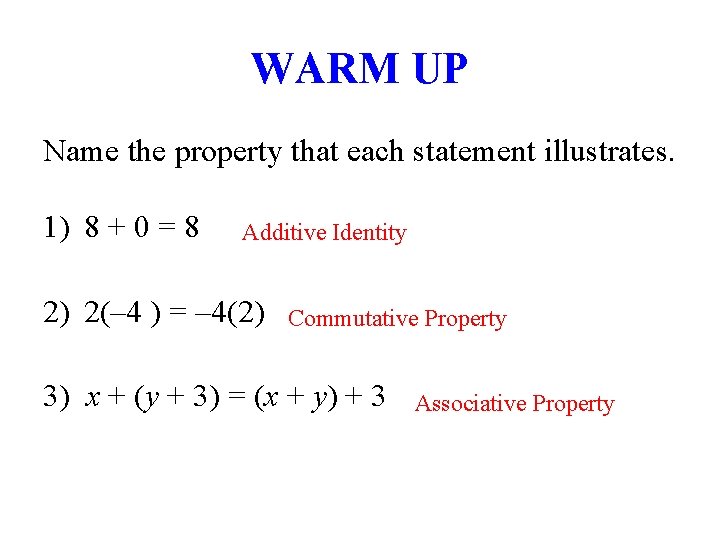
WARM UP Name the property that each statement illustrates. 1) 8 + 0 = 8 Additive Identity 2) 2(– 4 ) = – 4(2) Commutative Property 3) x + (y + 3) = (x + y) + 3 Associative Property
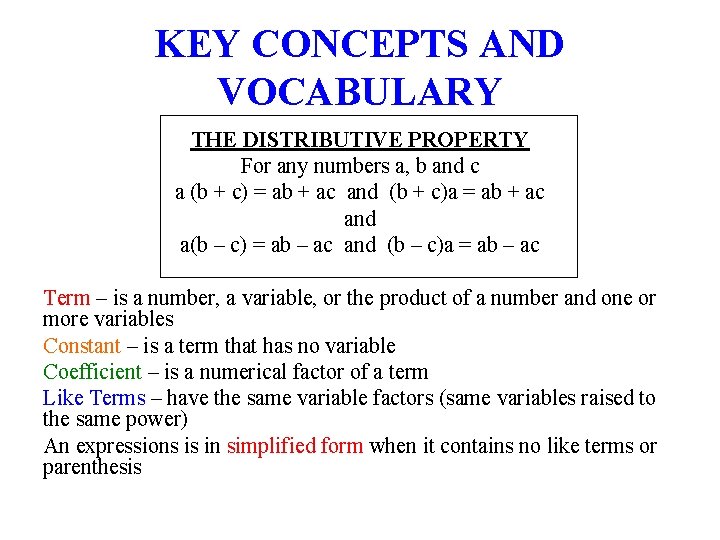
KEY CONCEPTS AND VOCABULARY THE DISTRIBUTIVE PROPERTY For any numbers a, b and c a (b + c) = ab + ac and (b + c)a = ab + ac and a(b – c) = ab – ac and (b – c)a = ab – ac Term – is a number, a variable, or the product of a number and one or more variables Constant – is a term that has no variable Coefficient – is a numerical factor of a term Like Terms – have the same variable factors (same variables raised to the same power) An expressions is in simplified form when it contains no like terms or parenthesis
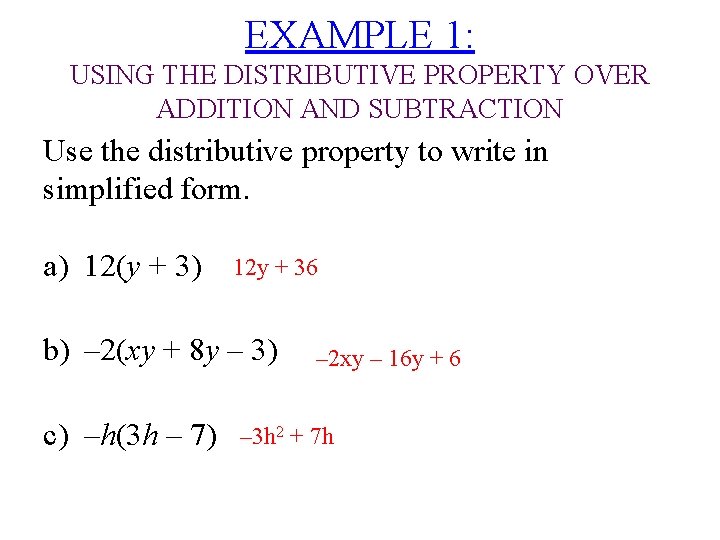
EXAMPLE 1: USING THE DISTRIBUTIVE PROPERTY OVER ADDITION AND SUBTRACTION Use the distributive property to write in simplified form. a) 12(y + 3) 12 y + 36 b) – 2(xy + 8 y – 3) c) –h(3 h – 7) – 2 xy – 16 y + 6 – 3 h 2 + 7 h
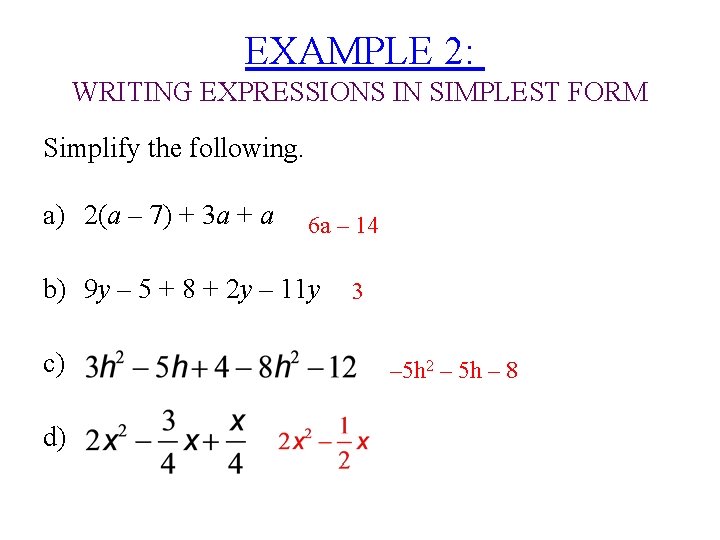
EXAMPLE 2: WRITING EXPRESSIONS IN SIMPLEST FORM Simplify the following. a) 2(a – 7) + 3 a + a 6 a – 14 b) 9 y – 5 + 8 + 2 y – 11 y c) d) 3 – 5 h 2 – 5 h – 8
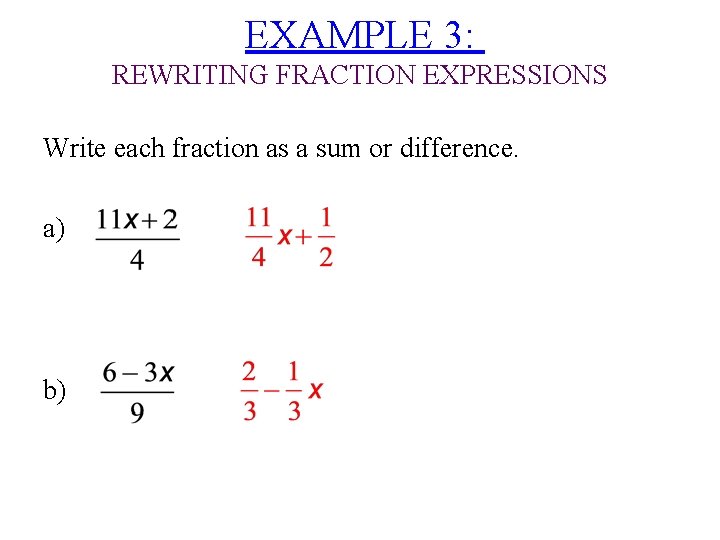
EXAMPLE 3: REWRITING FRACTION EXPRESSIONS Write each fraction as a sum or difference. a) b)
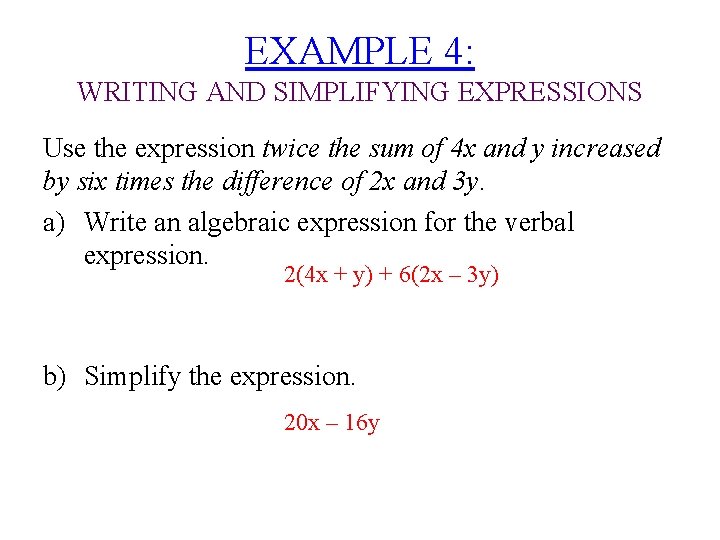
EXAMPLE 4: WRITING AND SIMPLIFYING EXPRESSIONS Use the expression twice the sum of 4 x and y increased by six times the difference of 2 x and 3 y. a) Write an algebraic expression for the verbal expression. 2(4 x + y) + 6(2 x – 3 y) b) Simplify the expression. 20 x – 16 y
RATE YOUR UNDERSTANDING THE DISTRIBUTIVE PROPERTY MACC. 912. A. SSE. A. 1. b: Interpret complicated expressions by viewing one or more of their parts as a single entity RATING 4 TARGET 3 2 1 LEARNING SCALE I am able to • use the Distributive Property to rewrite fraction expressions or solve more challenging problems that I have never previously attempted I am able to • use the Distributive Property to simplify expressions with help I am able to • understand that I can use the Distributive Property to simplify expressions
MACC. 912. A-CED. A. 1: Create equations and inequalities in one variable and use them to solve problems.
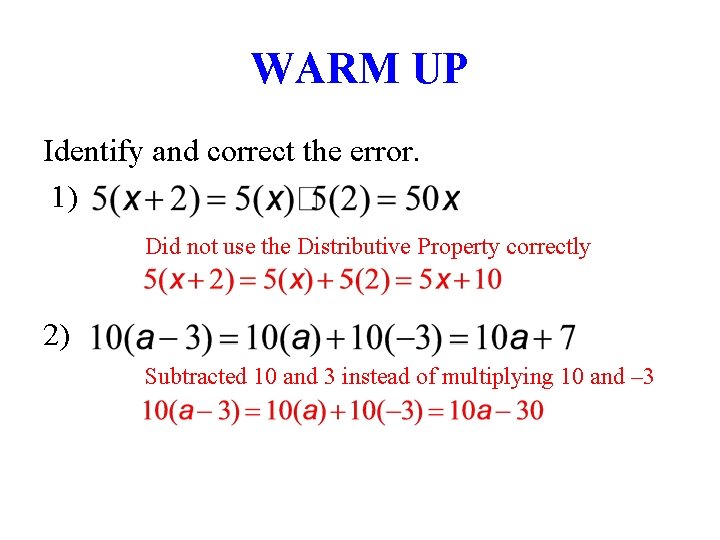
WARM UP Identify and correct the error. 1) Did not use the Distributive Property correctly 2) Subtracted 10 and 3 instead of multiplying 10 and – 3
KEY CONCEPTS AND VOCABULARY A mathematical statement that contains algebraic expressions and symbols is an open sentence. An equation is a mathematical sentence that uses an equal sign (=). A solution of an equation containing a variable is a value that makes the equation true. Identity- an equation that is true for every value of the variable.
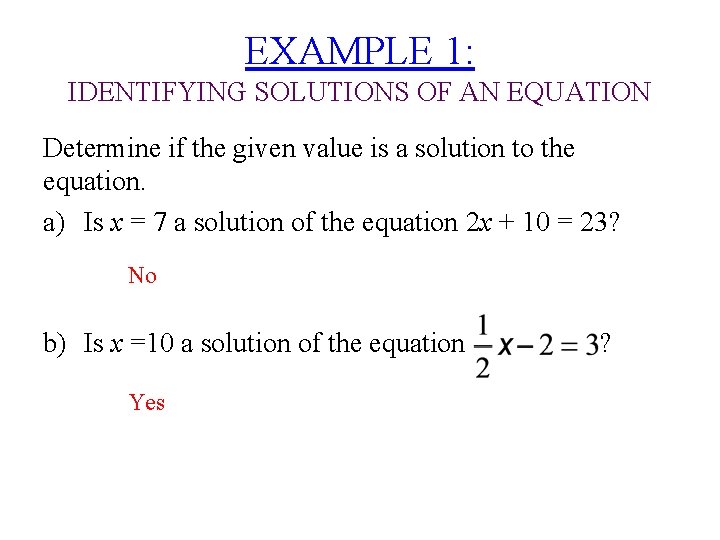
EXAMPLE 1: IDENTIFYING SOLUTIONS OF AN EQUATION Determine if the given value is a solution to the equation. a) Is x = 7 a solution of the equation 2 x + 10 = 23? No b) Is x =10 a solution of the equation Yes ?
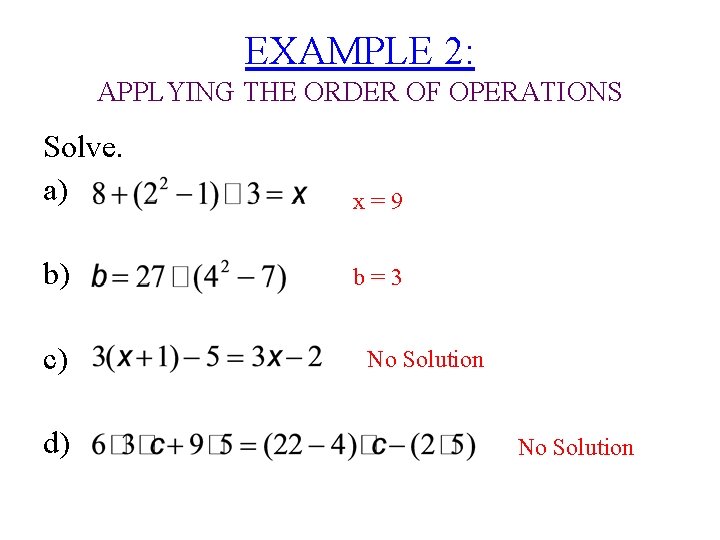
EXAMPLE 2: APPLYING THE ORDER OF OPERATIONS Solve. a) x=9 b) b=3 c) d) No Solution
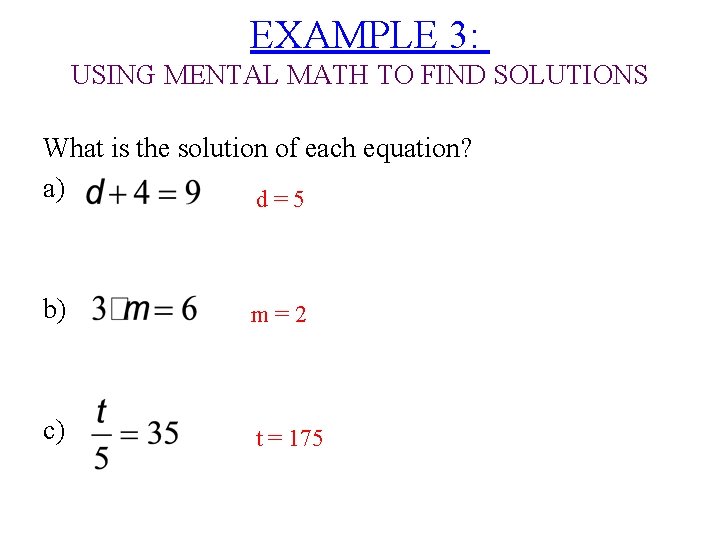
EXAMPLE 3: USING MENTAL MATH TO FIND SOLUTIONS What is the solution of each equation? a) d=5 b) m=2 c) t = 175
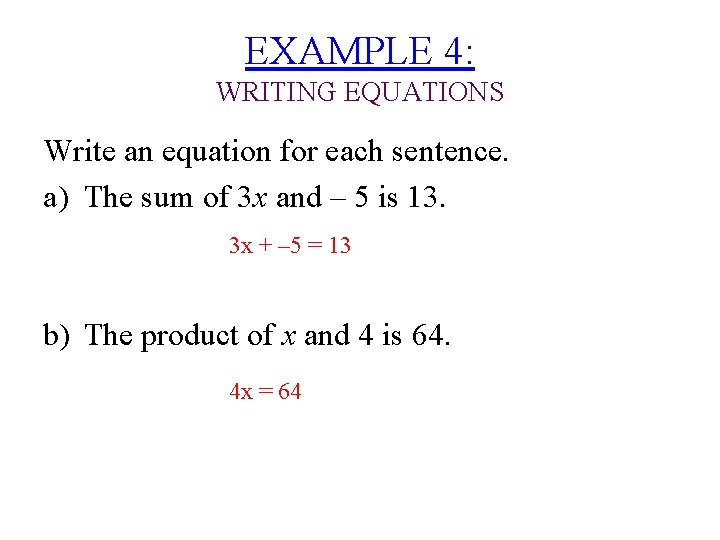
EXAMPLE 4: WRITING EQUATIONS Write an equation for each sentence. a) The sum of 3 x and – 5 is 13. 3 x + – 5 = 13 b) The product of x and 4 is 64. 4 x = 64
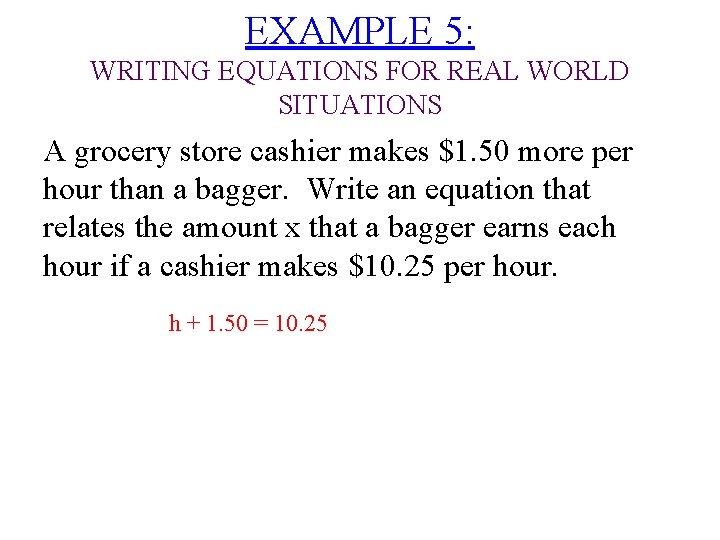
EXAMPLE 5: WRITING EQUATIONS FOR REAL WORLD SITUATIONS A grocery store cashier makes $1. 50 more per hour than a bagger. Write an equation that relates the amount x that a bagger earns each hour if a cashier makes $10. 25 per hour. h + 1. 50 = 10. 25
RATE YOUR UNDERSTANDING AN INTRODUCTION TO EQUATIONS MACC. 912. A-CED. A. 1: Create equations and inequalities in one variable and use them to solve problems. RATING 4 TARGET 3 2 1 LEARNING SCALE I am able to • write and solve equations with one variable and apply them to real world situations or more challenging problems that I have never previously attempted I am able to • write and solve equations with one variable with help I am able to • understand that an equation is a mathematical sentence
MACC. 912. A-REI. D. 10: Understand that the graph of an equation in two variables is the set of all its solutions plotted in the coordinate plane, often forming a curve (which could be a line)
WARM UP Ticket prices for admission to a museum are $8 for adults, $5 for children, and $6 for seniors. a) What algebraic expression models the total number of dollars collected in ticket sales? 8 a + 5 c + 6 s b) If 20 adult tickets, 16 children’s tickets, and 10 senior tickets are sold one morning, how much money is collected in all? $300
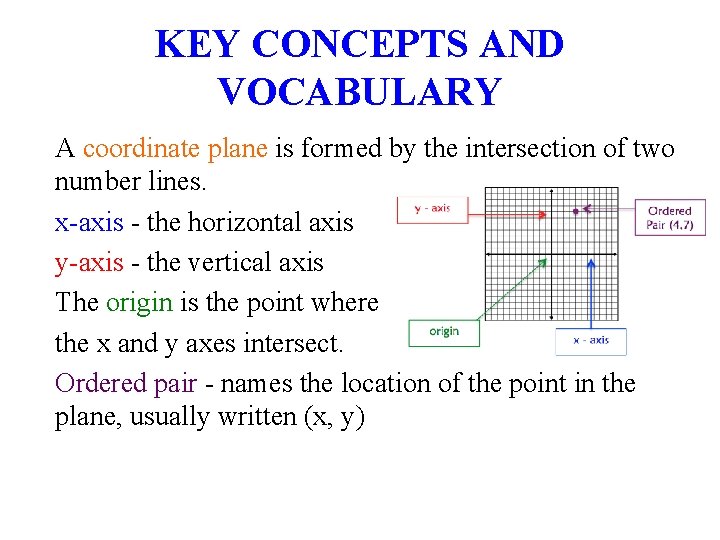
KEY CONCEPTS AND VOCABULARY A coordinate plane is formed by the intersection of two number lines. x-axis - the horizontal axis y-axis - the vertical axis The origin is the point where the x and y axes intersect. Ordered pair - names the location of the point in the plane, usually written (x, y)
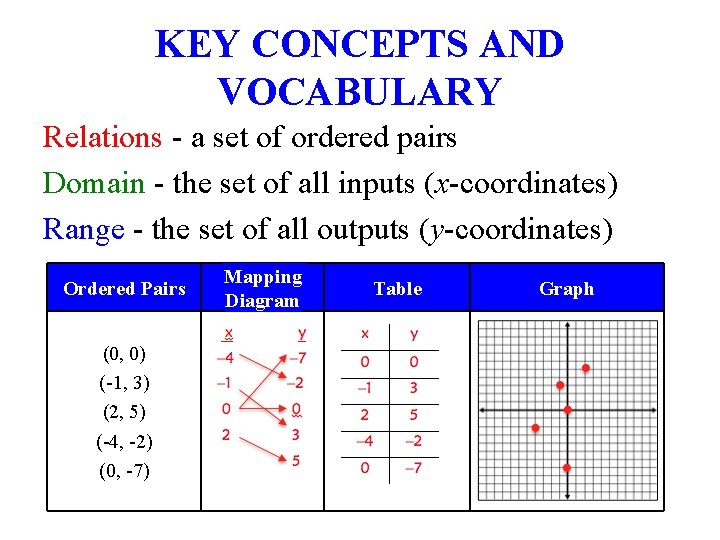
KEY CONCEPTS AND VOCABULARY Relations - a set of ordered pairs Domain - the set of all inputs (x-coordinates) Range - the set of all outputs (y-coordinates) Ordered Pairs (0, 0) (-1, 3) (2, 5) (-4, -2) (0, -7) Mapping Diagram Table Graph
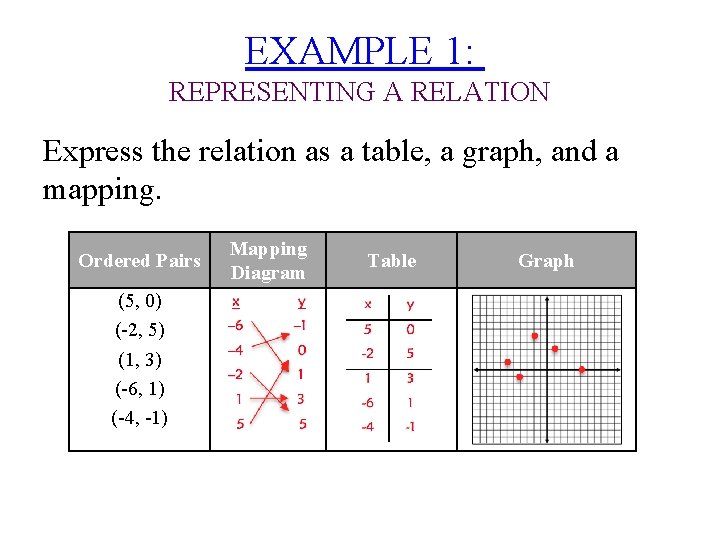
EXAMPLE 1: REPRESENTING A RELATION Express the relation as a table, a graph, and a mapping. Ordered Pairs (5, 0) (-2, 5) (1, 3) (-6, 1) (-4, -1) Mapping Diagram Table Graph
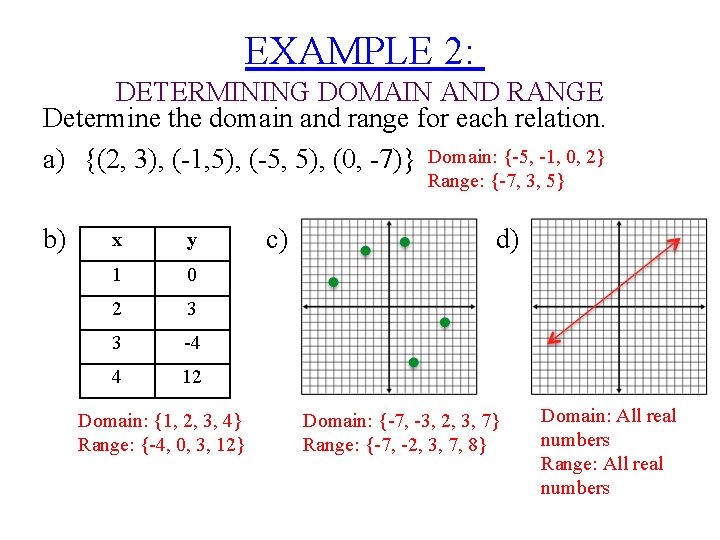
EXAMPLE 2: DETERMINING DOMAIN AND RANGE Determine the domain and range for each relation. a) {(2, 3), (-1, 5), (-5, 5), (0, -7)} Domain: {-5, -1, 0, 2} Range: {-7, 3, 5} b) x y 1 0 2 3 3 -4 4 12 Domain: {1, 2, 3, 4} Range: {-4, 0, 3, 12} c) d) Domain: {-7, -3, 2, 3, 7} Range: {-7, -2, 3, 7, 8} Domain: All real numbers Range: All real numbers
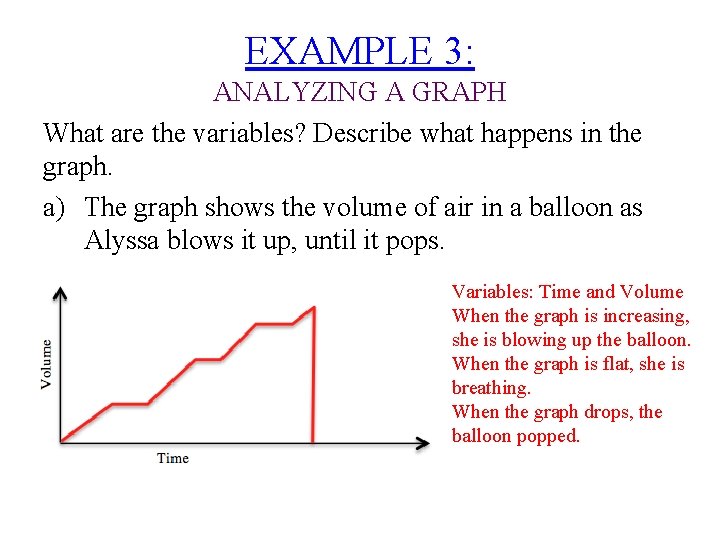
EXAMPLE 3: ANALYZING A GRAPH What are the variables? Describe what happens in the graph. a) The graph shows the volume of air in a balloon as Alyssa blows it up, until it pops. Variables: Time and Volume When the graph is increasing, she is blowing up the balloon. When the graph is flat, she is breathing. When the graph drops, the balloon popped.
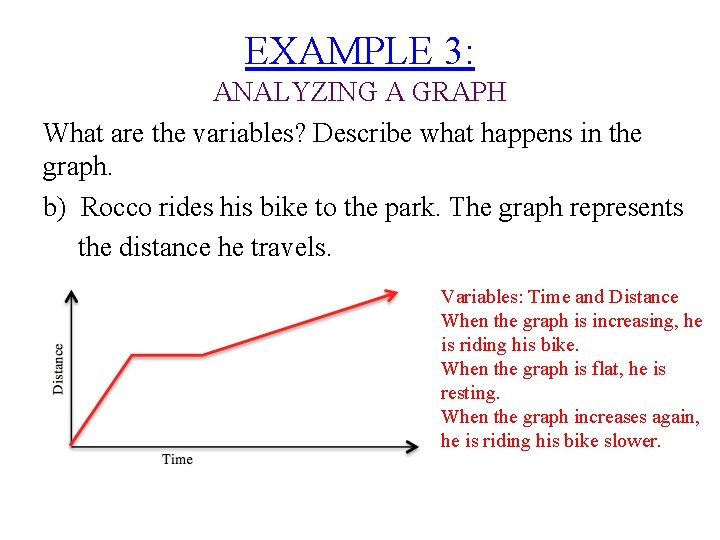
EXAMPLE 3: ANALYZING A GRAPH What are the variables? Describe what happens in the graph. b) Rocco rides his bike to the park. The graph represents the distance he travels. Variables: Time and Distance When the graph is increasing, he is riding his bike. When the graph is flat, he is resting. When the graph increases again, he is riding his bike slower.
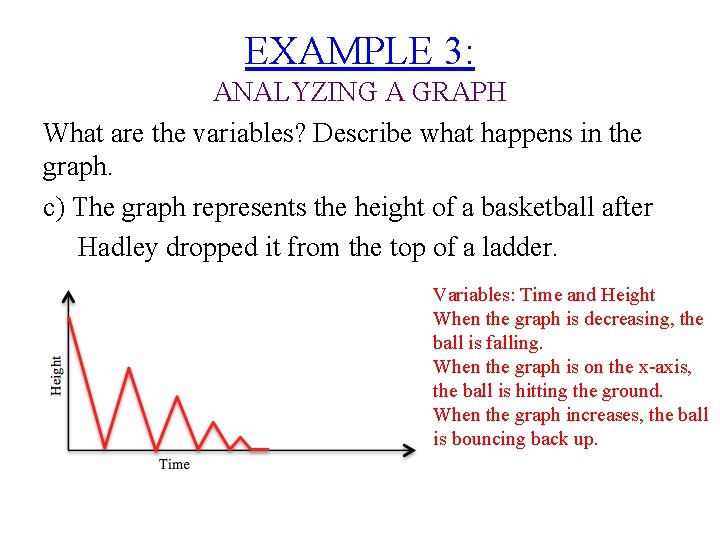
EXAMPLE 3: ANALYZING A GRAPH What are the variables? Describe what happens in the graph. c) The graph represents the height of a basketball after Hadley dropped it from the top of a ladder. Variables: Time and Height When the graph is decreasing, the ball is falling. When the graph is on the x-axis, the ball is hitting the ground. When the graph increases, the ball is bouncing back up.
RATE YOUR UNDERSTANDING RELATIONS MACC. 912. A-REI. D. 10: Understand that the graph of an equation in two variables is the set of all its solutions plotted in the coordinate plane, often forming a curve (which could be a line) RATING 4 TARGET 3 2 1 LEARNING SCALE I am able to • represent a relation and interpret graphs of relations that apply real-world situations I am able to • represent a relation • interpret graphs of relations I am able to • represent a relation with help • interpret graphs of relations with help I am able to • understand how to read and plot points on a coordinate plane
MACC. 912. F-IF. A. 1: Understand that a function from one set (called the domain) to another set (called the range) assigns to each element of the domain exactly one element of the range. If f is a function and x is an element of its domain, then f(x) denotes the output of f corresponding to the input x. The graph of f is the graph of the equation y = f(x). MACC. 912. F-IF. A. 2: Use function notation, evaluate functions for inputs in their domains, and interpret statements that use function notation in terms of a context.
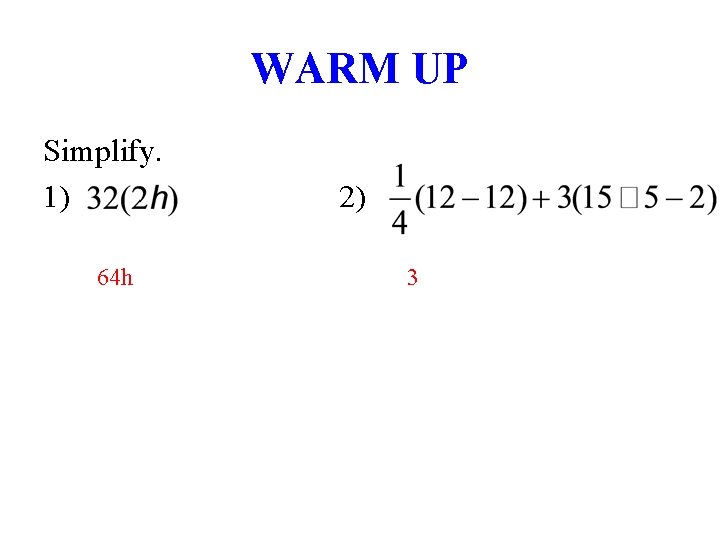
WARM UP Simplify. 1) 64 h 2) 3
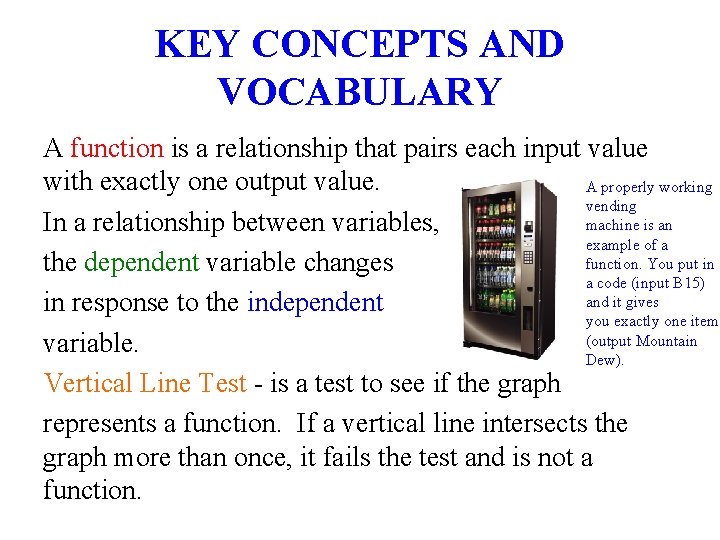
KEY CONCEPTS AND VOCABULARY A function is a relationship that pairs each input value with exactly one output value. A properly working vending machine is an In a relationship between variables, example of a function. You put in the dependent variable changes a code (input B 15) and it gives in response to the independent you exactly one item (output Mountain variable. Dew). Vertical Line Test - is a test to see if the graph represents a function. If a vertical line intersects the graph more than once, it fails the test and is not a function.
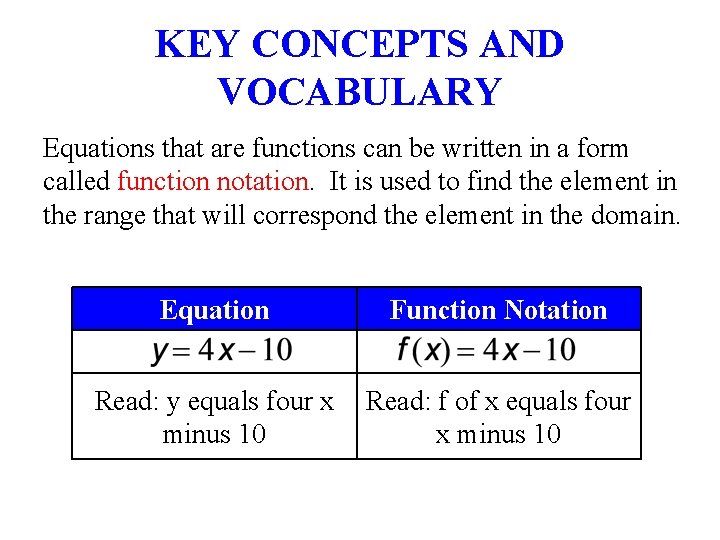
KEY CONCEPTS AND VOCABULARY Equations that are functions can be written in a form called function notation. It is used to find the element in the range that will correspond the element in the domain. Equation Function Notation Read: y equals four x minus 10 Read: f of x equals four x minus 10
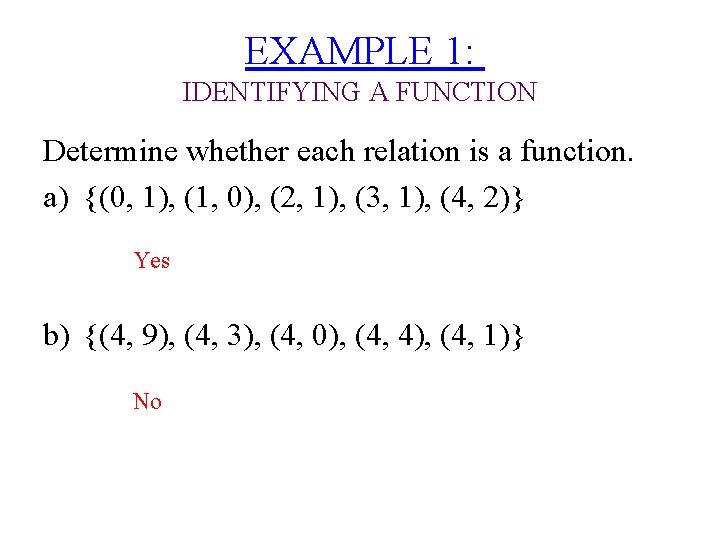
EXAMPLE 1: IDENTIFYING A FUNCTION Determine whether each relation is a function. a) {(0, 1), (1, 0), (2, 1), (3, 1), (4, 2)} Yes b) {(4, 9), (4, 3), (4, 0), (4, 4), (4, 1)} No
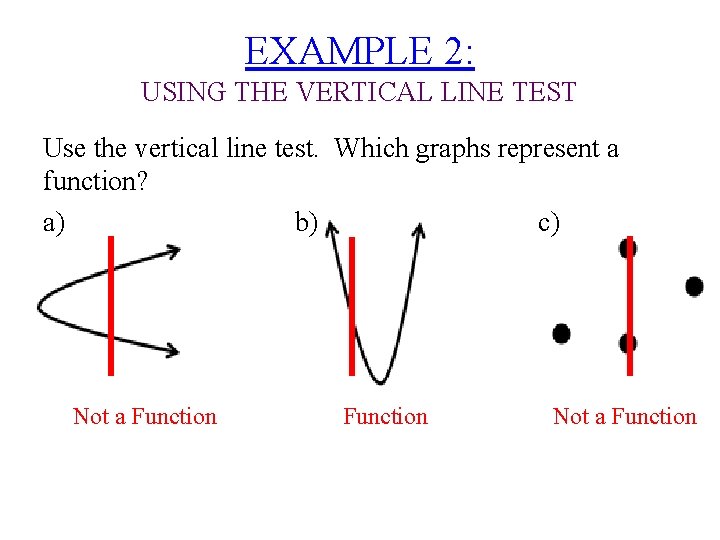
EXAMPLE 2: USING THE VERTICAL LINE TEST Use the vertical line test. Which graphs represent a function? a) b) c) Not a Function
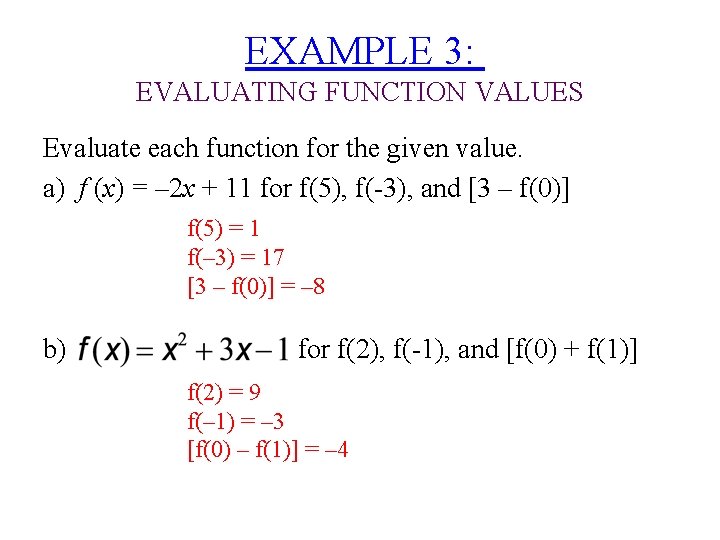
EXAMPLE 3: EVALUATING FUNCTION VALUES Evaluate each function for the given value. a) f (x) = – 2 x + 11 for f(5), f(-3), and [3 – f(0)] f(5) = 1 f(– 3) = 17 [3 – f(0)] = – 8 b) for f(2), f(-1), and [f(0) + f(1)] f(2) = 9 f(– 1) = – 3 [f(0) – f(1)] = – 4
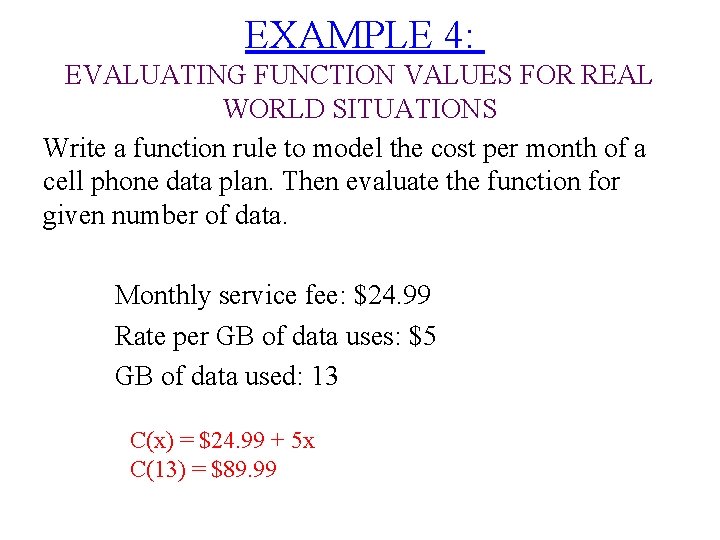
EXAMPLE 4: EVALUATING FUNCTION VALUES FOR REAL WORLD SITUATIONS Write a function rule to model the cost per month of a cell phone data plan. Then evaluate the function for given number of data. Monthly service fee: $24. 99 Rate per GB of data uses: $5 GB of data used: 13 C(x) = $24. 99 + 5 x C(13) = $89. 99
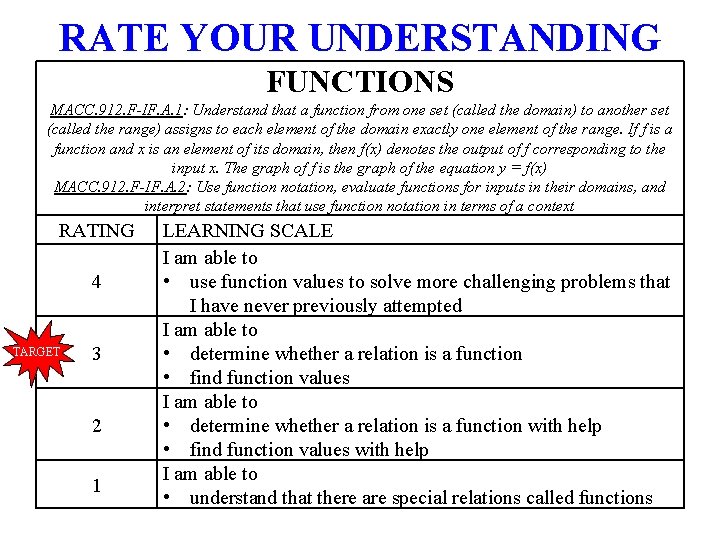
RATE YOUR UNDERSTANDING FUNCTIONS MACC. 912. F-IF. A. 1: Understand that a function from one set (called the domain) to another set (called the range) assigns to each element of the domain exactly one element of the range. If f is a function and x is an element of its domain, then f(x) denotes the output of f corresponding to the input x. The graph of f is the graph of the equation y = f(x) MACC. 912. F-IF. A. 2: Use function notation, evaluate functions for inputs in their domains, and interpret statements that use function notation in terms of a context RATING 4 TARGET 3 2 1 LEARNING SCALE I am able to • use function values to solve more challenging problems that I have never previously attempted I am able to • determine whether a relation is a function • find function values I am able to • determine whether a relation is a function with help • find function values with help I am able to • understand that there are special relations called functions
MACC. 912. F-IF. B. 4: For a function that models a relationship between two quantities, interpret key features of graphs and tables in terms of the quantities, and sketch graphs showing key features given a verbal description of the relationship MACC. 912. F-IF. B. 5: Relate the domain of a function to its graph and, where applicable, to the quantitative relationship it describes
WARM UP The cost of one scoop of ice cream is $3. 50 and the cost of two scoops of ice cream is $5. 75. Write and evaluate an expression to find the cost of 3 one-scoop ice creams and 4 two-scoop ice creams. Let x = one-scoop ice cream and let y = two-scoop ice cream $3. 50 x + $5. 75 y $33. 50
KEY CONCEPTS AND VOCABULARY x-intercept – the point in which the graph intersects the xaxis y-intercept – the point in which the graph intersects the yaxis A function whose graph is a straight line is a linear function A function whose graph is not a straight line is a nonlinear function A function has symmetry on some vertical line if each half of the graph on either side of the line matches exactly
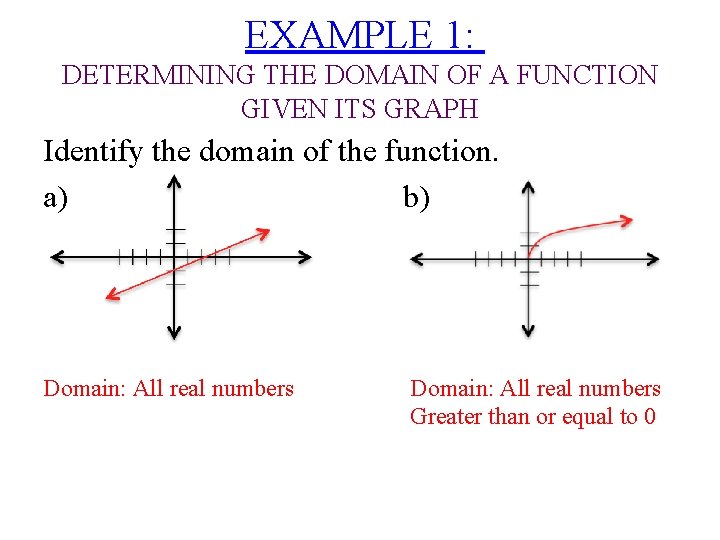
EXAMPLE 1: DETERMINING THE DOMAIN OF A FUNCTION GIVEN ITS GRAPH Identify the domain of the function. a) b) Domain: All real numbers Greater than or equal to 0
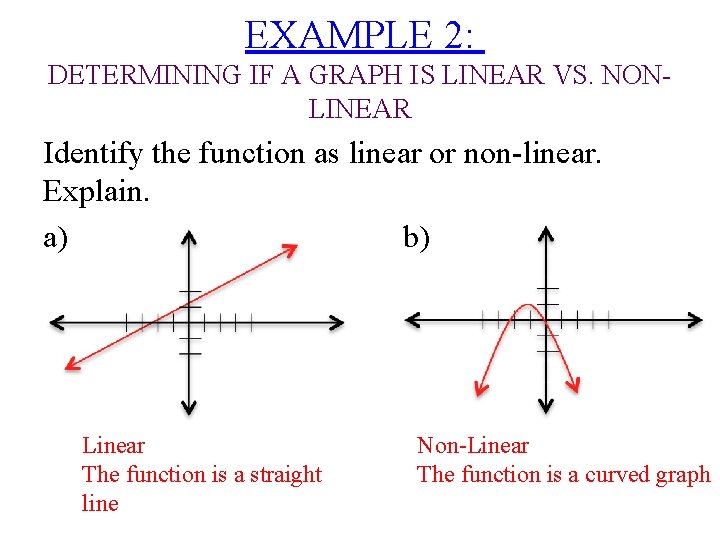
EXAMPLE 2: DETERMINING IF A GRAPH IS LINEAR VS. NONLINEAR Identify the function as linear or non-linear. Explain. a) b) Linear The function is a straight line Non-Linear The function is a curved graph
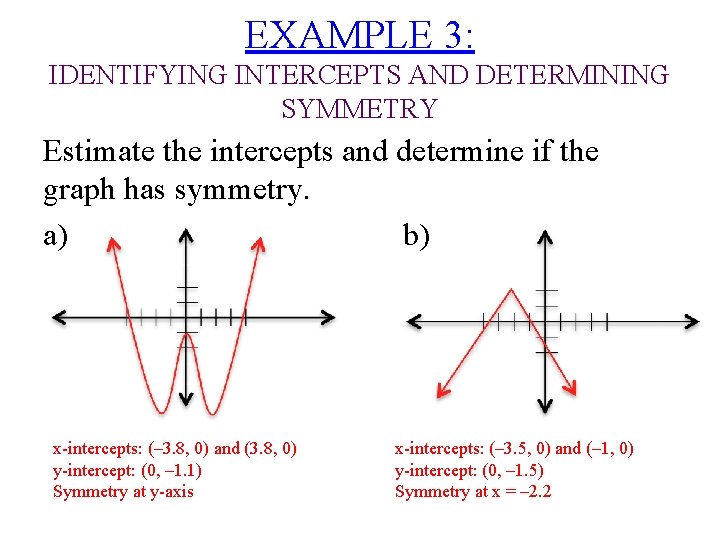
EXAMPLE 3: IDENTIFYING INTERCEPTS AND DETERMINING SYMMETRY Estimate the intercepts and determine if the graph has symmetry. a) b) x-intercepts: (– 3. 8, 0) and (3. 8, 0) y-intercept: (0, – 1. 1) Symmetry at y-axis x-intercepts: (– 3. 5, 0) and (– 1, 0) y-intercept: (0, – 1. 5) Symmetry at x = – 2. 2
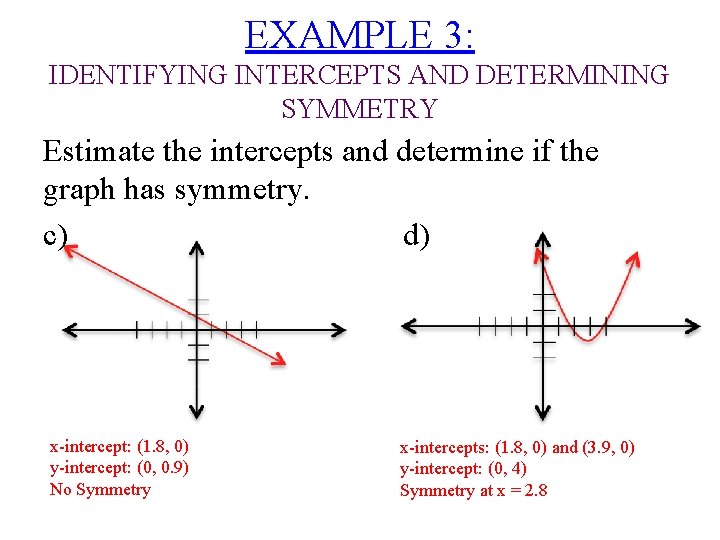
EXAMPLE 3: IDENTIFYING INTERCEPTS AND DETERMINING SYMMETRY Estimate the intercepts and determine if the graph has symmetry. c) d) x-intercept: (1. 8, 0) y-intercept: (0, 0. 9) No Symmetry x-intercepts: (1. 8, 0) and (3. 9, 0) y-intercept: (0, 4) Symmetry at x = 2. 8
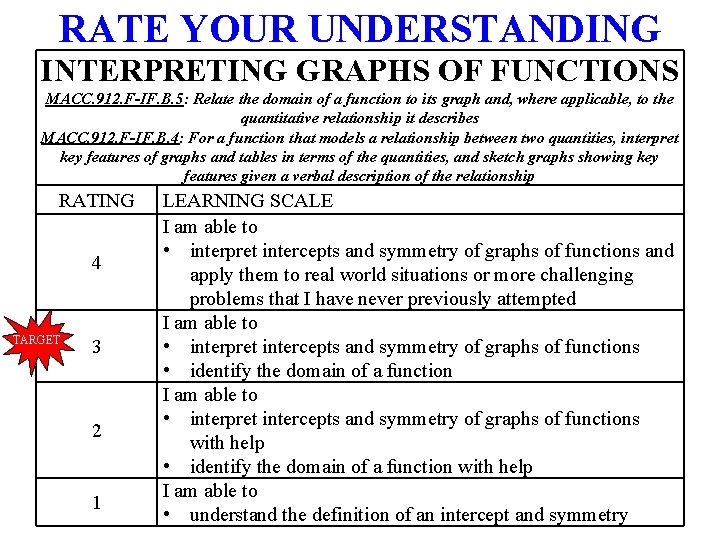
RATE YOUR UNDERSTANDING INTERPRETING GRAPHS OF FUNCTIONS MACC. 912. F-IF. B. 5: Relate the domain of a function to its graph and, where applicable, to the quantitative relationship it describes MACC. 912. F-IF. B. 4: For a function that models a relationship between two quantities, interpret key features of graphs and tables in terms of the quantities, and sketch graphs showing key features given a verbal description of the relationship RATING 4 TARGET 3 2 1 LEARNING SCALE I am able to • interpret intercepts and symmetry of graphs of functions and apply them to real world situations or more challenging problems that I have never previously attempted I am able to • interpret intercepts and symmetry of graphs of functions • identify the domain of a function I am able to • interpret intercepts and symmetry of graphs of functions with help • identify the domain of a function with help I am able to • understand the definition of an intercept and symmetry
- Slides: 79