
Algebra 1 Section 4 1 Inequalities An inequality
Algebra 1 Section 4. 1
Inequalities An inequality is a mathematical sentence stating that two quantities are not always equal. There are five basic inequality symbols.
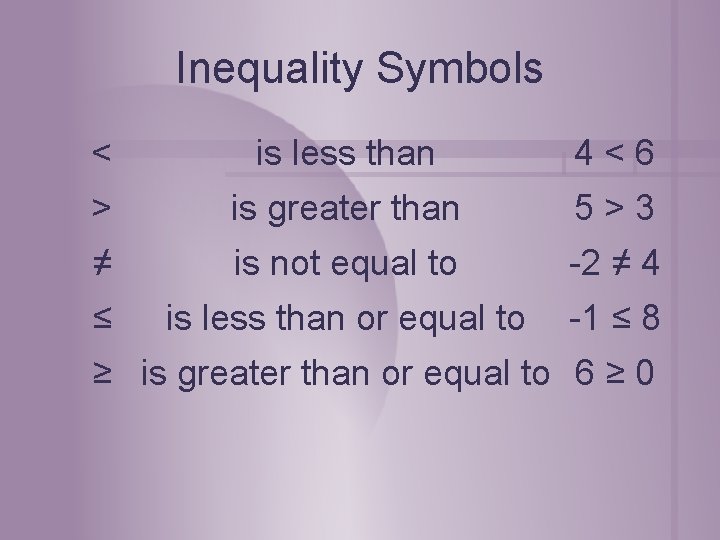
Inequality Symbols < is less than 4<6 > is greater than 5>3 ≠ is not equal to -2 ≠ 4 ≤ is less than or equal to -1 ≤ 8 ≥ is greater than or equal to 6 ≥ 0
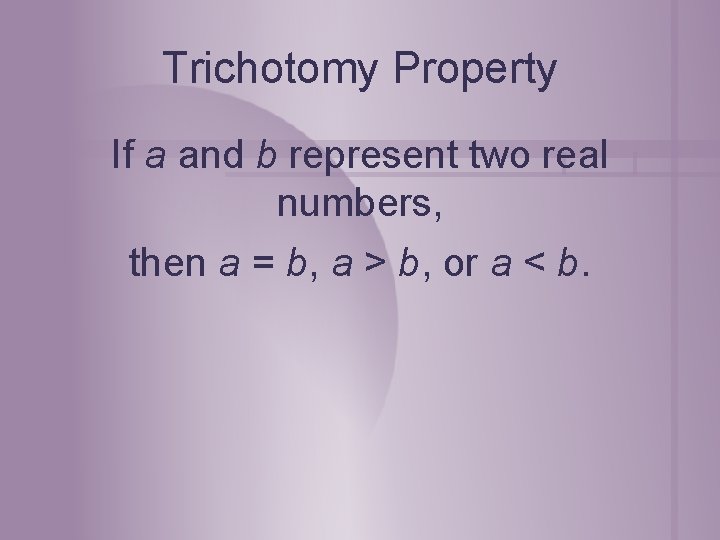
Trichotomy Property If a and b represent two real numbers, then a = b, a > b, or a < b.
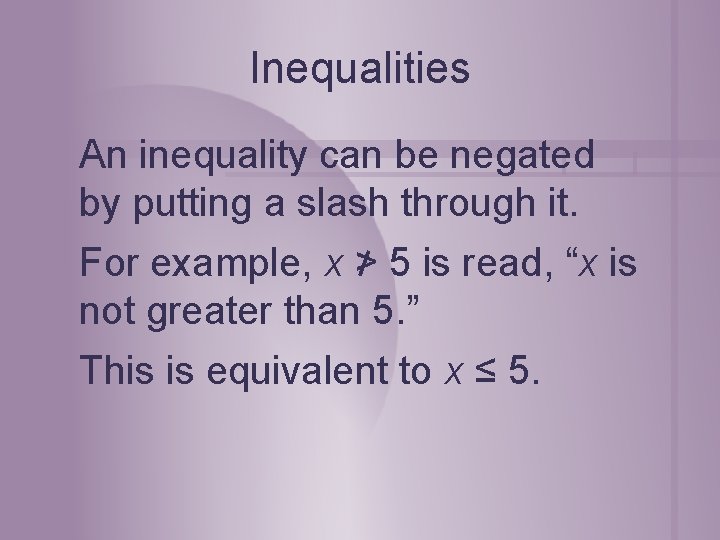
Inequalities An inequality can be negated by putting a slash through it. For example, x > 5 is read, “x is not greater than 5. ” This is equivalent to x ≤ 5.
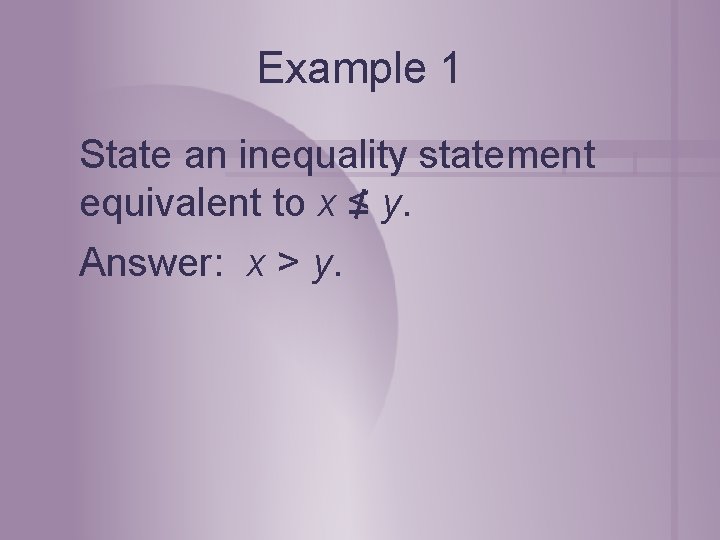
Example 1 State an inequality statement equivalent to x ≤ y. Answer: x > y.
Inequalities Any value of the variable that makes an inequality true is a solution of the inequality. There are typically an infinite number of solutions to each inequality.
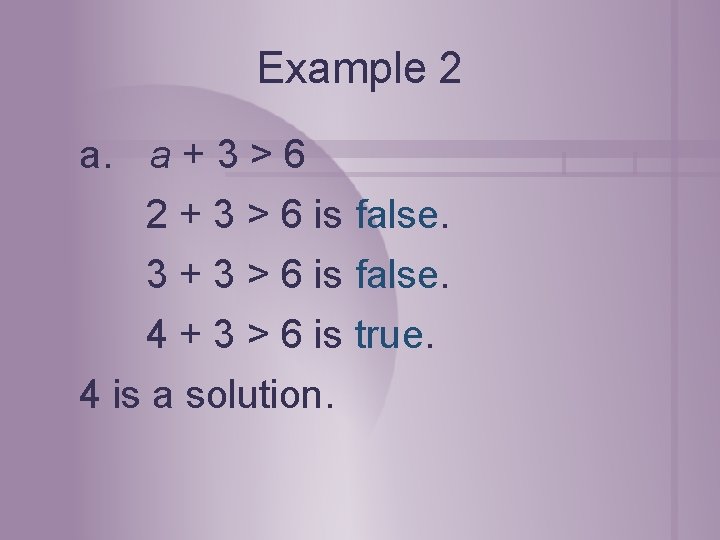
Example 2 a. a + 3 > 6 2 + 3 > 6 is false. 3 + 3 > 6 is false. 4 + 3 > 6 is true. 4 is a solution.
Example 2 b. 6 ≥ 2 b 6 ≥ 2(2) is true. 6 ≥ 2(3) is true. 6 ≥ 2(4) is false. 2 and 3 are solutions.
Example 2 c. 1 – c < -2 1 – c ≥ -2 1 – 2 ≥ -2 is true. 1 – 3 ≥ -2 is true. 1 – 4 ≥ -2 is false. 2 and 3 are solutions.
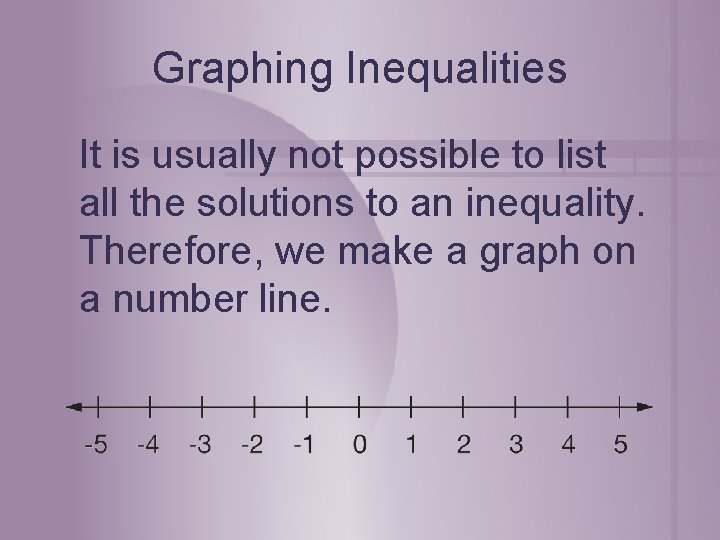
Graphing Inequalities It is usually not possible to list all the solutions to an inequality. Therefore, we make a graph on a number line.
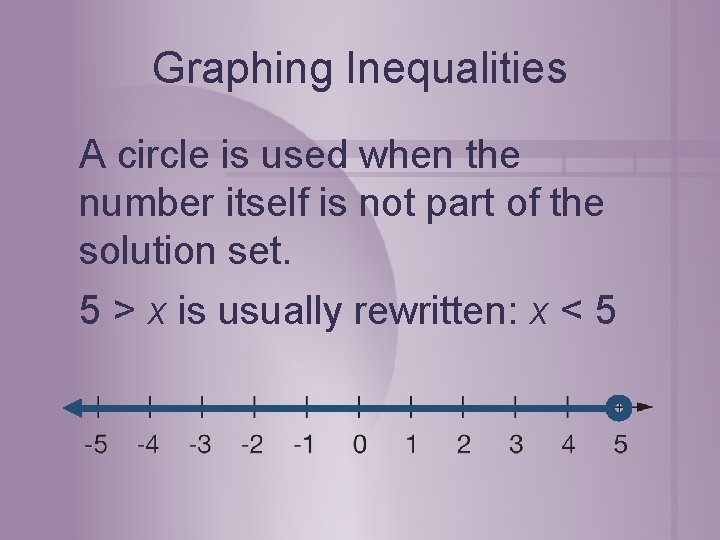
Graphing Inequalities A circle is used when the number itself is not part of the solution set. 5 > x is usually rewritten: x < 5
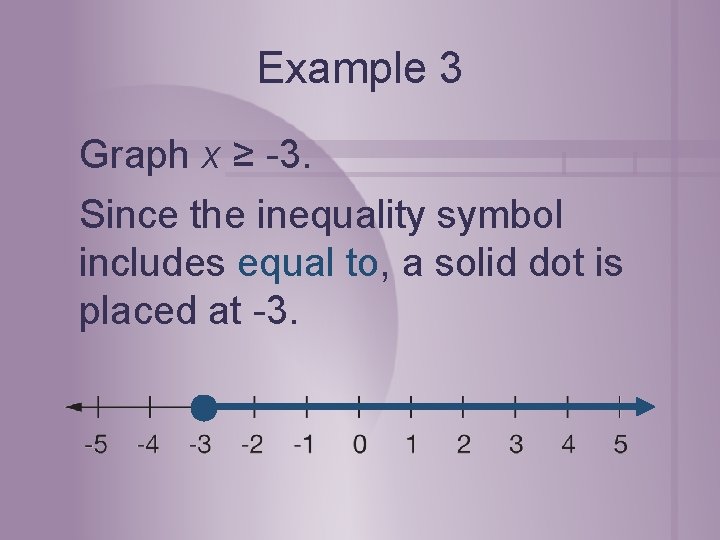
Example 3 Graph x ≥ -3. Since the inequality symbol includes equal to, a solid dot is placed at -3.
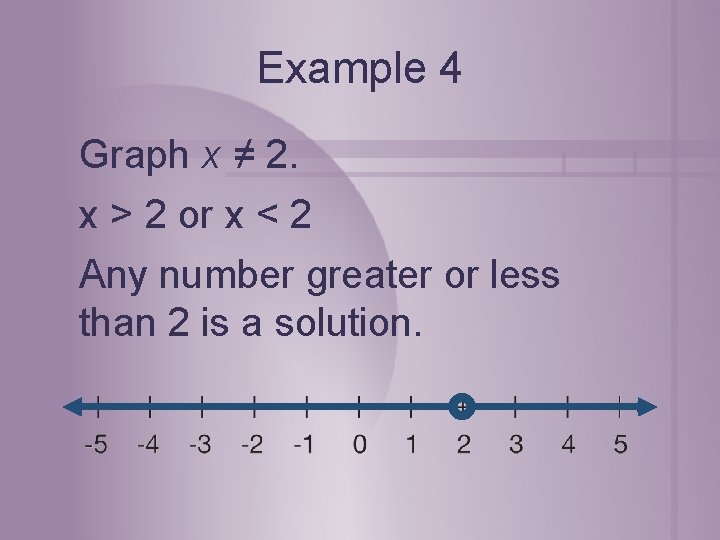
Example 4 Graph x ≠ 2. x > 2 or x < 2 Any number greater or less than 2 is a solution.
Example 6 (a) Let c = price of an item c ≥ 9. 99 (b) Let p = number of people p ≤ 225
Homework: pp. 146 -148
- Slides: 16