
ALGEBRA 1 LESSON 8 9 Direct Variation For
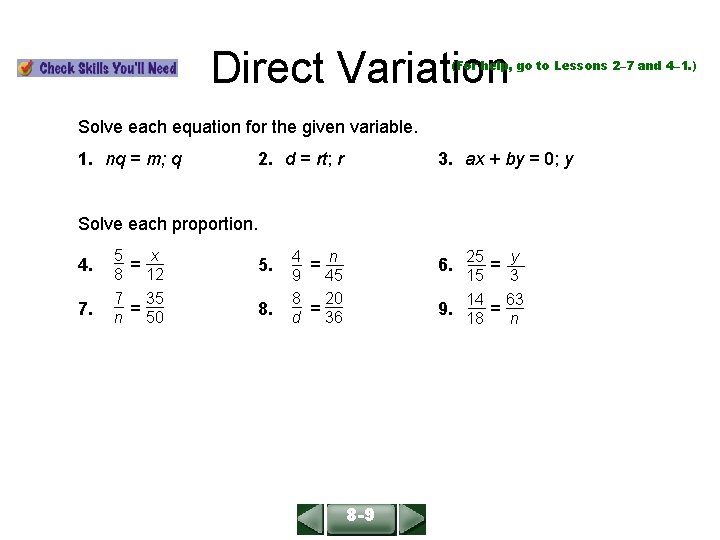
ALGEBRA 1 LESSON 8 -9 Direct Variation (For help, go to Lessons 2– 7 and 4– 1. ) Solve each equation for the given variable. 1. nq = m; q 2. d = rt; r 3. ax + by = 0; y Solve each proportion. 4. 7. 5 x = 8 12 7 35 = n 50 5. 8. 4 n = 9 45 8 20 = d 36 25 y = 15 3 14 63 9. = 18 n 6. 8 -9
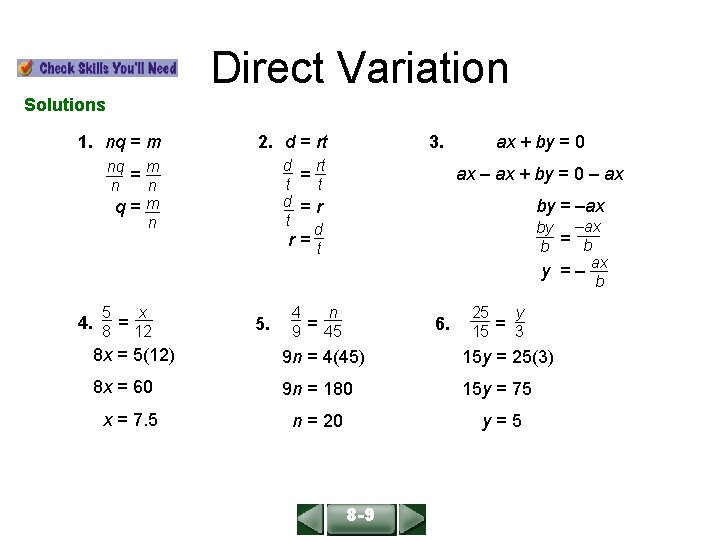
ALGEBRA 1 LESSON 8 -9 Direct Variation Solutions 1. nq = m 2. d = rt nq m = n n q=m n d rt = t t d =r t d r= t 5 x 4. 8 = 12 8 x = 5(12) 8 x = 60 x = 7. 5 5. 3. ax + by = 0 ax – ax + by = 0 – ax by = –ax by –ax b = b ax y =– b 4 n = 9 45 6. 25 y = 15 3 9 n = 4(45) 15 y = 25(3) 9 n = 180 15 y = 75 n = 20 y=5 8 -9
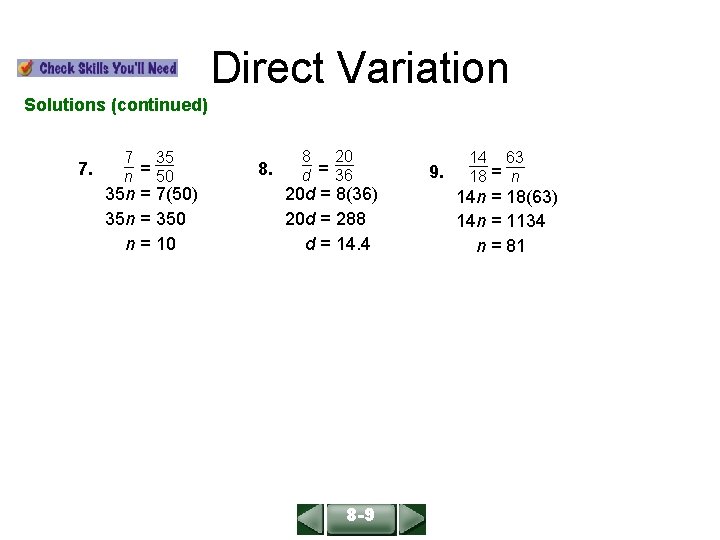
ALGEBRA 1 LESSON 8 -9 Direct Variation Solutions (continued) 7. 7 35 n = 50 35 n = 7(50) 35 n = 350 n = 10 8. 8 20 d = 36 20 d = 8(36) 20 d = 288 d = 14. 4 8 -9 9. 14 63 18 = n 14 n = 18(63) 14 n = 1134 n = 81
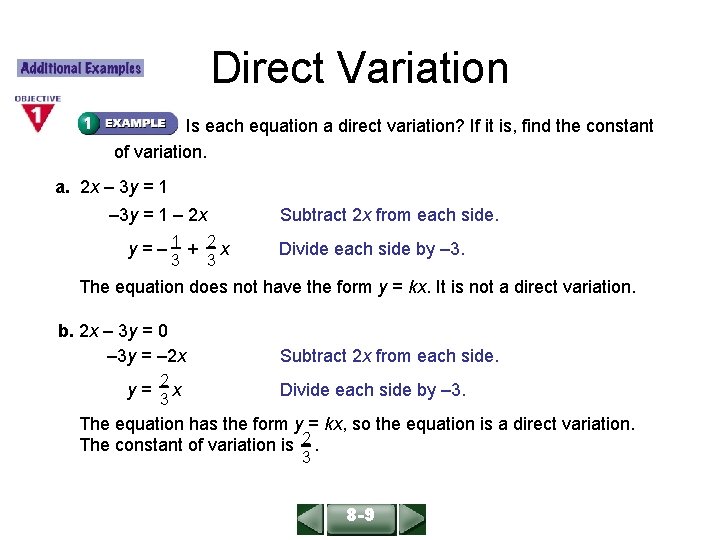
ALGEBRA 1 LESSON 8 -9 Direct Variation Is each equation a direct variation? If it is, find the constant of variation. a. 2 x – 3 y = 1 – 2 x y=– 1 + 2 x 3 3 Subtract 2 x from each side. Divide each side by – 3. The equation does not have the form y = kx. It is not a direct variation. b. 2 x – 3 y = 0 – 3 y = – 2 x y= 2 x 3 Subtract 2 x from each side. Divide each side by – 3. The equation has the form y = kx, so the equation is a direct variation. The constant of variation is 2. 3 8 -9
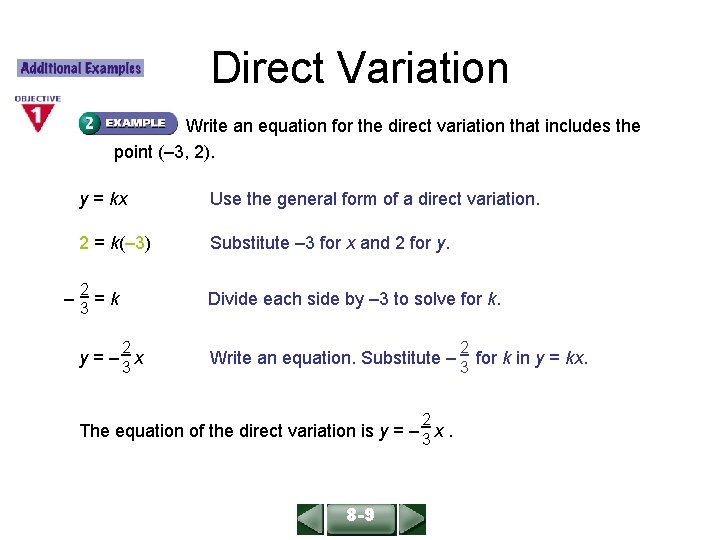
ALGEBRA 1 LESSON 8 -9 Direct Variation Write an equation for the direct variation that includes the point (– 3, 2). y = kx Use the general form of a direct variation. 2 = k(– 3) Substitute – 3 for x and 2 for y. 2 – 3=k Divide each side by – 3 to solve for k. 2 y = – 3 x 2 Write an equation. Substitute – 3 for k in y = kx. 2 The equation of the direct variation is y = – 3 x. 8 -9
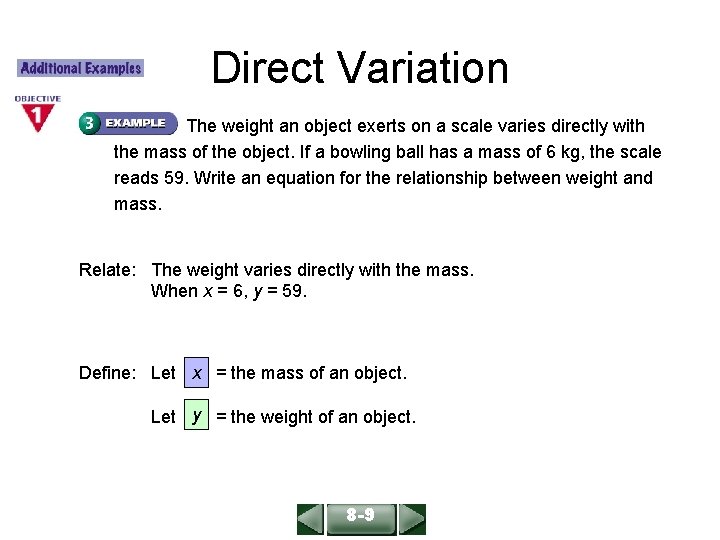
ALGEBRA 1 LESSON 8 -9 Direct Variation The weight an object exerts on a scale varies directly with the mass of the object. If a bowling ball has a mass of 6 kg, the scale reads 59. Write an equation for the relationship between weight and mass. Relate: The weight varies directly with the mass. When x = 6, y = 59. Define: Let x = the mass of an object. Let y = the weight of an object. 8 -9
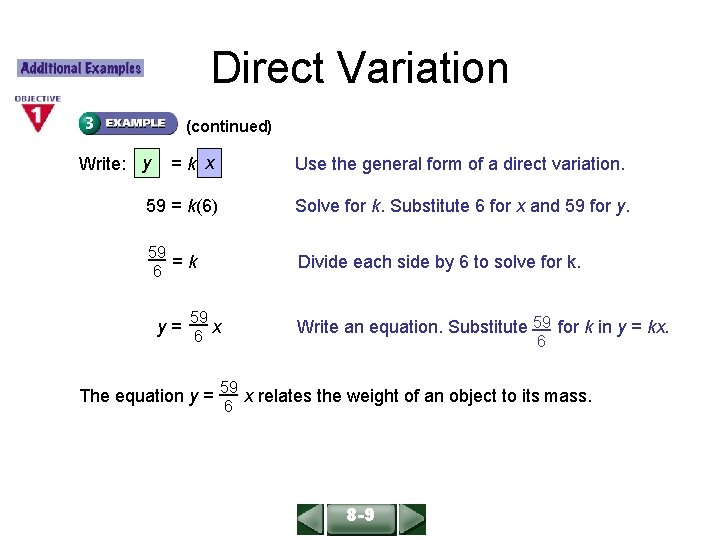
ALGEBRA 1 LESSON 8 -9 Direct Variation (continued) Write: y =k x Use the general form of a direct variation. 59 = k(6) Solve for k. Substitute 6 for x and 59 for y. 59 =k 6 Divide each side by 6 to solve for k. 59 Write an equation. Substitute 59 for k in y = kx. y= 6 x 6 The equation y = 59 x relates the weight of an object to its mass. 6 8 -9
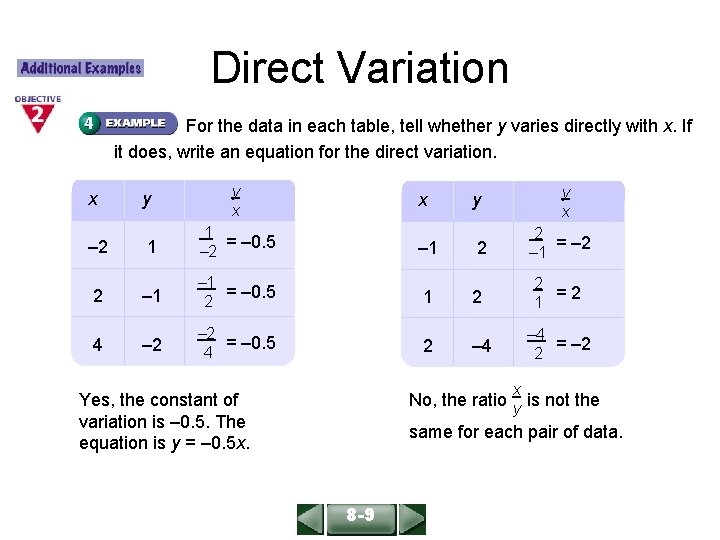
ALGEBRA 1 LESSON 8 -9 Direct Variation For the data in each table, tell whether y varies directly with x. If it does, write an equation for the direct variation. x y y x x 1 1 = – 0. 5 – 2 – 1 2 2 – 1 = – 0. 5 2 1 2 4 – 2 = – 0. 5 4 2 – 4 – 2 y x y 2 = – 2 – 1 2 =2 1 – 4 = – 2 2 x Yes, the constant of variation is – 0. 5. The equation is y = – 0. 5 x. No, the ratio y is not the same for each pair of data. 8 -9
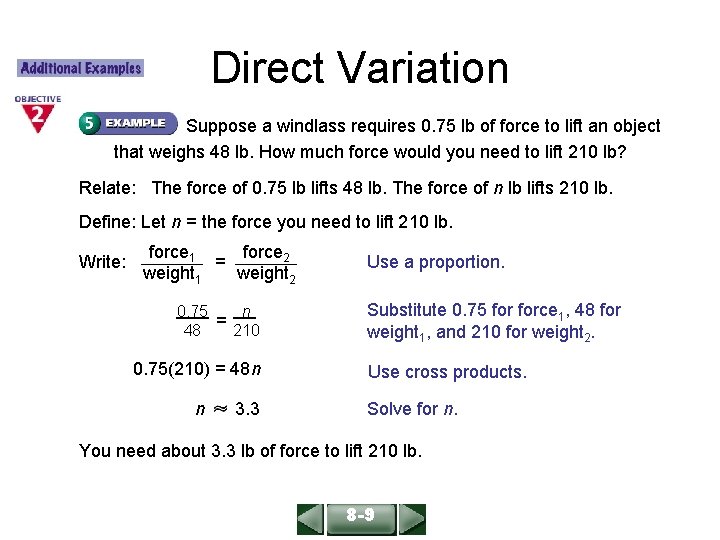
ALGEBRA 1 LESSON 8 -9 Direct Variation Suppose a windlass requires 0. 75 lb of force to lift an object that weighs 48 lb. How much force would you need to lift 210 lb? Relate: The force of 0. 75 lb lifts 48 lb. The force of n lb lifts 210 lb. Define: Let n = the force you need to lift 210 lb. Write: force 1 force 2 = weight 1 weight 2 0. 75 n = 48 210 0. 75(210) = 48 n n 3. 3 Use a proportion. Substitute 0. 75 force 1, 48 for weight 1, and 210 for weight 2. Use cross products. Solve for n. You need about 3. 3 lb of force to lift 210 lb. 8 -9
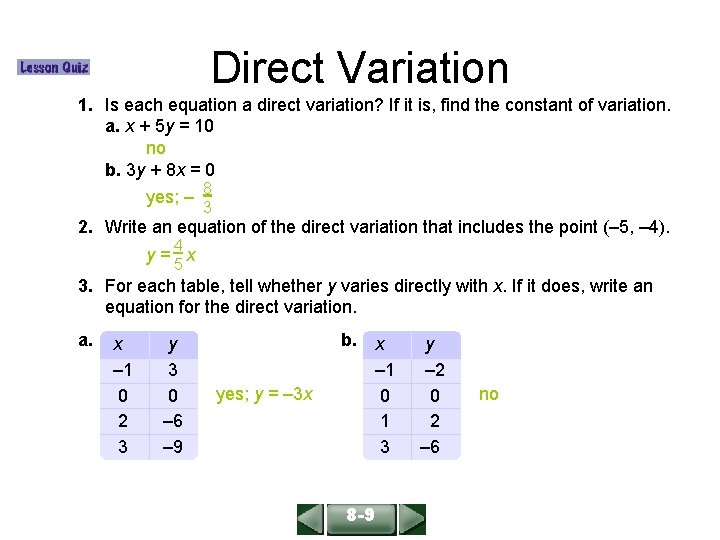
ALGEBRA 1 LESSON 8 -9 Direct Variation 1. Is each equation a direct variation? If it is, find the constant of variation. a. x + 5 y = 10 no b. 3 y + 8 x = 0 yes; – 8 3 2. Write an equation of the direct variation that includes the point (– 5, – 4). 4 5 y= x 3. For each table, tell whether y varies directly with x. If it does, write an equation for the direct variation. a. x – 1 0 2 3 y 3 0 – 6 – 9 b. yes; y = – 3 x x – 1 0 1 3 8 -9 y – 2 0 2 – 6 no
- Slides: 10