
Algebra 1 8 3 Factoring California Standards 11
Algebra 1 8. 3 Factoring
California Standards 11. 0 Students apply basic factoring techniques to second- and simple thirddegree polynomials. These techniques include finding a common factor for all terms in a polynomial, recognizing the difference of two squares, and recognizing perfect squares of binomials.
In Chapter 7, you learned how to multiply two binomials using the Distributive Property or the FOIL method. In this lesson, you will learn how to factor a trinomial into two binominals.
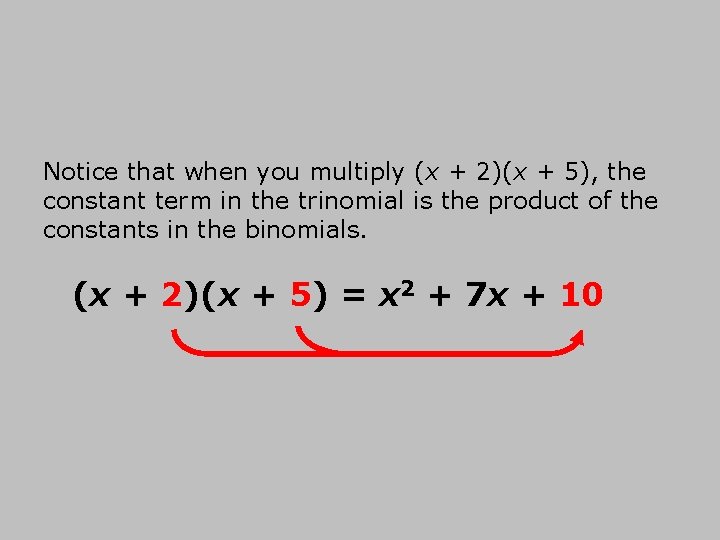
Notice that when you multiply (x + 2)(x + 5), the constant term in the trinomial is the product of the constants in the binomials. (x + 2)(x + 5) = x 2 + 7 x + 10
Use this fact to factor some trinomials into binomial factors. Look for two integers (positive or negative) that are factors of the constant term in the trinomial. Write two binomials with those integers, and then multiply integers to check. If no two factors of the constant term work, we say the trinomial is not factorable.
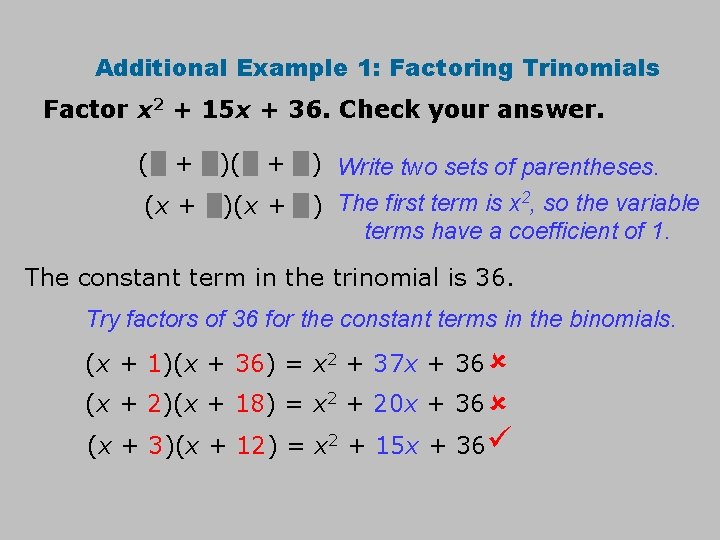
Additional Example 1: Factoring Trinomials Factor x 2 + 15 x + 36. Check your answer. ( + (x + )(x + ) Write two sets of parentheses. ) The first term is x 2, so the variable terms have a coefficient of 1. The constant term in the trinomial is 36. Try factors of 36 for the constant terms in the binomials. (x + 1)(x + 36) = x 2 + 37 x + 36 (x + 2)(x + 18) = x 2 + 20 x + 36 (x + 3)(x + 12) = x 2 + 15 x + 36
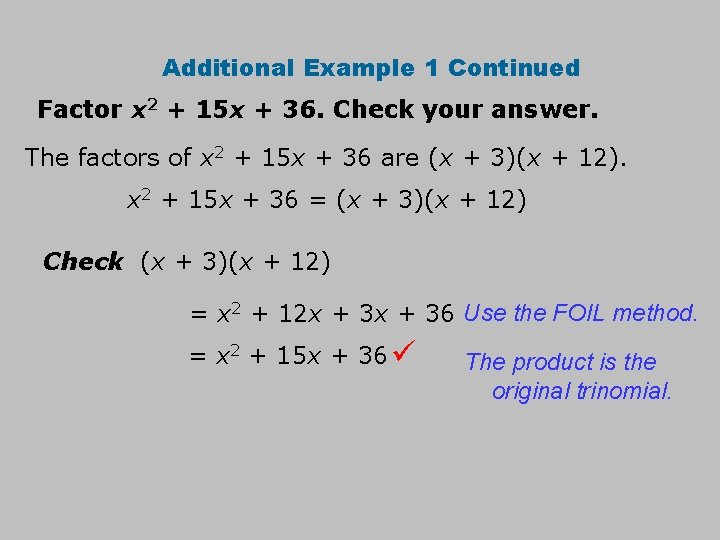
Additional Example 1 Continued Factor x 2 + 15 x + 36. Check your answer. The factors of x 2 + 15 x + 36 are (x + 3)(x + 12). x 2 + 15 x + 36 = (x + 3)(x + 12) Check (x + 3)(x + 12) = x 2 + 12 x + 36 Use the FOIL method. = x 2 + 15 x + 36 The product is the original trinomial.
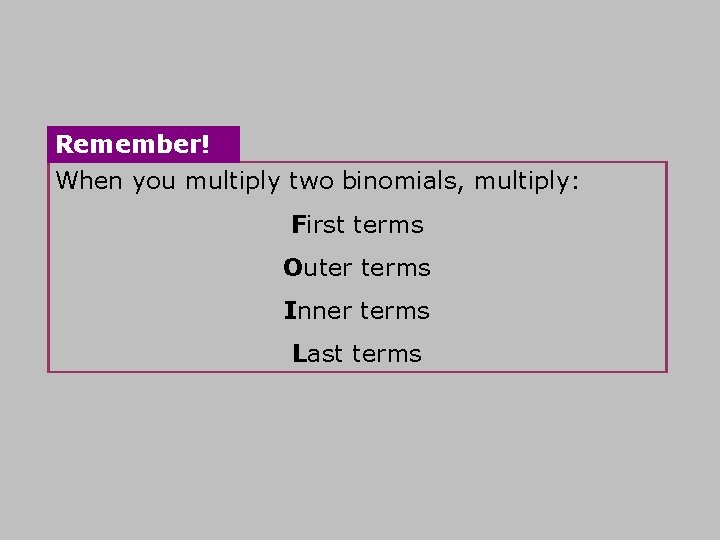
Remember! When you multiply two binomials, multiply: First terms Outer terms Inner terms Last terms
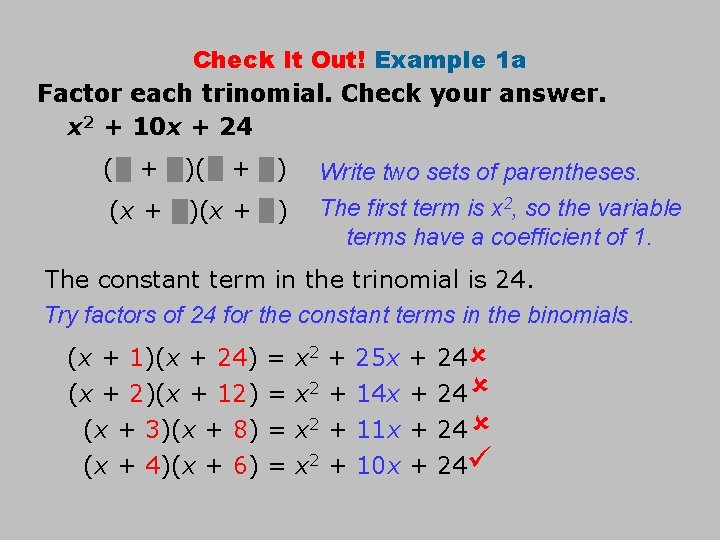
Check It Out! Example 1 a Factor each trinomial. Check your answer. x 2 + 10 x + 24 ( + (x + )( + ) )(x + ) Write two sets of parentheses. The first term is x 2, so the variable terms have a coefficient of 1. The constant term in the trinomial is 24. Try factors of 24 for the constant terms in the binomials. (x + 1)(x + 24) (x + 2)(x + 12) (x + 3)(x + 8) (x + 4)(x + 6) = = x 2 x 2 + + 25 x 14 x 11 x 10 x + + 24 24
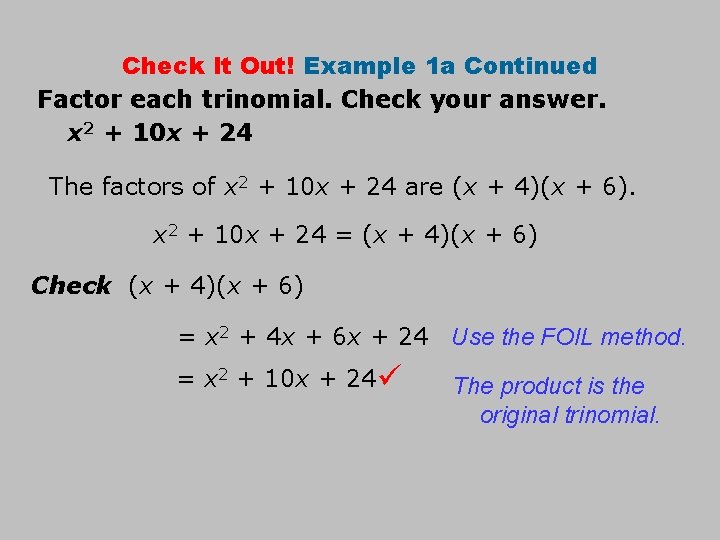
Check It Out! Example 1 a Continued Factor each trinomial. Check your answer. x 2 + 10 x + 24 The factors of x 2 + 10 x + 24 are (x + 4)(x + 6). x 2 + 10 x + 24 = (x + 4)(x + 6) Check (x + 4)(x + 6) = x 2 + 4 x + 6 x + 24 Use the FOIL method. = x 2 + 10 x + 24 The product is the original trinomial.
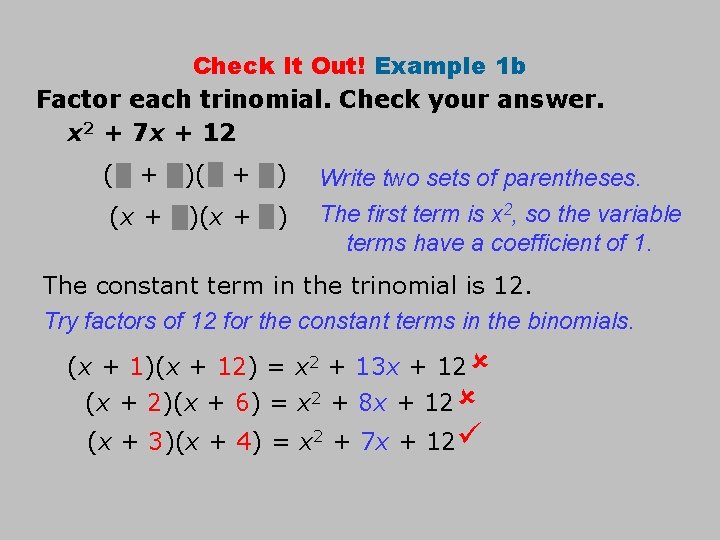
Check It Out! Example 1 b Factor each trinomial. Check your answer. x 2 + 7 x + 12 ( + (x + )( + ) )(x + ) Write two sets of parentheses. The first term is x 2, so the variable terms have a coefficient of 1. The constant term in the trinomial is 12. Try factors of 12 for the constant terms in the binomials. (x + 1)(x + 12) = x 2 + 13 x + 12 (x + 2)(x + 6) = x 2 + 8 x + 12 (x + 3)(x + 4) = x 2 + 7 x + 12
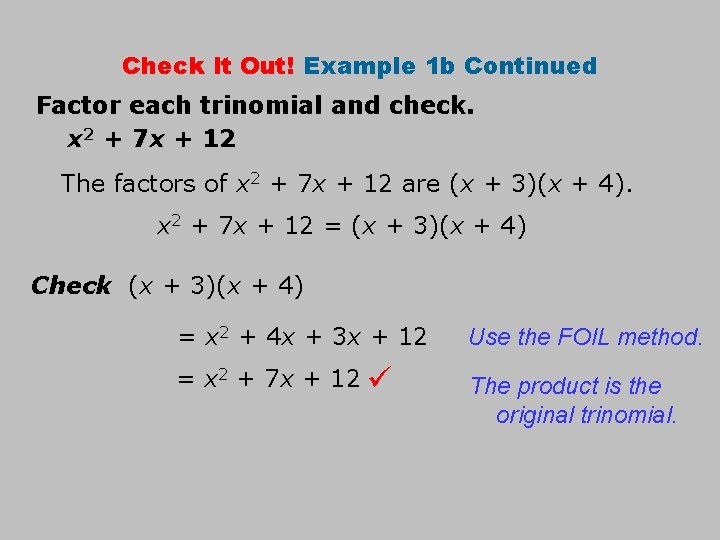
Check It Out! Example 1 b Continued Factor each trinomial and check. x 2 + 7 x + 12 The factors of x 2 + 7 x + 12 are (x + 3)(x + 4). x 2 + 7 x + 12 = (x + 3)(x + 4) Check (x + 3)(x + 4) = x 2 + 4 x + 3 x + 12 Use the FOIL method. = x 2 + 7 x + 12 The product is the original trinomial.
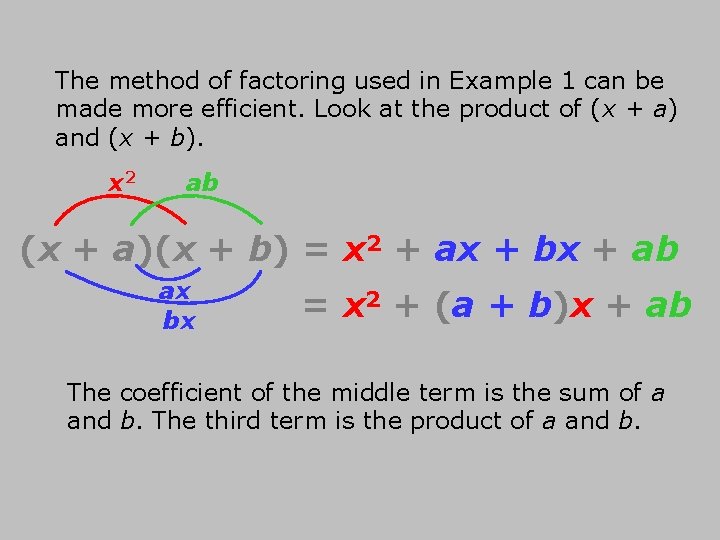
The method of factoring used in Example 1 can be made more efficient. Look at the product of (x + a) and (x + b). x 2 ab (x + a)(x + b) = x 2 + ax + bx + ab ax bx = x 2 + (a + b)x + ab The coefficient of the middle term is the sum of a and b. The third term is the product of a and b.
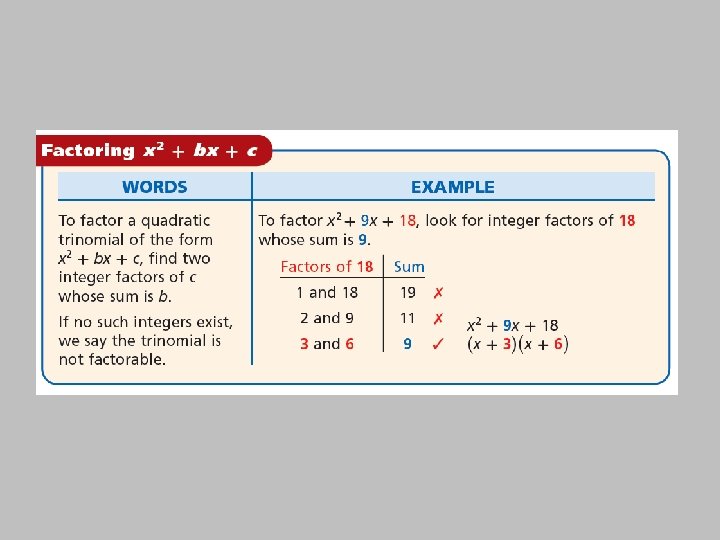
When c is positive, its factors have the same sign. The sign of b tells you whether the factors are positive or negative. When b is positive, the factors are positive and when b is negative, the factors are negative.
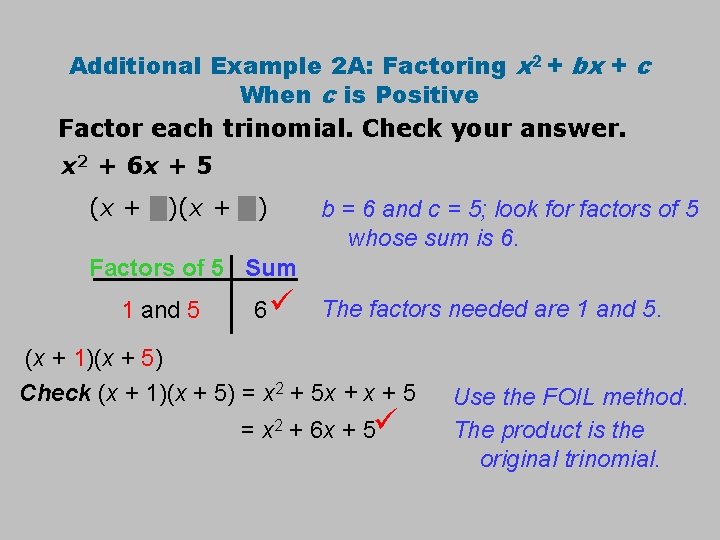
Additional Example 2 A: Factoring x 2 + bx + c When c is Positive Factor each trinomial. Check your answer. x 2 + 6 x + 5 (x + ) b = 6 and c = 5; look for factors of 5 whose sum is 6. Factors of 5 Sum 1 and 5 6 The factors needed are 1 and 5. (x + 1)(x + 5) Check (x + 1)(x + 5) = x 2 + 5 x + 5 = x 2 + 6 x + 5 Use the FOIL method. The product is the original trinomial.
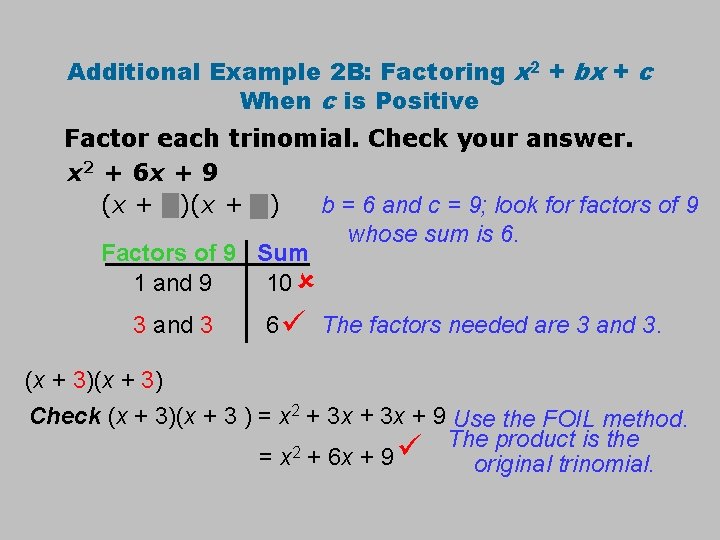
Additional Example 2 B: Factoring x 2 + bx + c When c is Positive Factor each trinomial. Check your answer. x 2 + 6 x + 9 b = 6 and c = 9; look for factors of 9 (x + ) whose sum is 6. Factors of 9 Sum 1 and 9 10 3 and 3 6 The factors needed are 3 and 3. (x + 3) Check (x + 3)(x + 3 ) = x 2 + 3 x + 9 Use the FOIL method. The product is the 2 = x + 6 x + 9 original trinomial.
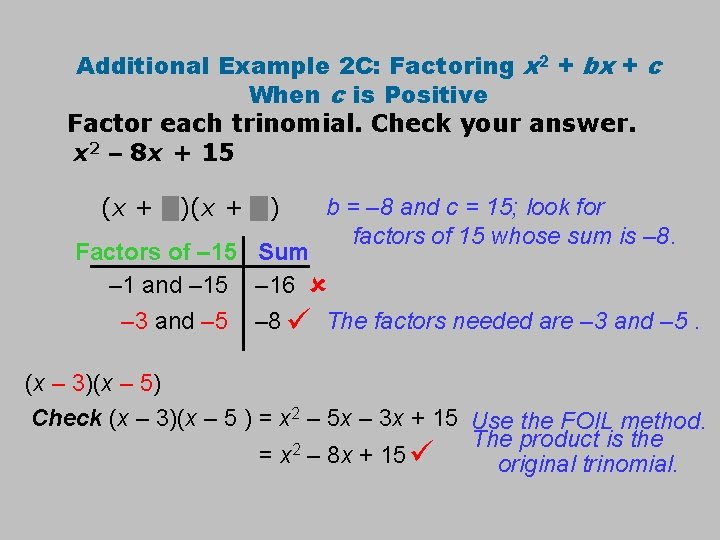
Additional Example 2 C: Factoring x 2 + bx + c When c is Positive Factor each trinomial. Check your answer. x 2 – 8 x + 15 (x + ) b = – 8 and c = 15; look for factors of 15 whose sum is – 8. Factors of – 15 Sum – 1 and – 15 – 16 – 3 and – 5 – 8 The factors needed are – 3 and – 5. (x – 3)(x – 5) Check (x – 3)(x – 5 ) = x 2 – 5 x – 3 x + 15 Use the FOIL method. The product is the 2 = x – 8 x + 15 original trinomial.
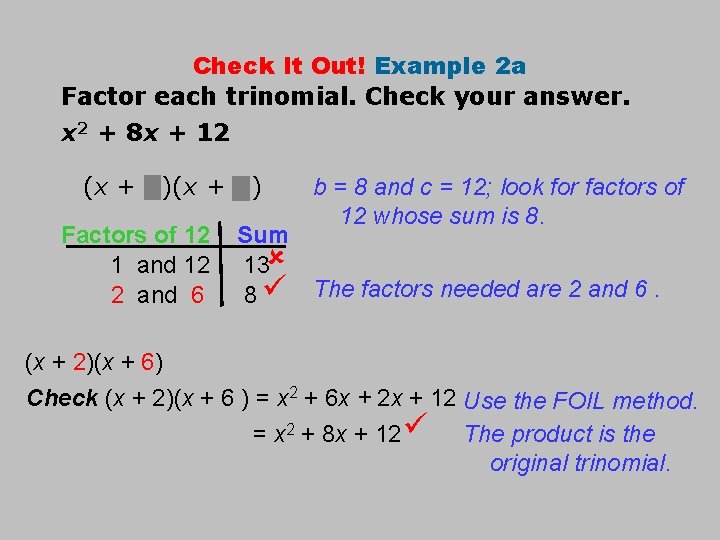
Check It Out! Example 2 a Factor each trinomial. Check your answer. x 2 + 8 x + 12 (x + )(x + Factors of 12 1 and 12 2 and 6 ) Sum 13 8 b = 8 and c = 12; look for factors of 12 whose sum is 8. The factors needed are 2 and 6. (x + 2)(x + 6) Check (x + 2)(x + 6 ) = x 2 + 6 x + 2 x + 12 Use the FOIL method. = x 2 + 8 x + 12 The product is the original trinomial.
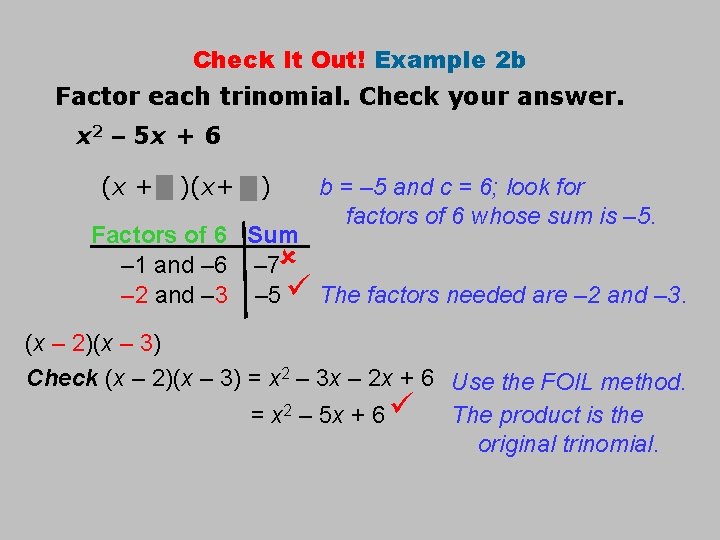
Check It Out! Example 2 b Factor each trinomial. Check your answer. x 2 – 5 x + 6 (x + )(x+ ) b = – 5 and c = 6; look for factors of 6 whose sum is – 5. Factors of 6 Sum – 1 and – 6 – 7 – 2 and – 3 – 5 The factors needed are – 2 and – 3. (x – 2)(x – 3) Check (x – 2)(x – 3) = x 2 – 3 x – 2 x + 6 Use the FOIL method. = x 2 – 5 x + 6 The product is the original trinomial.
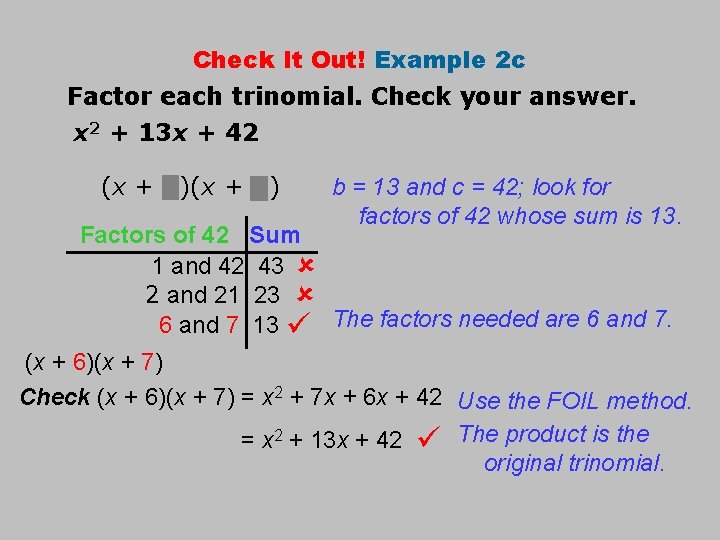
Check It Out! Example 2 c Factor each trinomial. Check your answer. x 2 + 13 x + 42 (x + ) b = 13 and c = 42; look for factors of 42 whose sum is 13. Factors of 42 Sum 1 and 42 43 2 and 21 23 6 and 7 13 The factors needed are 6 and 7. (x + 6)(x + 7) Check (x + 6)(x + 7) = x 2 + 7 x + 6 x + 42 Use the FOIL method. = x 2 + 13 x + 42 The product is the original trinomial.
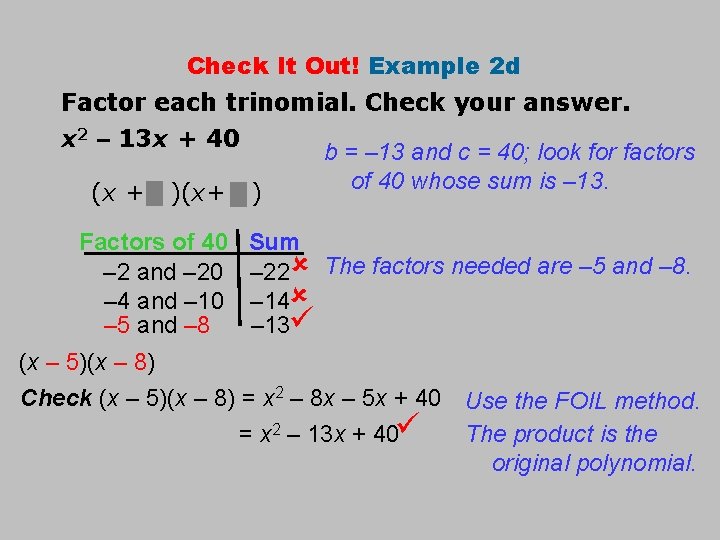
Check It Out! Example 2 d Factor each trinomial. Check your answer. x 2 – 13 x + 40 b = – 13 and c = 40; look for factors of 40 whose sum is – 13. (x + )(x+ ) Factors of 40 – 2 and – 20 – 4 and – 10 – 5 and – 8 Sum – 22 The factors needed are – 5 and – 8. – 14 – 13 (x – 5)(x – 8) Check (x – 5)(x – 8) = x 2 – 8 x – 5 x + 40 Use the FOIL method. = x 2 – 13 x + 40 The product is the original polynomial.
When c is negative, its factors have opposite signs. The sign of b tells you which factor is positive and which is negative. The factor with the greater absolute value has the same sign as b.
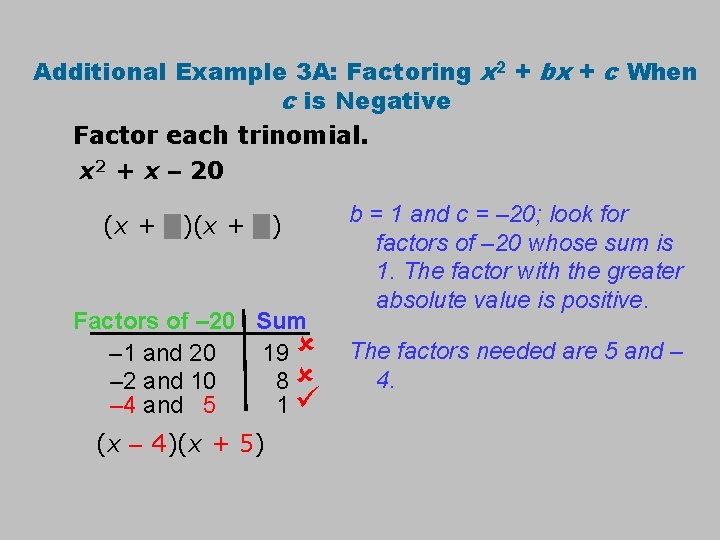
Additional Example 3 A: Factoring x 2 + bx + c When c is Negative Factor each trinomial. x 2 + x – 20 (x + ) Factors of – 20 Sum – 1 and 20 19 – 2 and 10 8 – 4 and 5 1 (x – 4)(x + 5) b = 1 and c = – 20; look for factors of – 20 whose sum is 1. The factor with the greater absolute value is positive. The factors needed are 5 and – 4.
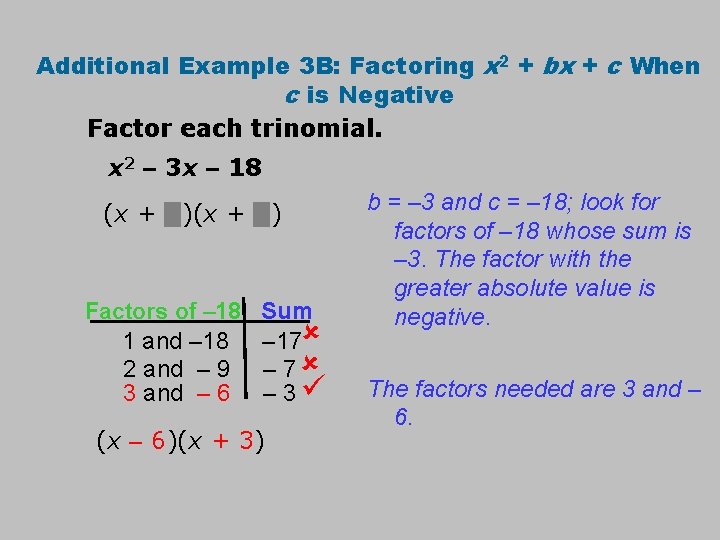
Additional Example 3 B: Factoring x 2 + bx + c When c is Negative Factor each trinomial. x 2 – 3 x – 18 (x + )(x + Factors of – 18 1 and – 18 2 and – 9 3 and – 6 ) Sum – 17 – 3 (x – 6)(x + 3) b = – 3 and c = – 18; look for factors of – 18 whose sum is – 3. The factor with the greater absolute value is negative. The factors needed are 3 and – 6.
Helpful Hint If you have trouble remembering the rules for which factor is positive and which is negative, you can try all the factor pairs and check their sums.
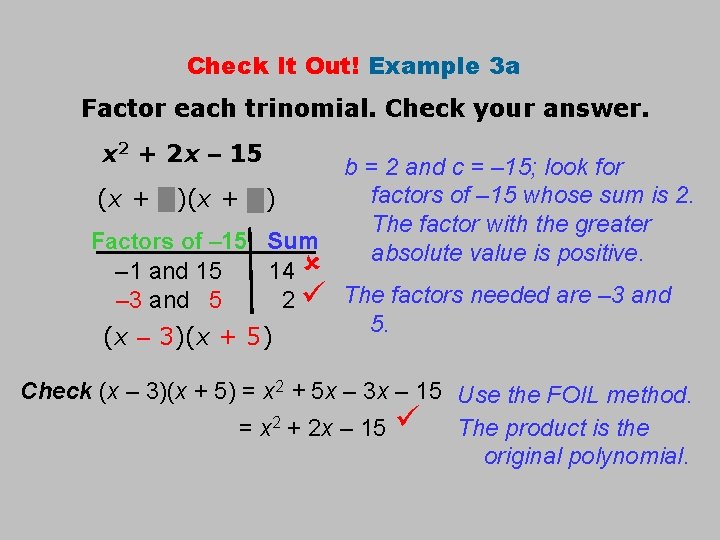
Check It Out! Example 3 a Factor each trinomial. Check your answer. x 2 + 2 x – 15 (x + ) b = 2 and c = – 15; look for factors of – 15 whose sum is 2. The factor with the greater absolute value is positive. Factors of – 15 Sum – 1 and 15 14 – 3 and 5 2 The factors needed are – 3 and 5. (x – 3)(x + 5) Check (x – 3)(x + 5) = x 2 + 5 x – 3 x – 15 Use the FOIL method. = x 2 + 2 x – 15 The product is the original polynomial.
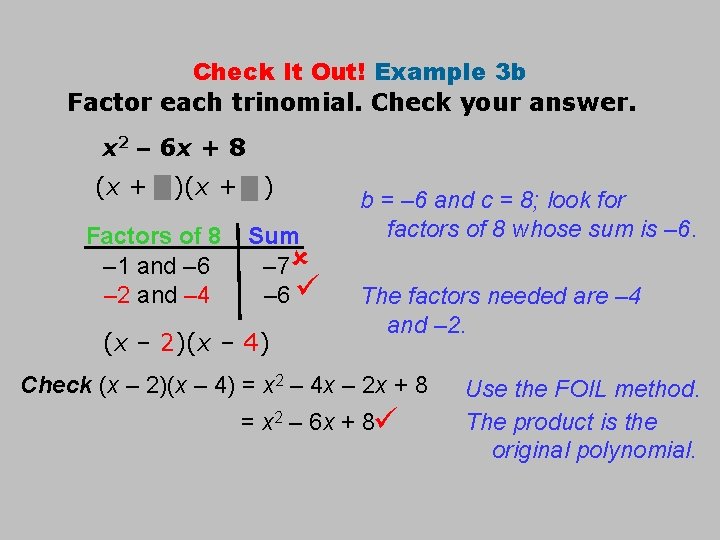
Check It Out! Example 3 b Factor each trinomial. Check your answer. x 2 – 6 x + 8 (x + )(x + Factors of 8 – 1 and – 6 – 2 and – 4 ) Sum – 7 – 6 (x – 2)(x – 4) b = – 6 and c = 8; look for factors of 8 whose sum is – 6. The factors needed are – 4 and – 2. Check (x – 2)(x – 4) = x 2 – 4 x – 2 x + 8 = x 2 – 6 x + 8 Use the FOIL method. The product is the original polynomial.
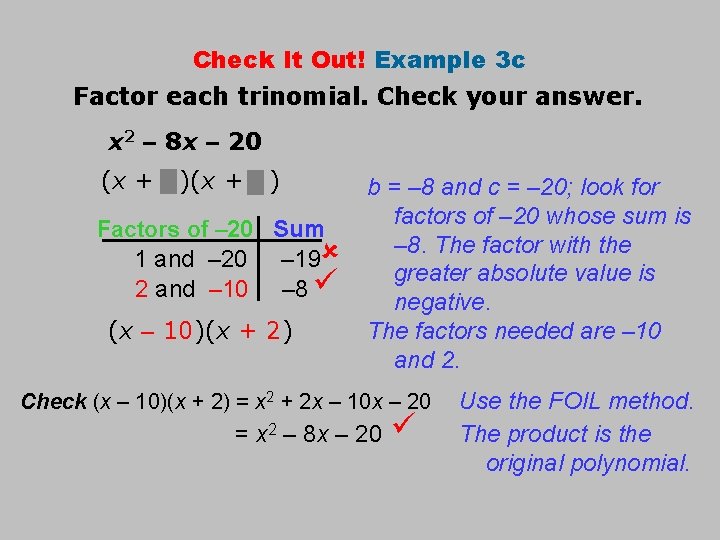
Check It Out! Example 3 c Factor each trinomial. Check your answer. x 2 – 8 x – 20 (x + ) Factors of – 20 Sum 1 and – 20 – 19 2 and – 10 – 8 (x – 10)(x + 2) b = – 8 and c = – 20; look for factors of – 20 whose sum is – 8. The factor with the greater absolute value is negative. The factors needed are – 10 and 2. Check (x – 10)(x + 2) = x 2 + 2 x – 10 x – 20 = x 2 – 8 x – 20 Use the FOIL method. The product is the original polynomial.
A polynomial and the factored form of the polynomial are equivalent expressions. When you evaluate these two expressions for the same value of the variable, the results are the same.
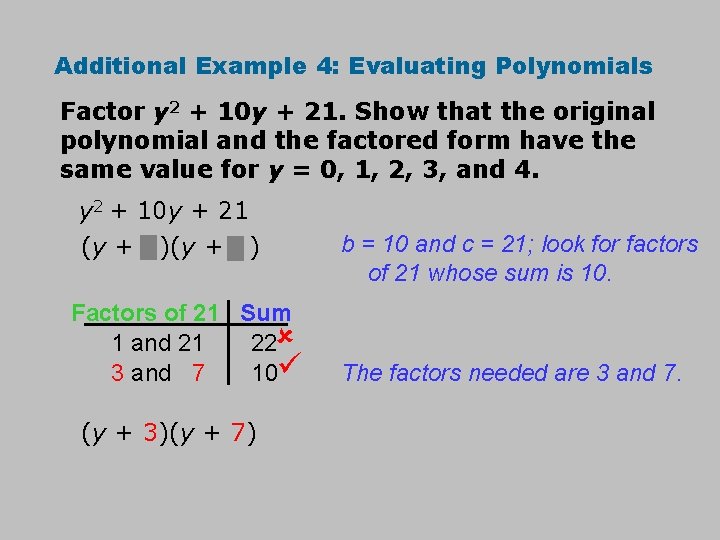
Additional Example 4: Evaluating Polynomials Factor y 2 + 10 y + 21. Show that the original polynomial and the factored form have the same value for y = 0, 1, 2, 3, and 4. y 2 + 10 y + 21 (y + ) Factors of 21 Sum 1 and 21 22 3 and 7 10 (y + 3)(y + 7) b = 10 and c = 21; look for factors of 21 whose sum is 10. The factors needed are 3 and 7.
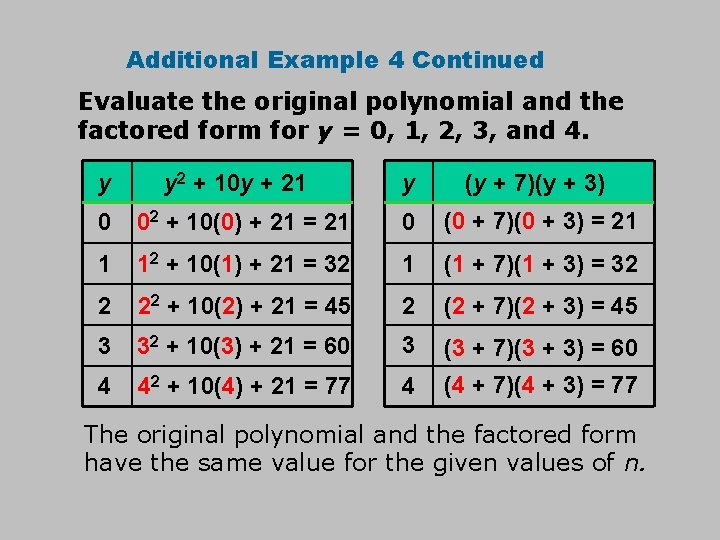
Additional Example 4 Continued Evaluate the original polynomial and the factored form for y = 0, 1, 2, 3, and 4. y y 2 + 10 y + 21 y (y + 7)(y + 3) 0 02 + 10(0) + 21 = 21 0 (0 + 7)(0 + 3) = 21 1 12 + 10(1) + 21 = 32 1 (1 + 7)(1 + 3) = 32 2 22 + 10(2) + 21 = 45 2 (2 + 7)(2 + 3) = 45 3 32 + 10(3) + 21 = 60 3 (3 + 7)(3 + 3) = 60 4 42 + 10(4) + 21 = 77 4 (4 + 7)(4 + 3) = 77 The original polynomial and the factored form have the same value for the given values of n.
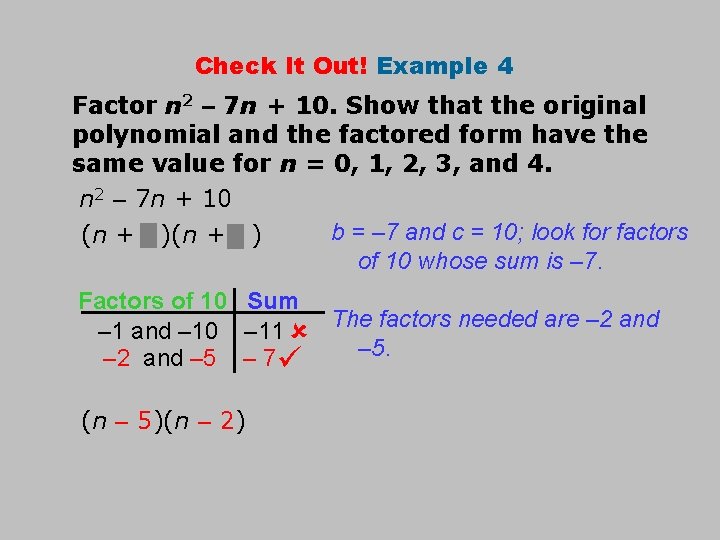
Check It Out! Example 4 Factor n 2 – 7 n + 10. Show that the original polynomial and the factored form have the same value for n = 0, 1, 2, 3, and 4. n 2 – 7 n + 10 b = – 7 and c = 10; look for factors (n + ) of 10 whose sum is – 7. Factors of 10 Sum – 1 and – 10 – 11 The factors needed are – 2 and – 5 – 7 (n – 5)(n – 2)
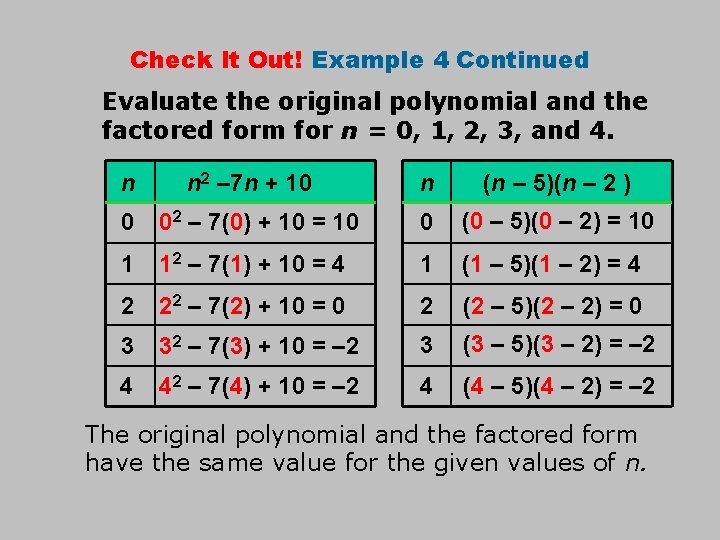
Check It Out! Example 4 Continued Evaluate the original polynomial and the factored form for n = 0, 1, 2, 3, and 4. n n 2 – 7 n + 10 n (n – 5)(n – 2 ) 0 02 – 7(0) + 10 = 10 0 (0 – 5)(0 – 2) = 10 1 12 – 7(1) + 10 = 4 1 (1 – 5)(1 – 2) = 4 2 22 – 7(2) + 10 = 0 2 (2 – 5)(2 – 2) = 0 3 32 – 7(3) + 10 = – 2 3 (3 – 5)(3 – 2) = – 2 4 42 – 7(4) + 10 = – 2 4 (4 – 5)(4 – 2) = – 2 The original polynomial and the factored form have the same value for the given values of n.
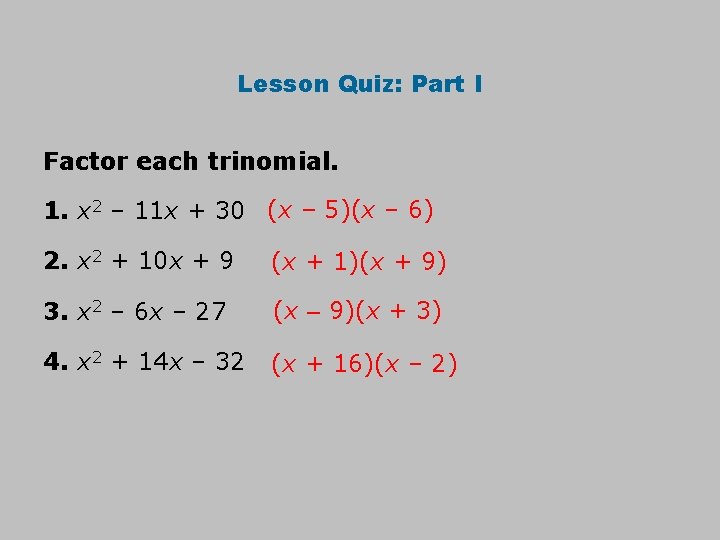
Lesson Quiz: Part I Factor each trinomial. 1. x 2 – 11 x + 30 (x – 5)(x – 6) 2. x 2 + 10 x + 9 (x + 1)(x + 9) 3. x 2 – 6 x – 27 (x – 9)(x + 3) 4. x 2 + 14 x – 32 (x + 16)(x – 2)
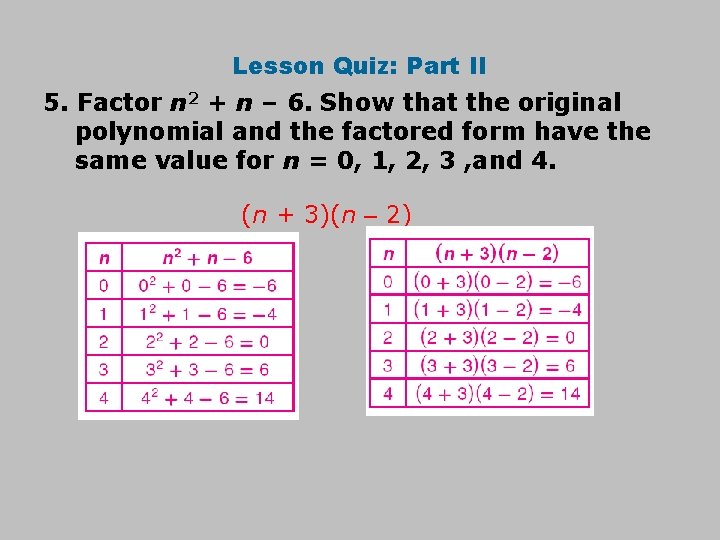
Lesson Quiz: Part II 5. Factor n 2 + n – 6. Show that the original polynomial and the factored form have the same value for n = 0, 1, 2, 3 , and 4. (n + 3)(n – 2)
- Slides: 36