
Algebra 1 7 6 Polynomials California Standards Preparation

Algebra 1 7. 6 Polynomials
California Standards Preparation for 10. 0 Students add, subtract, multiply, and divide monomials and polynomials. Student solve multistep problems, including word problems, by using these techniques.
Vocabulary monomial degree of a monomial polynomial degree of a polynomial standard form of a polynomial leading coefficient quadratic cubic binomial trinomial roots
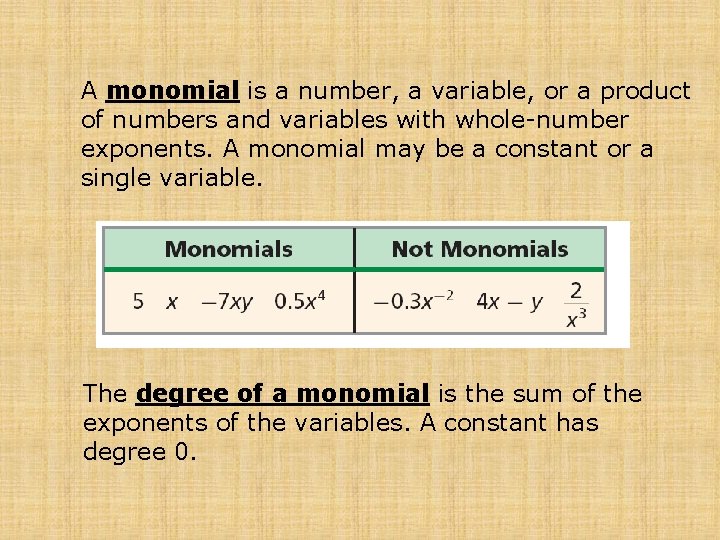
A monomial is a number, a variable, or a product of numbers and variables with whole-number exponents. A monomial may be a constant or a single variable. The degree of a monomial is the sum of the exponents of the variables. A constant has degree 0.
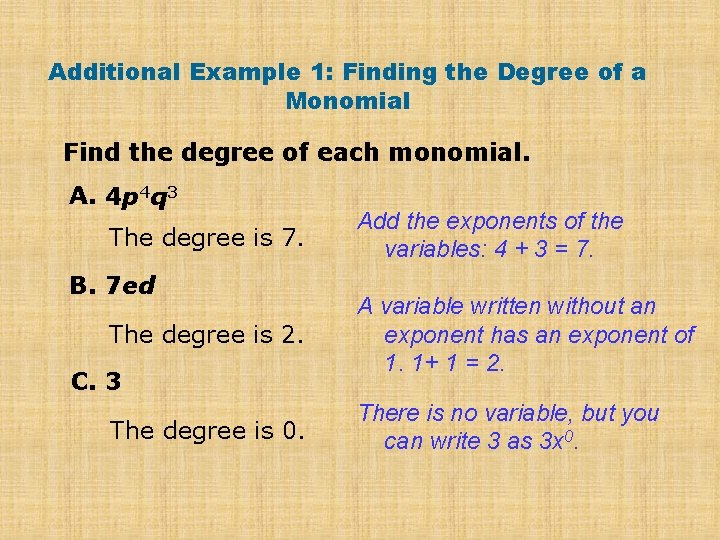
Additional Example 1: Finding the Degree of a Monomial Find the degree of each monomial. A. 4 p 4 q 3 The degree is 7. B. 7 ed The degree is 2. C. 3 The degree is 0. Add the exponents of the variables: 4 + 3 = 7. A variable written without an exponent has an exponent of 1. 1+ 1 = 2. There is no variable, but you can write 3 as 3 x 0.
Remember! The terms of an expression are the parts being added or subtracted. See Lesson 1 -7.
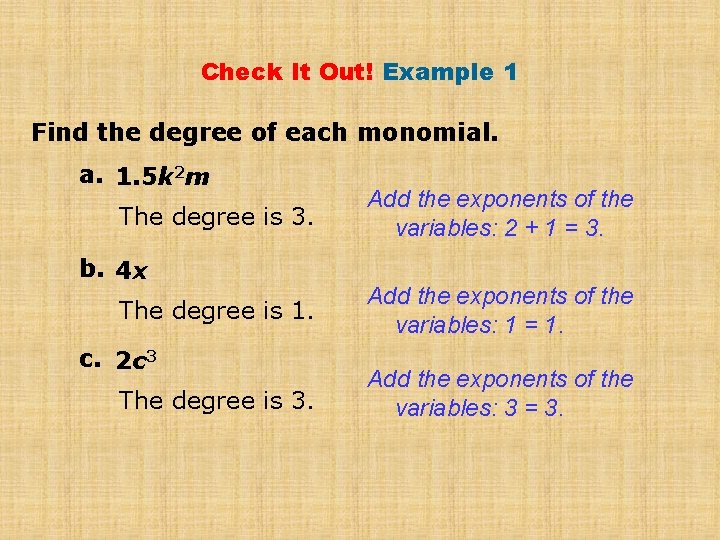
Check It Out! Example 1 Find the degree of each monomial. a. 1. 5 k 2 m The degree is 3. b. 4 x The degree is 1. c. 2 c 3 The degree is 3. Add the exponents of the variables: 2 + 1 = 3. Add the exponents of the variables: 1 = 1. Add the exponents of the variables: 3 = 3.
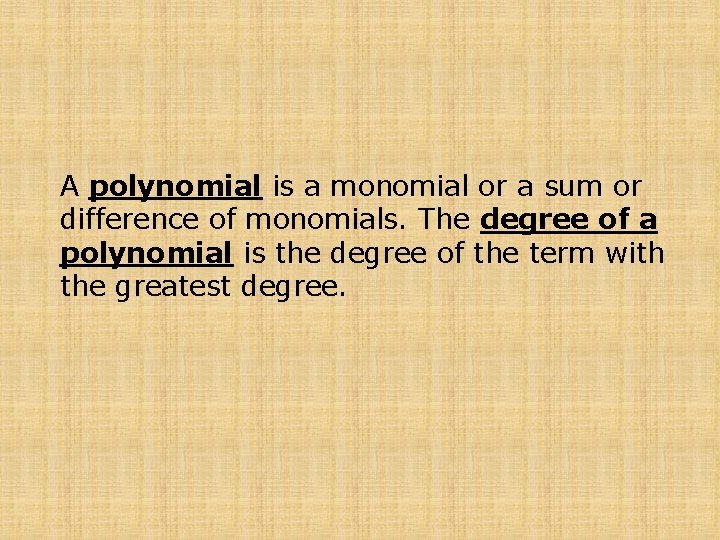
A polynomial is a monomial or a sum or difference of monomials. The degree of a polynomial is the degree of the term with the greatest degree.
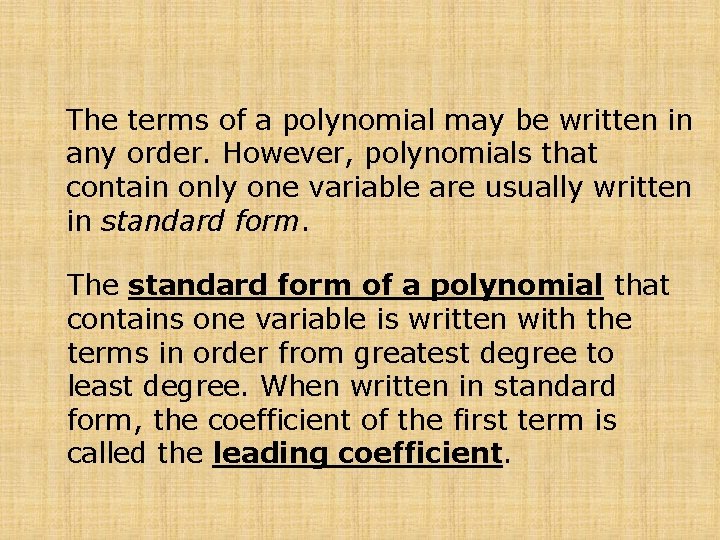
The terms of a polynomial may be written in any order. However, polynomials that contain only one variable are usually written in standard form. The standard form of a polynomial that contains one variable is written with the terms in order from greatest degree to least degree. When written in standard form, the coefficient of the first term is called the leading coefficient.

Additional Example 2 A: Writing Polynomials in Standard Form Write the polynomial in standard form. Then give the leading coefficient. 6 x – 7 x 5 + 4 x 2 + 9 Find the degree of each term. Then arrange them in descending order: 6 x – 7 x 5 + 4 x 2 + 9 Degree 1 5 2 0 – 7 x 5 + 4 x 2 + 6 x + 9 5 2 1 0 The standard form is – 7 x 5 + 4 x 2 + 6 x + 9. The leading coefficient is – 7.
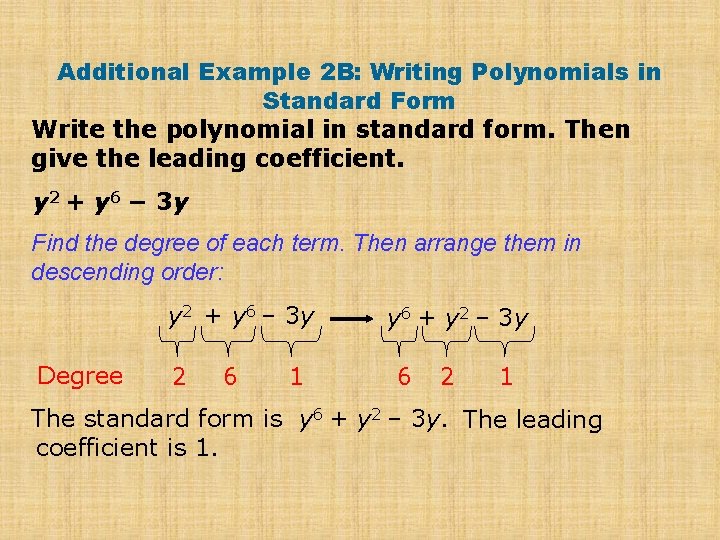
Additional Example 2 B: Writing Polynomials in Standard Form Write the polynomial in standard form. Then give the leading coefficient. y 2 + y 6 − 3 y Find the degree of each term. Then arrange them in descending order: y 2 + y 6 – 3 y Degree 2 6 1 y 6 + y 2 – 3 y 6 2 1 The standard form is y 6 + y 2 – 3 y. The leading coefficient is 1.

Remember! A variable written without a coefficient has a coefficient of 1. y 5 = 1 y 5
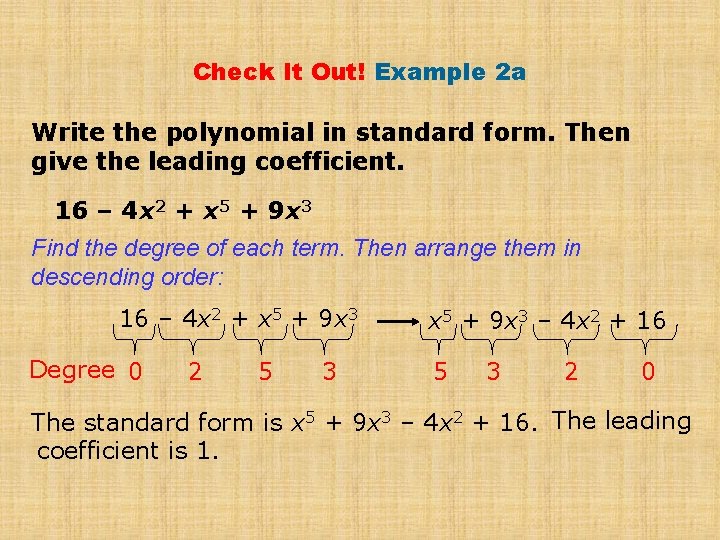
Check It Out! Example 2 a Write the polynomial in standard form. Then give the leading coefficient. 16 – 4 x 2 + x 5 + 9 x 3 Find the degree of each term. Then arrange them in descending order: 16 – 4 x 2 + x 5 + 9 x 3 Degree 0 2 5 3 x 5 + 9 x 3 – 4 x 2 + 16 5 3 2 0 The standard form is x 5 + 9 x 3 – 4 x 2 + 16. The leading coefficient is 1.
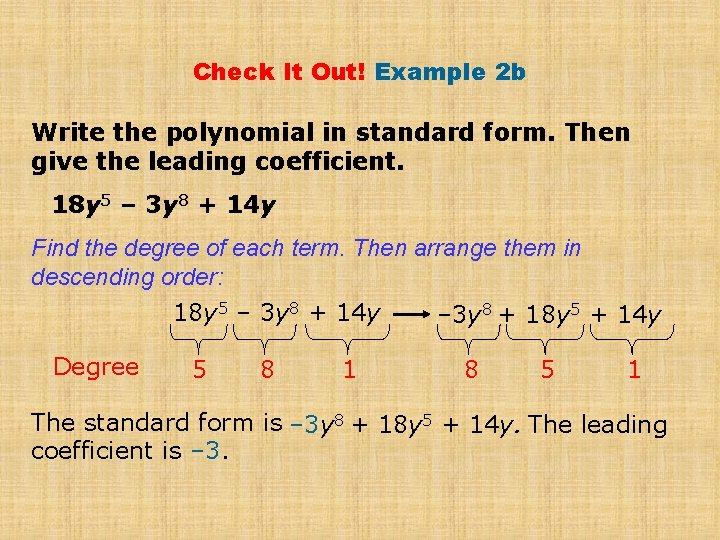
Check It Out! Example 2 b Write the polynomial in standard form. Then give the leading coefficient. 18 y 5 – 3 y 8 + 14 y Find the degree of each term. Then arrange them in descending order: 18 y 5 – 3 y 8 + 14 y Degree 5 8 1 – 3 y 8 + 18 y 5 + 14 y 8 5 1 The standard form is – 3 y 8 + 18 y 5 + 14 y. The leading coefficient is – 3.
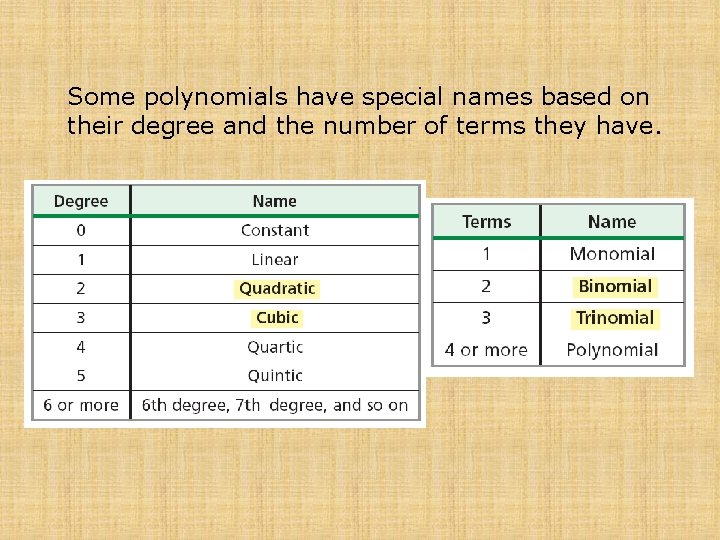
Some polynomials have special names based on their degree and the number of terms they have.
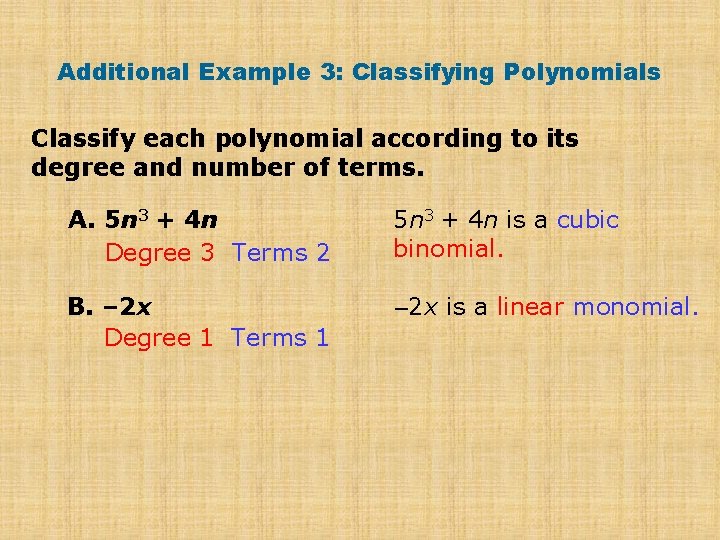
Additional Example 3: Classifying Polynomials Classify each polynomial according to its degree and number of terms. A. 5 n 3 + 4 n Degree 3 Terms 2 5 n 3 + 4 n is a cubic binomial. B. – 2 x Degree 1 Terms 1 – 2 x is a linear monomial.
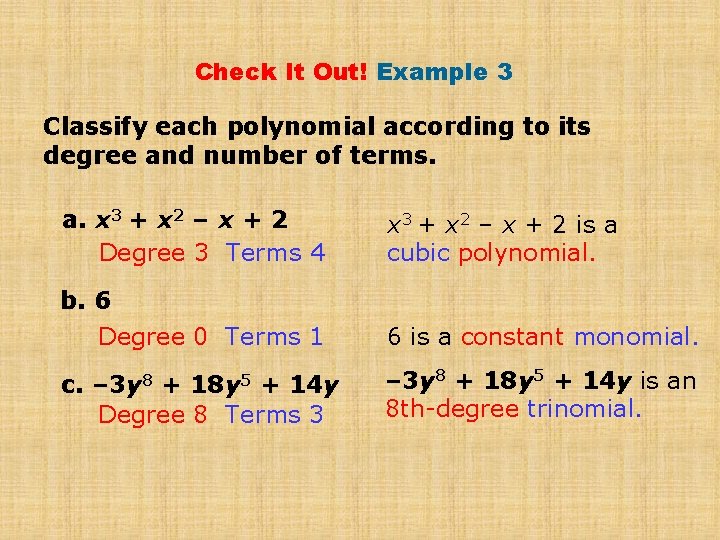
Check It Out! Example 3 Classify each polynomial according to its degree and number of terms. a. x 3 + x 2 – x + 2 Degree 3 Terms 4 x 3 + x 2 – x + 2 is a cubic polynomial. b. 6 Degree 0 Terms 1 6 is a constant monomial. c. – 3 y 8 + 18 y 5 + 14 y Degree 8 Terms 3 – 3 y 8 + 18 y 5 + 14 y is an 8 th-degree trinomial.
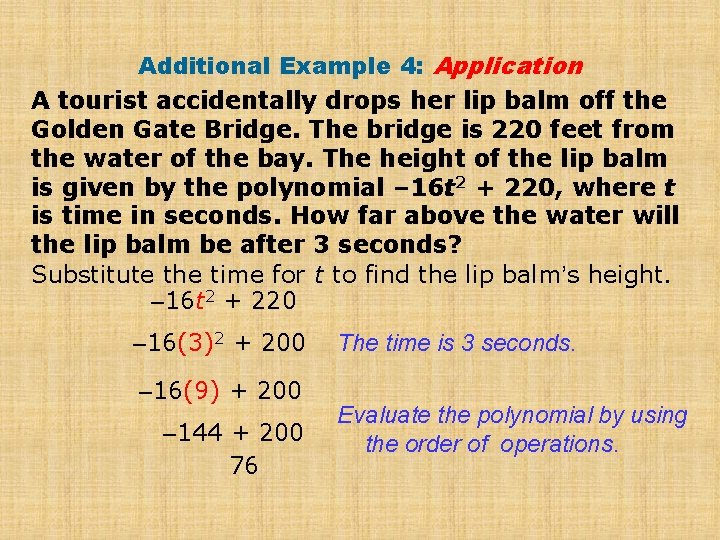
Additional Example 4: Application A tourist accidentally drops her lip balm off the Golden Gate Bridge. The bridge is 220 feet from the water of the bay. The height of the lip balm is given by the polynomial – 16 t 2 + 220, where t is time in seconds. How far above the water will the lip balm be after 3 seconds? Substitute the time for t to find the lip balm’s height. – 16 t 2 + 220 – 16(3)2 + 200 – 16(9) + 200 – 144 + 200 76 The time is 3 seconds. Evaluate the polynomial by using the order of operations.
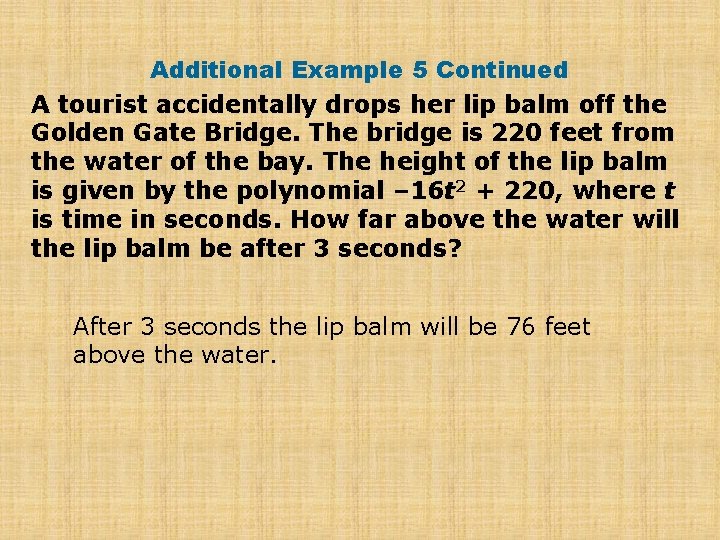
Additional Example 5 Continued A tourist accidentally drops her lip balm off the Golden Gate Bridge. The bridge is 220 feet from the water of the bay. The height of the lip balm is given by the polynomial – 16 t 2 + 220, where t is time in seconds. How far above the water will the lip balm be after 3 seconds? After 3 seconds the lip balm will be 76 feet above the water.
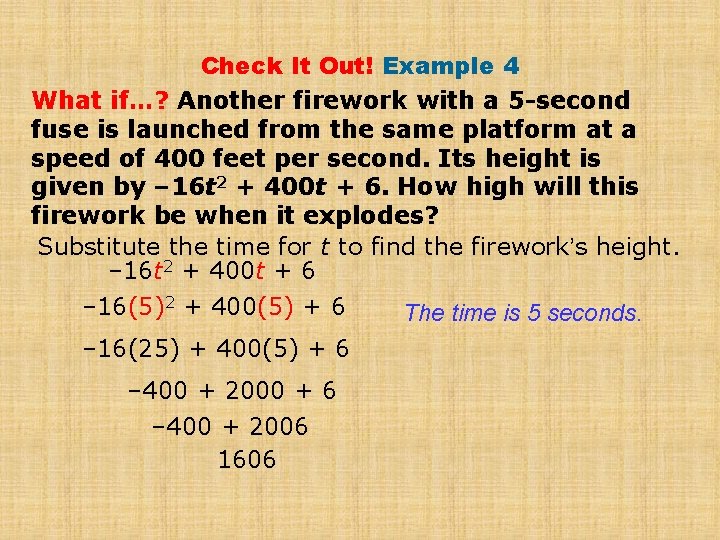
Check It Out! Example 4 What if…? Another firework with a 5 -second fuse is launched from the same platform at a speed of 400 feet per second. Its height is given by – 16 t 2 + 400 t + 6. How high will this firework be when it explodes? Substitute the time for t to find the firework’s height. – 16 t 2 + 400 t + 6 – 16(5)2 + 400(5) + 6 – 16(25) + 400(5) + 6 – 400 + 2000 + 6 – 400 + 2006 1606 The time is 5 seconds.
Check It Out! Example 4 Continued What if…? Another firework with a 5 -second fuse is launched from the same platform at a speed of 400 feet per second. Its height is given by – 16 t 2 +400 t + 6. How high will this firework be when it explodes? When the firework explodes, it will be 1606 feet above the ground.
A root of a polynomial in one variable is a value of the variable for which the polynomial is equal to 0.
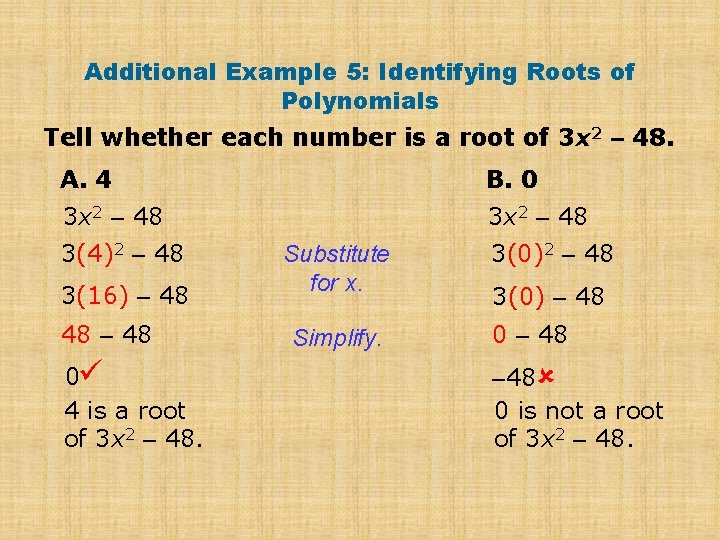
Additional Example 5: Identifying Roots of Polynomials Tell whether each number is a root of 3 x 2 – 48. A. 4 B. 0 3 x 2 – 48 3(4)2 – 48 3(16) – 48 48 – 48 0 4 is a root of 3 x 2 – 48. Substitute for x. Simplify. 3(0)2 – 48 3(0) – 48 0 is not a root of 3 x 2 – 48.
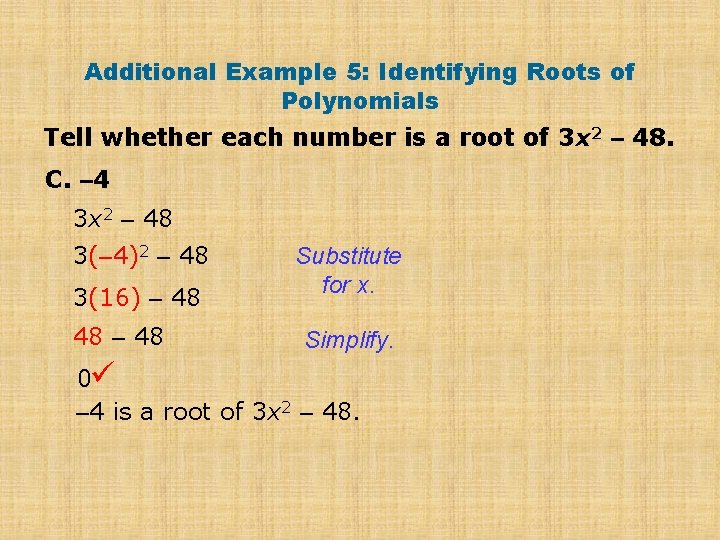
Additional Example 5: Identifying Roots of Polynomials Tell whether each number is a root of 3 x 2 – 48. C. – 4 3 x 2 – 48 3(– 4)2 – 48 3(16) – 48 48 – 48 Substitute for x. Simplify. 0 – 4 is a root of 3 x 2 – 48.
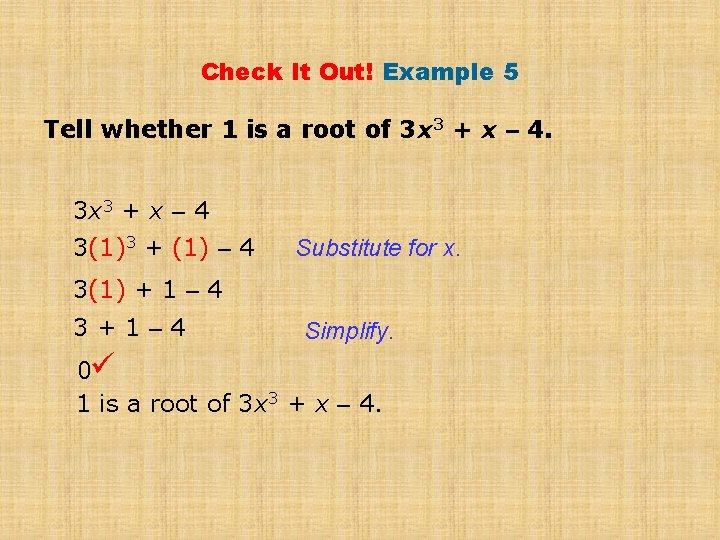
Check It Out! Example 5 Tell whether 1 is a root of 3 x 3 + x – 4 3(1)3 + (1) – 4 Substitute for x. 3(1) + 1 – 4 3+1– 4 Simplify. 0 1 is a root of 3 x 3 + x – 4.
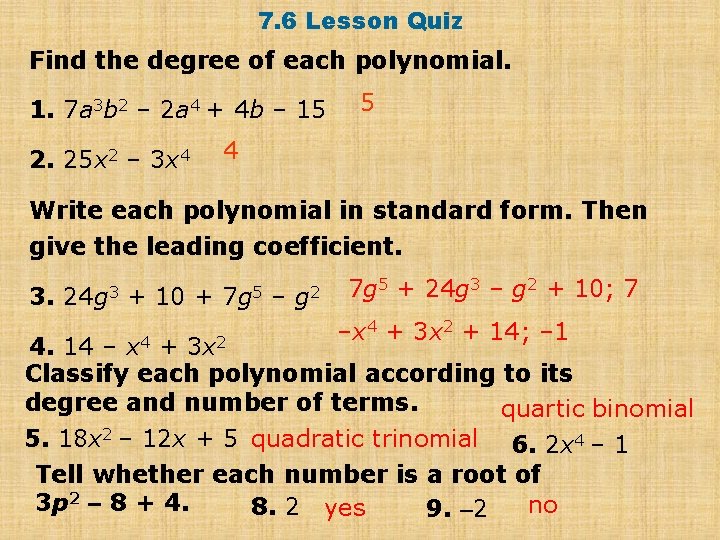
7. 6 Lesson Quiz Find the degree of each polynomial. 1. 7 a 3 b 2 – 2 a 4 + 4 b – 15 2. 25 x 2 – 3 x 4 5 4 Write each polynomial in standard form. Then give the leading coefficient. 3. 24 g 3 + 10 + 7 g 5 – g 2 7 g 5 + 24 g 3 – g 2 + 10; 7 –x 4 + 3 x 2 + 14; – 1 4. 14 – x 4 + 3 x 2 Classify each polynomial according to its degree and number of terms. quartic binomial 5. 18 x 2 – 12 x + 5 quadratic trinomial 6. 2 x 4 – 1 Tell whether each number is a root of 3 p 2 – 8 + 4. no 8. 2 yes 9. – 2
- Slides: 26