
Alfred Marshall PART 2 COMPETITIVE SUPPLY AND DEMAND
- Slides: 11
Alfred Marshall PART 2 COMPETITIVE SUPPLY AND DEMAND: SHORT RUN AND LONG RUN
Time in Marshall’s Analysis Alfred Marshall gave us microeconomic analysis in something fairly close to its current version, and there’s relatively little controversy between different “schools of thought” in microeconomics. On the other hand, Marshall’s student, John Maynard Keynes, was, in many ways, the Father of Macroeconomics, but hi presentation of it led to endless controversies between Keynesians, Monetarists, New Classicals, etc. What’s the difference? Partly the prominence of macroeconomic issues for basic economic stability, but partly the fact (in my opinion) that Marshall made a clear distinction between the microeconomics of the short run and the long run in a way that is intellectually satisfying. Keynes’s macroeconomics, I’ll argue a bit later, is the macroeconomics of the short run, and is not inconsistent with the classical macroeconomics of the long run. But there’s a tendency for people to needlessly “take sides” in the macro debates, because the two systems are not understood to be analyses of different time periods.
Time in Marshall’s Analysis Principles, Book 5, Chapter 5 The element of time is a chief cause of those difficulties in economic investigations which make it necessary for man with his limited powers to go step by step; breaking up a complex question, studying one bit at a time, and at last combining his partial solutions into a more or less complete solution of the whole riddle. In breaking it up, he segregates those disturbing causes, whose wanderings happen to be inconvenient, for the time in a pound called Cœteris Paribus… With each step more things can be let out of the pound; exact discussions can be made less abstract, realistic discussions can be made less inexact than was possible at an earlier stage… To sum up then as regards short periods. The supply of specialized skill and ability, of suitable machinery and other material capital, and of the appropriate industrial organization has not time to be fully adapted to demand; but the producers have to adjust their supply to the demand as best they can with the appliances already at their disposal… In long periods on the other hand all investments of capital and effort in providing the material plant and the organization of a business, and in acquiring trade knowledge and specialized ability, have time to be adjusted to the incomes which are expected to be earned by them: and the estimates of those incomes therefore directly govern supply, and are the true long-period normal supply price of the commodities produced.
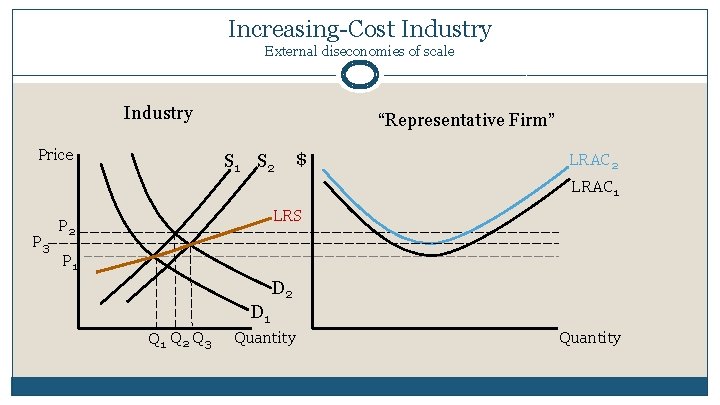
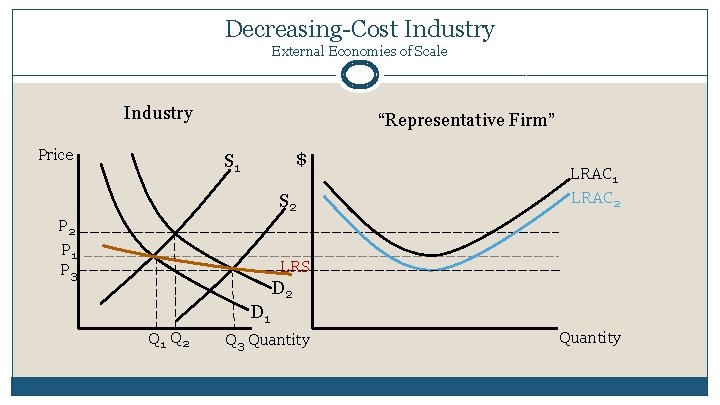
Internal and External Economies of Scale Principles, Book 4, Chapter 9 It is obvious that the efficiency of specialized machinery or specialized skill is but one condition of its economic use; the other is that sufficient work should be found to keep it well employed. . . Many of those economies in the use of specialized skill and machinery which are commonly regarded as within the reach of very large establishments, do not depend on the size of individual factories. Some depend on the aggregate volume of production of the kind in the neighborhood; while others again, especially those connected with the growth of knowledge and the progress of the arts, depend chiefly on the aggregate volume of production in the whole civilized world. And here we may introduce two technical terms. We may divide the economies arising from an increase in the scale of production of any kind of goods, into two classes—firstly, those dependent on the general development of the industry; and, secondly, those dependent on the resources of the individual houses of business engaged in it, on their organization and the efficiency of their management. We may call the former external economies, and the latter internal economies. In the present chapter we have been chiefly discussing internal economies; but we now proceed to examine those very important external economies which can often be secured by the concentration of many small businesses of a similar character in particular localities: or, as is commonly said, by the localization of industry.
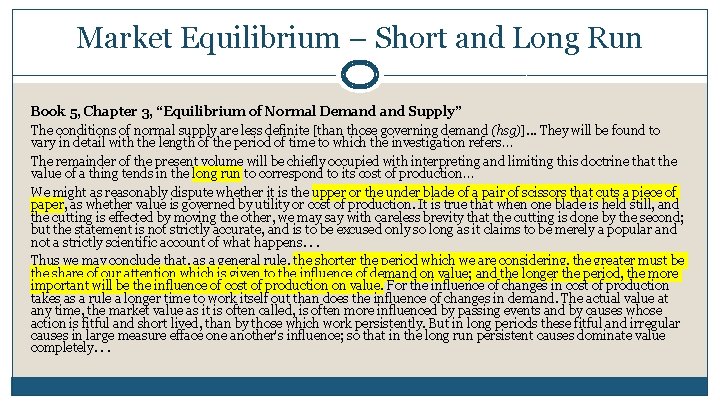
Market Equilibrium – Short and Long Run Book 5, Chapter 3, “Equilibrium of Normal Demand Supply” The conditions of normal supply are less definite [than those governing demand (hsg)]. . . They will be found to vary in detail with the length of the period of time to which the investigation refers… The remainder of the present volume will be chiefly occupied with interpreting and limiting this doctrine that the value of a thing tends in the long run to correspond to its cost of production… We might as reasonably dispute whether it is the upper or the under blade of a pair of scissors that cuts a piece of paper, as whether value is governed by utility or cost of production. It is true that when one blade is held still, and the cutting is effected by moving the other, we may say with careless brevity that the cutting is done by the second; but the statement is not strictly accurate, and is to be excused only so long as it claims to be merely a popular and not a strictly scientific account of what happens. . . Thus we may conclude that, as a general rule, the shorter the period which we are considering, the greater must be the share of our attention which is given to the influence of demand on value; and the longer the period, the more important will be the influence of cost of production on value. For the influence of changes in cost of production takes as a rule a longer time to work itself out than does the influence of changes in demand. The actual value at any time, the market value as it is often called, is often more influenced by passing events and by causes whose action is fitful and short lived, than by those which work persistently. But in long periods these fitful and irregular causes in large measure efface one another's influence; so that in the long run persistent causes dominate value completely. . .
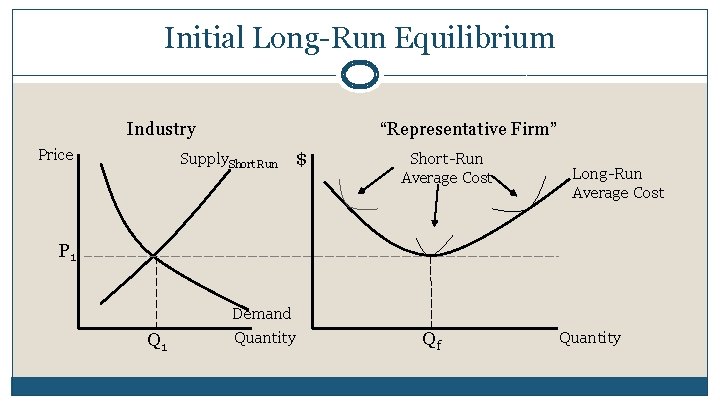
Initial Long-Run Equilibrium “Representative Firm” Industry Price Supply. Short Run $ Short-Run Average Cost Long-Run Average Cost P 1 Q 1 Demand Quantity Qf Quantity
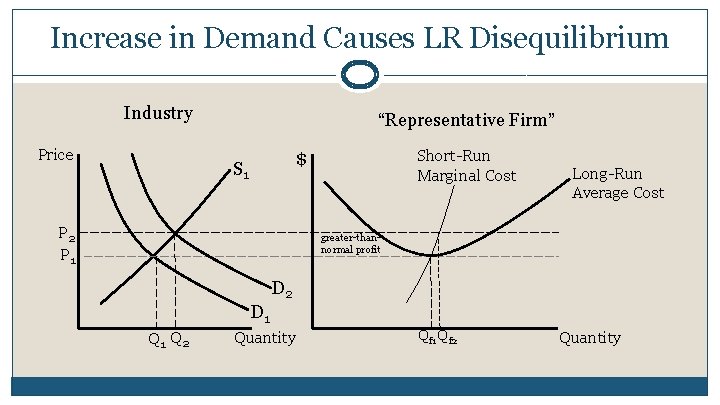
Increase in Demand Causes LR Disequilibrium Industry Price “Representative Firm” Short-Run Marginal Cost $ S 1 P 2 P 1 Long-Run Average Cost greater-thannormal profit D 2 D 1 Q 2 Quantity Qf 1 Qf 2 Quantity
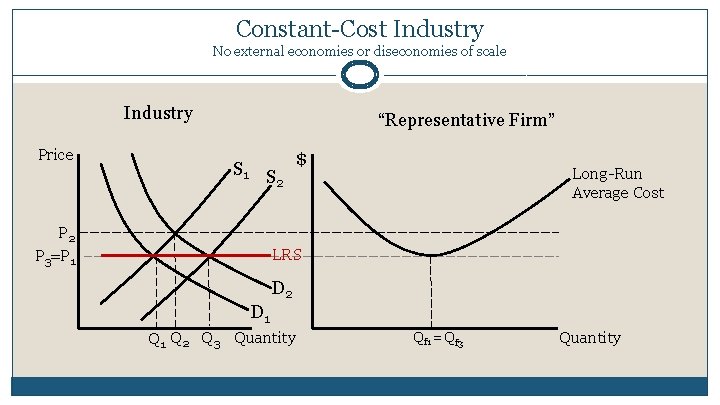
Constant-Cost Industry No external economies or diseconomies of scale Industry Price “Representative Firm” S 1 S 2 P 3=P 1 $ Long-Run Average Cost LRS D 2 D 1 Q 2 Q 3 Quantity Qf 1 = Qf 3 Quantity
Increasing-Cost Industry External diseconomies of scale Industry Price “Representative Firm” S 1 S 2 $ LRAC 2 LRAC 1 P 3 LRS P 2 P 1 D 2 D 1 Q 2 Q 3 Quantity
Decreasing-Cost Industry External Economies of Scale Industry Price “Representative Firm” $ S 1 S 2 LRAC 1 LRAC 2 P 1 P 3 LRS D 2 D 1 Q 2 Q 3 Quantity
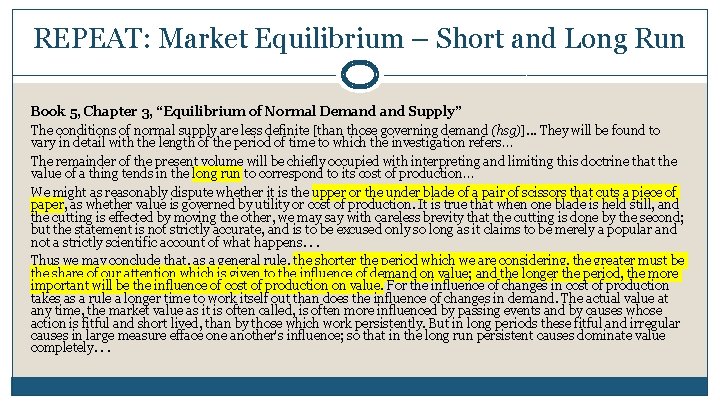
REPEAT: Market Equilibrium – Short and Long Run Book 5, Chapter 3, “Equilibrium of Normal Demand Supply” The conditions of normal supply are less definite [than those governing demand (hsg)]. . . They will be found to vary in detail with the length of the period of time to which the investigation refers… The remainder of the present volume will be chiefly occupied with interpreting and limiting this doctrine that the value of a thing tends in the long run to correspond to its cost of production… We might as reasonably dispute whether it is the upper or the under blade of a pair of scissors that cuts a piece of paper, as whether value is governed by utility or cost of production. It is true that when one blade is held still, and the cutting is effected by moving the other, we may say with careless brevity that the cutting is done by the second; but the statement is not strictly accurate, and is to be excused only so long as it claims to be merely a popular and not a strictly scientific account of what happens. . . Thus we may conclude that, as a general rule, the shorter the period which we are considering, the greater must be the share of our attention which is given to the influence of demand on value; and the longer the period, the more important will be the influence of cost of production on value. For the influence of changes in cost of production takes as a rule a longer time to work itself out than does the influence of changes in demand. The actual value at any time, the market value as it is often called, is often more influenced by passing events and by causes whose action is fitful and short lived, than by those which work persistently. But in long periods these fitful and irregular causes in large measure efface one another's influence; so that in the long run persistent causes dominate value completely. . .