
Alexis de Tocqueville Democracy in America Five Values
- Slides: 34
Alexis de Tocqueville Democracy in America Five Values 1. Laissez-Faire- government policy of “hands off” economy 2. Individualism-free to flourish without regard to station in life 3. Populism-participation of common people 4. Egalitarianism- society of equals 5. Liberty-protection from tyranny, rule of law, religious faith
Founding Father’s Line up 1. Benjamin Rush-Father of American Medicine, signer of D of I 2. John Jay - Federalists Papers, first Chief Justice of Supreme Court, neg. US borders 3. John Peter Muhlenberg-clergymen recruited soldiers to fight British 4. Jonathan Trumball, Sr. – colonial governor sided with colonists against the British, helped supply Washington’s army 5. John Hancock-Pres. Second Continental Congress, signer of D of I 6. John Witherspoon-signer of D of I, Pres. Of New Jersey College (Princeton) 7. Charles Carroll- helped to finance the war with his own money, signer of D of I 8. John Locke- theory that governments were to protect natural God given rights
Charters of Freedom 1. Dec. of Independence – “We Hold these truths to be selfevident” 2. Constitution – Preamble- a. form a more perfect union b. establish justice c. insure domestic tranquility d. provide for the common defense e. promote the general welfare 3. Bill of Rights – first ten amendments 1. 2. 3. 4. 5. self-incrimination, double jeopardy, private property taken without compensation
Principles of the US Constitution Seven Principles 1. Checks and Balances- prevents one branch from becoming too powerful. ie, presidential Veto 2. Federalism - powers divided between national and state governments, working together 3. Sep. of Powers- divide power between 3 branches; legislative, executive, judicial 4. Limited Government- powers of government are limited to those mentioned in the Constitution 5. Republicanism –democratic government of representatives elected by the people 6. Popular Sovereignty- powers of the government come from the consent of the governed 7. Individual Rights – rights guaranteed by the constitution
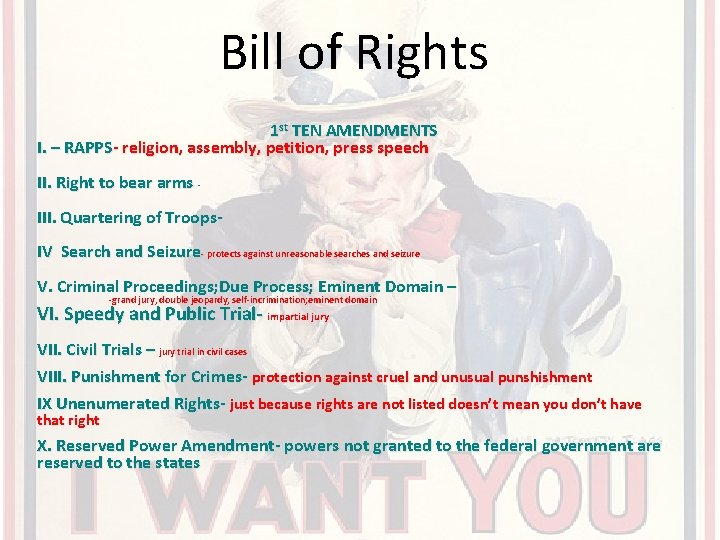
Bill of Rights 1 st TEN AMENDMENTS I. – RAPPS- religion, assembly, petition, press speech II. Right to bear arms - - III. Quartering of Troops- IV Search and Seizure- protects against unreasonable searches and seizure V. Criminal Proceedings; Due Process; Eminent Domain – -grand jury, double jeopardy, self-incrimination; eminent domain VI. Speedy and Public Trial- impartial jury VII. Civil Trials – jury trial in civil cases VIII. Punishment for Crimes- protection against cruel and unusual punshishment IX Unenumerated Rights- just because rights are not listed doesn’t mean you don’t have that right X. Reserved Power Amendment- powers not granted to the federal government are reserved to the states
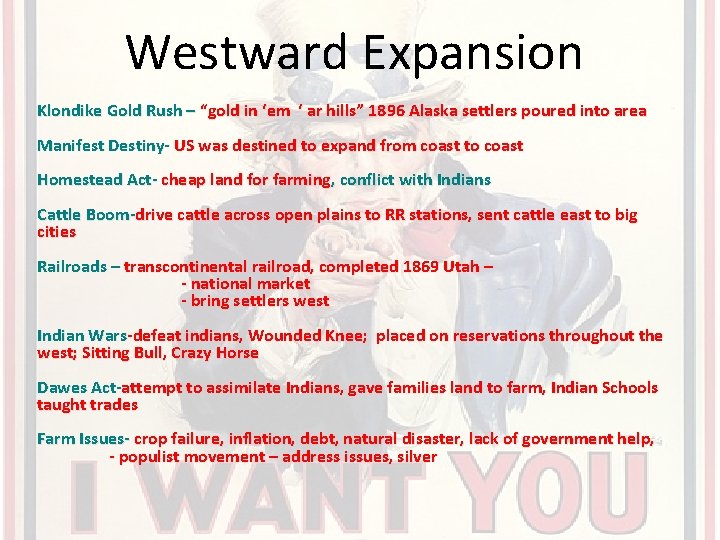
Westward Expansion Klondike Gold Rush – “gold in ‘em ‘ ar hills” 1896 Alaska settlers poured into area Manifest Destiny- US was destined to expand from coast to coast Homestead Act- cheap land for farming, conflict with Indians Cattle Boom-drive cattle across open plains to RR stations, sent cattle east to big cities Railroads – transcontinental railroad, completed 1869 Utah – - national market - bring settlers west Indian Wars-defeat indians, Wounded Knee; placed on reservations throughout the west; Sitting Bull, Crazy Horse Dawes Act-attempt to assimilate Indians, gave families land to farm, Indian Schools taught trades Farm Issues- crop failure, inflation, debt, natural disaster, lack of government help, - populist movement – address issues, silver
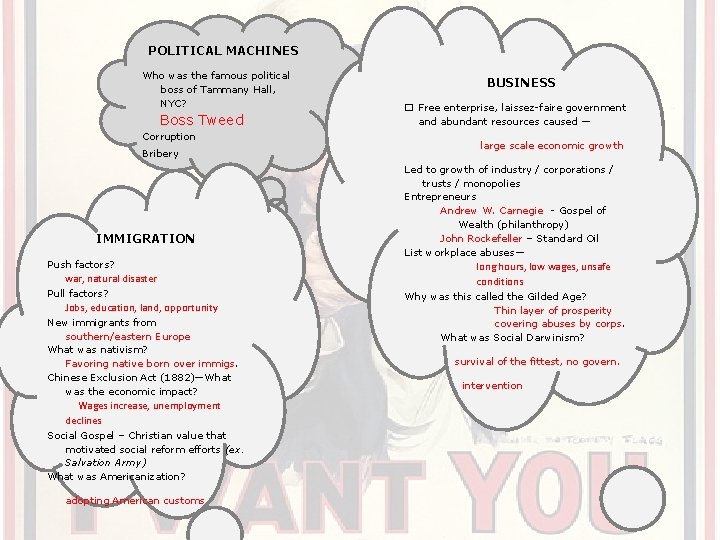
POLITICAL MACHINES Who was the famous political boss of Tammany Hall, NYC? Boss Tweed BUSINESS � Free enterprise, laissez-faire government and abundant resources caused — Corruption large scale economic growth Bribery IMMIGRATION Led to growth of industry / corporations / trusts / monopolies Entrepreneurs Andrew W. Carnegie - Gospel of Wealth (philanthropy) John Rockefeller – Standard Oil List workplace abuses— Push factors? long hours, low wages, unsafe conditions war, natural disaster Pull factors? Jobs, education, land, opportunity New immigrants from southern/eastern Europe What was nativism? Favoring native born over immigs. Chinese Exclusion Act (1882)—What was the economic impact? Why was this called the Gilded Age? Thin layer of prosperity covering abuses by corps. What was Social Darwinism? survival of the fittest, no govern. intervention Wages increase, unemployment declines Social Gospel – Christian value that motivated social reform efforts (ex. Salvation Army) What was Americanization? adopting American customs
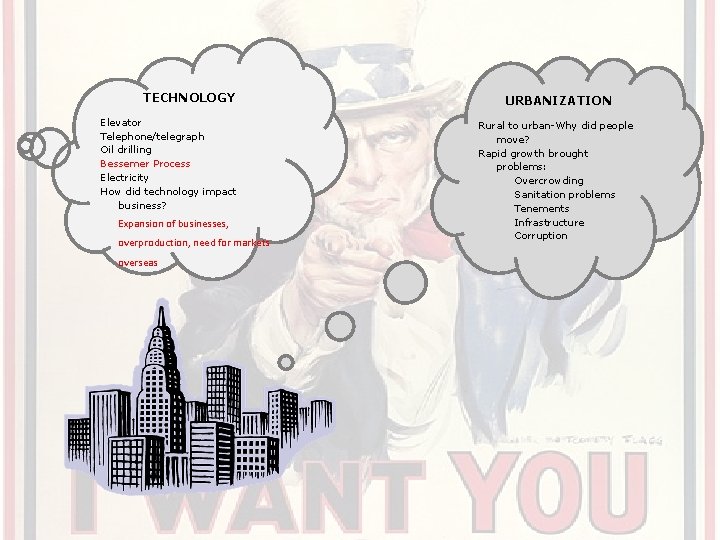
TECHNOLOGY Elevator Telephone/telegraph Oil drilling Bessemer Process Electricity How did technology impact business? Expansion of businesses, overproduction, need for markets overseas URBANIZATION Rural to urban-Why did people move? Rapid growth brought problems: Overcrowding Sanitation problems Tenements Infrastructure Corruption
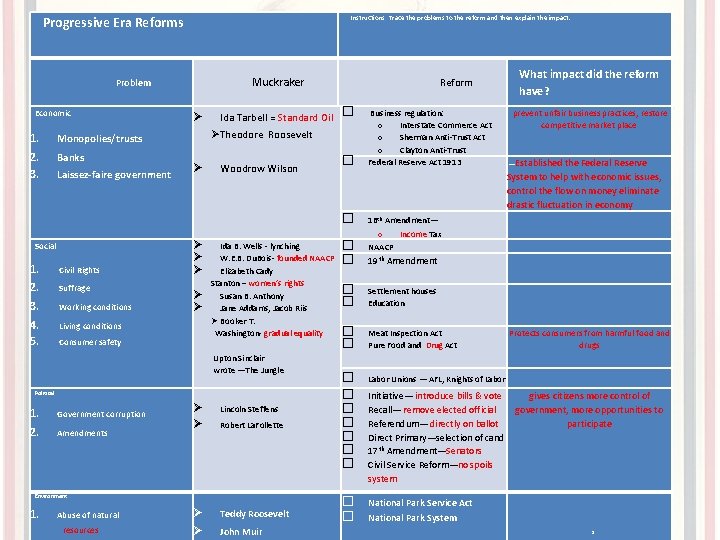
Instructions: Trace the problems to the reform and then explain the impact. Progressive Era Reforms Muckraker Problem Economic 1. Monopolies/trusts 2. 3. Banks Laissez-faire government Ida Tarbell = Standard Oil Theodore Roosevelt Woodrow Wilson � Business regulation: o Interstate Commerce Act o Sherman Anti Trust Act o Clayton Anti Trust Federal Reserve Act 1913 � � Social 1. Civil Rights 2. Suffrage 3. Working conditions 4. 5. Living conditions Consumer safety Political Ida B. Wells lynching W. E. B. Du. Bois founded NAACP Elizabeth Cady Stanton – women’s rights Susan B. Anthony Jane Addams, Jacob Riis Booker T. Washington gradual equality Upton Sinclair wrote —The Jungle 1. Government corruption 2. Amendments Lincoln Steffens Robert La. Follette What impact did the reform have? Reform � � 16 th Amendment— o Income Tax NAACP prevent unfair business practices, restore competitive market place Established the Federal Reserve System to help with economic issues, control the flow on money eliminate drastic fluctuation in economy — 19 th Amendment Settlement houses Education Meat Inspection Act Pure Food and Drug Act Protects consumers from harmful food and � � drugs � � � � Labor Unions — AFL, Knights of Labor Initiative— introduce bills & vote gives citizens more control of Recall— remove elected official government, more opportunities to Referendum— directly on ballot participate Direct Primary—selection of cand 17 th Amendment—Senators Civil Service Reform—no spoils system Environment 1. Abuse of natural resources Teddy Roosevelt John Muir � � National Park Service Act National Park System 8
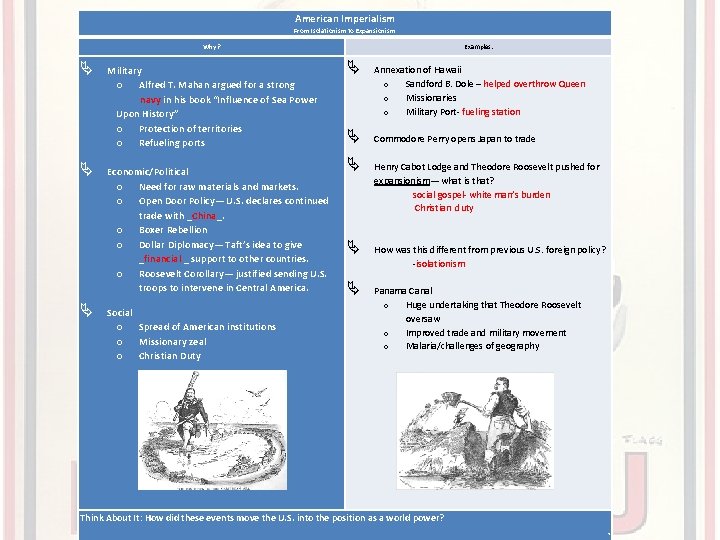
American Imperialism From Isolationism to Expansionism Why? Military o Alfred T. Mahan argued for a strong navy in his book “Influence of Sea Power Upon History” o Protection of territories o Refueling ports Examples: Economic/Political o Need for raw materials and markets. o Open Door Policy— U. S. declares continued trade with _China_. o Boxer Rebellion o Dollar Diplomacy— Taft’s idea to give _financial _ support to other countries. o Roosevelt Corollary— justified sending U. S. troops to intervene in Central America. Social o Spread of American institutions o Missionary zeal o Christian Duty Annexation of Hawaii o Sandford B. Dole – helped overthrow Queen o Missionaries o Military Port fueling station Commodore Perry opens Japan to trade Henry Cabot Lodge and Theodore Roosevelt pushed for expansionism— what is that? social gospel white man’s burden Christian duty How was this different from previous U. S. foreign policy? isolationism Panama Canal o Huge undertaking that Theodore Roosevelt oversaw o Improved trade and military movement o Malaria/challenges of geography Think About It: How did these events move the U. S. into the position as a world power? 9
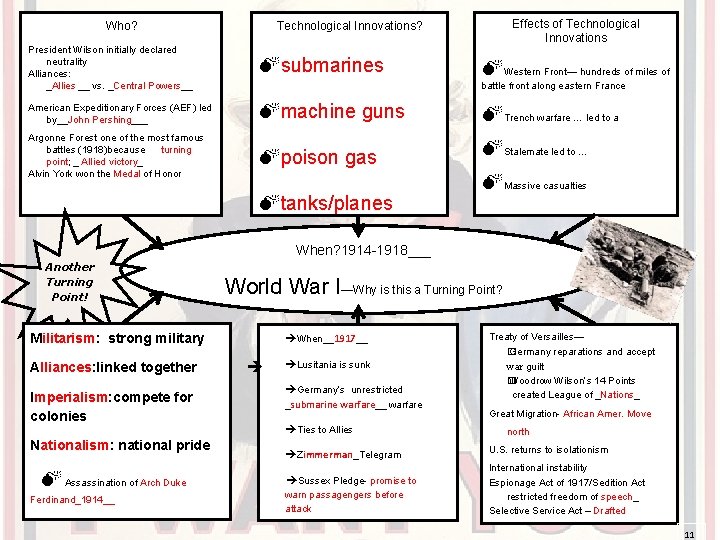
Who? Effects of Technological Innovations? President Wilson initially declared neutrality Alliances: _Allies __ vs. _Central Powers__ submarines American Expeditionary Forces (AEF) led by__John Pershing___ machine guns Trench warfare … led to a poison gas Stalemate led to … Western Front— hundreds of miles of battle front along eastern France Argonne Forest one of the most famous battles (1918)because turning point; _ Allied victory_ Alvin York won the Medal of Honor tanks/planes Another Turning Point! Imperialism: compete for colonies Nationalism: national pride Assassination of Arch Duke Ferdinand_1914__ When? 1914 -1918___ World War I—Why is this a Turning Point? Militarism: strong military Alliances: linked together Massive casualties When__1917__ Treaty of Versailles— � Germany reparations and accept Lusitania is sunk war guilt Germany’s unrestricted _submarine warfare__ warfare Ties to Allies Zimmerman_Telegram Sussex Pledge- promise to warn passagengers before attack � Woodrow Wilson’s 14 Points created League of _Nations_ Great Migration- African Amer. Move north U. S. returns to isolationism International instability Espionage Act of 1917/Sedition Act restricted freedom of speech_ Selective Service Act – Drafted 11
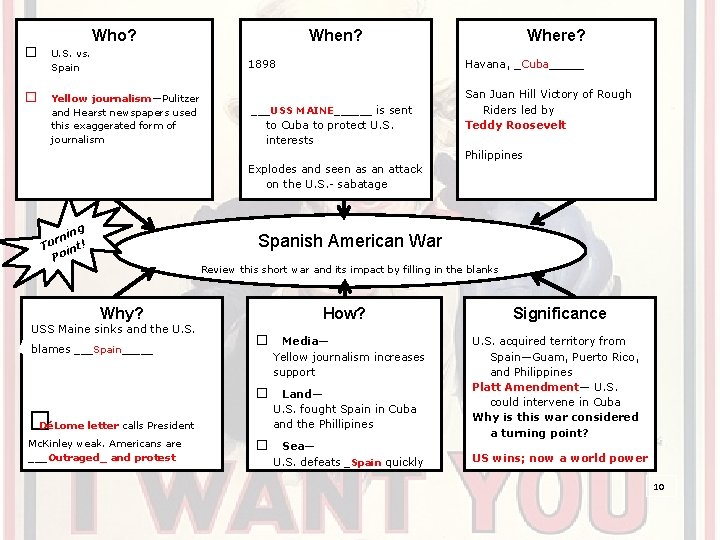
Who? � � U. S. vs. Spain When? 1898 Yellow journalism—Pulitzer and Hearst newspapers used this exaggerated form of journalism ___USS MAINE______ is sent to Cuba to protect U. S. interests Where? Havana, _Cuba_____ San Juan Hill Victory of Rough Riders led by Teddy Roosevelt Philippines Explodes and seen as an attack on the U. S. - sabatage ing rn ! u T int Po Spanish American War Review this short war and its impact by filling in the blanks Why? USS Maine sinks and the U. S. blames ___Spain_____ How? � Media— Yellow journalism increases support � Land— U. S. fought Spain in Cuba and the Phillipines � Sea— U. S. defeats _Spain quickly � DéLome letter calls President Mc. Kinley weak. Americans are ___Outraged_ and protest Significance U. S. acquired territory from Spain—Guam, Puerto Rico, and Philippines Platt Amendment— U. S. could intervene in Cuba Why is this war considered a turning point? US wins; now a world power 10
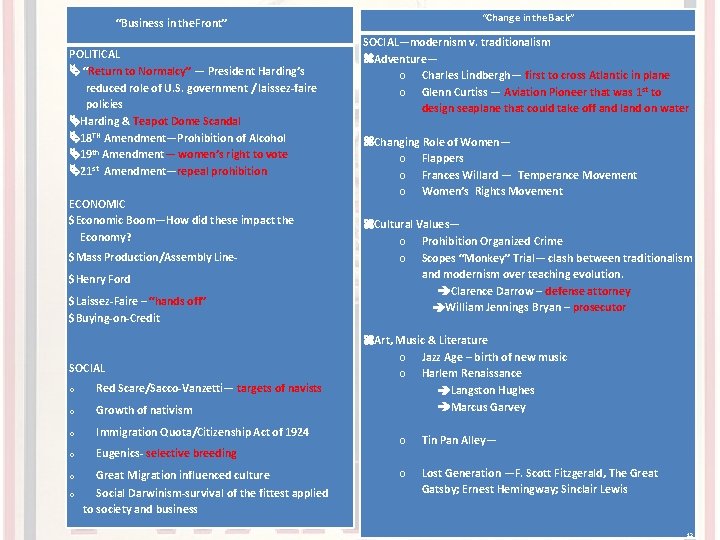
“Change in the Back” “Business in the Front” POLITICAL “Return to Normalcy” — President Harding’s reduced role of U. S. government / laissez-faire policies Harding & Teapot Dome Scandal 18 TH Amendment—Prohibition of Alcohol 19 th Amendment— women’s right to vote 21 st Amendment—repeal prohibition ECONOMIC $Economic Boom—How did these impact the Economy? $Mass Production/Assembly Line- $Henry Ford $Laissez-Faire – “hands off” $Buying-on-Credit SOCIAL o Red Scare/Sacco-Vanzetti— targets of navists o Growth of nativism o Immigration Quota/Citizenship Act of 1924 o Eugenics- selective breeding Great Migration influenced culture o Social Darwinism-survival of the fittest applied to society and business o SOCIAL—modernism v. traditionalism Adventure— o Charles Lindbergh— first to cross Atlantic in plane o Glenn Curtiss — Aviation Pioneer that was 1 st to design seaplane that could take off and land on water Changing Role of Women— o Flappers o Frances Willard — Temperance Movement o Women’s Rights Movement Cultural Values— o Prohibition Organized Crime o Scopes “Monkey” Trial— clash between traditionalism and modernism over teaching evolution. Clarence Darrow – defense attorney William Jennings Bryan – prosecutor Art, Music & Literature o Jazz Age – birth of new music o Harlem Renaissance Langston Hughes Marcus Garvey o Tin Pan Alley— o Lost Generation —F. Scott Fitzgerald, The Great Gatsby; Ernest Hemingway; Sinclair Lewis 12
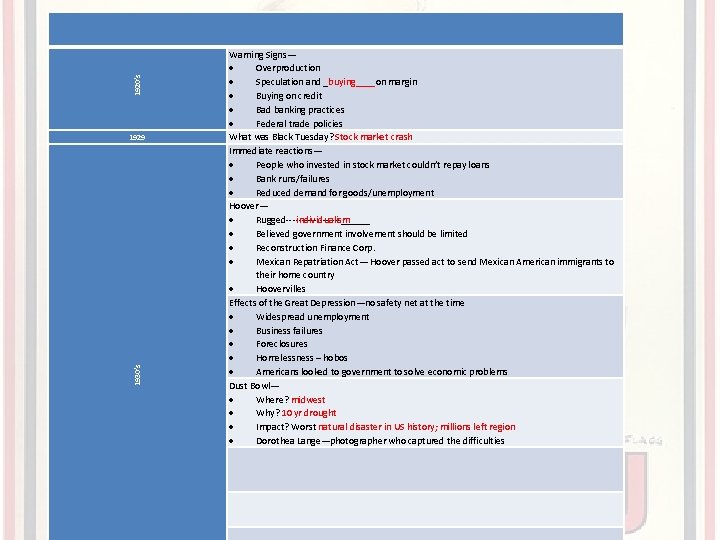
1920’s 1930’s 1929 Warning Signs— Overproduction Speculation and _buying____on margin Buying on credit Bad banking practices Federal trade policies What was Black Tuesday? Stock market crash Immediate reactions— People who invested in stock market couldn’t repay loans Bank runs/failures Reduced demand for goods/unemployment Hoover— Rugged __ individualism____ Believed government involvement should be limited Reconstruction Finance Corp. Mexican Repatriation Act— Hoover passed act to send Mexican American immigrants to their home country Hoovervilles Effects of the Great Depression—no safety net at the time Widespread unemployment Business failures Foreclosures Homelessness – hobos Americans looked to government to solve economic problems Dust Bowl— Where? midwest Why? 10 yr drought Impact? Worst natural disaster in US history; millions left region Dorothea Lange—photographer who captured the difficulties
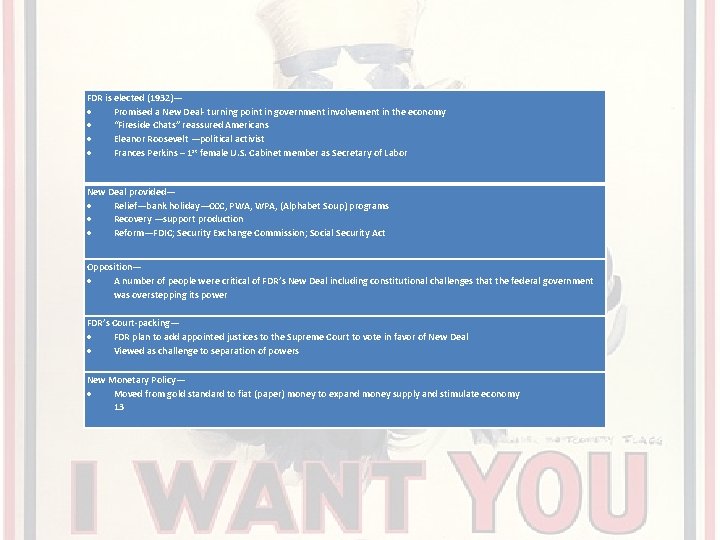
FDR is elected (1932)— Promised a New Deal- turning point in government involvement in the economy “Fireside Chats” reassured Americans Eleanor Roosevelt —political activist Frances Perkins – 1 st female U. S. Cabinet member as Secretary of Labor New Deal provided— Relief—bank holiday—CCC, PWA, WPA, (Alphabet Soup) programs Recovery —support production Reform—FDIC; Security Exchange Commission; Social Security Act Opposition— A number of people were critical of FDR’s New Deal including constitutional challenges that the federal government was overstepping its power FDR’s Court-packing— FDR plan to add appointed justices to the Supreme Court to vote in favor of New Deal Viewed as challenge to separation of powers New Monetary Policy— Moved from gold standard to fiat (paper) money to expand money supply and stimulate economy 13
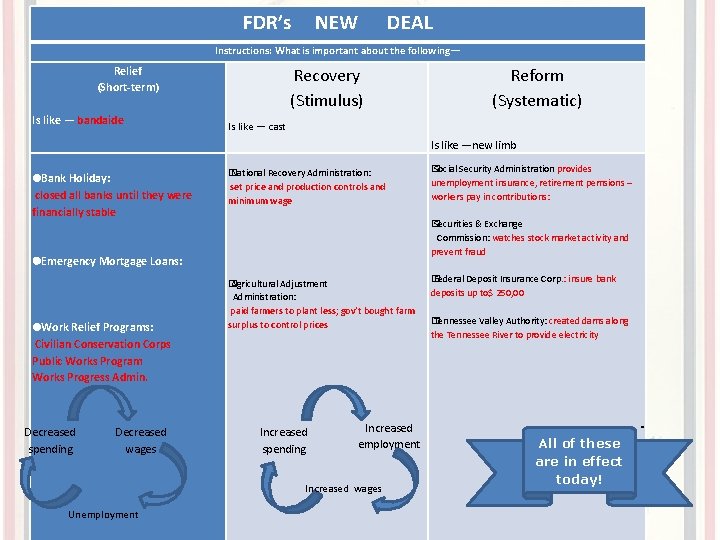
FDR’s NEW DEAL Instructions: What is important about the following— Relief (Short-term) Is like — bandaide Recovery (Stimulus) Reform (Systematic) Is like — cast Is like —new limb Bank Holiday: closed all banks until they were financially stable Emergency Mortgage Loans: Work Relief Programs: Civilian Conservation Corps Public Works Program Works Progress Admin. Decreased wages spending Unemployment � National Recovery Administration: set price and production controls and minimum wage � Agricultural Adjustment Administration: paid farmers to plant less; gov’t bought farm surplus to control prices Increased spending Increased employment Increased wages � Social Security Administration provides unemployment insurance, retirement pemsions – workers pay in contributions: � Securities & Exchange Commission: watches stock market activity and prevent fraud � Federal Deposit Insurance Corp. : insure bank deposits up to$ 250, 00 � Tennessee Valley Authority: created dams along the Tennessee River to provide electricity 14 All of these are in effect today!
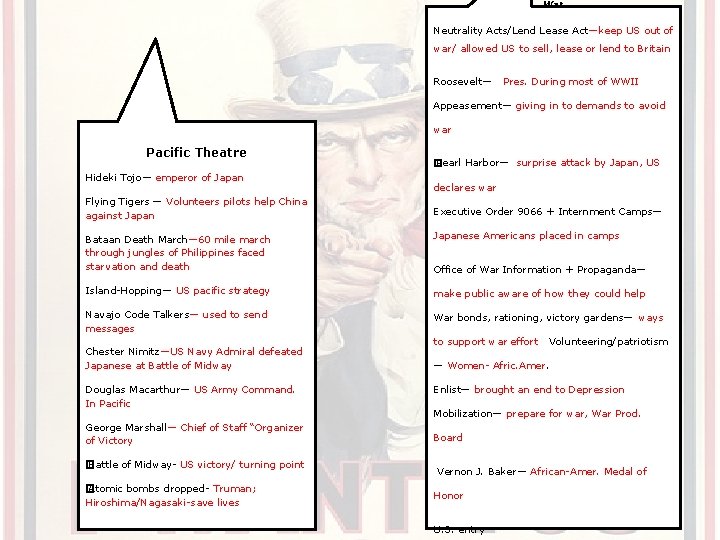
War Neutrality Acts/Lend Lease Act—keep US out of war/ allowed US to sell, lease or lend to Britain Roosevelt— Pres. During most of WWII Appeasement— giving in to demands to avoid war Pacific Theatre Hideki Tojo— emperor of Japan Flying Tigers — Volunteers pilots help China against Japan � Pearl Harbor— surprise attack by Japan, US declares war Executive Order 9066 + Internment Camps— Bataan Death March— 60 mile march through jungles of Philippines faced starvation and death Japanese Americans placed in camps Island-Hopping— US pacific strategy make public aware of how they could help Navajo Code Talkers— used to send messages War bonds, rationing, victory gardens— ways Chester Nimitz—US Navy Admiral defeated Japanese at Battle of Midway Douglas Macarthur— US Army Command. In Pacific George Marshall— Chief of Staff “Organizer of Victory � Battle of Midway- US victory/ turning point � Atomic bombs dropped- Truman; Hiroshima/Nagasaki-save lives Office of War Information + Propaganda— to support war effort Volunteering/patriotism — Women- Afric. Amer. Enlist— brought an end to Depression Mobilization— prepare for war, War Prod. Board Vernon J. Baker— African-Amer. Medal of Honor U. S. entry—
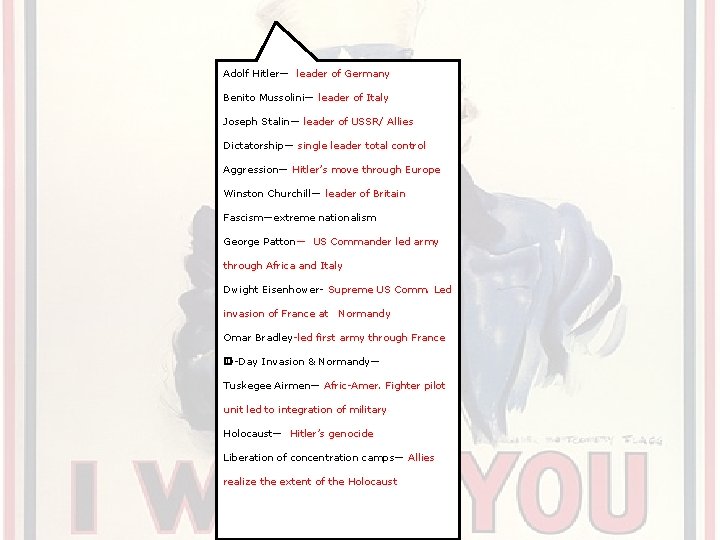
Adolf Hitler— leader of Germany Benito Mussolini— leader of Italy Joseph Stalin— leader of USSR/ Allies Dictatorship— single leader total control Aggression— Hitler’s move through Europe Winston Churchill— leader of Britain Fascism—extreme nationalism George Patton— US Commander led army through Africa and Italy Dwight Eisenhower- Supreme US Comm. Led invasion of France at Normandy Omar Bradley-led first army through France � D-Day Invasion & Normandy— Tuskegee Airmen— Afric-Amer. Fighter pilot unit led to integration of military Holocaust— Hitler’s genocide Liberation of concentration camps— Allies realize the extent of the Holocaust
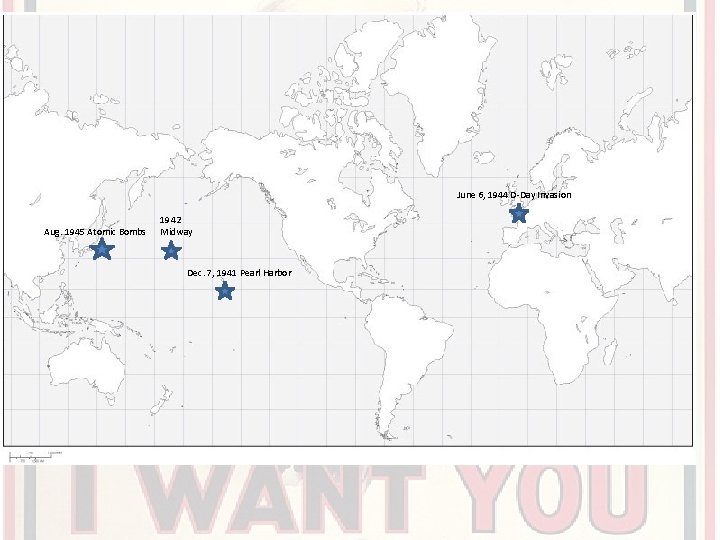
June 6, 1944 D Day Invasion Aug. 1945 Atomic Bombs 1942 Midway Dec. 7, 1941 Pearl Harbor
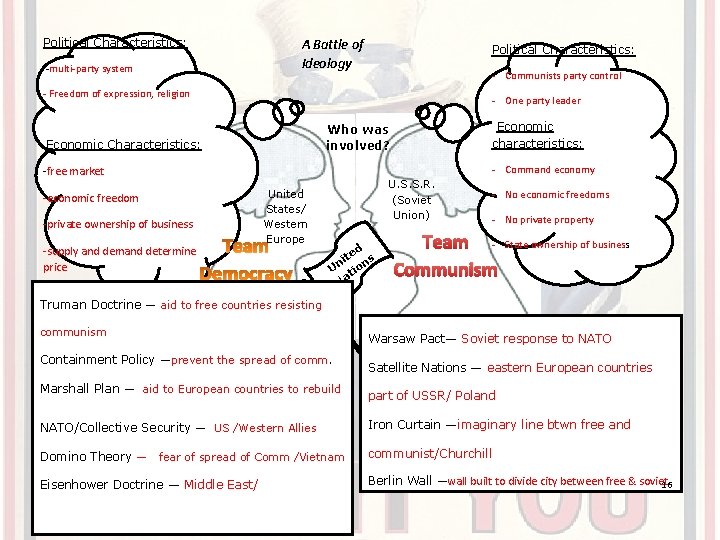
Political Characteristics: A Battle of Ideology multi party system Political Characteristics: Communists party control Freedom of expression, religion One party leader Economic Who was involved? Economic Characteristics: characteristics: Command economy a free market economic freedom private ownership of business supply and demand determine price United States/ Western Europe Team Democracy U. S. S. R. (Soviet Union) d te s i Un tion a N No economic freedoms No private property Team Communism State ownership of business Truman Doctrine — aid to free countries resisting communism Warsaw Pact— Soviet response to NATO Containment Policy —prevent the spread of comm. Satellite Nations — eastern European countries Marshall Plan — aid to European countries to rebuild part of USSR/ Poland Iron Curtain —imaginary line btwn free and NATO/Collective Security — US /Western Allies communist/Churchill Domino Theory — fear of spread of Comm /Vietnam Eisenhower Doctrine — Middle East/ Berlin Wall —wall built to divide city between free & soviet 16
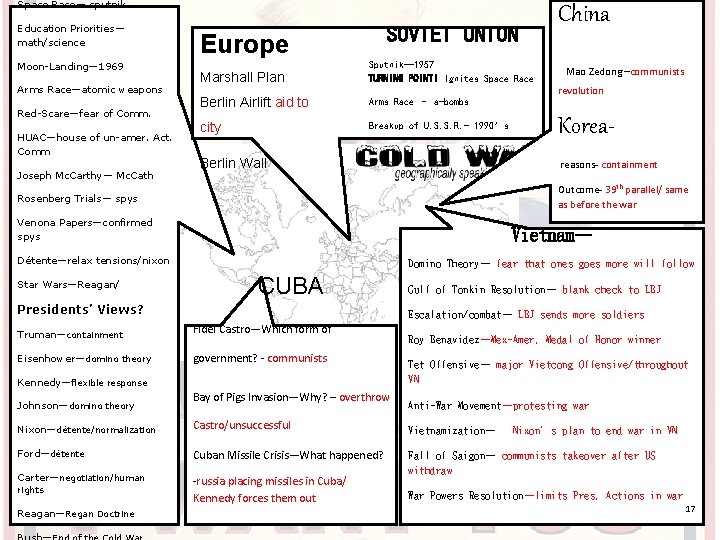
Space Race— sputnik Education Priorities— math/science SOVIET UNION Europe Sputnik— 1957 Marshall Plan TURNING POINT! Ignites Space Race Moon-Landing— 1969 Arms Race—atomic weapons Red-Scare—fear of Comm. HUAC—house of un-amer. Act. Comm Joseph Mc. Carthy— Mc. Cath Rosenberg Trials— spys Berlin Airlift aid to Arms Race – a-bombs city Breakup of U. S. S. R. - 1990’s Korea- Outcome 39 th parallel/ same as before the war Domino Theory— fear that ones goes more will follow CUBA Gulf of Tonkin Resolution— blank check to LBJ Presidents’ Views? Escalation/combat— LBJ sends more soldiers Truman—containment Fidel Castro—Which form of Eisenhower— domino theory government? communists Kennedy—flexible response Bay of Pigs Invasion—Why? – overthrow Nixon—détente/normalization Castro/unsuccessful Ford—détente Cuban Missile Crisis—What happened? Carter—negotiation/human russia placing missiles in Cuba/ Kennedy forces them out Reagan—Regan Doctrine revolution Vietnam— Star Wars—Reagan/ rights Mao Zedong –communists reasons containment Détente—relax tensions/nixon Johnson— domino theory Berlin Wall Venona Papers—confirmed spys China Roy Benavidez—Mex-Amer. Medal of Honor winner Tet Offensive— major Vietcong Offensive/throughout VN Anti-War Movement—protesting war Vietnamization— Nixon’s plan to end war in VN Fall of Saigon— communists takeover after US withdraw War Powers Resolution—limits Pres. Actions in war 17
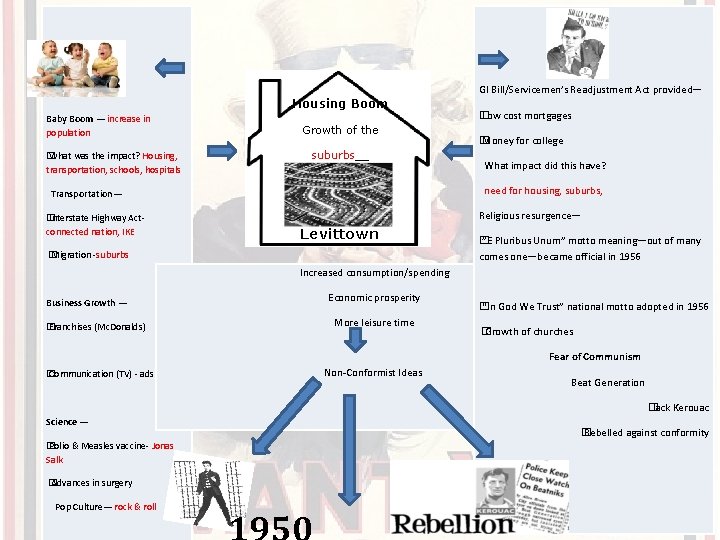
GI Bill/Servicemen’s Readjustment Act provided— Housing Boom Baby Boom — increase in population � What was the impact? Housing, transportation, schools, hospitals Growth of the suburbs__ � Low cost mortgages � Money for college What impact did this have? Transportation— need for housing, suburbs, � Interstate Highway Act connected nation, IKE Religious resurgence— Levittown � Migration suburbs Business Growth — � Franchises (Mc. Donalds) � Communication (TV) ads Increased consumption/spending Economic prosperity More leisure time Non Conformist Ideas Science — � Polio & Measles vaccine Jonas Salk � Advances in surgery Pop Culture— rock & roll � ”E Pluribus Unum” motto meaning—out of many comes one—became official in 1956 � “In God We Trust” national motto adopted in 1956 � Growth of churches Fear of Communism Beat Generation � Jack Kerouac � Rebelled against conformity
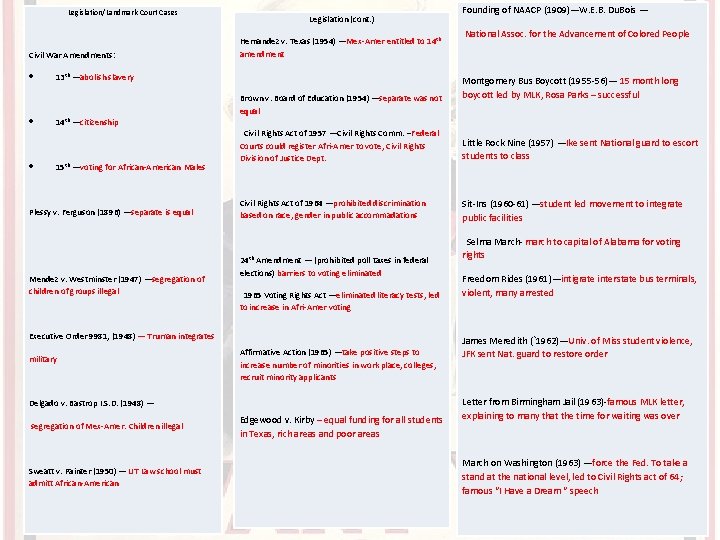
Legislation/Landmark Court Cases Legislation (cont. ) Civil War Amendments: Hernandez v. Texas (1954) —Mex Amer entitled to 14 th amendment 13 th —abolish slavery Brown v. Board of Education (1954) —separate was not equal 14 th —citizenship Founding of NAACP (1909)—W. E. B. Du. Bois — National Assoc. for the Advancement of Colored People Montgomery Bus Boycott (1955 56)— 15 month long boycott led by MLK, Rosa Parks – successful Civil Rights Act of 1957 —Civil Rights Comm. –Federal Courts could register Afri Amer to vote, Civil Rights Division of Justice Dept. Little Rock Nine (1957) —Ike sent National guard to escort students to class Plessy v. Ferguson (1896) —separate is equal Civil Rights Act of 1964 —prohibited discrimination based on race, gender in public accommadations Sit Ins (1960 61) —student led movement to integrate public facilities 24 th Amendment — (prohibited poll taxes in federal elections) barriers to voting eliminated Selma March march to capital of Alabama for voting rights 15 th —voting for African American Males Mendez v. Westminster (1947) —segregation of children of groups illegal Executive Order 9981, (1948) — Truman integrates military Delgado v. Bastrop I. S. D. (1948) — segregation of Mex Amer. Children illegal Sweatt v. Painter (1950) — UT Law school must admitt African American 1965 Voting Rights Act —eliminated literacy tests, led to increase in Afri Amer voting Affirmative Action (1965) —take positive steps to increase number of minorities in work place, colleges, recruit minority applicants Edgewood v. Kirby – equal funding for all students in Texas, rich areas and poor areas Freedom Rides (1961)—intigrate interstate bus terminals, violent, many arrested James Meredith (`1962)—Univ. of Miss student violence, JFK sent Nat. guard to restore order Letter from Birmingham Jail (1963) famous MLK letter, explaining to many that the time for waiting was over March on Washington (1963) —force the Fed. To take a stand at the national level, led to Civil Rights act of 64; famous “I Have a Dream “ speech
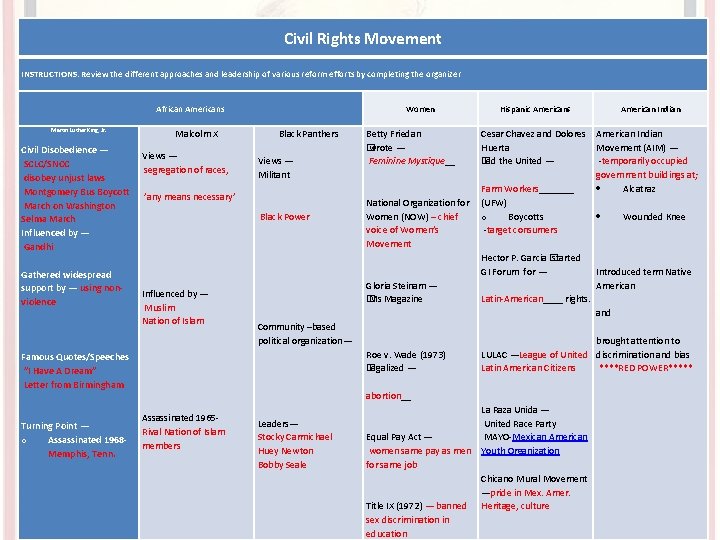
Civil Rights Movement INSTRUCTIONS: Review the different approaches and leadership of various reform efforts by completing the organizer African Americans Martin Luther King, Jr. Civil Disobedience — SCLC/SNCC disobey unjust laws Montgomery Bus Boycott March on Washington Selma March Influenced by — Gandhi Gathered widespread support by — using nonviolence Famous Quotes/Speeches ”I Have A Dream” Letter from Birmingham Turning Point — o Assassinated 1968 - Memphis, Tenn. Malcolm X Views — segregation of races, ’any means necessary’ Influenced by — Muslim Nation of Islam Assassinated 1965 Rival Nation of Islam members Black Panthers Views — Militant Black Power Community –based political organization— Leaders— Stocky Carmichael Huey Newton Bobby Seale Women Hispanic Americans Betty Friedan � wrote — Feminine Mystique__ National Organization for Women (NOW) – chief voice of Women’s Movement Gloria Steinam — � Ms Magazine Roe v. Wade (1973) � legalized — abortion__ Equal Pay Act — women same pay as men for same job Title IX (1972) — banned sex discrimination in education Cesar Chavez and Dolores Huerta � led the United — Farm Workers_______ (UFW) o Boycotts target consumers Hector P. Garcia � started GI Forum for — Latin American____ rights. LULAC —League of United Latin American Citizens La Raza Unida — United Race Party MAYO Mexican American Youth Organization Chicano Mural Movement —pride in Mex. Amer. Heritage, culture American Indian Movement (AIM) — temporarily occupied government buildings at; Alcatraz Wounded Knee Introduced term Native American and brought attention to discrimination and bias ****RED POWER*****
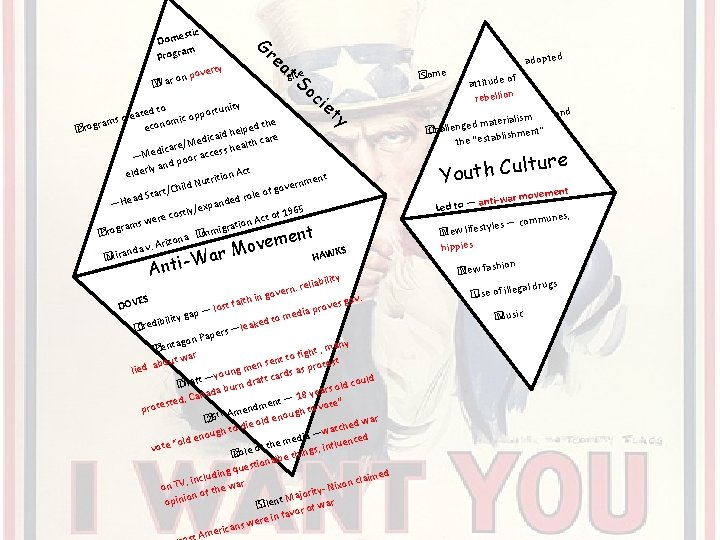
c mesti Do m a Progr rty pove n give o r a W � unity d to e t a pport e o r c c i s m m e o a h r n eco Prog ped t � id hel a c i d care Me ealth h care/ i s s d e e c —M nd poor ac a y l Act elder rition ent t u N vernm hild o C g / f t r o Sta role Head nded a p x e — 965 stly/ ct of 1 ere co A w n s o i am grat Progr � Immi � a n Arizo da v. KS n a r i M � HAW ility reliab . n r e gov ES gov. aith in f t s DO V oves o r l p — a i gap med ibility ed to d k e a r e C l � rs — Pape n o g a ny Pent � t , ma h g i f r a w nt to bout otest en se m g lied a as pr n s u d o r y a — ft c uld Draft rn dra � old co u s b r a a d e 18 y Cana nt — sted, e te” e t m o d r n p to vo h g t h Ame u o 26 ar � ld en hed w die o c o t t a h w g ou a — old en medi enced “ e u l h e f t t n f i o v Role o lbe things, � a estion u q g cludin r aimed l n i c , n V o T on e wa Nix of th jority n a o i M n i t op ar Silen � favor of w ere in ans w c i r e Am Gr ea t adopted e Som � f o e attitud rebellion and ialism r te a m d Challenge � t” blishmen the “esta So ci et y e Cultur Y t h u o ment war move i t n a — Led to es, commun — s le ty s e New lif � t n e m s ve hippie o M r a W n io i h s a t f New An � gs u r d l a g Use of ille � Music �
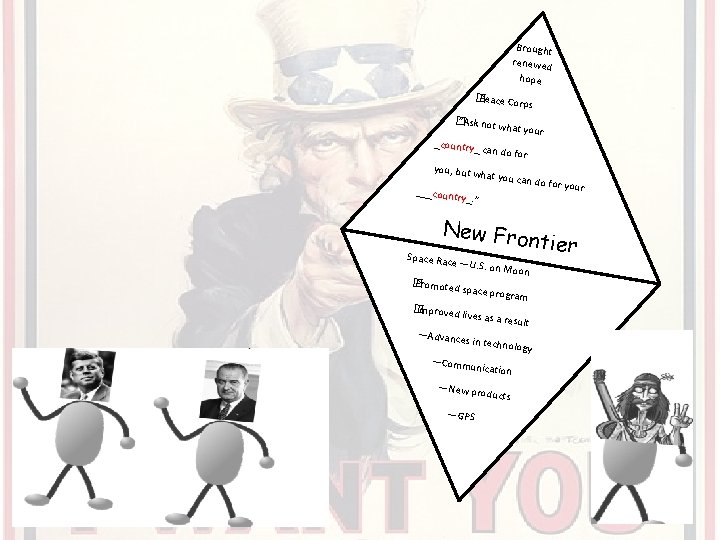
Brought renewed hope � Peace Corp s � “Ask not w hat your _countr y_ can do f or you, bu t what you can do fo r your ___countr y_. ” New Fron tier Space Rac e —U. S. o n Moon � Promoted space pro gram � Improved l ives as a re sult —Adv ances in te chnology — Communic ation —New pro ducts —GPS
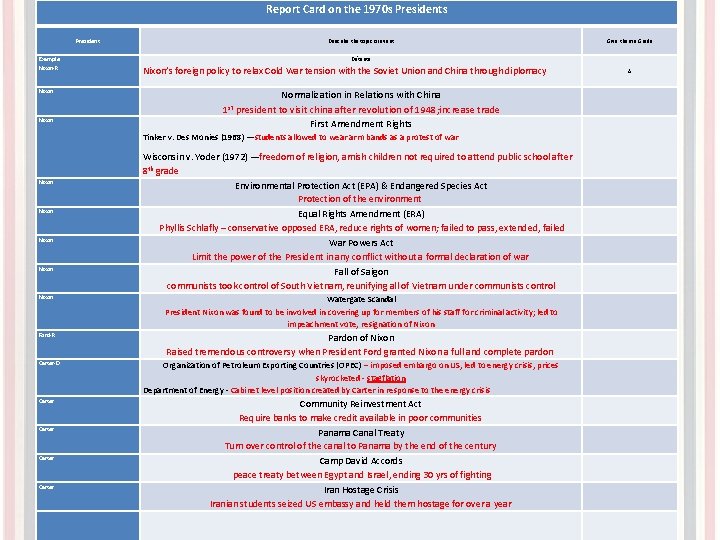
Report Card on the 1970 s President Example: Nixon-R Describe the topic or event Give them a Grade Détente Nixon’s foreign policy to relax Cold War tension with the Soviet Union and China through diplomacy Nixon Normalization in Relations with China st 1 president to visit china after revolution of 1948; increase trade Nixon A First Amendment Rights Tinker v. Des Monies (1968) —students allowed to wear arm bands as a protest of war Nixon Nixon Ford-R Carter-D Carter Wisconsin v. Yoder (1972) —freedom of religion, amish children not required to attend public school after 8 th grade Environmental Protection Act (EPA) & Endangered Species Act Protection of the environment Equal Rights Amendment (ERA) Phyllis Schlafly – conservative opposed ERA, reduce rights of women; failed to pass, extended, failed War Powers Act Limit the power of the President in any conflict without a formal declaration of war Fall of Saigon communists took control of South Vietnam, reunifying all of Vietnam under communists control Watergate Scandal President Nixon was found to be involved in covering up for members of his staff for criminal activity; led to impeachment vote, resignation of Nixon Pardon of Nixon Raised tremendous controversy when President Ford granted Nixon a full and complete pardon Organization of Petroleum Exporting Countries (OPEC) – imposed embargo on US, led to energy crisis, prices skyrocketed stagflation Department of Energy Cabinet level position created by Carter in response to the energy crisis Community Reinvestment Act Require banks to make credit available in poor communities Panama Canal Treaty Turn over control of the canal to Panama by the end of the century Camp David Accords peace treaty between Egypt and Israel, ending 30 yrs of fighting Iran Hostage Crisis Iranian students seized US embassy and held them hostage for over a year
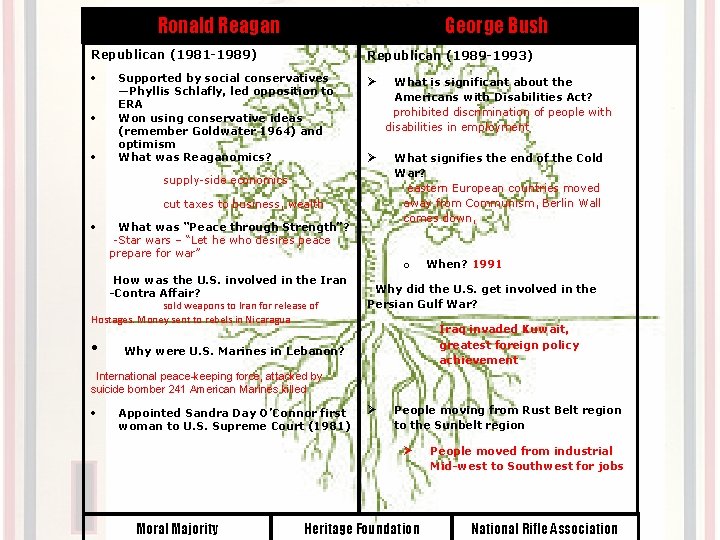
Ronald Reagan George Bush Republican (1981 -1989) Republican (1989 -1993) Supported by social conservatives What is significant about the —Phyllis Schlafly, led opposition to Americans with Disabilities Act? ERA prohibited discrimination of people with Won using conservative ideas disabilities in employment (remember Goldwater 1964) and optimism What was Reaganomics? What signifies the end of the Cold War? supply-side economics eastern European countries moved away from Communism, Berlin Wall cut taxes to business, wealth comes down, What was “Peace through Strength”? -Star wars – “Let he who desires peace prepare for war” o When? 1991 How was the U. S. involved in the Iran Why did the U. S. get involved in the -Contra Affair? Persian Gulf War? sold weapons to Iran for release of Hostages. Money sent to rebels in Nicaragua Iraq invaded Kuwait, greatest foreign policy Why were U. S. Marines in Lebanon? achievement International peace-keeping force, attacked by suicide bomber 241 American Marines killed • Appointed Sandra Day O’Connor first woman to U. S. Supreme Court (1981) People moving from Rust Belt region to the Sunbelt region People moved from industrial Mid-west to Southwest for jobs Moral Majority Heritage Foundation National Rifle Association
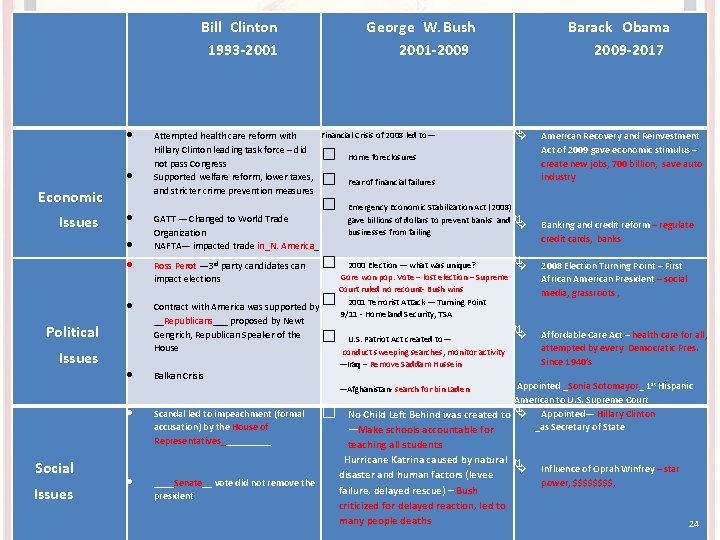
Bill Clinton 1993 -2001 George W. Bush 2001 -2009 Financial Crisis of 2008 led to— Attempted health care reform with Hillary Clinton leading task force – did Home foreclosures not pass Congress Supported welfare reform, lower taxes, Fear of financial failures and stricter crime prevention measures Barack Obama 2009 -2017 American Recovery and Reinvestment Act of 2009 gave economic stimulus – create new jobs, 700 billion, save auto industry � Economic Issues � GATT — Changed to World Trade Organization NAFTA— impacted trade in_N. America_ Ross Perot — 3 rd party candidates can impact elections Social Issues � � � Contract with America was supported by __Republicans___ proposed by Newt Gengrich, Republican Speaker of the House Political Issues � Balkan Crisis Scandal led to impeachment (formal accusation) by the House of Representatives_____ ____Senate__ vote did not remove the president � Emergency Economic Stabilization Act (2008) gave billions of dollars to prevent banks and businesses from failing 2000 Election — what was unique? Gore won pop. Vote – lost election – Supreme Court ruled no recount Bush wins 2001 Terrorist Attack — Turning Point 9/11 Homeland Security, TSA U. S. Patriot Act created to— conduct sweeping searches, monitor activity —Iraq – Remove Saddam Hussein —Afghanistan search for bin Laden Banking and credit reform – regulate credit cards, banks 2008 Election Turning Point – First African American President – social media, grassroots , Affordable Care Act – health care for all, attempted by every Democratic Pres. Since 1940’s Appointed _Sonia Sotomayor_ 1 st Hispanic American to U. S. Supreme Court Appointed— Hillary Clinton No Child Left Behind was created to _as Secretary of State —Make schools accountable for teaching all students Hurricane Katrina caused by natural Influence of Oprah Winfrey – star disaster and human factors (levee power, $$$$, failure, delayed rescue) – Bush criticized for delayed reaction, led to many people deaths 24
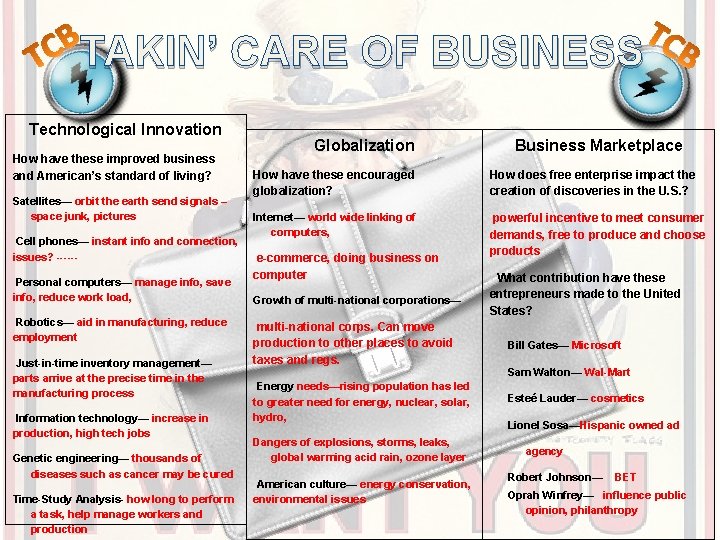
TC B TC TAKIN’ CARE OF BUSINESS B Technological Innovation How have these improved business and American’s standard of living? Satellites— orbit the earth send signals – space junk, pictures Cell phones— instant info and connection, issues? ----- Personal computers— manage info, save info, reduce work load, Robotics— aid in manufacturing, reduce employment Just-in-time inventory management— parts arrive at the precise time in the manufacturing process Information technology— increase in production, high tech jobs Genetic engineering— thousands of diseases such as cancer may be cured Time-Study Analysis- how long to perform a task, help manage workers and production Globalization Business Marketplace How have these encouraged globalization? How does free enterprise impact the creation of discoveries in the U. S. ? Internet— world wide linking of computers, powerful incentive to meet consumer demands, free to produce and choose products e-commerce, doing business on computer Growth of multi-national corporations— multi-national corps. Can move production to other places to avoid taxes and regs. Energy needs—rising population has led to greater need for energy, nuclear, solar, hydro, Dangers of explosions, storms, leaks, global warming acid rain, ozone layer American culture— energy conservation, environmental issues What contribution have these entrepreneurs made to the United States? Bill Gates— Microsoft Sam Walton— Wal-Mart Esteé Lauder— cosmetics Lionel Sosa—Hispanic owned ad agency Robert Johnson— BET Oprah Winfrey— influence public opinion, philanthropy
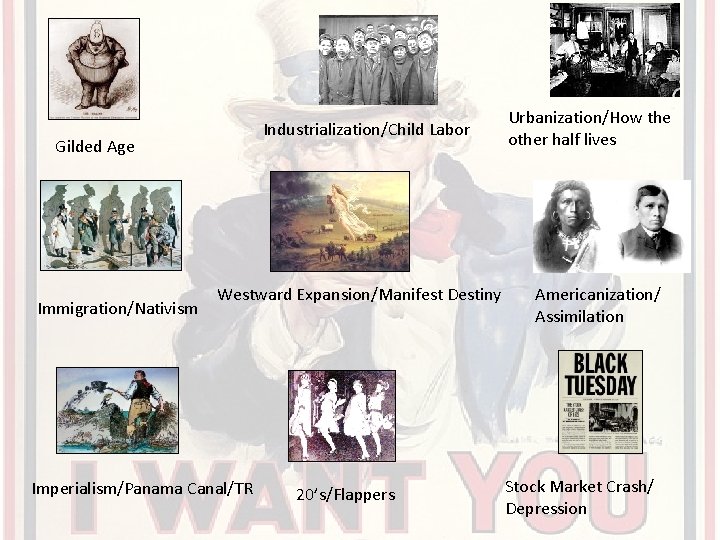
Industrialization/Child Labor Gilded Age Immigration/Nativism Westward Expansion/Manifest Destiny Imperialism/Panama Canal/TR 20’s/Flappers Urbanization/How the other half lives Americanization/ Assimilation Stock Market Crash/ Depression
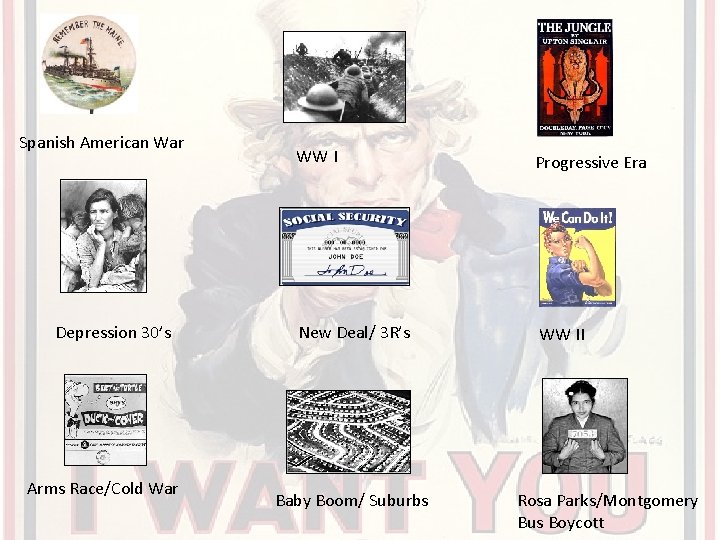
Spanish American War Depression 30’s Arms Race/Cold War WW I Progressive Era New Deal/ 3 R’s WW II Baby Boom/ Suburbs Rosa Parks/Montgomery Bus Boycott
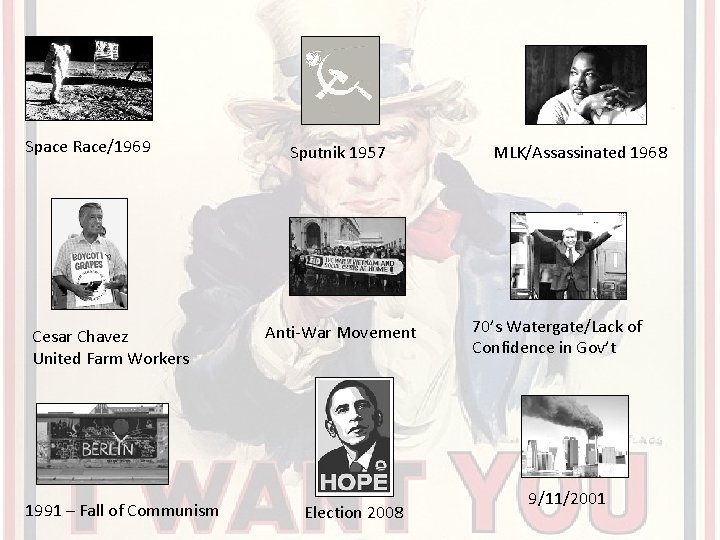
Space Race/1969 Cesar Chavez United Farm Workers 1991 – Fall of Communism Sputnik 1957 Anti War Movement Election 2008 MLK/Assassinated 1968 70’s Watergate/Lack of Confidence in Gov’t 9/11/2001
Practice EOC 99 – 1 97 2 96 3 94 4 93 5 91 6 90 7 88 8 87 9 85 10 84 11 82 12 81 13 79 14 78 15 76 16 75 17 74 18 72 19 71 20 69 21 68 22 66 23 65 24 63 25 62 26 60 27 59 28 57 29 56 30