
AlexanderSadiku Fundamentals of Electric Circuits Chapter 8 SecondOrder
- Slides: 18
Alexander-Sadiku Fundamentals of Electric Circuits Chapter 8 Second-Order Circuits Copyright © The Mc. Graw-Hill Companies, Inc. Permission required for reproduction or display. 1
Second-Order Circuits Chapter 8 8. 1 8. 2 8. 3 8. 4 8. 5 Examples of 2 nd order RCL circuit The source-free series RLC circuit The source-free parallel RLC circuit Step response of a series RLC circuit Step response of a parallel RLC 2
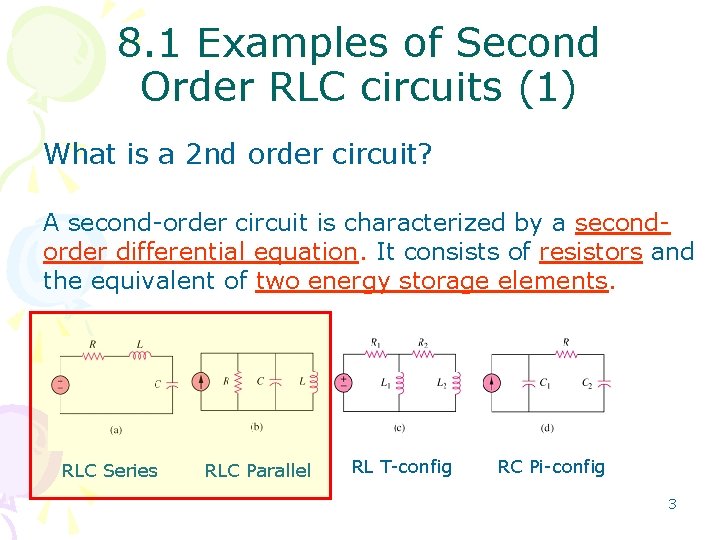
8. 1 Examples of Second Order RLC circuits (1) What is a 2 nd order circuit? A second-order circuit is characterized by a secondorder differential equation. It consists of resistors and the equivalent of two energy storage elements. RLC Series RLC Parallel RL T-config RC Pi-config 3
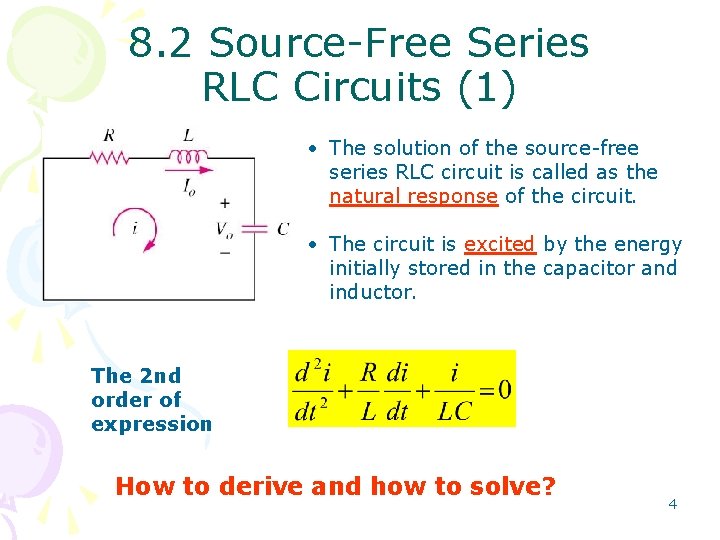
8. 2 Source-Free Series RLC Circuits (1) • The solution of the source-free series RLC circuit is called as the natural response of the circuit. • The circuit is excited by the energy initially stored in the capacitor and inductor. The 2 nd order of expression How to derive and how to solve? 4
8. 2 Source-Free Series RLC Circuits (2) Method will be illustrated during the lecture 5
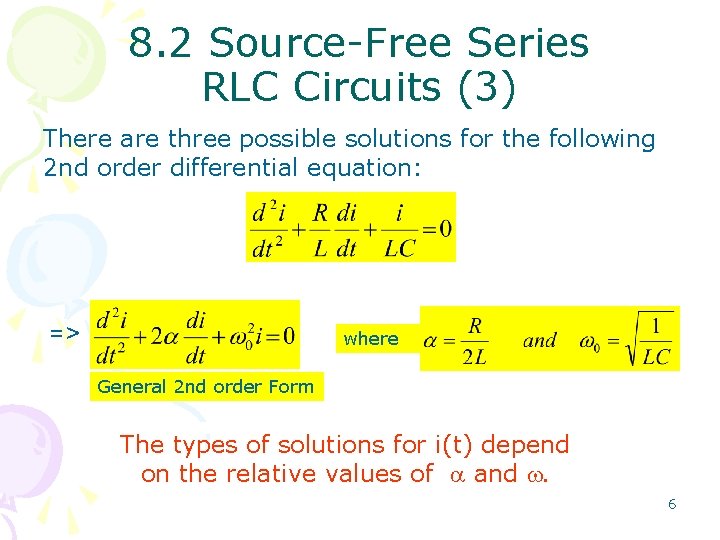
8. 2 Source-Free Series RLC Circuits (3) There are three possible solutions for the following 2 nd order differential equation: => where General 2 nd order Form The types of solutions for i(t) depend on the relative values of a and w. 6
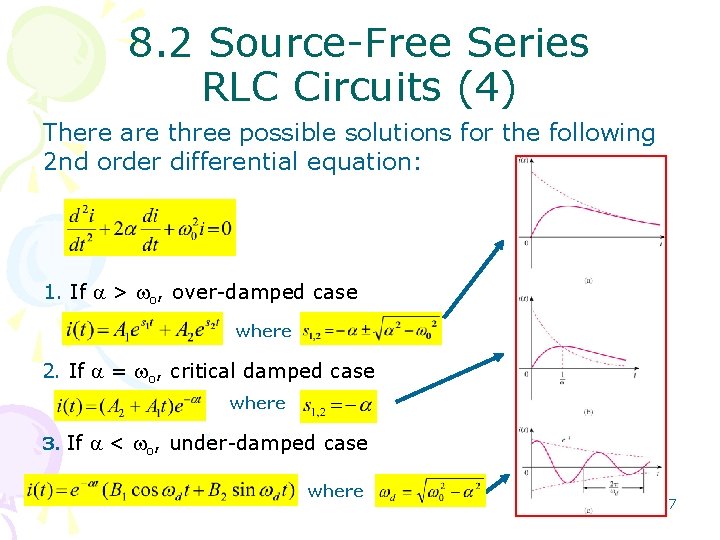
8. 2 Source-Free Series RLC Circuits (4) There are three possible solutions for the following 2 nd order differential equation: 1. If a > wo, over-damped case where 2. If a = wo, critical damped case where 3. If a < wo, under-damped case where 7
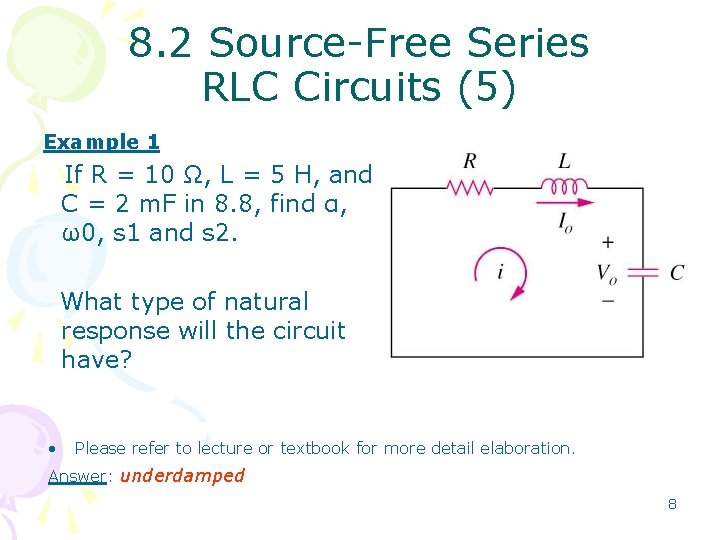
8. 2 Source-Free Series RLC Circuits (5) Example 1 If R = 10 Ω, L = 5 H, and C = 2 m. F in 8. 8, find α, ω0, s 1 and s 2. What type of natural response will the circuit have? • Please refer to lecture or textbook for more detail elaboration. Answer: underdamped 8
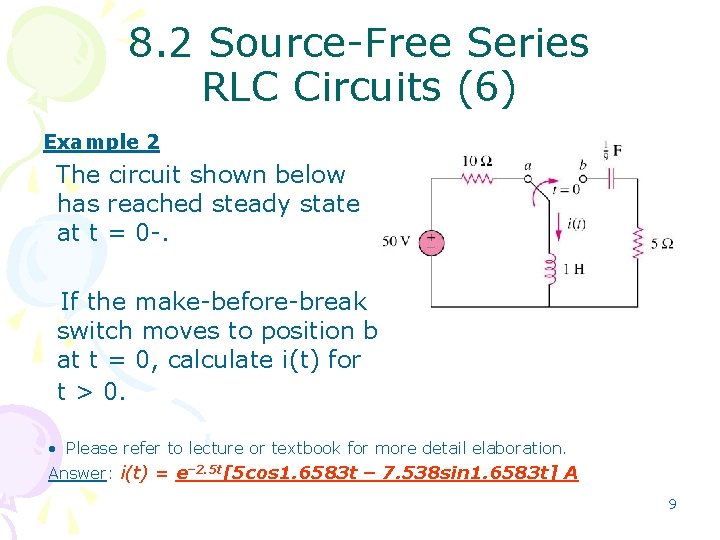
8. 2 Source-Free Series RLC Circuits (6) Example 2 The circuit shown below has reached steady state at t = 0 -. If the make-before-break switch moves to position b at t = 0, calculate i(t) for t > 0. • Please refer to lecture or textbook for more detail elaboration. Answer: i(t) = e– 2. 5 t[5 cos 1. 6583 t – 7. 538 sin 1. 6583 t] A 9
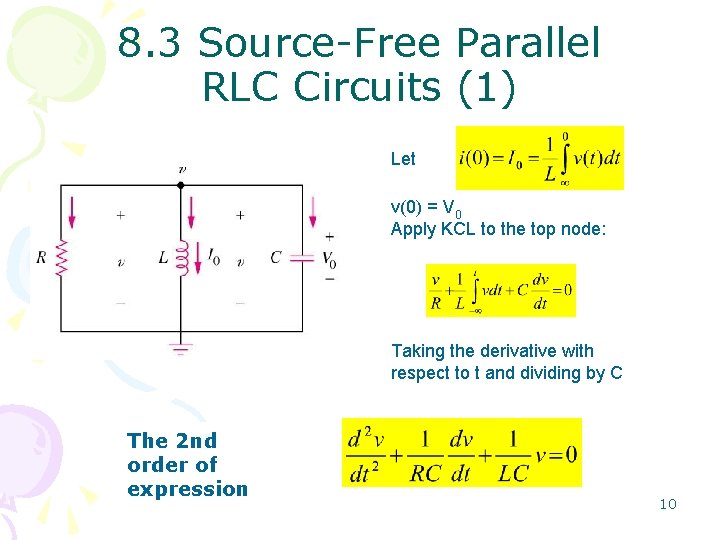
8. 3 Source-Free Parallel RLC Circuits (1) Let v(0) = V 0 Apply KCL to the top node: Taking the derivative with respect to t and dividing by C The 2 nd order of expression 10
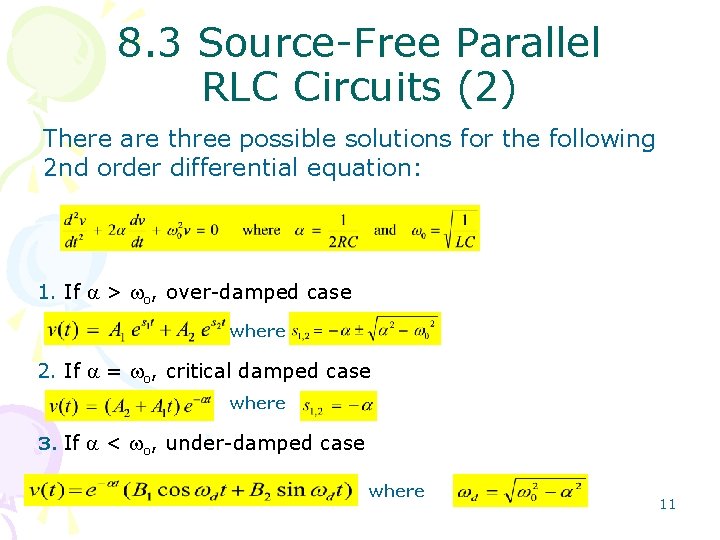
8. 3 Source-Free Parallel RLC Circuits (2) There are three possible solutions for the following 2 nd order differential equation: 1. If a > wo, over-damped case where 2. If a = wo, critical damped case where 3. If a < wo, under-damped case where 11
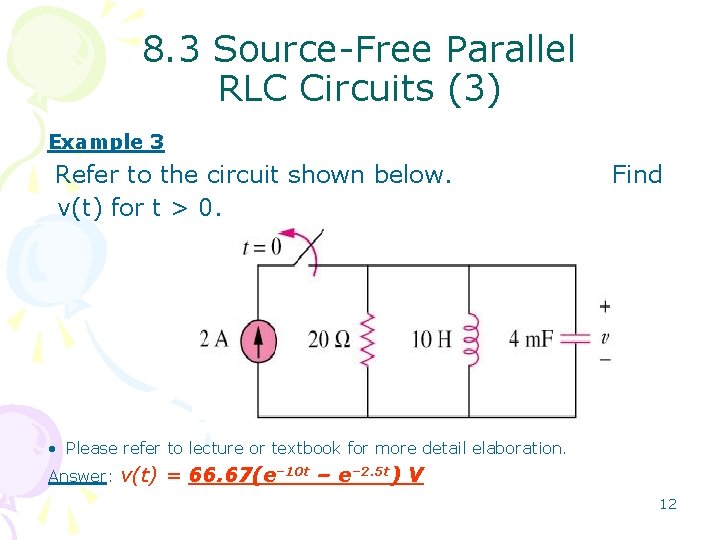
8. 3 Source-Free Parallel RLC Circuits (3) Example 3 Refer to the circuit shown below. v(t) for t > 0. Find • Please refer to lecture or textbook for more detail elaboration. Answer: v(t) = 66. 67(e– 10 t – e– 2. 5 t) V 12
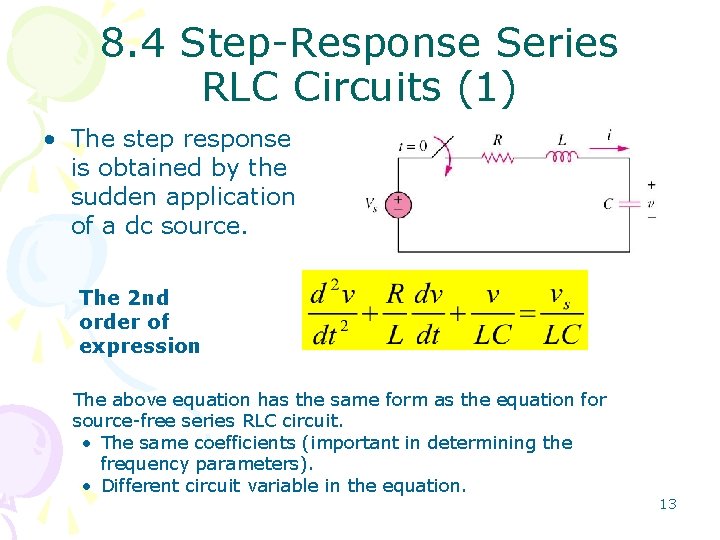
8. 4 Step-Response Series RLC Circuits (1) • The step response is obtained by the sudden application of a dc source. The 2 nd order of expression The above equation has the same form as the equation for source-free series RLC circuit. • The same coefficients (important in determining the frequency parameters). • Different circuit variable in the equation. 13
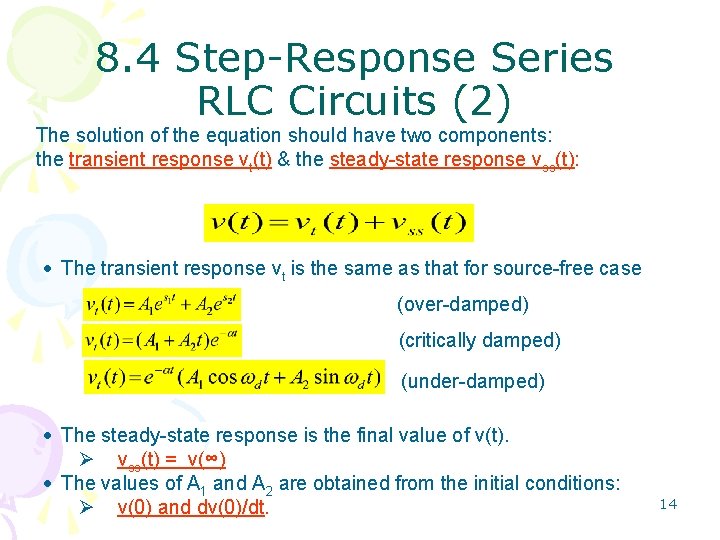
8. 4 Step-Response Series RLC Circuits (2) The solution of the equation should have two components: the transient response vt(t) & the steady-state response vss(t): The transient response vt is the same as that for source-free case (over-damped) (critically damped) (under-damped) The steady-state response is the final value of v(t). Ø vss(t) = v(∞) The values of A 1 and A 2 are obtained from the initial conditions: Ø v(0) and dv(0)/dt. 14
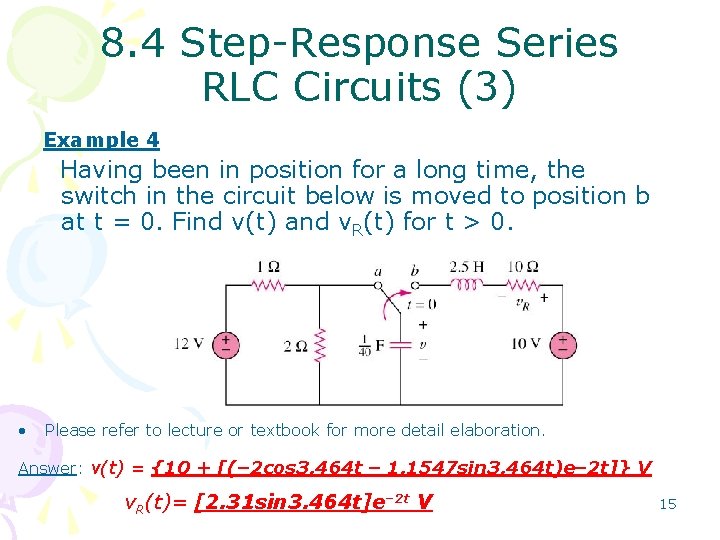
8. 4 Step-Response Series RLC Circuits (3) Example 4 Having been in position for a long time, the switch in the circuit below is moved to position b at t = 0. Find v(t) and v. R(t) for t > 0. • Please refer to lecture or textbook for more detail elaboration. Answer: v(t) = {10 + [(– 2 cos 3. 464 t – 1. 1547 sin 3. 464 t)e– 2 t]} V v. R(t)= [2. 31 sin 3. 464 t]e– 2 t V 15
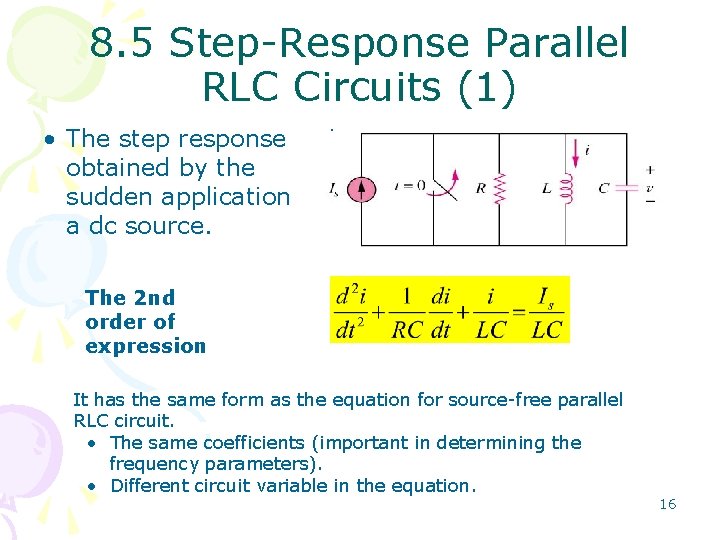
8. 5 Step-Response Parallel RLC Circuits (1) • The step response obtained by the sudden application a dc source. is of The 2 nd order of expression It has the same form as the equation for source-free parallel RLC circuit. • The same coefficients (important in determining the frequency parameters). • Different circuit variable in the equation. 16
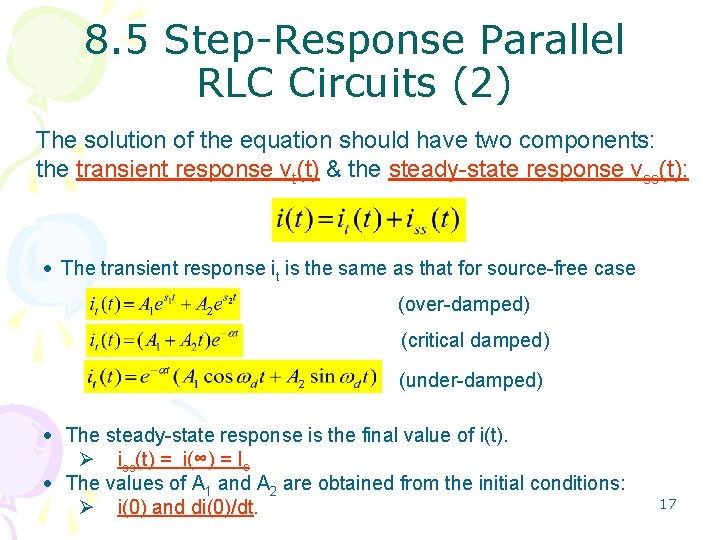
8. 5 Step-Response Parallel RLC Circuits (2) The solution of the equation should have two components: the transient response vt(t) & the steady-state response vss(t): The transient response it is the same as that for source-free case (over-damped) (critical damped) (under-damped) The steady-state response is the final value of i(t). Ø iss(t) = i(∞) = Is The values of A 1 and A 2 are obtained from the initial conditions: Ø i(0) and di(0)/dt. 17
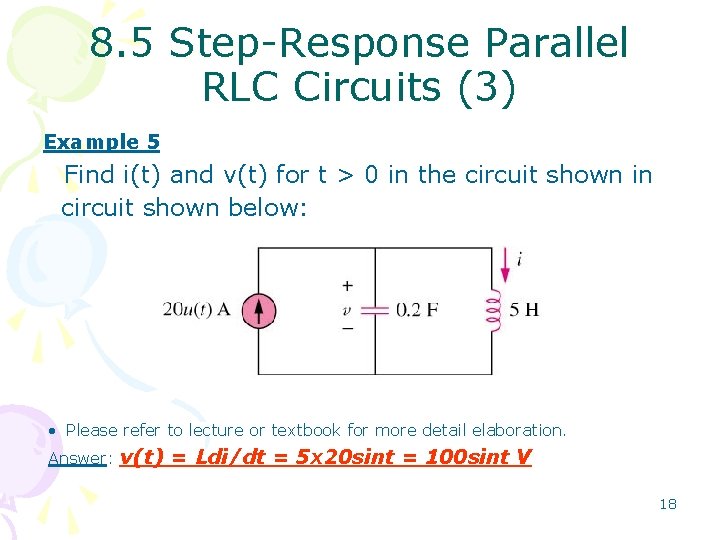
8. 5 Step-Response Parallel RLC Circuits (3) Example 5 Find i(t) and v(t) for t > 0 in the circuit shown in circuit shown below: • Please refer to lecture or textbook for more detail elaboration. Answer: v(t) = Ldi/dt = 5 x 20 sint = 100 sint V 18