
AlexanderSadiku Fundamentals of Electric Circuits Chapter 15 Introduction
- Slides: 20
Alexander-Sadiku Fundamentals of Electric Circuits Chapter 15 Introduction to the Laplace Transform Copyright © The Mc. Graw-Hill Companies, Inc. Permission required for reproduction or display. 1
Introduction to the Laplace Transform Chapter 15 15. 1 15. 2 15. 3 15. 4 15. 5 Definition of Laplace Transform Properties of Laplace Transform The Inverse Laplace Transform The Convolution Integral Application to Integro-differential Equations 2
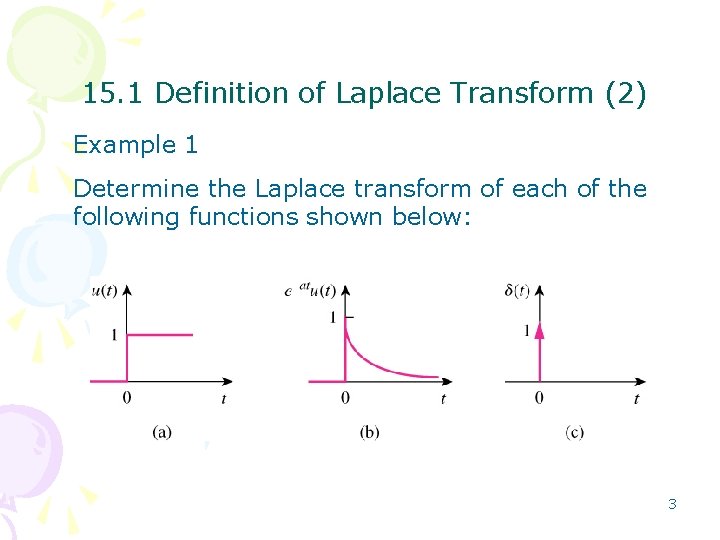
15. 1 Definition of Laplace Transform (2) Example 1 Determine the Laplace transform of each of the following functions shown below: 3
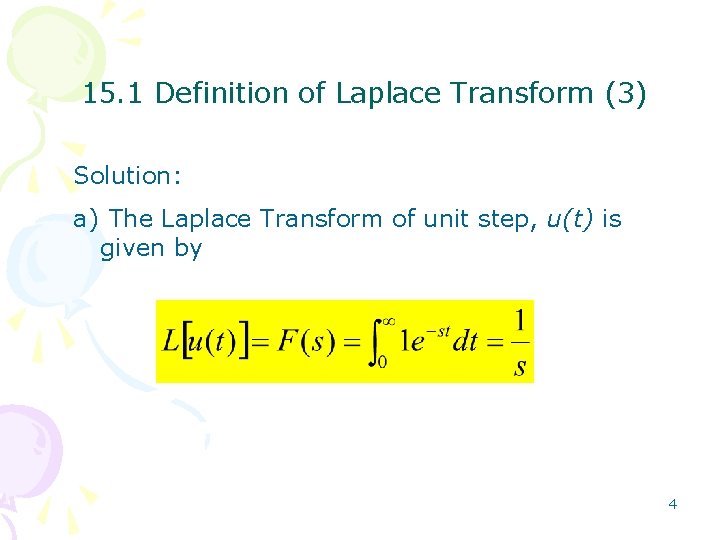
15. 1 Definition of Laplace Transform (3) Solution: a) The Laplace Transform of unit step, u(t) is given by 4
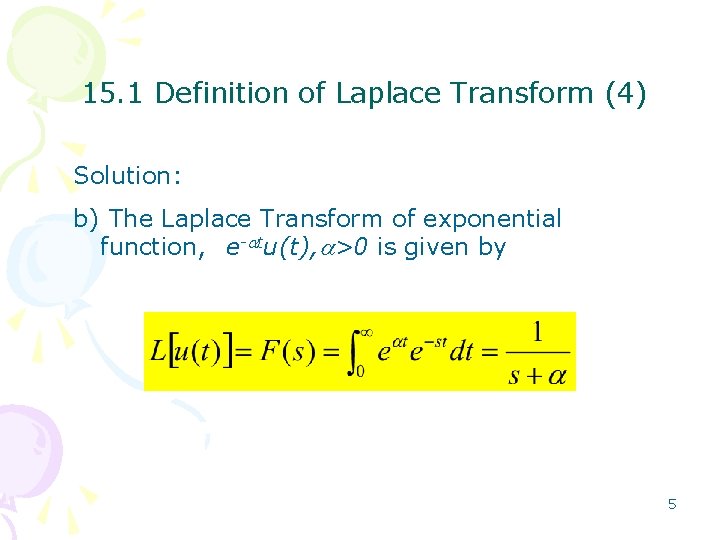
15. 1 Definition of Laplace Transform (4) Solution: b) The Laplace Transform of exponential function, e-atu(t), a>0 is given by 5
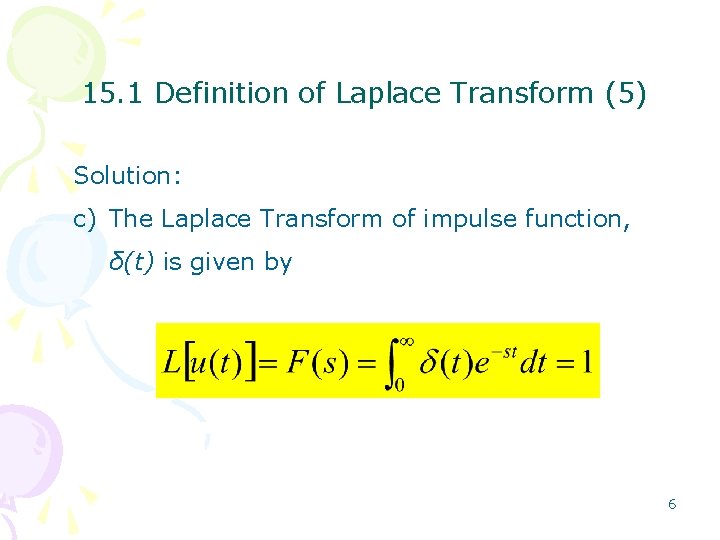
15. 1 Definition of Laplace Transform (5) Solution: c) The Laplace Transform of impulse function, δ(t) is given by 6
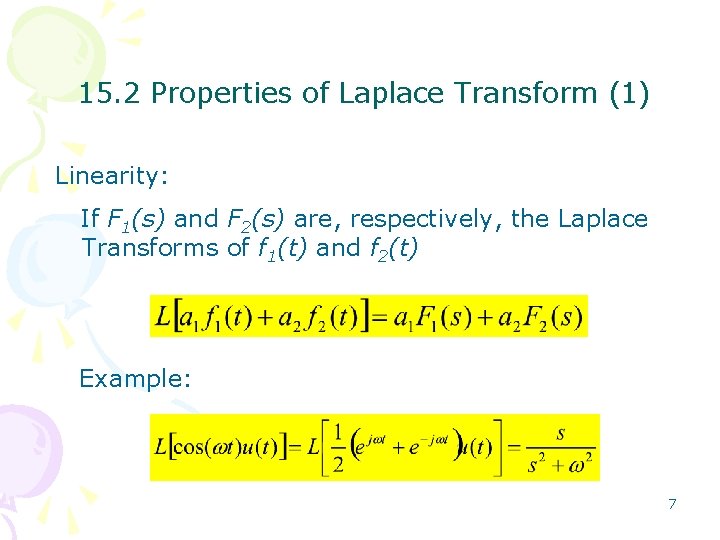
15. 2 Properties of Laplace Transform (1) Linearity: If F 1(s) and F 2(s) are, respectively, the Laplace Transforms of f 1(t) and f 2(t) Example: 7
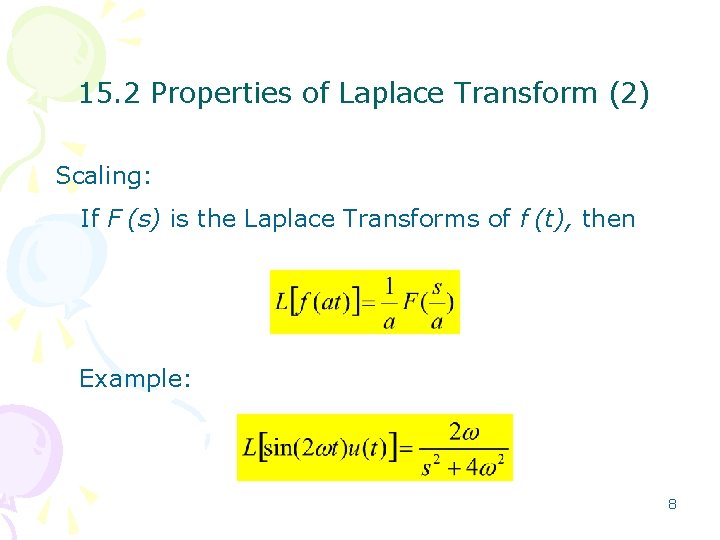
15. 2 Properties of Laplace Transform (2) Scaling: If F (s) is the Laplace Transforms of f (t), then Example: 8
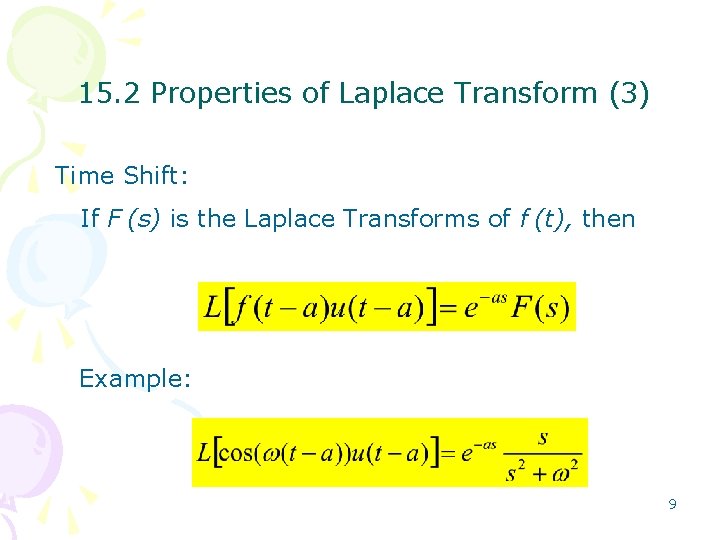
15. 2 Properties of Laplace Transform (3) Time Shift: If F (s) is the Laplace Transforms of f (t), then Example: 9
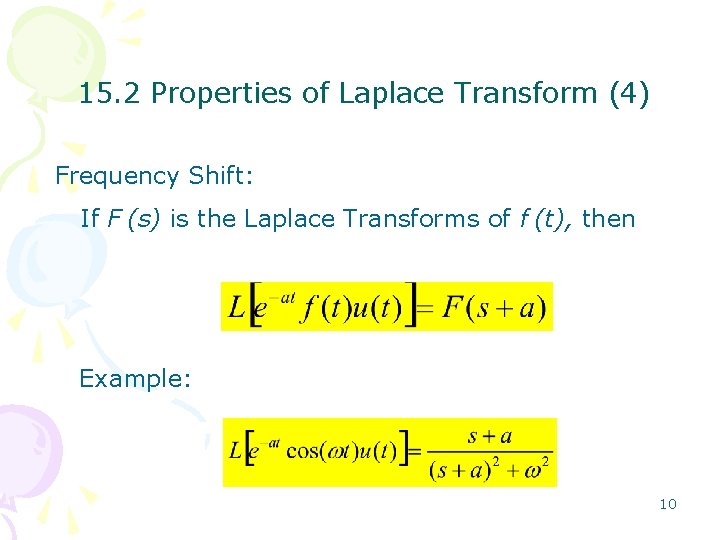
15. 2 Properties of Laplace Transform (4) Frequency Shift: If F (s) is the Laplace Transforms of f (t), then Example: 10
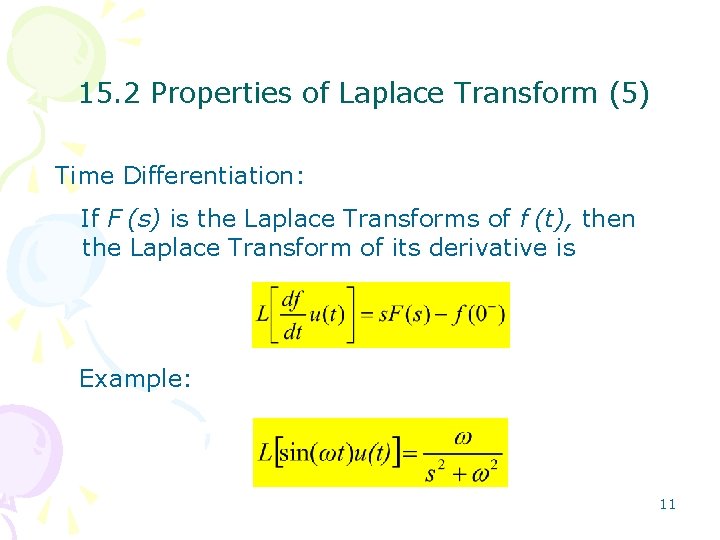
15. 2 Properties of Laplace Transform (5) Time Differentiation: If F (s) is the Laplace Transforms of f (t), then the Laplace Transform of its derivative is Example: 11
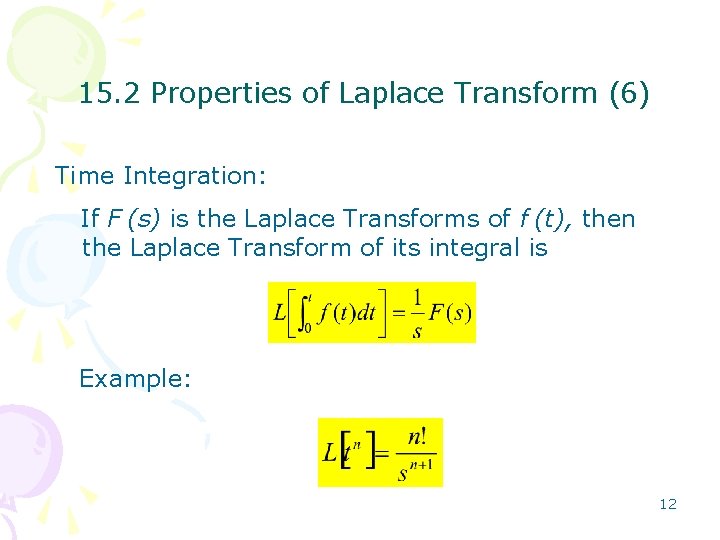
15. 2 Properties of Laplace Transform (6) Time Integration: If F (s) is the Laplace Transforms of f (t), then the Laplace Transform of its integral is Example: 12
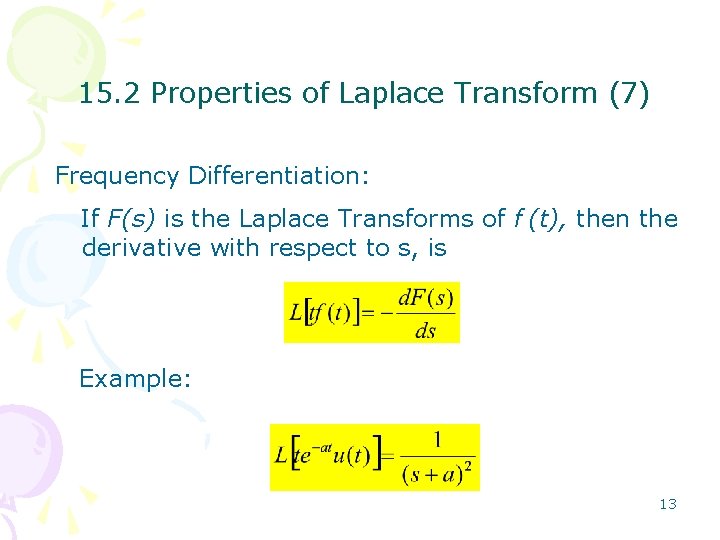
15. 2 Properties of Laplace Transform (7) Frequency Differentiation: If F(s) is the Laplace Transforms of f (t), then the derivative with respect to s, is Example: 13
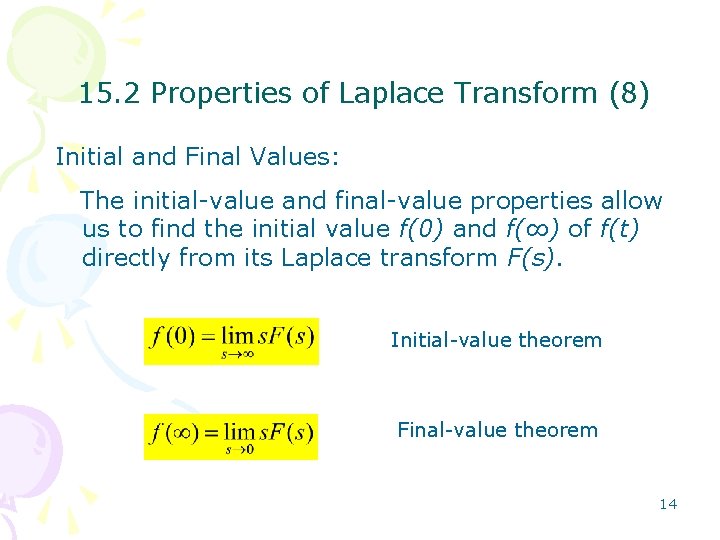
15. 2 Properties of Laplace Transform (8) Initial and Final Values: The initial-value and final-value properties allow us to find the initial value f(0) and f(∞) of f(t) directly from its Laplace transform F(s). Initial-value theorem Final-value theorem 14
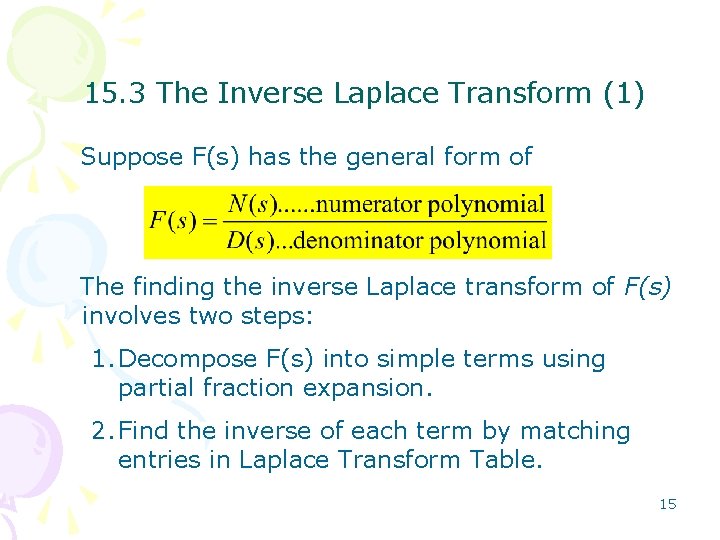
15. 3 The Inverse Laplace Transform (1) Suppose F(s) has the general form of The finding the inverse Laplace transform of F(s) involves two steps: 1. Decompose F(s) into simple terms using partial fraction expansion. 2. Find the inverse of each term by matching entries in Laplace Transform Table. 15
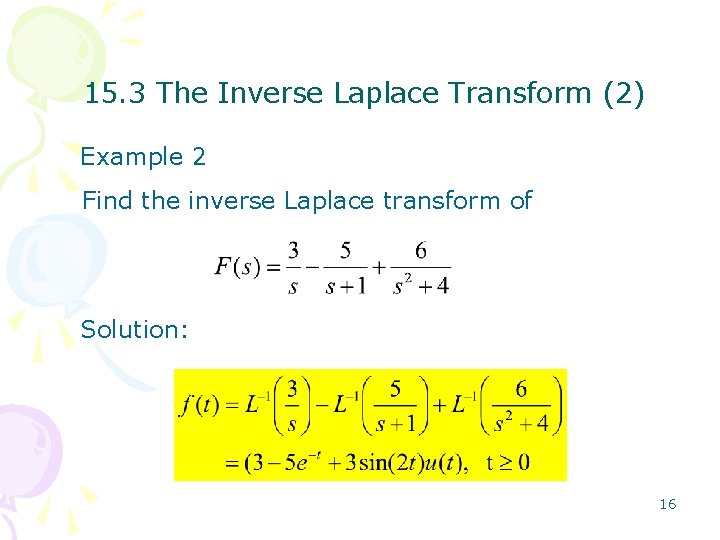
15. 3 The Inverse Laplace Transform (2) Example 2 Find the inverse Laplace transform of Solution: 16
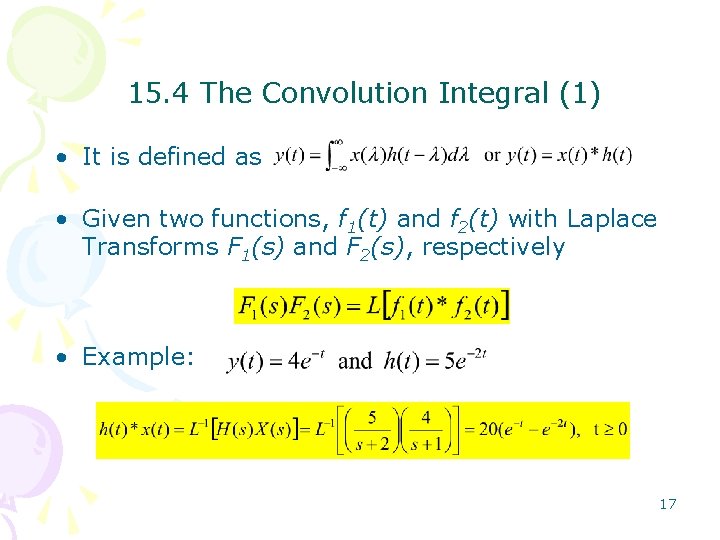
15. 4 The Convolution Integral (1) • It is defined as • Given two functions, f 1(t) and f 2(t) with Laplace Transforms F 1(s) and F 2(s), respectively • Example: 17
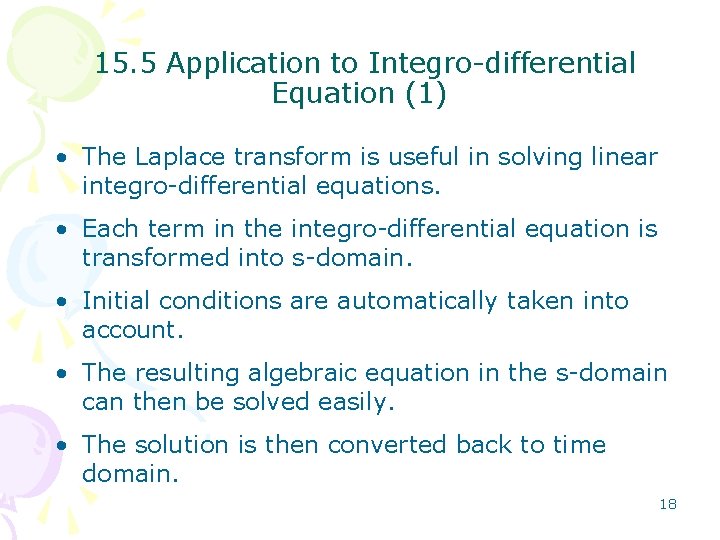
15. 5 Application to Integro-differential Equation (1) • The Laplace transform is useful in solving linear integro-differential equations. • Each term in the integro-differential equation is transformed into s-domain. • Initial conditions are automatically taken into account. • The resulting algebraic equation in the s-domain can then be solved easily. • The solution is then converted back to time domain. 18
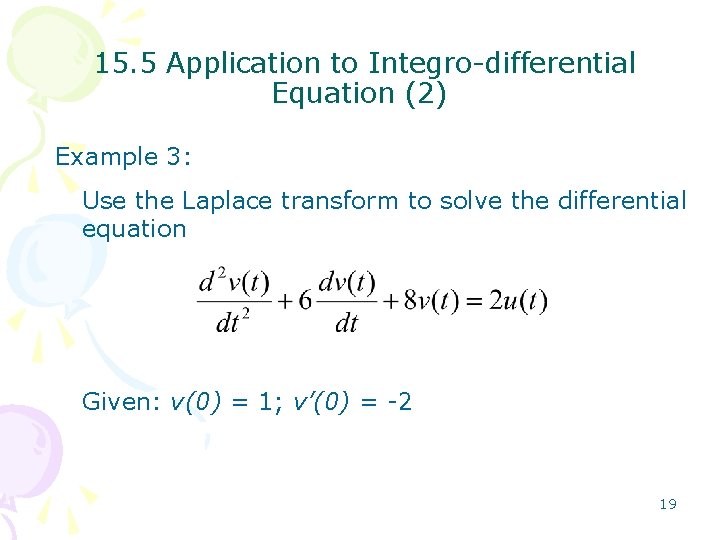
15. 5 Application to Integro-differential Equation (2) Example 3: Use the Laplace transform to solve the differential equation Given: v(0) = 1; v’(0) = -2 19
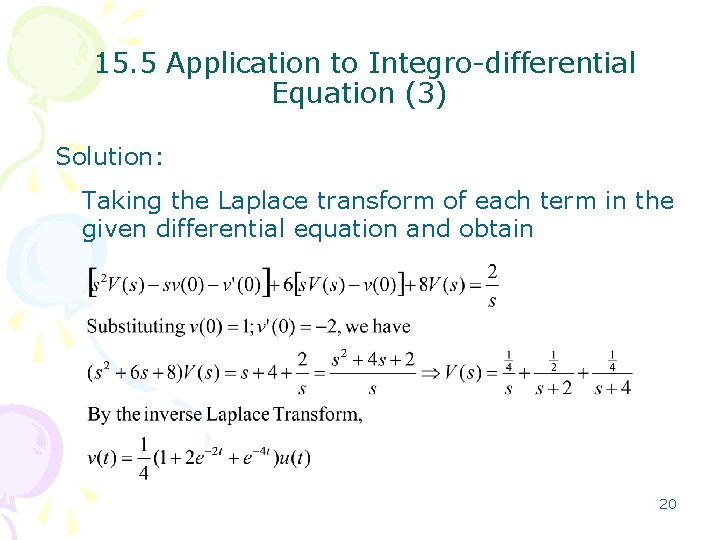
15. 5 Application to Integro-differential Equation (3) Solution: Taking the Laplace transform of each term in the given differential equation and obtain 20