
AlexanderSadiku Fundamentals of Electric Circuits Chapter 12 ThreePhase
- Slides: 24
Alexander-Sadiku Fundamentals of Electric Circuits Chapter 12 Three-Phase Circuit Copyright © The Mc. Graw-Hill Companies, Inc. Permission required for reproduction or display. 1
Three-Phase Circuits Chapter 12 12. 1 12. 2 12. 3 12. 4 12. 5 12. 6 What is a Three-Phase Circuit? Balance Three-Phase Voltages Balance Three-Phase Connection Power in a Balanced System Unbalanced Three-Phase Systems Application – Residential Wiring 2
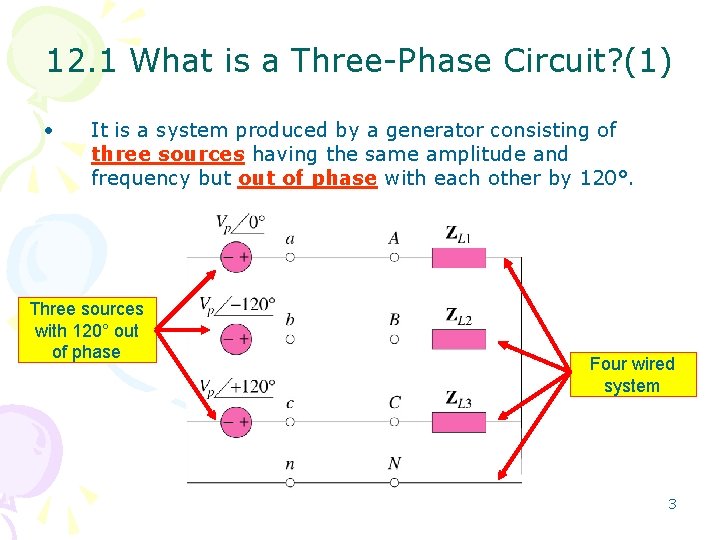
12. 1 What is a Three-Phase Circuit? (1) • It is a system produced by a generator consisting of three sources having the same amplitude and frequency but of phase with each other by 120°. Three sources with 120° out of phase Four wired system 3
12. 1 What is a Three-Phase Circuit? (2) Advantages: 1. Most of the electric power is generated and distributed in three-phase. 2. The instantaneous power in a three-phase system can be constant. 3. The amount of power, the three-phase system is more economical that the single-phase. 4. In fact, the amount of wire required for a threephase system is less than that required for an equivalent single-phase system. 4
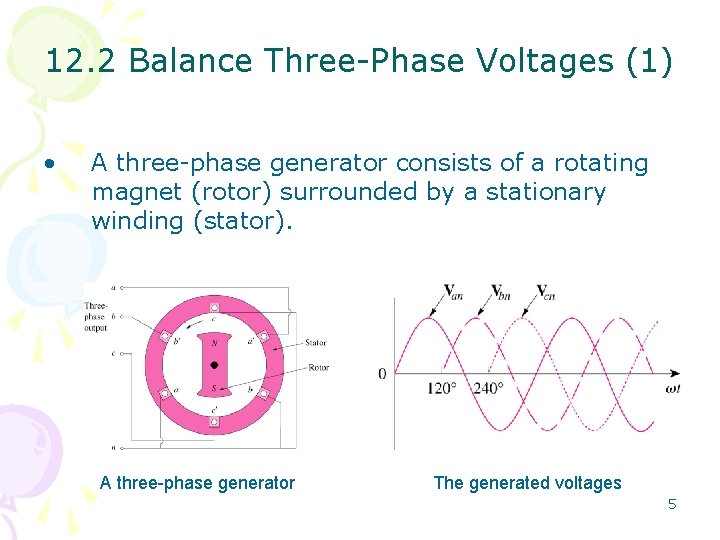
12. 2 Balance Three-Phase Voltages (1) • A three-phase generator consists of a rotating magnet (rotor) surrounded by a stationary winding (stator). A three-phase generator The generated voltages 5
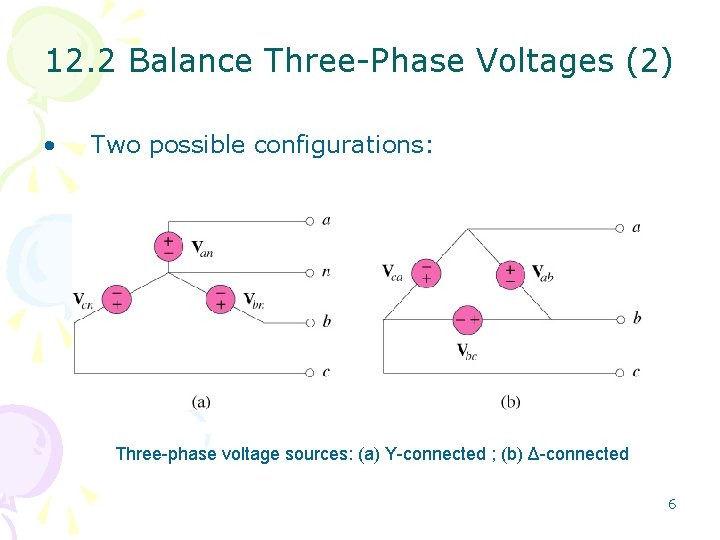
12. 2 Balance Three-Phase Voltages (2) • Two possible configurations: Three-phase voltage sources: (a) Y-connected ; (b) Δ-connected 6
12. 2 Balance Three-Phase Voltages (3) • Balanced phase voltages are equal in magnitude and are out of phase with each other by 120°. • The phase sequence is the time order in which the voltages pass through their respective maximum values. • A balanced load is one in which the phase impedances are equal in magnitude and in phase 7
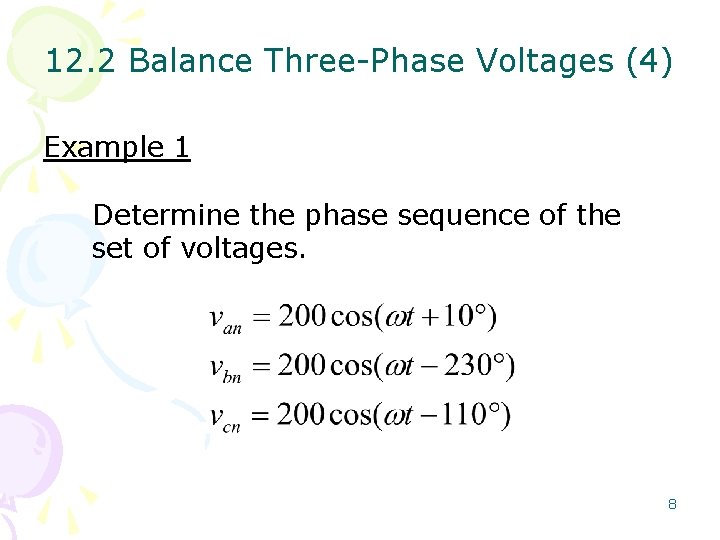
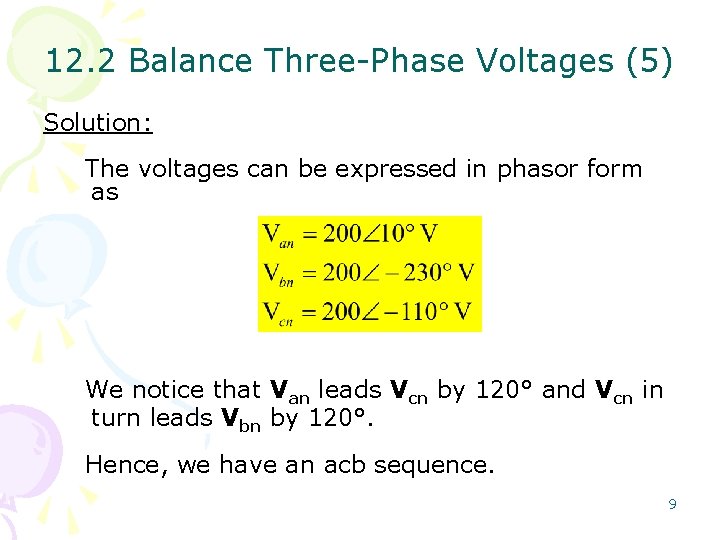
12. 2 Balance Three-Phase Voltages (4) Example 1 Determine the phase sequence of the set of voltages. 8
12. 2 Balance Three-Phase Voltages (5) Solution: The voltages can be expressed in phasor form as We notice that Van leads Vcn by 120° and Vcn in turn leads Vbn by 120°. Hence, we have an acb sequence. 9
12. 3 Balance Three-Phase Connection (1) • Four possible connections 1. Y-Y connection (Y-connected source with a Y-connected load) 2. Y-Δ connection (Y-connected source with a Δ-connected load) 3. Δ-Δ connection 4. Δ-Y connection 10
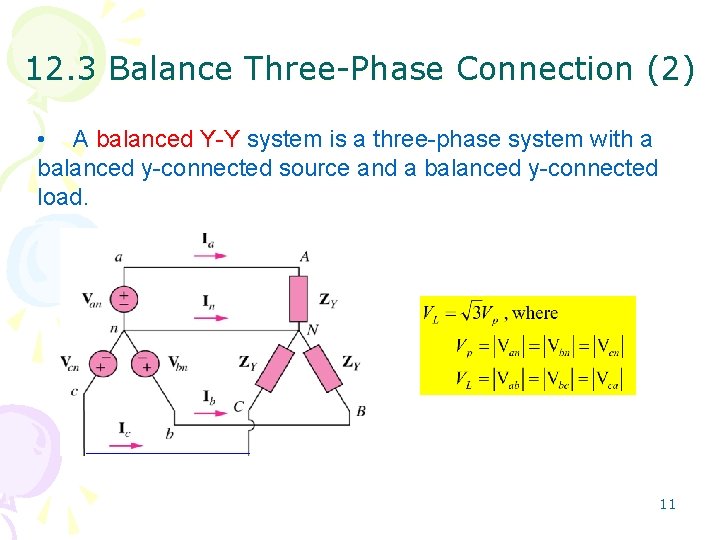
12. 3 Balance Three-Phase Connection (2) • A balanced Y-Y system is a three-phase system with a balanced y-connected source and a balanced y-connected load. 11
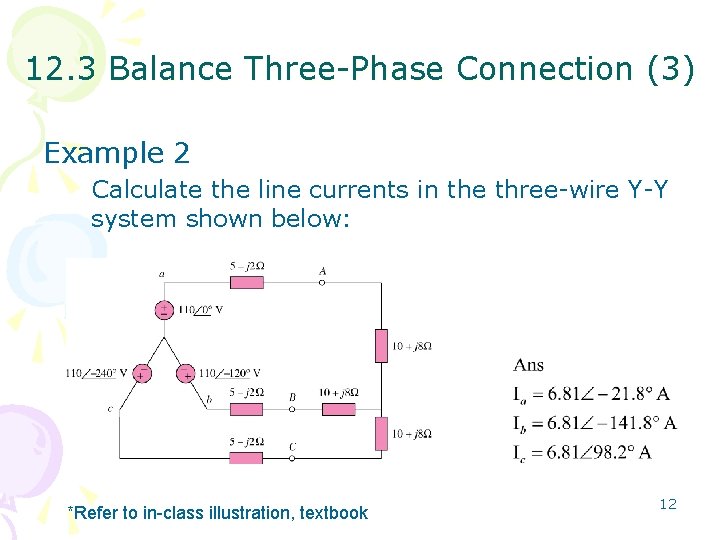
12. 3 Balance Three-Phase Connection (3) Example 2 Calculate the line currents in the three-wire Y-Y system shown below: *Refer to in-class illustration, textbook 12
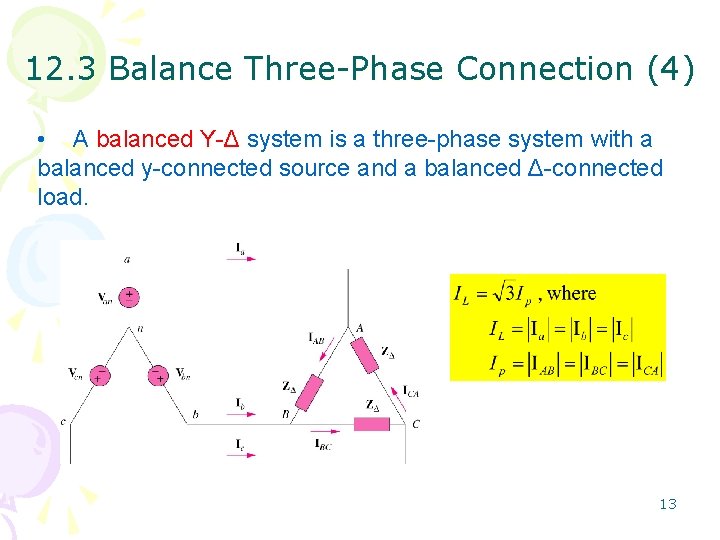
12. 3 Balance Three-Phase Connection (4) • A balanced Y-Δ system is a three-phase system with a balanced y-connected source and a balanced Δ-connected load. 13
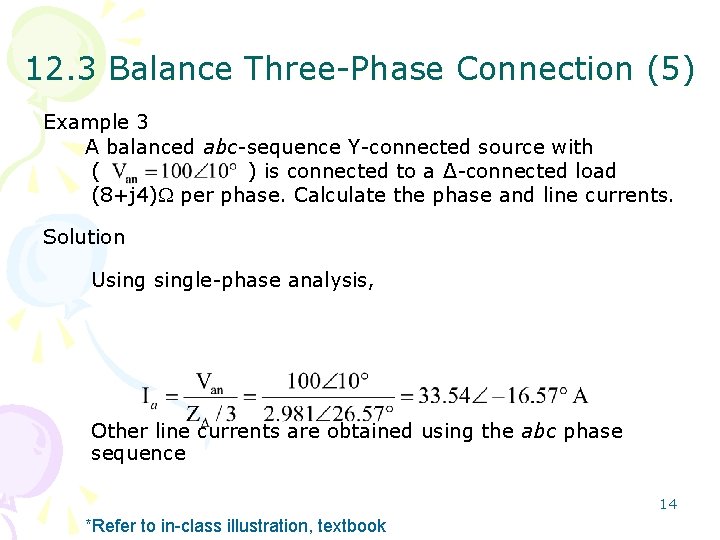
12. 3 Balance Three-Phase Connection (5) Example 3 A balanced abc-sequence Y-connected source with ( ) is connected to a Δ-connected load (8+j 4) per phase. Calculate the phase and line currents. Solution Usingle-phase analysis, Other line currents are obtained using the abc phase sequence 14 *Refer to in-class illustration, textbook
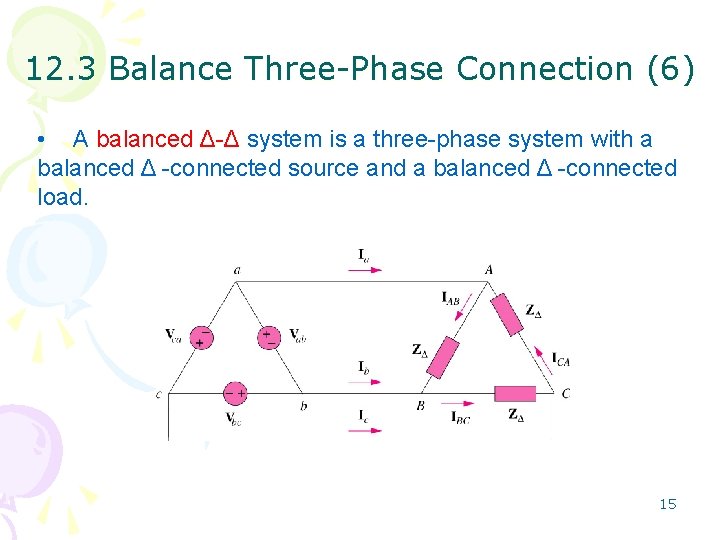
12. 3 Balance Three-Phase Connection (6) • A balanced Δ-Δ system is a three-phase system with a balanced Δ -connected source and a balanced Δ -connected load. 15
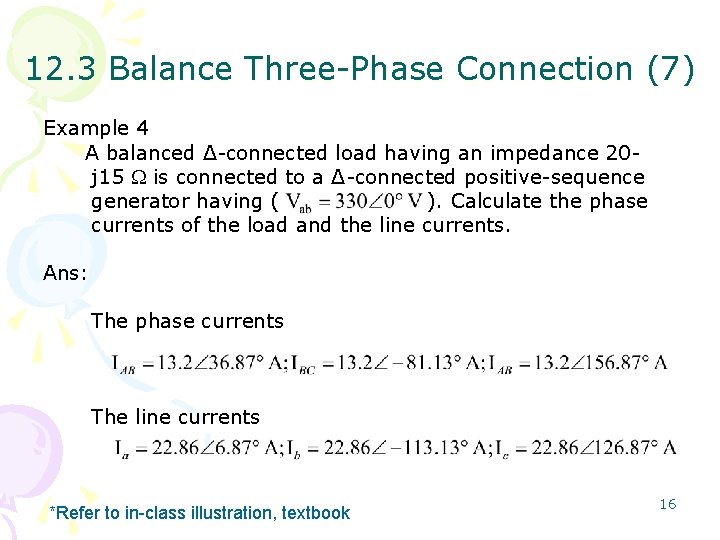
12. 3 Balance Three-Phase Connection (7) Example 4 A balanced Δ-connected load having an impedance 20 j 15 is connected to a Δ-connected positive-sequence generator having ( ). Calculate the phase currents of the load and the line currents. Ans: The phase currents The line currents *Refer to in-class illustration, textbook 16
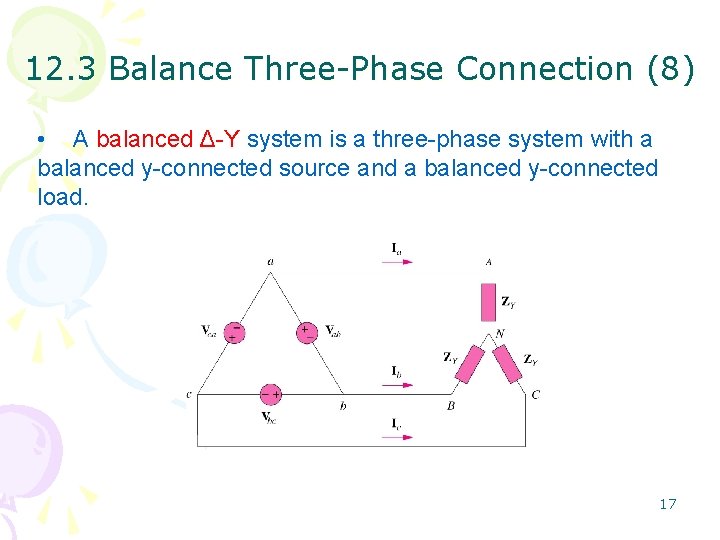
12. 3 Balance Three-Phase Connection (8) • A balanced Δ-Y system is a three-phase system with a balanced y-connected source and a balanced y-connected load. 17
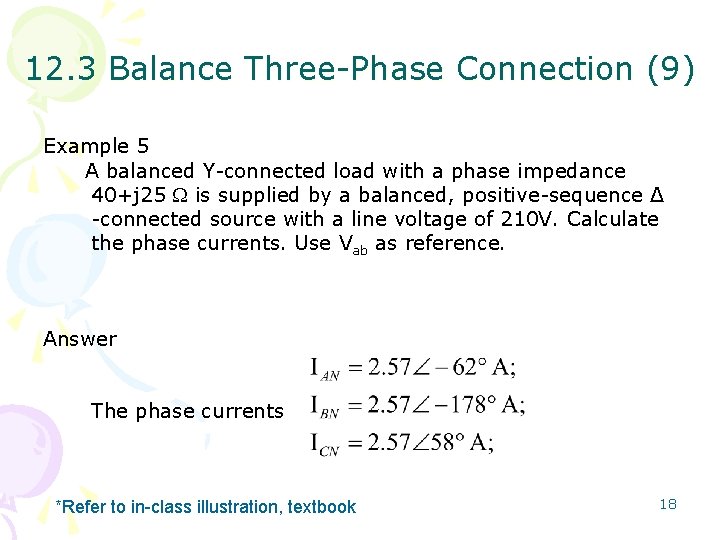
12. 3 Balance Three-Phase Connection (9) Example 5 A balanced Y-connected load with a phase impedance 40+j 25 is supplied by a balanced, positive-sequence Δ -connected source with a line voltage of 210 V. Calculate the phase currents. Use Vab as reference. Answer The phase currents *Refer to in-class illustration, textbook 18
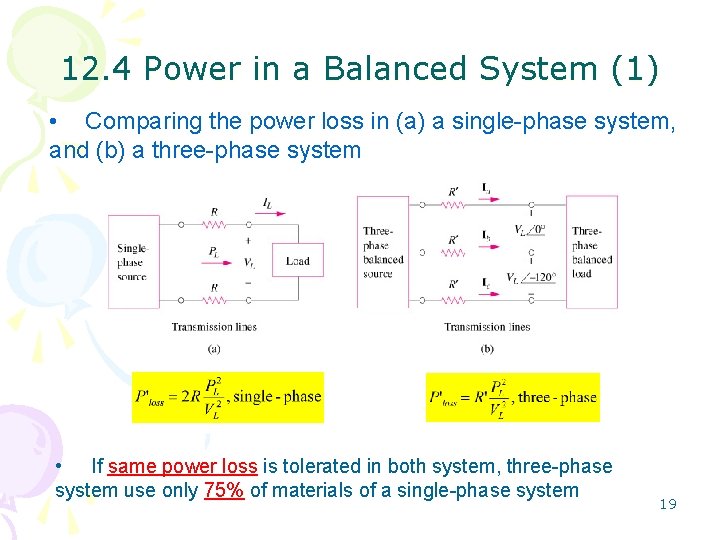
12. 4 Power in a Balanced System (1) • Comparing the power loss in (a) a single-phase system, and (b) a three-phase system • If same power loss is tolerated in both system, three-phase system use only 75% of materials of a single-phase system 19
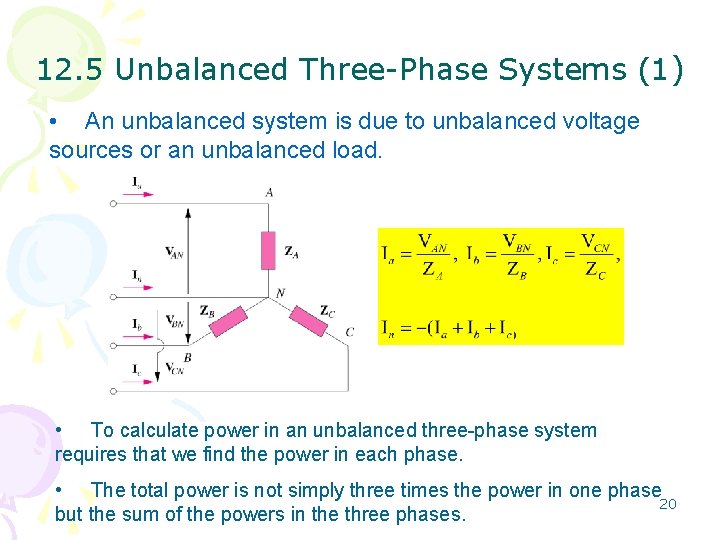
12. 5 Unbalanced Three-Phase Systems (1) • An unbalanced system is due to unbalanced voltage sources or an unbalanced load. • To calculate power in an unbalanced three-phase system requires that we find the power in each phase. • The total power is not simply three times the power in one phase 20 but the sum of the powers in the three phases.
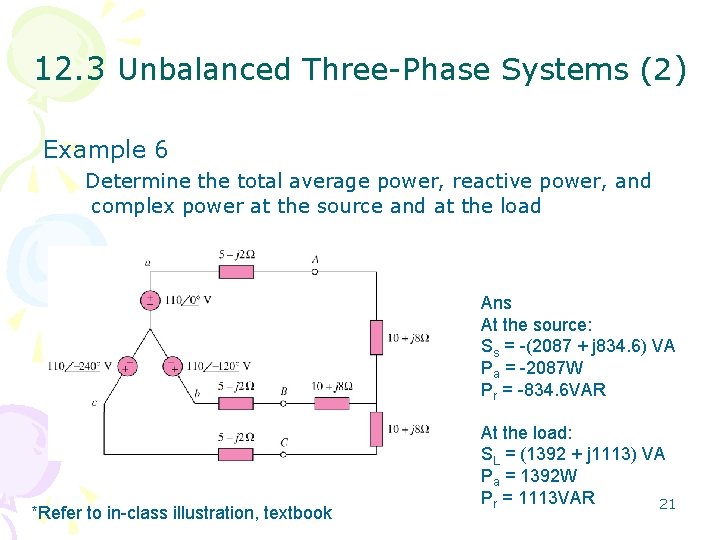
12. 3 Unbalanced Three-Phase Systems (2) Example 6 Determine the total average power, reactive power, and complex power at the source and at the load Ans At the source: Ss = -(2087 + j 834. 6) VA Pa = -2087 W Pr = -834. 6 VAR *Refer to in-class illustration, textbook At the load: SL = (1392 + j 1113) VA Pa = 1392 W Pr = 1113 VAR 21
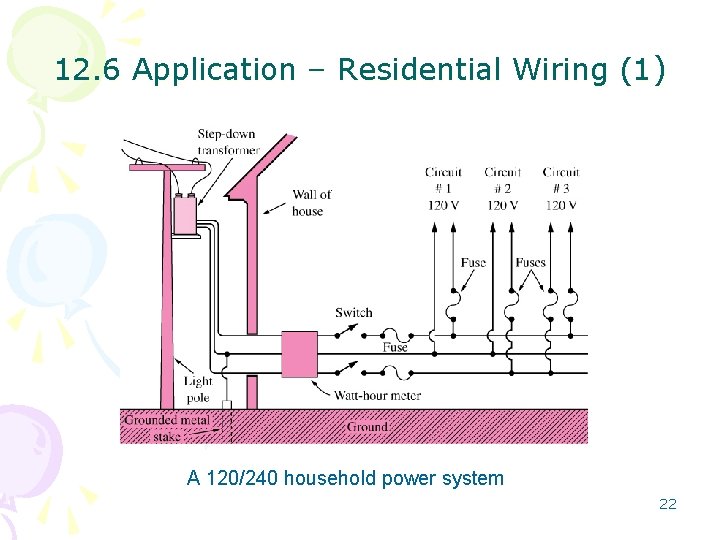
12. 6 Application – Residential Wiring (1) A 120/240 household power system 22
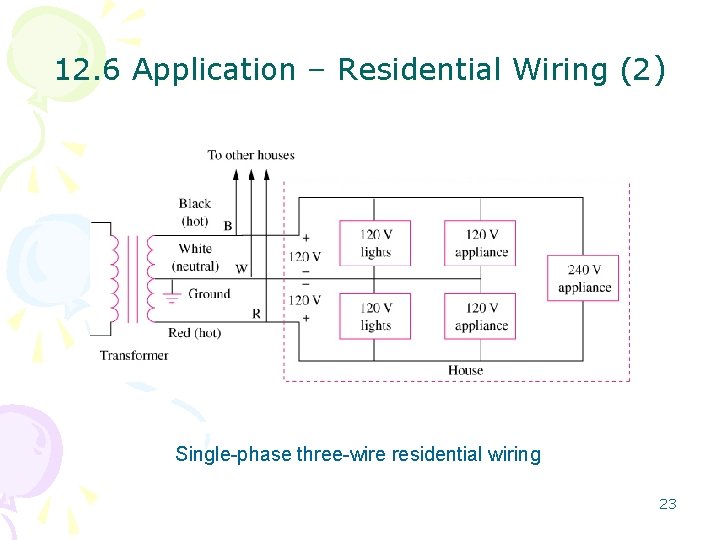
12. 6 Application – Residential Wiring (2) Single-phase three-wire residential wiring 23
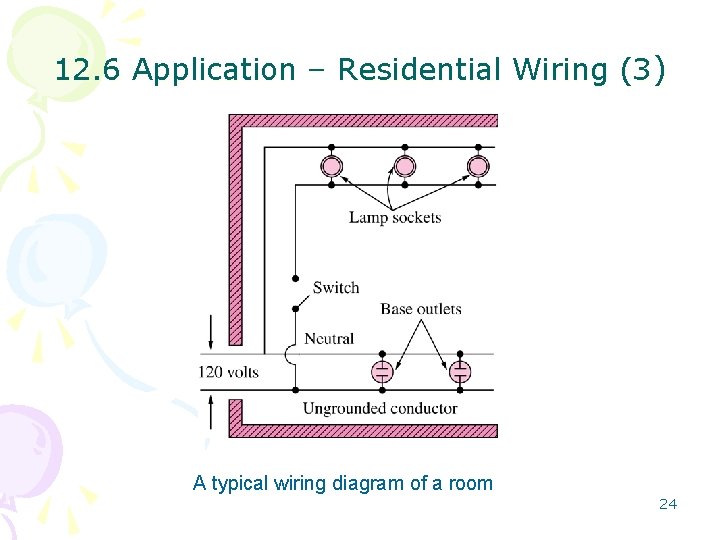
12. 6 Application – Residential Wiring (3) A typical wiring diagram of a room 24