
Alexander CHW 3 M Metropolitan Museum Heilbrunn Timeline
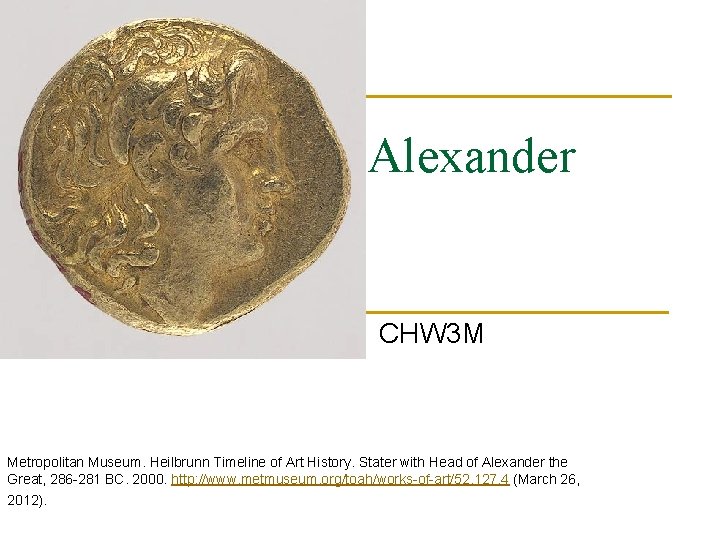
Alexander CHW 3 M Metropolitan Museum. Heilbrunn Timeline of Art History. Stater with Head of Alexander the Great, 286 -281 BC. 2000. http: //www. metmuseum. org/toah/works-of-art/52. 127. 4 (March 26, 2012).
Rise of Macedonia n n n 404 BC: After the Peloponnesian War Thebes was the strongest city-state 359 BC: Phillip II came to power Philip then turned his kingdom into a major power He used Theban battle tactics (phalanx) 338 BC: He defeated the southern Greeks at Chaeronaea n n Unity Then he was assassinated

Theban Phalanx n n 16 rows Each soldier had a pike (sarissa added by Phillip) Robert J. Walker, World Civilizations: A Comparative Study (Don Mills, ON: Oxford, 1998), p. 121.
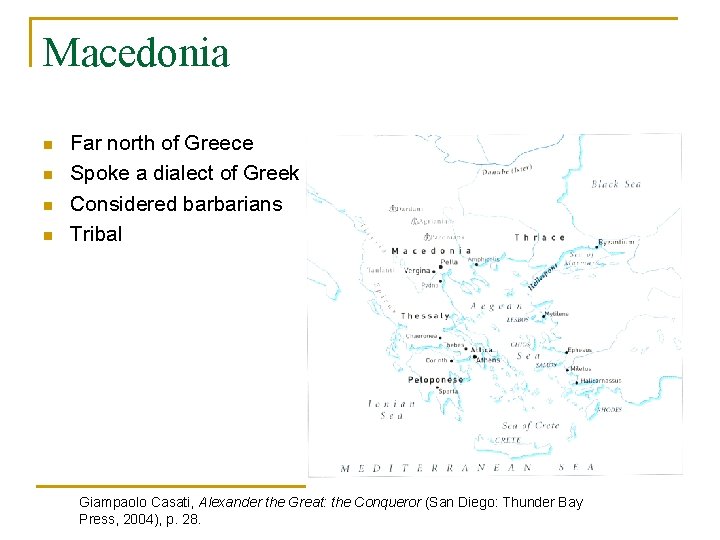
Macedonia n n Far north of Greece Spoke a dialect of Greek Considered barbarians Tribal Giampaolo Casati, Alexander the Great: the Conqueror (San Diego: Thunder Bay Press, 2004), p. 28.

A Big Head? At the Oracle at Delphi Alexander was told, just before leaving for Persia, “You are invincible, my son. ” Alan Fildes and Joann Fletcher, Alexander the Great: Son of the Gods (London: Duncan Baird Publishers, 2004), p. 37.
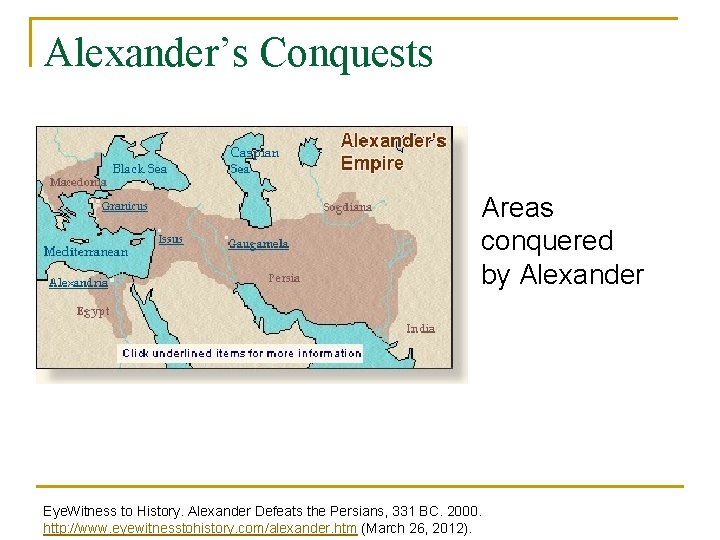
Alexander’s Conquests Areas conquered by Alexander Eye. Witness to History. Alexander Defeats the Persians, 331 BC. 2000. http: //www. eyewitnesstohistory. com/alexander. htm (March 26, 2012).
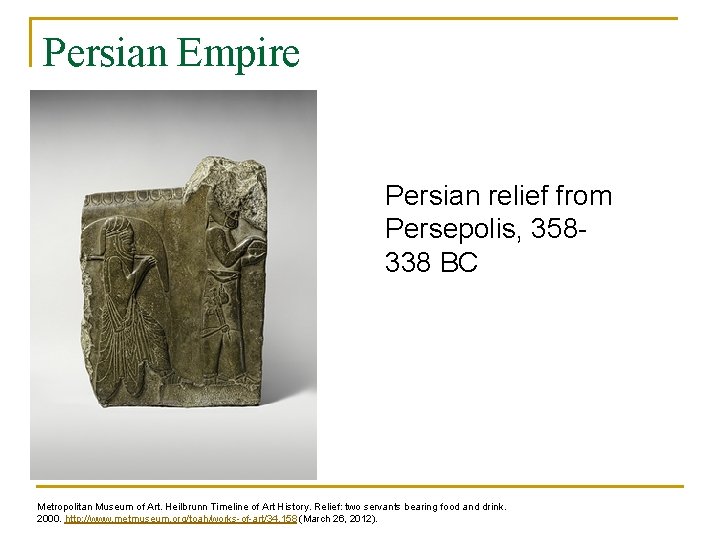
Persian Empire Persian relief from Persepolis, 358338 BC Metropolitan Museum of Art. Heilbrunn Timeline of Art History. Relief: two servants bearing food and drink. 2000. http: //www. metmuseum. org/toah/works-of-art/34. 158 (March 26, 2012).
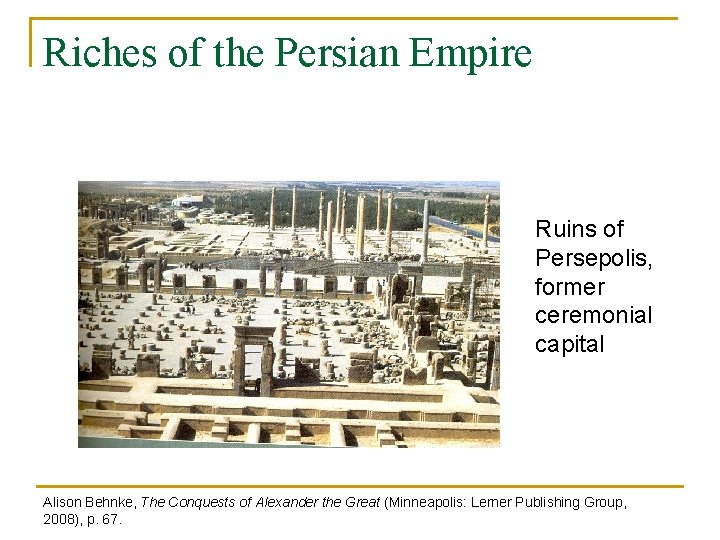
Riches of the Persian Empire Ruins of Persepolis, former ceremonial capital Alison Behnke, The Conquests of Alexander the Great (Minneapolis: Lerner Publishing Group, 2008), p. 67.
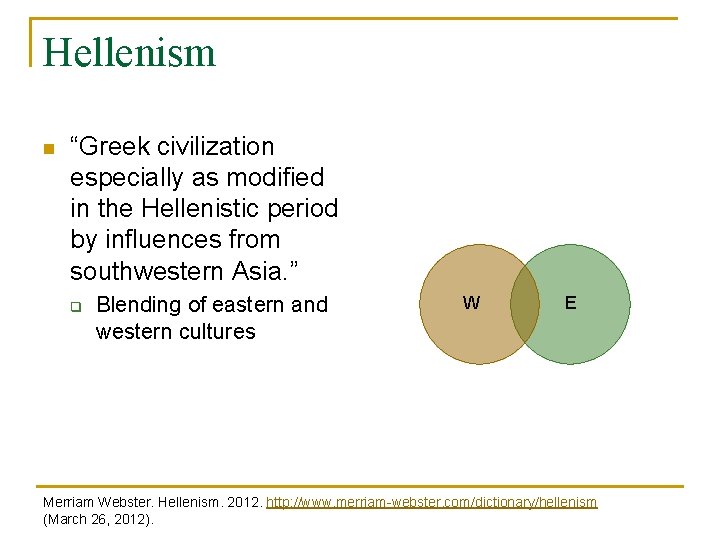
Hellenism n “Greek civilization especially as modified in the Hellenistic period by influences from southwestern Asia. ” q Blending of eastern and western cultures W E Merriam Webster. Hellenism. 2012. http: //www. merriam-webster. com/dictionary/hellenism (March 26, 2012).
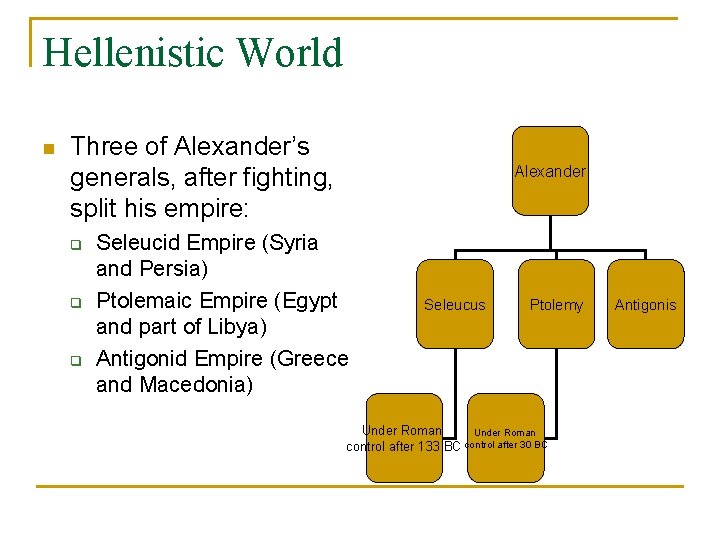
Hellenistic World n Three of Alexander’s generals, after fighting, split his empire: q q q Alexander Seleucid Empire (Syria and Persia) Ptolemaic Empire (Egypt and part of Libya) Antigonid Empire (Greece and Macedonia) Seleucus Ptolemy Under Roman control after 30 BC control after 133 BC Antigonis
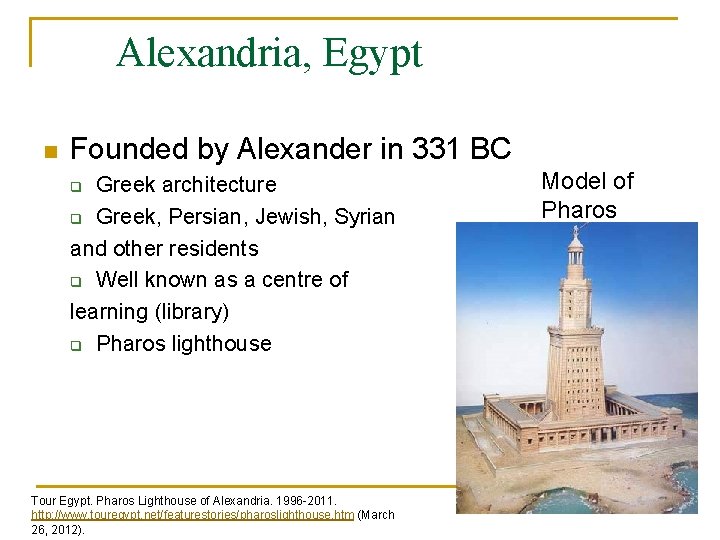
Alexandria, Egypt n Founded by Alexander in 331 BC Greek architecture q Greek, Persian, Jewish, Syrian and other residents q Well known as a centre of learning (library) q Pharos lighthouse q Tour Egypt. Pharos Lighthouse of Alexandria. 1996 -2011. http: //www. touregypt. net/featurestories/pharoslighthouse. htm (March 26, 2012). Model of Pharos
- Slides: 11