
Alexander and the Hellenistic Age Focus Question How





- Slides: 35
Alexander and the Hellenistic Age Focus Question How did Alexander the Great expand his empire and spread Greek culture throughout the realm?
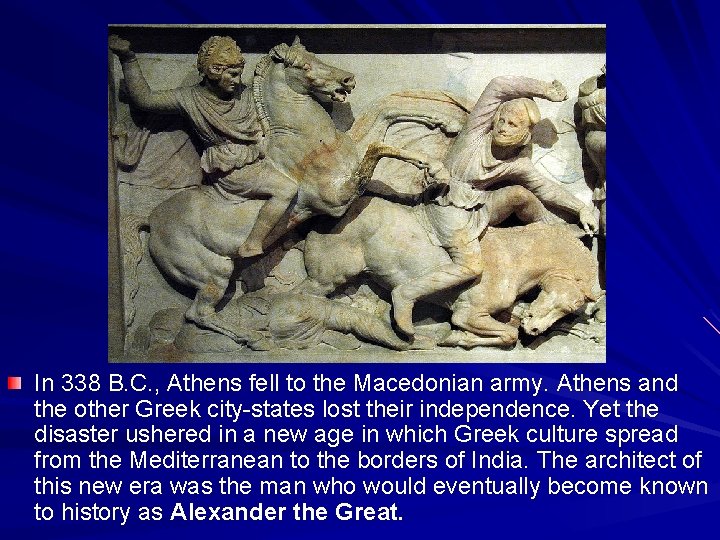
In 338 B. C. , Athens fell to the Macedonian army. Athens and the other Greek city-states lost their independence. Yet the disaster ushered in a new age in which Greek culture spread from the Mediterranean to the borders of India. The architect of this new era was the man who would eventually become known to history as Alexander the Great.
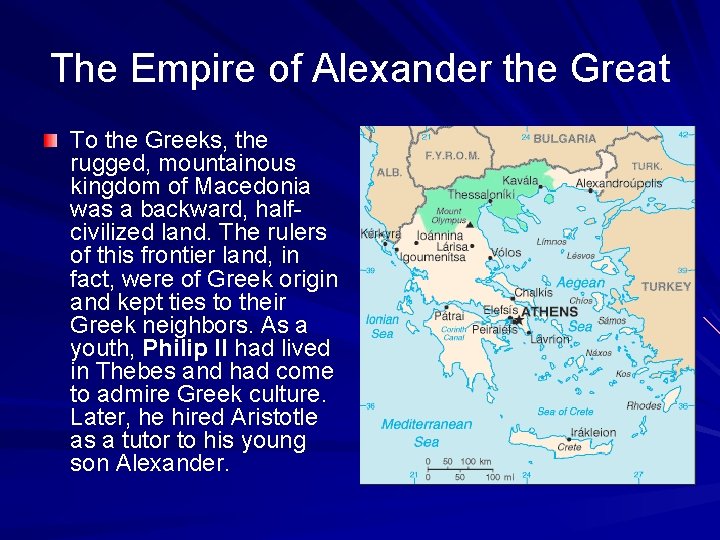
The Empire of Alexander the Great To the Greeks, the rugged, mountainous kingdom of Macedonia was a backward, halfcivilized land. The rulers of this frontier land, in fact, were of Greek origin and kept ties to their Greek neighbors. As a youth, Philip II had lived in Thebes and had come to admire Greek culture. Later, he hired Aristotle as a tutor to his young son Alexander.
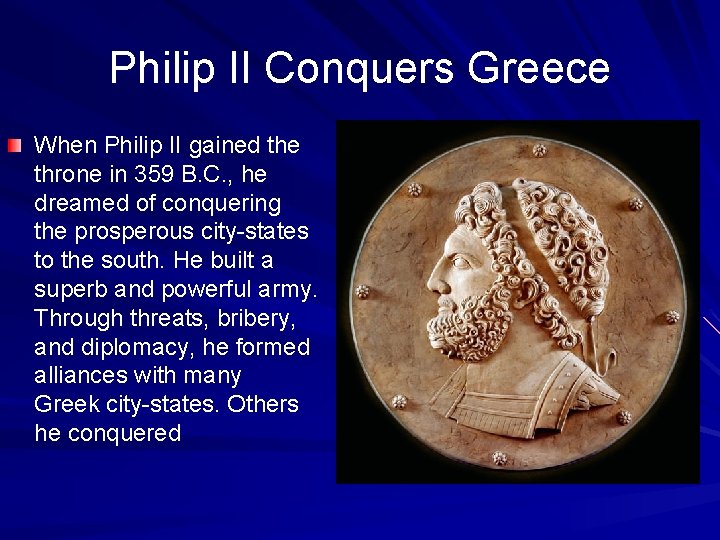
Philip II Conquers Greece When Philip II gained the throne in 359 B. C. , he dreamed of conquering the prosperous city-states to the south. He built a superb and powerful army. Through threats, bribery, and diplomacy, he formed alliances with many Greek city-states. Others he conquered
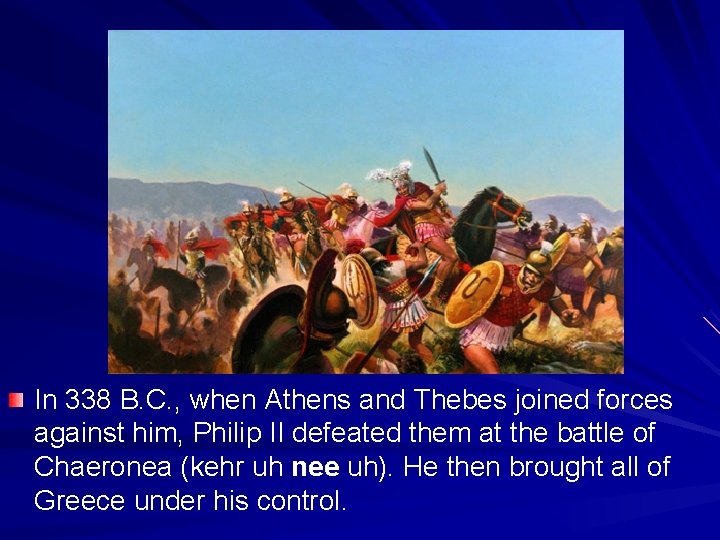
In 338 B. C. , when Athens and Thebes joined forces against him, Philip II defeated them at the battle of Chaeronea (kehr uh nee uh). He then brought all of Greece under his control.
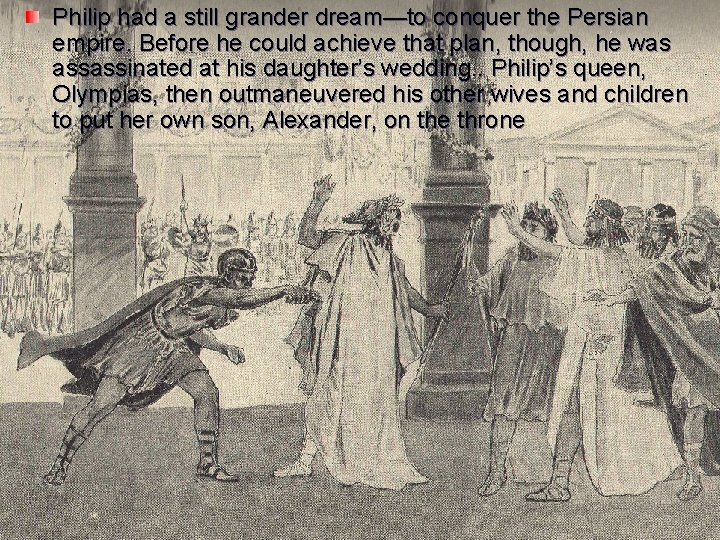
Philip had a still grander dream—to conquer the Persian empire. Before he could achieve that plan, though, he was assassinated at his daughter’s wedding. . Philip’s queen, Olympias, then outmaneuvered his other wives and children to put her own son, Alexander, on the throne
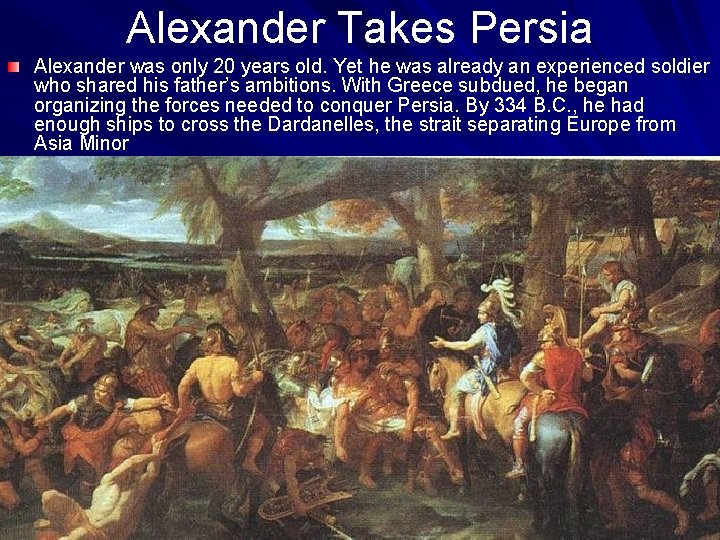
Alexander Takes Persia Alexander was only 20 years old. Yet he was already an experienced soldier who shared his father’s ambitions. With Greece subdued, he began organizing the forces needed to conquer Persia. By 334 B. C. , he had enough ships to cross the Dardanelles, the strait separating Europe from Asia Minor
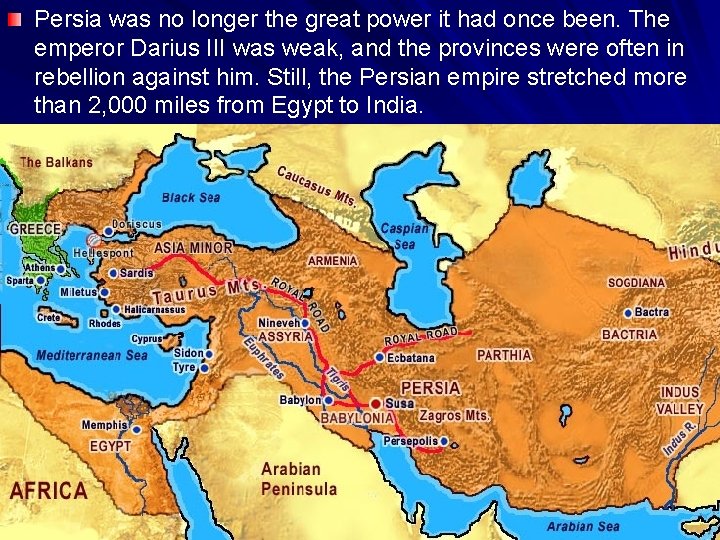
Persia was no longer the great power it had once been. The emperor Darius III was weak, and the provinces were often in rebellion against him. Still, the Persian empire stretched more than 2, 000 miles from Egypt to India.
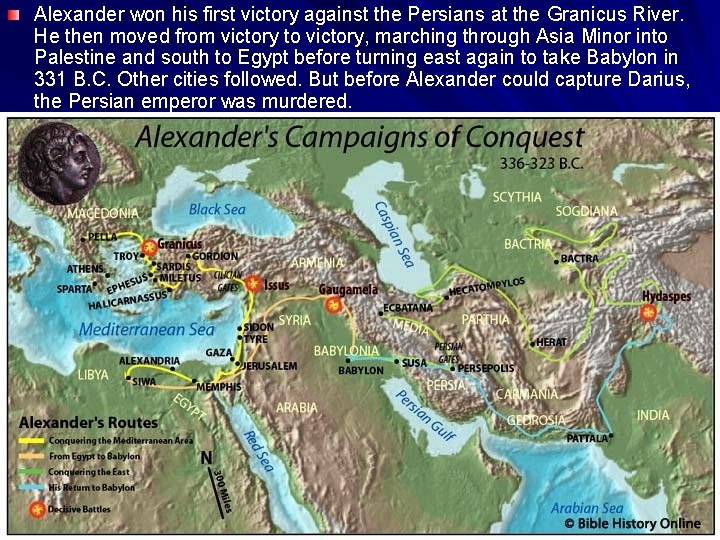
Alexander won his first victory against the Persians at the Granicus River. He then moved from victory to victory, marching through Asia Minor into Palestine and south to Egypt before turning east again to take Babylon in 331 B. C. Other cities followed. But before Alexander could capture Darius, the Persian emperor was murdered.
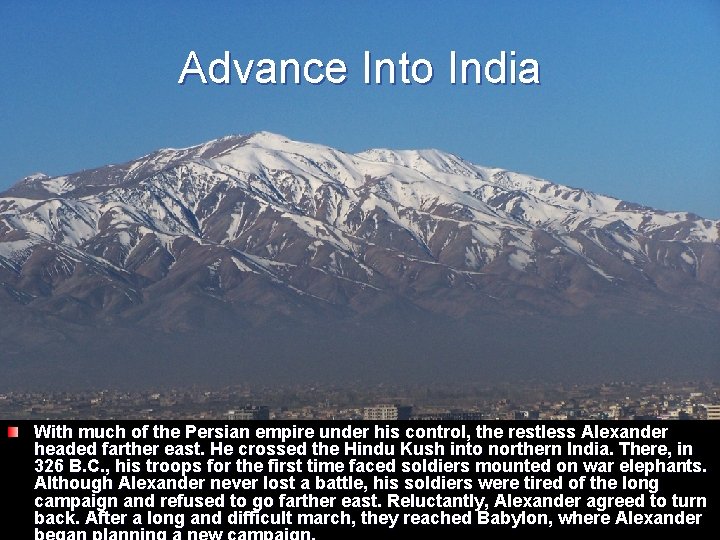
Advance Into India With much of the Persian empire under his control, the restless Alexander headed farther east. He crossed the Hindu Kush into northern India. There, in 326 B. C. , his troops for the first time faced soldiers mounted on war elephants. Although Alexander never lost a battle, his soldiers were tired of the long campaign and refused to go farther east. Reluctantly, Alexander agreed to turn back. After a long and difficult march, they reached Babylon, where Alexander
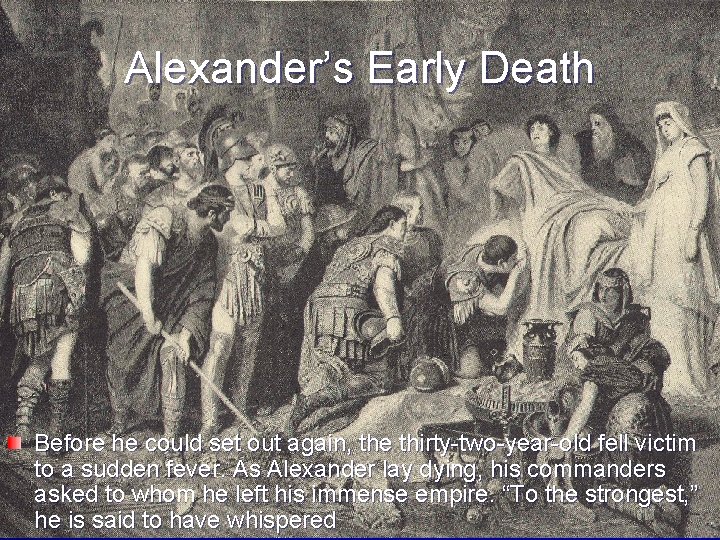
Alexander’s Early Death Before he could set out again, the thirty-two-year-old fell victim to a sudden fever. As Alexander lay dying, his commanders asked to whom he left his immense empire. “To the strongest, ” he is said to have whispered
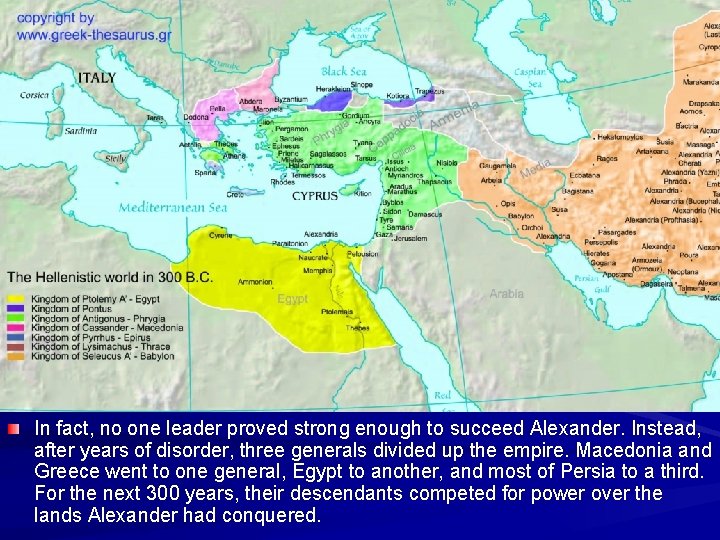
In fact, no one leader proved strong enough to succeed Alexander. Instead, after years of disorder, three generals divided up the empire. Macedonia and Greece went to one general, Egypt to another, and most of Persia to a third. For the next 300 years, their descendants competed for power over the lands Alexander had conquered.
Why was Alexander the Great able to conquer the Persian empire?
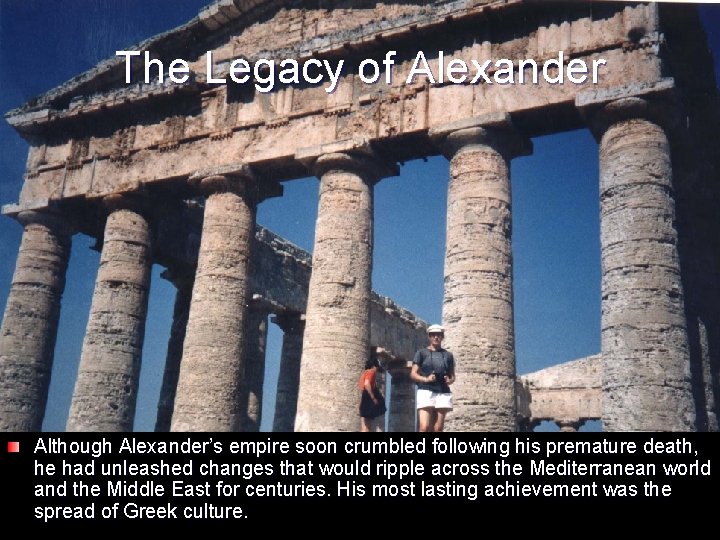
The Legacy of Alexander Although Alexander’s empire soon crumbled following his premature death, he had unleashed changes that would ripple across the Mediterranean world and the Middle East for centuries. His most lasting achievement was the spread of Greek culture.
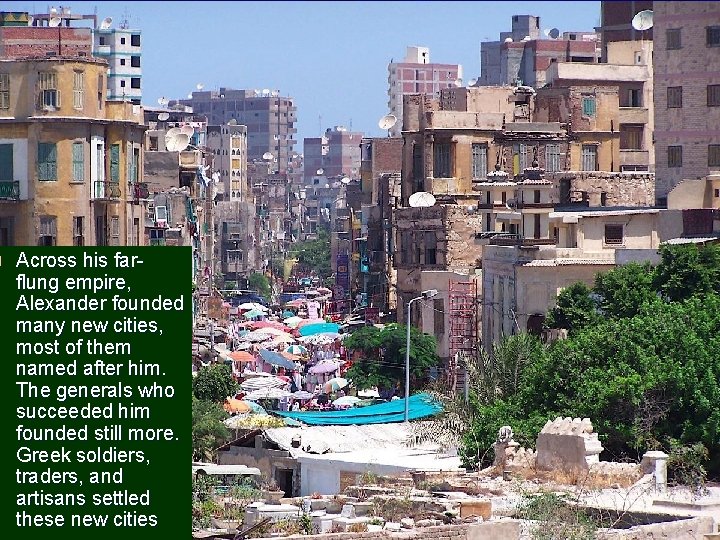
Across his farflung empire, Alexander founded many new cities, most of them named after him. The generals who succeeded him founded still more. Greek soldiers, traders, and artisans settled these new cities
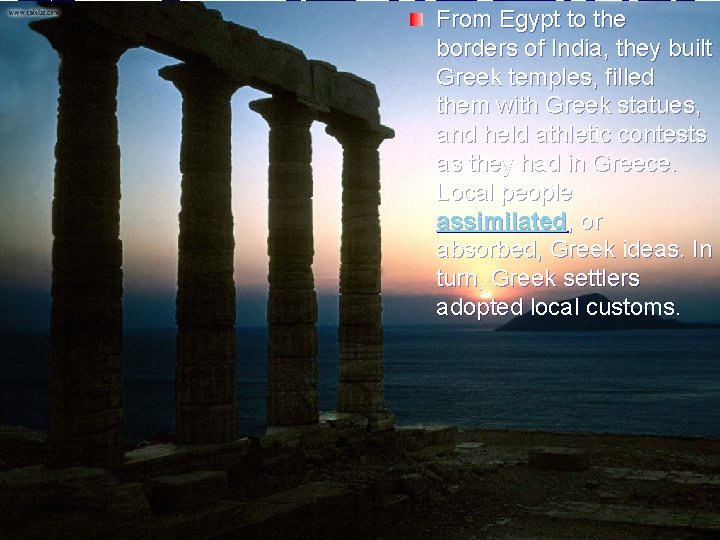
From Egypt to the borders of India, they built Greek temples, filled them with Greek statues, and held athletic contests as they had in Greece. Local people assimilated, or absorbed, Greek ideas. In turn, Greek settlers adopted local customs.
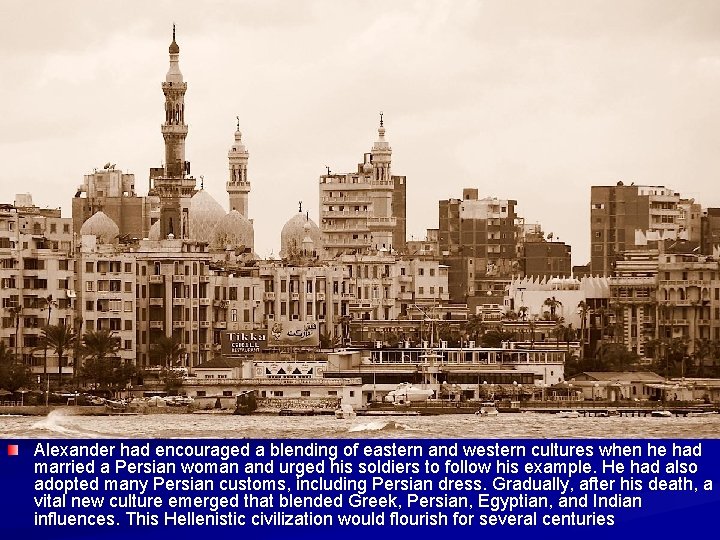
Alexander had encouraged a blending of eastern and western cultures when he had married a Persian woman and urged his soldiers to follow his example. He had also adopted many Persian customs, including Persian dress. Gradually, after his death, a vital new culture emerged that blended Greek, Persian, Egyptian, and Indian influences. This Hellenistic civilization would flourish for several centuries
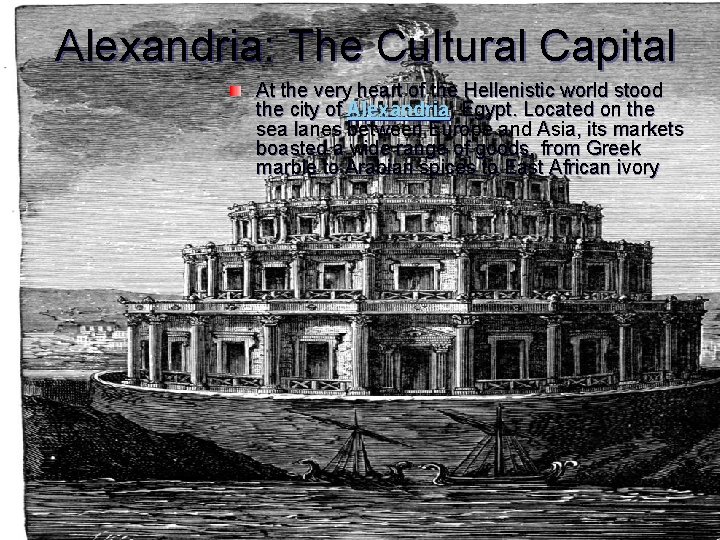
Alexandria: The Cultural Capital At the very heart of the Hellenistic world stood the city of Alexandria, Egypt. Located on the sea lanes between Europe and Asia, its markets boasted a wide range of goods, from Greek marble to Arabian spices to East African ivory
A Greek architect had drawn up plans for the city, which would become home to almost a million people. Among the city’s marvelous sights was the Pharos, an enormous lighthouse that soared 440 feet into the air.
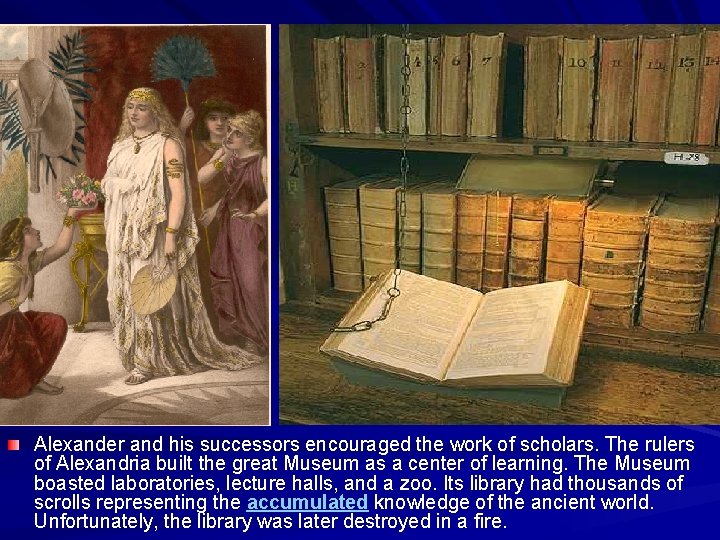
Alexander and his successors encouraged the work of scholars. The rulers of Alexandria built the great Museum as a center of learning. The Museum boasted laboratories, lecture halls, and a zoo. Its library had thousands of scrolls representing the accumulated knowledge of the ancient world. Unfortunately, the library was later destroyed in a fire.
New Roles for Women Paintings, statues, and legal codes show that women were no longer restricted to their homes during the Hellenistic period. More women learned to read and write. Some became philosophers or poets. Royal women held considerable power, working alongside husbands and sons who were the actual rulers. In Egypt, the able and clever queen Cleopatra VII came to rule in her own right.
How did Alexander encourage the blending of cultures?
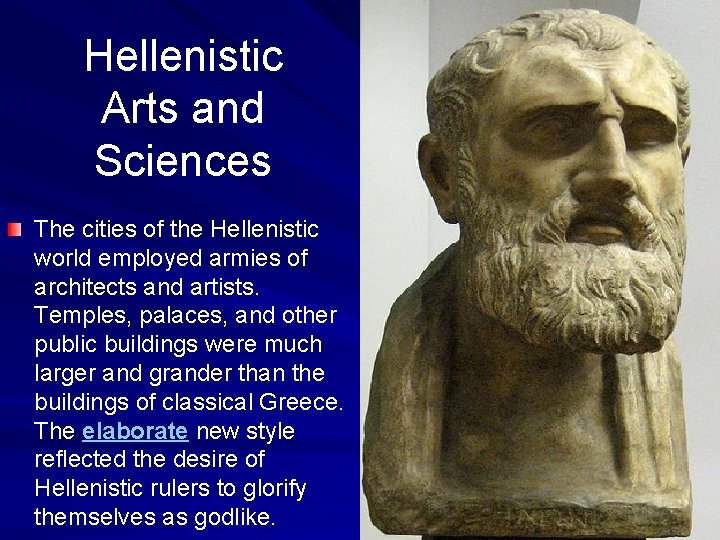
Hellenistic Arts and Sciences The cities of the Hellenistic world employed armies of architects and artists. Temples, palaces, and other public buildings were much larger and grander than the buildings of classical Greece. The elaborate new style reflected the desire of Hellenistic rulers to glorify themselves as godlike.
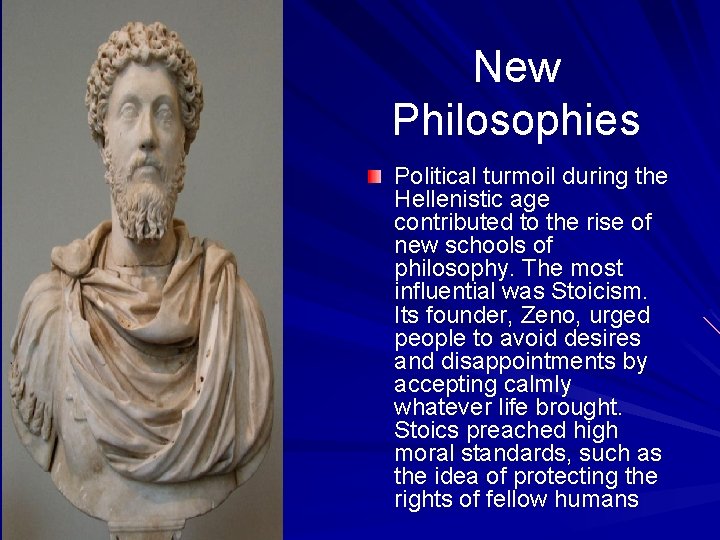
New Philosophies Political turmoil during the Hellenistic age contributed to the rise of new schools of philosophy. The most influential was Stoicism. Its founder, Zeno, urged people to avoid desires and disappointments by accepting calmly whatever life brought. Stoics preached high moral standards, such as the idea of protecting the rights of fellow humans
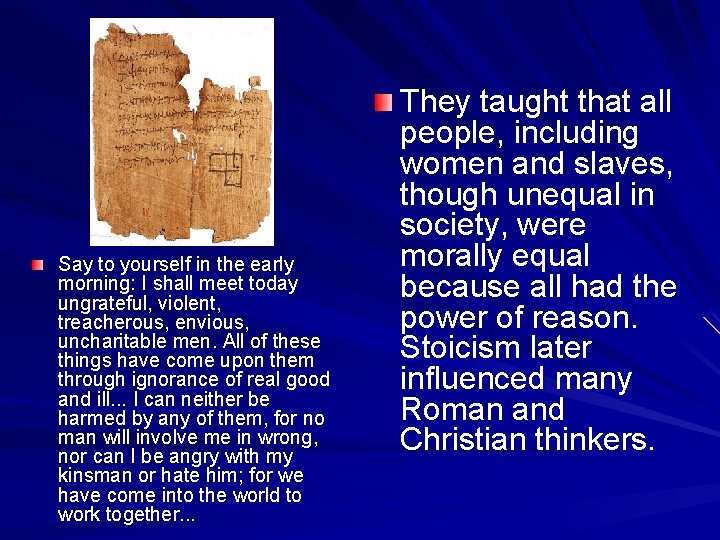
Say to yourself in the early morning: I shall meet today ungrateful, violent, treacherous, envious, uncharitable men. All of these things have come upon them through ignorance of real good and ill. . . I can neither be harmed by any of them, for no man will involve me in wrong, nor can I be angry with my kinsman or hate him; for we have come into the world to work together. . . They taught that all people, including women and slaves, though unequal in society, were morally equal because all had the power of reason. Stoicism later influenced many Roman and Christian thinkers.
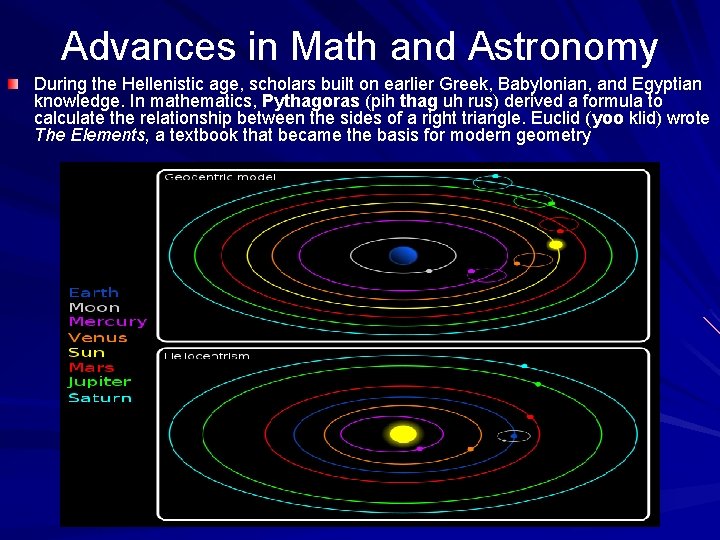
Advances in Math and Astronomy During the Hellenistic age, scholars built on earlier Greek, Babylonian, and Egyptian knowledge. In mathematics, Pythagoras (pih thag uh rus) derived a formula to calculate the relationship between the sides of a right triangle. Euclid (yoo klid) wrote The Elements, a textbook that became the basis for modern geometry
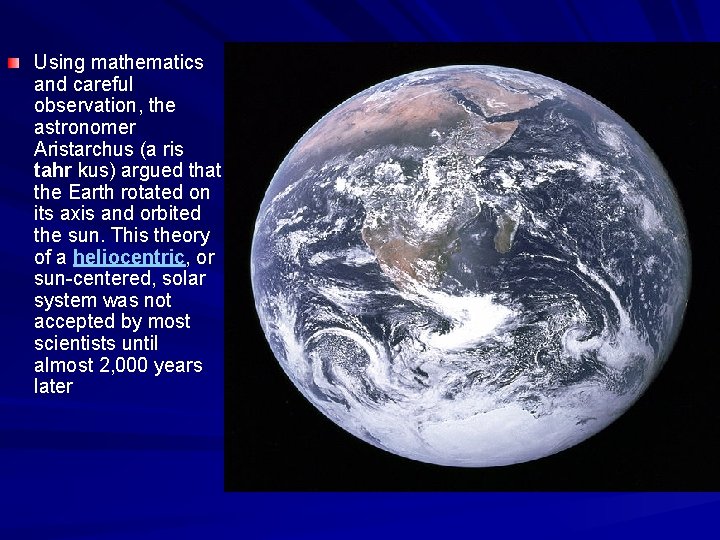
Using mathematics and careful observation, the astronomer Aristarchus (a ris tahr kus) argued that the Earth rotated on its axis and orbited the sun. This theory of a heliocentric, or sun-centered, solar system was not accepted by most scientists until almost 2, 000 years later
Another Hellenistic astronomer, Eratosthenes, (eh ruh tahs thuh neez), showed that the Earth was round accurately calculated its circumference.
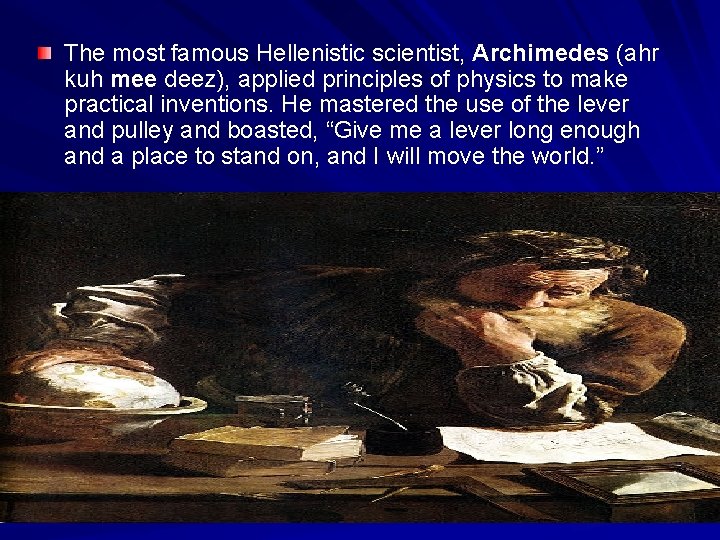
The most famous Hellenistic scientist, Archimedes (ahr kuh mee deez), applied principles of physics to make practical inventions. He mastered the use of the lever and pulley and boasted, “Give me a lever long enough and a place to stand on, and I will move the world. ”
to demonstrate the power of his invention, Archimedes used it to draw a ship over the land before a crowd of awed spectators.
Improving Medical Practice About 400 B. C. , the Greek physician Hippocrates (hih pah kruh teez) studied the causes of illnesses and looked for cures. The Hippocratic oath attributed to him set ethical standards for doctors. Greek physicians swore to “help the sick according to my ability and judgment but never with a view to injury and wrong. ” Doctors today still take a similar oath.
Watch Alexander the Great on the Witness History Discovery School
In what fields did Hellenistic civilization make advancements?
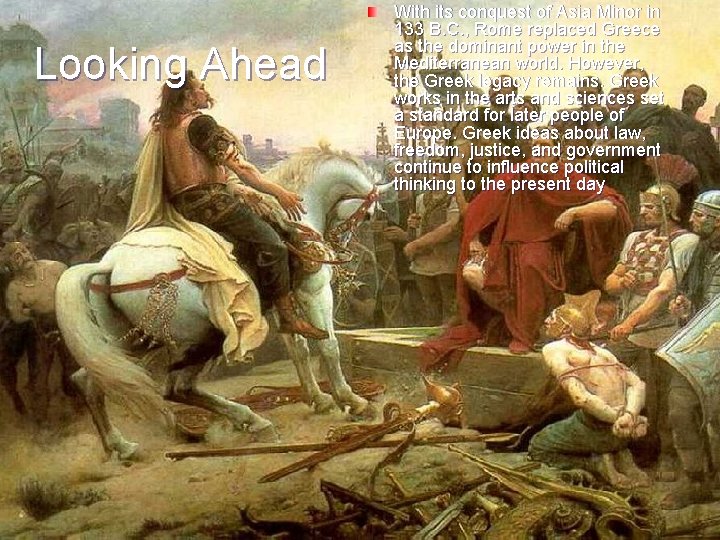
Looking Ahead With its conquest of Asia Minor in 133 B. C. , Rome replaced Greece as the dominant power in the Mediterranean world. However, the Greek legacy remains. Greek works in the arts and sciences set a standard for later people of Europe. Greek ideas about law, freedom, justice, and government continue to influence political thinking to the present day
These achievements were especially remarkable because they were produced by a scattering of tiny city-states whose rivalries left them too weak to defend themselves from conquest. Later, you will learn how the Greek legacy influenced the civilizations of Rome and of Western Europe.