
Alex Bogacz Acceleration in RLAs Design Choices Alex
Alex Bogacz, Acceleration in RLAs – Design Choices Alex Bogacz ‘Racetrack’ vs ‘Dogbone’ configuration multi-pass linacs focusing orbit separation simultaneous acceleration of both m+ m- species 10 Ge. V Two-step-Dogbone RLA Quadrupole focusing scheme – Triplet vs FODO lattices multi-pass linac matching to the Arcs vertical injection double-chicane Thomas Jefferson National Accelerator Facility Operated by the Jefferson Science Associates for the U. S. Depart. Of Energy
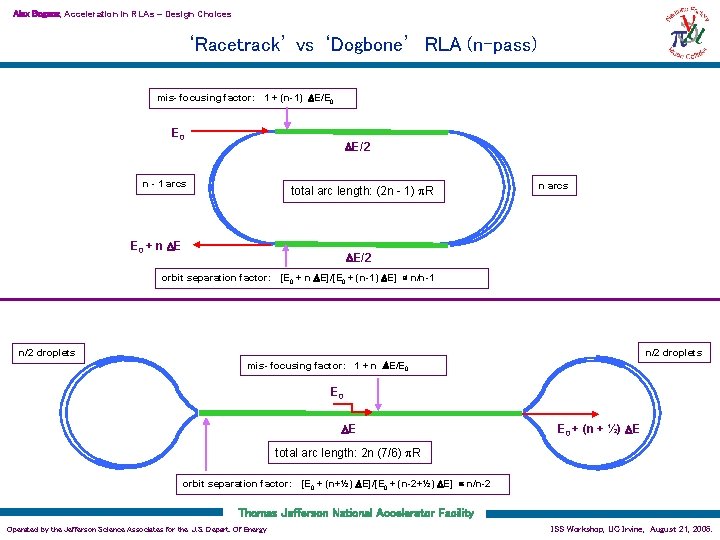
Alex Bogacz, Acceleration in RLAs – Design Choices ‘Racetrack’ vs ‘Dogbone’ RLA (n-pass) mis- focusing factor: 1 + (n-1) DE/E 0 DE/2 n - 1 arcs total arc length: (2 n - 1) p. R E 0 + n DE n arcs DE/2 orbit separation factor: [E 0 + n DE]/[E 0 + (n-1) DE] ≃ n/n-1 n/2 droplets mis- focusing factor: 1 + n DE/E 0 DE E 0 + (n + ½) DE total arc length: 2 n (7/6) p. R orbit separation factor: [E 0 + (n+½) DE]/[E 0 + (n-2+½) DE] ≃ n/n-2 Thomas Jefferson National Accelerator Facility Operated by the Jefferson Science Associates for the U. S. Depart. Of Energy ISS Workshop, UC Irvine, August 21, 2006.
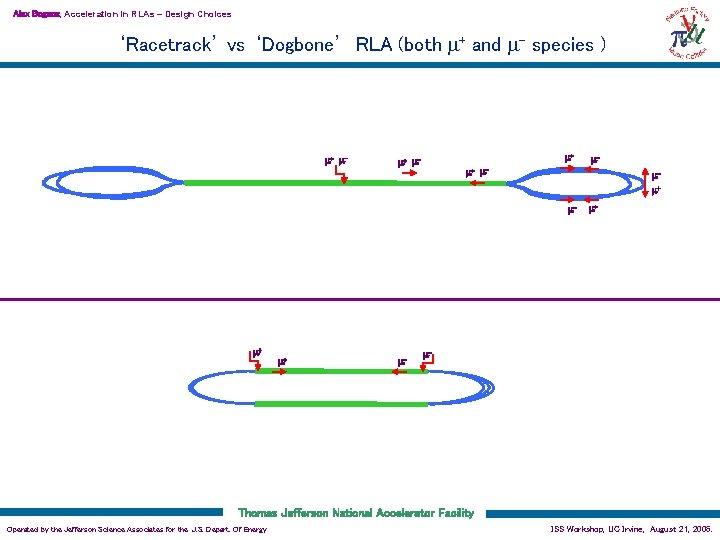
Alex Bogacz, Acceleration in RLAs – Design Choices ‘Racetrack’ vs ‘Dogbone’ RLA (both m+ and m- species ) m+ m- m+ m+ m- m- m+ m- Thomas Jefferson National Accelerator Facility Operated by the Jefferson Science Associates for the U. S. Depart. Of Energy ISS Workshop, UC Irvine, August 21, 2006.
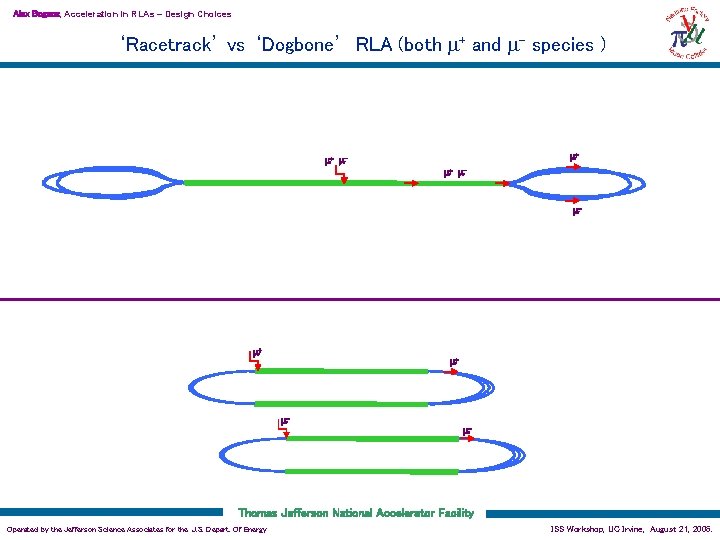
Alex Bogacz, Acceleration in RLAs – Design Choices ‘Racetrack’ vs ‘Dogbone’ RLA (both m+ and m- species ) m+ m- m+ m+ m- m- Thomas Jefferson National Accelerator Facility Operated by the Jefferson Science Associates for the U. S. Depart. Of Energy ISS Workshop, UC Irvine, August 21, 2006.
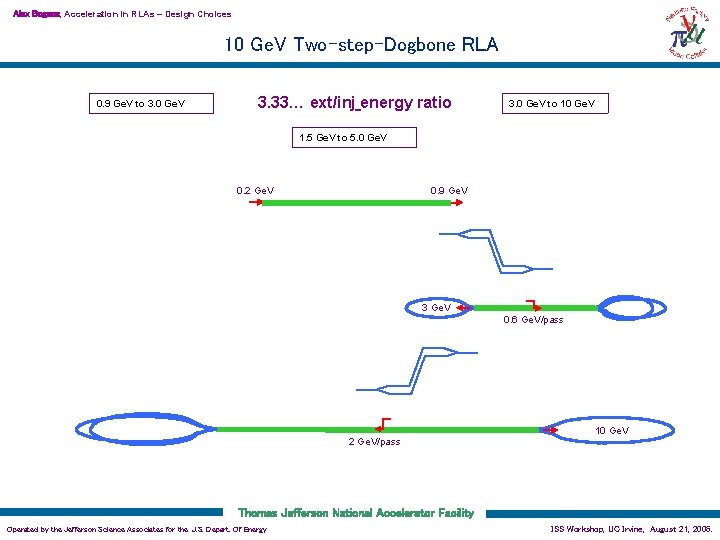
Alex Bogacz, Acceleration in RLAs – Design Choices 10 Ge. V Two-step-Dogbone RLA 0. 9 Ge. V to 3. 0 Ge. V 3. 33… ext/inj energy ratio 3. 0 Ge. V to 10 Ge. V 1. 5 Ge. V to 5. 0 Ge. V 0. 9 Ge. V 0. 2 Ge. V 3 Ge. V 0. 6 Ge. V/pass 10 Ge. V 2 Ge. V/pass Thomas Jefferson National Accelerator Facility Operated by the Jefferson Science Associates for the U. S. Depart. Of Energy ISS Workshop, UC Irvine, August 21, 2006.
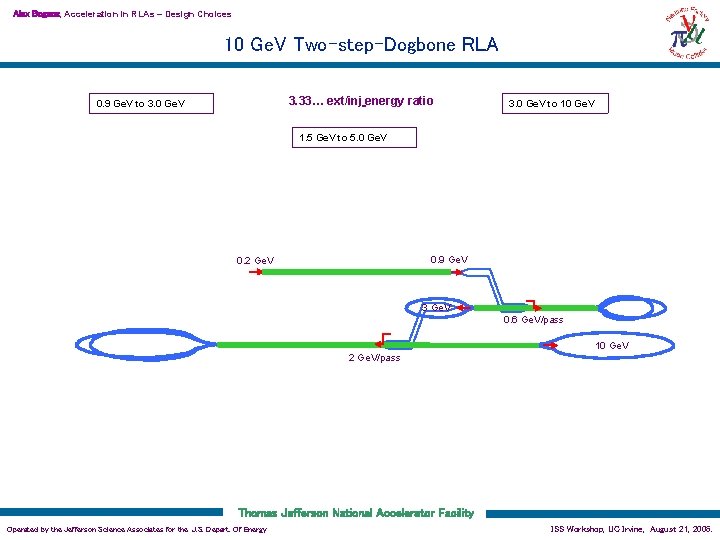
Alex Bogacz, Acceleration in RLAs – Design Choices 10 Ge. V Two-step-Dogbone RLA 3. 33… ext/inj energy ratio 0. 9 Ge. V to 3. 0 Ge. V to 10 Ge. V 1. 5 Ge. V to 5. 0 Ge. V 0. 9 Ge. V 0. 2 Ge. V 3 Ge. V 0. 6 Ge. V/pass 10 Ge. V 2 Ge. V/pass Thomas Jefferson National Accelerator Facility Operated by the Jefferson Science Associates for the U. S. Depart. Of Energy ISS Workshop, UC Irvine, August 21, 2006.
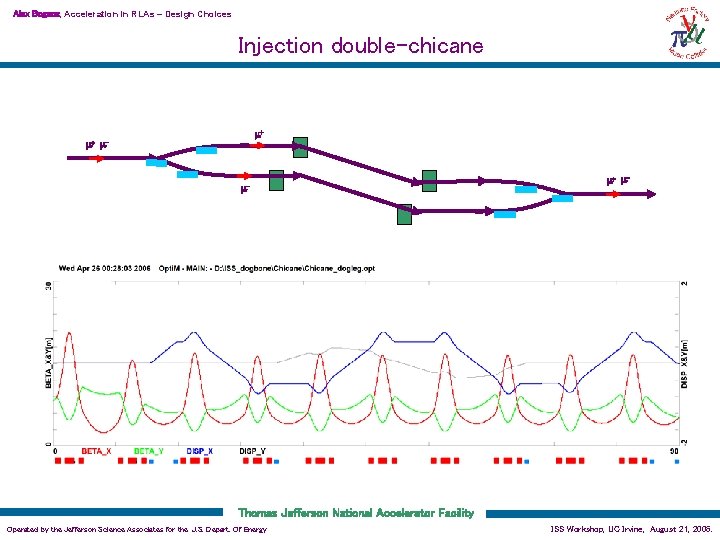
Alex Bogacz, Acceleration in RLAs – Design Choices Injection double-chicane m+ m+ m- m- m+ m- Thomas Jefferson National Accelerator Facility Operated by the Jefferson Science Associates for the U. S. Depart. Of Energy ISS Workshop, UC Irvine, August 21, 2006.
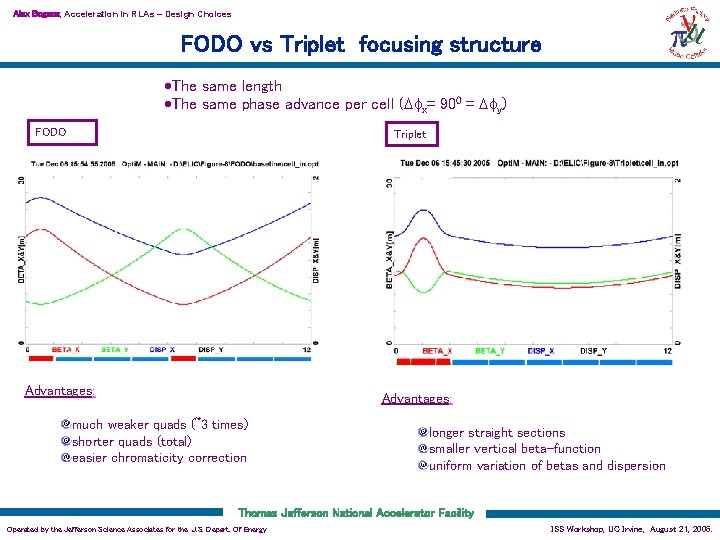
Alex Bogacz, Acceleration in RLAs – Design Choices FODO vs Triplet focusing structure ·The same length ·The same phase advance per cell (Dfx= 900 = Dfy) FODO Triplet Advantages: much weaker quads (~3 times) shorter quads (total) easier chromaticity correction longer straight sections smaller vertical beta-function uniform variation of betas and dispersion Thomas Jefferson National Accelerator Facility Operated by the Jefferson Science Associates for the U. S. Depart. Of Energy ISS Workshop, UC Irvine, August 21, 2006.
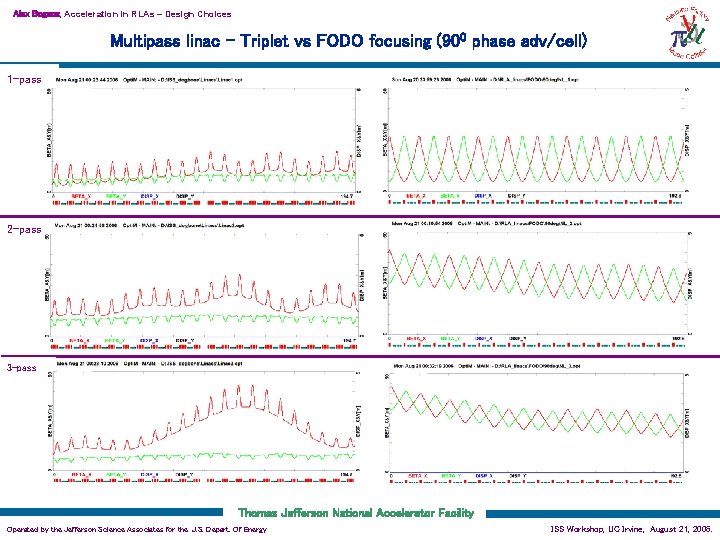
Alex Bogacz, Acceleration in RLAs – Design Choices Multipass linac - Triplet vs FODO focusing (900 phase adv/cell) 1 -pass 2 -pass 3 -pass Thomas Jefferson National Accelerator Facility Operated by the Jefferson Science Associates for the U. S. Depart. Of Energy ISS Workshop, UC Irvine, August 21, 2006.
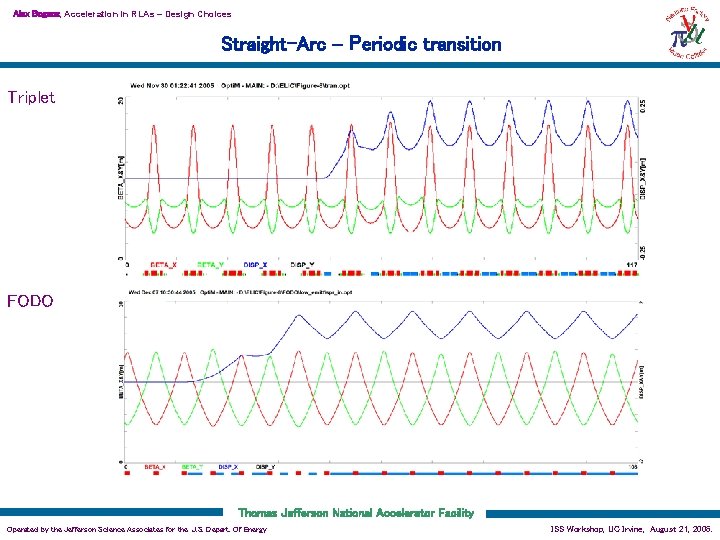
Alex Bogacz, Acceleration in RLAs – Design Choices Straight-Arc - Periodic transition Triplet FODO Thomas Jefferson National Accelerator Facility Operated by the Jefferson Science Associates for the U. S. Depart. Of Energy ISS Workshop, UC Irvine, August 21, 2006.
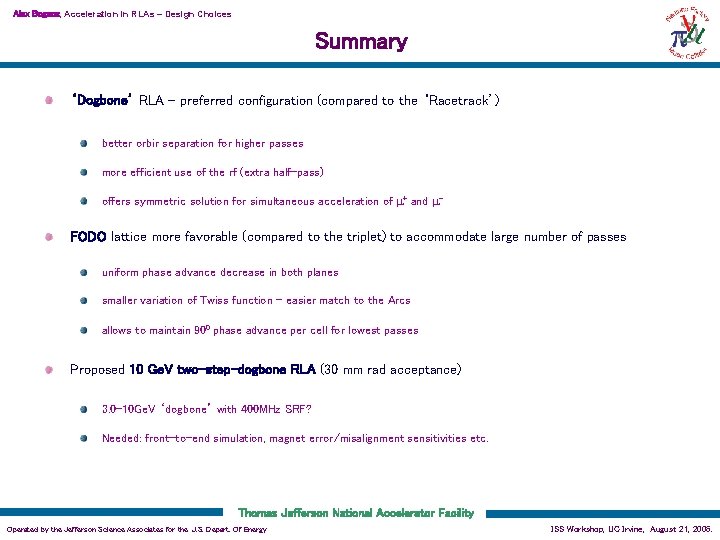
Alex Bogacz, Acceleration in RLAs – Design Choices Summary ‘Dogbone’ RLA – preferred configuration (compared to the ‘Racetrack’) better orbir separation for higher passes more efficient use of the rf (extra half-pass) offers symmetric solution for simultaneous acceleration of m+ and m- FODO lattice more favorable (compared to the triplet) to accommodate large number of passes uniform phase advance decrease in both planes smaller variation of Twiss function – easier match to the Arcs allows to maintain 900 phase advance per cell for lowest passes Proposed 10 Ge. V two-step-dogbone RLA (30 mm rad acceptance) 3. 0 -10 Ge. V ‘dogbone’ with 400 MHz SRF? Needed: front-to-end simulation, magnet error/misalignment sensitivities etc. Thomas Jefferson National Accelerator Facility Operated by the Jefferson Science Associates for the U. S. Depart. Of Energy ISS Workshop, UC Irvine, August 21, 2006.
- Slides: 11