
ALevel PE PHED 1 Skill Acquisition Memory Models









- Slides: 35
A-Level PE PHED 1 Skill Acquisition Memory Models
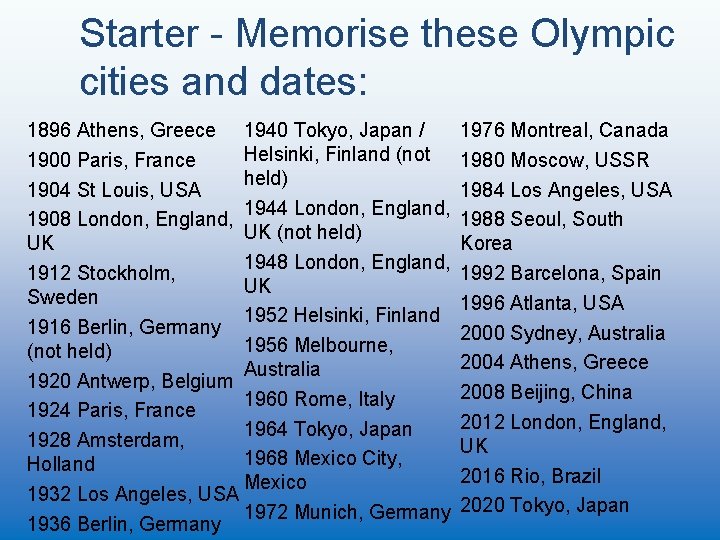
Starter - Memorise these Olympic cities and dates: 1896 Athens, Greece 1940 Tokyo, Japan / Helsinki, Finland (not 1900 Paris, France held) 1904 St Louis, USA 1944 London, England, 1908 London, England, UK (not held) UK 1948 London, England, 1912 Stockholm, UK Sweden 1952 Helsinki, Finland 1916 Berlin, Germany 1956 Melbourne, (not held) Australia 1920 Antwerp, Belgium 1960 Rome, Italy 1924 Paris, France 1964 Tokyo, Japan 1928 Amsterdam, 1968 Mexico City, Holland Mexico 1932 Los Angeles, USA 1972 Munich, Germany 1936 Berlin, Germany 1976 Montreal, Canada 1980 Moscow, USSR 1984 Los Angeles, USA 1988 Seoul, South Korea 1992 Barcelona, Spain 1996 Atlanta, USA 2000 Sydney, Australia 2004 Athens, Greece 2008 Beijing, China 2012 London, England, UK 2016 Rio, Brazil 2020 Tokyo, Japan
Starter You have 2 mins to write down as many Olympic City and dates as you can, GO!!!!
Memory What are the characteristics and functions of the Short Term memory? What are the characteristics and functions of the Long Term memory? How can we improve our memory?
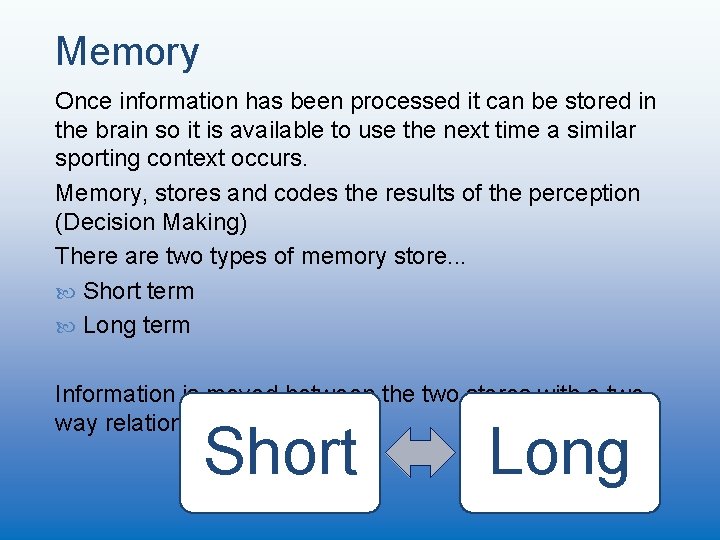
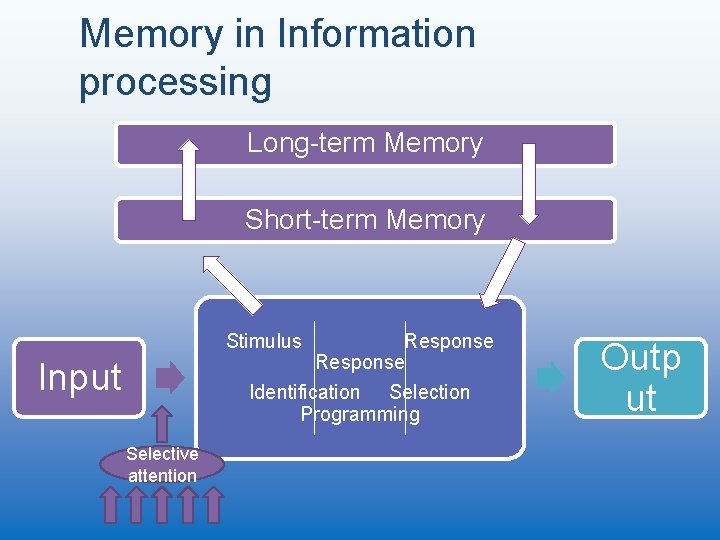
Memory Once information has been processed it can be stored in the brain so it is available to use the next time a similar sporting context occurs. Memory, stores and codes the results of the perception (Decision Making) There are two types of memory store. . . Short term Long term Information is moved between the two stores with a twoway relationship Short Long
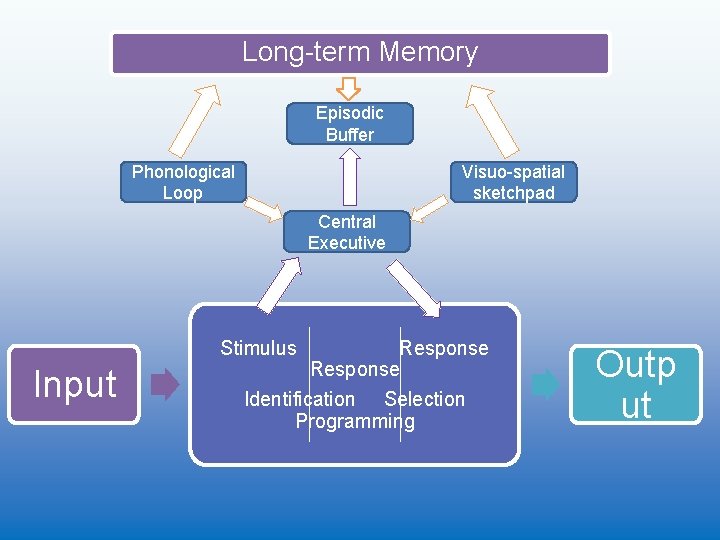
Memory in Information processing Long-term Memory Short-term Memory Stimulus Response Identification Selection Programming Input Selective attention Outp ut
Short Term Memory Capacity How to improve retrieval Click Here to Continue
Experiment 1 § Before proceeding, you will need a pen/pencil and a sheet of paper. § When you go to the next page, you will be presented with a sequence of numbers, which will appear in the centre of the screen at one second intervals. § Try to memorise the numbers in sequence as they are presented. § When you hear a tone/see the word NOW appear, write the numbers down in the same order as they were presented, (serial recall), on the sheet of paper. § Click on the forward button to start Trial 1 of Experiment 1.
4 3 6 8 9 2 1 5 7 NOW
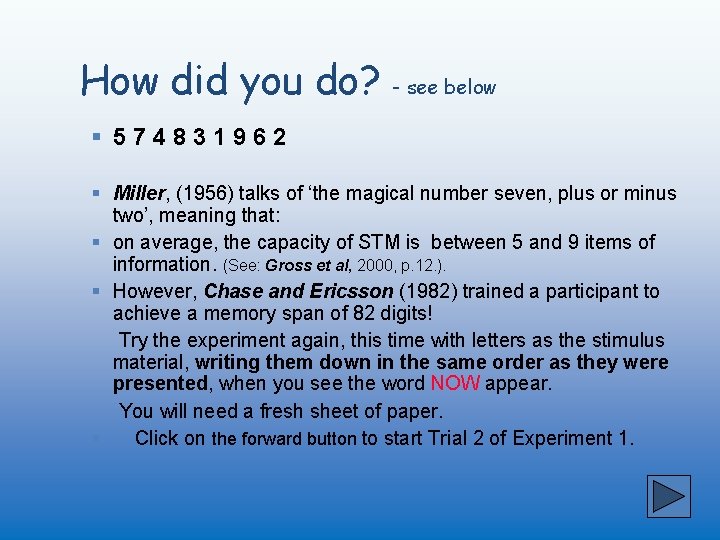
How did you do? - see below § 574831962 § Miller, (1956) talks of ‘the magical number seven, plus or minus two’, meaning that: § on average, the capacity of STM is between 5 and 9 items of information. (See: Gross et al, 2000, p. 12. ). § However, Chase and Ericsson (1982) trained a participant to achieve a memory span of 82 digits! Try the experiment again, this time with letters as the stimulus material, writing them down in the same order as they were presented, when you see the word NOW appear. You will need a fresh sheet of paper. § Click on the forward button to start Trial 2 of Experiment 1.
Q S A R E B H K T NOW
Difficult, isn’t it? - Answers below § QAHERSBKT § You probably found that you remembered between 5 and 9 items, digits or letters, on each trial, in line with Miller’s (1954) findings. § Now try Experiment 2 - click on the forward button for details.
Experiment 2 § Before proceeding, you will need a pen/pencil and a fresh sheet of paper. § When you go to the next page, you will be presented with a line of letters across the centre of the screen which will appear for approximately 10 seconds. § Your task is to remember as many of the letters as you can, in the order in which they were presented. § When you see the word NOW appear on the screen, write down on your paper as many of the letters as you can remember, in the same order as they were presented. § Click on the forward button to start Trial 1 of Experiment 2.
GCEBTECGCSEGNVQAS NOW
Difficult, wasn’t it? § Now try it again, using a fresh sheet of paper, obviously! § Click on the forward button to start Trial 2 of Experiment 2.
GCE BTEC GCSE GNVQ AS NOW
You probably did better this time - Answers below. GCE BTEC GCSE GNVQ AS Why might this be? – (apart from having seen the stimulus material twice, an example of the practice effect). § Miller (56) found that the capacity of STM could be considerably increased by combining, or organising, separate ‘bits’ of information, e. g. letters or digits, into larger chunks. § The process of chunking involves the imposition of meaning, through organising the To-Be-Remembered-Material (TBRM), in line with existing knowledge - in this case, of qualifications. This illustrates the important role played by the LTM in STM processes. § Armed with your new-found knowledge, click on the forward button to try Trial 3 of Experiment 2, writing your answers on a fresh sheet of paper when the word NOW appears.
190019141918193919452000 NOW
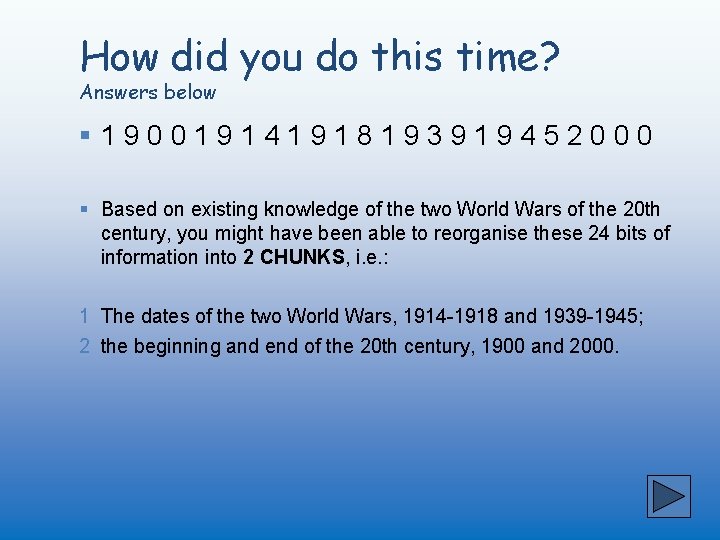
How did you do this time? Answers below § 190019141918193919452000 § Based on existing knowledge of the two World Wars of the 20 th century, you might have been able to reorganise these 24 bits of information into 2 CHUNKS, i. e. : 1 The dates of the two World Wars, 1914 -1918 and 1939 -1945; 2 the beginning and end of the 20 th century, 1900 and 2000.
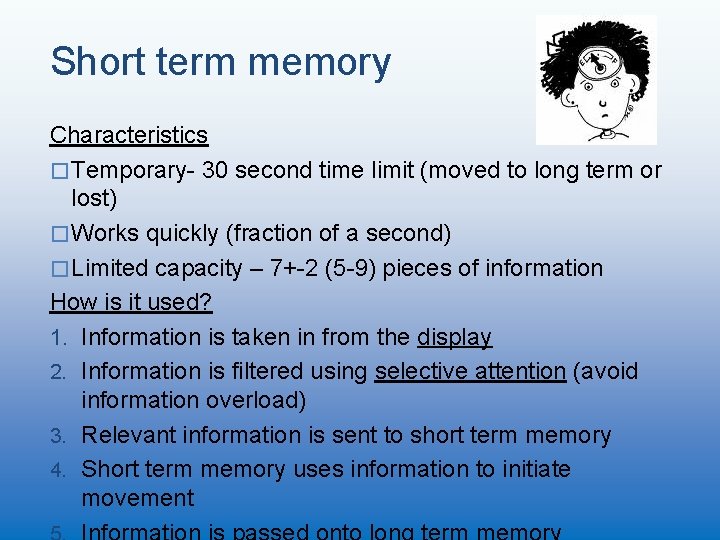
Short term memory Characteristics � Temporary- 30 second time limit (moved to long term or lost) � Works quickly (fraction of a second) � Limited capacity – 7+-2 (5 -9) pieces of information How is it used? 1. Information is taken in from the display 2. Information is filtered using selective attention (avoid information overload) 3. Relevant information is sent to short term memory 4. Short term memory uses information to initiate movement
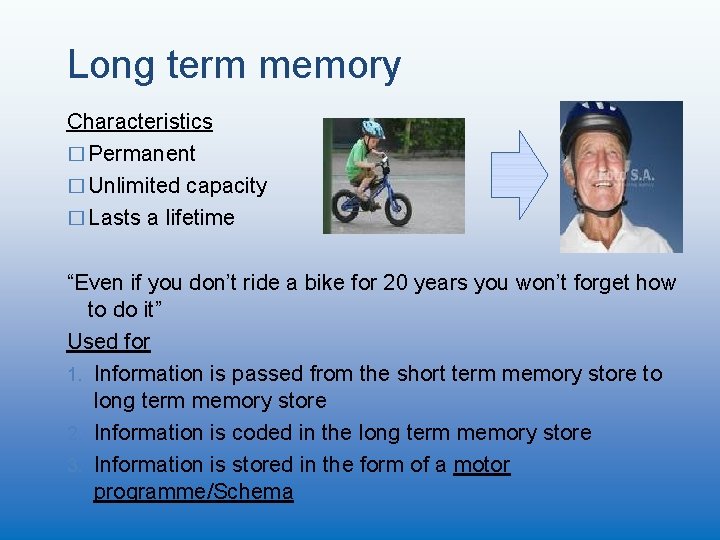
Long term memory Characteristics � Permanent � Unlimited capacity � Lasts a lifetime “Even if you don’t ride a bike for 20 years you won’t forget how to do it” Used for 1. Information is passed from the short term memory store to long term memory store 2. Information is coded in the long term memory store 3. Information is stored in the form of a motor programme/Schema
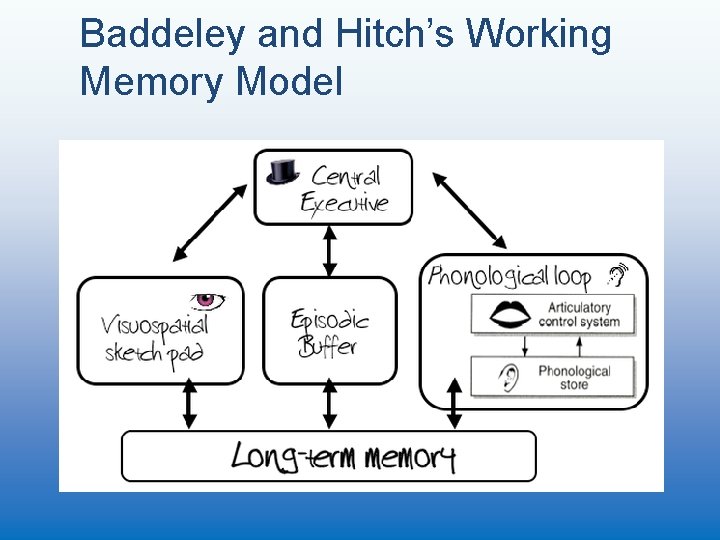
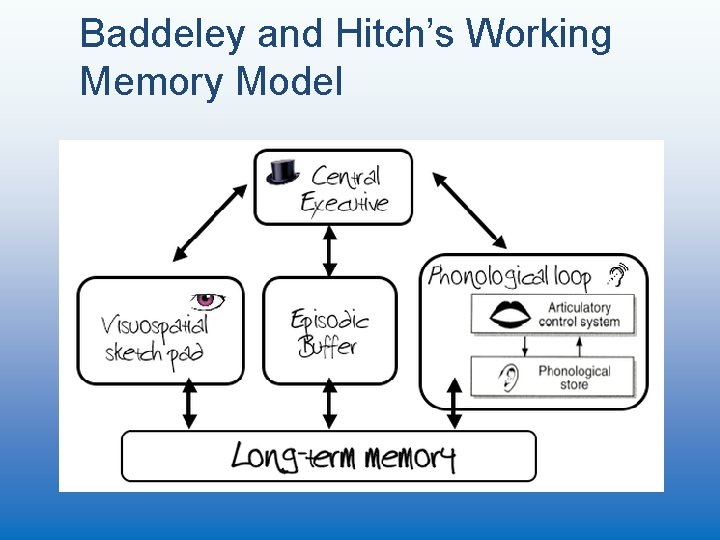
Baddeley and Hitch’s Working Memory Model
Long-term Memory Episodic Buffer Visuo-spatial sketchpad Phonological Loop Central Executive Stimulus Input Response Identification Selection Programming Outp ut
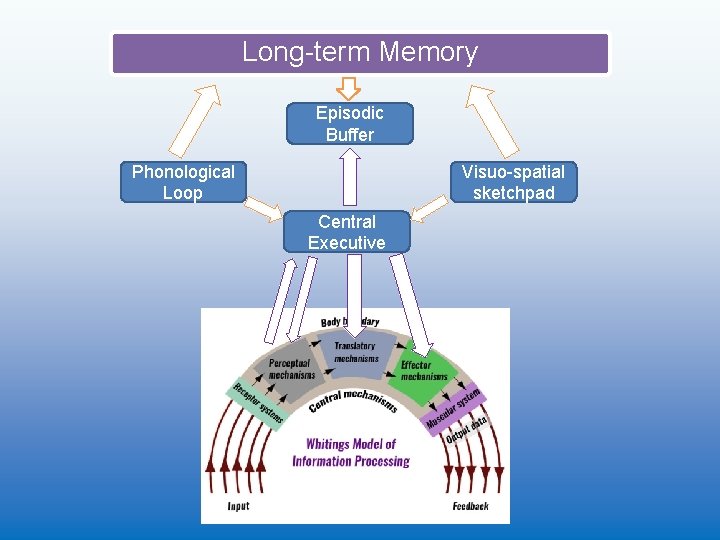
Long-term Memory Episodic Buffer Visuo-spatial sketchpad Phonological Loop Central Executive
The Central Executive drives the whole system and distributes data to the other two subsystems (VSS and PL). It also deals with cognitive tasks such as mental arithmetic and problem solving. The visuo-spatial sketch pad is responsible for manipulating images and the phonological loop is responsible for the managing of speech. These two subsystems are known as slaves.
The Central Executive The central executive is the most important and versatile component of the working memory model. It can combine information from the VSS and PL as well as stored information in long term memory to enable it to direct attention to the appropriate slave For example, if a performer is playing badminton and also notices that a shoe lace has become undone, the central executive directs attention to the badminton match rather than the lace.
The Visuo-Spatial Sketchpad (VSS) The Visuo-Spatial Sketch Pad (inner eye) deals with visual and spatial information such as what things look like. The VSS helps us keep track of where we are in relation to other objects as we move through our surroundings. The VSS also displays and manipulates visual and spatial information held in long-term memory. For example, the spatial layout of a basketball court is held in LTM.
Phonological Loop
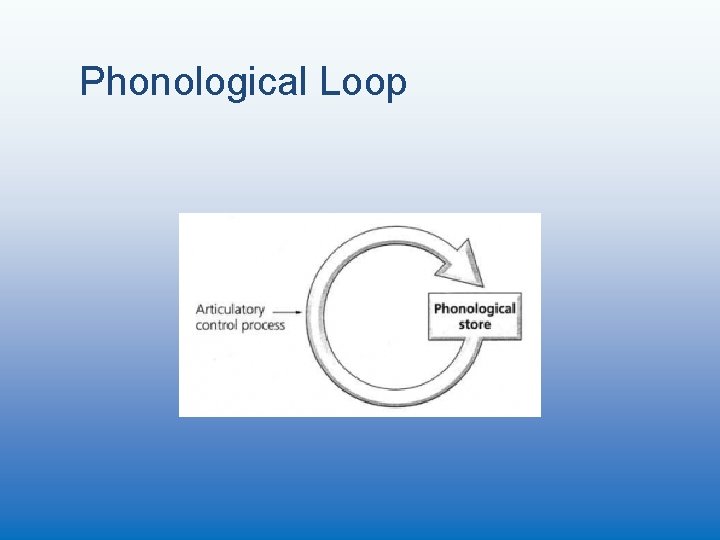
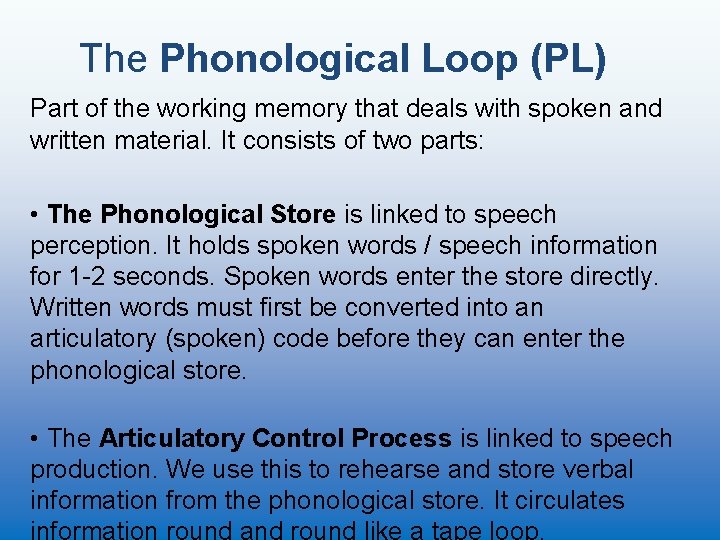
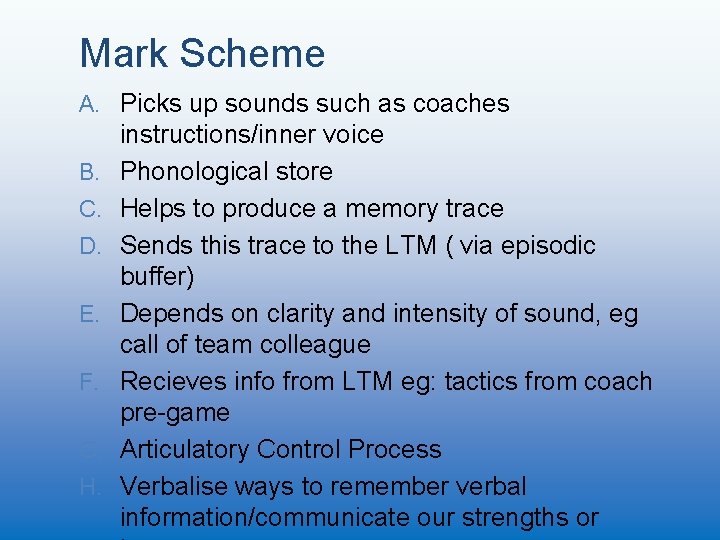
The Phonological Loop (PL) Part of the working memory that deals with spoken and written material. It consists of two parts: • The Phonological Store is linked to speech perception. It holds spoken words / speech information for 1 -2 seconds. Spoken words enter the store directly. Written words must first be converted into an articulatory (spoken) code before they can enter the phonological store. • The Articulatory Control Process is linked to speech production. We use this to rehearse and store verbal information from the phonological store. It circulates
Baddeley and Hitch’s Working Memory Model
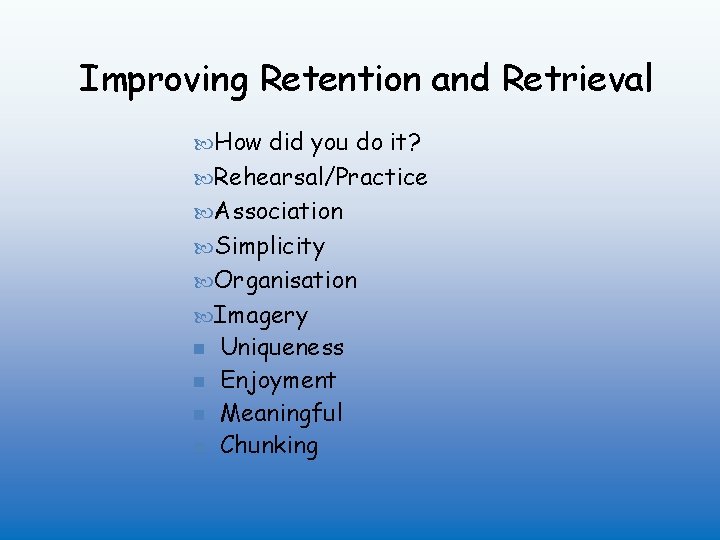
Improving Memory Various ways to improve memory. . . Practice Enables you to help make information in the LTM permanent Coaches will remind players of previous success Chaining Breaking a complex skill down into a series of simpler actions Chunking Putting bits of information together to use less of your capacity Mental Rehearsal Creating a mental picture of the skill to remember actions associated
Improving Retention and Retrieval How did you do it? Rehearsal/Practice Association Simplicity Organisation Imagery n n Uniqueness Enjoyment Meaningful Chunking
Task – Sporting Example For your chosen practical sport, choose a specific skill. Using Baddeley and Hitch’s Working Memory model, explain how you are able to receive information and use your memory to remember how to complete that skill effectively.
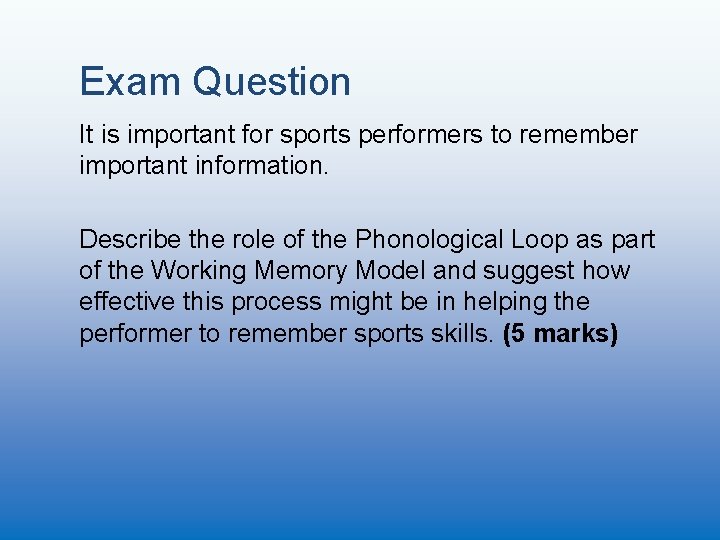
Exam Question It is important for sports performers to remember important information. Describe the role of the Phonological Loop as part of the Working Memory Model and suggest how effective this process might be in helping the performer to remember sports skills. (5 marks)
Mark Scheme A. Picks up sounds such as coaches B. C. D. E. F. G. H. instructions/inner voice Phonological store Helps to produce a memory trace Sends this trace to the LTM ( via episodic buffer) Depends on clarity and intensity of sound, eg call of team colleague Recieves info from LTM eg: tactics from coach pre-game Articulatory Control Process Verbalise ways to remember verbal information/communicate our strengths or