
ALEVEL MATHS ST 1 CLASS INTEGRATION 1 INTEGRALS
- Slides: 27
A-LEVEL MATHS: ST 1 CLASS INTEGRATION 1 ﺭﻭﺍﺀ ﺍﺑﺮﺍﻫﻴﻢ ﻋﻴﺴﻰ. ﻡ
INTEGRALS OF STANDARD FUNCTIONS Contents Integrals of standard functions Reversing the chain rule 2 of 57 © Boardworks Ltd 2006
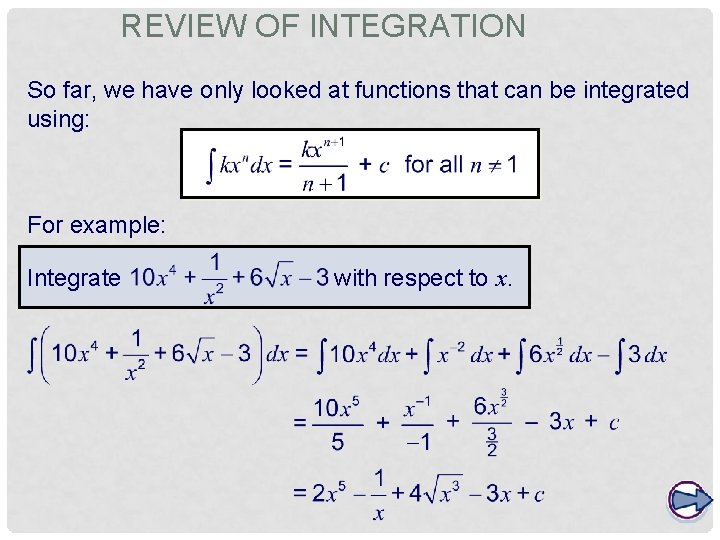
REVIEW OF INTEGRATION So far, we have only looked at functions that can be integrated using: For example: Integrate with respect to x.
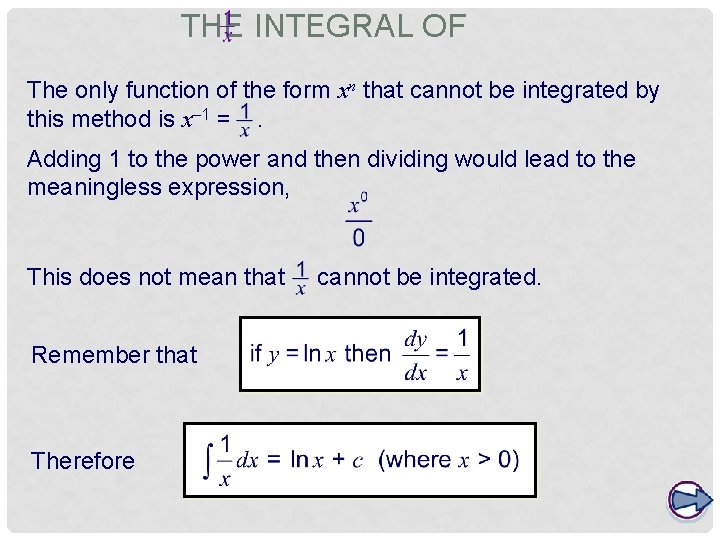
THE INTEGRAL OF The only function of the form xn that cannot be integrated by this method is x– 1 =. Adding 1 to the power and then dividing would lead to the meaningless expression, This does not mean that Remember that Therefore cannot be integrated.
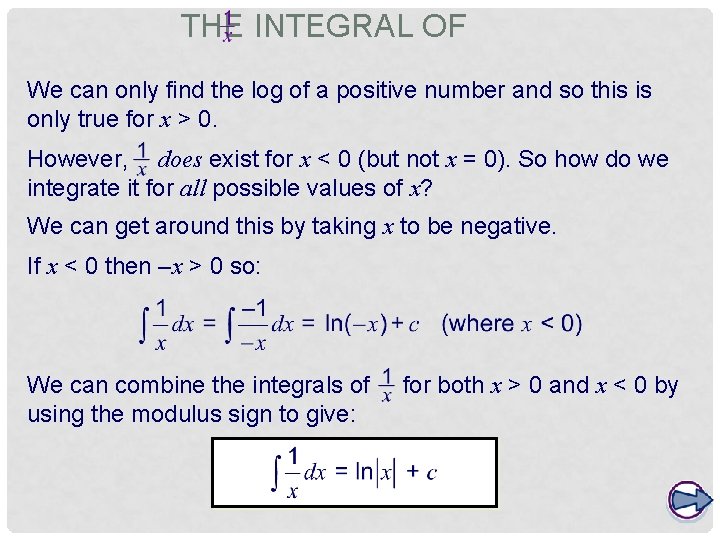
THE INTEGRAL OF We can only find the log of a positive number and so this is only true for x > 0. However, does exist for x < 0 (but not x = 0). So how do we integrate it for all possible values of x? We can get around this by taking x to be negative. If x < 0 then –x > 0 so: We can combine the integrals of using the modulus sign to give: for both x > 0 and x < 0 by
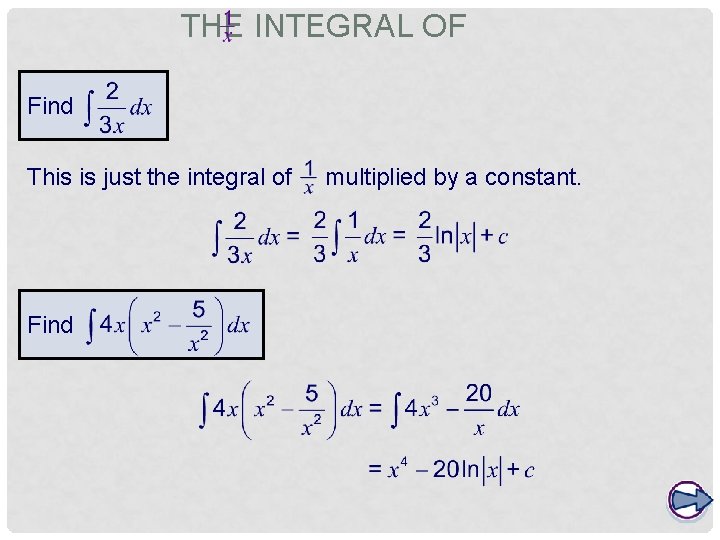
THE INTEGRAL OF Find This is just the integral of Find multiplied by a constant.
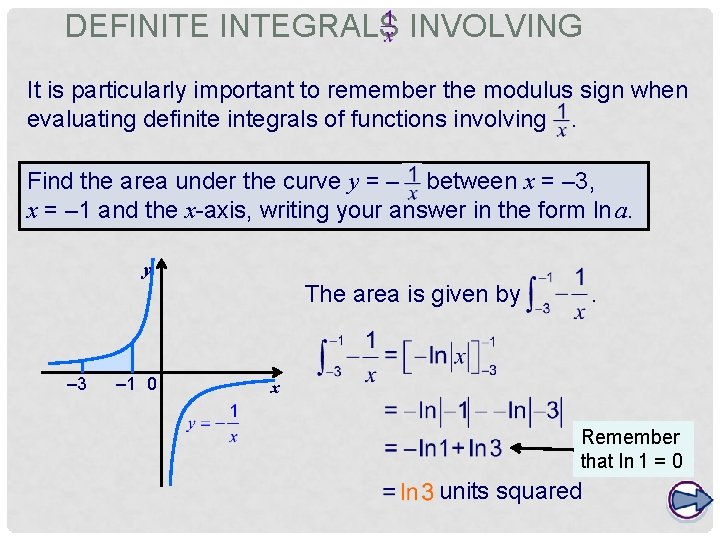
DEFINITE INTEGRALS INVOLVING It is particularly important to remember the modulus sign when evaluating definite integrals of functions involving. Find the area under the curve y = – between x = – 3, x = – 1 and the x-axis, writing your answer in the form ln a. y The area is given by – 3 – 1 0 . x Remember that ln 1 = 0 units squared
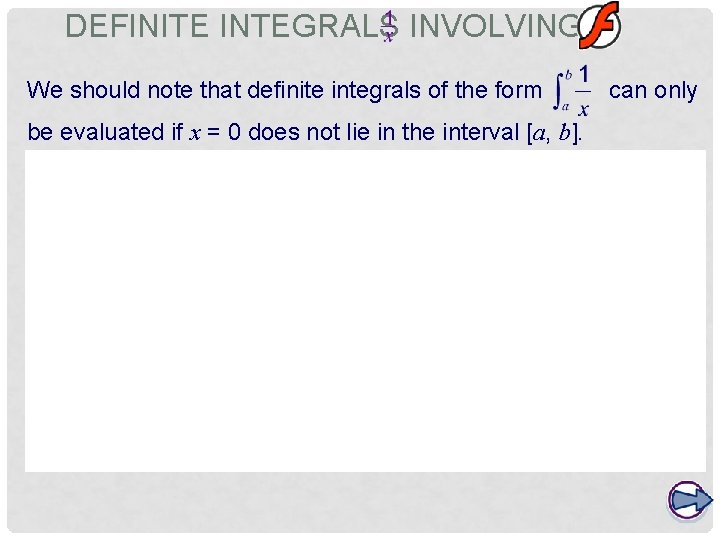
DEFINITE INTEGRALS INVOLVING We should note that definite integrals of the form be evaluated if x = 0 does not lie in the interval [a, b]. can only
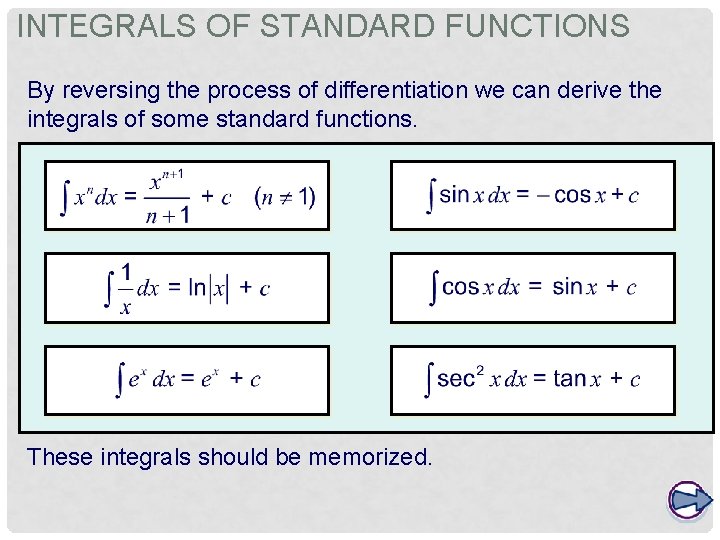
INTEGRALS OF STANDARD FUNCTIONS By reversing the process of differentiation we can derive the integrals of some standard functions. These integrals should be memorized.
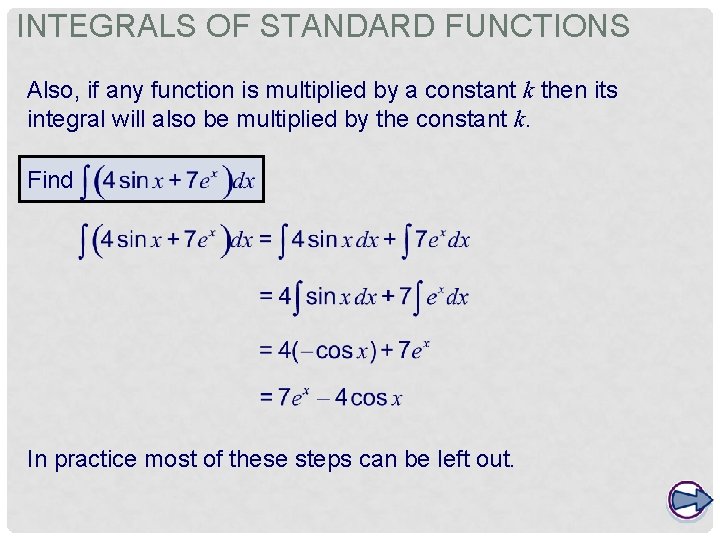
INTEGRALS OF STANDARD FUNCTIONS Also, if any function is multiplied by a constant k then its integral will also be multiplied by the constant k. Find In practice most of these steps can be left out.
REVERSING THE CHAIN RULE Contents Integrals of standard functions Reversing the chain rule Integration by substitution Integration by parts Volumes of revolution Examination-style question 11 of 57 © Boardworks Ltd 2006
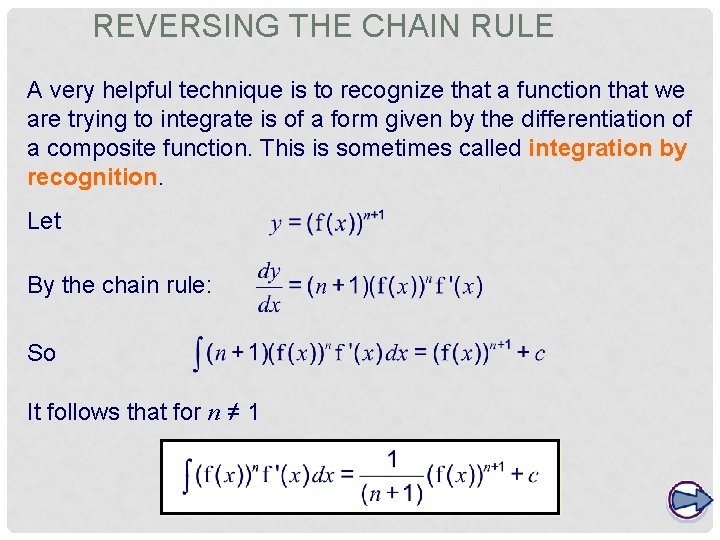
REVERSING THE CHAIN RULE A very helpful technique is to recognize that a function that we are trying to integrate is of a form given by the differentiation of a composite function. This is sometimes called integration by recognition. Let By the chain rule: So It follows that for n ≠ 1
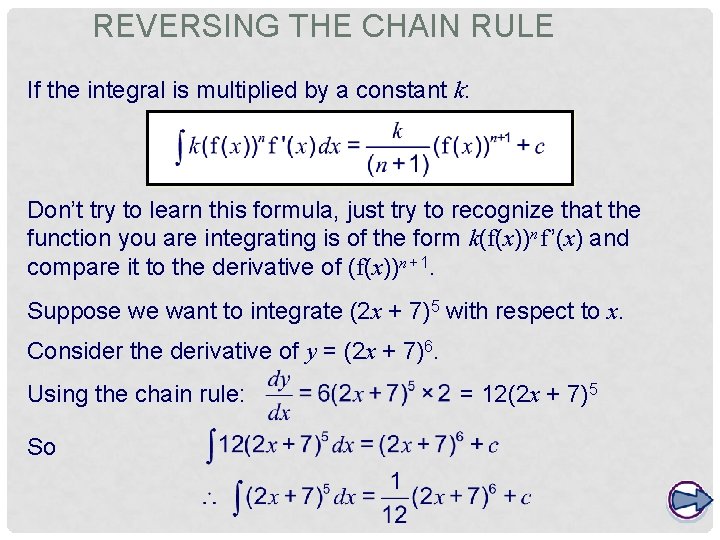
REVERSING THE CHAIN RULE If the integral is multiplied by a constant k: Don’t try to learn this formula, just try to recognize that the function you are integrating is of the form k(f(x))n f ’(x) and compare it to the derivative of (f(x))n + 1. Suppose we want to integrate (2 x + 7)5 with respect to x. Consider the derivative of y = (2 x + 7)6. Using the chain rule: So = 12(2 x + 7)5
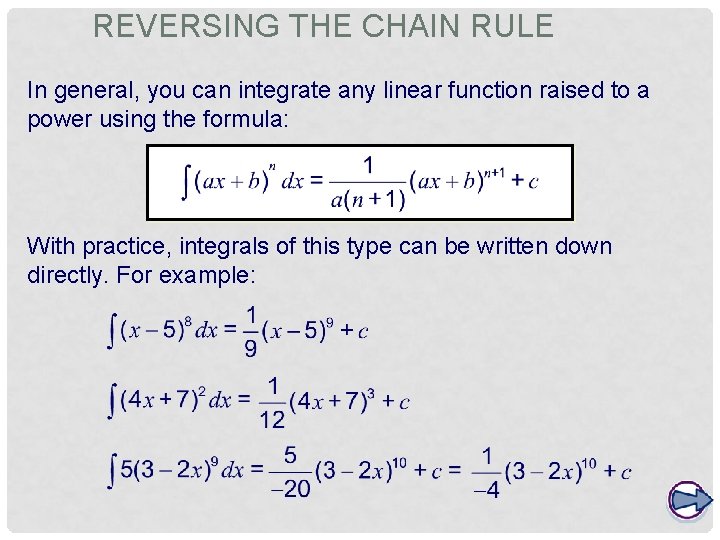
REVERSING THE CHAIN RULE In general, you can integrate any linear function raised to a power using the formula: With practice, integrals of this type can be written down directly. For example:
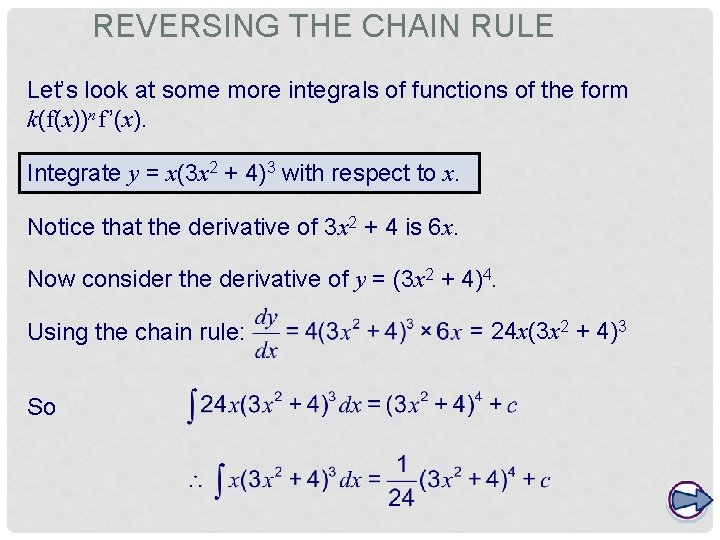
REVERSING THE CHAIN RULE Let’s look at some more integrals of functions of the form k(f(x))n f ’(x). Integrate y = x(3 x 2 + 4)3 with respect to x. Notice that the derivative of 3 x 2 + 4 is 6 x. Now consider the derivative of y = (3 x 2 + 4)4. Using the chain rule: So = 24 x(3 x 2 + 4)3
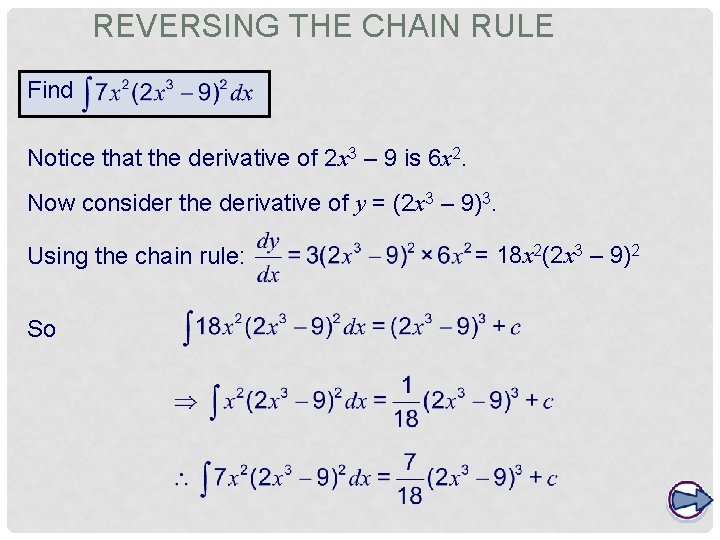
REVERSING THE CHAIN RULE Find . Notice that the derivative of 2 x 3 – 9 is 6 x 2. Now consider the derivative of y = (2 x 3 – 9)3. Using the chain rule: So = 18 x 2(2 x 3 – 9)2
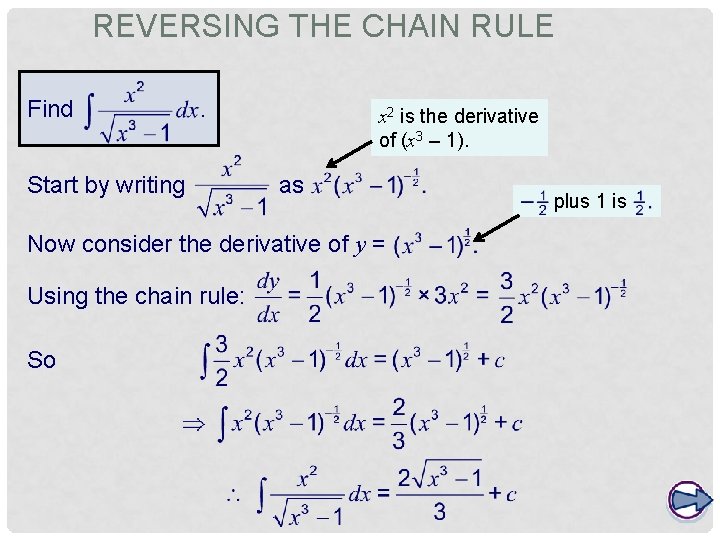
REVERSING THE CHAIN RULE Find . Start by writing x 2 is the derivative of (x 3 – 1). as Now consider the derivative of y = Using the chain rule: So plus 1 is
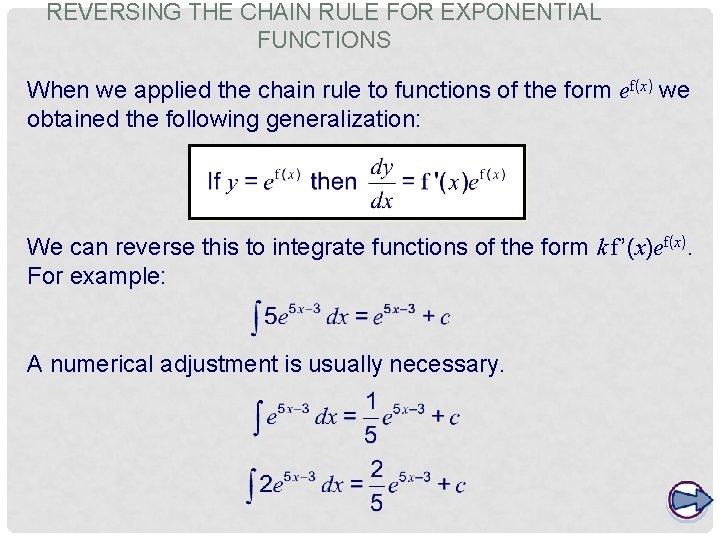
REVERSING THE CHAIN RULE FOR EXPONENTIAL FUNCTIONS When we applied the chain rule to functions of the form ef(x) we obtained the following generalization: We can reverse this to integrate functions of the form k f ’(x)ef(x). For example: A numerical adjustment is usually necessary.
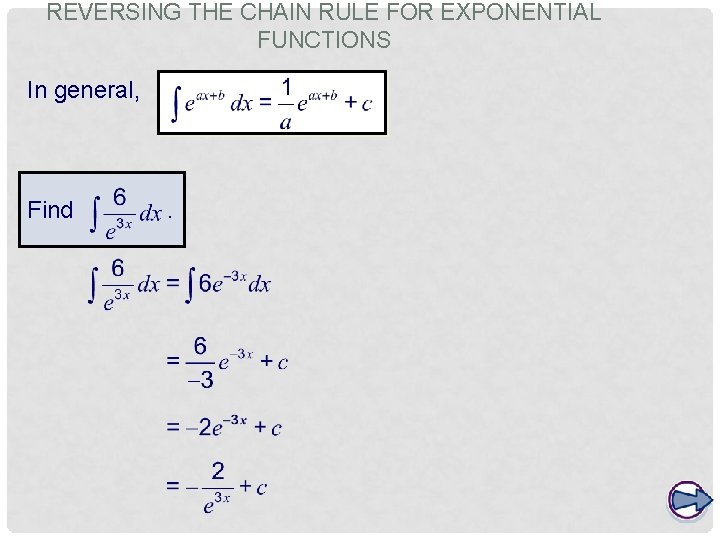
REVERSING THE CHAIN RULE FOR EXPONENTIAL FUNCTIONS In general, Find .
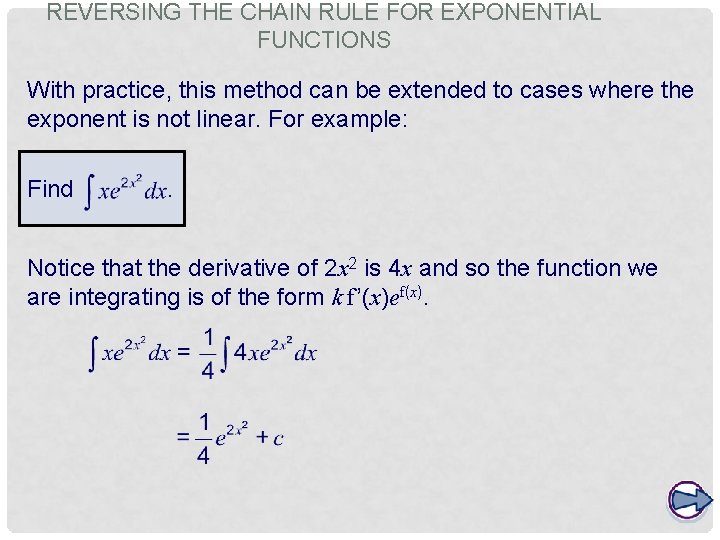
REVERSING THE CHAIN RULE FOR EXPONENTIAL FUNCTIONS With practice, this method can be extended to cases where the exponent is not linear. For example: Find . Notice that the derivative of 2 x 2 is 4 x and so the function we are integrating is of the form k f ’(x)ef(x).
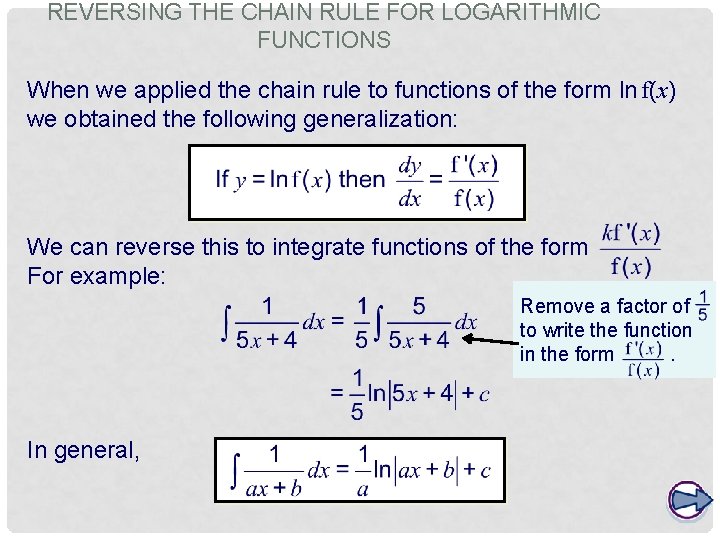
REVERSING THE CHAIN RULE FOR LOGARITHMIC FUNCTIONS When we applied the chain rule to functions of the form ln f(x) we obtained the following generalization: We can reverse this to integrate functions of the form For example: Remove a factor of to write the function in the form. In general,
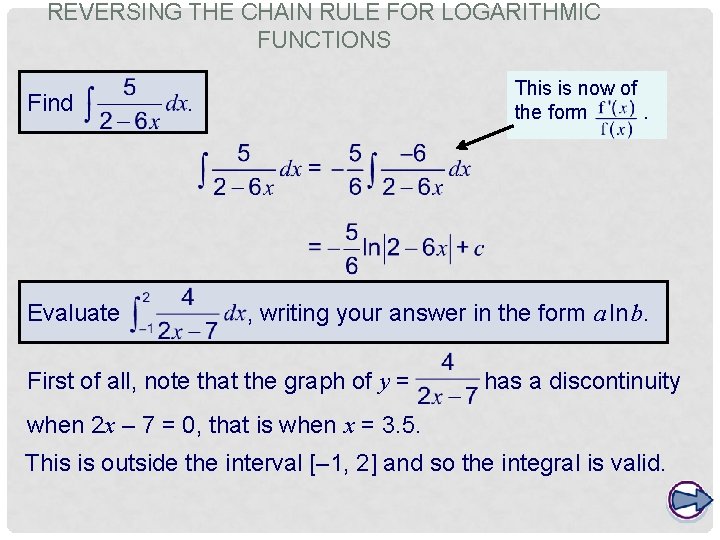
REVERSING THE CHAIN RULE FOR LOGARITHMIC FUNCTIONS Find Evaluate This is now of the form. . , writing your answer in the form a ln b. First of all, note that the graph of y = has a discontinuity when 2 x – 7 = 0, that is when x = 3. 5. This is outside the interval [– 1, 2] and so the integral is valid.
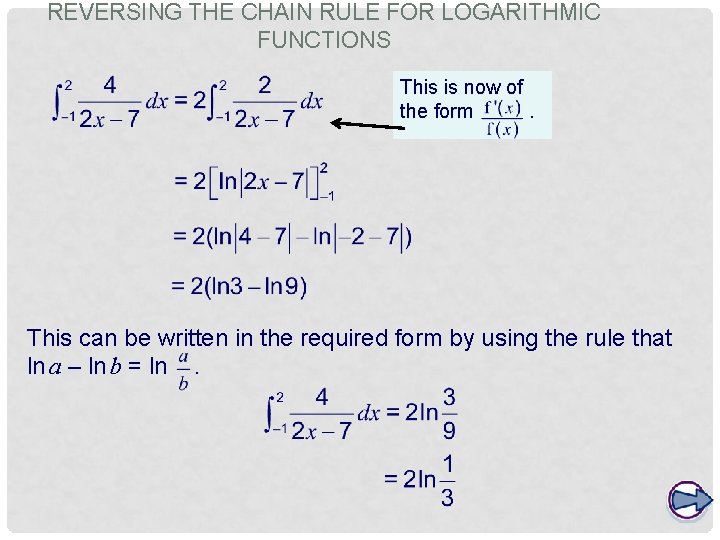
REVERSING THE CHAIN RULE FOR LOGARITHMIC FUNCTIONS This is now of the form. This can be written in the required form by using the rule that ln a – ln b = ln.
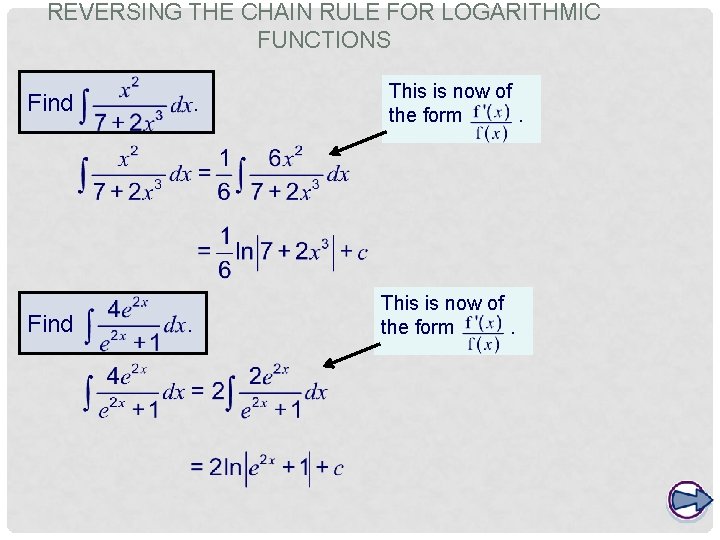
REVERSING THE CHAIN RULE FOR LOGARITHMIC FUNCTIONS Find . . This is now of the form.
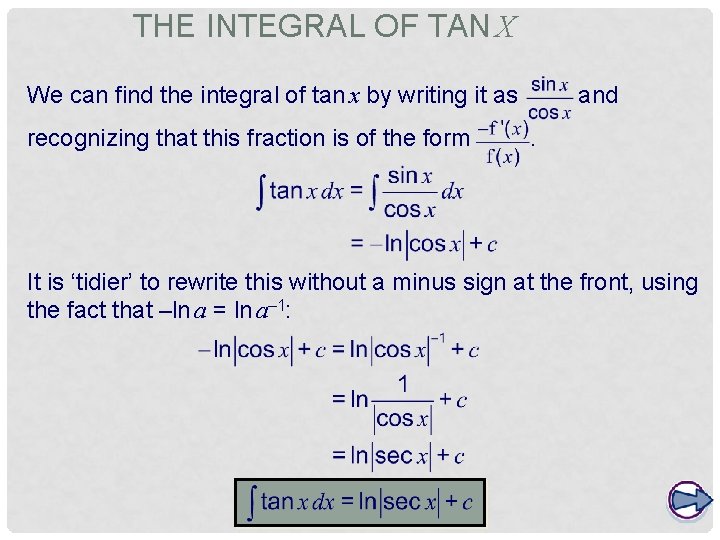
THE INTEGRAL OF TAN X We can find the integral of tan x by writing it as recognizing that this fraction is of the form and. It is ‘tidier’ to rewrite this without a minus sign at the front, using the fact that –ln a = ln a– 1:
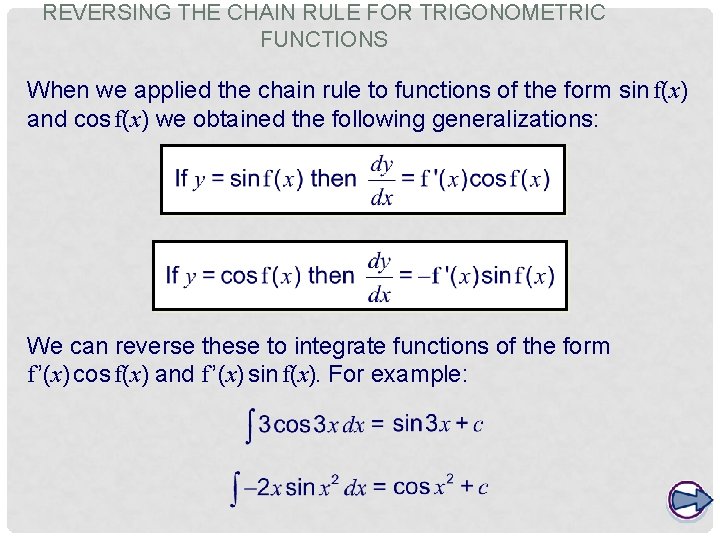
REVERSING THE CHAIN RULE FOR TRIGONOMETRIC FUNCTIONS When we applied the chain rule to functions of the form sin f(x) and cos f(x) we obtained the following generalizations: We can reverse these to integrate functions of the form f ’(x) cos f(x) and f ’(x) sin f(x). For example:
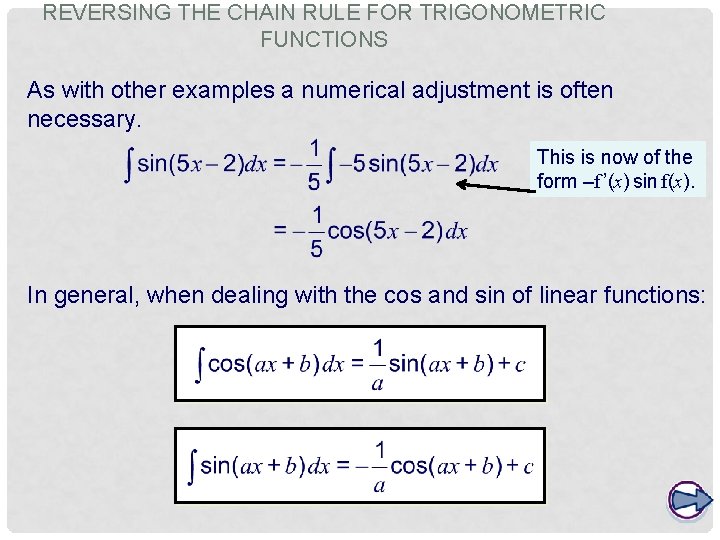
REVERSING THE CHAIN RULE FOR TRIGONOMETRIC FUNCTIONS As with other examples a numerical adjustment is often necessary. This is now of the form –f ’(x) sin f(x). In general, when dealing with the cos and sin of linear functions: