
ALevel Computing Project Investigation and Analysis Learning objectives
A–Level Computing Project Investigation and Analysis

Learning objectives Identify methods by which to investigate the problem: including questionnaires, observation and structured interviews; Record information/data and gather sample documents currently used; Identify the current processes and current data structures; Analyse the data and processes: candidates will be expected to use appropriate techniques such as structure diagrams/data flow diagrams/system flowcharts to illustrate their analysis;

Learning objectives Specify inefficiencies and problems apparent from discussions with the user and the analysis work that has been carried out; Derive the user and information requirements of the system; Specify the required hardware and give reasons for their choice; Specify the required software and give reasons for their choice; Develop and document a clear requirement specification.
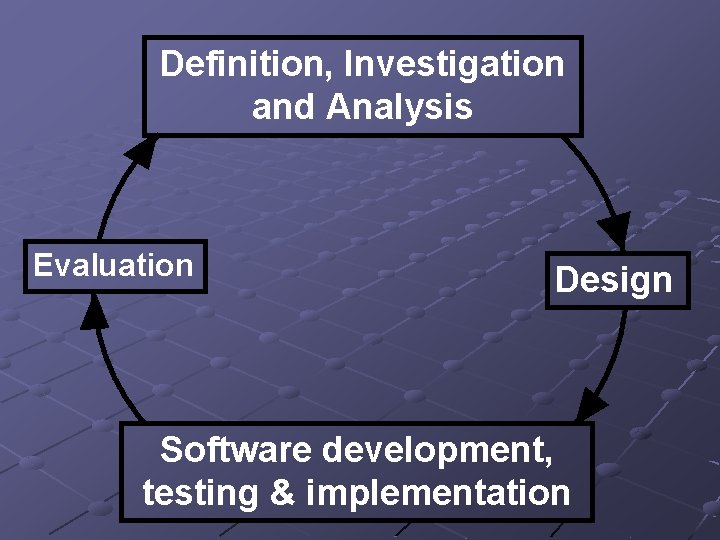
Definition, Investigation and Analysis Evaluation Design Software development, testing & implementation
Investigation and Analysis This section is really the pivotal section of the whole project. It is in this section that the analyst and the end-user pool their knowledge in order that decisions can be made about the direction that the project should take. Following the first stage, the analyst should have a number of questions to which they need the answers.
Stages 1. Finding out what the problem is in some detail. 2. Learning about the area within which the problem is situated. 3. Considering different types of solution to the identified problem. 4. A requirements specification which will allow the student to carry on to the next stage.
1. Problem The analyst (student) needs to find out, in detail, what the end user wants from the system. If this part of the project is not done carefully, then the project will not be successful because the end user and the analyst will have different ideas of what the problem is.
Interview This is not a matter of having a general chat with your end user, or even having detailed discussions where you have carefully considered all the questions and ask them in order. It must be planned and yet be very different from simply reading from a questionnaire.
Conducting the interview Will you try to copy down the end-users comments? n No time to consider what is being said before asking the next question. Either: 1. 2. Take a third person with you as a scribe. Use a tape recorder. Ask permission. Check whethere any subjects that should not be brought up in the interview. n n There may be sensitive topics that you will not be allowed access to. This will show an understanding on your part if you cover this problem beforehand.
True Systems Analyst - Be flexible Prepare a series of questions to ask. n But do not restrict yourself to this list as otherwise a questionnaire could have been used. You should have ‘starter’ questions on each of the areas to which you want answers. n n But you should also have prepared a series of follow up questions that can be used, dependent upon the answer to the initial question. For example: “That is interesting, in which case what would you do about…” then you will be demonstrating a flexibility in your questions. Listen to the responses, and show an interest in the end user.
2. Background. There are different people involved in an organisation. n n n Mrs. Robinson is responsible for the allocation of lockers, so she will be the end user who will be interviewed. However, Mr. Arapah is in charge of year 8 and therefore deals with any problems that may arise, the form teachers actually distribute the keys and collect in the money, and the pupils and their parents are the actual users of the lockers. Important information can be gleaned from these people, which can be done by using different methods of collection. For example, a sample of parents (how are they to be chosen? ) could be sent a questionnaire, while the students may be invited to go to the next Year 8 form teachers’ meeting to lead a discussion about the present system.
Present Documentation The present documentation needs to be collected analysed. n Does the current documentation collect all the information which is thought necessary?
3. Solutions Having collected all the information, different types of solution may present themselves for consideration. n For example: Keeping a check on the money (suggesting a spreadsheet solution) Form teachers are fed up with writing letters home (a database solution producing standard letters under particular circumstances). Security may be a problem leading to a computer control solution with some kind of PIN to open lockers. Different types of solution must be considered as they provide a pointer towards the identification of the final problem. Different approaches should be discussed with the enduser and the responses should be noted.
4. A requirements specification What hardware and the software will be necessary to provide a solution? n Make sure that the requirements are going to be available and that there are not going to be any unpleasant surprises later on in the work. The chosen software cannot do something that was expected of it.
Evidence Detail relating to the planning of the end-user interview. The original plan of the questions, showing that all areas had been planned to be covered and that sensible follow up questions had been considered. Transcript of the interview itself, including an element of later analysis and isolation of important facts. Further evidence of information collection relevant to the problem area. A data flow diagram showing how the present system works. Consideration of different methods of solving the problem, together with some evidence that the end user has been involved in the decision making. A detailed requirements specification based on the information collected has been produced.
Sample Project Have a look at the ‘Investigation and Analysis’ section in the unmarked sample project. Use the GUIDANCE ON MARKING THE COMPUTING PROJECT pdf file to mark it. Now look at my comments in the marked version and compare with your own.
Homework Start your ‘Investigation and Analysis’.
- Slides: 17