
ALevel Computing Project Definition Nature of the problem

A–Level Computing Project Definition - Nature of the problem (& Initial Discussions )

Learning objectives Define the nature of the problem to be solved.
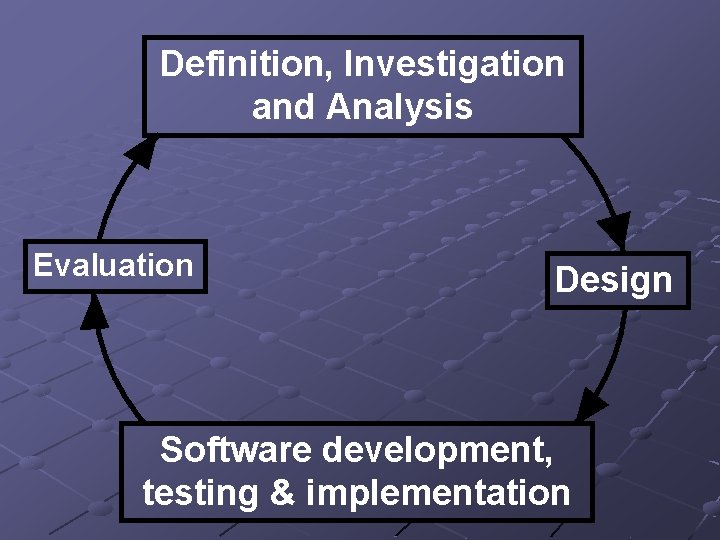
Definition, Investigation and Analysis Evaluation Design Software development, testing & implementation
Problem Definition The most important part of the analysis because if it is not done correctly the wrong problem may be solved. n n Discussions between all the interested parties held, and then a list of objectives written up. The success or otherwise of the project depends on the completion of these objectives.

Review of the different methods of fact-finding
Methods Of Information Collection 1. Interviews Advantage: Interviewee can talk at length. Disadvantage: Time consuming and so cannot interview many people. 2. Questionnaires Advantage: Find out the views of a large number of people very quickly. Disadvantage: Pre-determined questions and so people may find it difficult to put their point of view across. 3. Group meetings Advantage: A number of people can discuss points and make their views known. Disadvantage: Not all the members of the group can give their opinions.
Methods Of Information Collection 4. Observe the current system in action Advantage: Shows present system not just views which may be clouded. Disadvantages: People tend not to act in the way they normally do. Data and forms tend to be seen in isolation. 5. Collect printed documentation Advantage: A clear indication of the data used and the collection methods. Disadvantages: Volume collected. Data and forms tend to be seen in isolation.
Gantt chart & Project Diary Formal time planning for your project. Use a previously prepared template ‘A-Level Gantt Chart Template 07/08’ Also keep a project diary showing any major decisions made.
Report Structure 1. 2. 3. 4. 5. 6. Title and contents page. Clear and logical organisation - set out in sections. Continuous page numbering. Information presented in continuous prose. Good use of grammar, punctuation and spelling. Use of a clear font style and size e. g. Times New Roman 10 pt or 12 pt. 7. Use of appropriate techniques e. g. headers and footers, consistent styles for headings, use of tables etc. 8. Footers should contain the candidate’s name and page. number. 9. Inclusion of a bibliography.
Definition - Nature of the problem 1. The person who has to assess the worth of your project when it is finished knows nothing about the problem and must have it explained to them in great detail if they are to understand the rest of the work. 2. The student and the owner of the problem must have the same idea about the nature of the project otherwise the student can never be sure that they are solving the correct problem. The first of these problems gives rise to this section of the project work.
Definition - Nature of the problem List those members of the organisation that have direct access to the data around which the project is going to be written, and to describe what rights of access each of them should enjoy.
Arbiter Find a arbiter who knows little or nothing about the problem area to act as a sounding board, to ensure that you provide the right level of information.
Definition - Nature of the problem Methods by which these data are presently stored. Types of data that are used/produced by the system. How the data is collected/where does it come from? What form the data takes and in what form is it stored?
Definition - Nature of the problem Indicate possible areas that are not performing as well as they should or that are not currently covered by the present system n If there are no such areas then the project does not have a problem to solve. This discussion will be sketchy because the views are all coming from the point of view of the systems analyst, the owner of the problem has not yet become fully involved. This is what happens in the next stage of the work.
Evidence A description of the organisation that has the problem and the place of the problem within it. n This does not have to be in any great detail, as a guide, half a side of A 4 should be quite adequate. A description of how the chosen problem is dealt with at the moment. n This can only be a sketchy description because, until the analysis section has been completed, it is not possible to describe the area in any detail.
Evidence A CLEAR description of the data that is used in the area of the problem. n n The exact data that will form part of the solution is not yet known because the problem has not yet been fully specified, however, it is necessary to be aware of all the data that may be required. This does not mean all the information. We do not yet want to know that John Jones hired a school locker (NO. 453) on the 18/11/01. He is in form 8 JHL and that he … What we do need to know is that the pupil name is important, that the name must be linked to a locker, that the date the hire began is important in order to calculate the cost, that the form of the pupil is important in order to give a point of contact, …
Evidence A clear indication of where the data came from and how it is collected. Something along the lines of: n The school sends a letter home with a tear off portion that asks for the following facts…. ; the lockers are in different areas of the building with those in block 1 starting with the number 1…; Different year groups are in different blocks…
Sample Project Have a look at the ‘Definition - Nature of the problem’ section in the unmarked sample project. Use the GUIDANCE ON MARKING THE COMPUTING PROJECT pdf file to mark it. Now look at my comments in the marked version and compare with your own.
Homework Start your ‘Definition - Nature of the problem’.
- Slides: 19