
Alec Tudor ADVERTISING Does it create unrealistic expectations
- Slides: 9
Alec Tudor ADVERTISING Does it create unrealistic expectations?
Advertising Objectives • • To inform To persuade To remind To meet a specific need – (eg brand awareness, drive sales, open a new market etc. ) Overall the objective is to drive/persuade/attract consumers to buy a product or service.
Methods Advertising can use a variety of methods to achieve its goals: • Personal appeal – Driving emotions such as security, love, happiness, ambition etc. • Fear appeal – Beauty and health care often use this method (eg if you don’t us our product you will look like this) • Humour appeal – Helps get the attention and helps to remember the product • Sex appeal – Can use emotions to create strong feelings about a product Each of these methods can encourage unrealistic expectations to be portrayed to meet the aim.
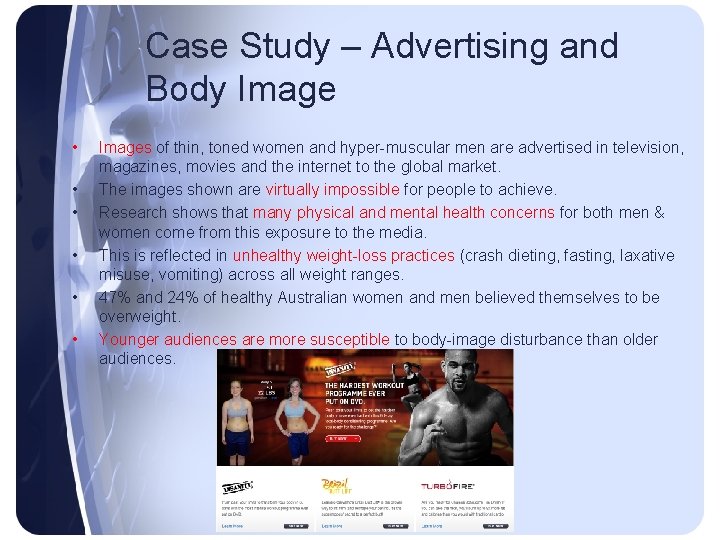
Case Study – Advertising and Body Image • • • Images of thin, toned women and hyper-muscular men are advertised in television, magazines, movies and the internet to the global market. The images shown are virtually impossible for people to achieve. Research shows that many physical and mental health concerns for both men & women come from this exposure to the media. This is reflected in unhealthy weight-loss practices (crash dieting, fasting, laxative misuse, vomiting) across all weight ranges. 47% and 24% of healthy Australian women and men believed themselves to be overweight. Younger audiences are more susceptible to body-image disturbance than older audiences.
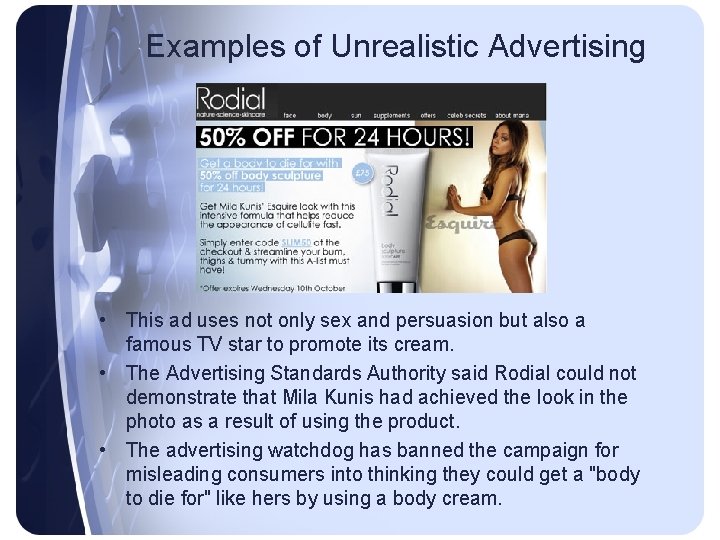
Examples of Unrealistic Advertising • This ad uses not only sex and persuasion but also a famous TV star to promote its cream. • The Advertising Standards Authority said Rodial could not demonstrate that Mila Kunis had achieved the look in the photo as a result of using the product. • The advertising watchdog has banned the campaign for misleading consumers into thinking they could get a "body to die for" like hers by using a body cream.
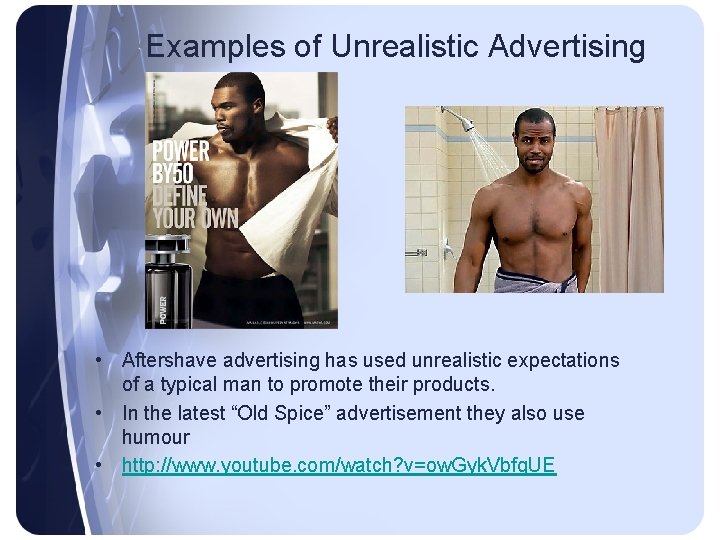
Examples of Unrealistic Advertising • Aftershave advertising has used unrealistic expectations of a typical man to promote their products. • In the latest “Old Spice” advertisement they also use humour • http: //www. youtube. com/watch? v=ow. Gyk. Vbfg. UE
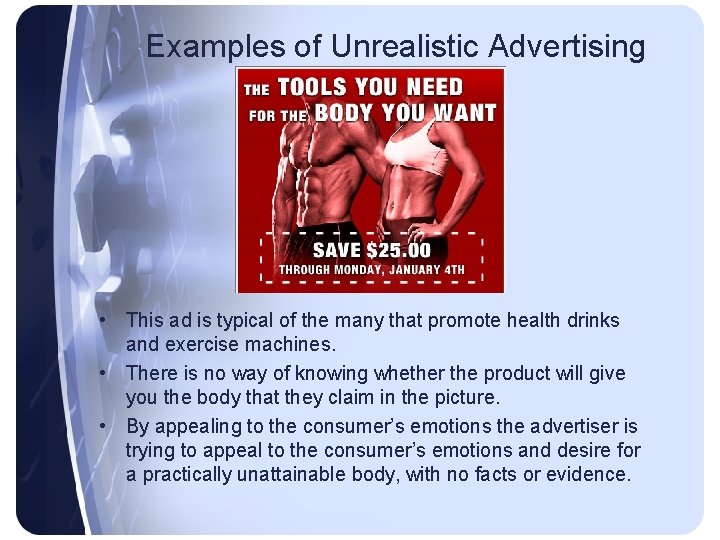
Examples of Unrealistic Advertising • This ad is typical of the many that promote health drinks and exercise machines. • There is no way of knowing whether the product will give you the body that they claim in the picture. • By appealing to the consumer’s emotions the advertiser is trying to appeal to the consumer’s emotions and desire for a practically unattainable body, with no facts or evidence.
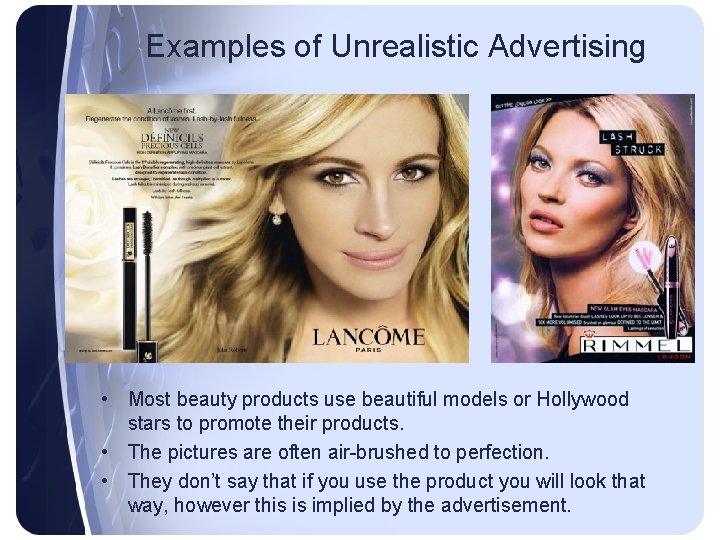
Examples of Unrealistic Advertising • Most beauty products use beautiful models or Hollywood stars to promote their products. • The pictures are often air-brushed to perfection. • They don’t say that if you use the product you will look that way, however this is implied by the advertisement.
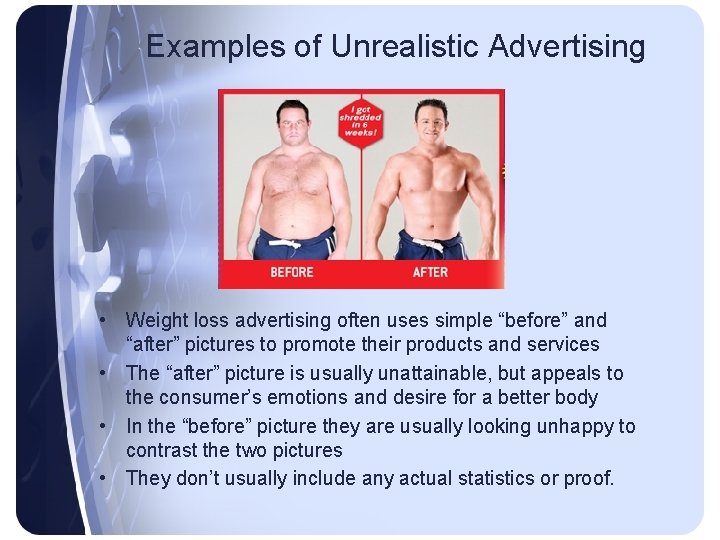
Examples of Unrealistic Advertising • Weight loss advertising often uses simple “before” and “after” pictures to promote their products and services • The “after” picture is usually unattainable, but appeals to the consumer’s emotions and desire for a better body • In the “before” picture they are usually looking unhappy to contrast the two pictures • They don’t usually include any actual statistics or proof.