
ALDCS SEND Learning event Natalie Parish 29 November
ALDCS SEND Learning event Natalie Parish 29 November 2019
Purpose and methodology Purpose of research Methodology • Identify the causes of increased spending in children’s services and high needs budgets. • Analysis of the London Councils children’s services dataset • Reach conclusions on the types of management action that can reduce cost while assuring quality and safeguarding. • Triangulation with other published data. • Fieldwork visits to fourteen LAs – 6 with a focus on CSC, 6 with a focus on HN and 2 with a focus on both. • LAs chosen to create a sample that is broadly representative in terms of patterns in spending / other contextual factors. • Review of a selection of EHCPs. • • • Secure more government funding for children’s services, both in children’s social care and the high needs block. Develop an evidence base for policy changes that might be needed at a national level. Support the boroughs to make changes to practice and so reduce costs whilst maintaining positive outcomes for children. RESTRICTED – COMMERCIAL – NOT FOR ONWARD CIRCULATION 2
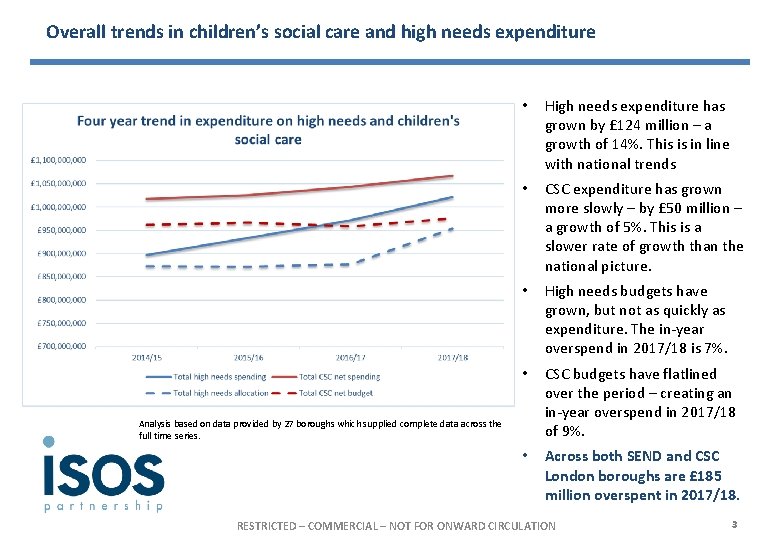
Overall trends in children’s social care and high needs expenditure • High needs expenditure has grown by £ 124 million – a growth of 14%. This is in line with national trends • CSC expenditure has grown more slowly – by £ 50 million – a growth of 5%. This is a slower rate of growth than the national picture. • High needs budgets have grown, but not as quickly as expenditure. The in-year overspend in 2017/18 is 7%. • CSC budgets have flatlined over the period – creating an in-year overspend in 2017/18 of 9%. • Across both SEND and CSC London boroughs are £ 185 million overspent in 2017/18. Analysis based on data provided by 27 boroughs which supplied complete data across the full time series. RESTRICTED – COMMERCIAL – NOT FOR ONWARD CIRCULATION 3
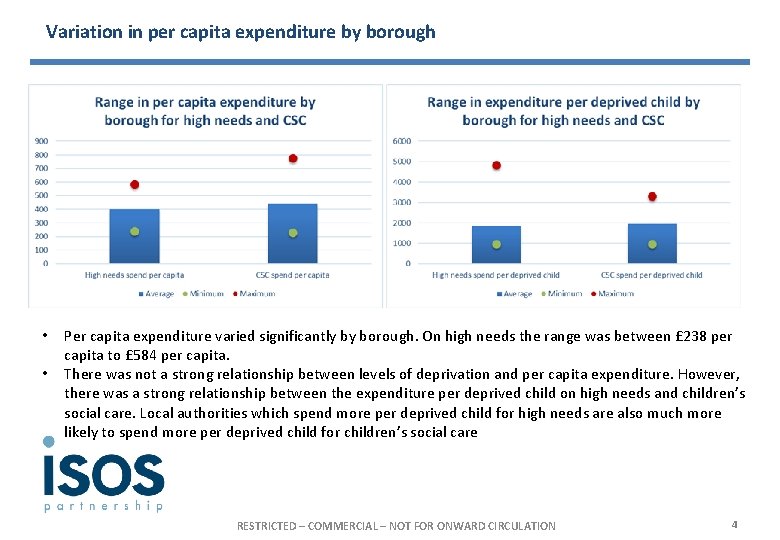
Variation in per capita expenditure by borough • • Per capita expenditure varied significantly by borough. On high needs the range was between £ 238 per capita to £ 584 per capita. There was not a strong relationship between levels of deprivation and per capita expenditure. However, there was a strong relationship between the expenditure per deprived child on high needs and children’s social care. Local authorities which spend more per deprived child for high needs are also much more likely to spend more per deprived child for children’s social care RESTRICTED – COMMERCIAL – NOT FOR ONWARD CIRCULATION 4
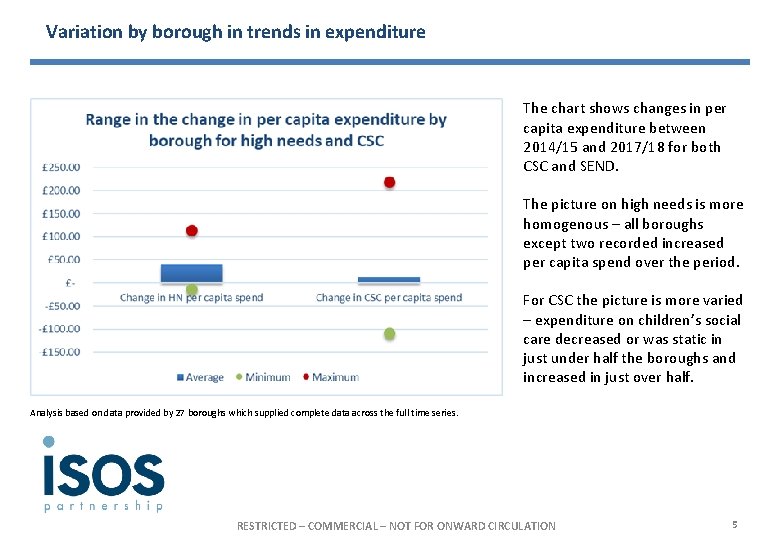
Variation by borough in trends in expenditure The chart shows changes in per capita expenditure between 2014/15 and 2017/18 for both CSC and SEND. The picture on high needs is more homogenous – all boroughs except two recorded increased per capita spend over the period. For CSC the picture is more varied – expenditure on children’s social care decreased or was static in just under half the boroughs and increased in just over half. Analysis based on data provided by 27 boroughs which supplied complete data across the full time series. RESTRICTED – COMMERCIAL – NOT FOR ONWARD CIRCULATION 5
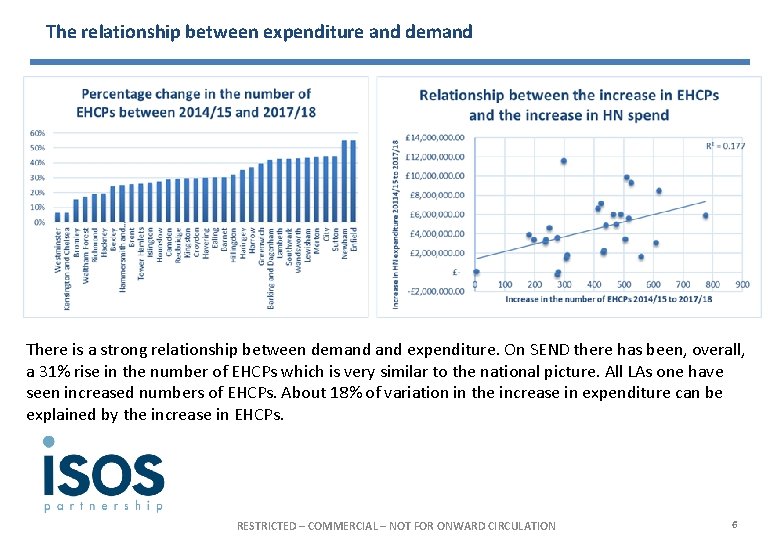
The relationship between expenditure and demand There is a strong relationship between demand expenditure. On SEND there has been, overall, a 31% rise in the number of EHCPs which is very similar to the national picture. All LAs one have seen increased numbers of EHCPs. About 18% of variation in the increase in expenditure can be explained by the increase in EHCPs. RESTRICTED – COMMERCIAL – NOT FOR ONWARD CIRCULATION 6
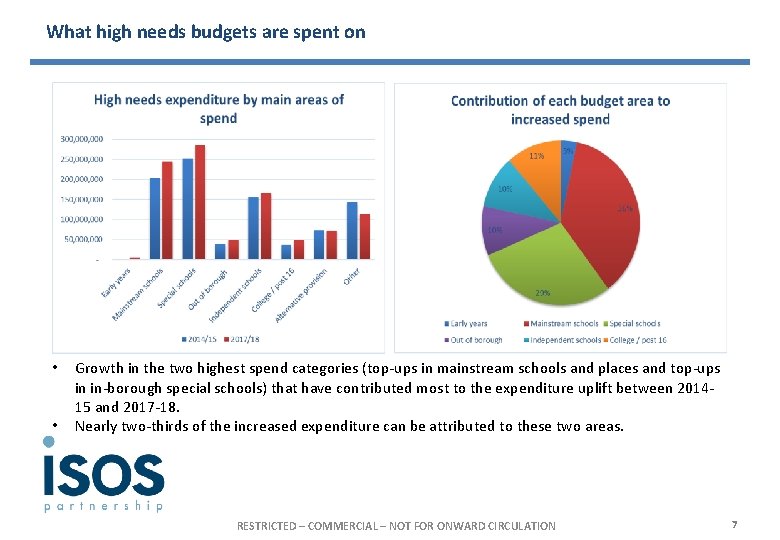
What high needs budgets are spent on • • Growth in the two highest spend categories (top-ups in mainstream schools and places and top-ups in in-borough special schools) that have contributed most to the expenditure uplift between 201415 and 2017 -18. Nearly two-thirds of the increased expenditure can be attributed to these two areas. RESTRICTED – COMMERCIAL – NOT FOR ONWARD CIRCULATION 7
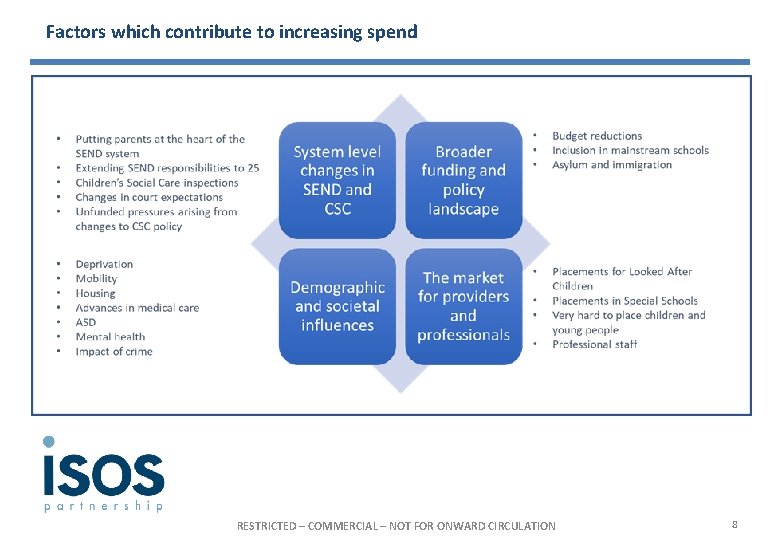
Factors which contribute to increasing spend RESTRICTED – COMMERCIAL – NOT FOR ONWARD CIRCULATION 8
System level changes in SEND – the 2015 SEND Code of Practice • The SEND code of practice rightly raised parental expectations and put parental preference at the heart of the system. This is contributing to the need to spend. • Low threshold for assessments, held up at Tribunal, are increasing overall volume of EHCPs. In 2014, 5, 070 assessments for EHCPs were carried out in London during the calendar year but by 2017 this figure had risen to 8541. In London, 93% of assessments result in an EHCP. Putting parents at the heart of the SEND system • Parental preferences around placement choice, also supported by Tribunal system, can also lead to increased spend particularly where parents request INMSS placements. Around 15% of the variation in per capita high needs expenditure can be explained by variations in the percentage of the overall budget spent on INMSS Extension of responsibilities to 25 • The 8 boroughs with the lowest levels of deprivation spend on average 25% of their high-needs expenditure on INMSS, compared to 13% in all other London boroughs. • Extension of responsibilities to 25 has led to increases from the continuing cohort of young people not transferring to adult services as well as new 16+ EHCPs. • In London around a quarter of the growth in EHCPs is attributable to the 19 -25 cohort and around 60% is attributable to increases in the post-16 cohort. RESTRICTED – COMMERCIAL – NOT FOR ONWARD CIRCULATION 9
The broader policy and funding landscape • There have been budget reductions in the range of services and support in the community which can help to reduce demand for SEND, for example health budgets and therapies, pastoral and learning support in schools, youth services and more targeted early intervention. • The degree of health input, both financially and strategically is very variable between boroughs. • The current accountability system does not incentivise schools to be inclusive which is contributing to a movement into more specialist forms of education both in London and nationally. • In some boroughs the rate of exclusions and use of AP is also making a significant contribution to increased spend. Budget reductions Inclusion in mainstream schools RESTRICTED – COMMERCIAL – NOT FOR ONWARD CIRCULATION 10
Demographic and societal influences Deprivation Mobility Housing Medical advances ASD Mental health • Patterns of deprivation shifting, particularly growth of working poor families. Some boroughs continue to contend with the impact of supporting populations with multiple disadvantages. • High levels of mobility leading to significant population growth in some areas. Some children with very complex needs moving from outside the UK. • Lack of affordable housing and impact of intentionally homeless legislation driving displacement of very vulnerable families. • LAs report increasing numbers of U 5 s requiring special school support or meeting continuing care criteria. This appears to be impacting significantly on both HN and CWD budgets in some areas. • Numbers of children with ASD increasing. In London the percentage of children with EHCPs whose primary need was autism increased from 8. 8% to 10. 3% in two years. These young people can be among the hardest to place. • Referrals to child mental health services are rising and services unable to meet demand. Increasing impact of adult mental health and learning disability on family life. RESTRICTED – COMMERCIAL – NOT FOR ONWARD CIRCULATION 11
The market for providers and professionals Placements in Special Schools • • Maintained special schools are largely full. LAs looking to expand provision through Special Free Schools and Enhanced Resourced Provision. INMSS market competitive and providers becoming more selective of the pupils they will take. INMSS also shaping their own market – inviting parents to take up free ‘assessment places’. Very hard to place young people • • • Emerging cohort of young people who are very hard to place either in terms of CSC or SEND – older age males with a history of challenging behaviour, mental health and possible ASD / ADHD. Not a strong system response or range of provision available. Very high costs associated with educating or accommodating this cohort. Professional staff • • A lot of employers in a confined geographical area leads to a competitive market. Significant issues for EP recruitment and growth of private market, which can in turn drive further spend. RESTRICTED – COMMERCIAL – NOT FOR ONWARD CIRCULATION 12
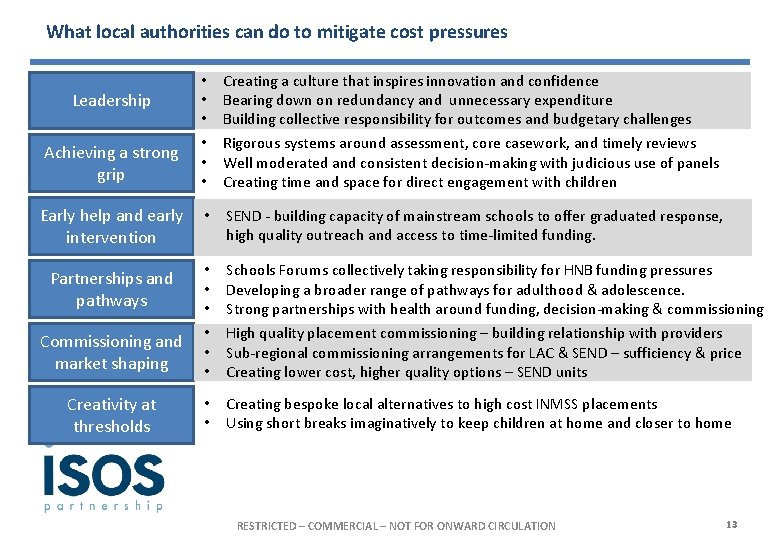
What local authorities can do to mitigate cost pressures • • • Creating a culture that inspires innovation and confidence Bearing down on redundancy and unnecessary expenditure Building collective responsibility for outcomes and budgetary challenges Rigorous systems around assessment, core casework, and timely reviews Well moderated and consistent decision-making with judicious use of panels Creating time and space for direct engagement with children Early help and early intervention • SEND - building capacity of mainstream schools to offer graduated response, high quality outreach and access to time-limited funding. Partnerships and pathways Schools Forums collectively taking responsibility for HNB funding pressures Developing a broader range of pathways for adulthood & adolescence. Strong partnerships with health around funding, decision-making & commissioning Commissioning and market shaping • • • Creativity at thresholds • • Creating bespoke local alternatives to high cost INMSS placements Using short breaks imaginatively to keep children at home and closer to home Leadership Achieving a strong grip High quality placement commissioning – building relationship with providers Sub-regional commissioning arrangements for LAC & SEND – sufficiency & price Creating lower cost, higher quality options – SEND units RESTRICTED – COMMERCIAL – NOT FOR ONWARD CIRCULATION 13
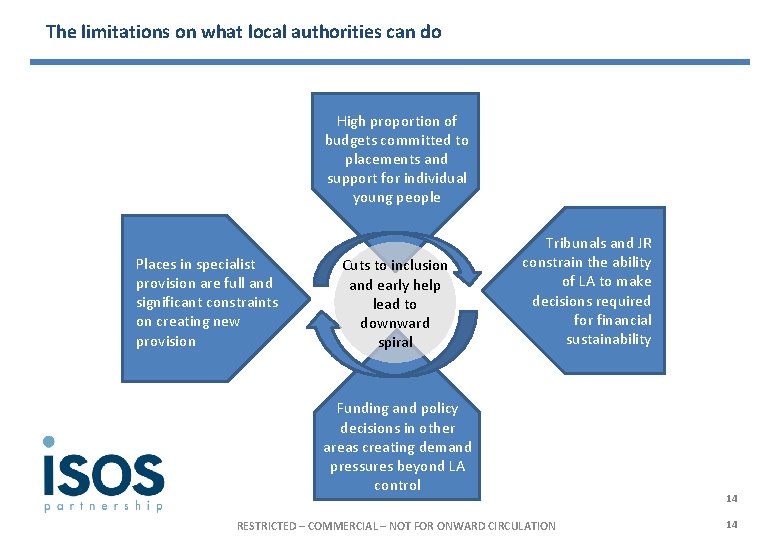
The limitations on what local authorities can do High proportion of budgets committed to placements and support for individual young people Places in specialist provision are full and significant constraints on creating new provision Cuts to inclusion and early help lead to downward spiral Tribunals and JR constrain the ability of LA to make decisions required for financial sustainability Funding and policy decisions in other areas creating demand pressures beyond LA control RESTRICTED – COMMERCIAL – NOT FOR ONWARD CIRCULATION 14 14
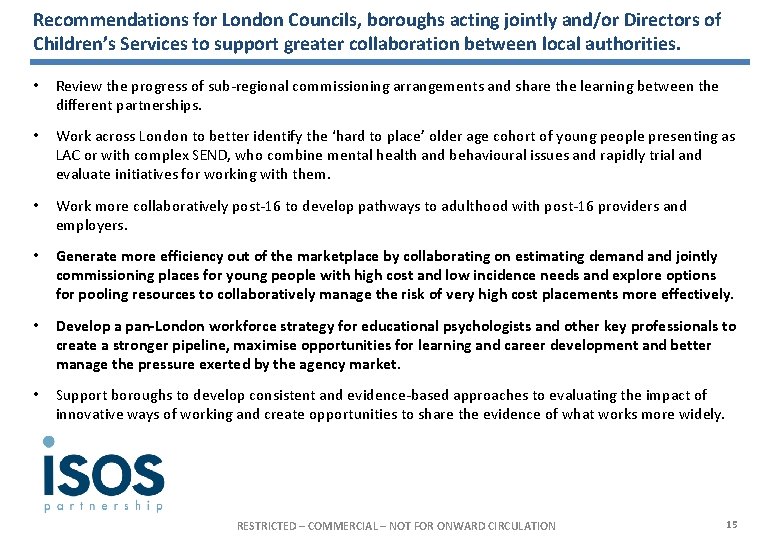
Recommendations for London Councils, boroughs acting jointly and/or Directors of Children’s Services to support greater collaboration between local authorities. • Review the progress of sub-regional commissioning arrangements and share the learning between the different partnerships. • Work across London to better identify the ‘hard to place’ older age cohort of young people presenting as LAC or with complex SEND, who combine mental health and behavioural issues and rapidly trial and evaluate initiatives for working with them. • Work more collaboratively post-16 to develop pathways to adulthood with post-16 providers and employers. • Generate more efficiency out of the marketplace by collaborating on estimating demand jointly commissioning places for young people with high cost and low incidence needs and explore options for pooling resources to collaboratively manage the risk of very high cost placements more effectively. • Develop a pan-London workforce strategy for educational psychologists and other key professionals to create a stronger pipeline, maximise opportunities for learning and career development and better manage the pressure exerted by the agency market. • Support boroughs to develop consistent and evidence-based approaches to evaluating the impact of innovative ways of working and create opportunities to share the evidence of what works more widely. RESTRICTED – COMMERCIAL – NOT FOR ONWARD CIRCULATION 15
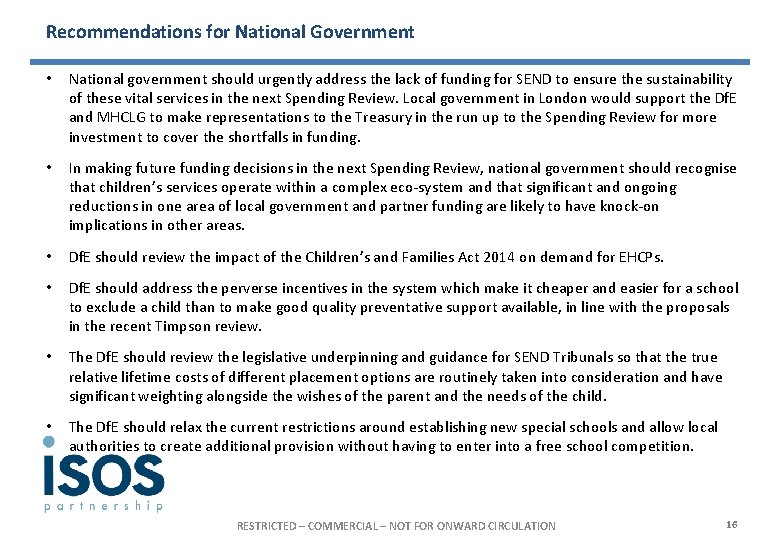
Recommendations for National Government • National government should urgently address the lack of funding for SEND to ensure the sustainability of these vital services in the next Spending Review. Local government in London would support the Df. E and MHCLG to make representations to the Treasury in the run up to the Spending Review for more investment to cover the shortfalls in funding. • In making future funding decisions in the next Spending Review, national government should recognise that children’s services operate within a complex eco-system and that significant and ongoing reductions in one area of local government and partner funding are likely to have knock-on implications in other areas. • Df. E should review the impact of the Children’s and Families Act 2014 on demand for EHCPs. • Df. E should address the perverse incentives in the system which make it cheaper and easier for a school to exclude a child than to make good quality preventative support available, in line with the proposals in the recent Timpson review. • The Df. E should review the legislative underpinning and guidance for SEND Tribunals so that the true relative lifetime costs of different placement options are routinely taken into consideration and have significant weighting alongside the wishes of the parent and the needs of the child. • The Df. E should relax the current restrictions around establishing new special schools and allow local authorities to create additional provision without having to enter into a free school competition. RESTRICTED – COMMERCIAL – NOT FOR ONWARD CIRCULATION 16
Recommendations for National Government continued • To improve inclusivity in mainstream schools, The Df. E should review the impact of Progress 8, Attainment 8 and the narrowing of the curriculum at GCSE and develop ways of holding schools to account that better incentivise an inclusive approach to education. • The Df. E, DH and local authorities should work together to clarify the specific responsibilities for CCGs in supporting and funding placements for those with EHCPs and use existing examples of good practice to promote the benefits of close joint working more widely to CCGs. RESTRICTED – COMMERCIAL – NOT FOR ONWARD CIRCULATION 17
Recommendations for local authorities individually • Focus on doing the basics, in terms of core SEND support and financial management, really well. • Carry out more forensic analysis of the impact of creative solutions to address particular areas of cost or demand. • Work to break down internal silos between different parts of local government so that decision-making maximises the cost benefits to local government as a whole, rather than one service at the expense of another. • Conduct more joint analysis, commissioning and pathway planning for those young people who straddle both the SEND and CSC cohorts. • Be open and proactive in drawing on good practice from elsewhere. RESTRICTED – COMMERCIAL – NOT FOR ONWARD CIRCULATION 18
- Slides: 18