
ALCOHOLS ETHERS part 1 ROHAZITA BAHARI Physical Properties
ALCOHOLS & ETHERS part 1 ROHAZITA BAHARI
Physical Properties of Alcohols O The most important physical property is their polarity O Both the C-O bond and the O-H bond are polar covalent bonds O Thus alcohols are polar molecules O They also have the ability to hydrogen bond. O These factors lead to higher B. P’s, M. P’s. etc
Physical Properties of Alcohols O Because of increase London forces (van der Waals forces) between larger molecules, the B. P. of all types of compounds, including alcohols, increase as molecular weight increases O Alcohols are much more soluble in H 2 O due to their H-bonding capacity. O As MW increases, the water solubility of alcohols decreases O This is because the hydrocarbon portion of the molecule dominates.
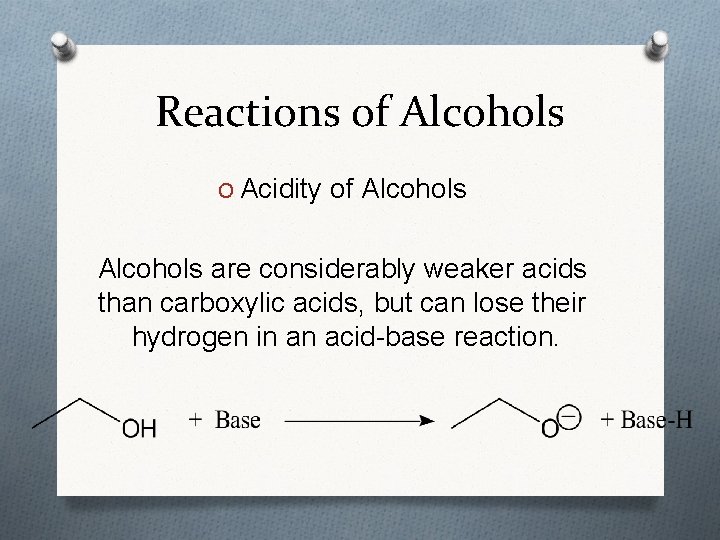
Reactions of Alcohols O Acidity of Alcohols are considerably weaker acids than carboxylic acids, but can lose their hydrogen in an acid-base reaction.
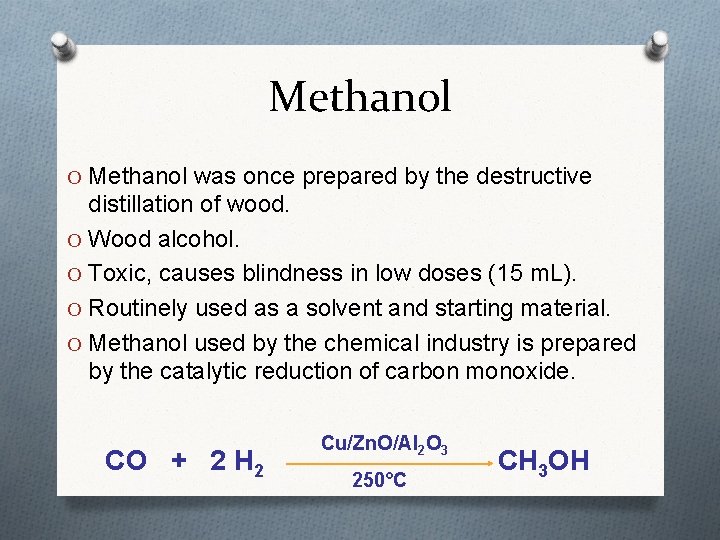
Methanol O Methanol was once prepared by the destructive distillation of wood. O Wood alcohol. O Toxic, causes blindness in low doses (15 m. L). O Routinely used as a solvent and starting material. O Methanol used by the chemical industry is prepared by the catalytic reduction of carbon monoxide. CO + 2 H 2 Cu/Zn. O/Al 2 O 3 250°C CH 3 OH
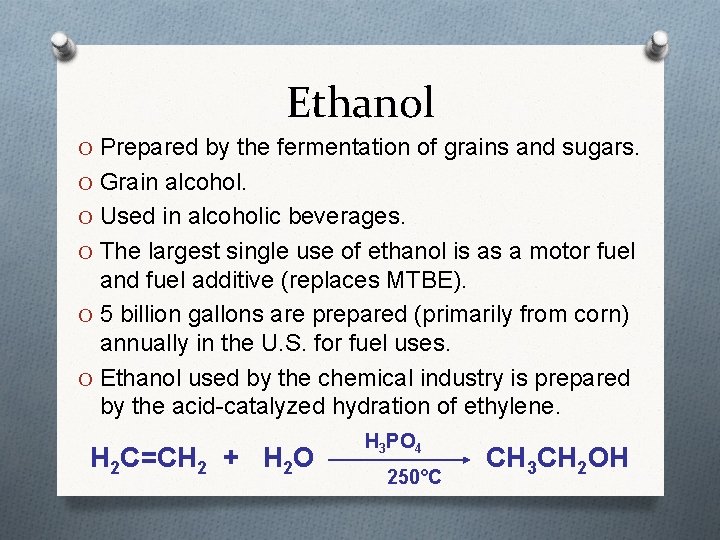
Ethanol O Prepared by the fermentation of grains and sugars. O Grain alcohol. O Used in alcoholic beverages. O The largest single use of ethanol is as a motor fuel and fuel additive (replaces MTBE). O 5 billion gallons are prepared (primarily from corn) annually in the U. S. for fuel uses. O Ethanol used by the chemical industry is prepared by the acid-catalyzed hydration of ethylene. H 2 C=CH 2 + H 2 O H 3 PO 4 250°C CH 3 CH 2 OH
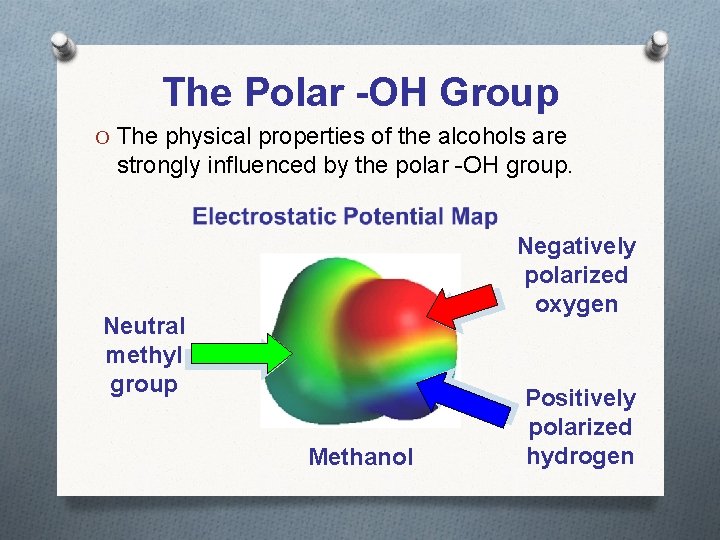
The Polar -OH Group O The physical properties of the alcohols are strongly influenced by the polar -OH group. Negatively polarized oxygen Neutral methyl group Methanol Positively polarized hydrogen
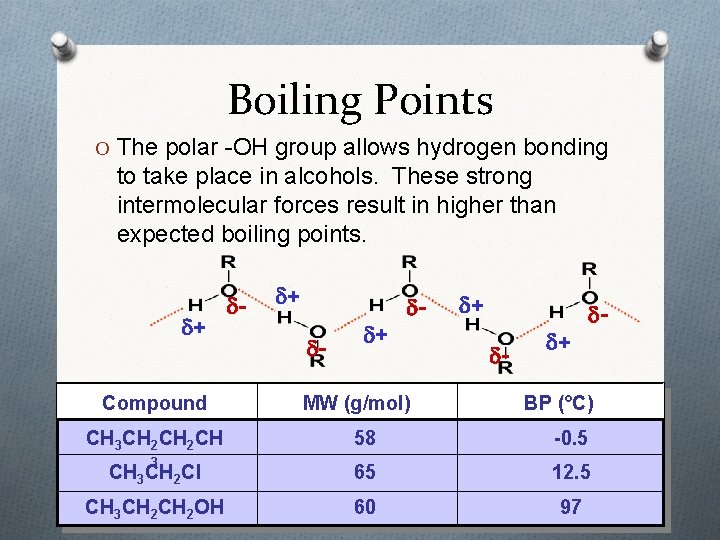
Boiling Points O The polar -OH group allows hydrogen bonding to take place in alcohols. These strong intermolecular forces result in higher than expected boiling points. + Compound - + - MW (g/mol) + - + - BP (°C) CH 3 CH 2 CH 58 -0. 5 CH 3 CH 2 Cl 3 65 12. 5 CH 3 CH 2 OH 60 97
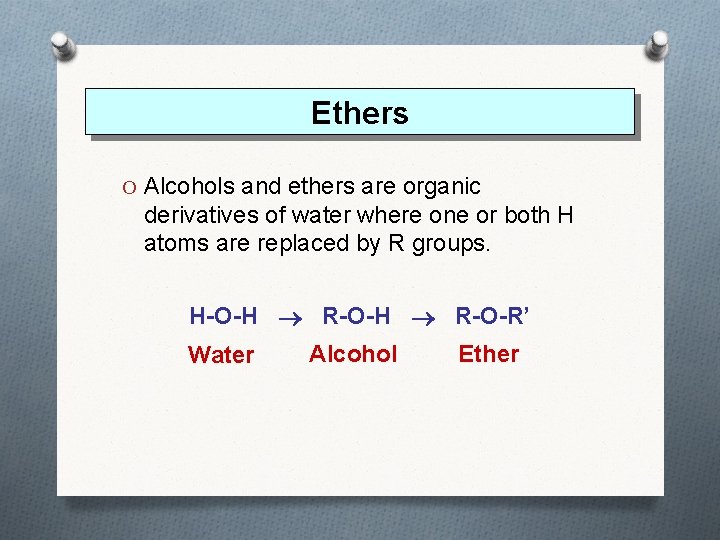
Ethers O Alcohols and ethers are organic derivatives of water where one or both H atoms are replaced by R groups. H-O-H R-O-R’ Water Alcohol Ether
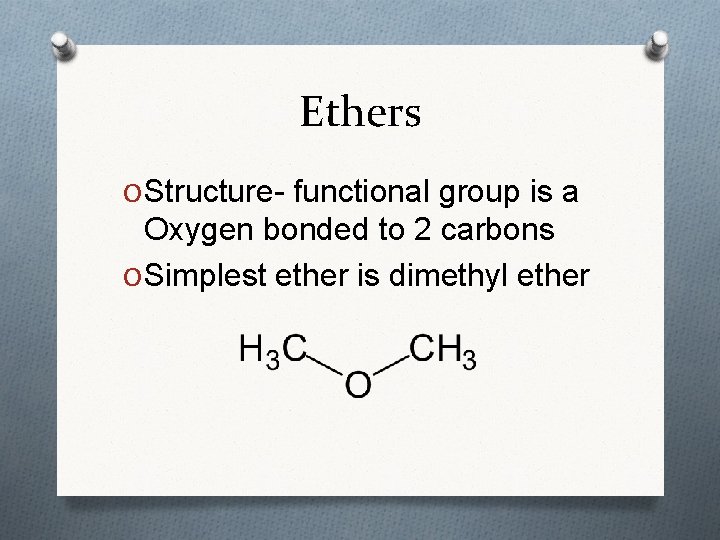
Ethers O Structure- functional group is a Oxygen bonded to 2 carbons O Simplest ether is dimethyl ether
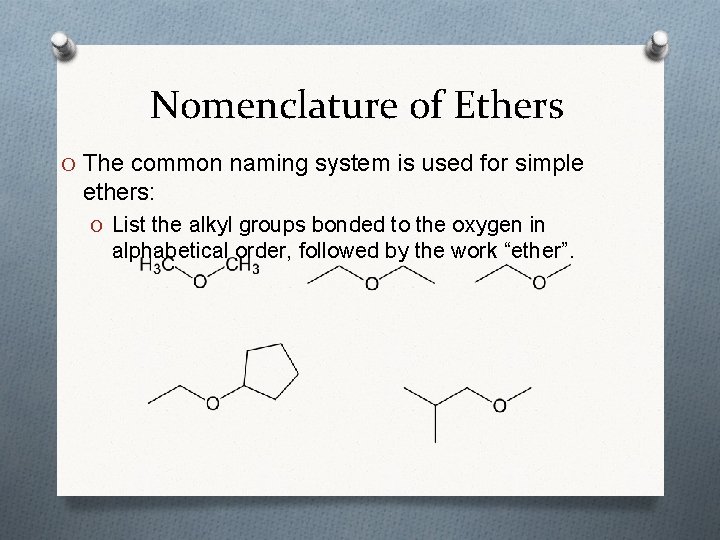
Nomenclature of Ethers O The common naming system is used for simple ethers: O List the alkyl groups bonded to the oxygen in alphabetical order, followed by the work “ether”.
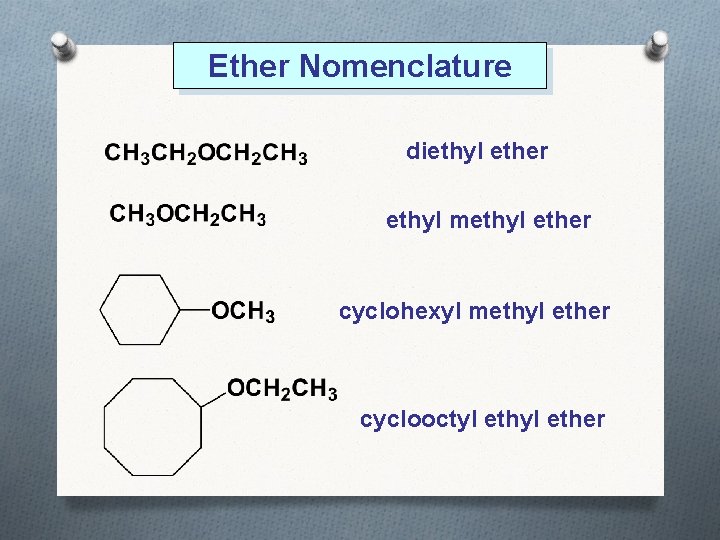
Ether Nomenclature diethyl ether ethyl methyl ether cyclohexyl methyl ether cyclooctyl ether
Crown Ethers O Large rings consisting repeating (-OCH 2 -) or similar units O Named as x-crown-y O x is the total number of atoms in the ring O y is the number of oxygen atoms O 18 -crown-6 ether: 18 -membered ring containing 6 oxygens atoms O Central cavity is electronegative and attracts cations
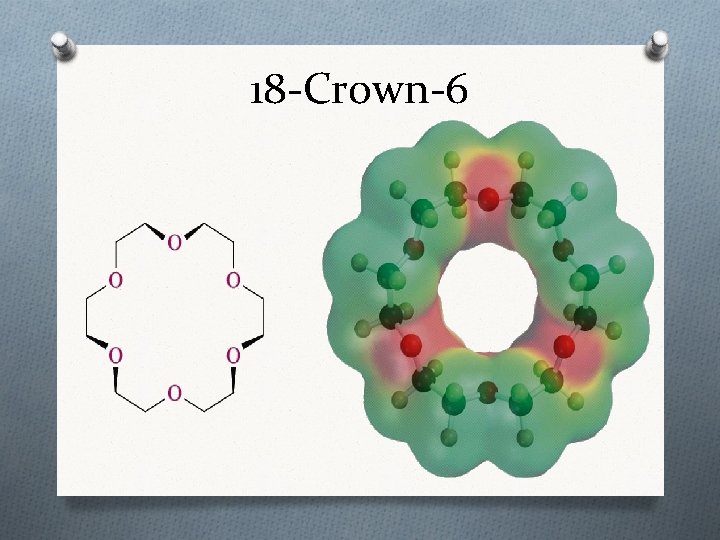
18 -Crown-6
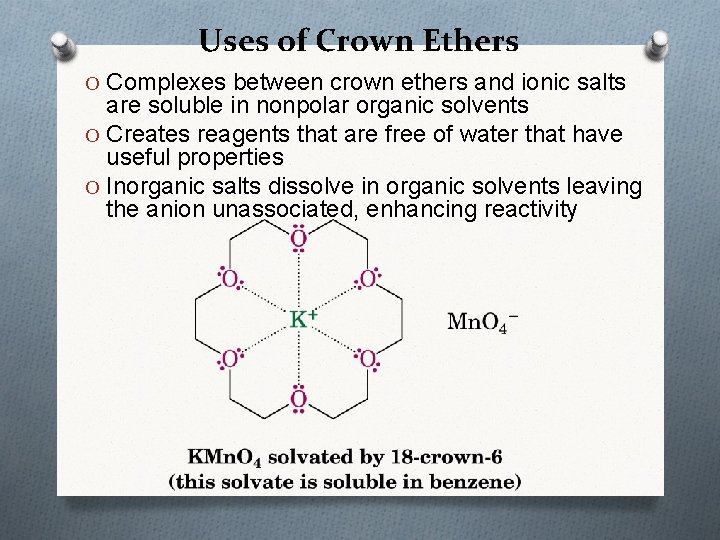
Uses of Crown Ethers O Complexes between crown ethers and ionic salts are soluble in nonpolar organic solvents O Creates reagents that are free of water that have useful properties O Inorganic salts dissolve in organic solvents leaving the anion unassociated, enhancing reactivity
Physical Properties of Ethers O Ethers are polar compounds O The oxygen has a partial minus charge, the carbons bonded to the oxygen have a partial positive charge O Ether have very weak intermolecular forces which results in low boiling points
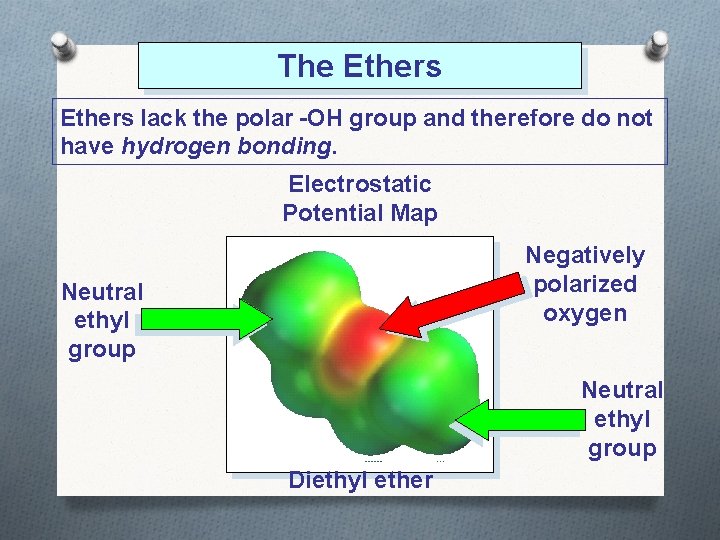
The Ethers lack the polar -OH group and therefore do not have hydrogen bonding. Electrostatic Potential Map Negatively polarized oxygen Neutral ethyl group Diethyl ether
Reactions of Ethers O Like alkanes, they are resistant to most chemical reactions O Therefore, they are ideal to use as solvents
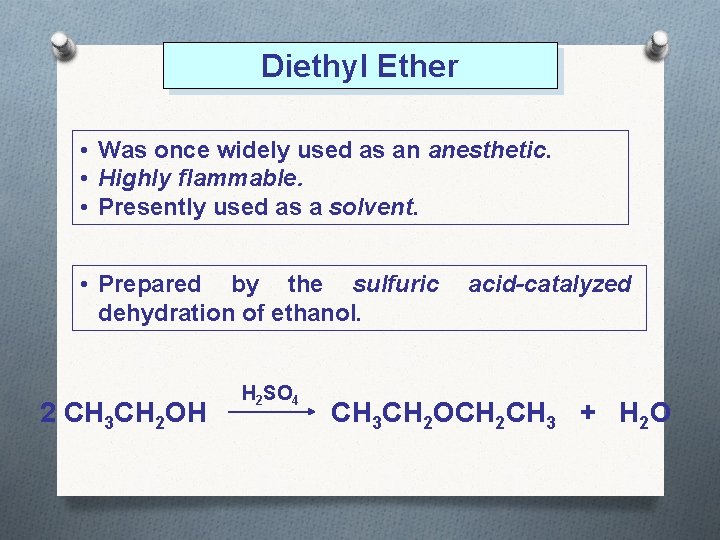
Diethyl Ether • Was once widely used as an anesthetic. • Highly flammable. • Presently used as a solvent. • Prepared by the sulfuric dehydration of ethanol. 2 CH 3 CH 2 OH H 2 SO 4 acid-catalyzed CH 3 CH 2 OCH 2 CH 3 + H 2 O
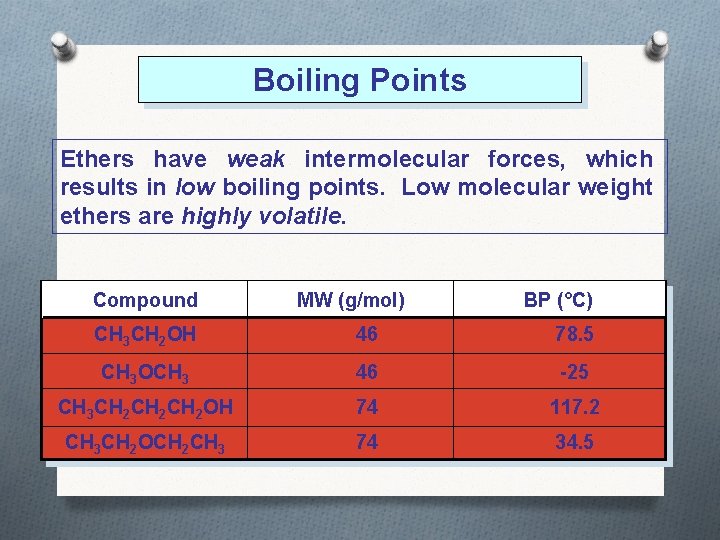
Boiling Points Ethers have weak intermolecular forces, which results in low boiling points. Low molecular weight ethers are highly volatile. Compound MW (g/mol) BP (°C) CH 3 CH 2 OH 46 78. 5 CH 3 OCH 3 46 -25 CH 3 CH 2 CH 2 OH 74 117. 2 CH 3 CH 2 OCH 2 CH 3 74 34. 5
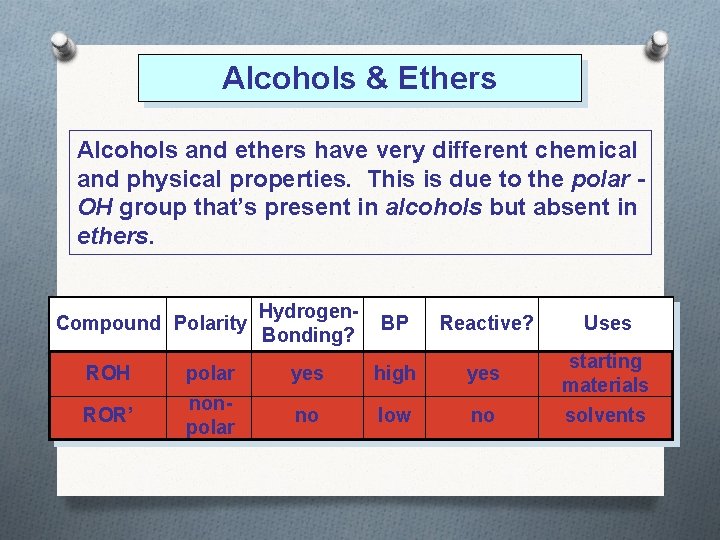
Alcohols & Ethers Alcohols and ethers have very different chemical and physical properties. This is due to the polar OH group that’s present in alcohols but absent in ethers. Compound Polarity ROH ROR’ polar nonpolar Hydrogen. Bonding? BP Reactive? yes high yes no low no Uses starting materials solvents
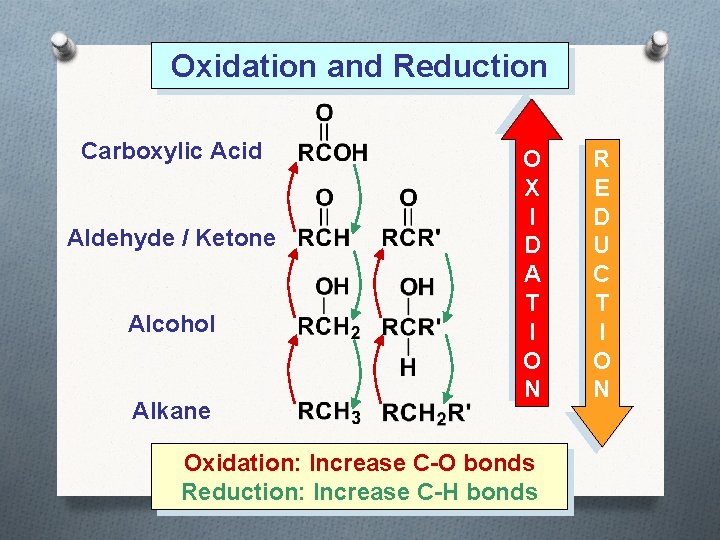
Oxidation and Reduction Carboxylic Acid Aldehyde / Ketone Alcohol Alkane O X I D A T I O N Oxidation: Increase C-O bonds Reduction: Increase C-H bonds R E D U C T I O N
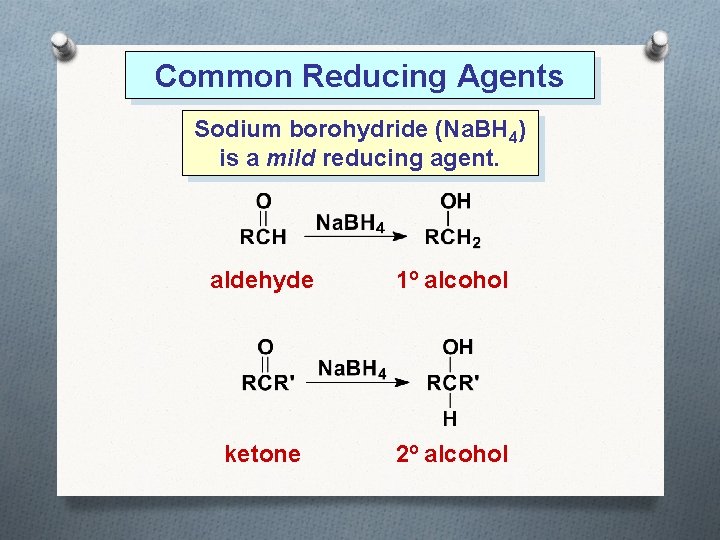
Common Reducing Agents Sodium borohydride (Na. BH 4) is a mild reducing agent. aldehyde 1º alcohol ketone 2º alcohol
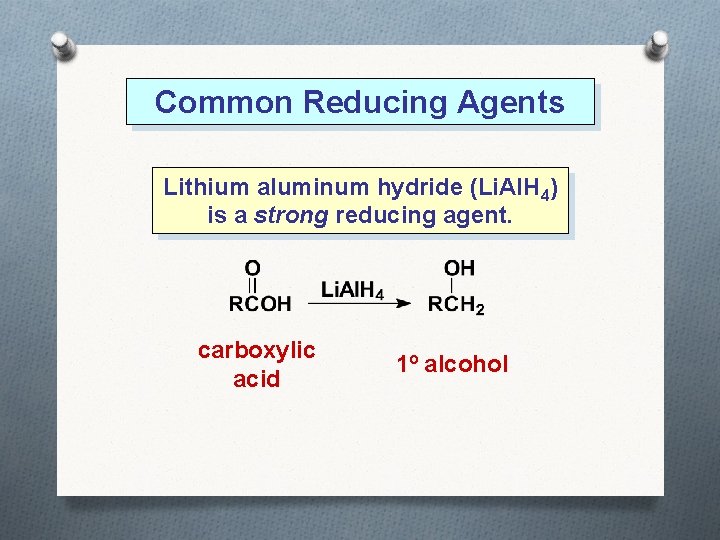
Common Reducing Agents Lithium aluminum hydride (Li. Al. H 4) is a strong reducing agent. carboxylic acid 1º alcohol
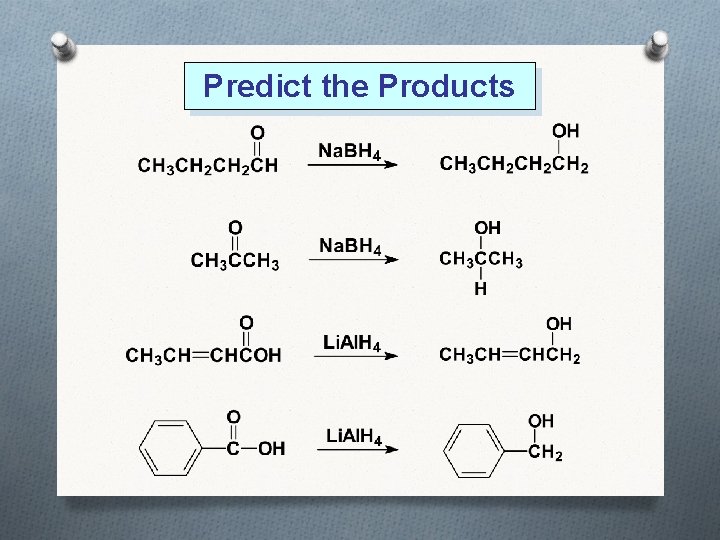
Predict the Products
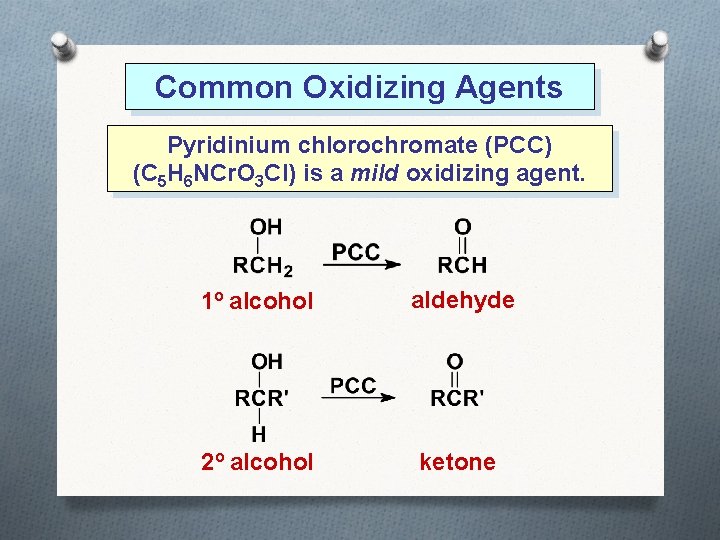
Common Oxidizing Agents Pyridinium chlorochromate (PCC) (C 5 H 6 NCr. O 3 Cl) is a mild oxidizing agent. 1º alcohol aldehyde 2º alcohol ketone
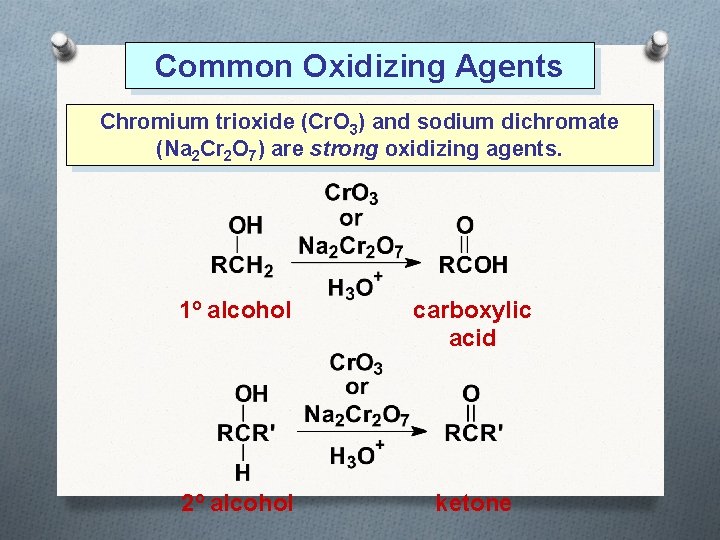
Common Oxidizing Agents Chromium trioxide (Cr. O 3) and sodium dichromate (Na 2 Cr 2 O 7) are strong oxidizing agents. 1º alcohol carboxylic acid 2º alcohol ketone
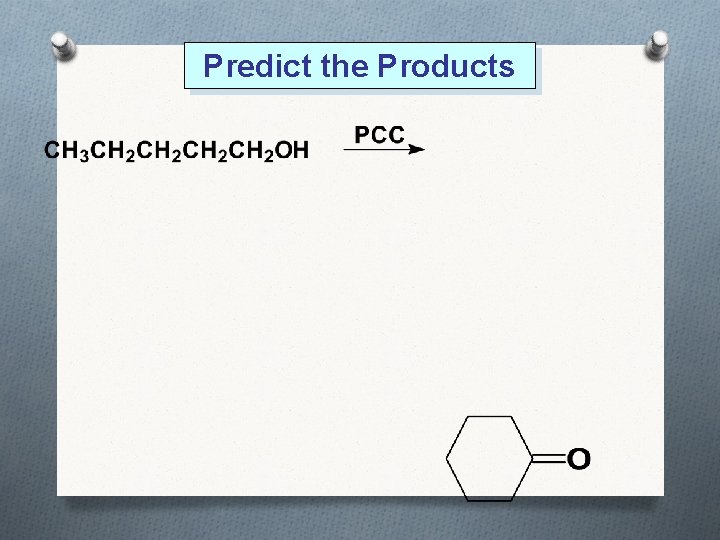
Predict the Products
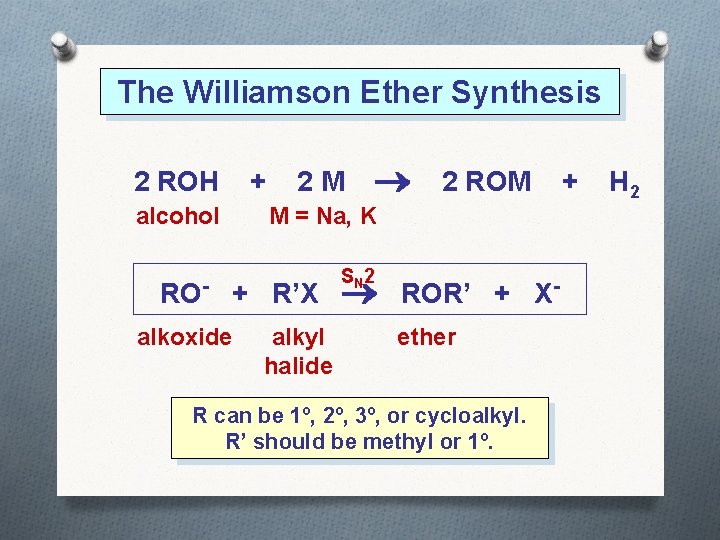
The Williamson Ether Synthesis 2 ROH + alcohol RO- 2 M 2 ROM M = Na, K + R’X alkoxide alkyl halide SN 2 ROR’ + Xether R can be 1º, 2º, 3º, or cycloalkyl. R’ should be methyl or 1º. + H 2
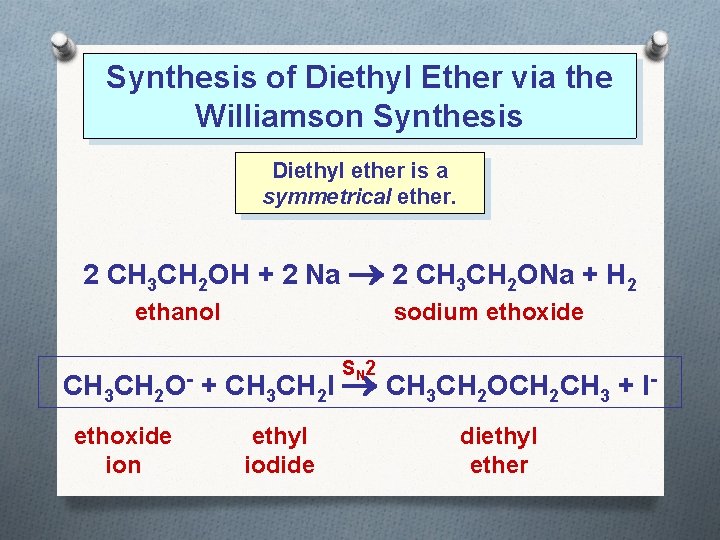
Synthesis of Diethyl Ether via the Williamson Synthesis Diethyl ether is a symmetrical ether. 2 CH 3 CH 2 OH + 2 Na 2 CH 3 CH 2 ONa + H 2 ethanol CH 3 CH 2 O- ethoxide ion sodium ethoxide SN 2 + CH 3 CH 2 I CH 3 CH 2 OCH 2 CH 3 + Iethyl iodide diethyl ether
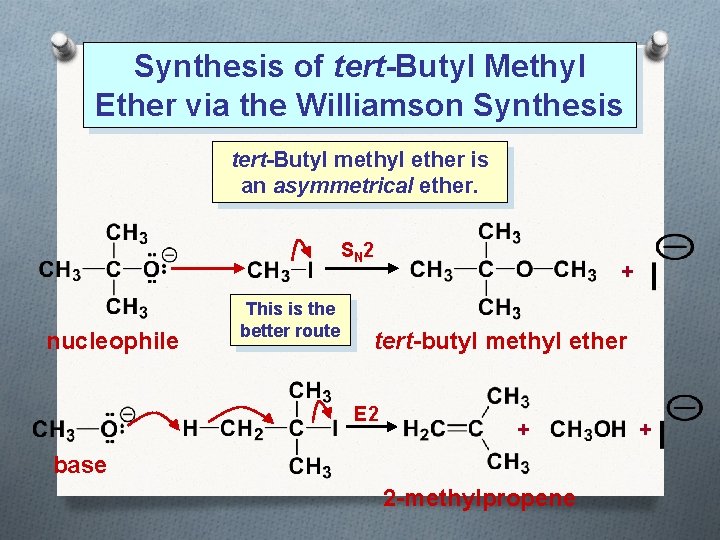
Synthesis of tert-Butyl Methyl Ether via the Williamson Synthesis tert-Butyl methyl ether is an asymmetrical ether. SN 2 nucleophile This is the better route + tert-butyl methyl ether E 2 + base 2 -methylpropene +
- Slides: 31