
Alcohols and Phenols Dr Shatha I Alaqeel 108
- Slides: 35
Alcohols and Phenols Dr. Shatha I Alaqeel 108 Chem
Learning Objectives Chapter six concerns alcohols and phenols and by the end of this chapter the student will: know the difference in structure between alcohols and phenols Know the different classes of alcohols Know how to name alcohols and phenols Know the physical properties (solubility, boiling and melting points) Know hydrogen bonds are formed and its effect on boiling points of alcohols Know the acidic properties of alcohols and phenols know the different methods that can be used to prepare alcohols and phenols. Know the chemical reactions of these compounds ( some reactions are review, others are extensions of the chemistry that will be discussed on other chapters. 2 108 Chem
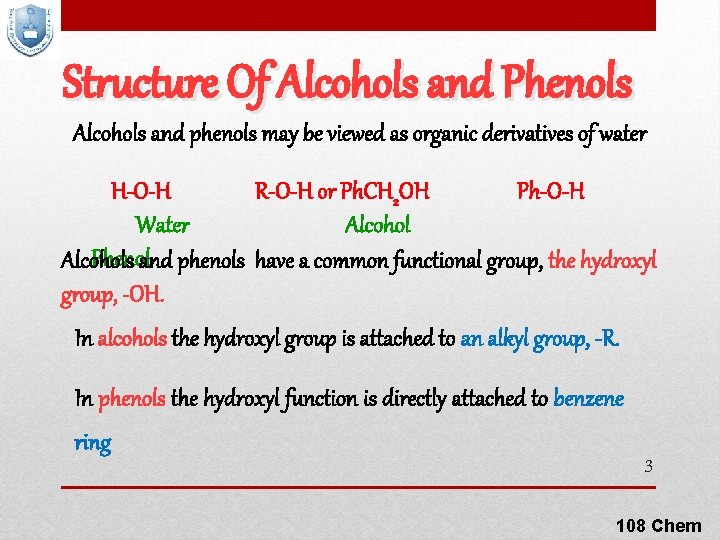
Structure Of Alcohols and Phenols Alcohols and phenols may be viewed as organic derivatives of water H-O-H R-O-H or Ph. CH 2 OH Ph-O-H Water Alcohol Phenoland phenols have a common functional group, the hydroxyl Alcohols group, -OH. In alcohols the hydroxyl group is attached to an alkyl group, -R. In phenols the hydroxyl function is directly attached to benzene ring 3 108 Chem
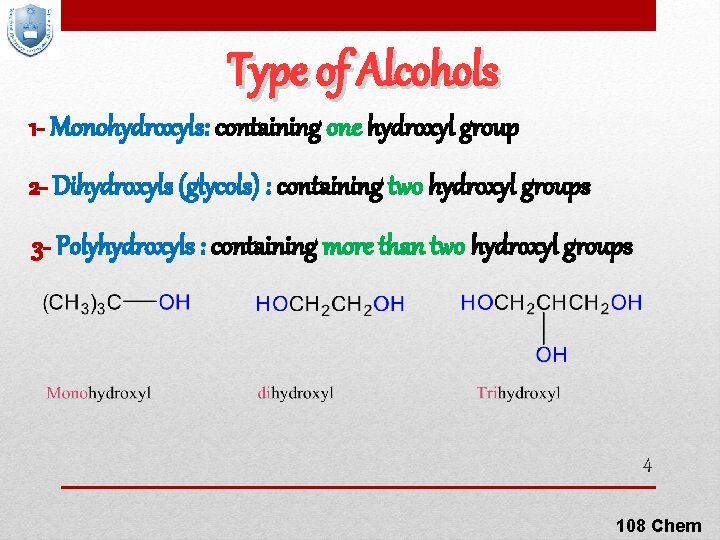
Type of Alcohols 1 - Monohydroxyls: containing one hydroxyl group 2 - Dihydroxyls (glycols) : containing two hydroxyl groups 3 - Polyhydroxyls : containing more than two hydroxyl groups 4 108 Chem
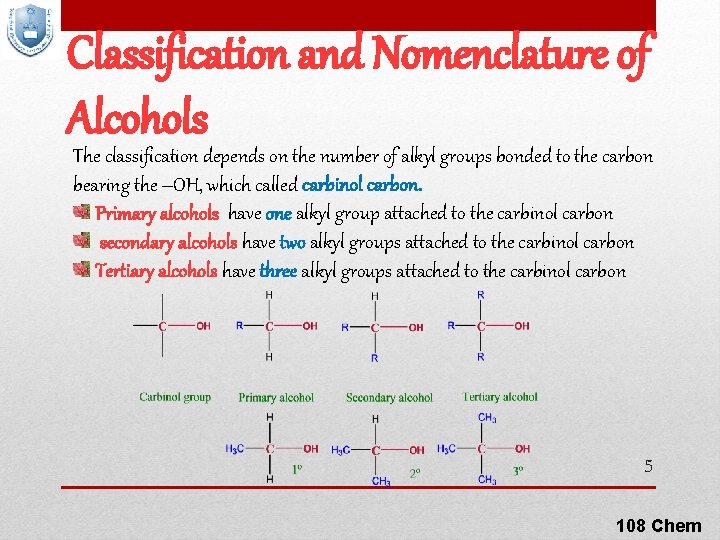
Classification and Nomenclature of Alcohols The classification depends on the number of alkyl groups bonded to the carbon bearing the –OH, which called carbinol carbon. Primary alcohols have one alkyl group attached to the carbinol carbon secondary alcohols have two alkyl groups attached to the carbinol carbon Tertiary alcohols have three alkyl groups attached to the carbinol carbon 5 108 Chem
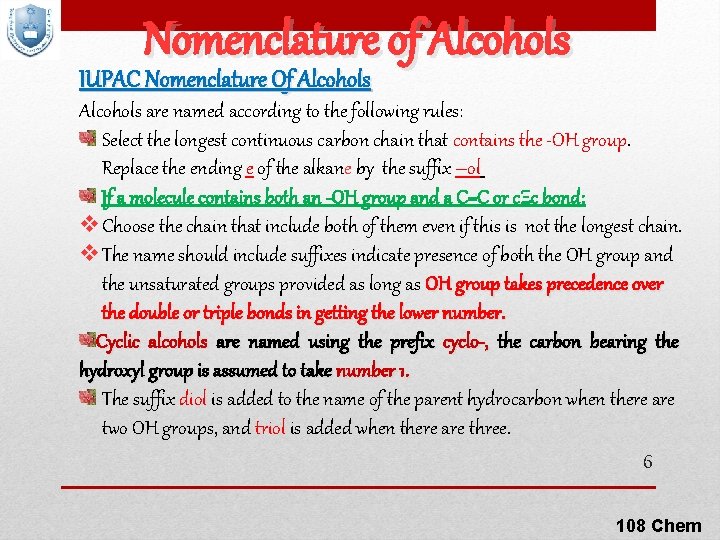
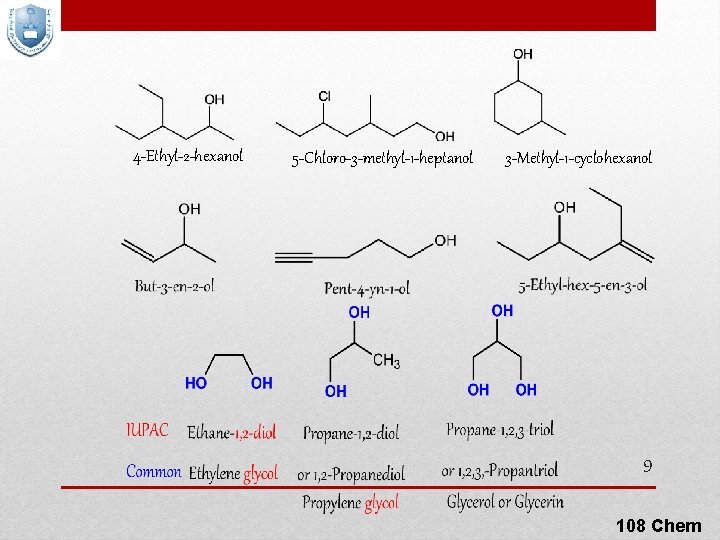
Nomenclature of Alcohols IUPAC Nomenclature Of Alcohols are named according to the following rules: Select the longest continuous carbon chain that contains the -OH group. Replace the ending e of the alkane by the suffix –ol If a molecule contains both an -OH group and a C=C or cΞc bond; v. Choose the chain that include both of them even if this is not the longest chain. v. The name should include suffixes indicate presence of both the OH group and the unsaturated groups provided as long as OH group takes precedence over the double or triple bonds in getting the lower number. Cyclic alcohols are named using the prefix cyclo-, the carbon bearing the hydroxyl group is assumed to take number 1. The suffix diol is added to the name of the parent hydrocarbon when there are two OH groups, and triol is added when there are three. 6 108 Chem
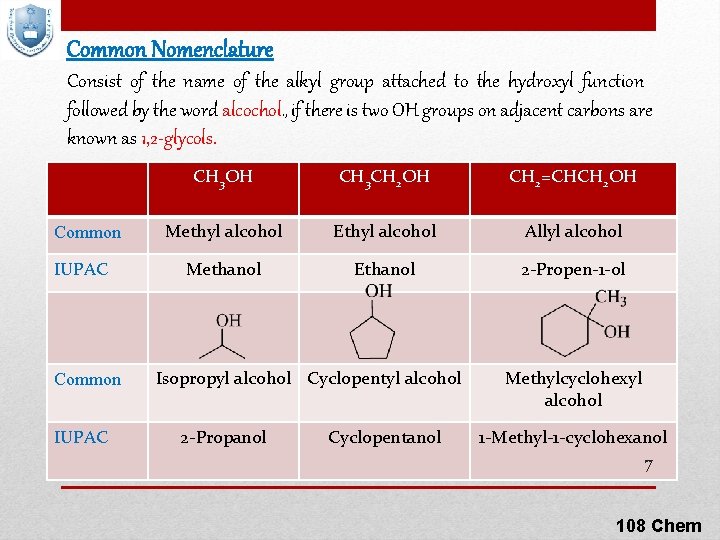
Common Nomenclature Consist of the name of the alkyl group attached to the hydroxyl function followed by the word alcochol. , if there is two OH groups on adjacent carbons are known as 1, 2 -glycols. Common IUPAC CH 3 OH CH 3 CH 2 OH CH 2=CHCH 2 OH Methyl alcohol Ethyl alcohol Allyl alcohol Methanol Ethanol 2 -Propen-1 -ol Isopropyl alcohol Cyclopentyl alcohol 2 -Propanol Cyclopentanol Methylcyclohexyl alcohol 1 -Methyl-1 -cyclohexanol 7 108 Chem
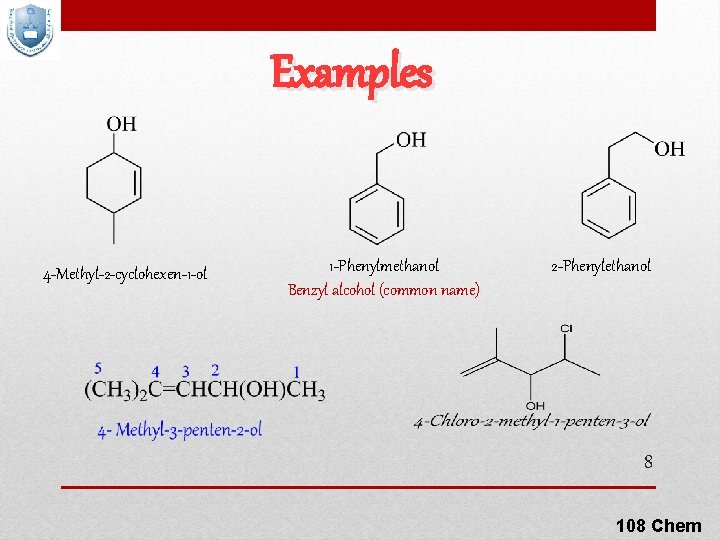
Examples 4 -Methyl-2 -cyclohexen-1 -ol 1 -Phenylmethanol Benzyl alcohol (common name) 2 -Phenylethanol 8 108 Chem
4 -Ethyl-2 -hexanol 5 -Chloro-3 -methyl-1 -heptanol 3 -Methyl-1 -cyclohexanol 9 108 Chem
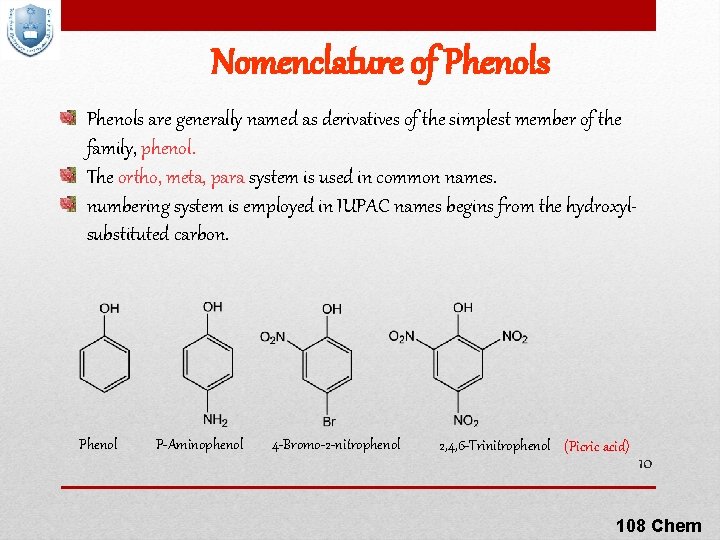
Nomenclature of Phenols are generally named as derivatives of the simplest member of the family, phenol. The ortho, meta, para system is used in common names. numbering system is employed in IUPAC names begins from the hydroxylsubstituted carbon. Phenol P-Aminophenol 4 -Bromo-2 -nitrophenol 2, 4, 6 -Trinitrophenol (Picric acid) 10 108 Chem
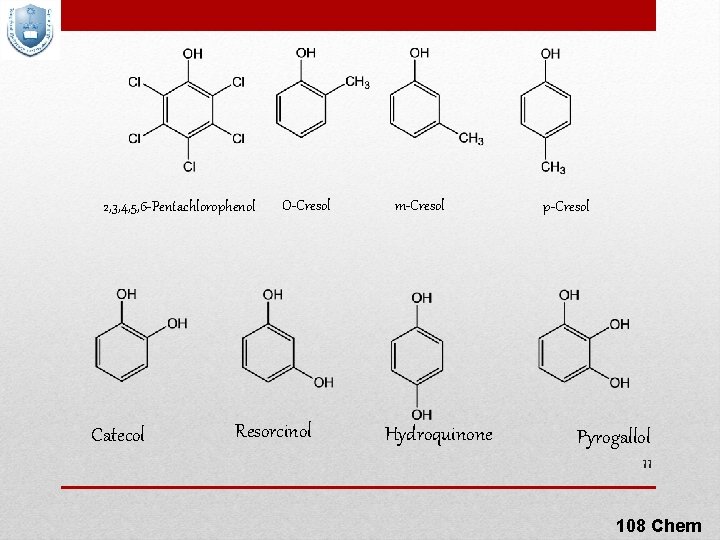
2, 3, 4, 5, 6 -Pentachlorophenol Catecol O-Cresol Resorcinol m-Cresol Hydroquinone p-Cresol Pyrogallol 11 108 Chem
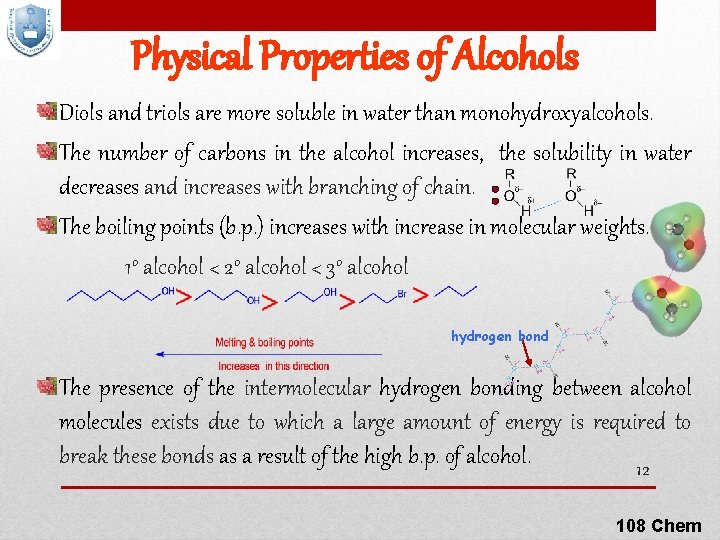
Physical Properties of Alcohols Diols and triols are more soluble in water than monohydroxyalcohols. The number of carbons in the alcohol increases, the solubility in water decreases and increases with branching of chain. The boiling points (b. p. ) increases with increase in molecular weights. 1 o alcohol < 2 o alcohol < 3 o alcohol hydrogen bond The presence of the intermolecular hydrogen bonding between alcohol molecules exists due to which a large amount of energy is required to break these bonds as a result of the high b. p. of alcohol. 12 108 Chem
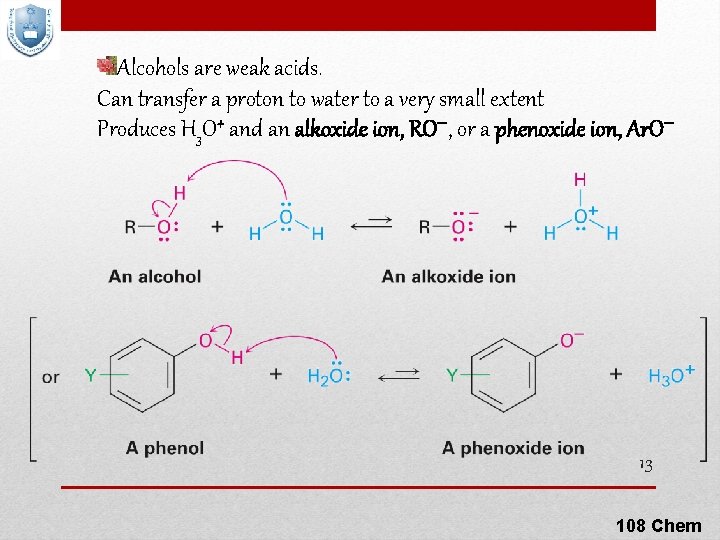
Alcohols are weak acids. Can transfer a proton to water to a very small extent Produces H 3 O+ and an alkoxide ion, RO , or a phenoxide ion, Ar. O 13 108 Chem
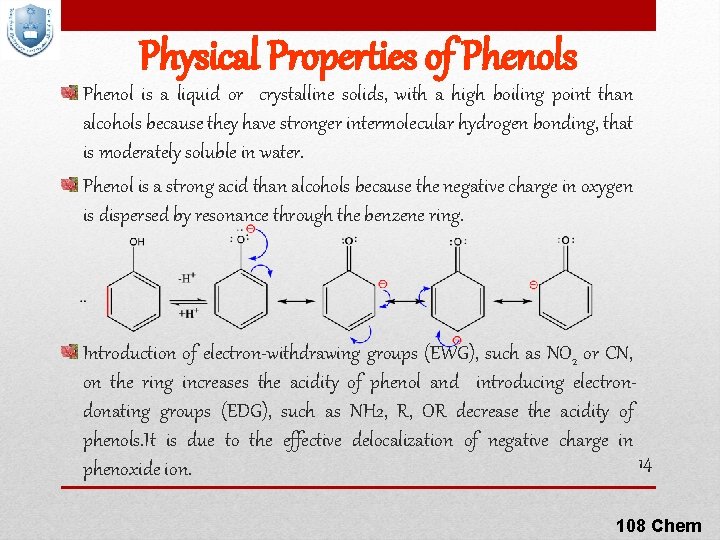
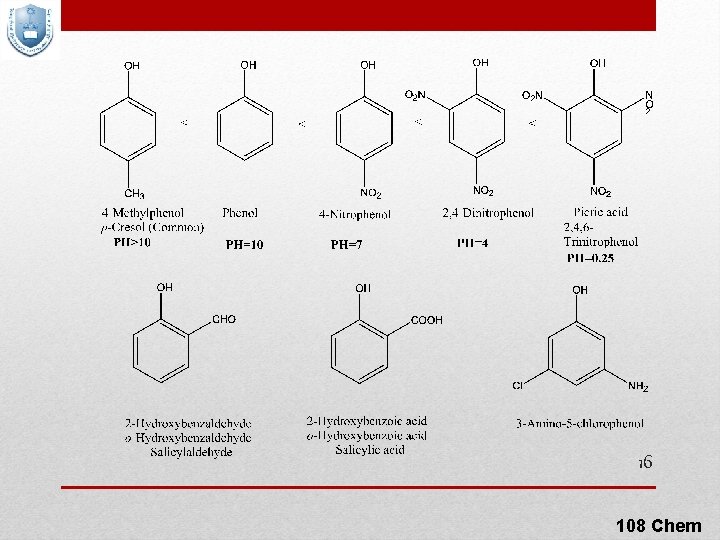
Physical Properties of Phenols Phenol is a liquid or crystalline solids, with a high boiling point than alcohols because they have stronger intermolecular hydrogen bonding, that is moderately soluble in water. Phenol is a strong acid than alcohols because the negative charge in oxygen is dispersed by resonance through the benzene ring. Introduction of electron-withdrawing groups (EWG), such as NO 2 or CN, on the ring increases the acidity of phenol and introducing electrondonating groups (EDG), such as NH 2, R, OR decrease the acidity of phenols. It is due to the effective delocalization of negative charge in 14 phenoxide ion. 108 Chem
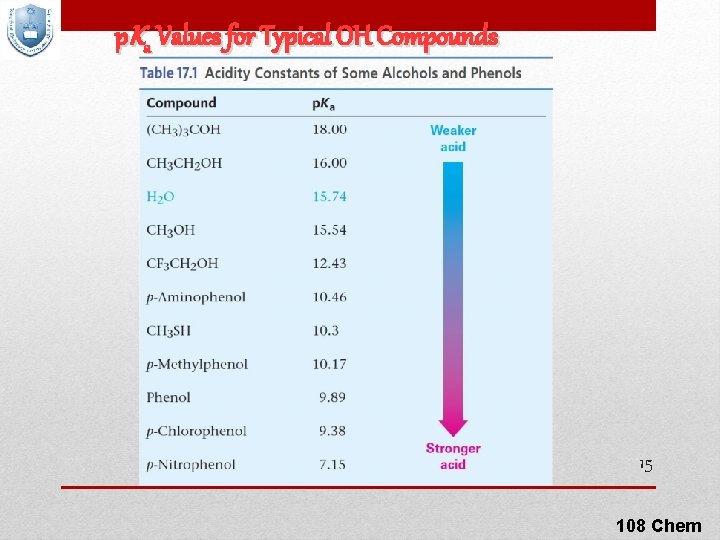
p. Ka Values for Typical OH Compounds 15 108 Chem
16 108 Chem
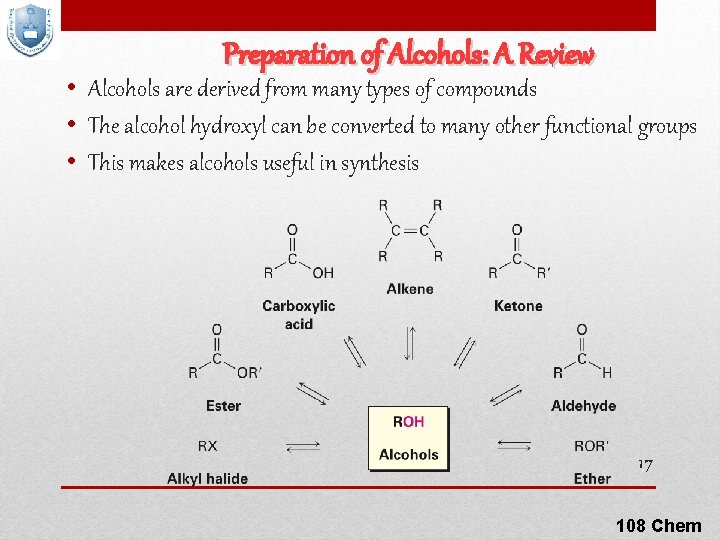
Preparation of Alcohols: A Review • Alcohols are derived from many types of compounds • The alcohol hydroxyl can be converted to many other functional groups • This makes alcohols useful in synthesis 17 108 Chem
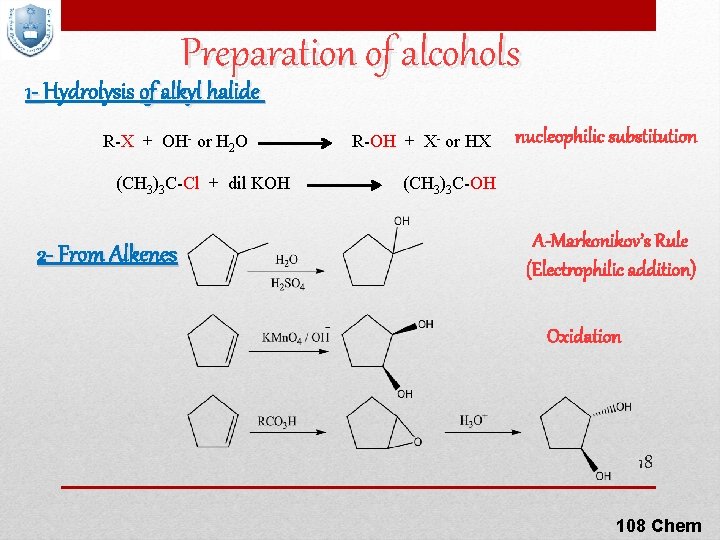
Preparation of alcohols 1 - Hydrolysis of alkyl halide R-X + OH- or H 2 O (CH 3)3 C-Cl + dil KOH 2 - From Alkenes R-OH + X- or HX nucleophilic substitution (CH 3)3 C-OH A-Markonikov’s Rule (Electrophilic addition) Oxidation 18 108 Chem
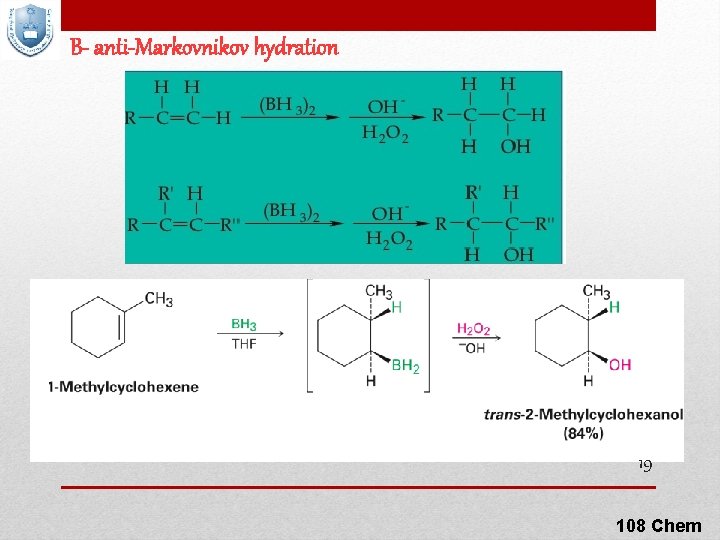
B- anti-Markovnikov hydration 19 108 Chem
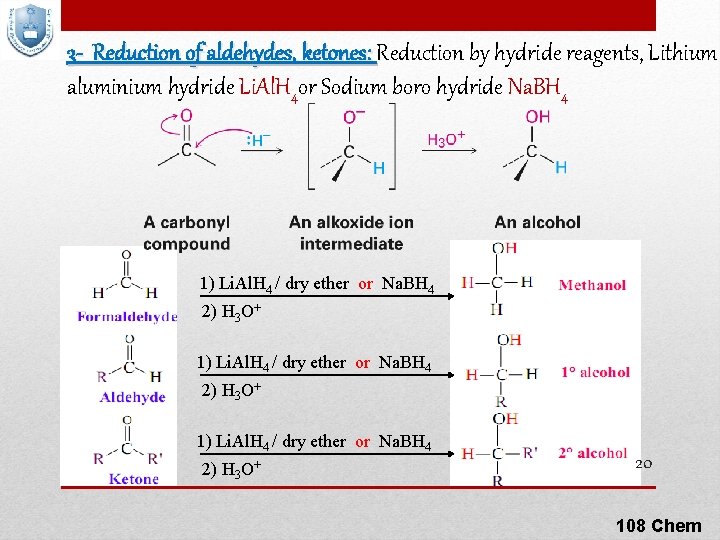
3 - Reduction of aldehydes, ketones: Reduction by hydride reagents, Lithium aluminium hydride Li. Al. H 4 or Sodium boro hydride Na. BH 4 1) Li. Al. H 4 / dry ether or Na. BH 4 2) H 3 O+ 20 108 Chem
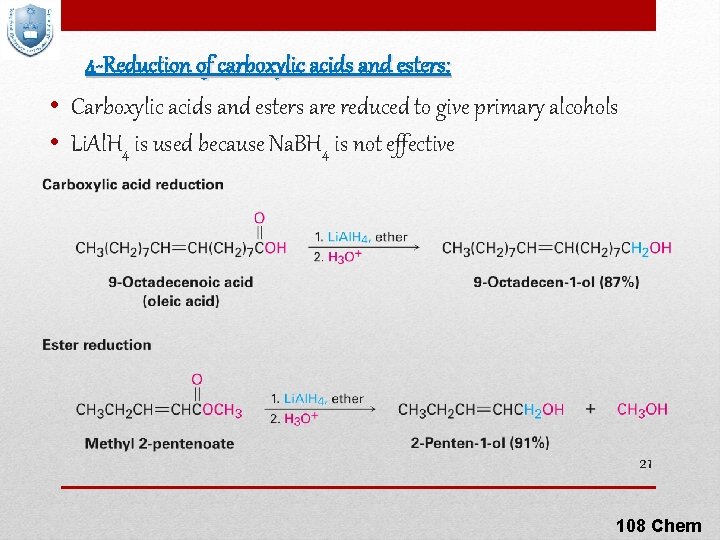
4 -Reduction of carboxylic acids and esters: • Carboxylic acids and esters are reduced to give primary alcohols • Li. Al. H 4 is used because Na. BH 4 is not effective 21 108 Chem
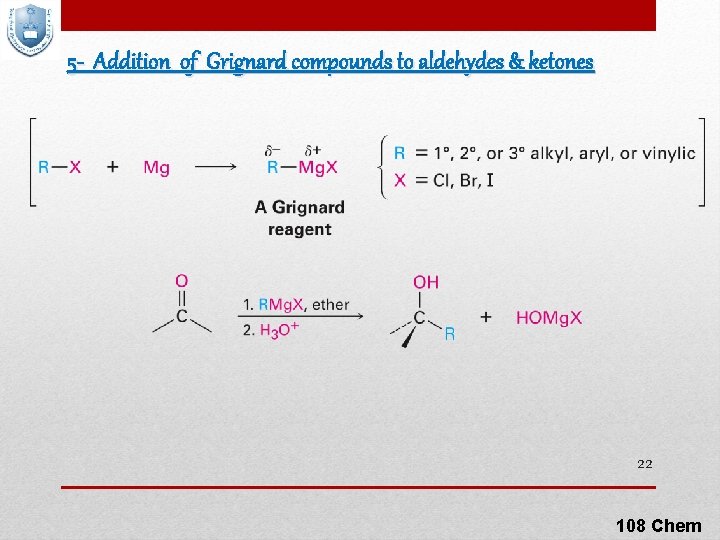
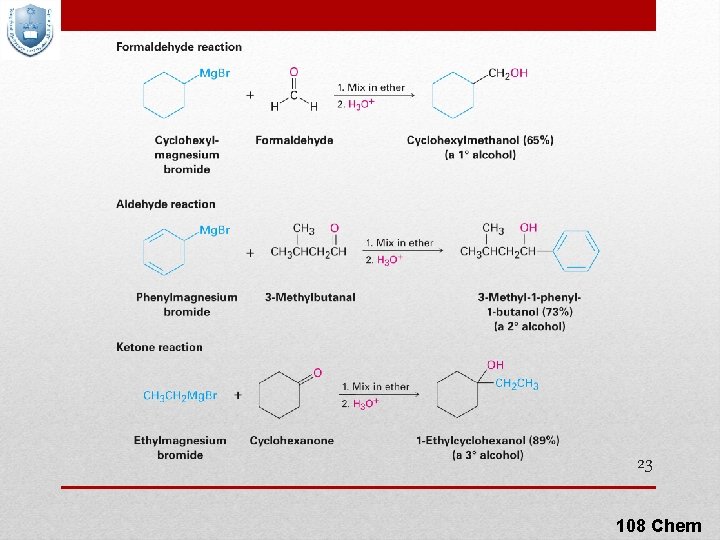
5 - Addition of Grignard compounds to aldehydes & ketones 22 108 Chem
23 108 Chem
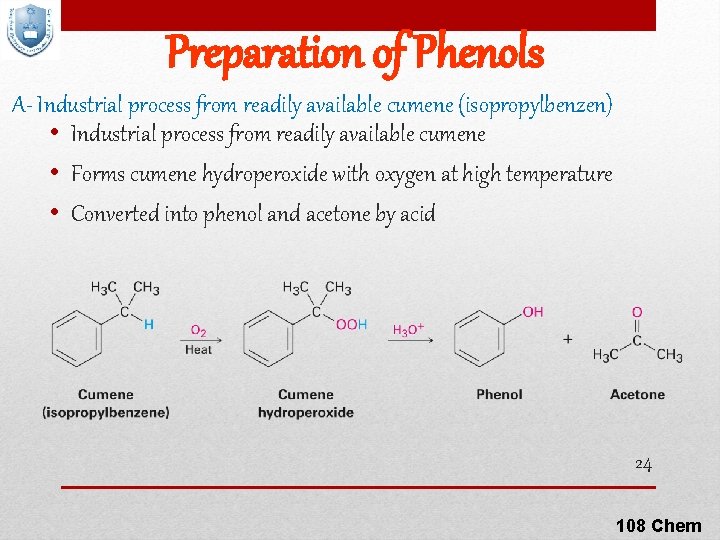
Preparation of Phenols A- Industrial process from readily available cumene (isopropylbenzen) • Industrial process from readily available cumene • Forms cumene hydroperoxide with oxygen at high temperature • Converted into phenol and acetone by acid 24 108 Chem
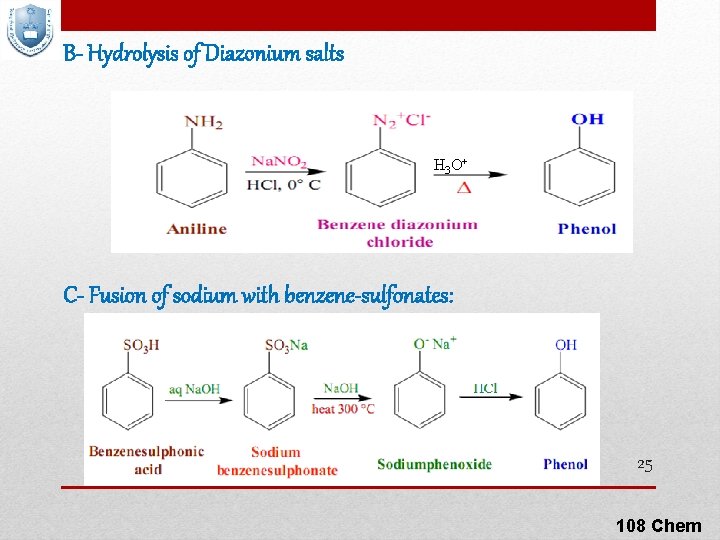
B- Hydrolysis of Diazonium salts H 3 O+ C- Fusion of sodium with benzene-sulfonates: 25 108 Chem
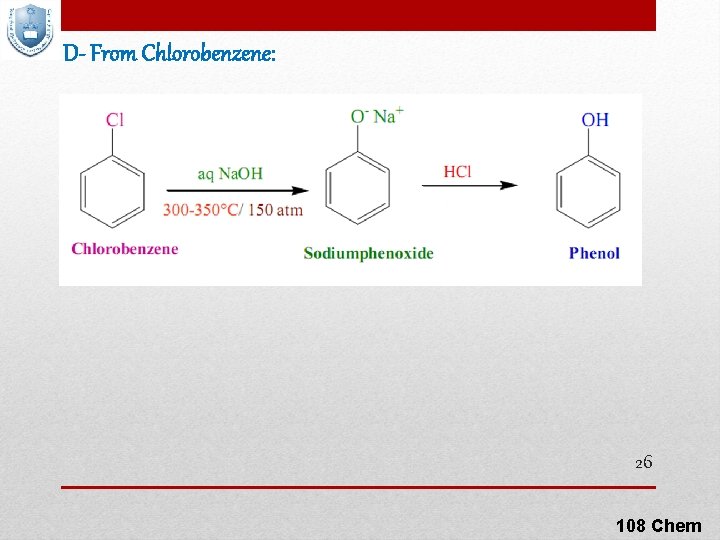
D- From Chlorobenzene: 26 108 Chem
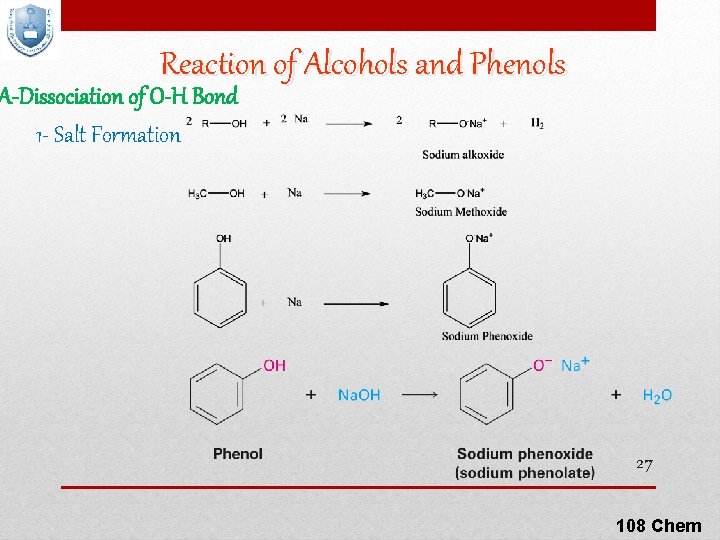
Reaction of Alcohols and Phenols A-Dissociation of O-H Bond 1 - Salt Formation 27 108 Chem
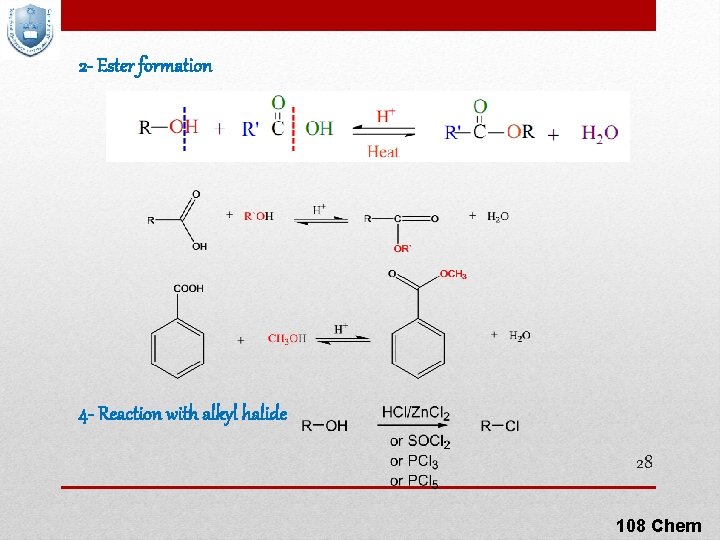
2 - Ester formation 4 - Reaction with alkyl halide 28 108 Chem
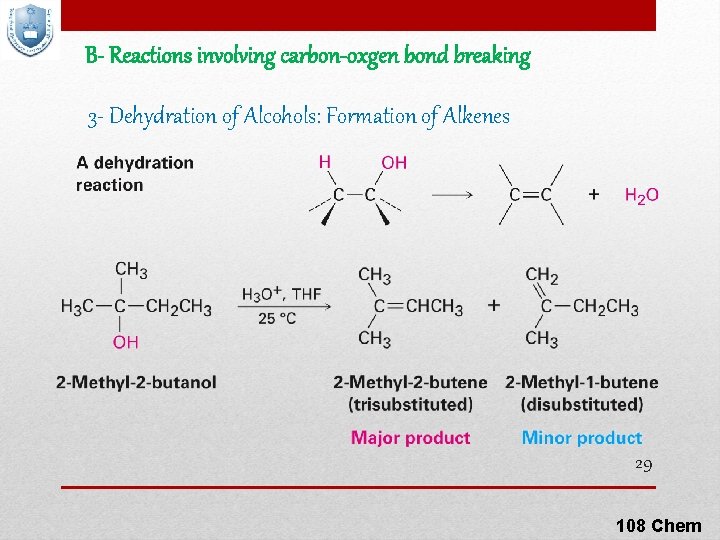
B- Reactions involving carbon-oxgen bond breaking 3 - Dehydration of Alcohols: Formation of Alkenes 29 108 Chem
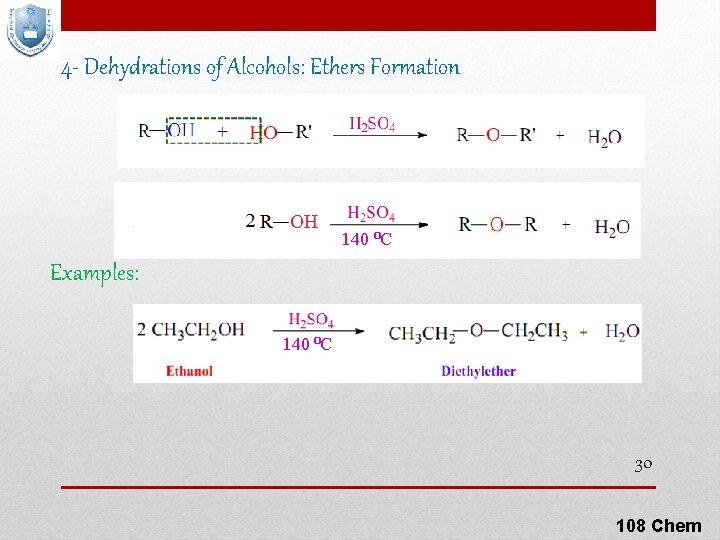
4 - Dehydrations of Alcohols: Ethers Formation 140 ⁰C Examples: 140 ⁰C 30 108 Chem
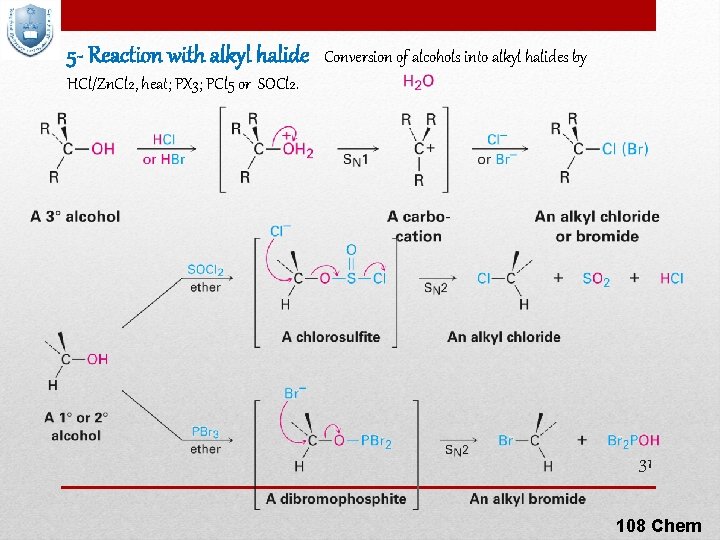
5 - Reaction with alkyl halide Conversion of alcohols into alkyl halides by HCl/Zn. Cl 2, heat; PX 3; PCl 5 or SOCl 2. 31 108 Chem
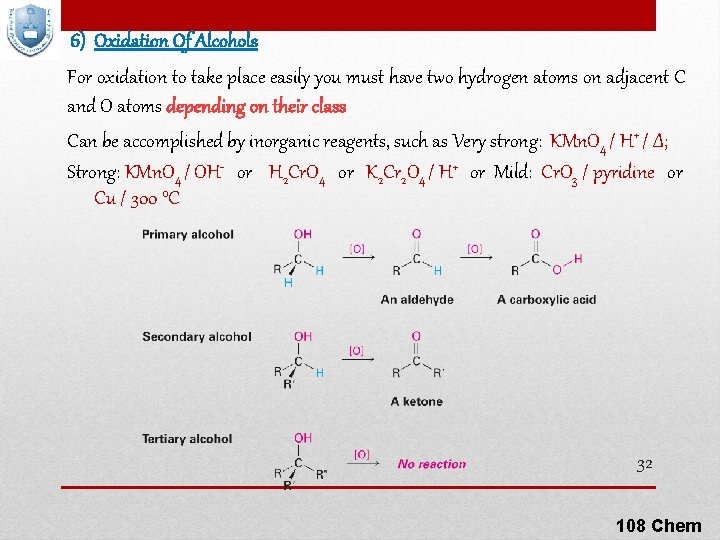
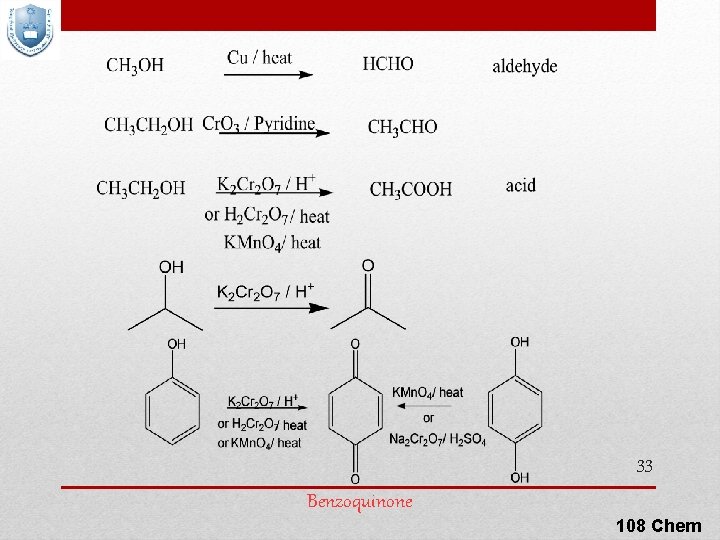
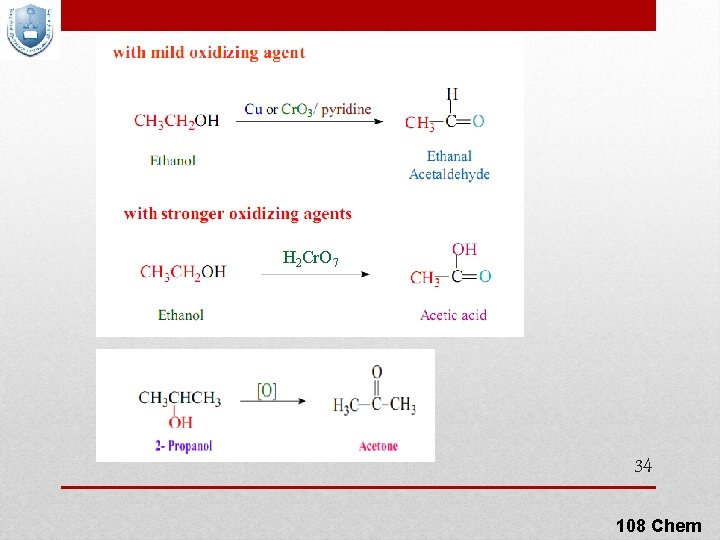
6) Oxidation Of Alcohols For oxidation to take place easily you must have two hydrogen atoms on adjacent C and O atoms depending on their class Can be accomplished by inorganic reagents, such as Very strong: KMn. O 4 / H+ / Δ; Strong: KMn. O 4 / OH- or H 2 Cr. O 4 or K 2 Cr 2 O 4 / H+ or Mild: Cr. O 3 / pyridine or Cu / 300 °C 32 108 Chem
33 Benzoquinone 108 Chem
H 2 Cr. O 7 34 108 Chem
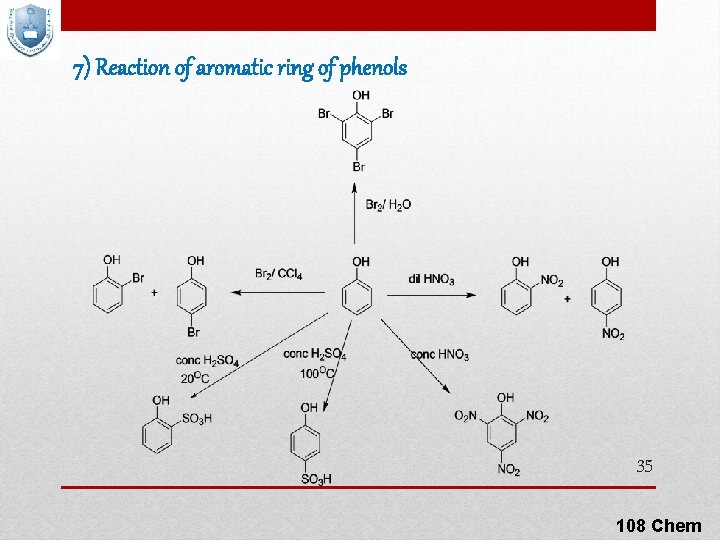
7) Reaction of aromatic ring of phenols 35 108 Chem