
Alcohols and Ethers Important Alcohols in Nature Menthol





- Slides: 35
Alcohols and Ethers
Important Alcohols in Nature (-) Menthol Vanillin 2
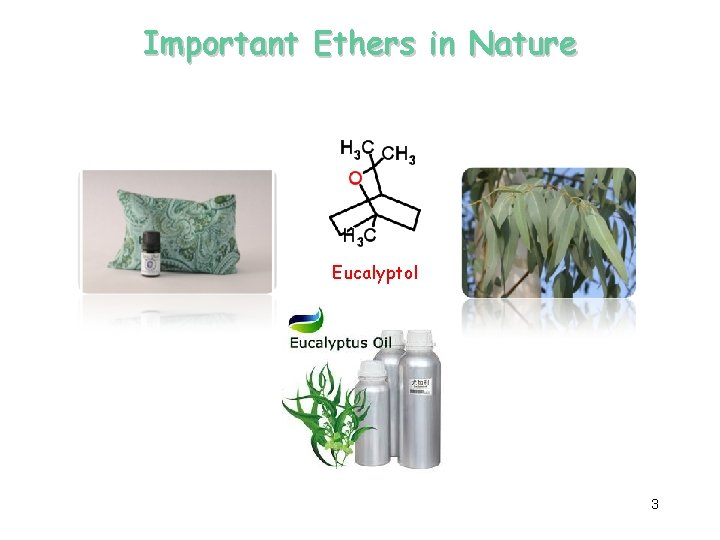
Important Ethers in Nature Eucalyptol 3
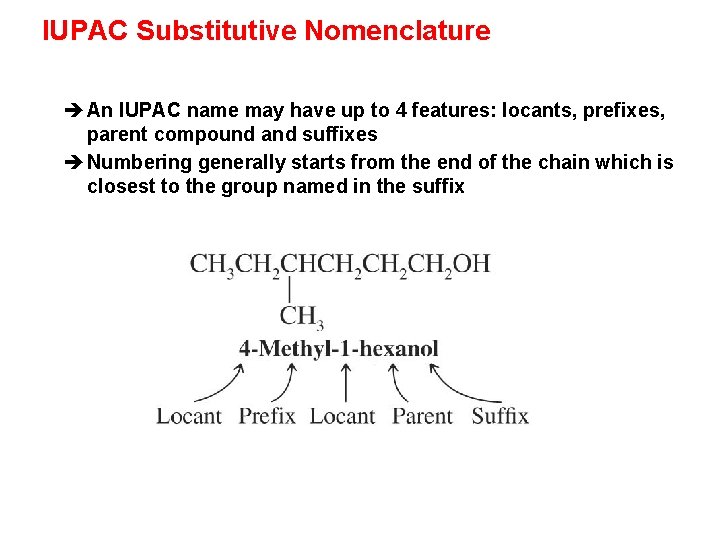
IUPAC Substitutive Nomenclature è An IUPAC name may have up to 4 features: locants, prefixes, parent compound and suffixes è Numbering generally starts from the end of the chain which is closest to the group named in the suffix
Alcohols R-OH l IUPAC Nomenclature of Alcohols è Select the longest chain containing the hydroxyl and change the suffix name of the corresponding parent alkane from -ane to -ol è Number the parent to give the hydroxyl the lowest possible number è The other substituents take their locations accordingly 5
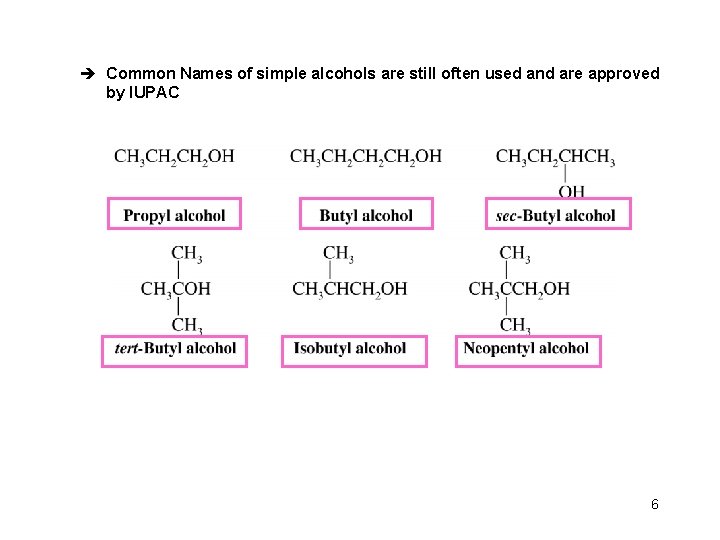
è Common Names of simple alcohols are still often used and are approved by IUPAC 6
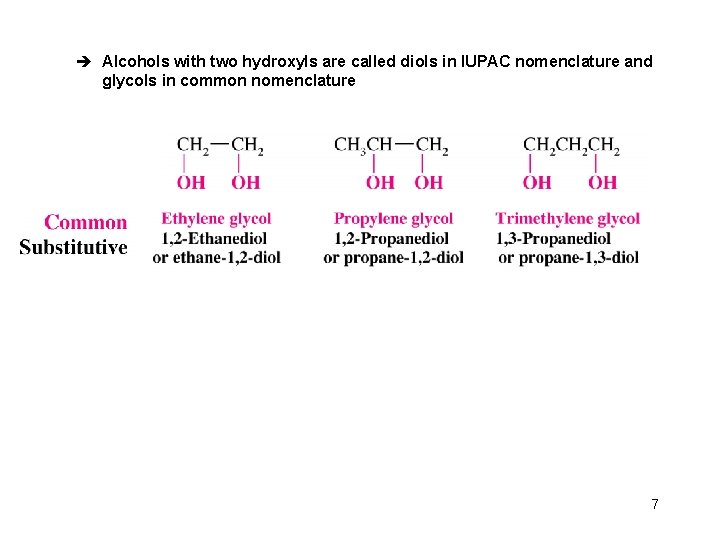
è Alcohols with two hydroxyls are called diols in IUPAC nomenclature and glycols in common nomenclature 7
Alcohols R-OH l Classification of Alcohols 1° Primary Alcohol 2° Secondary Alcohol 3° Tertiary Alcohol 8
Ethers R-O-R l Nomenclature of Ethers èCommon Names H The groups attached to the oxygen are listed in alphabetical order èIUPAC H Ethers are named as having an alkoxyl substituent on the main chain 9
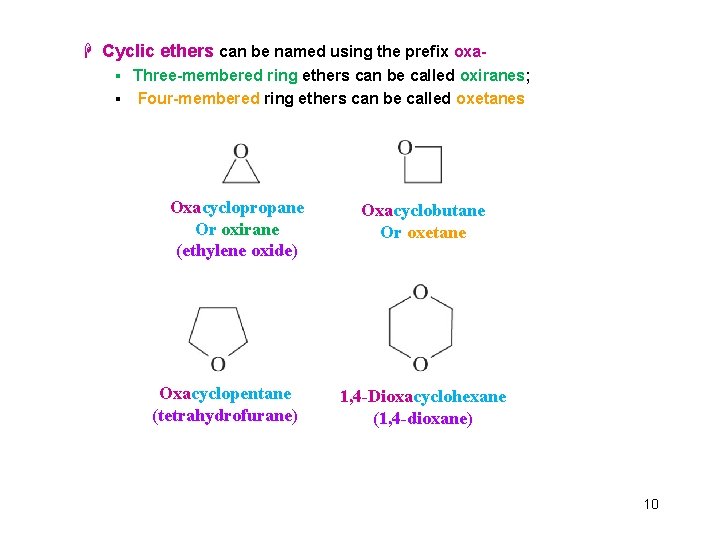
H Cyclic ethers can be named using the prefix oxa§ Three-membered ring ethers can be called oxiranes; § Four-membered ring ethers can be called oxetanes Oxacyclopropane Or oxirane (ethylene oxide) Oxacyclopentane (tetrahydrofurane) Oxacyclobutane Or oxetane 1, 4 -Dioxacyclohexane (1, 4 -dioxane) 10
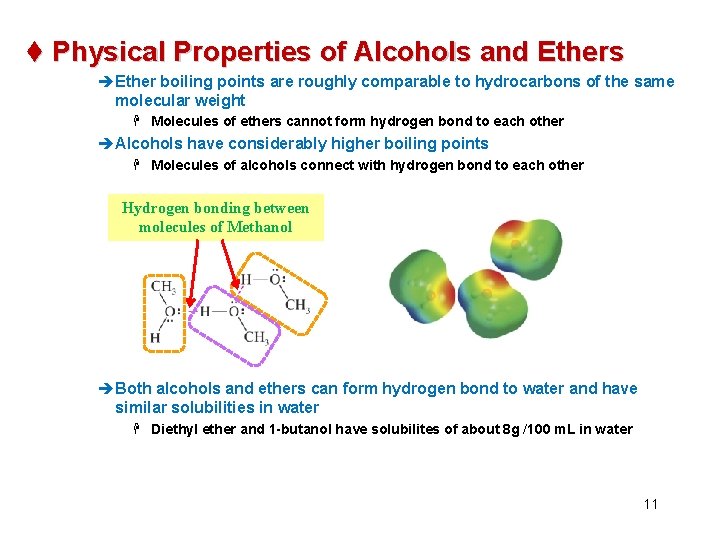
t Physical Properties of Alcohols and Ethers èEther boiling points are roughly comparable to hydrocarbons of the same molecular weight H Molecules of ethers cannot form hydrogen bond to each other èAlcohols have considerably higher boiling points H Molecules of alcohols connect with hydrogen bond to each other Hydrogen bonding between molecules of Methanol èBoth alcohols and ethers can form hydrogen bond to water and have similar solubilities in water H Diethyl ether and 1 -butanol have solubilites of about 8 g /100 m. L in water 11
Synthesis of Alcohols 1. Via Acid-Catalyzed Hydration of Alkenes 2. Via Reduction of Cabonyl Compounds 3. Via Grignard Reagents 12
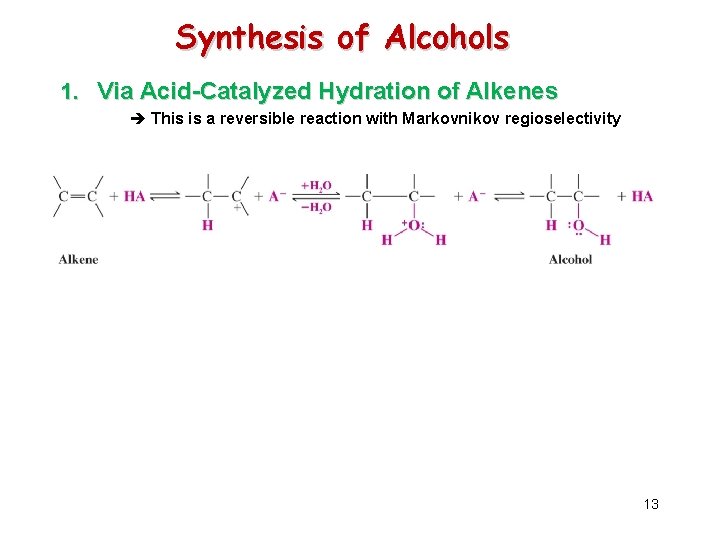
Synthesis of Alcohols 1. Via Acid-Catalyzed Hydration of Alkenes è This is a reversible reaction with Markovnikov regioselectivity 13
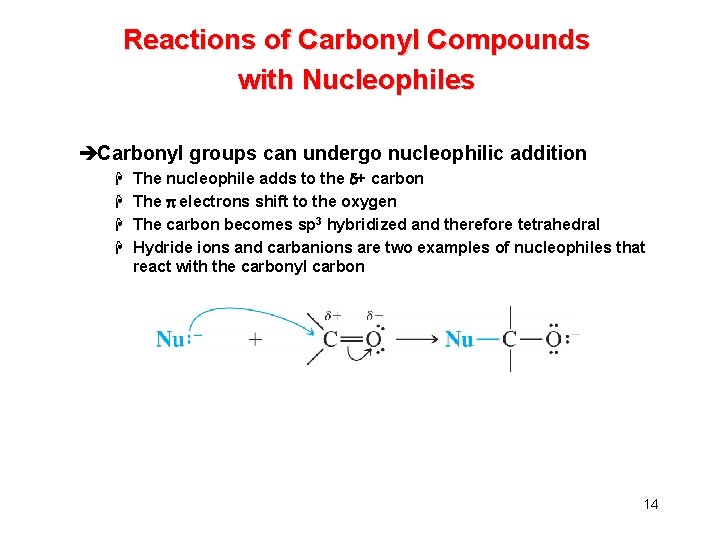
Reactions of Carbonyl Compounds with Nucleophiles èCarbonyl groups can undergo nucleophilic addition H The nucleophile adds to the d+ carbon H The p electrons shift to the oxygen H The carbon becomes sp 3 hybridized and therefore tetrahedral H Hydride ions and carbanions are two examples of nucleophiles that react with the carbonyl carbon 14
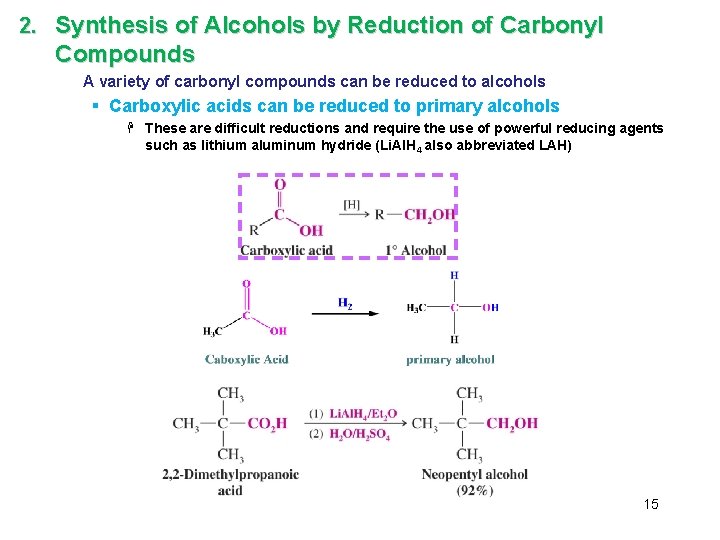
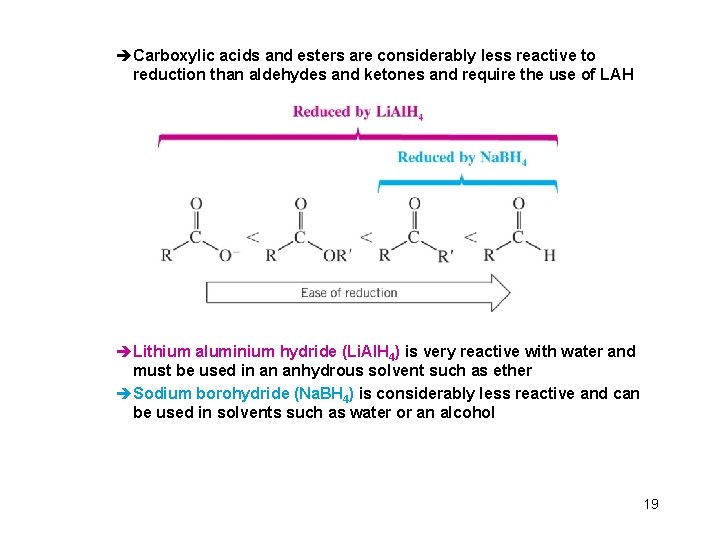
2. Synthesis of Alcohols by Reduction of Carbonyl Compounds A variety of carbonyl compounds can be reduced to alcohols § Carboxylic acids can be reduced to primary alcohols H These are difficult reductions and require the use of powerful reducing agents such as lithium aluminum hydride (Li. Al. H 4 also abbreviated LAH) 15
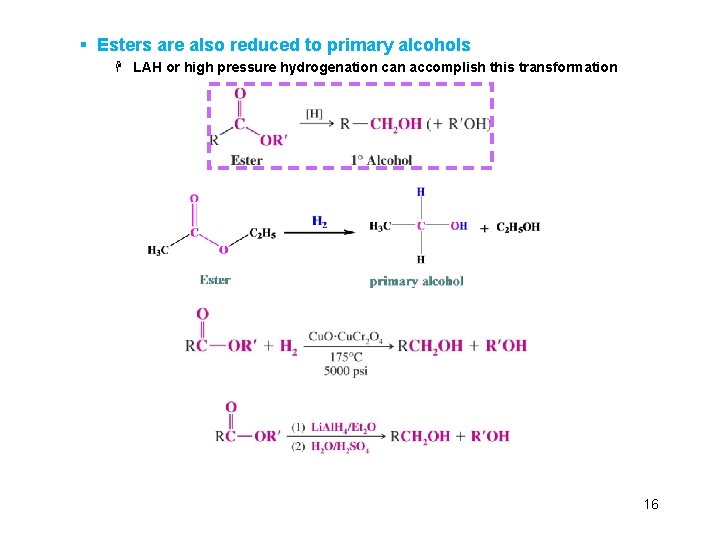
§ Esters are also reduced to primary alcohols H LAH or high pressure hydrogenation can accomplish this transformation 16
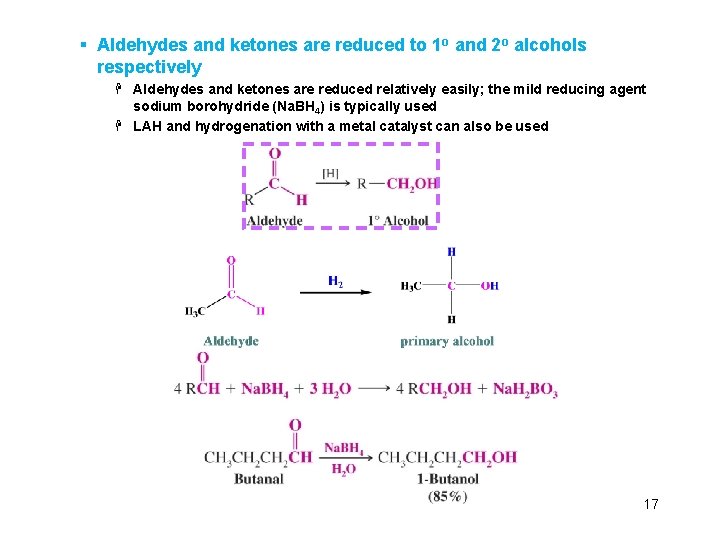
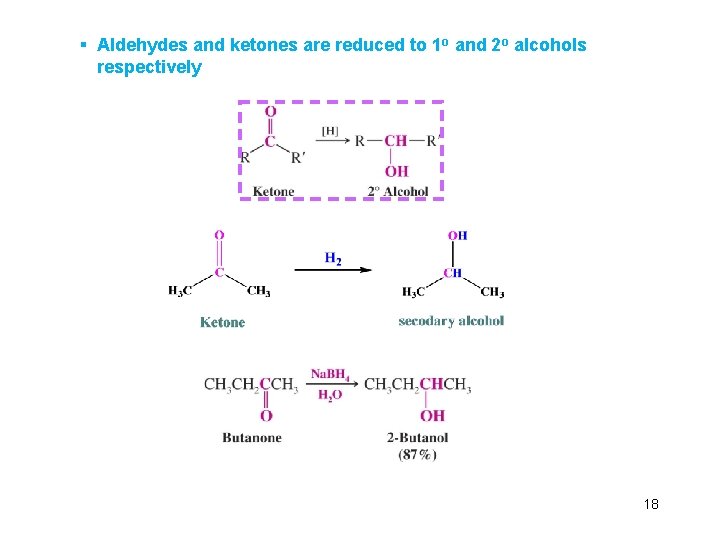
§ Aldehydes and ketones are reduced to 1 o and 2 o alcohols respectively H Aldehydes and ketones are reduced relatively easily; the mild reducing agent sodium borohydride (Na. BH 4) is typically used H LAH and hydrogenation with a metal catalyst can also be used 17
§ Aldehydes and ketones are reduced to 1 o and 2 o alcohols respectively 18
èCarboxylic acids and esters are considerably less reactive to reduction than aldehydes and ketones and require the use of LAH èLithium aluminium hydride (Li. Al. H 4) is very reactive with water and must be used in an anhydrous solvent such as ether èSodium borohydride (Na. BH 4) is considerably less reactive and can be used in solvents such as water or an alcohol 19
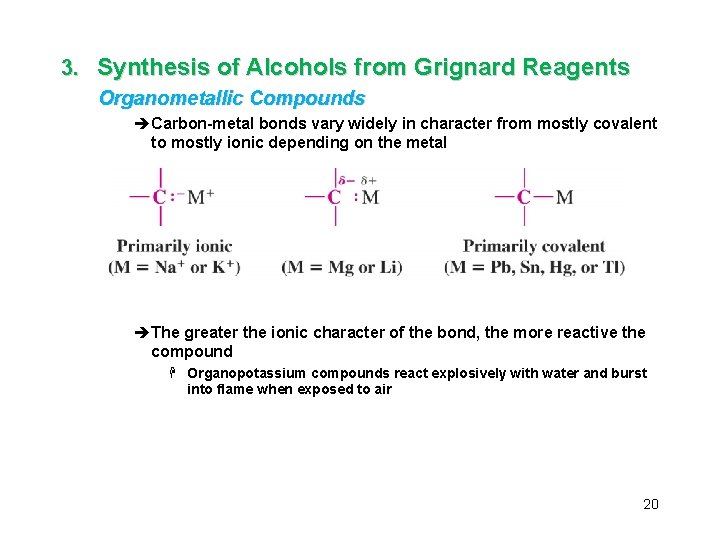
3. Synthesis of Alcohols from Grignard Reagents Organometallic Compounds èCarbon-metal bonds vary widely in character from mostly covalent to mostly ionic depending on the metal èThe greater the ionic character of the bond, the more reactive the compound H Organopotassium compounds react explosively with water and burst into flame when exposed to air 20
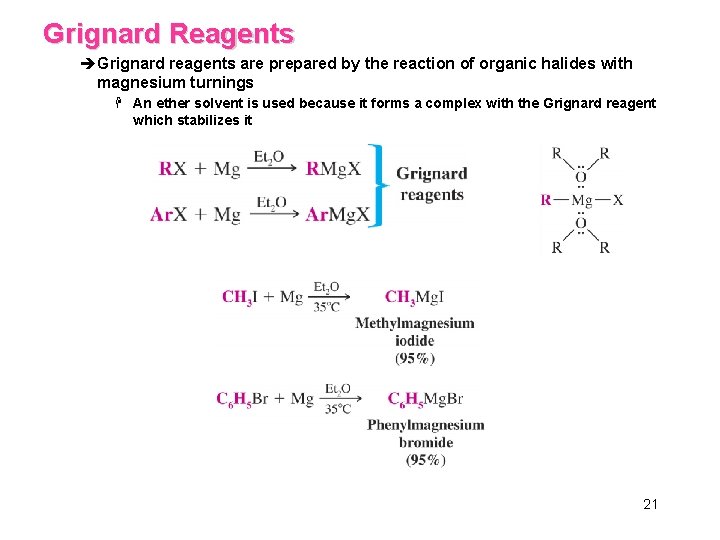
Grignard Reagents èGrignard reagents are prepared by the reaction of organic halides with magnesium turnings H An ether solvent is used because it forms a complex with the Grignard reagent which stabilizes it 21
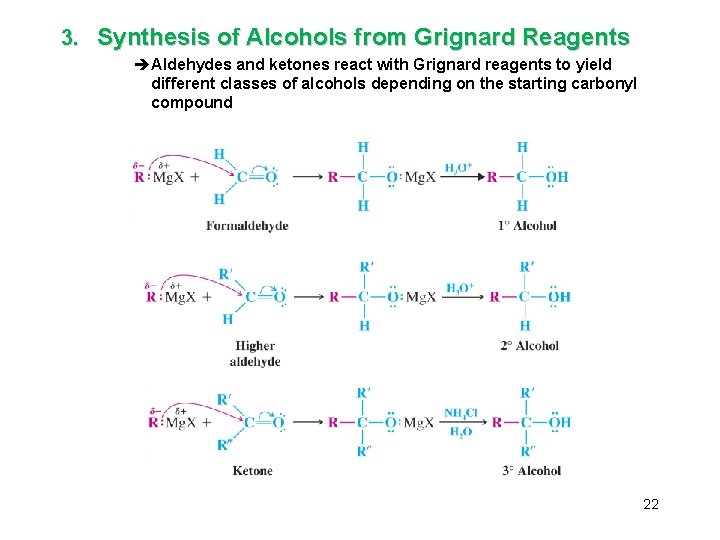
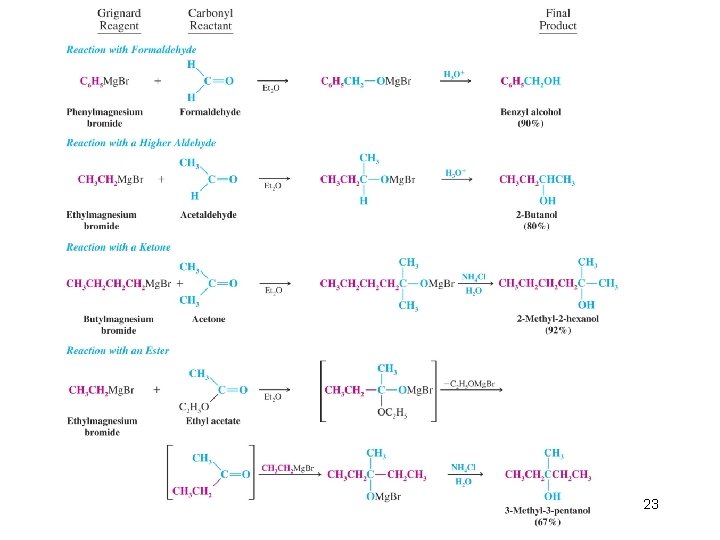
3. Synthesis of Alcohols from Grignard Reagents èAldehydes and ketones react with Grignard reagents to yield different classes of alcohols depending on the starting carbonyl compound 22
23
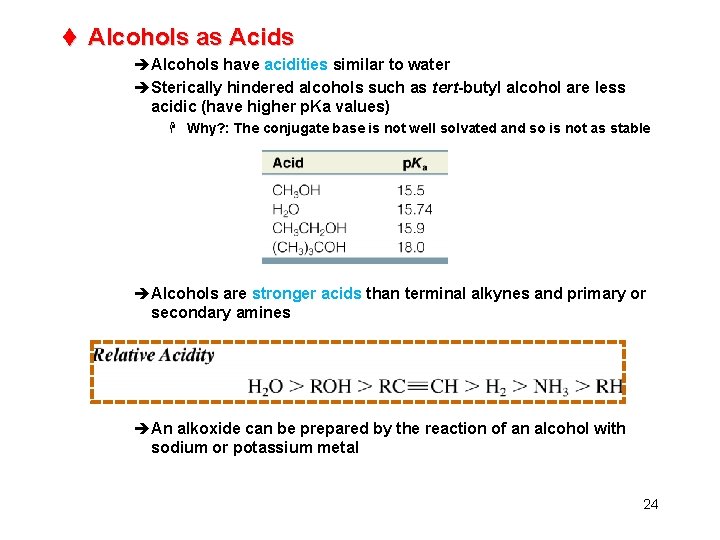
t Alcohols as Acids èAlcohols have acidities similar to water èSterically hindered alcohols such as tert-butyl alcohol are less acidic (have higher p. Ka values) H Why? : The conjugate base is not well solvated and so is not as stable èAlcohols are stronger acids than terminal alkynes and primary or secondary amines èAn alkoxide can be prepared by the reaction of an alcohol with sodium or potassium metal 24
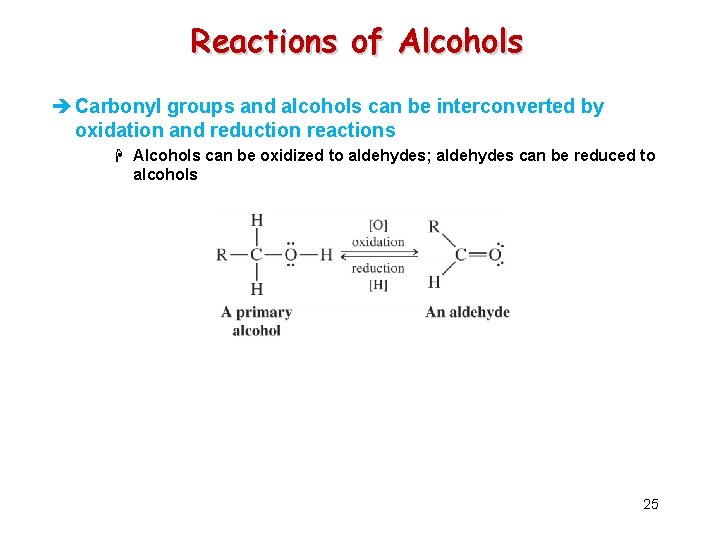
Reactions of Alcohols è Carbonyl groups and alcohols can be interconverted by oxidation and reduction reactions H Alcohols can be oxidized to aldehydes; aldehydes can be reduced to alcohols 25
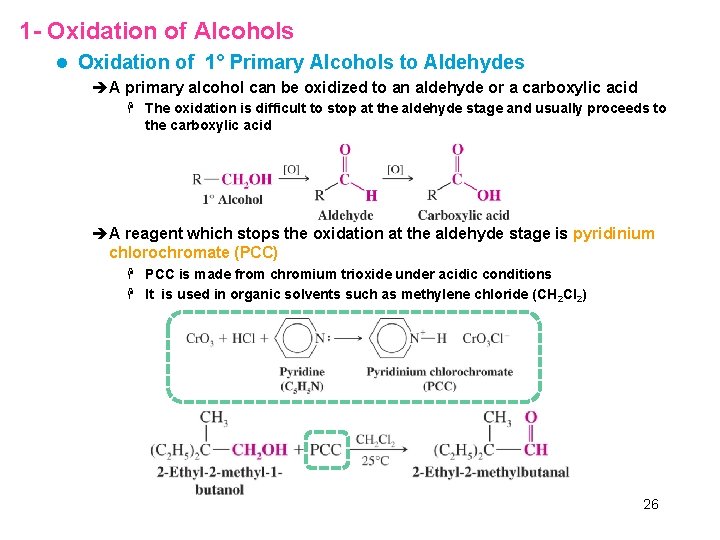
1 - Oxidation of Alcohols l Oxidation of 1° Primary Alcohols to Aldehydes èA primary alcohol can be oxidized to an aldehyde or a carboxylic acid H The oxidation is difficult to stop at the aldehyde stage and usually proceeds to the carboxylic acid èA reagent which stops the oxidation at the aldehyde stage is pyridinium chlorochromate (PCC) H PCC is made from chromium trioxide under acidic conditions H It is used in organic solvents such as methylene chloride (CH 2 Cl 2) 26
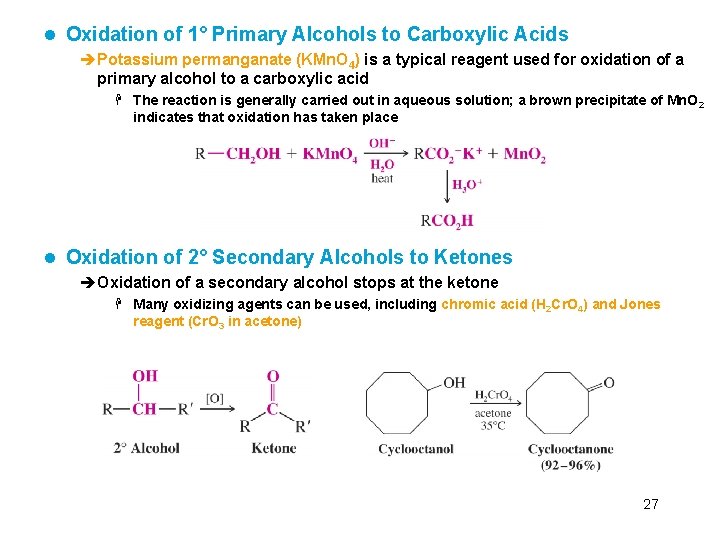
l Oxidation of 1° Primary Alcohols to Carboxylic Acids èPotassium permanganate (KMn. O 4) is a typical reagent used for oxidation of a primary alcohol to a carboxylic acid H The reaction is generally carried out in aqueous solution; a brown precipitate of Mn. O 2 indicates that oxidation has taken place l Oxidation of 2° Secondary Alcohols to Ketones èOxidation of a secondary alcohol stops at the ketone H Many oxidizing agents can be used, including chromic acid (H 2 Cr. O 4) and Jones reagent (Cr. O 3 in acetone) 27
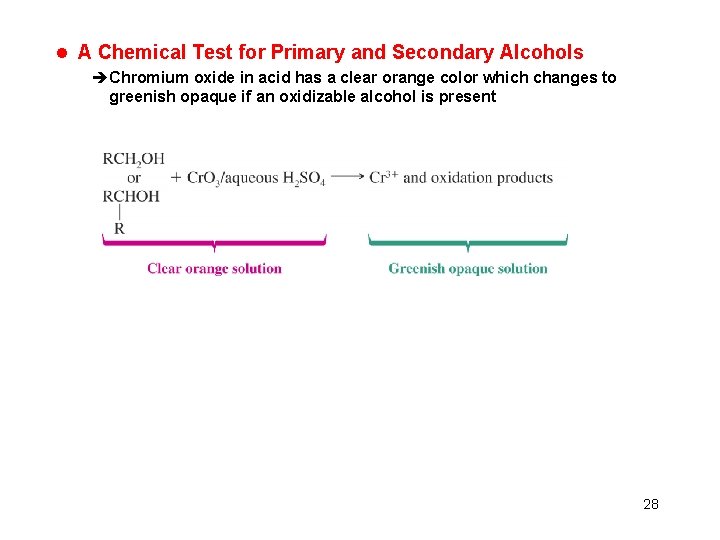
l A Chemical Test for Primary and Secondary Alcohols èChromium oxide in acid has a clear orange color which changes to greenish opaque if an oxidizable alcohol is present 28
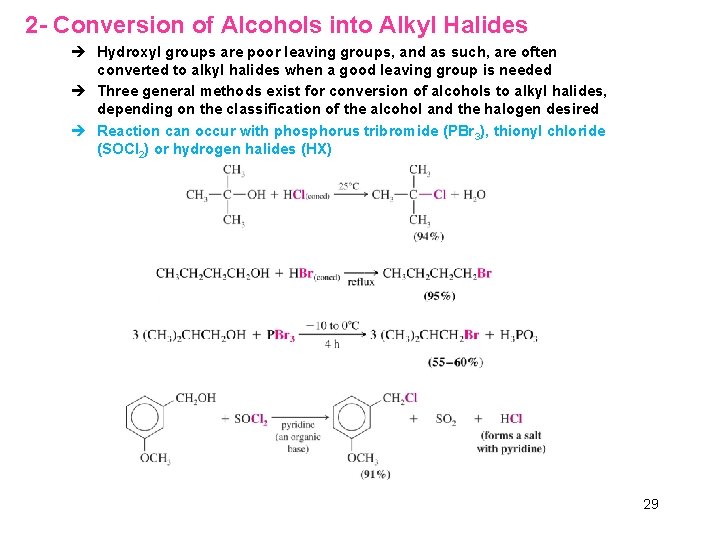
2 - Conversion of Alcohols into Alkyl Halides è Hydroxyl groups are poor leaving groups, and as such, are often converted to alkyl halides when a good leaving group is needed è Three general methods exist for conversion of alcohols to alkyl halides, depending on the classification of the alcohol and the halogen desired è Reaction can occur with phosphorus tribromide (PBr 3), thionyl chloride (SOCl 2) or hydrogen halides (HX) 29
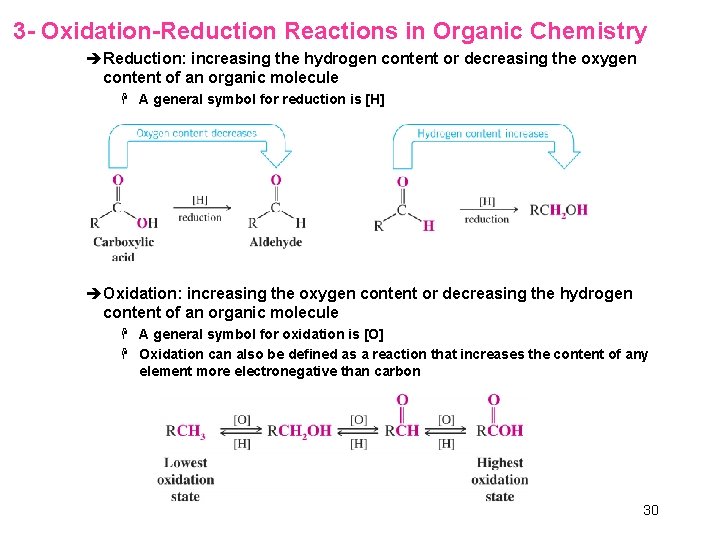
3 - Oxidation-Reduction Reactions in Organic Chemistry èReduction: increasing the hydrogen content or decreasing the oxygen content of an organic molecule H A general symbol for reduction is [H] èOxidation: increasing the oxygen content or decreasing the hydrogen content of an organic molecule H A general symbol for oxidation is [O] H Oxidation can also be defined as a reaction that increases the content of any element more electronegative than carbon 30
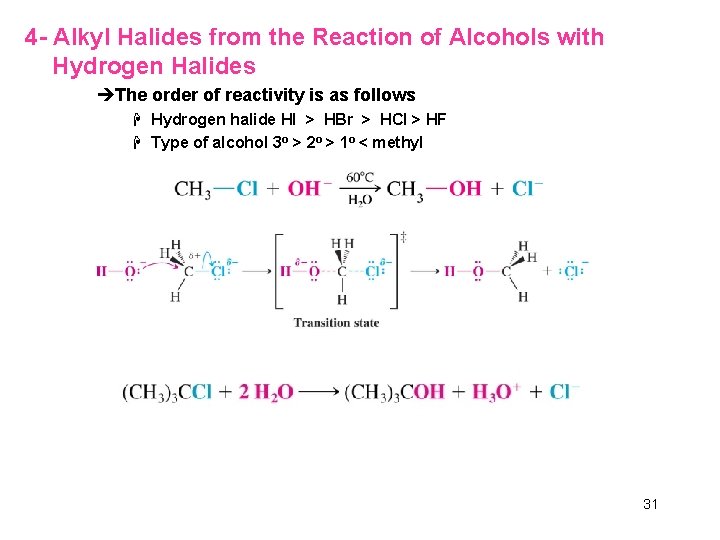
4 - Alkyl Halides from the Reaction of Alcohols with Hydrogen Halides èThe order of reactivity is as follows H Hydrogen halide HI > HBr > HCl > HF H Type of alcohol 3 o > 2 o > 1 o < methyl 31
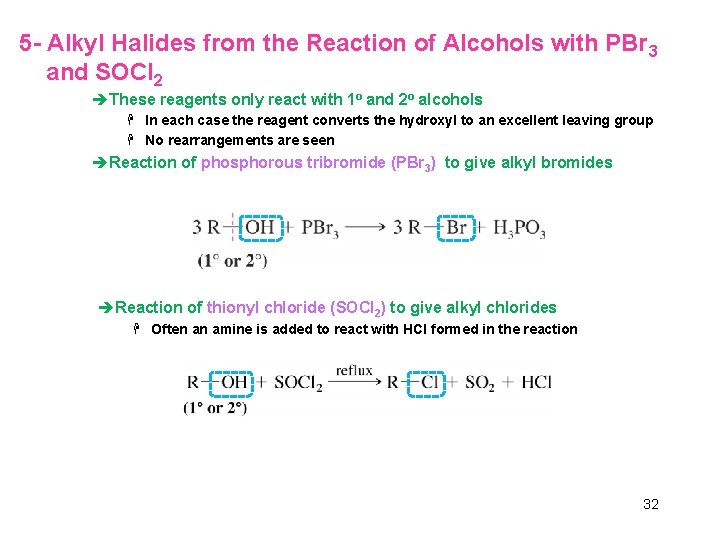
5 - Alkyl Halides from the Reaction of Alcohols with PBr 3 and SOCl 2 èThese reagents only react with 1 o and 2 o alcohols H In each case the reagent converts the hydroxyl to an excellent leaving group H No rearrangements are seen èReaction of phosphorous tribromide (PBr 3) to give alkyl bromides èReaction of thionyl chloride (SOCl 2) to give alkyl chlorides H Often an amine is added to react with HCl formed in the reaction 32
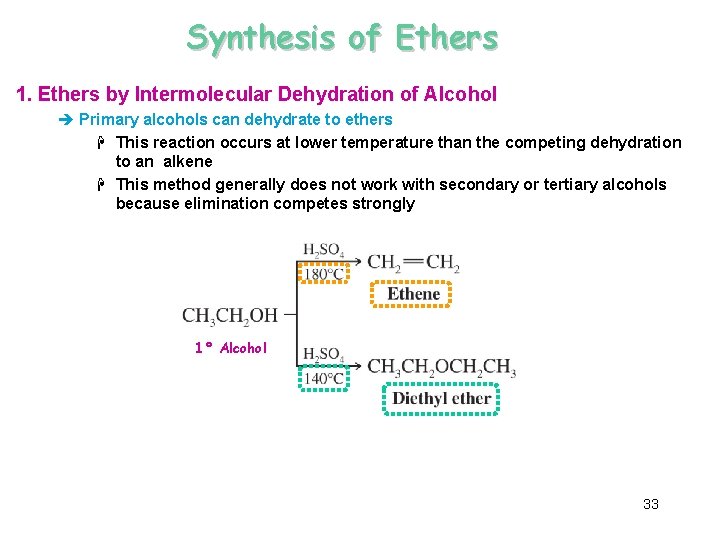
Synthesis of Ethers 1. Ethers by Intermolecular Dehydration of Alcohol è Primary alcohols can dehydrate to ethers H This reaction occurs at lower temperature than the competing dehydration to an alkene H This method generally does not work with secondary or tertiary alcohols because elimination competes strongly 1° Alcohol 33
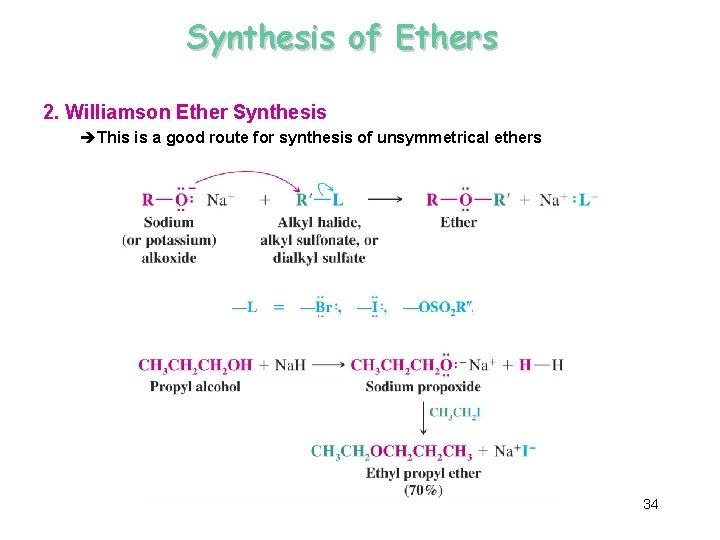
Synthesis of Ethers 2. Williamson Ether Synthesis èThis is a good route for synthesis of unsymmetrical ethers 34
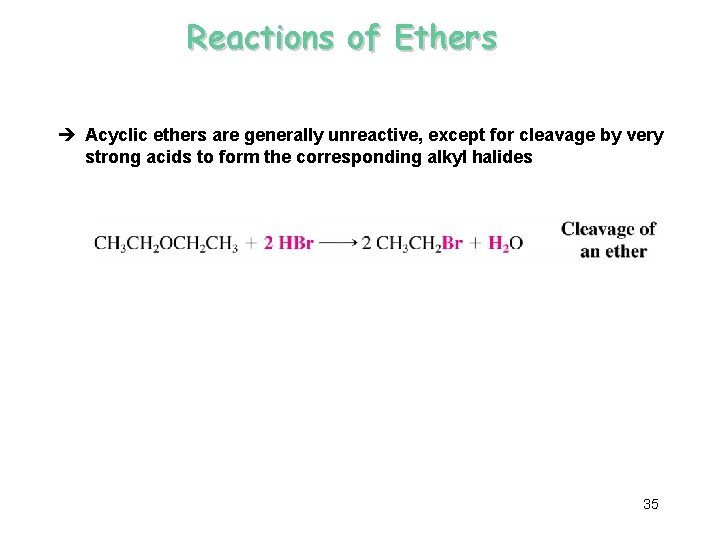
Reactions of Ethers è Acyclic ethers are generally unreactive, except for cleavage by very strong acids to form the corresponding alkyl halides 35