
ALCOHOL WITHDRAWAL PATHOPHYSIOLOGY DIAGNOSIS AND TREATMENT Carlos A
- Slides: 30
ALCOHOL WITHDRAWAL: PATHOPHYSIOLOGY, DIAGNOSIS AND TREATMENT Carlos A. Hernandez-Avila, M. D. University of Connecticut School of Medicine Alcohol Medical Scholars Program Copyright Alcohol Medical Scholars Program 1
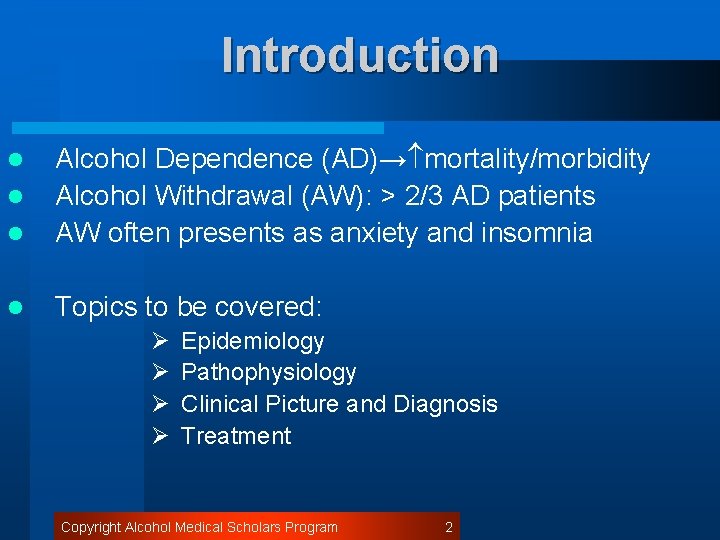
Introduction l Alcohol Dependence (AD)→ mortality/morbidity Alcohol Withdrawal (AW): > 2/3 AD patients AW often presents as anxiety and insomnia l Topics to be covered: l l Ø Ø Epidemiology Pathophysiology Clinical Picture and Diagnosis Treatment Copyright Alcohol Medical Scholars Program 2
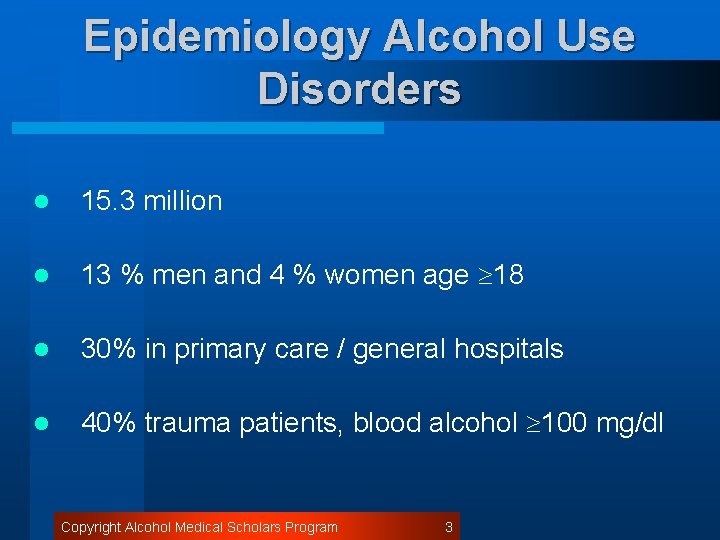
Epidemiology Alcohol Use Disorders l 15. 3 million l 13 % men and 4 % women age 18 l 30% in primary care / general hospitals l 40% trauma patients, blood alcohol 100 mg/dl Copyright Alcohol Medical Scholars Program 3
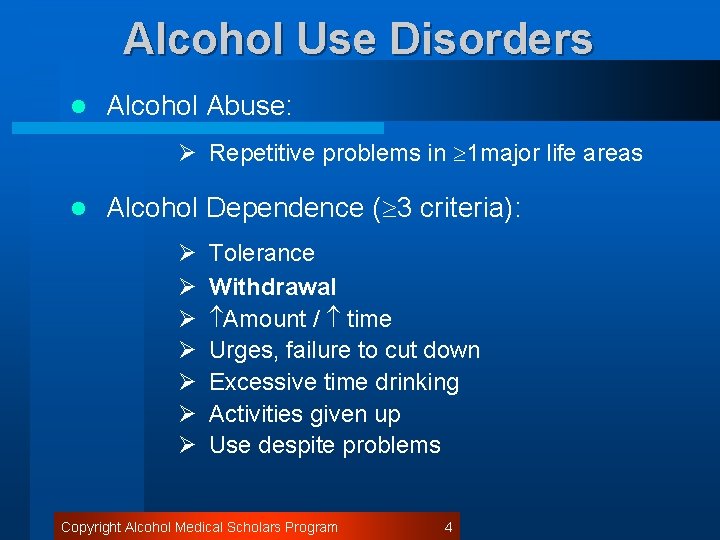
Alcohol Use Disorders l Alcohol Abuse: Ø Repetitive problems in 1 major life areas l Alcohol Dependence ( 3 criteria): Ø Ø Ø Ø Tolerance Withdrawal Amount / time Urges, failure to cut down Excessive time drinking Activities given up Use despite problems Copyright Alcohol Medical Scholars Program 4
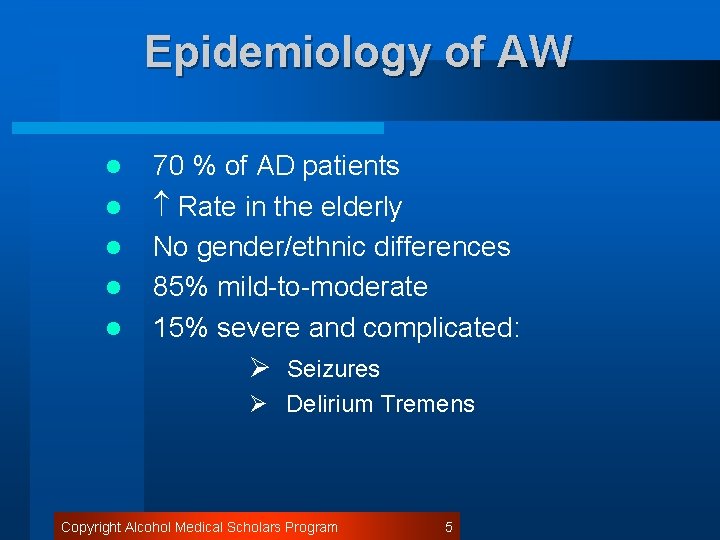
Epidemiology of AW l l l 70 % of AD patients Rate in the elderly No gender/ethnic differences 85% mild-to-moderate 15% severe and complicated: Ø Seizures Ø Delirium Tremens Copyright Alcohol Medical Scholars Program 5
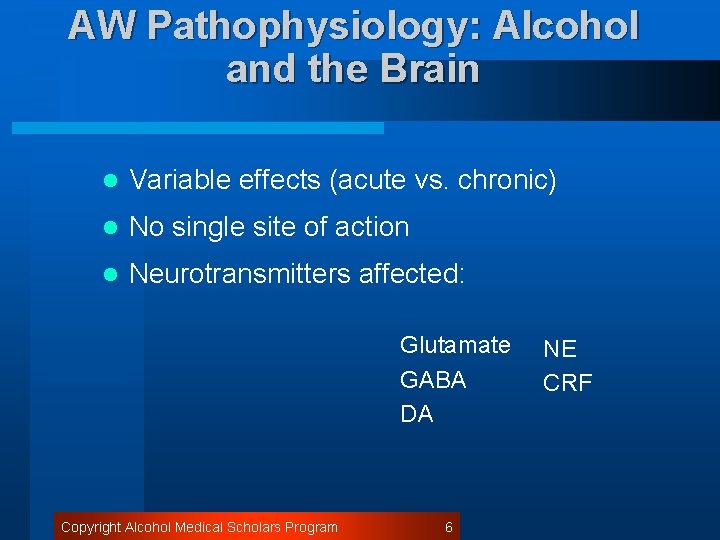
AW Pathophysiology: Alcohol and the Brain l Variable effects (acute vs. chronic) l No single site of action l Neurotransmitters affected: Glutamate GABA DA Copyright Alcohol Medical Scholars Program 6 NE CRF
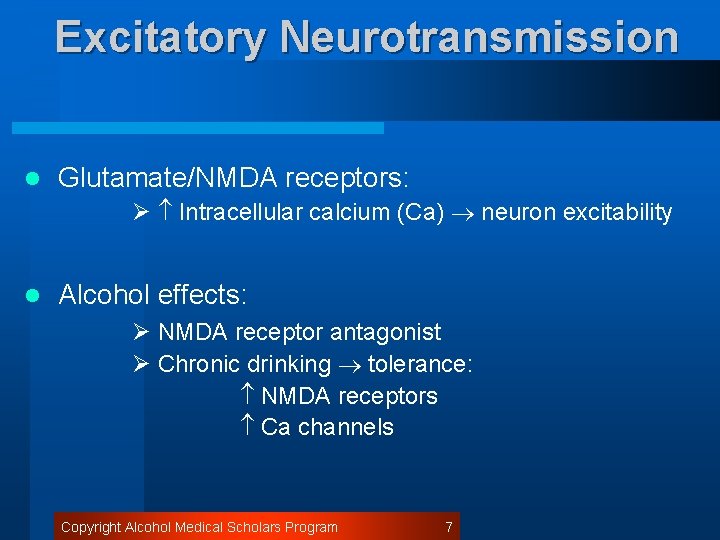
Excitatory Neurotransmission l Glutamate/NMDA receptors: Ø Intracellular calcium (Ca) neuron excitability l Alcohol effects: Ø NMDA receptor antagonist Ø Chronic drinking tolerance: NMDA receptors Ca channels Copyright Alcohol Medical Scholars Program 7
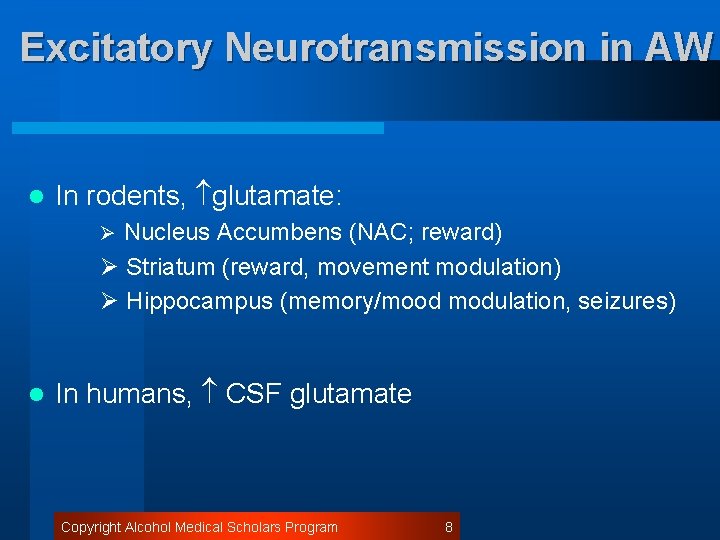
Excitatory Neurotransmission in AW l In rodents, glutamate: Ø Nucleus Accumbens (NAC; reward) Ø Striatum (reward, movement modulation) Ø Hippocampus (memory/mood modulation, seizures) l In humans, CSF glutamate Copyright Alcohol Medical Scholars Program 8
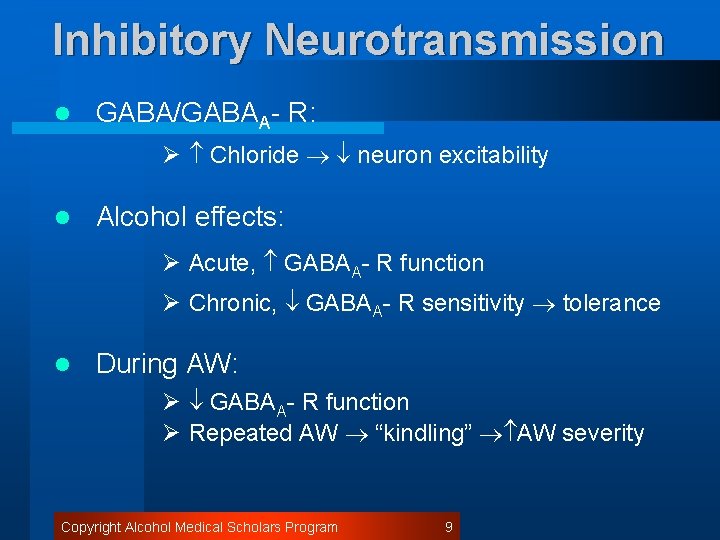
Inhibitory Neurotransmission l GABA/GABAA- R: Ø Chloride neuron excitability l Alcohol effects: Ø Acute, GABAA- R function Ø Chronic, GABAA- R sensitivity tolerance l During AW: Ø GABAA- R function Ø Repeated AW “kindling” AW severity Copyright Alcohol Medical Scholars Program 9
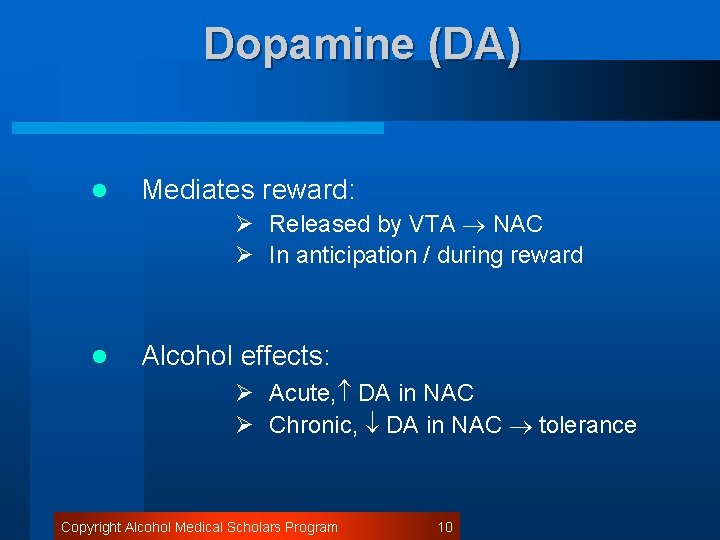
Dopamine (DA) l Mediates reward: Ø Released by VTA NAC Ø In anticipation / during reward l Alcohol effects: Ø Acute, DA in NAC Ø Chronic, DA in NAC tolerance Copyright Alcohol Medical Scholars Program 10
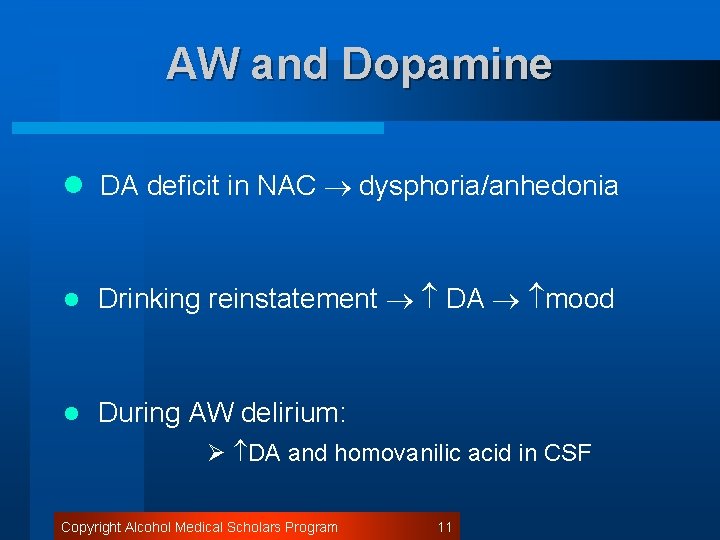
AW and Dopamine l DA deficit in NAC dysphoria/anhedonia l Drinking reinstatement DA mood l During AW delirium: Ø DA and homovanilic acid in CSF Copyright Alcohol Medical Scholars Program 11
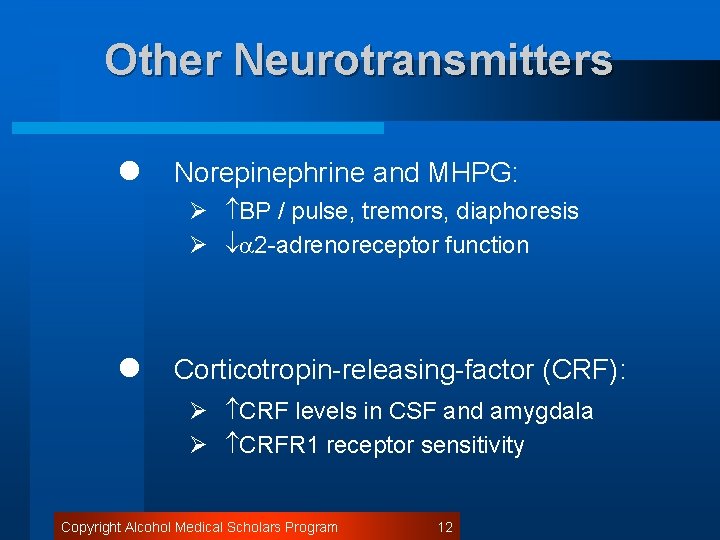
Other Neurotransmitters l Norepinephrine and MHPG: Ø BP / pulse, tremors, diaphoresis Ø 2 -adrenoreceptor function l Corticotropin-releasing-factor (CRF): Ø CRF levels in CSF and amygdala Ø CRFR 1 receptor sensitivity Copyright Alcohol Medical Scholars Program 12
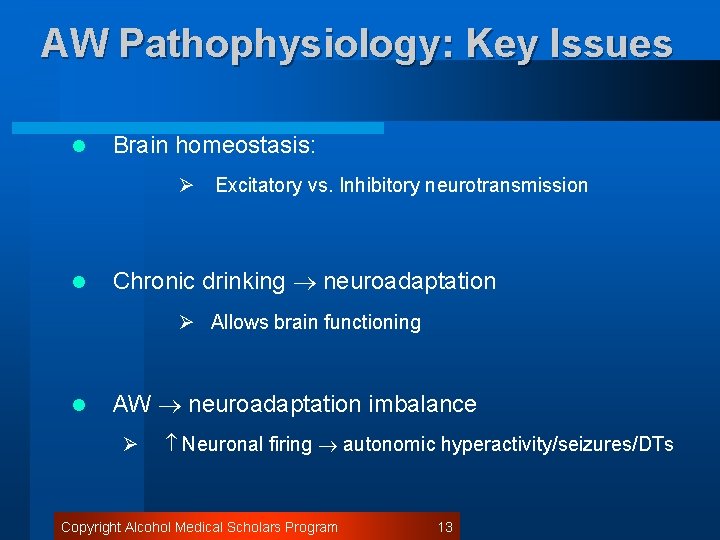
AW Pathophysiology: Key Issues l Brain homeostasis: Ø Excitatory vs. Inhibitory neurotransmission l Chronic drinking neuroadaptation Ø Allows brain functioning l AW neuroadaptation imbalance Ø Neuronal firing autonomic hyperactivity/seizures/DTs Copyright Alcohol Medical Scholars Program 13
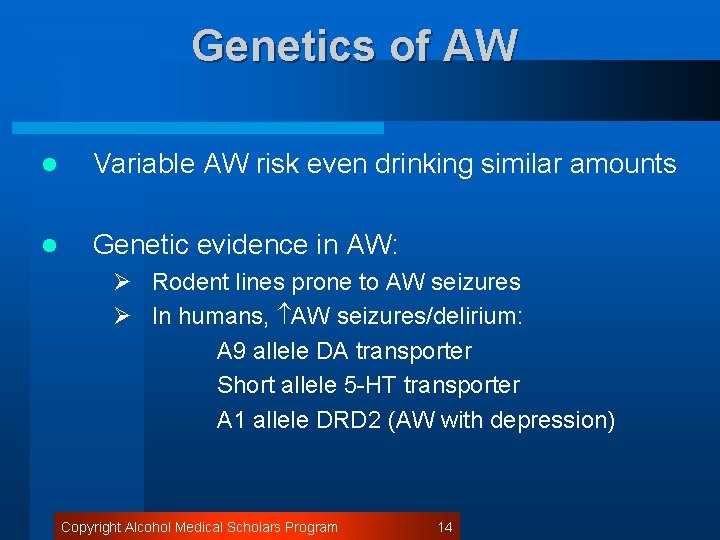
Genetics of AW l Variable AW risk even drinking similar amounts l Genetic evidence in AW: Ø Rodent lines prone to AW seizures Ø In humans, AW seizures/delirium: A 9 allele DA transporter Short allele 5 -HT transporter A 1 allele DRD 2 (AW with depression) Copyright Alcohol Medical Scholars Program 14
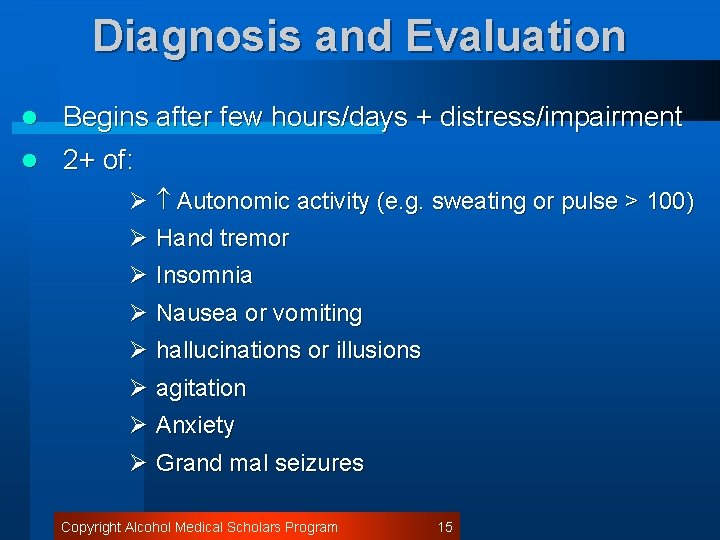
Diagnosis and Evaluation l Begins after few hours/days + distress/impairment l 2+ of: Ø Autonomic activity (e. g. sweating or pulse > 100) Ø Hand tremor Ø Insomnia Ø Nausea or vomiting Ø hallucinations or illusions Ø agitation Ø Anxiety Ø Grand mal seizures Copyright Alcohol Medical Scholars Program 15
Assessment l Optimal Assessment of AW: Ø Complete history, physical, and mental status exam Ø Laboratory test Ø Standardized assessments Copyright Alcohol Medical Scholars Program 16
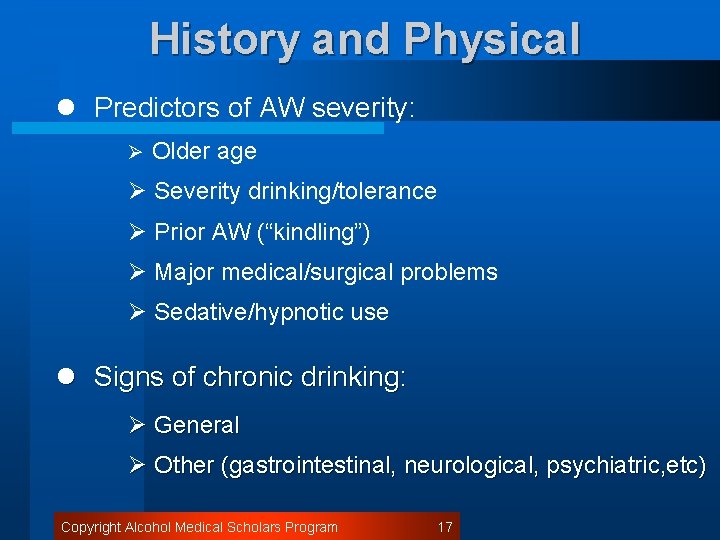
History and Physical l Predictors of AW severity: Ø Older age Ø Severity drinking/tolerance Ø Prior AW (“kindling”) Ø Major medical/surgical problems Ø Sedative/hypnotic use l Signs of chronic drinking: Ø General Ø Other (gastrointestinal, neurological, psychiatric, etc) Copyright Alcohol Medical Scholars Program 17
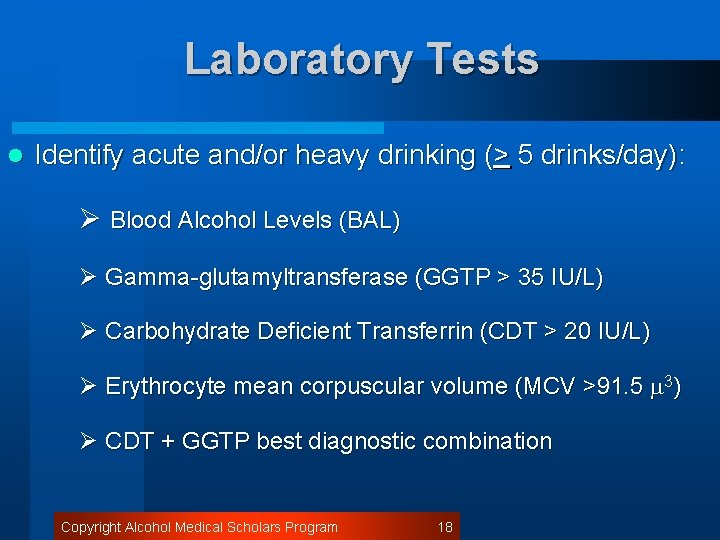
Laboratory Tests l Identify acute and/or heavy drinking (> 5 drinks/day): Ø Blood Alcohol Levels (BAL) Ø Gamma-glutamyltransferase (GGTP > 35 IU/L) Ø Carbohydrate Deficient Transferrin (CDT > 20 IU/L) Ø Erythrocyte mean corpuscular volume (MCV >91. 5 3) Ø CDT + GGTP best diagnostic combination Copyright Alcohol Medical Scholars Program 18
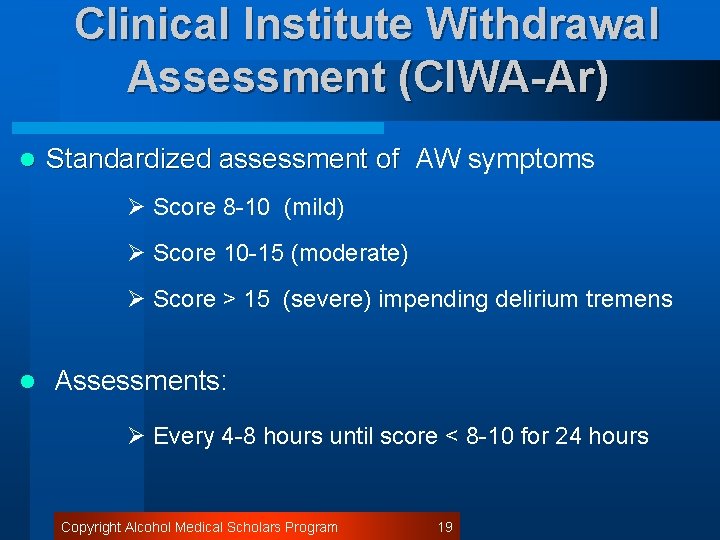
Clinical Institute Withdrawal Assessment (CIWA-Ar) l Standardized assessment of AW symptoms Ø Score 8 -10 (mild) Ø Score 10 -15 (moderate) Ø Score > 15 (severe) impending delirium tremens l Assessments: Ø Every 4 -8 hours until score < 8 -10 for 24 hours Copyright Alcohol Medical Scholars Program 19
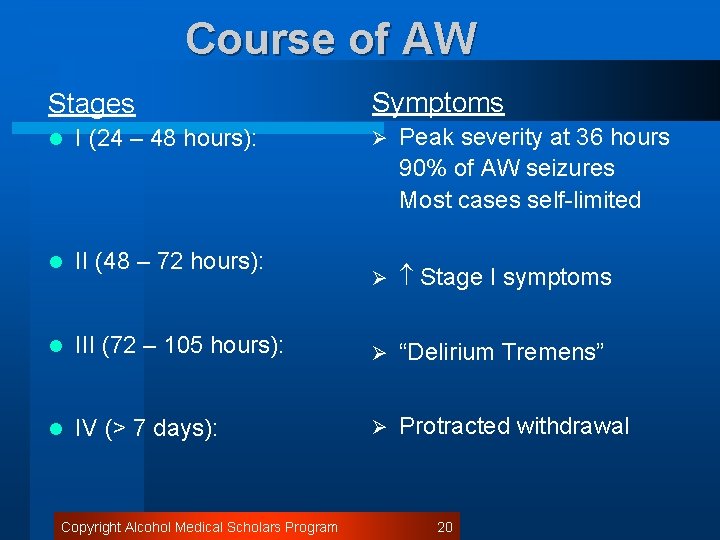
Course of AW Stages Symptoms Ø Peak severity at 36 hours 90% of AW seizures Most cases self-limited Ø Stage I symptoms III (72 – 105 hours): Ø “Delirium Tremens” IV (> 7 days): Ø Protracted withdrawal l I (24 – 48 hours): l II (48 – 72 hours): l l Copyright Alcohol Medical Scholars Program 20
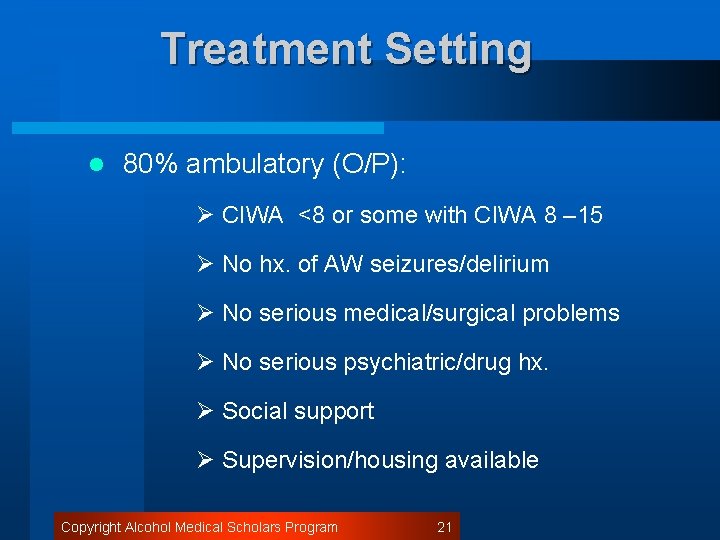
Treatment Setting l 80% ambulatory (O/P): Ø CIWA <8 or some with CIWA 8 – 15 Ø No hx. of AW seizures/delirium Ø No serious medical/surgical problems Ø No serious psychiatric/drug hx. Ø Social support Ø Supervision/housing available Copyright Alcohol Medical Scholars Program 21
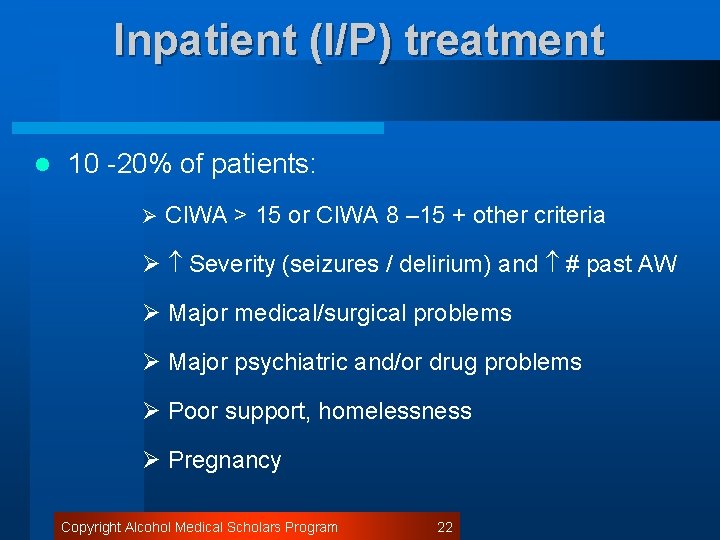
Inpatient (I/P) treatment l 10 -20% of patients: Ø CIWA > 15 or CIWA 8 – 15 + other criteria Ø Severity (seizures / delirium) and # past AW Ø Major medical/surgical problems Ø Major psychiatric and/or drug problems Ø Poor support, homelessness Ø Pregnancy Copyright Alcohol Medical Scholars Program 22
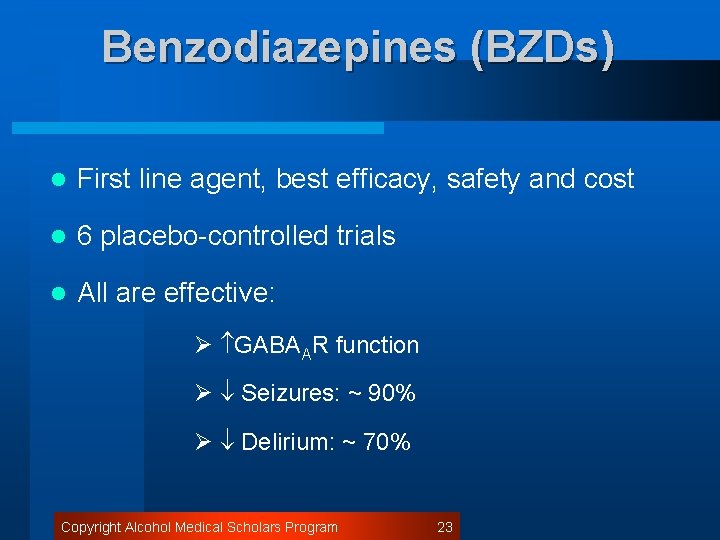
Benzodiazepines (BZDs) l First line agent, best efficacy, safety and cost l 6 placebo-controlled trials l All are effective: Ø GABAAR function Ø Seizures: ~ 90% Ø Delirium: ~ 70% Copyright Alcohol Medical Scholars Program 23
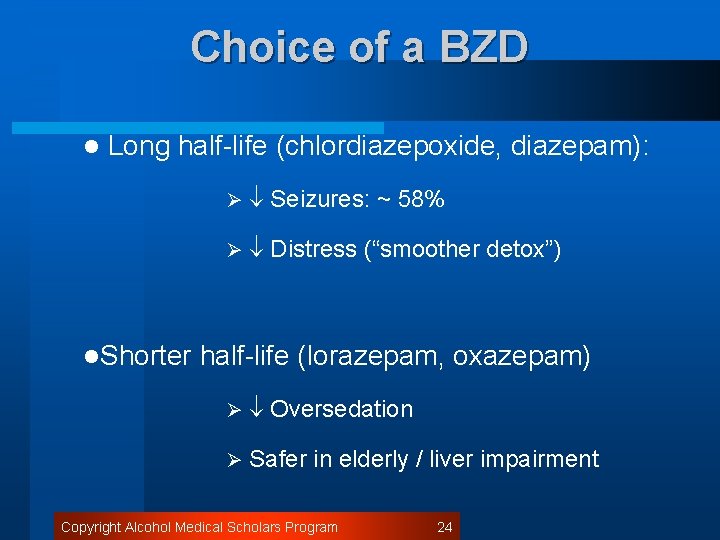
Choice of a BZD l Long half-life (chlordiazepoxide, diazepam): l. Shorter Ø Seizures: ~ 58% Ø Distress (“smoother detox”) half-life (lorazepam, oxazepam) Ø Oversedation Ø Safer in elderly / liver impairment Copyright Alcohol Medical Scholars Program 24
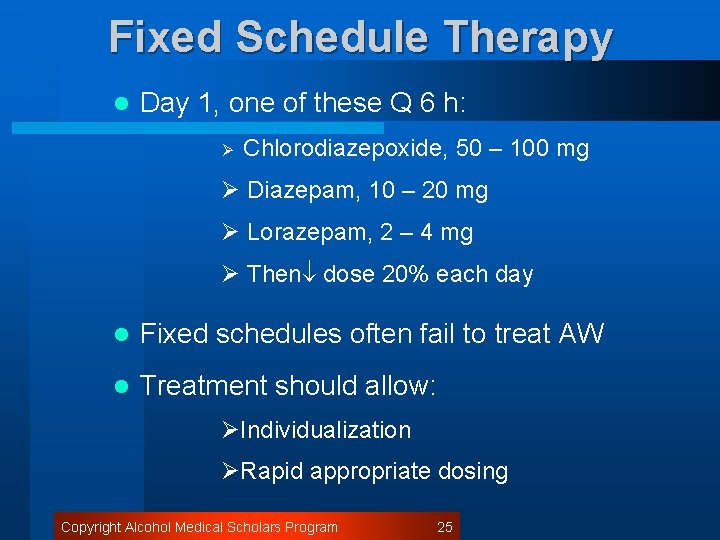
Fixed Schedule Therapy l Day 1, one of these Q 6 h: Ø Chlorodiazepoxide, 50 – 100 mg Ø Diazepam, 10 – 20 mg Ø Lorazepam, 2 – 4 mg Ø Then dose 20% each day l Fixed schedules often fail to treat AW l Treatment should allow: ØIndividualization ØRapid appropriate dosing Copyright Alcohol Medical Scholars Program 25
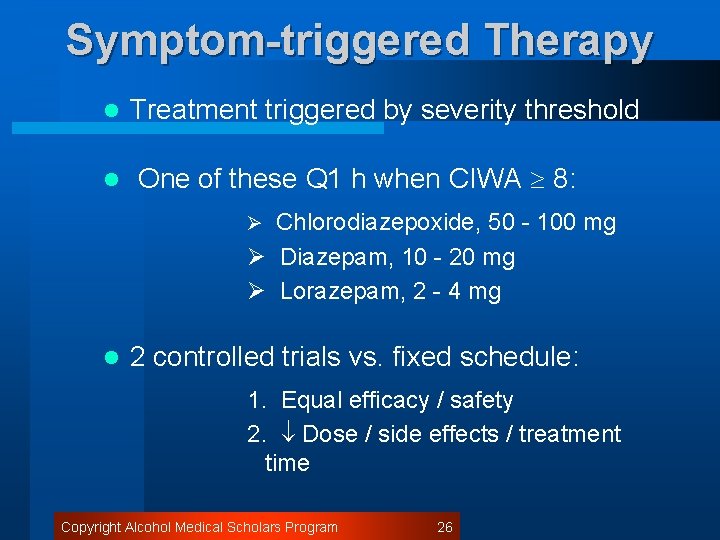
Symptom-triggered Therapy l l Treatment triggered by severity threshold One of these Q 1 h when CIWA 8: Ø Chlorodiazepoxide, 50 - 100 mg Ø Diazepam, 10 - 20 mg Ø Lorazepam, 2 - 4 mg l 2 controlled trials vs. fixed schedule: 1. Equal efficacy / safety 2. Dose / side effects / treatment time Copyright Alcohol Medical Scholars Program 26
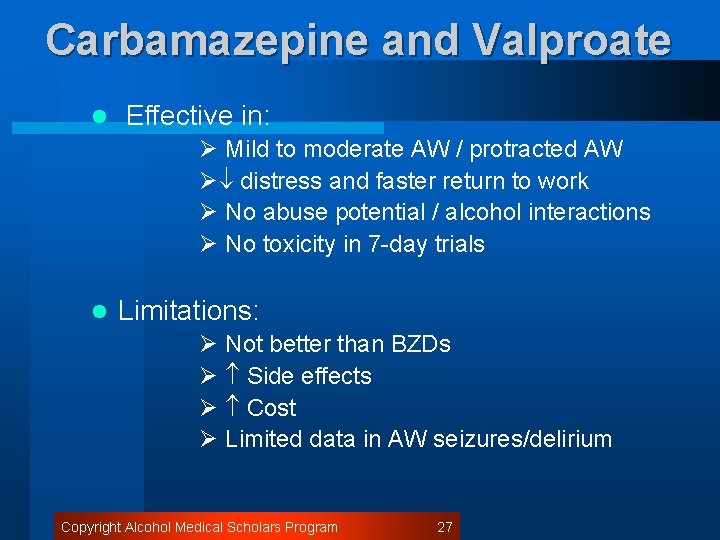
Carbamazepine and Valproate l Effective in: Ø Mild to moderate AW / protracted AW Ø distress and faster return to work Ø No abuse potential / alcohol interactions Ø No toxicity in 7 -day trials l Limitations: Ø Not better than BZDs Ø Side effects Ø Cost Ø Limited data in AW seizures/delirium Copyright Alcohol Medical Scholars Program 27
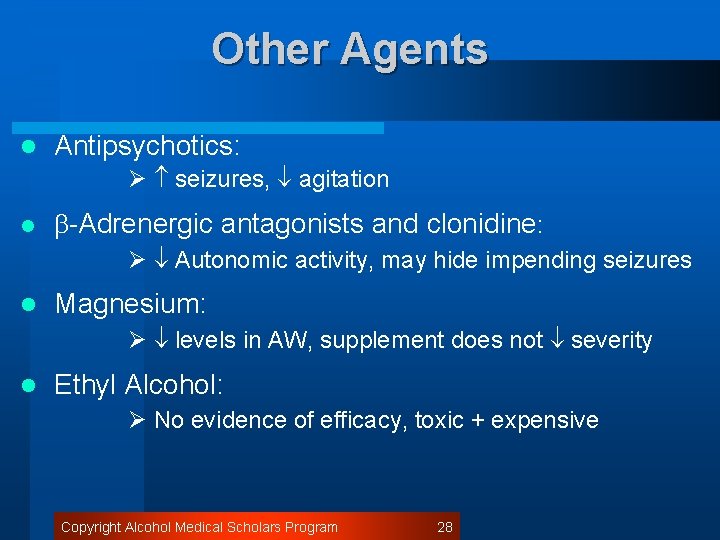
Other Agents l Antipsychotics: Ø seizures, agitation l -Adrenergic antagonists and clonidine: Ø Autonomic activity, may hide impending seizures l Magnesium: Ø levels in AW, supplement does not severity l Ethyl Alcohol: Ø No evidence of efficacy, toxic + expensive Copyright Alcohol Medical Scholars Program 28
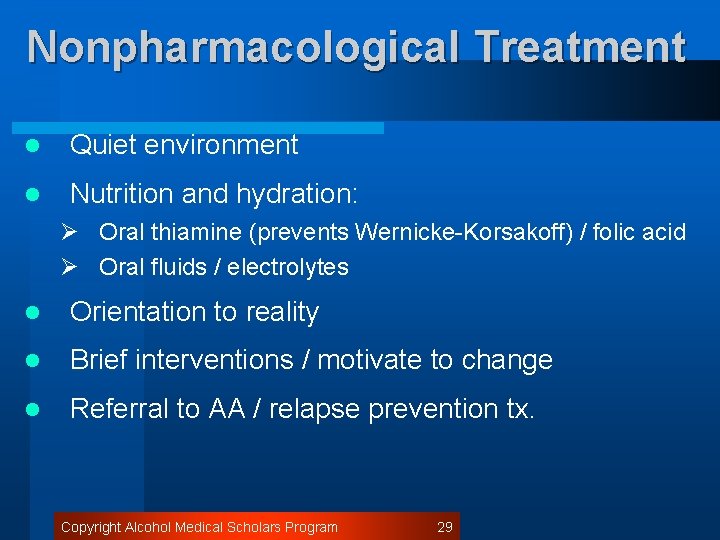
Nonpharmacological Treatment l Quiet environment l Nutrition and hydration: Ø Oral thiamine (prevents Wernicke-Korsakoff) / folic acid Ø Oral fluids / electrolytes l Orientation to reality l Brief interventions / motivate to change l Referral to AA / relapse prevention tx. Copyright Alcohol Medical Scholars Program 29
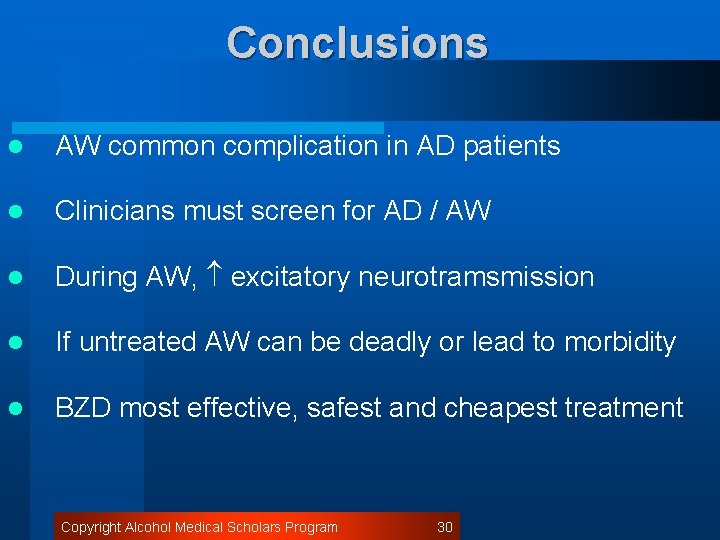
Conclusions l AW common complication in AD patients l Clinicians must screen for AD / AW l During AW, excitatory neurotramsmission l If untreated AW can be deadly or lead to morbidity l BZD most effective, safest and cheapest treatment Copyright Alcohol Medical Scholars Program 30