
ALCHEMY AGE Alchemy started in Mesopotamia Ancient Egypt



- Slides: 9
ALCHEMY AGE Ø Alchemy started in Mesopotamia, Ancient Egypt, Iran, India, China, and in later periods Greece, Roman Empire, and Islamic states began to be seen in time. Ø After the 12 th century, it became an important activity in Medieval Europe. The basis of alchemy was largely based on the narratives of information from Ancient Greece. 1
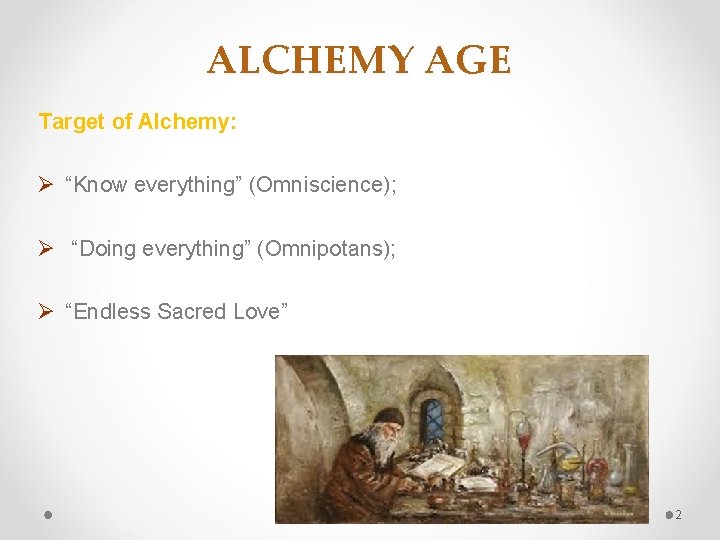
ALCHEMY AGE Target of Alchemy: Ø “Know everything” (Omniscience); Ø “Doing everything” (Omnipotans); Ø “Endless Sacred Love” 2
ALCHEMY AGE Philosophy of alchemy: Ø Everything arises from One, exists in One and is based on the monistic judgment that revolves to One and passes through the mind and soul as a light in the Platonic thought, which ends in the dark area of matter. Ø The monist philosophical basis of alchemy is evident in the icon of the Oroboros (snake biting a tail). The shape of the symbol describes the universal cycle with no starting and end points in the circle, and the snake describes the eternal life. 3
ALCHEMY AGE Purpose of alchemy: Ø "Philosopher Stone" using a reagent that is a universal magical factor, converting worthless metals into precious ones such as Gold and Silver by secret and mysterious prescriptions, Ø “Tincture” find the magical solution that enable the transformation through metals in color change, Ø "Panacea" the universal medicine that passes all diseases and Elixir Vitae, the immortality potion. 4
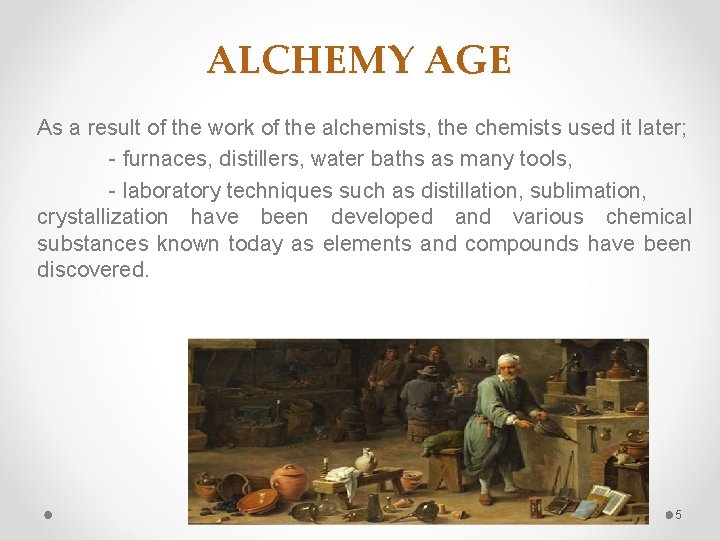
ALCHEMY AGE As a result of the work of the alchemists, the chemists used it later; - furnaces, distillers, water baths as many tools, - laboratory techniques such as distillation, sublimation, crystallization have been developed and various chemical substances known today as elements and compounds have been discovered. 5
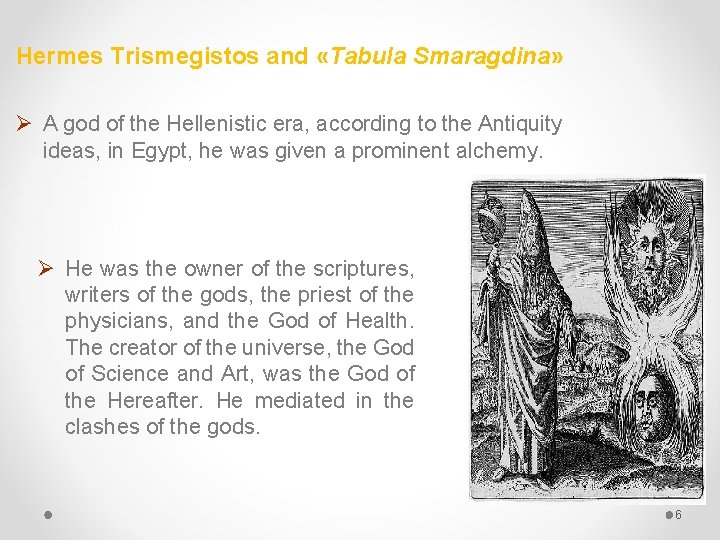
Hermes Trismegistos and «Tabula Smaragdina» Ø A god of the Hellenistic era, according to the Antiquity ideas, in Egypt, he was given a prominent alchemy. Ø He was the owner of the scriptures, writers of the gods, the priest of the physicians, and the God of Health. The creator of the universe, the God of Science and Art, was the God of the Hereafter. He mediated in the clashes of the gods. 6
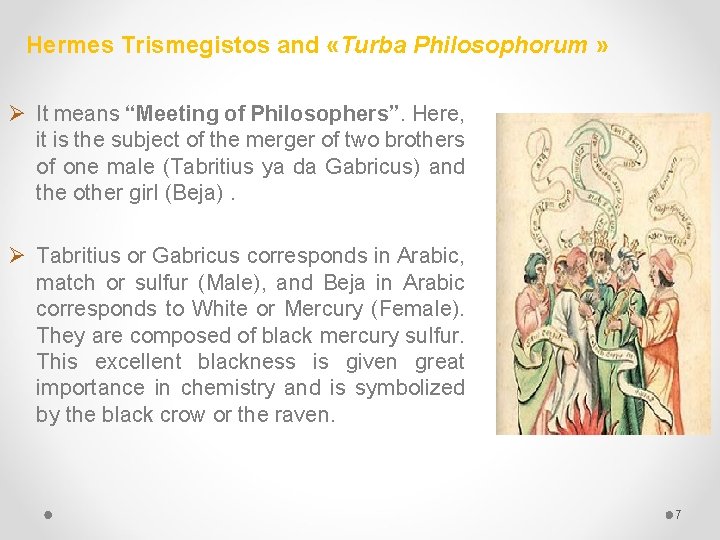
Hermes Trismegistos and «Turba Philosophorum » Ø It means “Meeting of Philosophers”. Here, it is the subject of the merger of two brothers of one male (Tabritius ya da Gabricus) and the other girl (Beja). Ø Tabritius or Gabricus corresponds in Arabic, match or sulfur (Male), and Beja in Arabic corresponds to White or Mercury (Female). They are composed of black mercury sulfur. This excellent blackness is given great importance in chemistry and is symbolized by the black crow or the raven. 7
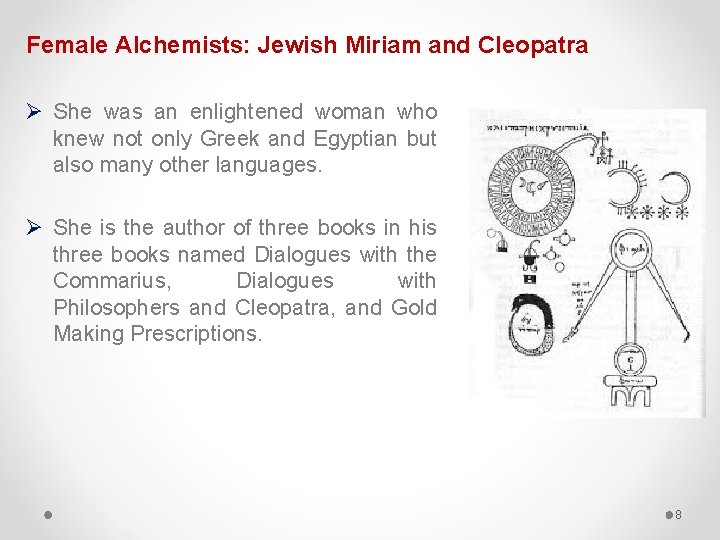
Female Alchemists: Jewish Miriam and Cleopatra Ø She was an enlightened woman who knew not only Greek and Egyptian but also many other languages. Ø She is the author of three books in his three books named Dialogues with the Commarius, Dialogues with Philosophers and Cleopatra, and Gold Making Prescriptions. 8
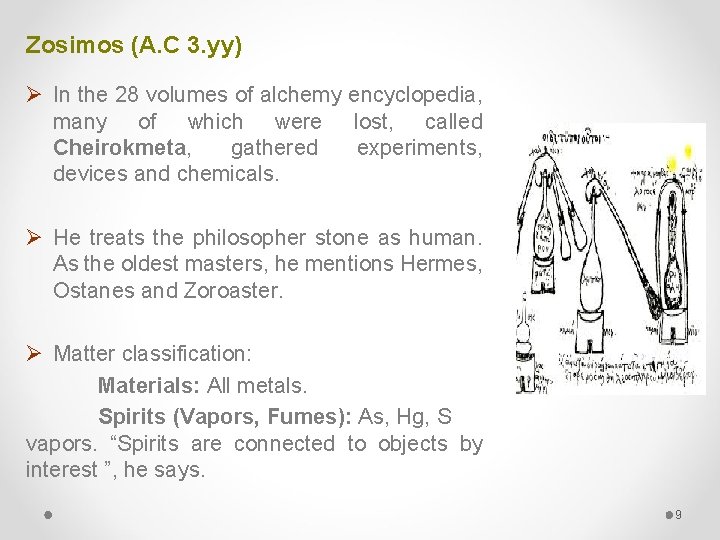
Zosimos (A. C 3. yy) Ø In the 28 volumes of alchemy encyclopedia, many of which were lost, called Cheirokmeta, gathered experiments, devices and chemicals. Ø He treats the philosopher stone as human. As the oldest masters, he mentions Hermes, Ostanes and Zoroaster. Ø Matter classification: Materials: All metals. Spirits (Vapors, Fumes): As, Hg, S vapors. “Spirits are connected to objects by interest ”, he says. 9