
Alberto Grillo Software Engineering II Summary Introduction to
Alberto Grillo Software Engineering II
Summary • Introduction to Ubiquitous Computing • History of Ubiquitous Computing • Challenges and Requirements • Comparison of Technologies • Software Engineering • References
Introduction to Ubiquitous Computing • What is • Characteristics • Goals
What is (1/3) • the method of enhancing computing use by making many devices (services) available throughout the physical environment, but making them effectively invisible to the user (Mark Weiser)
What is (2/3) • tries to construct a universal computing environment (UCE) that conceals: • • computing instruments devices resources technology • invisible to users from applications or customers
What is (3/3) • computing everywhere • many embedded, wearable, handheld devices communicate transparently to provide different services to the users • devices mostly have low power and shortrange wireless communication capabilities • devices utilize multiple on-board sensors to gather information about surrounding environments
Characteristics of Ubicomp Applications • context-awareness • impromptu and volatile interaction • interactions among applications are based on specific context
Goals • the promise of ubiquitous computing: a life in which our endeavours are powerfully, though subtly, assisted by computers • the idealistic visions painted by the ubiquitous computing movement stand in stark contrast to what we see when we boot up our computers each day
Summary • Introduction to Ubiquitous Computing • History of Ubiquitous Computing • Challenges and Requirements • Comparison of Technologies • Software Engineering • Références
History of Ubiquitous Computing • History • Mark Weiser • Experiments
History • Active Badge • Andy Hopper • Xerox PARC 1991 -2000 • Mark Weiser (until, sadly, April 1999) • Calm Technology
Mark Weiser: the father of ubiquitous computing • researcher in the Computer Science Lab at Xerox’s PARC (Palo Alto Research Center) • first articulated computing in 1988 the idea of ubiquitous • has called UC “…highest ideal is to make a computer so imbedded, so fitting, so natural, that we use it without even thinking about it. ”
Experiments • Tabs • Pads 1988 – 1994 at PARC Xerox • Boards • Classroom 2000 • SAAMPad Method Pad) (Software • The Conference Assistant Architecture Analysis
Summary • Introduction to Ubiquitous Computing • History of Ubiquitous Computing • Challenges and Requirements • Comparison of Technologies • Software Engineering • Références
Challenges and Requirements • • • Hardware Applications User Interfaces Networking Mobility Scalability Reliability Interoperability Resource Discovery Privacy and Security
Nanotechnology (1/2) The trend toward miniaturization of computer components down to an atomic scale is known as nanotechnology
Nanotechnology (2/2) • Mobile data technology – GSM, GPRS, UMTS, CDMA, WAP, Imode • Wireless data technology – Bluetooth, 802. 11 b • Internet data technology – IP over optical, Broadband • Content services – Web & WAP • Applications – Multimedia, Internet messaging
Applications • main motivation of ubiquitous computing (Weiser 1993) • need to have an awareness of their context: a combination of several factors, including the current location, the current user or if there any other Ubicomp devices present in the near surroundings
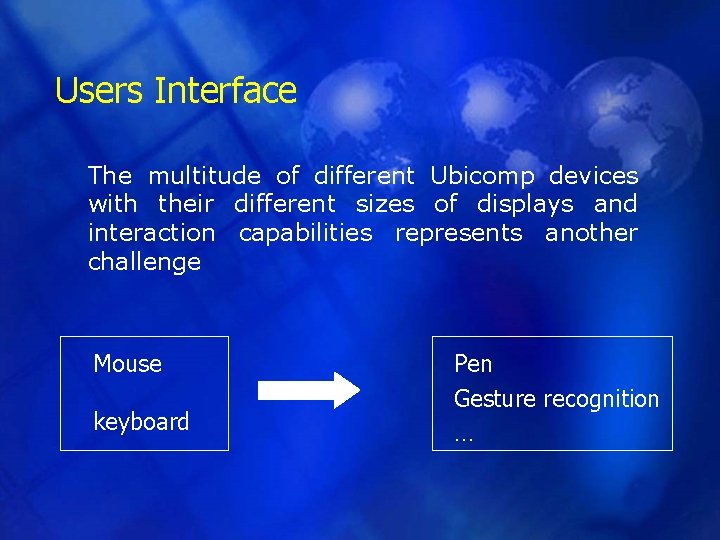
Users Interface The multitude of different Ubicomp devices with their different sizes of displays and interaction capabilities represents another challenge Mouse keyboard Pen Gesture recognition …
Networking Another key driver for the final transition will be the use of short-range wireless as well as traditional wired technologies Wireless computing refers to the use of wireless technology to connect computers to a network
Mobility is made possible communication technologies through wireless Problem of disconnectivity!!! This behaviour is an inherent property of the ubicomp concept and it should not be treated as a failure
Scalability In a ubiquitous computing environment where possibly thousands and thousands of devices are part of scalability of the whole system is a key requirement All the devices are autonomous and must be able to operate independently a decentralized management will most likely be most suitable
Reliability Thus the reliability of ubiquitous services and devices is a crucial requirement In order to construct reliable systems selfmonitoring, self-regulating and self-healing features like they are found in biology might be a solution
Interoperability This will probably be one of the major factors for the success or failure of the Ubicomp vision Use of technology just existed: JINI, CORBA, ecc… This diversity will make it impossible that there is only one agreed standard
Resource Discovery The ability of devices to describe their behaviour to the network is a key requirement. On the other hand, it can not be assumed that devices in a ubiquitous environment have prior knowledge of the capabilites of other occupants.
Privacy and Security In a fully networked world with ubiquitous, sensor-equipped devices several privacy and security issues arise • the people in this environment will be worried about their privacy since there is the potential of total monitoring • must be understandable by the user and it must be modelled into the system architecture
Summary • Introduction to Ubiquitous Computing • History of Ubiquitous Computing • Challenges and Requirements • Comparison of Technologies • Software Engineering • References

Comparison of Technologies Table shows a list of these APIs and technologies. The original comparison made by Olstad, Ramirez, Brady and Mc. Hollan. Without Bluetooth or Ir. DA.
Summary • Introduction to Ubiquitous Computing • History of Ubiquitous Computing • Challenges and Requirements • Comparison of Technologies • Software Engineering • References
Software Engineering • research is inherently empirical and relies on a rapid prototyping development cycle • information should be pushed to user based on current task, inferences made about user’s situation • as user moves into different environments
Summary • Introduction to Ubiquitous Computing • History of Ubiquitous Computing • Challenges and Requirements • Comparison of Technologies • Software Engineering • Références
References • Mario-Leander Reimer Ubiquitous Computing: Challenges, Requirements and Technologies Staffordshire University April 3, 2001 http: //research. soc. staffs. ac. uk/~rimmer/knowledge/papers/ubicomp. pdf • Abowd, G. D. (1999) Software Engineering Issues for Ubiquitous Computing http: //www. cc. gatech. edu/fce/pubs/icse 99/final. html
References • Weiser, Gold and Brown The origins of ubiquitous computing research at PARC in the late 1980 s IBM Systems Journal, VOL 38, NO 4, 1999 http: //www. itee. uq. edu. au/~comp 4501/weiser. pdf • Weiser, M. (1991) The Testbed Devices of the Infrastructure for Ubiquitous Computing Project http: //www. ubiq. com/hypertext/weiser/The Testbed Devices of the Infrastructure for Ubiquitous Computing Project. htm
References • Weiser, M. A complete movie about ubiquitous computing at Xerox PARC http: //www. ubiq. com/hypertext/weiser/Ubiquitous Computing Movies. htm • Weiser, M. Ubiquitous Computing http: //www. ubiq. comp/hypertext/weiser/Ubi. Home. htm
References • Weiser, Mark The Computer for the 21 st Century Scientific American September 1991 http: //www. ubiq. com/hypertext/weiser/Sci. Am. Draft 3. html • Weiser, Mark Some Computer Science Issues in Ubiquitous Computing CACM July 1993 http: //www. ubiq. com/hypertext/weiser/Ubi. CAM. html
References • Gregory D. Abowd and Elizabeth D. Mynatt Charting Past, Present, and Future Research in Ubiquitous Computing Georgia Institute of Technology htpp: //cc. gatech. edu/fce/pubs/tochi-millenium. pdf

THANKS
Xerox PARC 1991 -2000 • PARC = Palo Alto Research Center 41 people immersed in ubiquitous computing environment • • virtual UCE with several interconnected devices such as notepads, blackboards and electronic scrap papers • difference from a standard PC: people using these devices do not perceive them as computers anymore and can therefore focus on the actual tasks
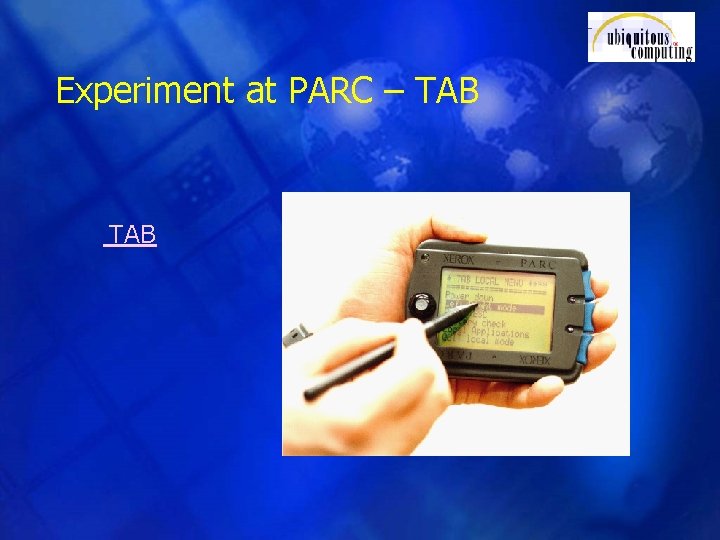
Experiment at PARC – TAB
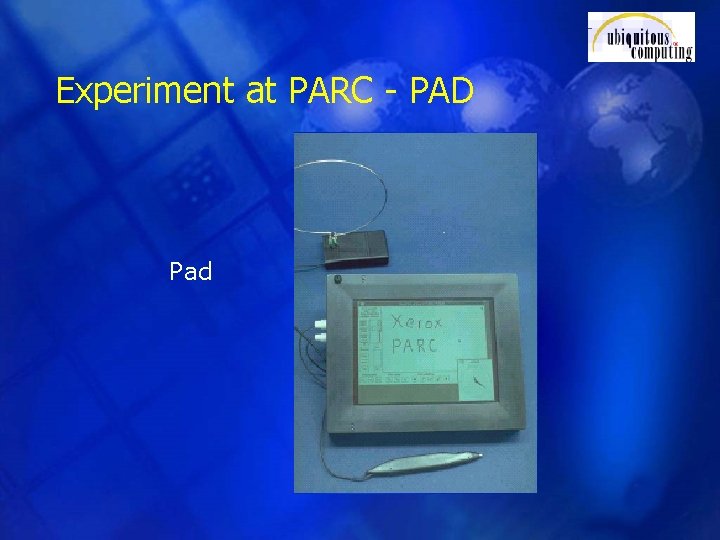
Experiment at PARC - PAD Pad
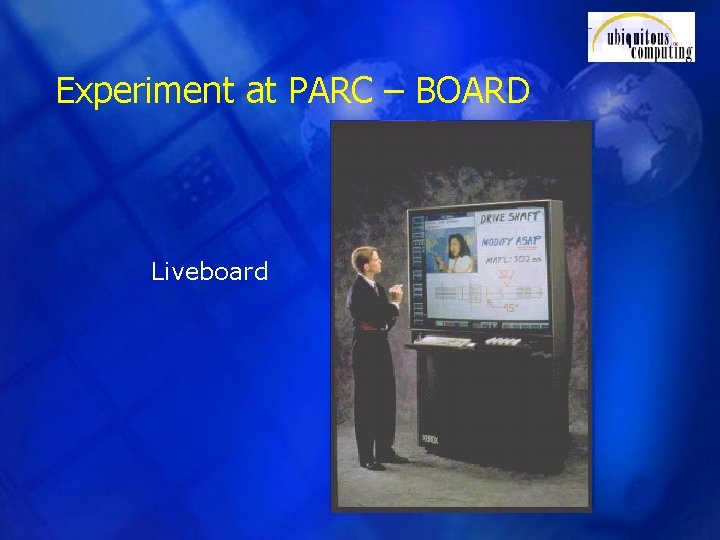
Experiment at PARC – BOARD Liveboard
Tab • prototype handheld computer • was 2 x 3 x 0. 5", had a 2 week battery life on rechargeable batteries, and weighed 7 oz • used a Phillips 8051 processor with 128 k NVRAM • featured an external I 2 C external bus, a custom resistive touch screen, and a 128 x 64 mono display • included an infrared base station in the ceiling for LAN connectivity The Tab project is consider by many to be the most significant of the three prototyping efforts
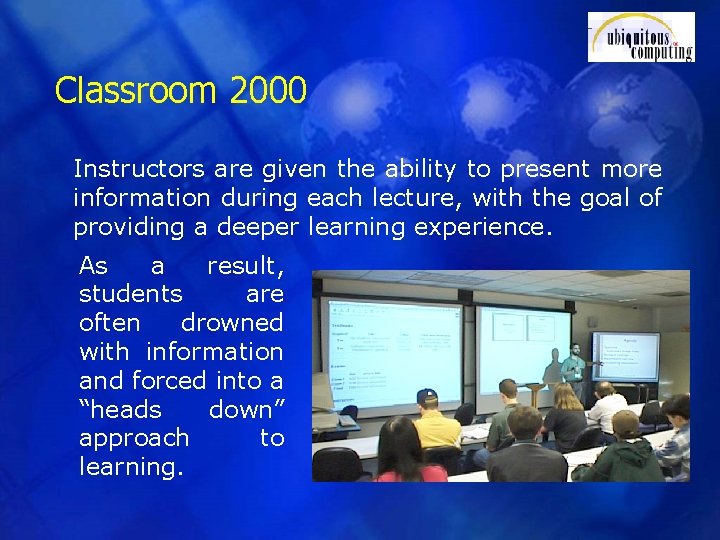
Classroom 2000 Instructors are given the ability to present more information during each lecture, with the goal of providing a deeper learning experience. As a result, students are often drowned with information and forced into a “heads down” approach to learning.
Computing Everywhere Ubiquitous means: • present everywhere • simultaneously encountered in numerous different instances • computers become a useful but invisible force, assisting the user in meeting his needs without getting lost in the way
Wireless Infrastructure (1/2) • Technology Advancement – Wide adoption of wireless technology: 67 million mobile professionals by 2002 – Cost for wireless access: comparable to wired networks • What does the new Internet provide? – Mobility – Ubiquitous access
Wireless Infrastructure (2/2) • What is mobile Internet? – Extension of Internet – Extension of Wireless Services
Wireless Infrastructure – Key Components • Mobile data technology – GSM, GPRS, UMTS, CDMA, WAP, Imode • Wireless data technology – Bluetooth, 802. 11 b • Internet data technology – IP over optical, Broadband • Content services – Web & WAP • Applications – Multimedia, Internet messaging
Universal Computing Environment The infrastructure of the ubiquitous computing environment may be organized and structured as a cyber equivalent of an ecosystem, a very complex, dynamic infrastructure. A ubiquitous computing system is a integrated system of computing resources, devices, services, and the ubiquitous computing environment (UCE) that provides a communication framework to connect all of the components.
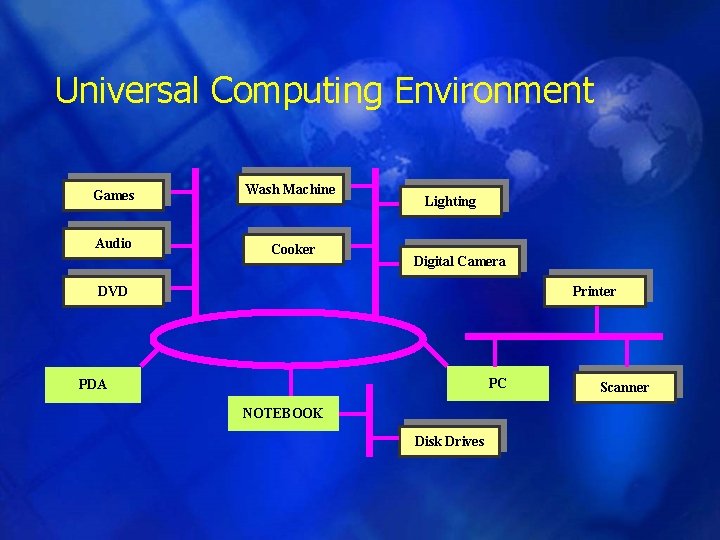
Universal Computing Environment Games Wash Machine Audio Cooker Lighting Digital Camera DVD Printer PC PDA NOTEBOOK Disk Drives Scanner
Universal Computing Environment • this architecture was used as the basis for the implementation of BEACH • it provides the functionality for synchronous cooperation and interaction with room ware components
Active Badge 1988 • smart telephone networks • problem of automatically routing telephone calls to the correct place in a building • opened up a whole new area of research and helped to realize a new opportunity for context based computing
Calm Technology (1/3) The Major Trends in Computing Mainframe many people share a computer Personal Computer one computer, one person Internet - Widespread Distributed Computing. . . transition to. . . Ubiquitous Computing many computers share each of us
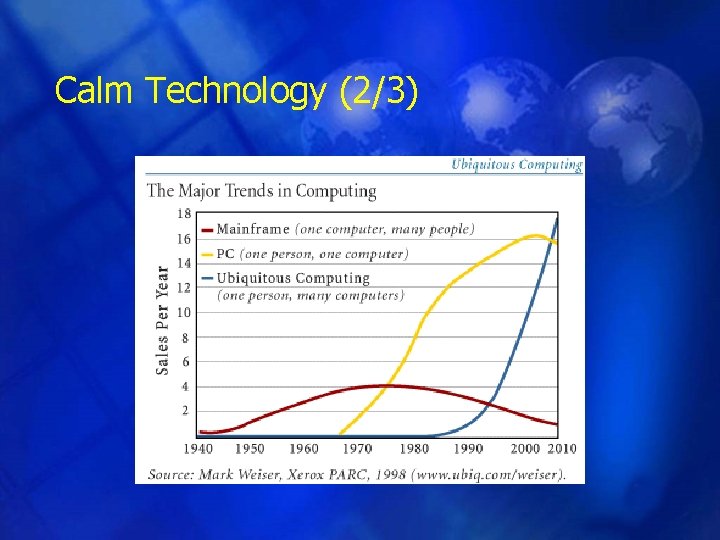
Calm Technology (2/3)
Calm Technology (3/3) Today Internet is carrying us through an era of widespread distributed computing towards the relationship of ubiquitous computing, characterized by deeply embedding computation in the world. Ubiquitous computing will require a new approach to fitting technology to our life, an approach we call "calm technology".
Context-Awareness • computers will be able to understand enough of a user’s current situation to offer services, resources, or information relevant to the particular context • the attributes of context to a particular situation vary widely, and may include the user’s location, current role and other elements • the application of context may include any combination of these elements
- Slides: 55