
ALBERTAS NEW PROVINCIAL CURRICULUM Curriculum 101 Acknowledgement We

ALBERTA’S NEW PROVINCIAL CURRICULUM Curriculum 101

Acknowledgement We acknowledge that we are located on traditional territory and respect the history, languages, and cultures of the First Nations, Métis, Inuit, and all First Peoples of Canada, whose presence continues to enrich our institution and strengthens treaty relationship. We would also like to acknowledge the traditional knowledge holders and Elders who are still with us today and those who have gone before us.

Goals for Our Session 1. Create an awareness of concept-based curriculum theory and how it differs from a knowledge-skills-attitudes (KSA) approach to curriculum. 2. Begin to develop a working knowledge of the architecture and design of Alberta’s new concept-based curriculum.

Getting Warmed Up: True or False?

Two Classic Questions in Curriculum-development Work • • What do we want students to learn? How do we want to organize that learning?

Current Curriculum • Current curriculum is based on knowledge, skills, and attitudes (KSA). • It features a two-dimensional design; emphasizes coverage of content knowledge that students learn (facts) and specific strategies and skills that students perform (skills). • Knowing is a primary goal and endpoint in itself. • Verbs within learning outcomes direct students from a behaviouralistic lens.

Why Shift to a Concept-based Curriculum? Concept-based curriculum provides… • a means to reduce an overloaded curriculum • a way to raise academic standards by bringing relevance and rigour to learning • more opportunities for interdisciplinary teaching and learning • an emphasis on higher-level thinking skills, such as analysis, synthesis, and evaluation, as students apply concepts to other contexts • greater latitude for teachers’ professional judgement and local decision making based on students’ needs and local context

The Guiding Framework: Bridging Theory & Practice • review of concept-based curricula of other jurisdictions • review of work of many leading theorists in fields of curriculum and assessment • review of foundations and principles of Curriculum Studies • synthesizing theory to create a coherent architecture and design suitable for all subjects

Alberta’s Concept-based Curriculum Design • custom designed for the Alberta context • grounded in the field of Curriculum Studies • draws from work of a wide range of theorists from around the world • represents a unique blend of best practices in curriculum design
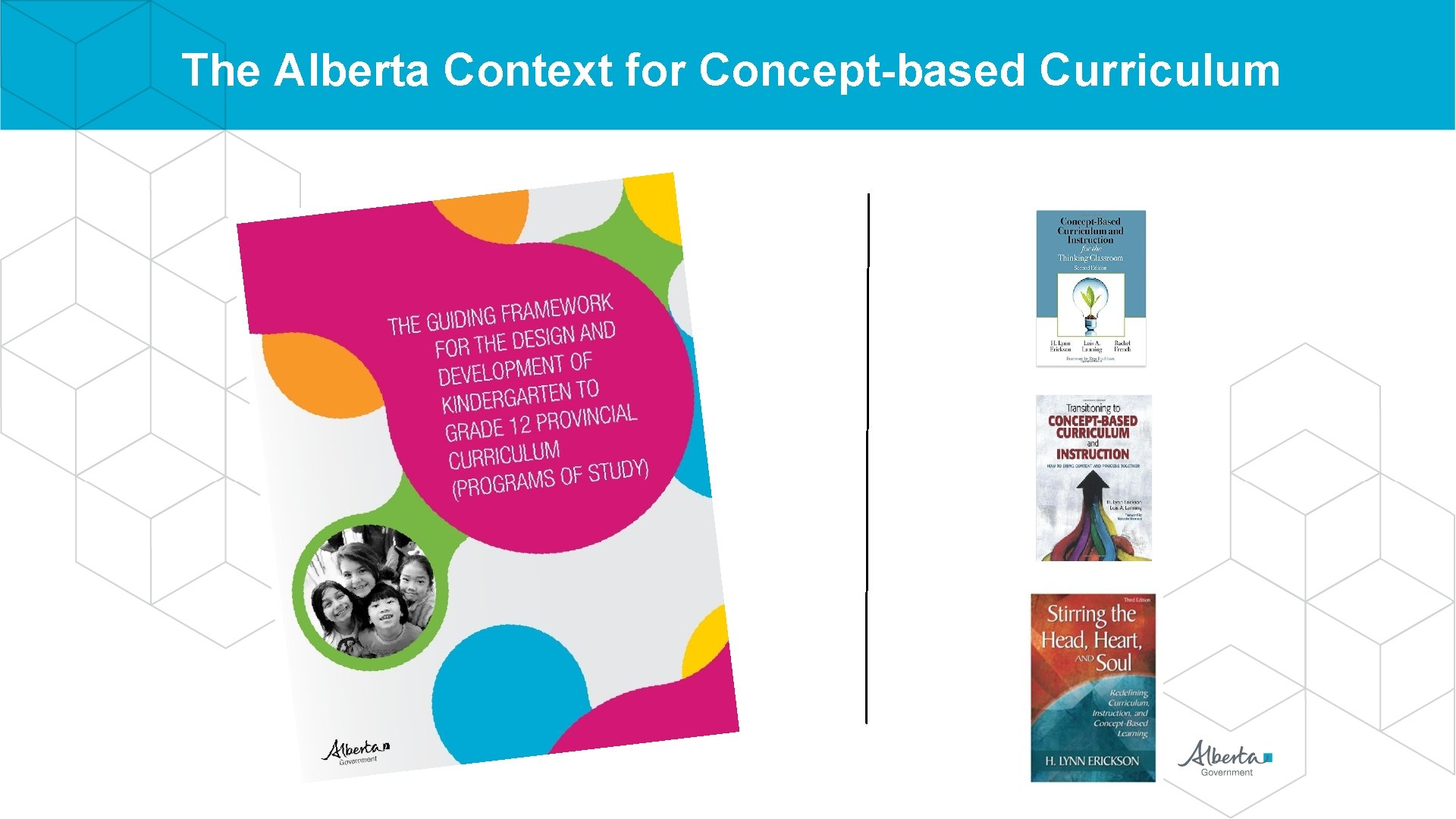
The Alberta Context for Concept-based Curriculum

Concept-based Paradigm: Curriculum • Features a three-dimensional design, with “conceptual understanding” as the third dimension. • “When students understand, they are able to better retain and transfer their learning. ” (Lanning, 2013).

FACT OR FICTION? A concept-based curriculum will not allow students to get at the “basics” that are important to some Albertans.

Why “Understanding”? Understanding … is a primary goal of teaching … is a primary goal of thinking … is not a type of thinking per se; rather, it is an outcome of thinking … comes about as a result of applying, analyzing, synthesizing, and evaluating

FACT OR FICTION? It is not possible to have a curriculum that is both “concept-based” and “competencies-focused. ”

Why “Understanding”? • Like competencies, thinking is bound to context and purpose. • “Tackling” the competencies requires us to consider teaching and learning through the lens of thinking. • The architecture and design of new curriculum emphasizes deep learning.

Concept-based Curriculum for Students “Students are becoming conceptual thinkers who have the abilities to examine factual information critically, relate new learning to prior knowledge, see patterns and connections, draw out significant understandings at the conceptual level, evaluate the truth of these understandings based on the supporting evidence, transfer understandings across time or situation, and, often, use a conceptual understanding creatively to solve a problem. ” (Erickson, Lanning, and French. 2017. Concept-Based Curriculum and Instruction for the Thinking Classroom, 2 nd edition, pp. 24– 25)

Curriculum Shift Knowledge, Skills, and Attitudes Is based primarily on topics, skills, and facts. Content focuses on facts that are often isolated and disconnected. Knowledge is fragmented. Concept-based Focuses on the transfer of the important conceptual ideas of a discipline. Concept-based focuses on making sense of facts and the world around us. Knowledge is presented as a “whole. ” Understand the relationship between individual facts, principles, or generalizations. Verbs are used to tell students what to know or do. Concept-based is a thinking curriculum. The verb describes the ways through which we come to understand the concept. Represents a two-dimensional design model that includes process and content knowledge. Has a third dimension–conceptual understanding. Content-based teaching may not get beyond the transmission of superficial learning. Concept-based curriculum focuses on critical concepts and processes students will be able to transfer to new situations. Asks teachers to cover long lists of content and skill objectives … but knowledge expands exponentially and there is not enough time to cover everything. Simply covering information does not result in deep understanding. Key concepts (ideas) of a discipline become the “drivers” for learning, leading students to deeper understandings that transfer across different situations.

Concept-based Curriculum in Action

Curriculum Architecture and Design

K– 12 Subject Introductions • intended to provide the justification for why the subject is learned and how the subject addresses student and societal needs now and in the future • intended to describe the subject and its purpose as it relates to the education of students in K– 12

Essential Understanding Guiding Question(s) Learning Outcome(s) Conceptual and Procedural Knowledge Organizational Structure for Future Provincial K– 12 Curriculum

One of the big ideas of the subject/across subjects, K– 12 Derived from the EU and frame LO(s) for the grade What students are expected to know, understand, be able to do and put into action after planned learning experiences What students should know and understand to achieve the Learning Outcome What students should be able to do to achieve the Learning Outcome Competencies, Literacy and Numeracy Reading the Draft Curriculum
![What is a Concept? “… a mental category [that] allows us to identify and](http://slidetodoc.com/presentation_image_h2/bac2858589dcf05648d8228c2eb1f453/image-23.jpg "What is a Concept? “… a mental category [that] allows us to identify and")
What is a Concept? “… a mental category [that] allows us to identify and classify objects, events or ideas, building on the notion that they are similar in significant ways and/or have certain common, relevant features” UNESCO. 2017. Guiding Principles for Learning in the Twenty-First Century. International Bureau of Education.

A concept is… When determining what a concept is, we consider the following criteria: Timeless – The concepts that frame the content of our disciplines will always be with us. Universal – Concepts are the same across the world. Abstract and broad – By nature, concepts are abstract and broad in order to provide for a variety of examples.

Defining Critical Attributes of Concepts may be sequenced in many ways repeated design or recurring sequence PATTERN follows a rule

Defining Critical Attributes of Concepts

Procedures • Procedures are the method and tools; presented as a verb. • Verbs ensure that students are developing deeper levels of conceptual understanding. (Erickson, 2002) • Verbs are the ways through which the student will come to understand the concept. (Erickson, 2008)

Learning Outcomes • are broader in nature • support depth of learning that leads to deep understanding • facilitate holistic development across the learning domains (intellectual, physical, social, spiritual, emotional) • provide context for development of competencies • support literacy and numeracy development within and across subjects

Learning Outcomes • derived from the concepts and procedures outlined in scope and sequence • describe what students are required to know, understand, and be able to do • conceptual knowledge and procedural knowledge represent the “unpacking” of a learning outcome

Conceptual and Procedural Knowledge • include the specific, critical knowledge and understanding of the concepts and procedures in the learning outcome(s) • the combination of conceptual knowledge and procedural knowledge helps to move students towards deep understanding • represent a baseline for what students are required to know, understand, and do in order to achieve the learning outcome

Conceptual and Procedural Knowledge • represent what students are required to know, understand, and do in order to achieve the learning outcome(s) • not exhaustive in order to allow for community context and flexibility of teacher judgement

The Interaction of Conceptual and Procedural Knowledge Conceptual Knowledge: what students need to know and understand at the level of the “concept” as opposed to knowing isolated facts Procedural Knowledge: knowing how, why, and when to apply the processes, strategies, and skills appropriate to a given task; the methods and tools

The Interaction of Procedural and Conceptual Knowledge: - plants and animals change in appearance and activities during different stages of life cycles Procedural Knowledge: - examine plants and animals at various stages of development

MACROconcepts give us breadth. Breadth give us depth. Depth MICROconcepts

MACROconcepts • the broadest, most abstract concepts that transfer across subject areas or organize more specific microconcepts within disciplines • develop breadth of knowledge in inter - and intradisciplinary contexts

MICROconcepts • specific concepts in a discipline that are evident when a macroconcept is unpacked • require more subject-specific expertise to understand them • may show progression or increasing depth of understanding through grade levels

Investigating change and the diversity of Earth’s systems helps us to develop understandings of the conditions necessary to sustain life. How do living things grow and experience change? Concepts: living things change Procedures: investigate analyze Students investigate and analyze life cycles of different plants and animals. Conceptual: living things plants animals life cycles Procedural: predict represent observe identify compare examine

Macro and Micro Concept Activity

An Interdisciplinary Approach

What Is the Purpose of Shared Essential Understandings? • span more than one subject • may be appropriate when interdisciplinary opportunities are present in two or more subjects • reinforce the notion of interdisciplinarity • help to bring focus to authentic learning

Breadth Relationships 41 vs. Depth Collaboration — Language Arts Land, Place — Social Studies Connections — Arts Education Stewardship — Science Patterns — Math Friendship, Healthy Relationships — Wellness

A Classroom Example

Considering Assessment • Learning outcomes delineate what students are expected to know, understand, and be able to do independently at the completion of a grade level. • Assessing each conceptual knowledge or procedural knowledge bullet individually is not supportive of students’ understanding of the learning outcome. • A more holistic approach to assessment is necessary.

What Is Assessed and Reported?

Questions

Thank you!
- Slides: 46