
Albert Camus 1913 1960 Camus Early Life Born
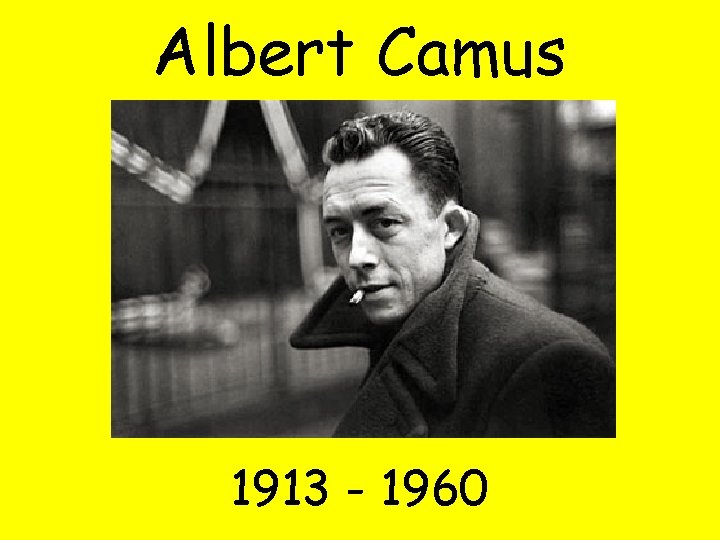
Albert Camus 1913 - 1960
Camus’ Early Life Born – 7 November 1973 in Mondovi, Algeria Family settled in Algeria in 1871 Death of his father during World War I His mother moves to a working class area, Belcourt, Algiers • 1918 – 1923 – Primary School Education • 1924 – 1930 – Scholarship studies at the Lycées of Algiers • The influence of Gustave Acaut and Jean Grenier on his early writing • •
The 1930 s • 1932 – Receives his Baccalauréat • Meets his wife Simone Hié • 1933 – attends the University of Algiers • 1934 – gets married
The 1930 s – Religion and Politics • Struggle with (the absence of) religion • Joins the Communist Party • 1935 – disillusionment with the Communist Party • Begins to work with a theatre group “Théâtre du Travail” • 1936 – graduation from university • The Philosophy of Moralism
The 1930 s – Moving to Central Europe • The breakdown of his marriage • 1937 – completion of the book “A Happy Death” • Expelled from the Communist Party • Refusal of a teaching post in Sidi-Bel-Abbès • Renaming of theatre group to “Théâtre d’équipe” – produced plays by Malraux, Gide, Synge, Dostoevsky • 1938 – becomes a journalist at Alger. Républicain
The Early 1940 s • Outbreak of the Second World War • 1940 – marriage to second wife, Francine Faure • Alger-Républicain banned • 1941 – “L’étranger” finished and a move back to Algeria • 1942 – return to France due to illness and publication of “L’étranger” • Remains in the south of France
1940 - 1944 • Moves to Paris • Becomes the editor at Gallimard • 1943 – joins the resistance and a journalist at their paper Combat • “Lettres to a German Friend” is published • 1944 – Liberation of France • Expansion of his family
The mid to late 1940 s • Visits to Algeria and the writing of articles attacking French policy • First performance of “Caligula” • Tour of the United States • Publication of “Neither Victims nor Executions” • Re-start of his love affaire with Maria Casarès • Tuberculosis forces convalescence at Grasse
The early to mid 1950 s 1951 – publication of “The Rebel” Depression and an inability to write Quarrels with Jean-Paul Sartre Wife becomes ill Continues to oppose repression across the world 1954 – start of the Algerian War and publication of “Summer” • 1956 – Camus calls for a truce in Algeria and the publication of “The Fall” • Separation from his wife • 1957 – Revival of “Caligula”, publishes “Exile and the Kingdom” and “Reflections on the Guillotine” as well as winning the Nobel Prize for Literature • • •
The late 1950 s • Buys a house in Lourmarin, Southern France • Turns down the opportunity to be the artistic director at the Comédie Française • 1959 – adapts Dostoevsky’s “The Possessed” for an experimental stage • Commences full-time work on the novel “The First Man”
1960 onwards • 4 th January 1960 – killed in a car accident at Villeblevin • Posthumous publication of “A very happy death” and “The First Man” • Continued popularity
- Slides: 11