
Alan Bryman Social Research Methods Chapter 2 Social
Alan Bryman Social Research Methods Chapter 2: Social research strategies: quantitative research and qualitative research © Alan Bryman, 2016. All rights reserved.

Student experience A valuable feature of the text is the ‘Student experience’ boxes with links to the Online Resource Centre Page 17 Bryman: Social Research Methods, 5 th edition
Theory and research • What type of theory? page 18 - explanation of observed regularities • Merton (1967) – grand theories • highly abstract • Butler and Robinson (2001) – Bourdieu’s concept of social capital – gentrification of areas of London – middle range theories • useful for empirical research - limited domain Pages 18 and 19 Bryman: Social Research Methods, 5 th edition
Theory and research • Middle range theories - unlike grand ones, operate in a limited domain; whether it is juvenile delinquency, racial prejudice, educational attainment or ethnic relations • Conflict and contact theory: These theories are about the effects of ethnic diversity on the quality of inter-group relations. - they offer contrasting theories (see Hughes et al. 2011; Sturgis et al. 2014) • Cohen(2010) - postal questionnaire survey of hairstylist’s relationship with their clients Pages 19 and 20 Bryman: Social Research Methods, 5 th edition

Empiricism - Philosophical approach to theorising - Only knowledge gained through sensory experiences is acceptable - Rigorous scientific testing of theories - Positivist epistemology - Accumulation of ‘facts’ as data - Naïve empiricism? Page 20 Bryman: Social Research Methods, 5 th edition
Empiricism • Mc. Keganey and Barnard (1996) - research on prostitutes and their clients • Goffman (1963) - notion of ‘stigma’ • Hochschild (1983) - concept of ‘emotional labour’ Pages 20 and 21 Bryman: Social Research Methods, 5 th edition
Deductive and inductive theory • Deductivism: – theory --> data – explicit hypothesis to be confirmed or rejected – quantitative research • Inductivism: – data --> theory – generalizable inferences from observations – qualitative research /grounded theory Pages 21 and 22 Bryman: Social Research Methods, 5 th edition

Deductive and inductive theory Fig. 2. 1 Page 21 Bryman: Social Research Methods, 5 th edition

Deductive and inductive theory Fig. 2. 2 Page 23 Bryman: Social Research Methods, 5 th edition
Deductive and inductive theory • Deductive: Roder and Muhlau (2014) - When migrants move from a country in which egalitarian attitudes are weak to one where they are strong • Inductive: O’Reilly et al. (2012) - A study of interactions between customers and front-line employees Pages 22 and 23 Bryman: Social Research Methods, 5 th edition
Epistemological considerations • What is (or should be) considered acceptable knowledge? • Can the social world be studied ‘scientifically’? • Is it appropriate to apply the methods of the natural sciences to social science research? • Positivist and interpretivist epistemologies Page 24 Bryman: Social Research Methods, 5 th edition
Positivist epistemology • Application of natural science methods to social science research • Phenomenalism: knowledge via the senses • Deductivism: theory testing • Inductivism: theory building • Objective, value-free researcher • Distinction between scientific and normative statements Page 24 Bryman: Social Research Methods, 5 th edition
Realist epistemology • Similarities to positivism: - natural science methods appropriate - external reality exists independently of our perceptions • Empirical (naïve? ) realism - close correspondence between reality and terms used to describe it - direct knowledge of the social world • Critical realism - theoretical terms mediate our knowledge of reality - underlying structures generate observable events Page 25 Bryman: Social Research Methods, 5 th edition
Interpretivist epistemology • Subject matter of the social sciences (people) demands nonpositivist methods • Positivism vs hermeneutics (Von Wright 1971) - concerned with theory and method of the interpretation of human action • Hermeneutic-phenomenological tradition • Verstehen: interpretative understanding of social action (Weber 1947) • Attempts to see world from the actor’s perspective: subjective reality (Bogdan and Taylor 1975) • Influenced by symbolic interactionism Pages 26 to 28 Bryman: Social Research Methods, 5 th edition
Ontological considerations • Social ontology: the nature of social entities • What kind of objects exist in the social world? • Do social entities exist independently of our perceptions of them? • Is social reality external to social actors or constructed by them? Page 28 Bryman: Social Research Methods, 5 th edition
Objectivist ontology • Social phenomena confront us as external facts • Individuals are born into a pre-existing social world • Social forces and rules exert pressure on actors to conform • e. g. culture exists independently of social actors who are socialized into its values Page 29 Bryman: Social Research Methods, 5 th edition
Constructionist ontology • Social phenomena and their meanings are constructed by social actors • Continually accomplished and revised • Researchers’ accounts of events are also constructions - many alternative interpretations • e. g. Strauss et al (1973) negotiated order in a psychiatric hospital • Language and representation shape our perceptions of reality Pages 29 and 30 Bryman: Social Research Methods, 5 th edition
Research strategy: quantitative and qualitative • Useful way of classifying methods of social research • Two distinctive clusters of research strategies: quantitative and qualitative • These strategies differ in terms of their: – general orientation to social research – epistemological foundations – ontological basis Page 31 Bryman: Social Research Methods, 5 th edition
Quantitative research • Measurement of social variables • Common research designs: surveys and experiments • Numerical and statistical data • Deductive theory testing • Positivist epistemology • Objectivist view of reality as external to social actors Page 32 Bryman: Social Research Methods, 5 th edition

Quantitative research Table 2. 1 Page 32 Bryman: Social Research Methods, 5 th edition
Qualitative research • Understanding the subjective meanings held by actors (interpretivist epistemology) • Common methods: interviews, ethnography • Data are words, texts and stories • Inductive approach: theory emerges from data • Social constructionist ontology Page 33 Bryman: Social Research Methods, 5 th edition
Mixed methods research • Both quantitative and qualitative research • Poortinga et al (2004) - Foot and Mouth Disease – public trust of government and perceived associated risks • Beck (1992) - Notion of the ‘risk society’ Page 32 Bryman: Social Research Methods, 5 th edition
Influences on the conduct of social research • Values – – personal beliefs or the feelings of researcher all ‘preconceptions must be eradicated’ (Durkheim 1938) affect every stage of research process some advocate value-laden research: • Becker (1967) sympathy with ‘underdog’ groups • feminist research encourages reciprocity (Oakley 1981) and ‘conscious partiality’ (Mies 1993) Pages 34 to 36 Bryman: Social Research Methods, 5 th edition
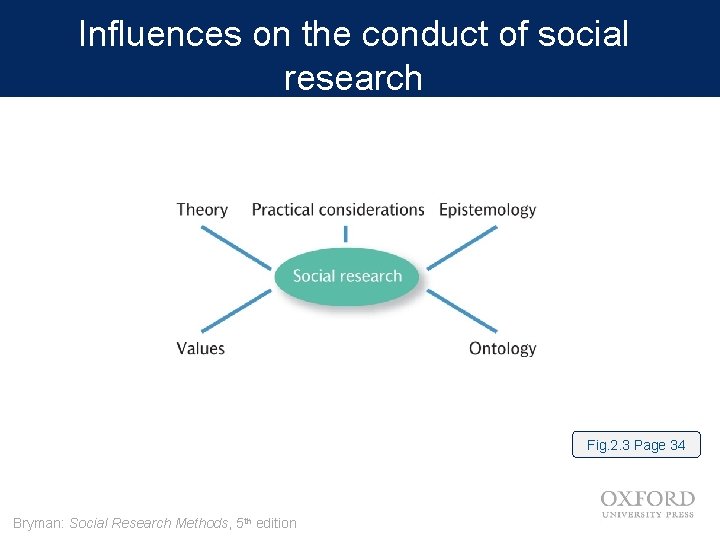
Influences on the conduct of social research Fig. 2. 3 Page 34 Bryman: Social Research Methods, 5 th edition
Influences on the conduct of research • Practical considerations – time – cost/funding available – how much prior literature exists (theory testing or theory building? ) – topic (deviant activities/sensitive issues may be more suited to qualitative research) – all social research is a compromise between the ideal and the feasible Page 36 Bryman: Social Research Methods, 5 th edition
- Slides: 25