
Alabamas Economic Support of the Confederacy Between Alabamas
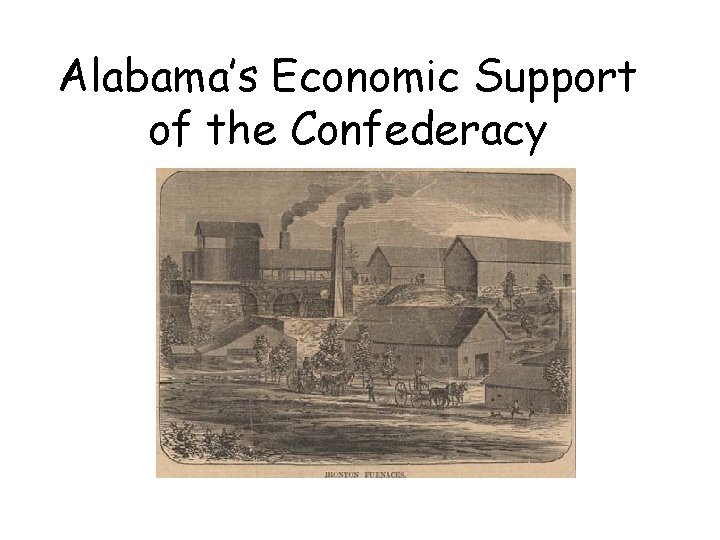
Alabama’s Economic Support of the Confederacy
Between Alabama's statehood in 1819 and the Civil War in 1861, the economy of the state was based in agriculture. Plantation Economics • On a 1, 000 -acre plantation, a third might be planted in cotton as a cash crop. Timber, pastureland, buildings, and gardens would cover the remaining acreage. • Supplies for the plantation would be ordered through the plantation’s factor (representative) in Mobile who also sold the cotton as an agent of the owner. • Planters usually bought yard goods (material), tools, and foods such as coffee, tea, flour, and sugar through their factors because these items were not produced on the plantation. • Farm animals were usually purchased locally. Yeoman Farming • Two-thirds of the farmers in Alabama in 1860 were not planters, but yeoman farmers who seldom were slave owners. • These farmers raised cotton as cash crop, grew their own food, and raised cattle. http: //www. encyclopediaofalabama. org
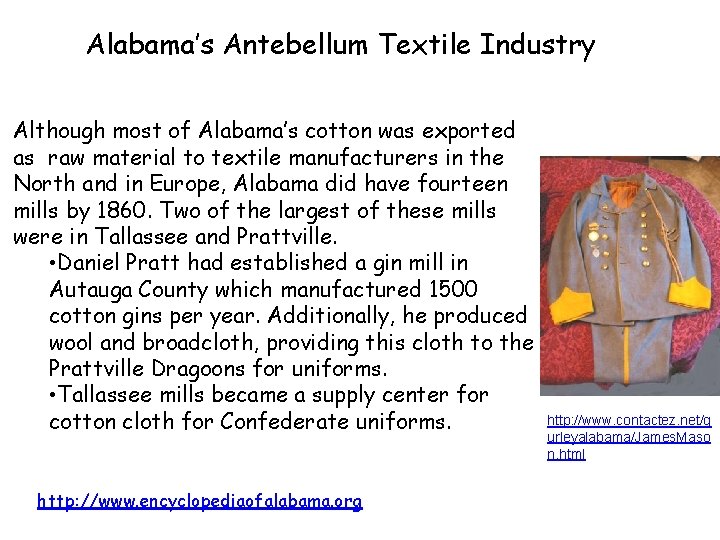
Alabama’s Antebellum Textile Industry Although most of Alabama’s cotton was exported as raw material to textile manufacturers in the North and in Europe, Alabama did have fourteen mills by 1860. Two of the largest of these mills were in Tallassee and Prattville. • Daniel Pratt had established a gin mill in Autauga County which manufactured 1500 cotton gins per year. Additionally, he produced wool and broadcloth, providing this cloth to the Prattville Dragoons for uniforms. • Tallassee mills became a supply center for cotton cloth for Confederate uniforms. http: //www. encyclopediaofalabama. org http: //www. contactez. net/g urleyalabama/James. Maso n. html
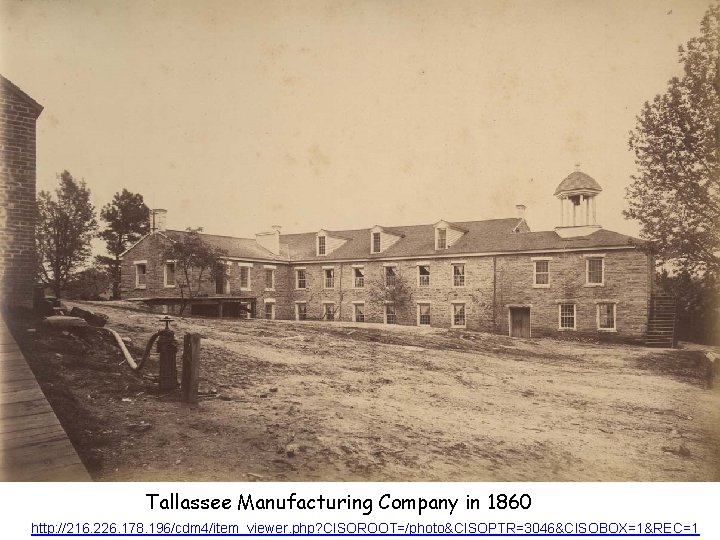
Tallassee Manufacturing Company in 1860 http: //216. 226. 178. 196/cdm 4/item_viewer. php? CISOROOT=/photo&CISOPTR=3046&CISOBOX=1&REC=1
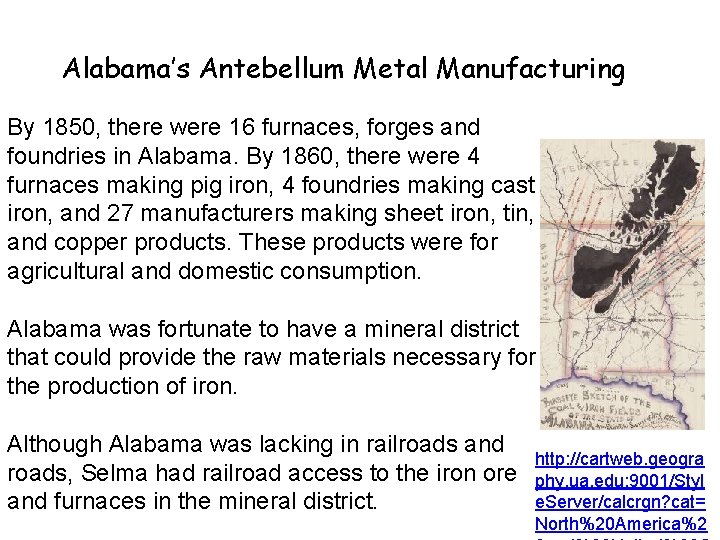
Alabama’s Antebellum Metal Manufacturing By 1850, there were 16 furnaces, forges and foundries in Alabama. By 1860, there were 4 furnaces making pig iron, 4 foundries making cast iron, and 27 manufacturers making sheet iron, tin, and copper products. These products were for agricultural and domestic consumption. Alabama was fortunate to have a mineral district that could provide the raw materials necessary for the production of iron. Although Alabama was lacking in railroads and roads, Selma had railroad access to the iron ore and furnaces in the mineral district. http: //cartweb. geogra phy. ua. edu: 9001/Styl e. Server/calcrgn? cat= North%20 America%2
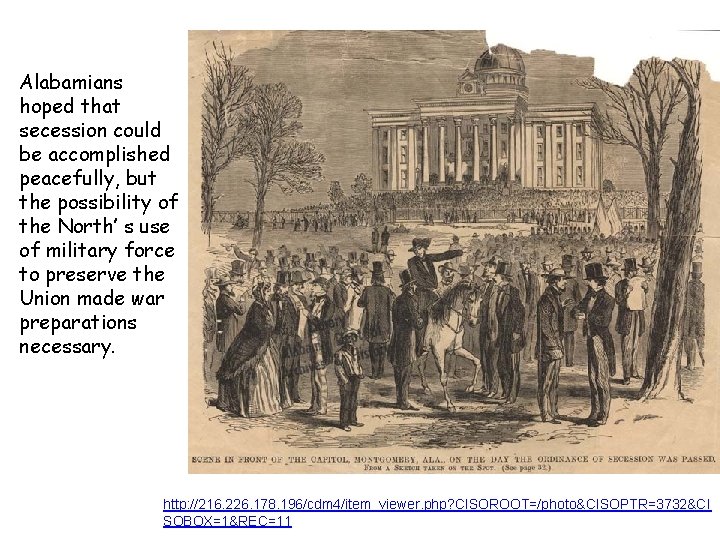
Alabamians hoped that secession could be accomplished peacefully, but the possibility of the North’ s use of military force to preserve the Union made war preparations necessary. http: //216. 226. 178. 196/cdm 4/item_viewer. php? CISOROOT=/photo&CISOPTR=3732&CI SOBOX=1&REC=11
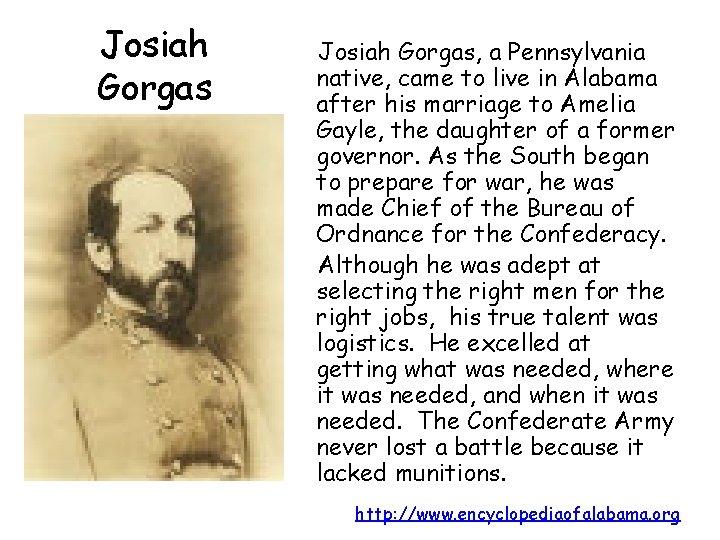
Josiah Gorgas, a Pennsylvania native, came to live in Alabama after his marriage to Amelia Gayle, the daughter of a former governor. As the South began to prepare for war, he was made Chief of the Bureau of Ordnance for the Confederacy. Although he was adept at selecting the right men for the right jobs, his true talent was logistics. He excelled at getting what was needed, where it was needed, and when it was needed. The Confederate Army never lost a battle because it lacked munitions. http: //www. encyclopediaofalabama. org
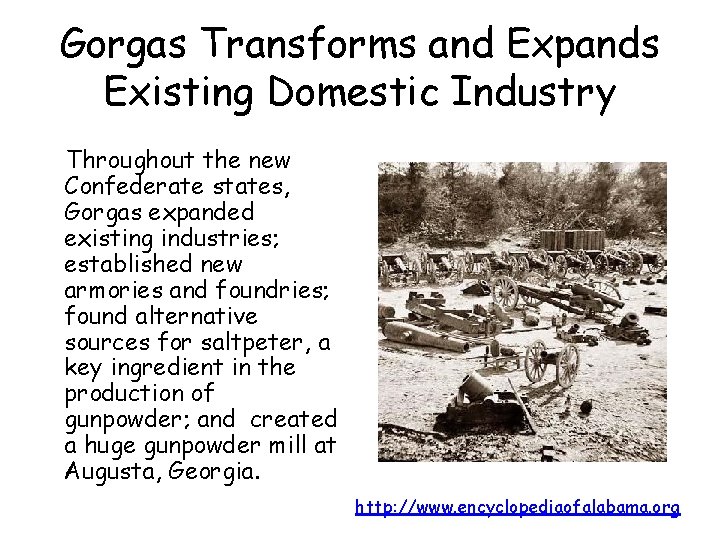
Gorgas Transforms and Expands Existing Domestic Industry Throughout the new Confederate states, Gorgas expanded existing industries; established new armories and foundries; found alternative sources for saltpeter, a key ingredient in the production of gunpowder; and created a huge gunpowder mill at Augusta, Georgia. http: //www. encyclopediaofalabama. org
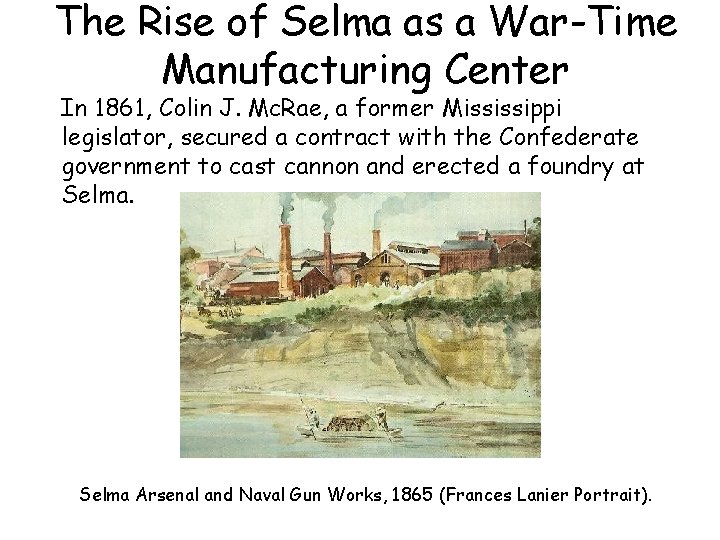
The Rise of Selma as a War-Time Manufacturing Center In 1861, Colin J. Mc. Rae, a former Mississippi legislator, secured a contract with the Confederate government to cast cannon and erected a foundry at Selma Arsenal and Naval Gun Works, 1865 (Frances Lanier Portrait).
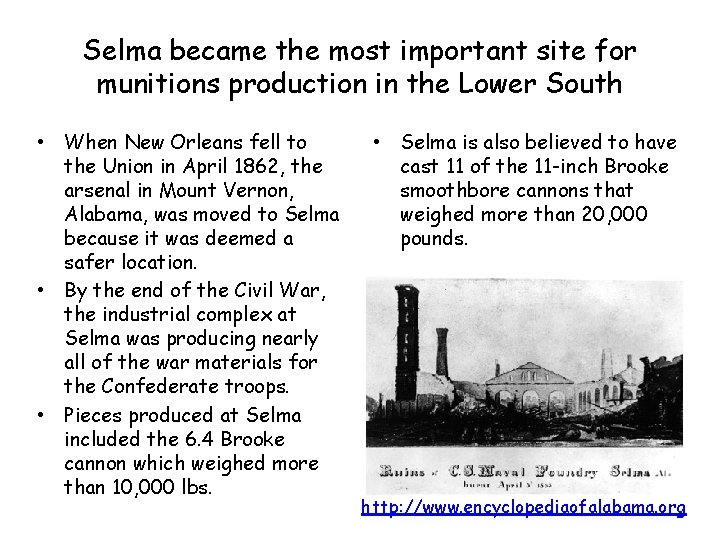
Selma became the most important site for munitions production in the Lower South • When New Orleans fell to the Union in April 1862, the arsenal in Mount Vernon, Alabama, was moved to Selma because it was deemed a safer location. • By the end of the Civil War, the industrial complex at Selma was producing nearly all of the war materials for the Confederate troops. • Pieces produced at Selma included the 6. 4 Brooke cannon which weighed more than 10, 000 lbs. • Selma is also believed to have cast 11 of the 11 -inch Brooke smoothbore cannons that weighed more than 20, 000 pounds. http: //www. encyclopediaofalabama. org
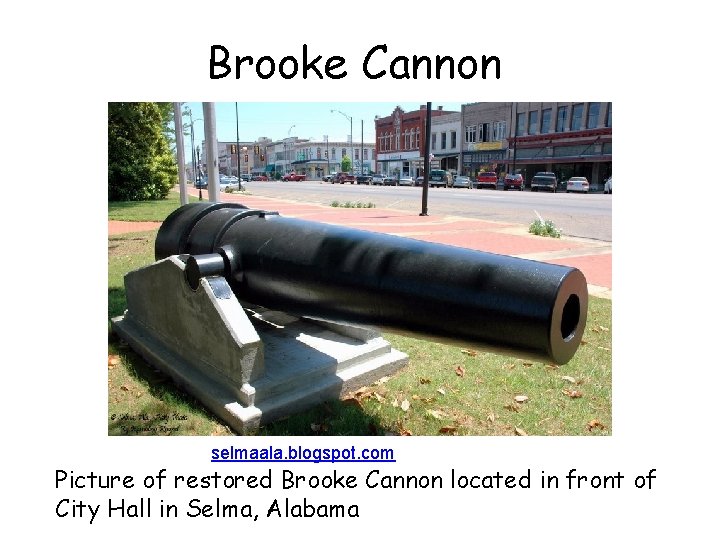
Brooke Cannon selmaala. blogspot. com Picture of restored Brooke Cannon located in front of City Hall in Selma, Alabama
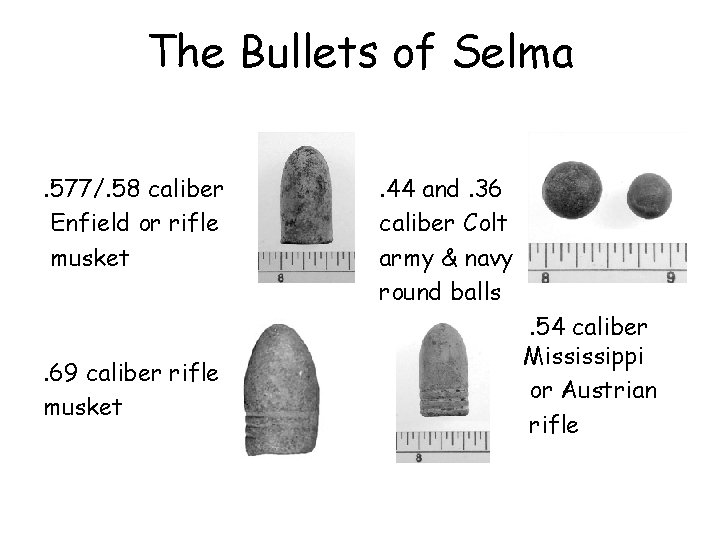
The Bullets of Selma. 577/. 58 caliber Enfield or rifle musket . 69 caliber rifle musket . 44 and. 36 caliber Colt army & navy round balls. 54 caliber Mississippi or Austrian rifle
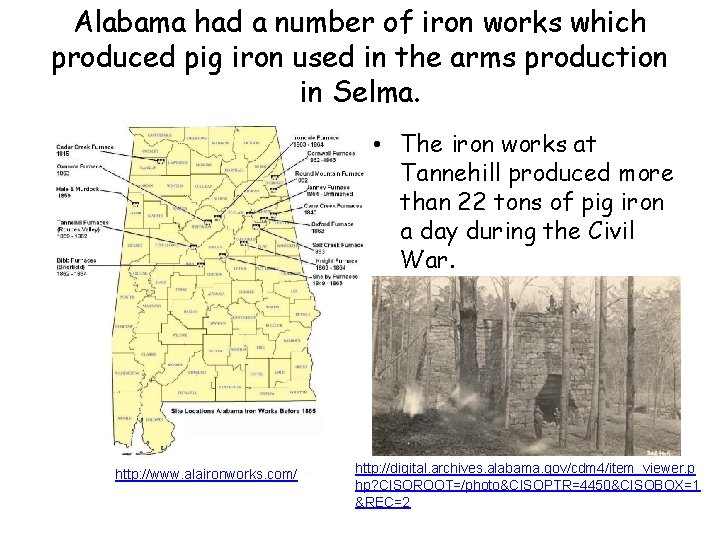
Alabama had a number of iron works which produced pig iron used in the arms production in Selma. • The iron works at Tannehill produced more than 22 tons of pig iron a day during the Civil War. http: //www. alaironworks. com/ http: //digital. archives. alabama. gov/cdm 4/item_viewer. p hp? CISOROOT=/photo&CISOPTR=4450&CISOBOX=1 &REC=2
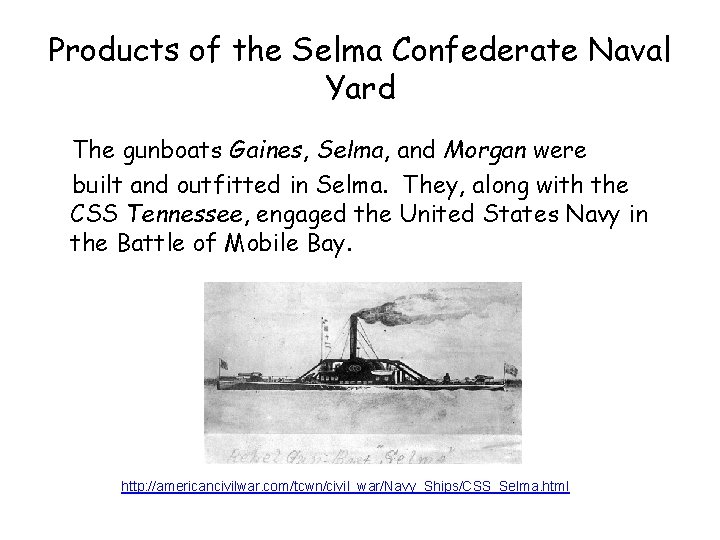
Products of the Selma Confederate Naval Yard The gunboats Gaines, Selma, and Morgan were built and outfitted in Selma. They, along with the CSS Tennessee, engaged the United States Navy in the Battle of Mobile Bay. http: //americancivilwar. com/tcwn/civil_war/Navy_Ships/CSS_Selma. html
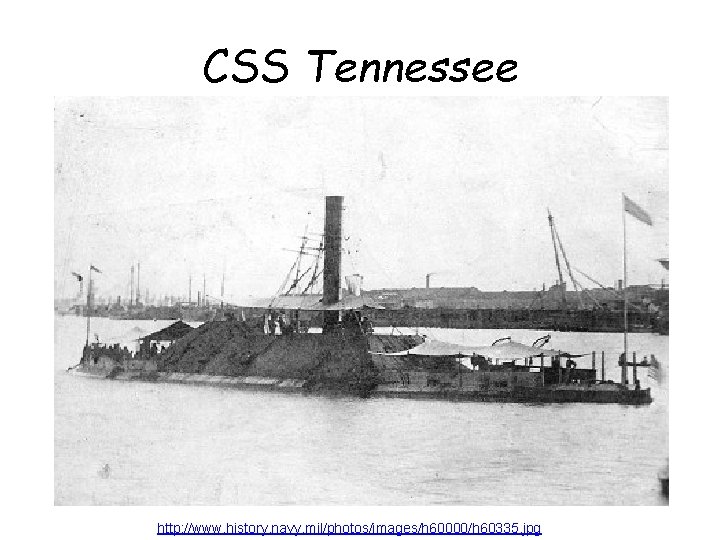
CSS Tennessee http: //www. history. navy. mil/photos/images/h 60000/h 60335. jpg
CSS Tennessee • The hull of the CSS Tennessee, an ironclad ram, was laid down in Selma in 1862. • The iron mail of the Tennessee was three thicknesses of 2” by 10” plate. • She was commissioned in February of 1864, after which she was towed to Mobile to be engined and armed. She had two fatal flaws: 1. The engines which were salvaged from a riverboat were not powerful enough. 2. The steering chains were placed outside the armored deck making the chains vulnerable to attack. • One imposing aspect of her armament was a hot water attachment to her boiler for repelling boarders, throwing one stream from forward of the casemate and one aft. •
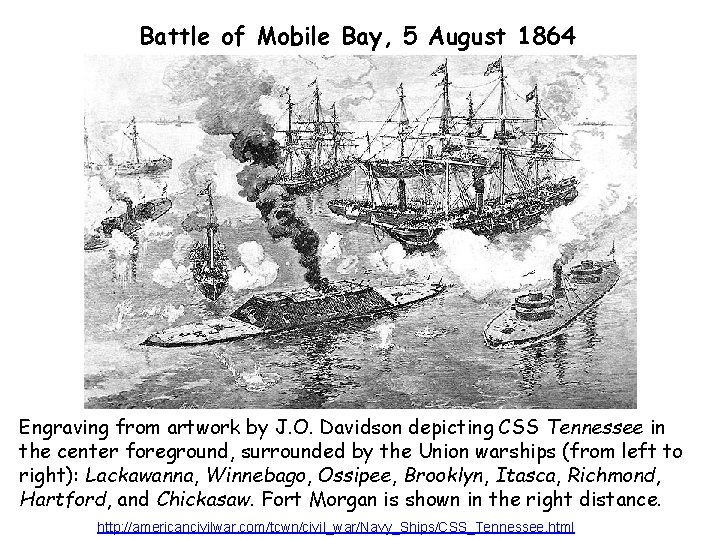
Battle of Mobile Bay, 5 August 1864 Engraving from artwork by J. O. Davidson depicting CSS Tennessee in the center foreground, surrounded by the Union warships (from left to right): Lackawanna, Winnebago, Ossipee, Brooklyn, Itasca, Richmond, Hartford, and Chickasaw. Fort Morgan is shown in the right distance. http: //americancivilwar. com/tcwn/civil_war/Navy_Ships/CSS_Tennessee. html
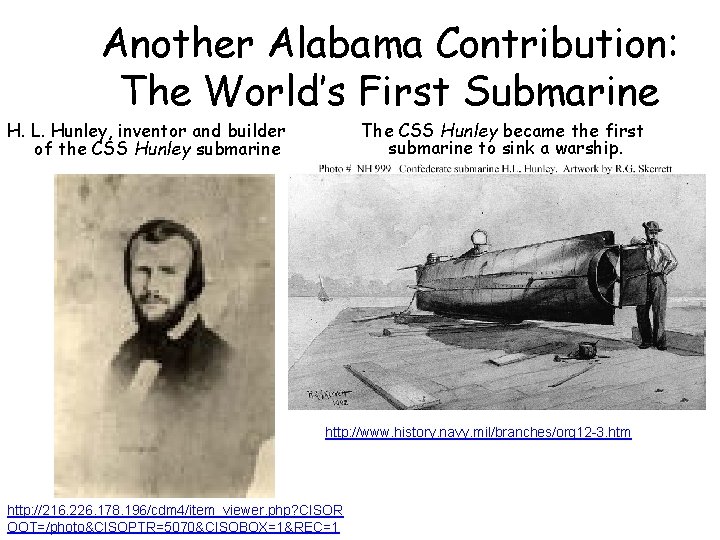
Another Alabama Contribution: The World’s First Submarine H. L. Hunley, inventor and builder of the CSS Hunley submarine The CSS Hunley became the first submarine to sink a warship. http: //www. history. navy. mil/branches/org 12 -3. htm http: //216. 226. 178. 196/cdm 4/item_viewer. php? CISOR OOT=/photo&CISOPTR=5070&CISOBOX=1&REC=1
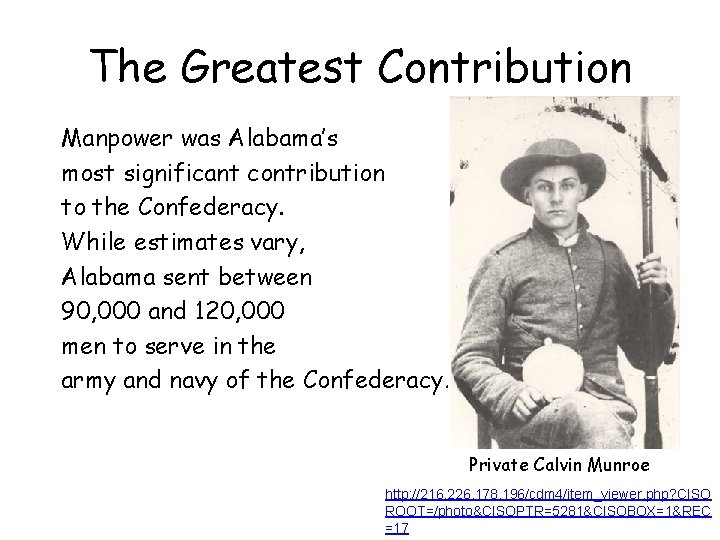
The Greatest Contribution Manpower was Alabama’s most significant contribution to the Confederacy. While estimates vary, Alabama sent between 90, 000 and 120, 000 men to serve in the army and navy of the Confederacy. Private Calvin Munroe http: //216. 226. 178. 196/cdm 4/item_viewer. php? CISO ROOT=/photo&CISOPTR=5281&CISOBOX=1&REC =17
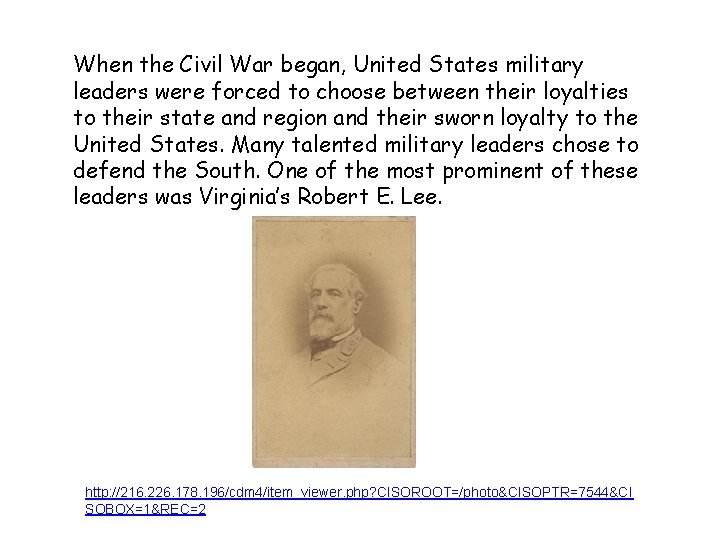
When the Civil War began, United States military leaders were forced to choose between their loyalties to their state and region and their sworn loyalty to the United States. Many talented military leaders chose to defend the South. One of the most prominent of these leaders was Virginia’s Robert E. Lee. http: //216. 226. 178. 196/cdm 4/item_viewer. php? CISOROOT=/photo&CISOPTR=7544&CI SOBOX=1&REC=2
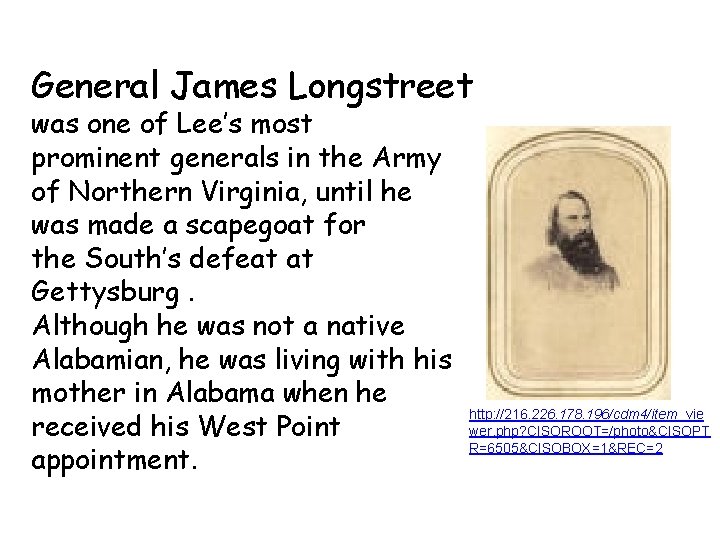
General James Longstreet was one of Lee’s most prominent generals in the Army of Northern Virginia, until he was made a scapegoat for the South’s defeat at Gettysburg. Although he was not a native Alabamian, he was living with his mother in Alabama when he received his West Point appointment. http: //216. 226. 178. 196/cdm 4/item_vie wer. php? CISOROOT=/photo&CISOPT R=6505&CISOBOX=1&REC=2
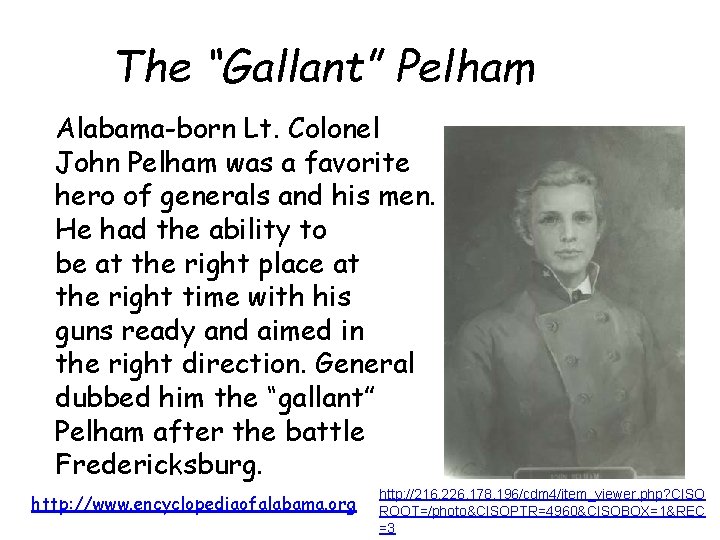
The “Gallant” Pelham Alabama-born Lt. Colonel John Pelham was a favorite hero of generals and his men. He had the ability to be at the right place at the right time with his guns ready and aimed in the right direction. General dubbed him the “gallant” Pelham after the battle Fredericksburg. http: //www. encyclopediaofalabama. org http: //216. 226. 178. 196/cdm 4/item_viewer. php? CISO ROOT=/photo&CISOPTR=4960&CISOBOX=1&REC =3
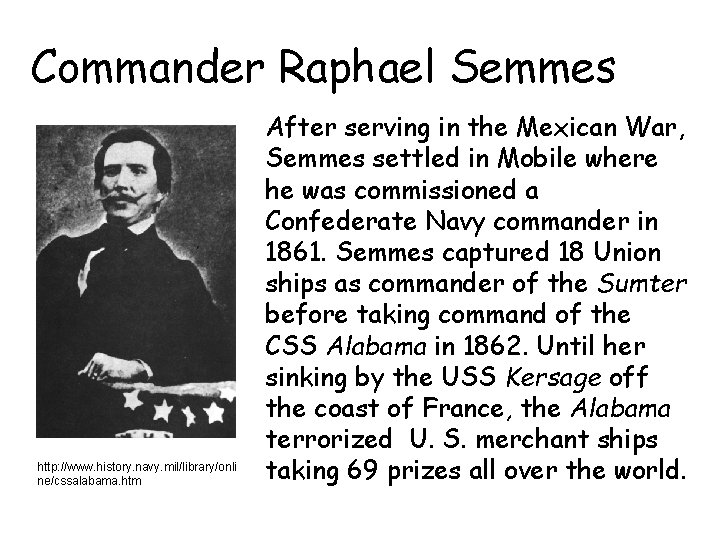
Commander Raphael Semmes http: //www. history. navy. mil/library/onli ne/cssalabama. htm After serving in the Mexican War, Semmes settled in Mobile where he was commissioned a Confederate Navy commander in 1861. Semmes captured 18 Union ships as commander of the Sumter before taking command of the CSS Alabama in 1862. Until her sinking by the USS Kersage off the coast of France, the Alabama terrorized U. S. merchant ships taking 69 prizes all over the world.
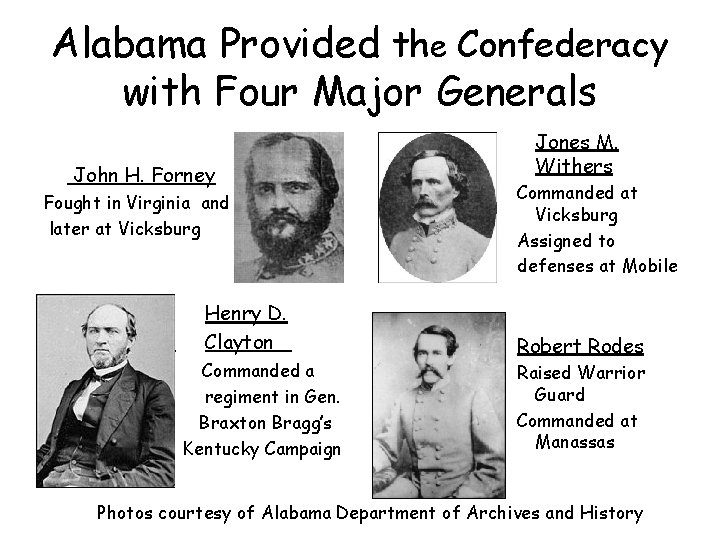
Alabama Provided the Confederacy with Four Major Generals John H. Forney Fought in Virginia and later at Vicksburg Henry D. Clayton Commanded a regiment in Gen. Braxton Bragg’s Kentucky Campaign Jones M. Withers Commanded at Vicksburg Assigned to defenses at Mobile Robert Rodes Raised Warrior Guard Commanded at Manassas Photos courtesy of Alabama Department of Archives and History
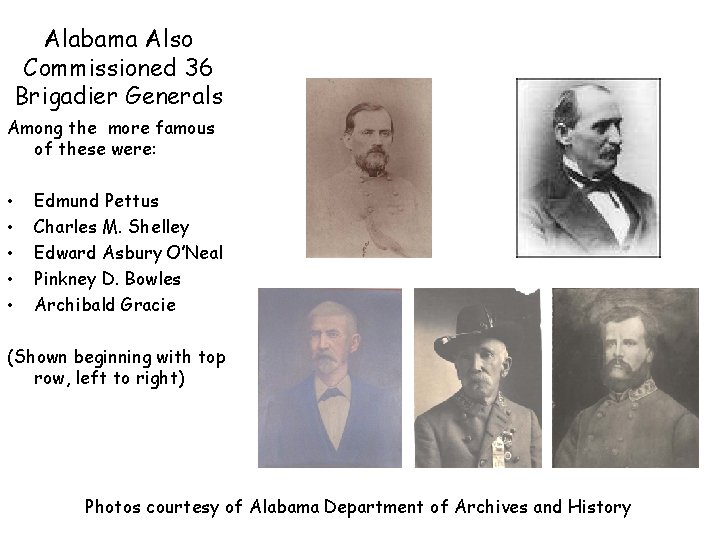
Alabama Also Commissioned 36 Brigadier Generals Among the more famous of these were: • • • Edmund Pettus Charles M. Shelley Edward Asbury O’Neal Pinkney D. Bowles Archibald Gracie (Shown beginning with top row, left to right) Photos courtesy of Alabama Department of Archives and History
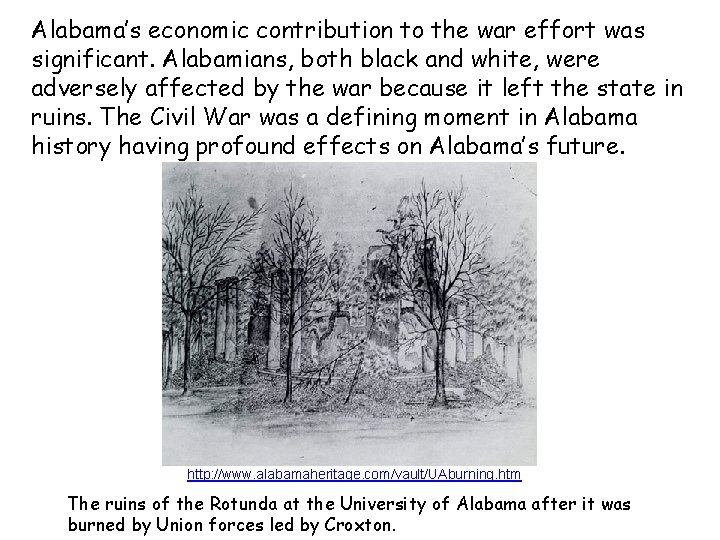
Alabama’s economic contribution to the war effort was significant. Alabamians, both black and white, were adversely affected by the war because it left the state in ruins. The Civil War was a defining moment in Alabama history having profound effects on Alabama’s future. http: //www. alabamaheritage. com/vault/UAburning. htm The ruins of the Rotunda at the University of Alabama after it was burned by Union forces led by Croxton.
- Slides: 26