
Alabama Educator Certification Assessment Program Alabama Educator Preparation
Alabama Educator Certification Assessment Program Alabama Educator Preparation Programs and Certain Certification Approaches Dr. Jendia Grissett
What is ? • Nationally available, subject-specific performance assessment • Focuses on student learning and principles from research and theory • Designed to be educative for candidates, preparation programs and policy makers
What is 1. ? Helps candidates develop the confidence and skills they need to be successful in urban, suburban, and rural schools. 2. Provides a uniform and evidence-based process that can be used across states to confirm that aspiring teachers demonstrate their readiness for the classroom. 3. Measures candidates' ability to differentiate instruction for diverse learners, including English language learners and special education students. 4. Provides meaningful and consistent data that can be used to improve teacher education programs and renew program curriculum. 5. Creates a body of evidence of teacher performance
Who is Involved?
ed. TPA Development • Stanford University faculty and staff have been involved in the past 25 -years in the development of performance-based assessments of teaching including the – National Board for Professional Teaching Standards – In. TASC portfolio – Performance Assessment for California Teachers • Reflects substantive advice from teachers and teacher educators • Input from design and review team members comprised of – university faculty – national subject matter organization representatives – K-12 teachers
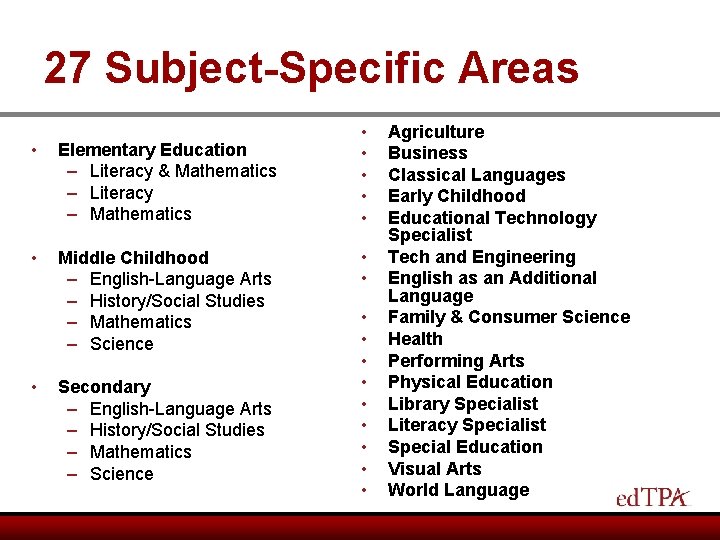
27 Subject-Specific Areas • Elementary Education – Literacy & Mathematics – Literacy – Mathematics • Middle Childhood – English-Language Arts – History/Social Studies – Mathematics – Science • Secondary – English-Language Arts – History/Social Studies – Mathematics – Science • • • • Agriculture Business Classical Languages Early Childhood Educational Technology Specialist Tech and Engineering English as an Additional Language Family & Consumer Science Health Performing Arts Physical Education Library Specialist Literacy Specialist Special Education Visual Arts World Language
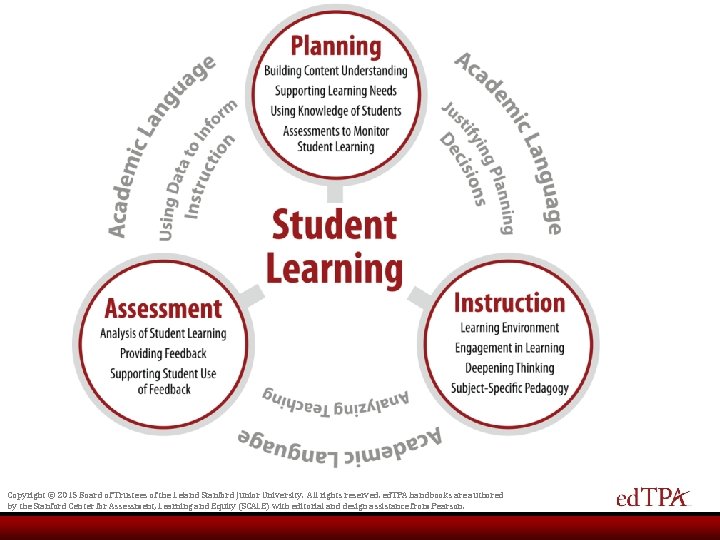
Copyright © 2015 Board of Trustees of the Leland Stanford Junior University. All rights reserved. TPA handbooks are authored by the Stanford Center for Assessment, Learning and Equity (SCALE) with editorial and design assistance from Pearson.
Summative Assessment of Teaching Practice • Common Architecture across 27 fields • Subject Specific “Learning Segment” of 3 -5 days/hours of instruction • Plans based on contextual knowledge of the learning environment: o Academic, social emotional and language development o Prior academic learning, lived experiences, personal, community and cultural assets • Portfolio collection of artifacts and commentaries
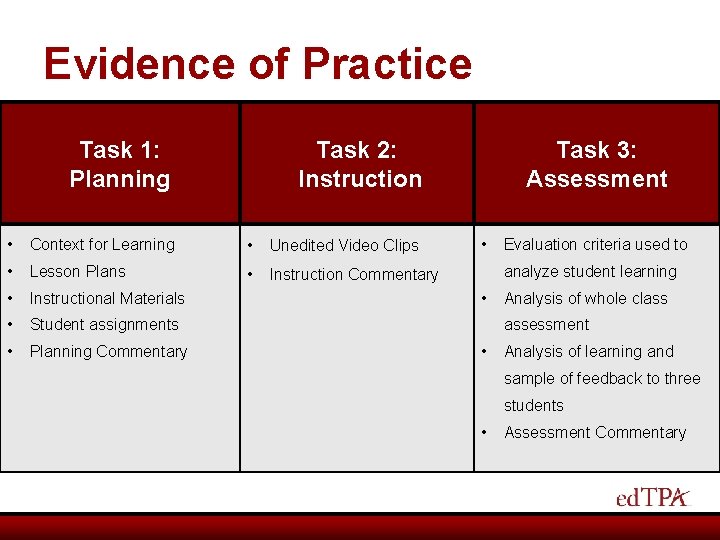
Evidence of Practice Task 1: Planning Task 2: Instruction • Context for Learning • Unedited Video Clips • Lesson Plans • Instruction Commentary • Instructional Materials • Student assignments • Planning Commentary Task 3: Assessment • Evaluation criteria used to analyze student learning • Analysis of whole class assessment • Analysis of learning and sample of feedback to three students • Assessment Commentary
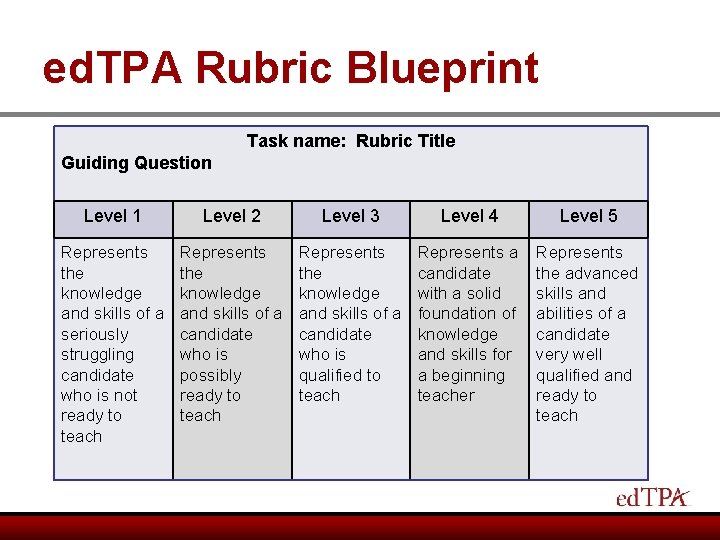
ed. TPA Rubric Blueprint Task name: Rubric Title Guiding Question Level 1 Level 2 Level 3 Level 4 Level 5 Represents the knowledge and skills of a seriously struggling candidate who is not ready to teach Represents the knowledge and skills of a candidate who is possibly ready to teach Represents the knowledge and skills of a candidate who is qualified to teach Represents a candidate with a solid foundation of knowledge and skills for a beginning teacher Represents the advanced skills and abilities of a candidate very well qualified and ready to teach
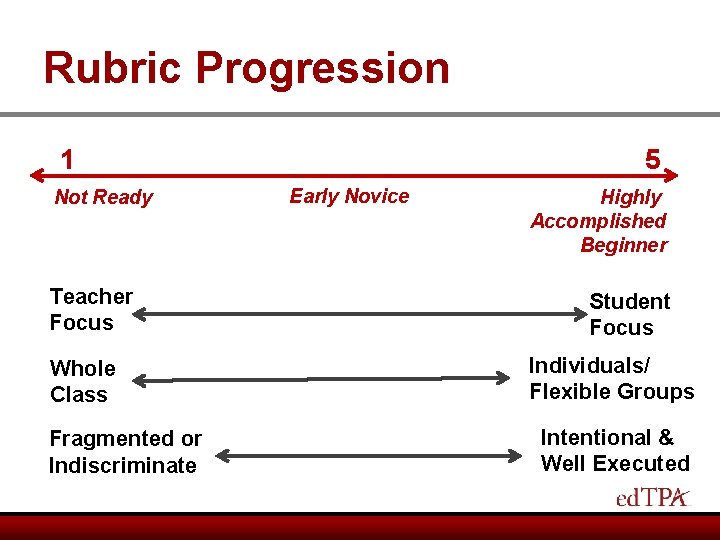
Rubric Progression 1 Not Ready Teacher Focus Whole Class Fragmented or Indiscriminate 5 Early Novice Highly Accomplished Beginner Student Focus Individuals/ Flexible Groups Intentional & Well Executed
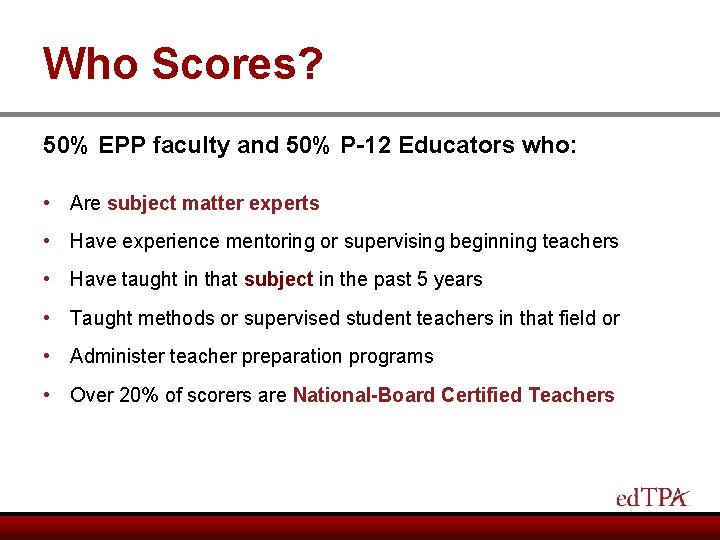
Who Scores? 50% EPP faculty and 50% P-12 Educators who: • Are subject matter experts • Have experience mentoring or supervising beginning teachers • Have taught in that subject in the past 5 years • Taught methods or supervised student teachers in that field or • Administer teacher preparation programs • Over 20% of scorers are National-Board Certified Teachers
Scores and Score Reporting Candidates • Aggregate score across all rubrics • Rubric-level descriptive feedback Preparation Programs • Candidate-level scores • Aggregate data by field
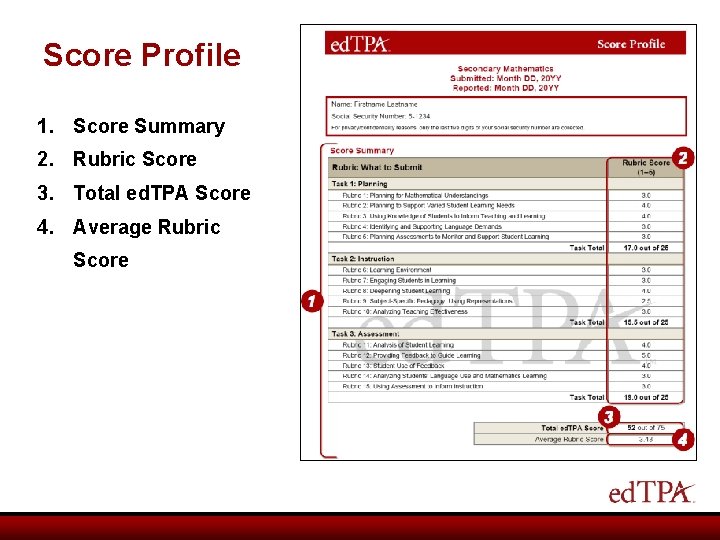
Score Profile 1. Score Summary 2. Rubric Score 3. Total ed. TPA Score 4. Average Rubric Score
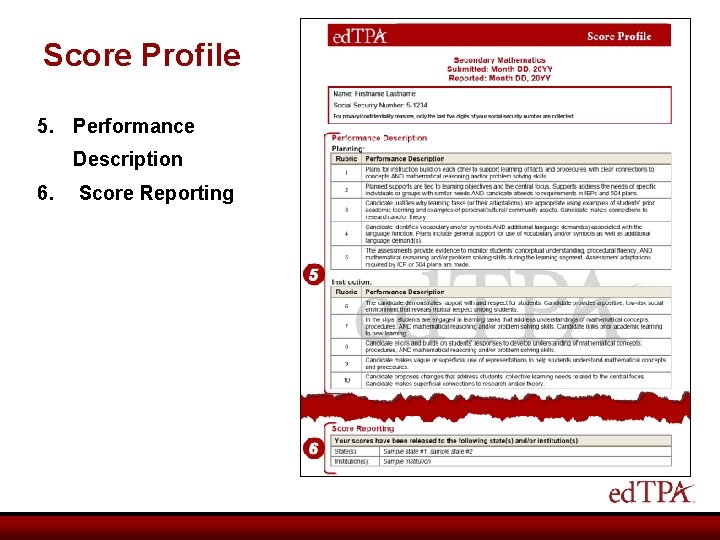
Score Profile 5. Performance Description 6. Score Reporting
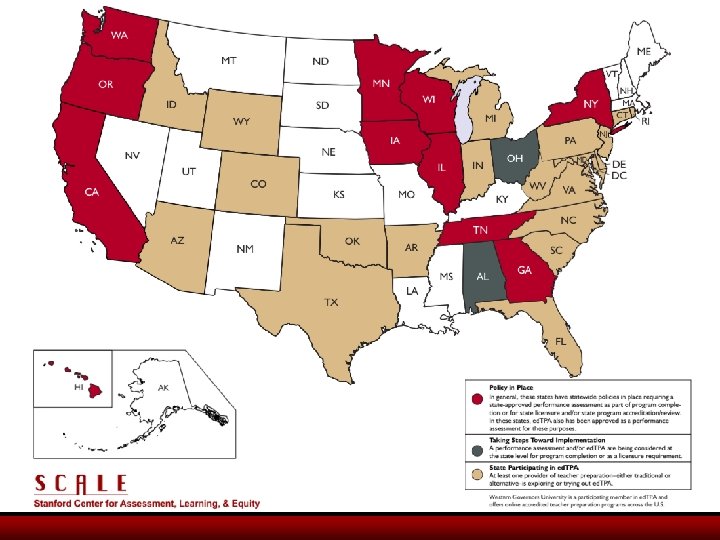

Why ? Alabama Educator Certification Assessment Program 1. Basic Skills Assessments: Reading for Information; Writing; and Mathematics – Entry into a Teacher Education Program and some initial certification approaches such as the Alternative Baccalaureate Certification route. 2. Content Knowledge Assessments: Praxis II assessments to gauge “a just qualified candidates” knowledge of his/her content knowledge. (A federal requirement under Title II reporting. ) 3. ed. TPA: A performance assessment that requires a beginning teacher to demonstrate teaching effectiveness.
Why ? August 2014 • 21 of 27 EPPs attended Auburn University session on GA’s implementation of ed. TPA September 2014 • AL State BOE adopts resolution to endorse ACEPLEP report concepts • Combining CAEP standards with Continuous Improvement of Educator Preparation Program Review • Explore use of Teacher Performance Assessment October 2014 • State Superintendent Memo
Why ? • Implement State-wide performance assessment • Fall semester 2018 -2019 Academic year • Initial Professional Educator Certificate requirement – Class B internships – Alternative Class A internships • Grant opportunity – Learn about ed. TPA – Plan with K-12 partners – Encourage interns to participate in official scoring

Alignment to Initial Certification in Alabama http: //www. alsde. edu/sec/ea/ed. TPA/ALABAMA%20 Initial%20 Certification% 20 and%20 ed. TPA%20 Handbook%20 Alignment%20102815. pdf
P-12 Partners and Cooperating Teachers • • • Collaborative Co-Teaching Mutually Beneficial Reflection Analysis of Data Mentor Facilitator Videotaping National Board Certification IEPs Contextual Learning Environment
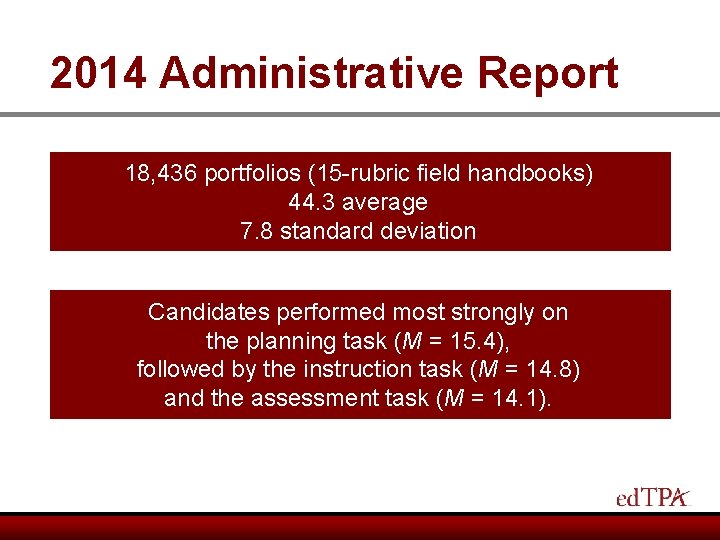
2014 Administrative Report 18, 436 portfolios (15 -rubric field handbooks) 44. 3 average 7. 8 standard deviation Candidates performed most strongly on the planning task (M = 15. 4), followed by the instruction task (M = 14. 8) and the assessment task (M = 14. 1).
Additional Sources of Information ed. TPA. com ed. TPA. aacte. org
- Slides: 24