
Al shaikh Diabetic ketoacidosis and hyperosmolar hyperglycaemic state
Al shaikh Diabetic ketoacidosis and hyperosmolar hyperglycaemic state Abdulrahman Al shaikh. Asso professor, consultant endo. Slides current until 2008
DKA and HHS What is DKA? Al shaikh Curriculum Module III-6 Slide 2 of 55 High blood glucose, ketones, acidosis and dehydration • Absolute or relative insulin deficiency • Increase in counter-regulatory hormones • Breakdown of fat and muscle • Biochemical triad – hyperglycaemia – ketoacids – metabolic acidosis Slides current until 2008
DKA and HHS Incidence of DKA Curriculum Module III-6 Slide 3 of 55 • Varies • Death mainly from cerebral oedema • Most common at onset in type 1 diabetes • Recurrent episodes Al shaikh • Can occur in type 2 diabetes Kitabchi et al 2001, Joslin 2005 Slides current until 2008
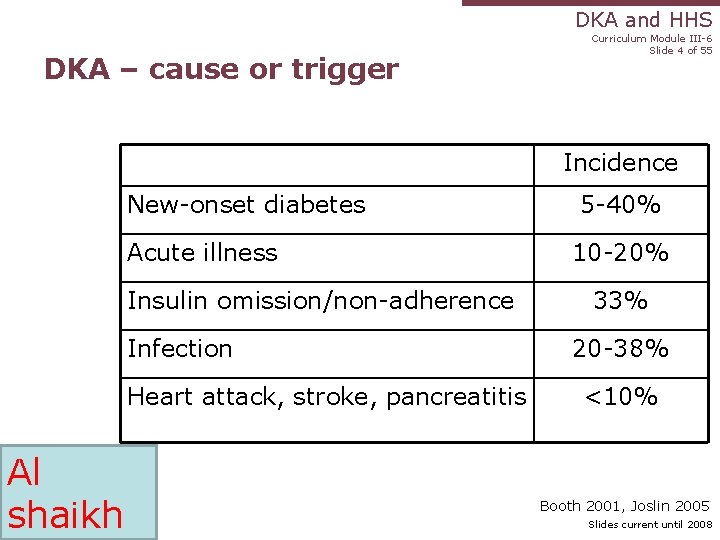
DKA and HHS Curriculum Module III-6 Slide 4 of 55 DKA – cause or trigger Incidence New-onset diabetes 5 -40% Acute illness 10 -20% Insulin omission/non-adherence Infection 20 -38% Heart attack, stroke, pancreatitis Al shaikh 33% <10% Booth 2001, Joslin 2005 Slides current until 2008
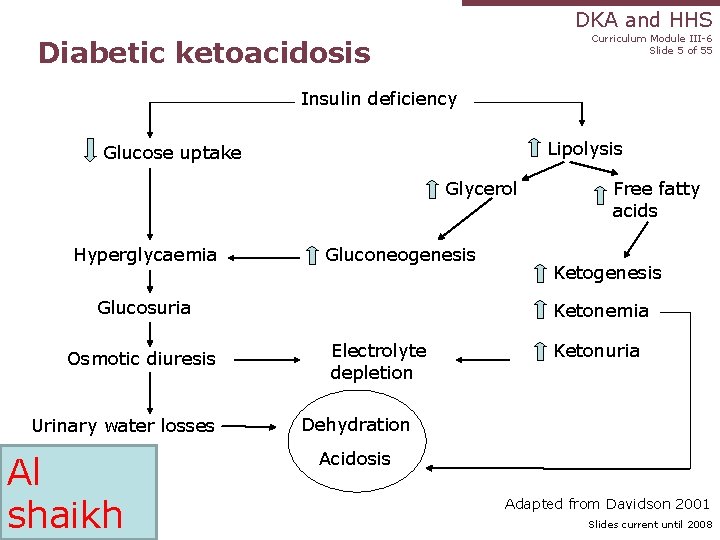
DKA and HHS Curriculum Module III-6 Slide 5 of 55 Diabetic ketoacidosis Insulin deficiency Lipolysis Glucose uptake Glycerol Hyperglycaemia Gluconeogenesis Glucosuria Osmotic diuresis Urinary water losses Al shaikh Free fatty acids Ketogenesis Ketonemia Electrolyte depletion Ketonuria Dehydration Acidosis Adapted from Davidson 2001 Slides current until 2008
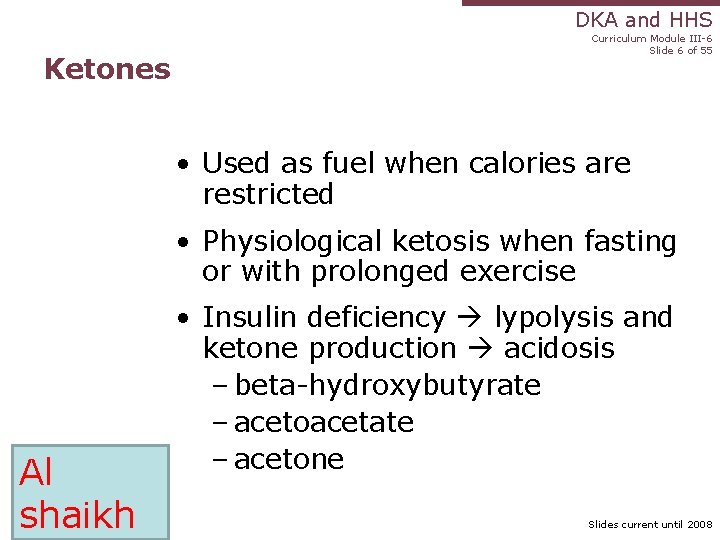
DKA and HHS Ketones Curriculum Module III-6 Slide 6 of 55 • Used as fuel when calories are restricted • Physiological ketosis when fasting or with prolonged exercise Al shaikh • Insulin deficiency lypolysis and ketone production acidosis – beta-hydroxybutyrate – acetoacetate – acetone Slides current until 2008
DKA and HHS Ketones Curriculum Module III-6 Slide 7 of 55 • Beta-hydroxybutyrate predominant – not detected by test strips or acetone tablets • Ketoacidosis may be present without detectable urinary ketones Al shaikh • Blood ketone testing may enable early identification of DKA Slides current until 2008
DKA and HHS Earlier clinical symptoms and signs of DKA Curriculum Module III-6 Slide 8 of 55 • Polyuria • Polydipsia • Polyphagia • Tiredness • Muscle cramps Al shaikh • Flushed facial appearance Slides current until 2008
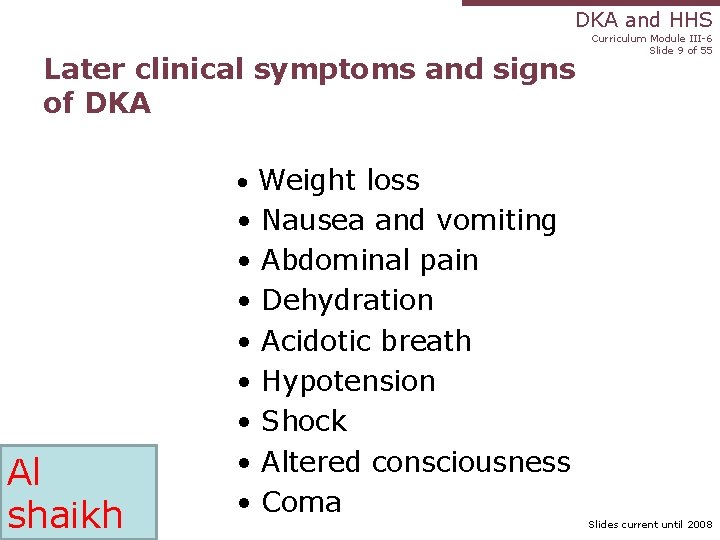
DKA and HHS Later clinical symptoms and signs of DKA Curriculum Module III-6 Slide 9 of 55 • Weight loss Al shaikh • • Nausea and vomiting Abdominal pain Dehydration Acidotic breath Hypotension Shock Altered consciousness Coma Slides current until 2008

DKA and HHS DKA – investigations Curriculum Module III-6 Slide 10 of 55 Immediate for diagnosis • Capillary blood glucose, urinary glucose and ketones Urgent for assessment and treatment • Blood glucose • Blood gases • Electrolytes, urea, creatinine • WBC Al shaikh Consider • Cardiac monitor • Blood culture, urine culture • Chest X-ray Slides current until 2008
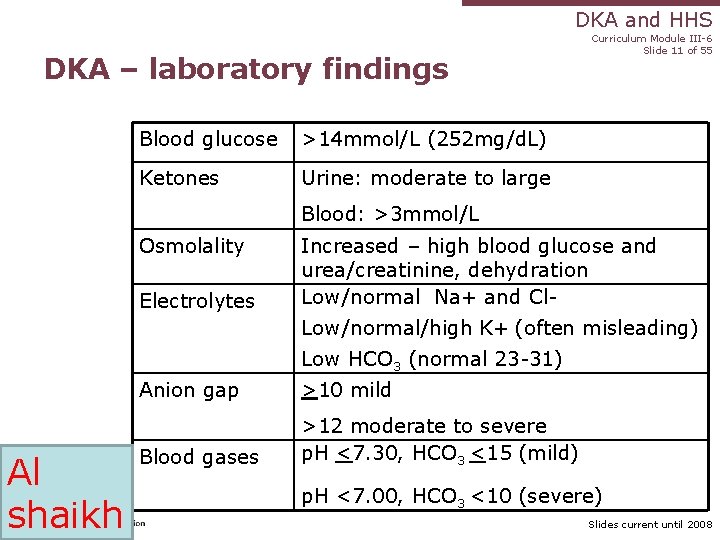
DKA and HHS DKA – laboratory findings Blood glucose >14 mmol/L (252 mg/d. L) Ketones Urine: moderate to large Curriculum Module III-6 Slide 11 of 55 Blood: >3 mmol/L Osmolality Electrolytes Increased – high blood glucose and urea/creatinine, dehydration Low/normal Na+ and Cl. Low/normal/high K+ (often misleading) Low HCO 3 (normal 23 -31) Al shaikh Anion gap >10 mild Blood gases >12 moderate to severe p. H <7. 30, HCO 3 <15 (mild) p. H <7. 00, HCO 3 <10 (severe) Slides current until 2008
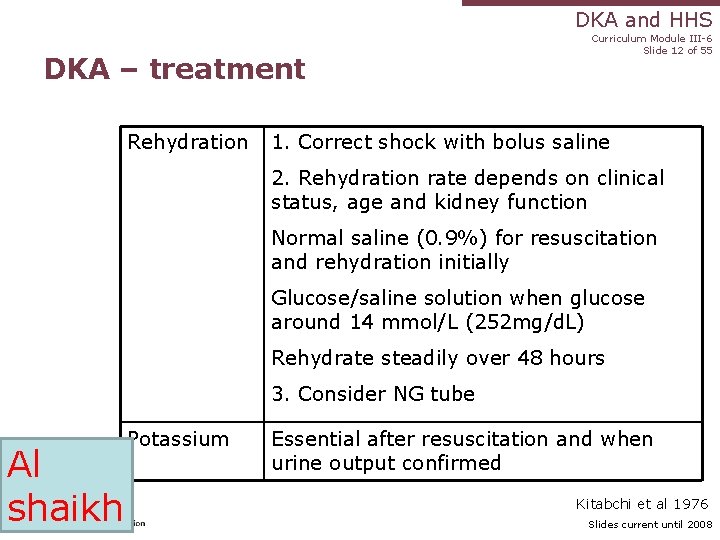
DKA and HHS DKA – treatment Rehydration Curriculum Module III-6 Slide 12 of 55 1. Correct shock with bolus saline 2. Rehydration rate depends on clinical status, age and kidney function Normal saline (0. 9%) for resuscitation and rehydration initially Glucose/saline solution when glucose around 14 mmol/L (252 mg/d. L) Rehydrate steadily over 48 hours 3. Consider NG tube Al shaikh Potassium Essential after resuscitation and when urine output confirmed Kitabchi et al 1976 Slides current until 2008
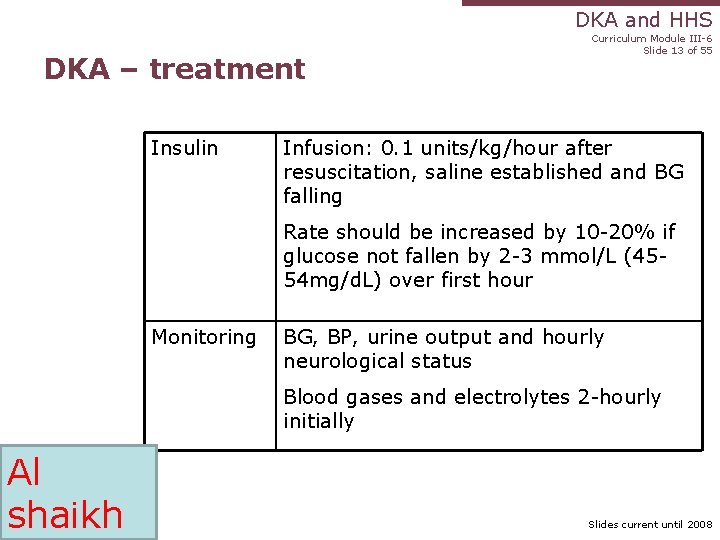
DKA and HHS DKA – treatment Insulin Curriculum Module III-6 Slide 13 of 55 Infusion: 0. 1 units/kg/hour after resuscitation, saline established and BG falling Rate should be increased by 10 -20% if glucose not fallen by 2 -3 mmol/L (4554 mg/d. L) over first hour Monitoring BG, BP, urine output and hourly neurological status Blood gases and electrolytes 2 -hourly initially Al shaikh Slides current until 2008
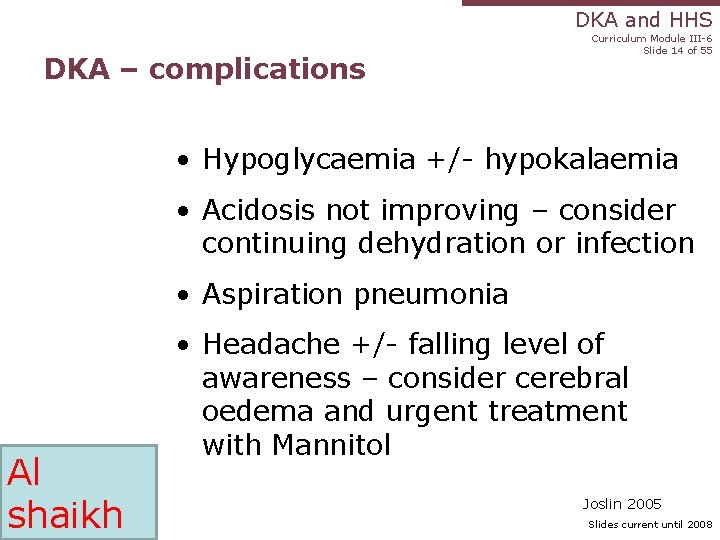
DKA and HHS DKA – complications Curriculum Module III-6 Slide 14 of 55 • Hypoglycaemia +/- hypokalaemia • Acidosis not improving – consider continuing dehydration or infection • Aspiration pneumonia Al shaikh • Headache +/- falling level of awareness – consider cerebral oedema and urgent treatment with Mannitol Joslin 2005 Slides current until 2008
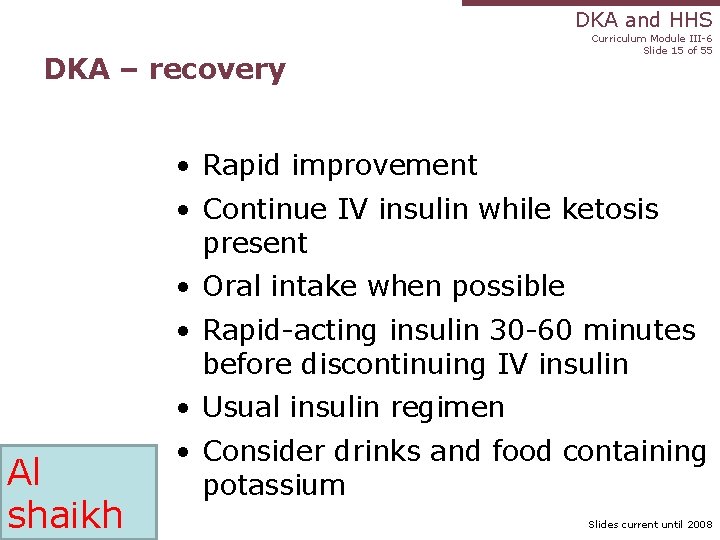
DKA and HHS DKA – recovery Curriculum Module III-6 Slide 15 of 55 • Rapid improvement • Continue IV insulin while ketosis present • Oral intake when possible • Rapid-acting insulin 30 -60 minutes before discontinuing IV insulin • Usual insulin regimen Al shaikh • Consider drinks and food containing potassium Slides current until 2008

DKA and HHS Curriculum Module III-6 Slide 16 of 55 What is HHS? • Ketosis may be present • Coma not always present • Primarily in older people with/without history of type 2 diabetes Al shaikh • Always associated with severe dehydration and hyperosmolar state • Develops over weeks Kitabchi et al 2001 Slides current until 2008
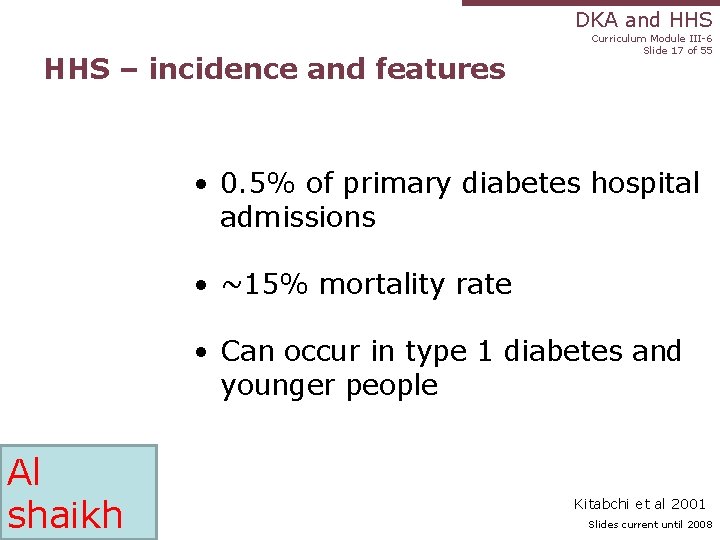
DKA and HHS – incidence and features Curriculum Module III-6 Slide 17 of 55 • 0. 5% of primary diabetes hospital admissions • ~15% mortality rate • Can occur in type 1 diabetes and younger people Al shaikh Kitabchi et al 2001 Slides current until 2008
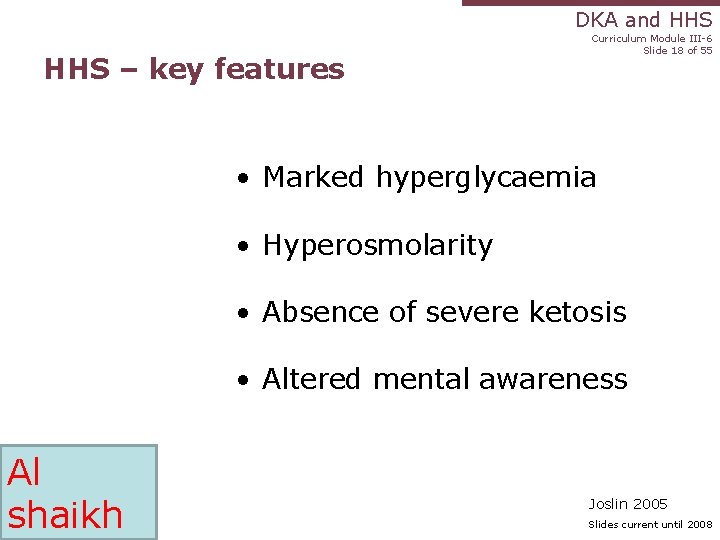
DKA and HHS – key features Curriculum Module III-6 Slide 18 of 55 • Marked hyperglycaemia • Hyperosmolarity • Absence of severe ketosis • Altered mental awareness Al shaikh Joslin 2005 Slides current until 2008
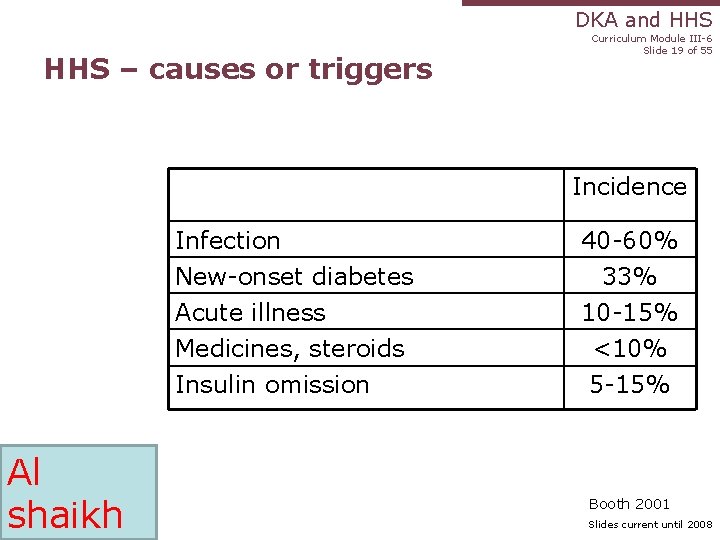
DKA and HHS – causes or triggers Curriculum Module III-6 Slide 19 of 55 Incidence Infection New-onset diabetes 40 -60% 33% Acute illness Medicines, steroids 10 -15% <10% Insulin omission Al shaikh 5 -15% Booth 2001 Slides current until 2008
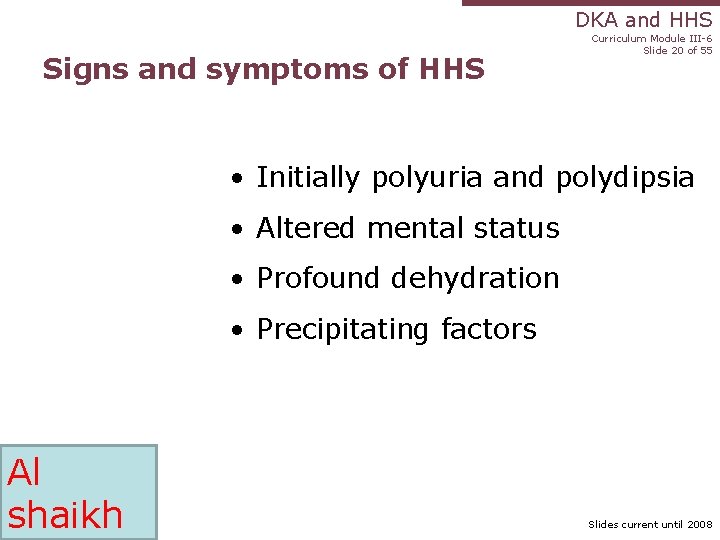
DKA and HHS Signs and symptoms of HHS Curriculum Module III-6 Slide 20 of 55 • Initially polyuria and polydipsia • Altered mental status • Profound dehydration • Precipitating factors Al shaikh Slides current until 2008
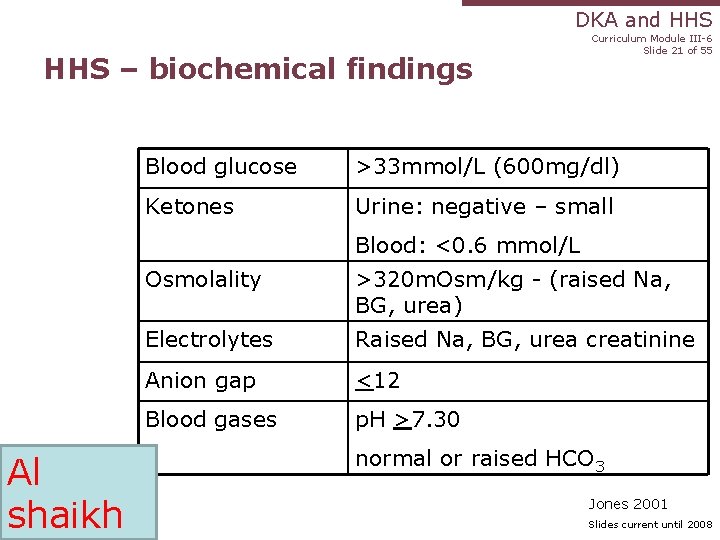
DKA and HHS – biochemical findings Curriculum Module III-6 Slide 21 of 55 Blood glucose >33 mmol/L (600 mg/dl) Ketones Urine: negative – small Blood: <0. 6 mmol/L Al shaikh Osmolality >320 m. Osm/kg - (raised Na, BG, urea) Electrolytes Raised Na, BG, urea creatinine Anion gap <12 Blood gases p. H >7. 30 normal or raised HCO 3 Jones 2001 Slides current until 2008
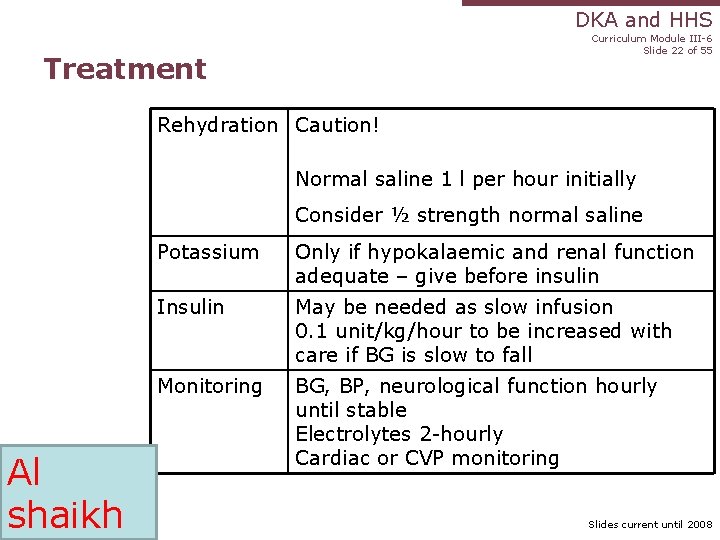
DKA and HHS Curriculum Module III-6 Slide 22 of 55 Treatment Rehydration Caution! Normal saline 1 l per hour initially Consider ½ strength normal saline Al shaikh Potassium Only if hypokalaemic and renal function adequate – give before insulin Insulin May be needed as slow infusion 0. 1 unit/kg/hour to be increased with care if BG is slow to fall Monitoring BG, BP, neurological function hourly until stable Electrolytes 2 -hourly Cardiac or CVP monitoring Slides current until 2008
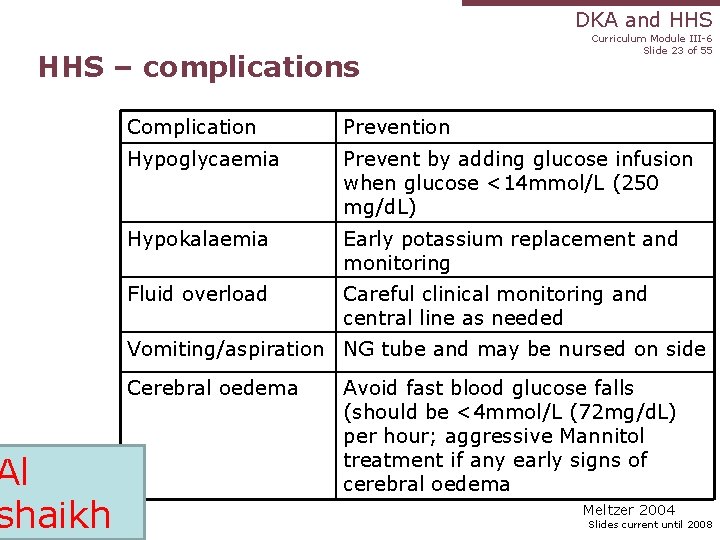
DKA and HHS – complications Al shaikh Curriculum Module III-6 Slide 23 of 55 Complication Prevention Hypoglycaemia Prevent by adding glucose infusion when glucose <14 mmol/L (250 mg/d. L) Hypokalaemia Early potassium replacement and monitoring Fluid overload Careful clinical monitoring and central line as needed Vomiting/aspiration NG tube and may be nursed on side Cerebral oedema Avoid fast blood glucose falls (should be <4 mmol/L (72 mg/d. L) per hour; aggressive Mannitol treatment if any early signs of cerebral oedema Meltzer 2004 Slides current until 2008
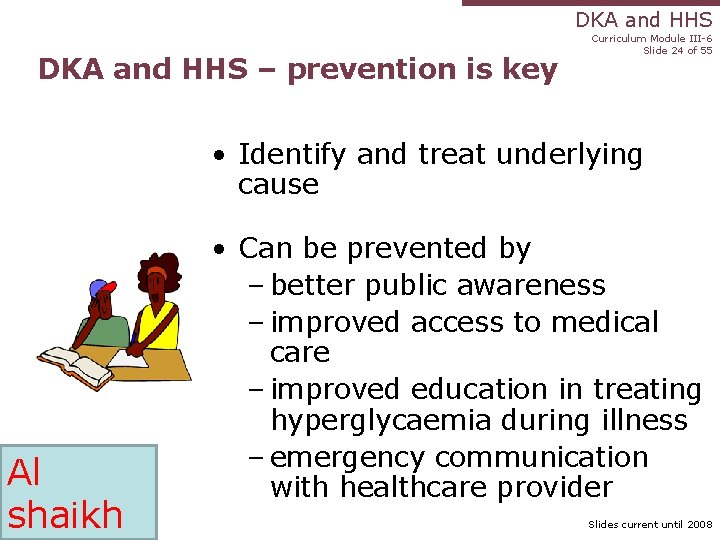
DKA and HHS – prevention is key Curriculum Module III-6 Slide 24 of 55 • Identify and treat underlying cause Al shaikh • Can be prevented by – better public awareness – improved access to medical care – improved education in treating hyperglycaemia during illness – emergency communication with healthcare provider Slides current until 2008
Managing diabetes during illness Slides current until 2008
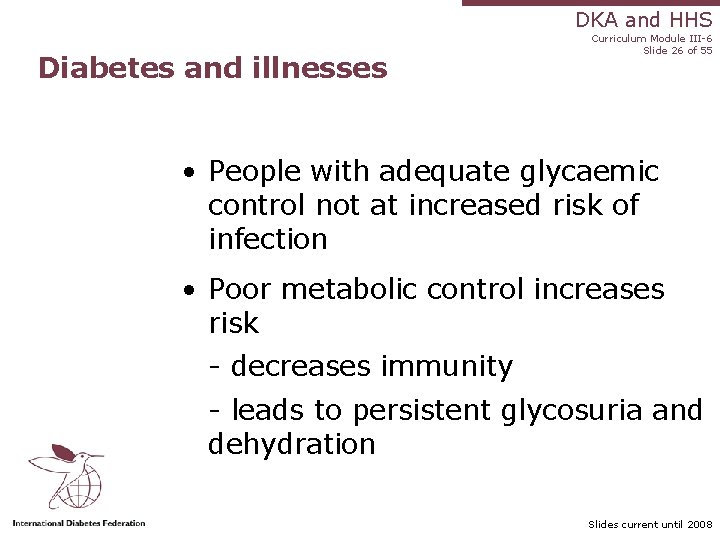
DKA and HHS Diabetes and illnesses Curriculum Module III-6 Slide 26 of 55 • People with adequate glycaemic control not at increased risk of infection • Poor metabolic control increases risk - decreases immunity - leads to persistent glycosuria and dehydration Slides current until 2008
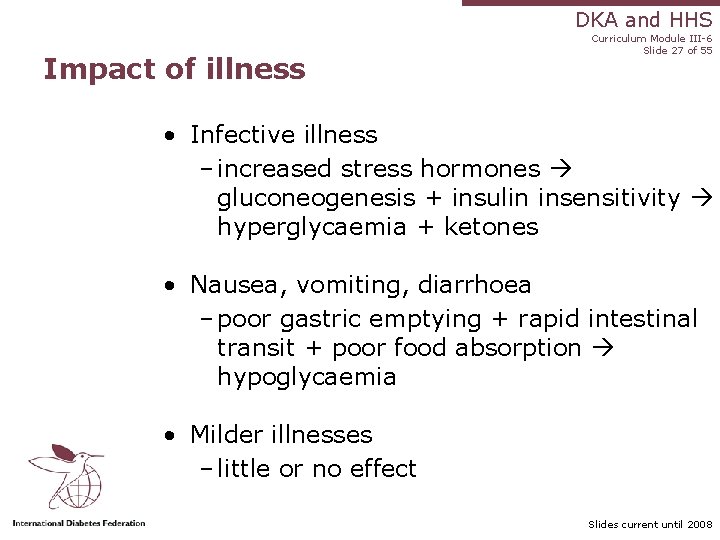
DKA and HHS Impact of illness Curriculum Module III-6 Slide 27 of 55 • Infective illness – increased stress hormones gluconeogenesis + insulin insensitivity hyperglycaemia + ketones • Nausea, vomiting, diarrhoea – poor gastric emptying + rapid intestinal transit + poor food absorption hypoglycaemia • Milder illnesses – little or no effect Slides current until 2008
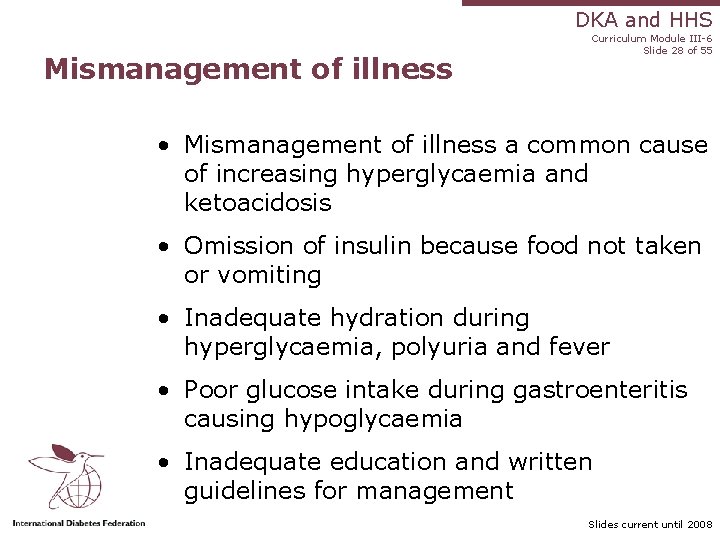
DKA and HHS Mismanagement of illness Curriculum Module III-6 Slide 28 of 55 • Mismanagement of illness a common cause of increasing hyperglycaemia and ketoacidosis • Omission of insulin because food not taken or vomiting • Inadequate hydration during hyperglycaemia, polyuria and fever • Poor glucose intake during gastroenteritis causing hypoglycaemia • Inadequate education and written guidelines for management Slides current until 2008
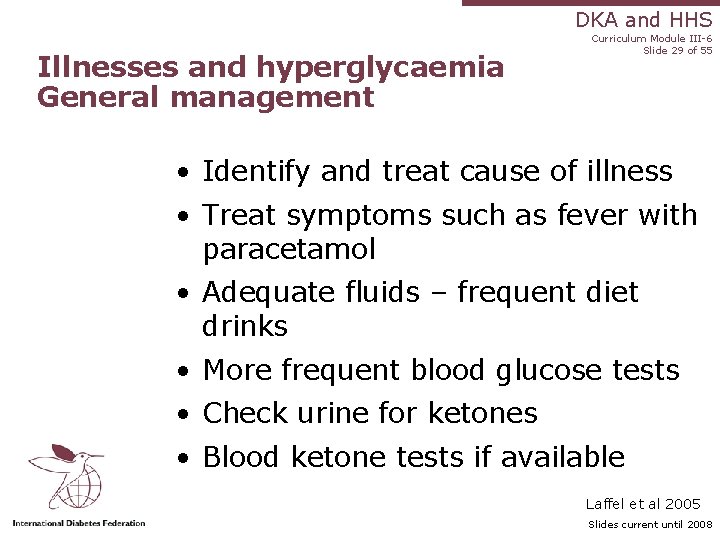
DKA and HHS Illnesses and hyperglycaemia General management Curriculum Module III-6 Slide 29 of 55 • Identify and treat cause of illness • Treat symptoms such as fever with paracetamol • Adequate fluids – frequent diet drinks • More frequent blood glucose tests • Check urine for ketones • Blood ketone tests if available Laffel et al 2005 Slides current until 2008
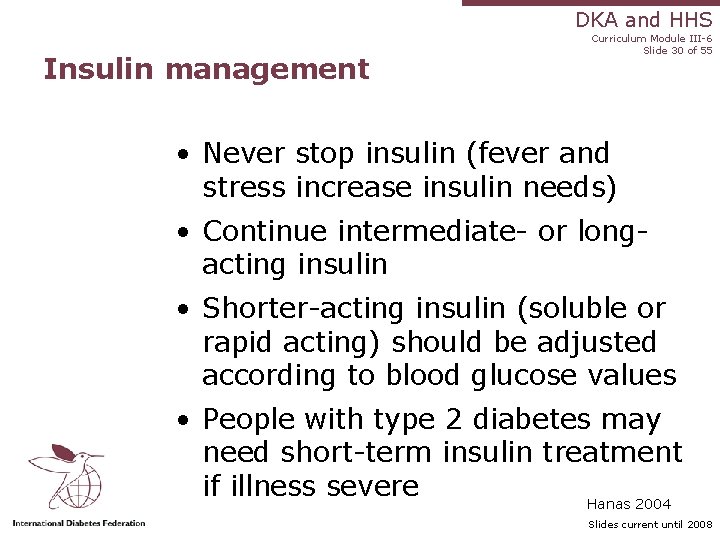
DKA and HHS Insulin management Curriculum Module III-6 Slide 30 of 55 • Never stop insulin (fever and stress increase insulin needs) • Continue intermediate- or longacting insulin • Shorter-acting insulin (soluble or rapid acting) should be adjusted according to blood glucose values • People with type 2 diabetes may need short-term insulin treatment if illness severe Hanas 2004 Slides current until 2008
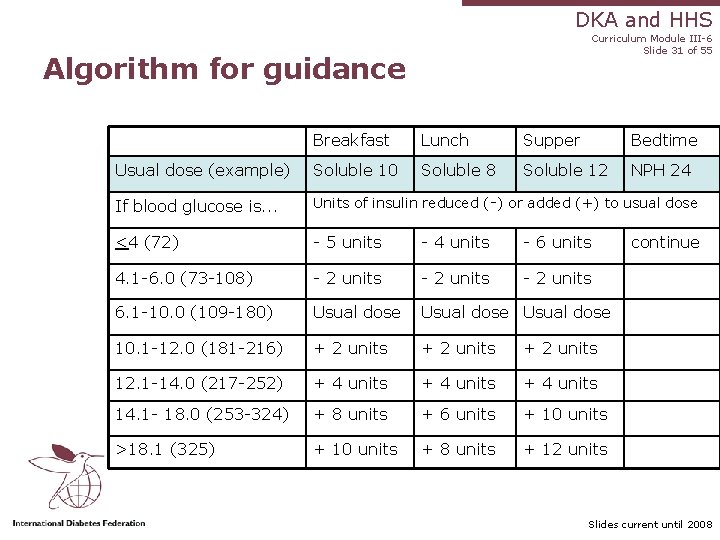
DKA and HHS Curriculum Module III-6 Slide 31 of 55 Algorithm for guidance Breakfast Lunch Supper Bedtime Usual dose (example) Soluble 10 Soluble 8 Soluble 12 NPH 24 If blood glucose is. . . Units of insulin reduced (-) or added (+) to usual dose <4 (72) - 5 units - 4 units - 6 units 4. 1 -6. 0 (73 -108) - 2 units 6. 1 -10. 0 (109 -180) Usual dose 10. 1 -12. 0 (181 -216) + 2 units 12. 1 -14. 0 (217 -252) + 4 units 14. 1 - 18. 0 (253 -324) + 8 units + 6 units + 10 units >18. 1 (325) + 10 units + 8 units + 12 units continue Slides current until 2008
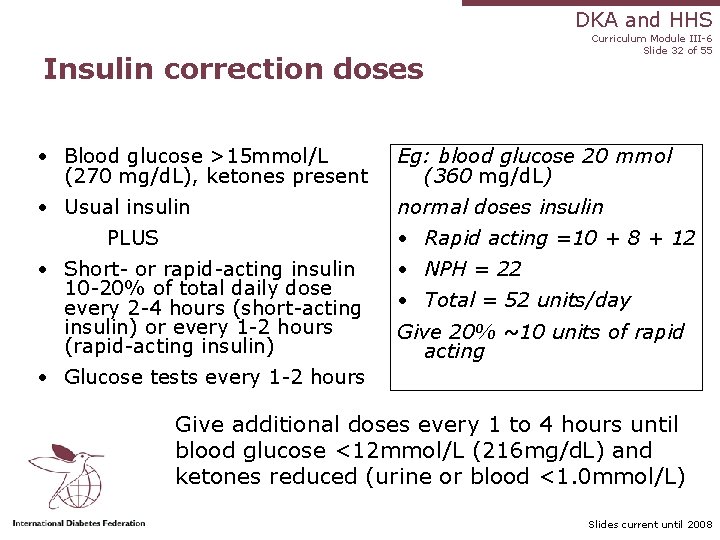
DKA and HHS Insulin correction doses Curriculum Module III-6 Slide 32 of 55 • Blood glucose >15 mmol/L (270 mg/d. L), ketones present Eg: blood glucose 20 mmol (360 mg/d. L) • Usual insulin normal doses insulin • Rapid acting =10 + 8 + 12 PLUS • Short- or rapid-acting insulin 10 -20% of total daily dose every 2 -4 hours (short-acting insulin) or every 1 -2 hours (rapid-acting insulin) • NPH = 22 • Total = 52 units/day Give 20% ~10 units of rapid acting • Glucose tests every 1 -2 hours Give additional doses every 1 to 4 hours until blood glucose <12 mmol/L (216 mg/d. L) and ketones reduced (urine or blood <1. 0 mmol/L) Slides current until 2008
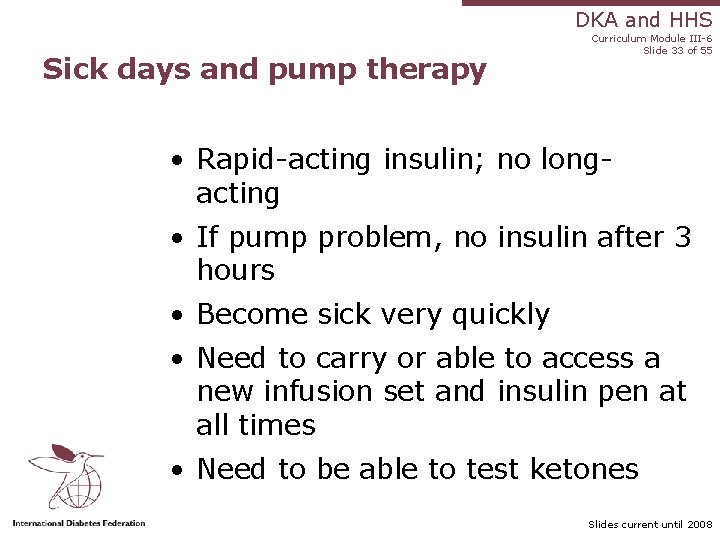
DKA and HHS Sick days and pump therapy Curriculum Module III-6 Slide 33 of 55 • Rapid-acting insulin; no longacting • If pump problem, no insulin after 3 hours • Become sick very quickly • Need to carry or able to access a new infusion set and insulin pen at all times • Need to be able to test ketones Slides current until 2008
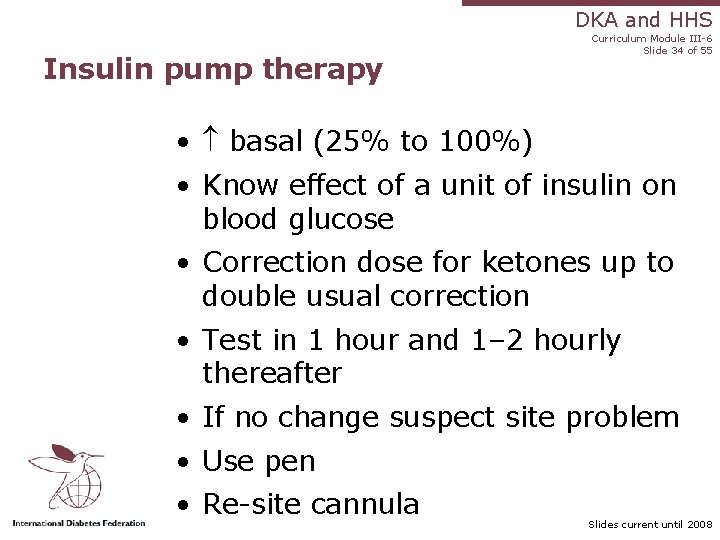
DKA and HHS Insulin pump therapy Curriculum Module III-6 Slide 34 of 55 • basal (25% to 100%) • Know effect of a unit of insulin on blood glucose • Correction dose for ketones up to double usual correction • Test in 1 hour and 1– 2 hourly thereafter • If no change suspect site problem • Use pen • Re-site cannula Slides current until 2008
DKA and HHS Food tolerance Curriculum Module III-6 Slide 35 of 55 Insulin must be given but may be reduced Eg: blood glucose 10 -12 mmol/L (180 -216 mg/d. L) • About 150 ml sweetened fluids each hour to hydrate and avoid hypoglycaemia • If feverish, additional 150 ml lowcalorie fluid each hour may be needed for re-hydration Slides current until 2008
DKA and HHS Food tolerance Curriculum Module III-6 Slide 36 of 55 If unable to tolerate food Eg: blood glucose >15 mmol/L (270 mg/d. L) (additional insulin needed as above) • Give 150 ml to 300 ml of low-calorie fluid each hour for hydration and to help blood glucose to fall • Monitor blood glucose every 1 -2 hours Slides current until 2008
DKA and HHS ACTIVITY Curriculum Module III-6 Slide 37 of 55 Provide a list of drinks easily available in your community that are suitable for an ill person with diabetes who is nauseated and unable to eat food. Slides current until 2008
DKA and HHS When to seek professional help Curriculum Module III-6 Slide 38 of 55 Advise to call the physician or nurse if. . . • Uncertain of diagnosis • Persistent vomiting or diarrhoea (3 episodes or more within 6 hours) • Unwell for 2 days and not getting better • Blood glucose remains above 15 mmol/L (270 mg/d. L) despite extra fluid and insulin • Moderate to large ketones persist, despite extra fluid and insulin Slides current until 2008
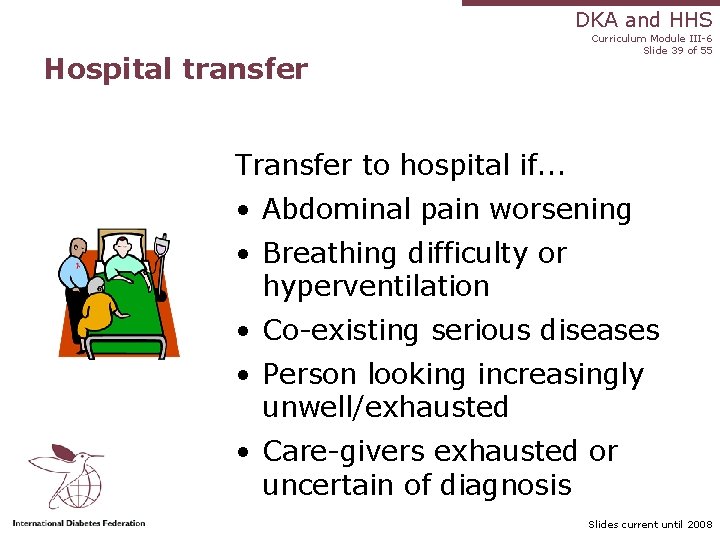
DKA and HHS Hospital transfer Curriculum Module III-6 Slide 39 of 55 Transfer to hospital if. . . • Abdominal pain worsening • Breathing difficulty or hyperventilation • Co-existing serious diseases • Person looking increasingly unwell/exhausted • Care-givers exhausted or uncertain of diagnosis Slides current until 2008
DKA and HHS ACTIVITY Type 2 diabetes Curriculum Module III-6 Slide 40 of 55 • Mr M: 20 years, type 2 diabetes – maximal sulphonylureas and metformin – twice a day intermediate acting insulin • Presented with 12 hours diarrhoea, nausea, no appetite • What do you do? Stop tablets, remain on insulin, or stop Slides current until 2008 insulin and remain on tablets?
DKA and HHS Type 2 diabetes Curriculum Module III-6 Slide 41 of 55 • Metformin can aggravate gut problems • Often easier to cease medication and continue insulin • Easier to control glucose levels with insulin; may need reduced dose • Re-introduce oral medication when food intake normal and symptoms subside Slides current until 2008
DKA and HHS Curriculum Module III-6 Slide 42 of 55 Type 2 diabetes Metformin • Cease 24 hours before surgery • Restart! Slides current until 2008
DKA and HHS Develop clear plans for sick days Curriculum Module III-6 Slide 43 of 55 • Make written guideline available and review plans with all people with diabetes regularly • Determine when healthcare provider should be contacted or alerted • Establish blood glucose goals for sick days Adapted from: Diab Care 2004; 27 Suppl 1 Slides current until 2008
DKA and HHS Develop clear plans for sick days Curriculum Module III-6 Slide 44 of 55 • Define how to use supplemental short-acting insulin • Explain how to use a fluid diet when unable to eat • Explain what equipment is required Slides current until 2008
DKA and HHS Education tips Curriculum Module III-6 Slide 45 of 55 • Under-treated sick days are a common cause of diabetic ketoacidosis and hospitalization • At each annual complication assessment, ask your patient to solve a sick-day scenario • Access a 24 -hour hotline Slides current until 2008
DKA and HHS Summary – diabetes and illness Curriculum Module III-6 Slide 46 of 55 • Never stop insulin • Do more blood glucose tests – high blood glucose levels means more insulin • In case of loss of appetite, eat foods that are easy to digest and drink more sugar-free fluids • In case of vomiting, drink frequent small volumes of carb-containing fluids Slides current until 2008
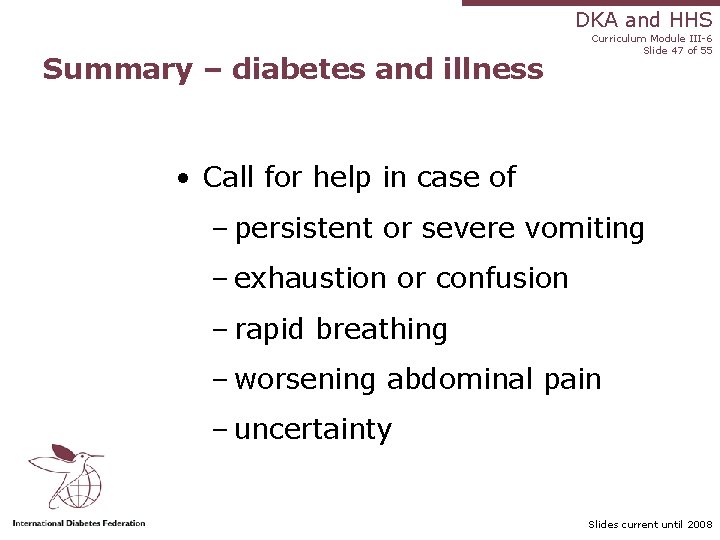
DKA and HHS Summary – diabetes and illness Curriculum Module III-6 Slide 47 of 55 • Call for help in case of – persistent or severe vomiting – exhaustion or confusion – rapid breathing – worsening abdominal pain – uncertainty Slides current until 2008
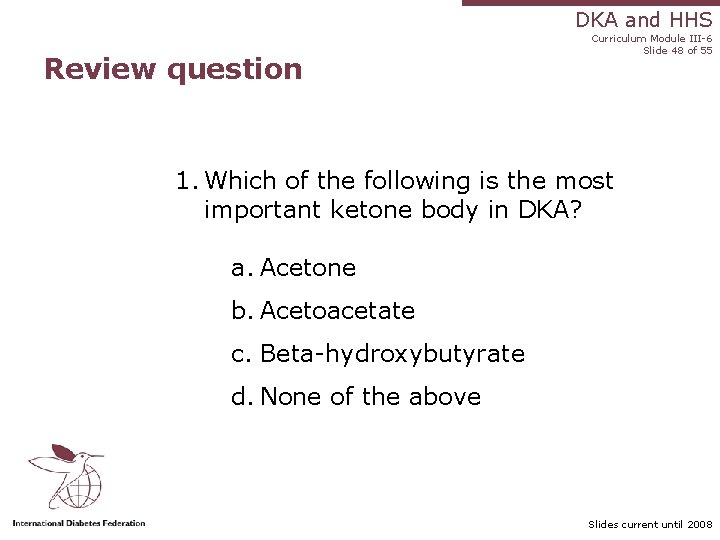
DKA and HHS Review question Curriculum Module III-6 Slide 48 of 55 1. Which of the following is the most important ketone body in DKA? a. Acetone b. Acetoacetate c. Beta-hydroxybutyrate d. None of the above Slides current until 2008
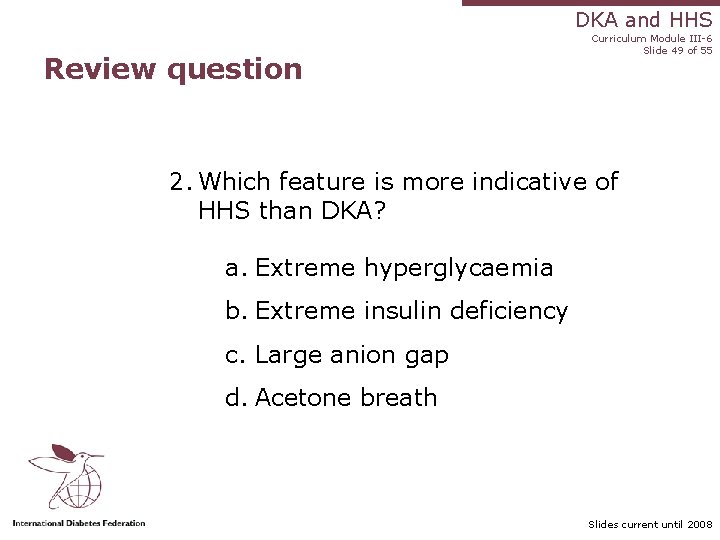
DKA and HHS Review question Curriculum Module III-6 Slide 49 of 55 2. Which feature is more indicative of HHS than DKA? a. Extreme hyperglycaemia b. Extreme insulin deficiency c. Large anion gap d. Acetone breath Slides current until 2008
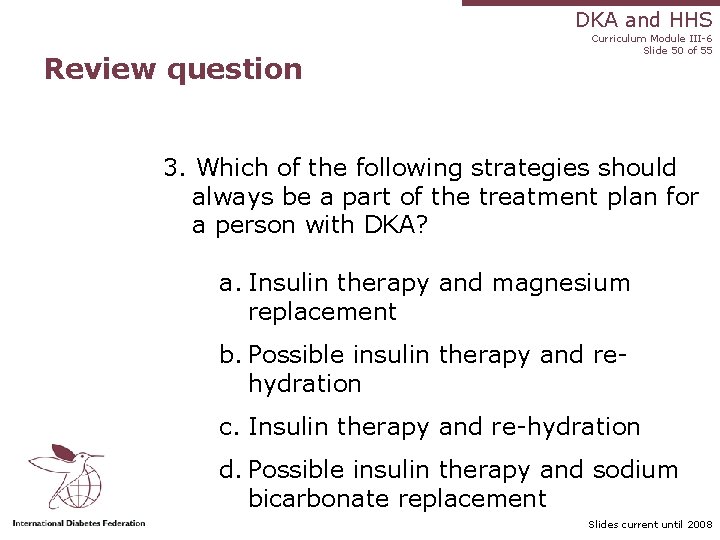
DKA and HHS Review question Curriculum Module III-6 Slide 50 of 55 3. Which of the following strategies should always be a part of the treatment plan for a person with DKA? a. Insulin therapy and magnesium replacement b. Possible insulin therapy and rehydration c. Insulin therapy and re-hydration d. Possible insulin therapy and sodium bicarbonate replacement Slides current until 2008
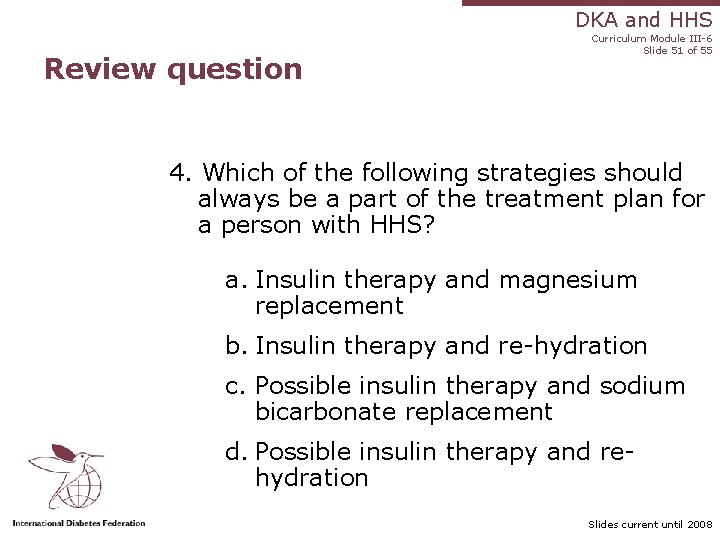
DKA and HHS Review question Curriculum Module III-6 Slide 51 of 55 4. Which of the following strategies should always be a part of the treatment plan for a person with HHS? a. Insulin therapy and magnesium replacement b. Insulin therapy and re-hydration c. Possible insulin therapy and sodium bicarbonate replacement d. Possible insulin therapy and rehydration Slides current until 2008
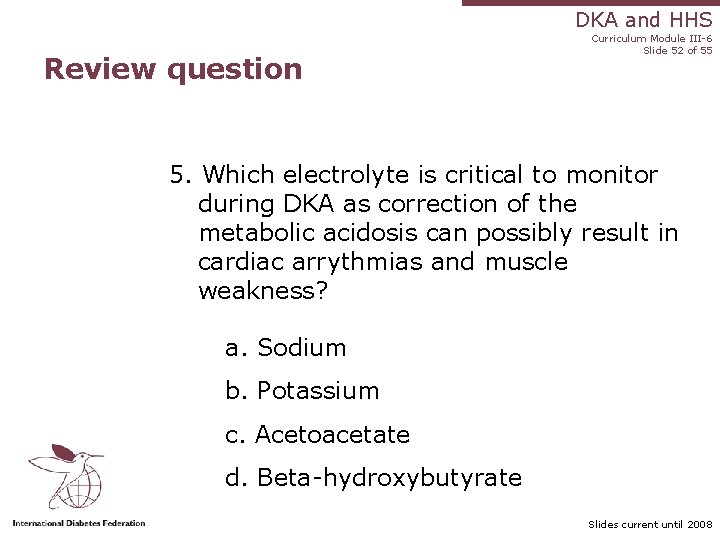
DKA and HHS Review question Curriculum Module III-6 Slide 52 of 55 5. Which electrolyte is critical to monitor during DKA as correction of the metabolic acidosis can possibly result in cardiac arrythmias and muscle weakness? a. Sodium b. Potassium c. Acetoacetate d. Beta-hydroxybutyrate Slides current until 2008
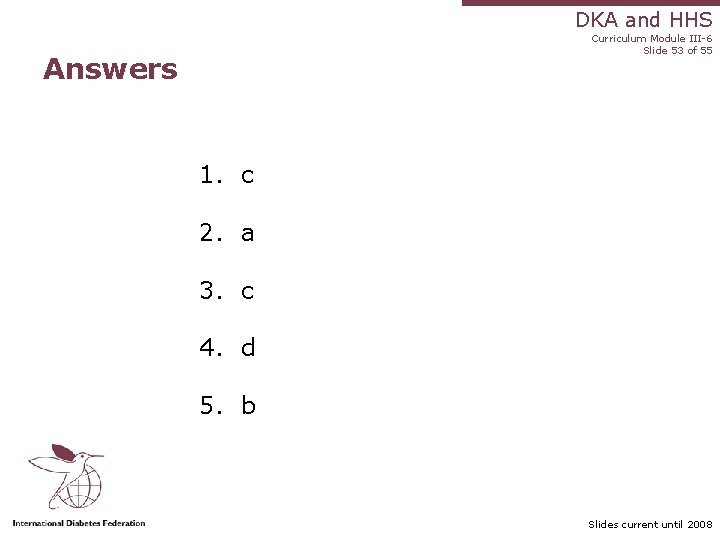
DKA and HHS Curriculum Module III-6 Slide 53 of 55 Answers 1. c 2. a 3. c 4. d 5. b Slides current until 2008
DKA and HHS References – DKA and HHS Curriculum Module III-6 Slide 54 of 55 1. Booth GL. Short-Term Clinical Consequences of diabetes. In H. Gerstein & RB Haynes (EDs. ), Hamilton: BC Decker. Evidence-Based Diabetes Care 2001; 75 -90. 2. Jones H, Cleave B, Fredericks C, Hamilton C, Opsteen C. Building Competency in Diabetes education: the essentials. Canadian Diabetes Association, Canada, 2001. 3. Kitabchi AE, Umpierrez GE, Murphy MB, et al. Management of hyperglycemic crises in patients with diabetes. Diabetes Care 2001; 24(1): 131 -53. 4. Kitabchi AE, Ayyagari V, Guerra SMO. The efficacy of low dose versus conventional therapy of insulin for treament of DKA. Ann Int Med 1976; 84: 633 -8. 5. American Diabetes Association. Hyperglycemic crisis in patients with diabetes. Diabetes Care 2001; 26(S 1): S 109 -17. 6. Meltzer S, Yale JF, Belton AB, Clement M. Eds. Practical Diabetes Management; Clinical support for primary care physicians 5 th ed. Canadian Diabetes Association, Canada, 2004. 7. Davidson MB. Hyperglycemia. In: Franz MJ, ed. A Core Curriculum for Diabetes Education: Diabetes and Complications. 4 th ed. Chicago: American Association of Diabetes Educators 2001; 23. 8. Joslin’s Diabetes Mellitus. Eds Kahn CR, Weir GC et al. Publ Lippincott Williams & Wilkins, Philadelphia, 2005; 53. Slides current until 2008
DKA and HHS References – managing illness Curriculum Module III-6 Slide 55 of 55 1. Hyperglycemic crises in diabetes. ADA position statement. Diab Care 2004; 27 (Suppl 1). 2. Hanas R. Type 1 diabetes in children, adolescents and young adults. 2 nd edition 2004. Publ Class Publishing, London 3. Laffel L, Pasquarello C, Lawlor M. Treatment of the child and adolescent with diabetes. Chap 35 in Joslin’s Textbook Diabetes. Publ Lippincott Williams & Wilkins, Philadelphia, 2005. Slides current until 2008
- Slides: 55