
AL BARAKAH MULTIPURPOSE COOPERATIVE SOCIETY LIMITED H O
AL BARAKAH MULTI-PURPOSE CO-OPERATIVE SOCIETY LIMITED H. O. : Madam Lolo Road, Rose Belle, Mauritius Tel: (+230) 6275766 E-mail: albarakahcoop@yahoo. com; www. albarakahcoop. org ISLAMIC FINANCIAL COOPERATIVE Case study of AL BARAKAH Multi-purpose Cooperative Society, Mauritius
Agenda • • • Introduction: The Islamic Finance industry The Coop Movement & Financial Cooperatives /CU Financial Cooperatives /Credit Unions Worldwide The Financial Cooperatives/ CU Movement and Islamic Financial Institutions Islamic Financial Cooperatives/Credit Unions Setting up Islamic Financial Cooperatives/CU/SACCO Financing Instruments of Islamic Financial Cooperatives/CU Reserves and other Funds of IFC/ICU Case Study of AL Barakah MCSL Mauritius and Africa Conclusion

Setting up Islamic Financial Coop/CU/ SACCOS in Africa • Conceptual Framework “Cooperate with all in what is good and pious and do not cooperate in what is sinful and wicked…” (Q-5: 2)- Ta’awoun • Legal Framework – Easy formation, less regulated than other corporate sector (Cooperatives Act , Credit Union Act); Shari'ahcompliant- WOCCU • Values: – IF based on Islamic ethics/values: justice, sharing, solidarity – Coop based on values: honesty, equity, solidarity, self-help, mutual-help etc • Common bond - IB • CBO (community-based organization) / Member-owned organization • Small seed capital – can promote saving culture among the community • Incentives & Benefits – Tax Relief in certain countries • Multi-purposes - open to various types of economic activity • Broaden ownership of business and reduce concentration of wealth • Democratisation of the IFS (SMFInst. )
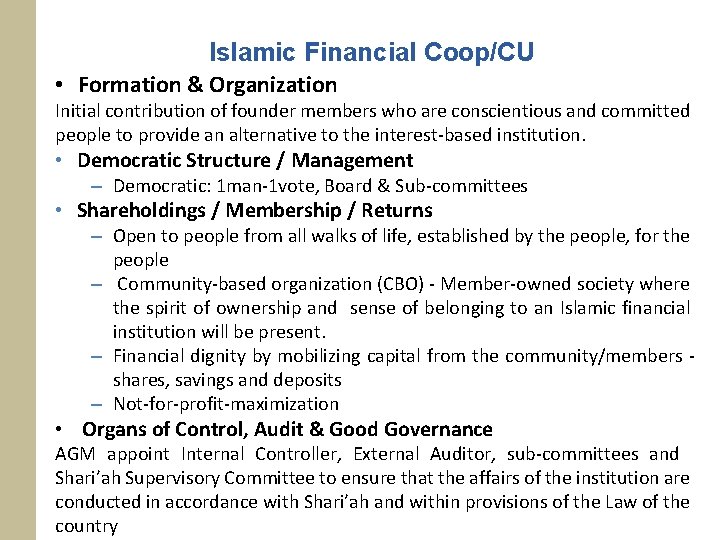
Islamic Financial Coop/CU • Formation & Organization Initial contribution of founder members who are conscientious and committed people to provide an alternative to the interest-based institution. • Democratic Structure / Management – Democratic: 1 man-1 vote, Board & Sub-committees • Shareholdings / Membership / Returns – Open to people from all walks of life, established by the people, for the people – Community-based organization (CBO) - Member-owned society where the spirit of ownership and sense of belonging to an Islamic financial institution will be present. – Financial dignity by mobilizing capital from the community/members shares, savings and deposits – Not-for-profit-maximization • Organs of Control, Audit & Good Governance AGM appoint Internal Controller, External Auditor, sub-committees and Shari’ah Supervisory Committee to ensure that the affairs of the institution are conducted in accordance with Shari’ah and within provisions of the Law of the country
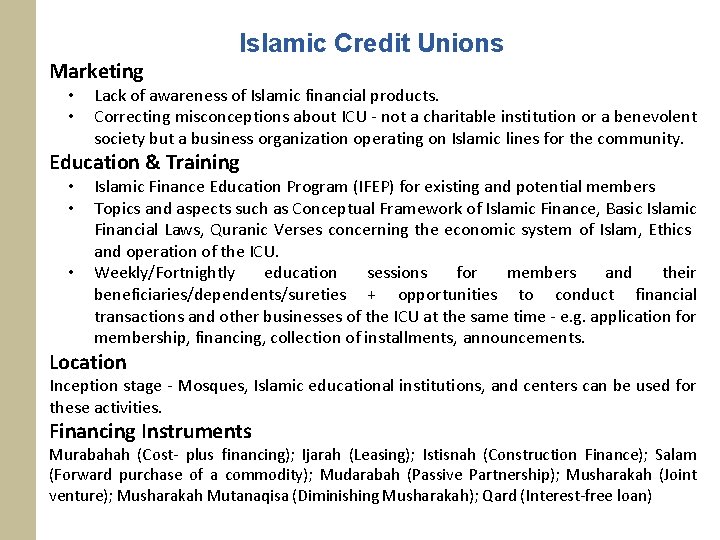
Islamic Credit Unions Marketing • • Lack of awareness of Islamic financial products. Correcting misconceptions about ICU - not a charitable institution or a benevolent society but a business organization operating on Islamic lines for the community. Education & Training • • • Islamic Finance Education Program (IFEP) for existing and potential members Topics and aspects such as Conceptual Framework of Islamic Finance, Basic Islamic Financial Laws, Quranic Verses concerning the economic system of Islam, Ethics and operation of the ICU. Weekly/Fortnightly education sessions for members and their beneficiaries/dependents/sureties + opportunities to conduct financial transactions and other businesses of the ICU at the same time - e. g. application for membership, financing, collection of installments, announcements. Location Inception stage - Mosques, Islamic educational institutions, and centers can be used for these activities. Financing Instruments Murabahah (Cost- plus financing); Ijarah (Leasing); Istisnah (Construction Finance); Salam (Forward purchase of a commodity); Mudarabah (Passive Partnership); Musharakah (Joint venture); Musharakah Mutanaqisa (Diminishing Musharakah); Qard (Interest-free loan)
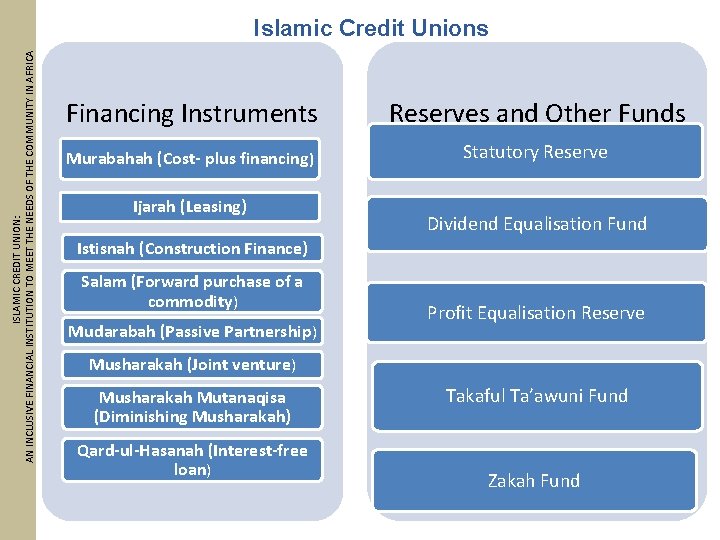
ISLAMIC CREDIT UNION: AN INCLUSIVE FINANCIAL INSTITUTION TO MEET THE NEEDS OF THE COMMUNITY IN AFRICA Islamic Credit Unions Financing Instruments Reserves and Other Funds Murabahah (Cost- plus financing) Statutory Reserve Ijarah (Leasing) Dividend Equalisation Fund Istisnah (Construction Finance) Salam (Forward purchase of a commodity) Mudarabah (Passive Partnership) Profit Equalisation Reserve Musharakah (Joint venture) Musharakah Mutanaqisa (Diminishing Musharakah) Qard-ul-Hasanah (Interest-free loan) Takaful Ta’awuni Fund Zakah Fund
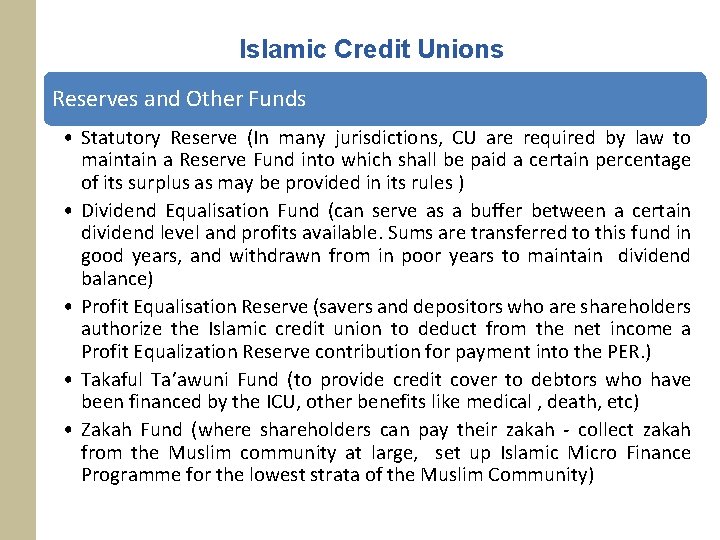
Islamic Credit Unions Reserves and Other Funds • Statutory Reserve (In many jurisdictions, CU are required by law to maintain a Reserve Fund into which shall be paid a certain percentage of its surplus as may be provided in its rules ) • Dividend Equalisation Fund (can serve as a buffer between a certain dividend level and profits available. Sums are transferred to this fund in good years, and withdrawn from in poor years to maintain dividend balance) • Profit Equalisation Reserve (savers and depositors who are shareholders authorize the Islamic credit union to deduct from the net income a Profit Equalization Reserve contribution for payment into the PER. ) • Takaful Ta’awuni Fund (to provide credit cover to debtors who have been financed by the ICU, other benefits like medical , death, etc) • Zakah Fund (where shareholders can pay their zakah - collect zakah from the Muslim community at large, set up Islamic Micro Finance Programme for the lowest strata of the Muslim Community)
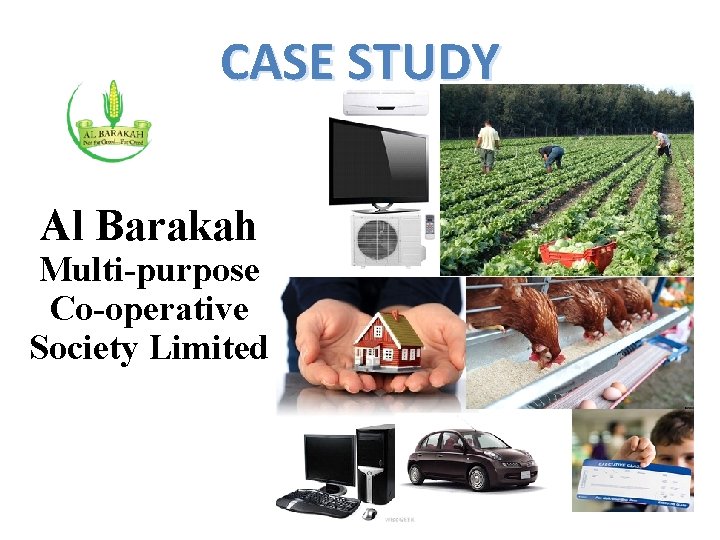
CASE STUDY Al Barakah Multi-purpose Co-operative Society Limited 8
Mauritius and Africa • Belonging to Africa, Mauritius is a dot on world map, but a reference in the region • Mauritius is a member of the African Union, Southern African Development Community (SADC), the Common Market for Eastern and Southern Africa (COMESA) and the Indian Ocean Rim – Association for Regional Cooperation (IOR-ARC). • In 2012 the Board of Investment of Mauritius launched the Africa Centre of Excellence to discover investment opportunities in the African continent, to provide information on Mauritian companies doing business in Africa, to facilitate joint venture opportunities between the international investors and local companies. • Mauritius has signed Investment Promotion and Protection Agreements (IPPAs) with 15 African countries • International Arbitration Act 2008 – Mauritius is increasingly being used as an arbitration jurisdiction and in particular as a centre for International Commercial and Investment Arbitration, in the African Region. • Chartered Institute of Logistics and Transport Africa Forum Meeting, Wednesday 09 March 2016
Facilities in Mauritius • Facilities in Mauritius - Liberalised Legal Services to enable foreign law firms to establish local offices or joint ventures with Mauritian lawyers • Air transportation sector, a historical agreement has been signed with Changi Airport Singapore for the establishment of an air corridor between Asia and Africa using Mauritius and Singapore as hubs. Air Mauritius has made good progress to increase the number of destinations and frequencies in Africa, which is also planning to operate to Dar-es-Salam and Maputo as from May this year. Other destinations such as Harare, Lusaka, Mbabane and Gaborone upcoming… ( PM Keynote Address ) • International banks operating in Mauritius – HSBC, Standard chartered • Bilingual – English, French & other Asian languages • Commitment of authorities to promulgate Islamic Finance in Mauritius • 2007: Adherence of the BOM as Associate Member to IFSB. Graduated to Full Membership in October 2008 • April 2009: Launch of Islamic window by HSBC Amanah and October 2009: Islamic banking license granted to Century Banking Corporation Ltd • 2010: Signing of Agreement for the establishment of International Islamic Liquidity Management Corporation (IILM). The BOM becomes founding member of IILM.
Why Mauritius • Impressive track record, political stability and more than 3 decades of sustained economic growth • Secure investment location with established rule of law • Freest and most business-friendly country in Africa • Peaceful, multi-ethnic with a unique lifestyle in a blend of cultures • Investment-friendly regulatory regime • Ocean State with one of the largest Exclusive Economic Zones in the world • Preferential market access to Africa, Europe and the USA • State-of-the-art infrastructure • Active double taxation agreement (DTA) with 43 countries Quick Facts GDP per capita: approx. USD 9, 200 * Moody’s Investors Service: BAA 1 (2015) Population: approx. 1. 3 million Political System: Democracy with free and fair elections held every 5 years Official Language: English Legal System: dual system (Common & Civil Law) GDP Growth: 3. 4% * Unemployment: 8% * * 2015 est.
Why Mauritius International Benchmarks No Index 1 World Bank Doing Business 2016 Global Rank 32 out of 189 countries 2 Global Competitiveness Index 2015 -2016 46 out of 140 countries 3 Corruption Perceptions Index 2015 45 out of 168 (Transparency International) countries 4 International Property Rights Index 2014 31 of 97 countries 5 Mo Ibrahim Index of African Governance 2015 6 2016 Index of Economic Freedom 15 out of 178 (Heritage Foundation) countries 7 Economic Freedom of the World 2015 6 out of 157 (Fraser Institute) countries 63 out 188 8 Human Development Index 2015 countries 9 Global Enabling Trade Report 2014 – World 29 out of 138 Economic Forum countries 10 Forbes Survey of Best Countries for Business 34 out of 145 2014 countries Africa Rank 1 st 5 th 2 nd 1 st 1 st 1 st
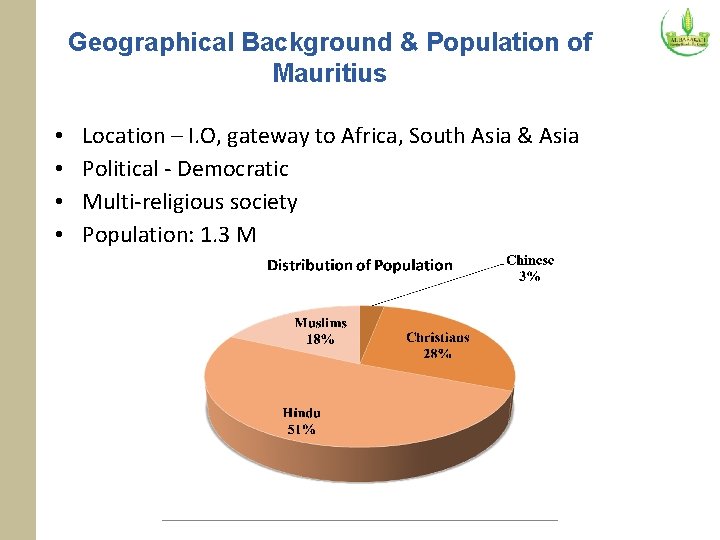
Geographical Background & Population of Mauritius • • Location – I. O, gateway to Africa, South Asia & Asia Political - Democratic Multi-religious society Population: 1. 3 M
Muslims in Mauritius § Presence in all walks of life: Islamic schools, professionals, orphanage, business, politics, etc. § Contribute enormously in the development of the economy § As a community, little has been done to establish the IBF. ü In 1990’s there was a keen desire by Muslims to establish an IB in Mauritius. ü Preliminary work carried out – Research - Different Laws, Coop Law ü Formation of an Islamic Financial Cooperative/Credit Union in the Cooperative sector - AL BARAKAH
Formation of ABMCSL Formation meeting by promoters & committed members Draft Rules, Regulations Registration with the Registrar of Cooperatives (10 th June 1998) Legal Framework Operates: - Within the Co-operative Societies Act 2005 - Within the framework of its rules, regulations and policies - According to Islamic Financial principles
VISION • To be a leading Cooperative Society in the field of Islamic Finance for a fair and just society. MISSION • To operate as a financial institution based on Islamic Finance and cooperative principles and providing a wide range of services on an interest-free basis. GOALS • To present a practical model of Islamic Financial Institution through the co-operative sector. 16 Objectives • Provide Halal investment opportunities and returns. • Promote the welfare and economic and social interest of its members • Create a source of credit for its members for provident and productive purposes in a Shari’ah-compliant way • Provide savings facilities for members
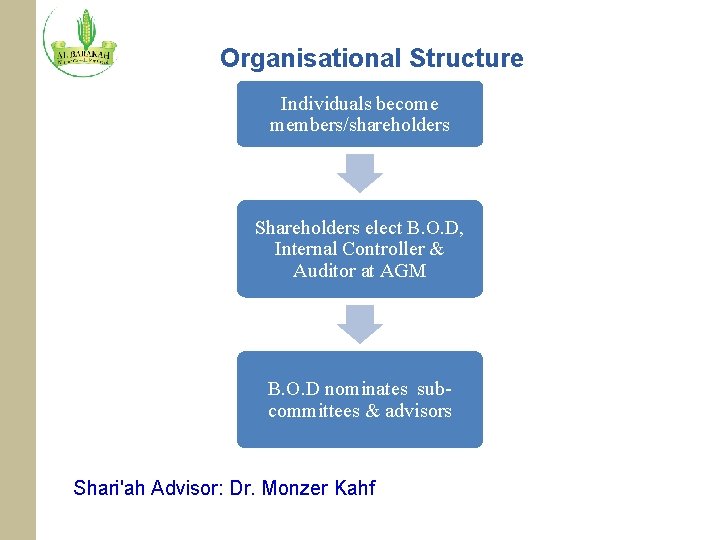
Organisational Structure Individuals become members/shareholders Shareholders elect B. O. D, Internal Controller & Auditor at AGM B. O. D nominates subcommittees & advisors Shari'ah Advisor: Dr. Monzer Kahf
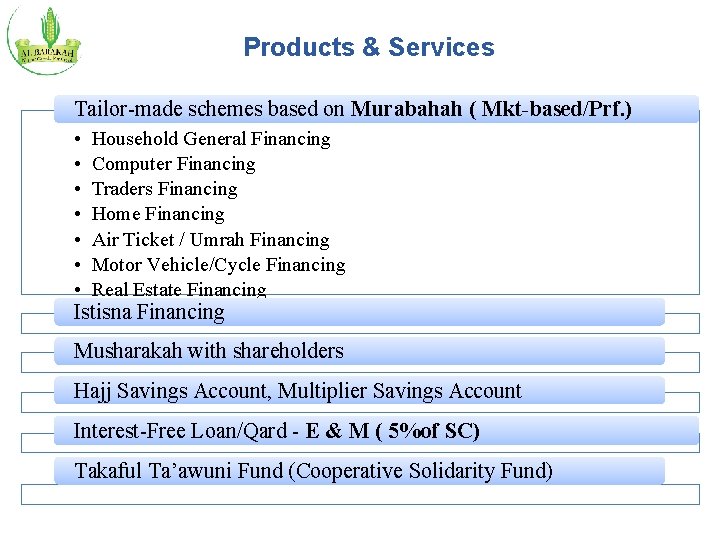
Products & Services Tailor-made schemes based on Murabahah ( Mkt-based/Prf. ) • • Household General Financing Computer Financing Traders Financing Home Financing Air Ticket / Umrah Financing Motor Vehicle/Cycle Financing Real Estate Financing Istisna Financing Musharakah with shareholders Hajj Savings Account, Multiplier Savings Account Interest-Free Loan/Qard - E & M ( 5%of SC) Takaful Ta’awuni Fund (Cooperative Solidarity Fund) 18
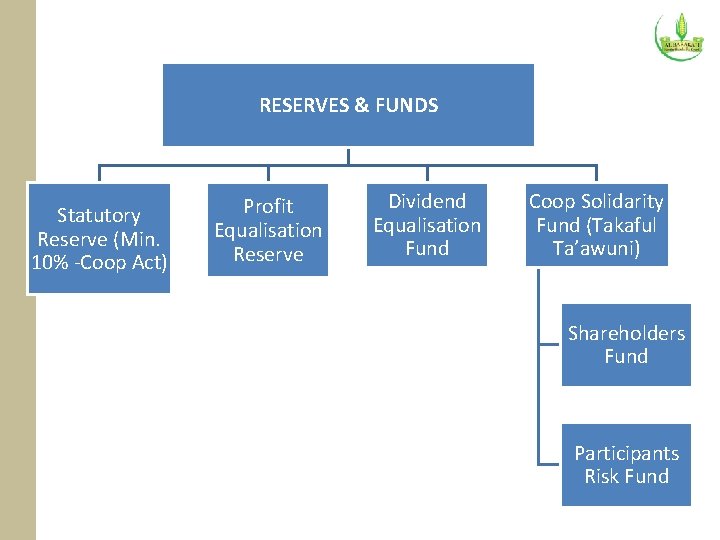
RESERVES & FUNDS Statutory Reserve (Min. 10% -Coop Act) Profit Equalisation Reserve Dividend Equalisation Fund Coop Solidarity Fund (Takaful Ta’awuni) Shareholders Fund Participants Risk Fund
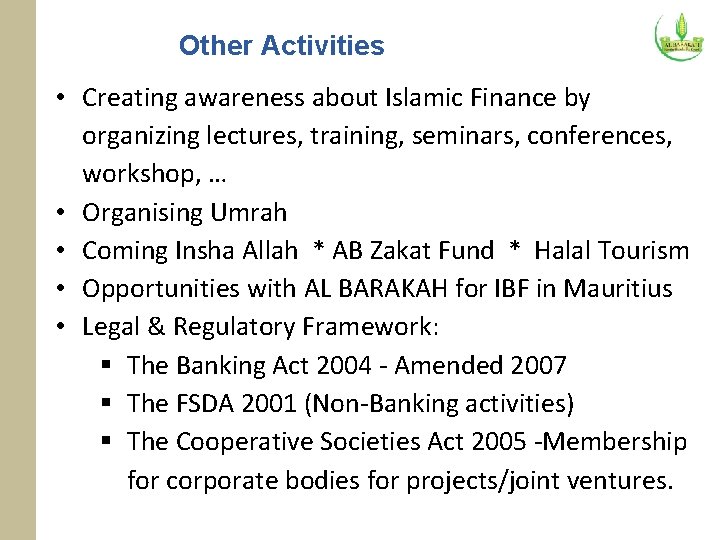
Other Activities • Creating awareness about Islamic Finance by organizing lectures, training, seminars, conferences, workshop, … • Organising Umrah • Coming Insha Allah * AB Zakat Fund * Halal Tourism • Opportunities with AL BARAKAH for IBF in Mauritius • Legal & Regulatory Framework: § The Banking Act 2004 - Amended 2007 § The FSDA 2001 (Non-Banking activities) § The Cooperative Societies Act 2005 -Membership for corporate bodies for projects/joint ventures.
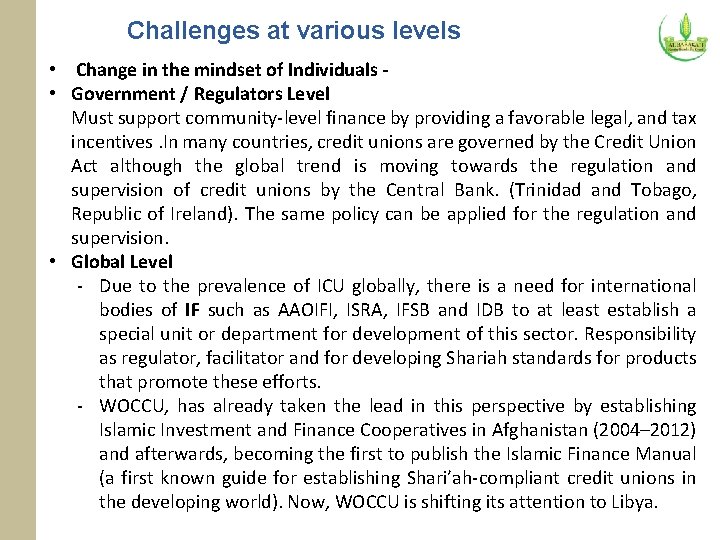
Challenges at various levels • Change in the mindset of Individuals • Government / Regulators Level Must support community-level finance by providing a favorable legal, and tax incentives. In many countries, credit unions are governed by the Credit Union Act although the global trend is moving towards the regulation and supervision of credit unions by the Central Bank. (Trinidad and Tobago, Republic of Ireland). The same policy can be applied for the regulation and supervision. • Global Level - Due to the prevalence of ICU globally, there is a need for international bodies of IF such as AAOIFI, ISRA, IFSB and IDB to at least establish a special unit or department for development of this sector. Responsibility as regulator, facilitator and for developing Shariah standards for products that promote these efforts. - WOCCU, has already taken the lead in this perspective by establishing Islamic Investment and Finance Cooperatives in Afghanistan (2004– 2012) and afterwards, becoming the first to publish the Islamic Finance Manual (a first known guide for establishing Shari’ah-compliant credit unions in the developing world). Now, WOCCU is shifting its attention to Libya.
Conclusion • ICU is in line with both cooperative and Islamic principles • Financial services to all strata of the community in Africa. • Opportunities of managing the wealth of the community in a Shari’ah compliant manner. • ICU will assist to build up a robust community-based financial institution, spread ownership of business and reduce concentration of wealth. • A combination of self-reliance with active participation of the community will strengthen economic and social development in Africa • Global prosperity cannot be pursued without the inclusion of the Africa • ICU can make people have to learn to live a modest and balanced material and spiritual lifestyle/good life (Hayat tayyiba) to attain success (falah). • Overall, the whole global community will benefit if they take the initiative to bring about the desired change as Allah says: “…Indeed, Allah will not change the condition of a people until they change what is in themselves…” (Ar-Ra`d 13: 11) • Concern for community - Finally it will be the job of everybody
Thank You Mr. Mamode Raffick NABEE MOHOMED Founder & Secretary AL BARAKAH MCSL E-mail: albarakahcoop@yahoo. com rafficknm@yahoo. com www. albarakahcoop. org Tel: (+230) 6275766, Mb. 57781738
- Slides: 23