
AKT Organisation and Management Dr Chris Webb January

AKT Organisation and Management Dr Chris Webb - January 2021
Access to Medical Records www. nhs. uk • Patients right to view their own records is governed by 1998 Data Protection Act and 1990 Access to Health Records Act • Key principles • Patients have a right to see what is written in their medical record • Competent children may seek access to their records • Parents may request access to their children's (< 16 y) records • Doctors should not release information they feel may damage a patients emotional or physical health • Following the Data Protection Act access to medical records should be given within 28 days • Following the General Data Protection Regulations and the Data Protection Act 2018 a fee can no longer be charged for a simple copy of the medical notes
Data Protection Act www. gov. uk • 1998. Main main piece of legislation governing protection of personal data in the UK. Act covers both manual and computerised records. • 8 main principles of the Data Protection Act: • Data must be used for the specific purpose it was collected • Data must not be disclosed to other parties without the consent of the individual whom it is about • Individuals have a right of access to the information held about them • Personal information may be kept for no longer than is necessary and must be kept up-to-date • Personal information may not be transmitted outside the European Union unless consent has been given • All entities (e. g. a GP surgery) that process personal information must register with the Information Commissioner's Office • Adequate security measures must be in place. Those include technical measures (e. g. passwords, firewalls) and organisational measures (e. g. staff training) • Subjects (i. e. patients) have the right to have factually incorrect information about them corrected
GP Appraisal www. gpappraisals. uk • Appraisal has been a requirement for GPs since 2002. It is meant to be a formative process identifying development needs rather than performance management. Since the introduction of revalidation by the GMC appraisals also offer a regular, structured system for recording progress towards revalidation and identifying development needs • NHS England took on the responsibility for appraisals after the Primary Care Trusts were disbanded • The appraiser should be another GP (principal or non-principal), who will have been properly trained in appraisal. NHS England recommend that a doctor should have no more than 3 consecutive appraisals by the same appraiser in the same revalidation cycle. Typically the average time commitment for appraisal is a minimum of 4. 5 - 6. 5 h. This includes between 2 & 4 h preparation
Appraisal. . . continued • The content of appraisal based on the 4 key domains set out in the GMC's Good Medical Practice document: • Knowledge, skills and performance • Includes developing and maintaining professional performance • Includes keeping accurate patient records • Contributing and complying with systems to protect patients • Includes acting on risks posed by your own health problems • Communication, partnership and teamwork • Includes the teaching and training of other doctors • Maintaining trust • Treating patients and colleagues with respect and without discrimination • Acting with honesty and integrity
Revalidation www. gmc-uk. org • Revalidation introduced a change in the way doctors are licensed and certificated. Previously UK doctors automatically received their licence to practise if they have paid their annual fee and have no limitations on their registration (e. g. Following a GMC ruling). To practise as a GP doctors must also be on the GP Register - a process known as certification • Following the introduction of revalidation in 2012 doctors are now required to prove their fitness to practise to allow them to continue to work as a doctor. Revalidation will occur every 5 years and in one process combine relicensing and recertification. Annual appraisals will continue as before but there will be a focus on whether the doctor is making sufficient progress towards their revalidation portfolio
Revalidation. . . continued • The RCGP is creating an e. Portfolio for the process and proposes that it should contain the following: • Description of your work • Description of any special circumstances (e. g. Prolonged illness) • Details of previous appraisals • Current PDP • Review of previous PDPs • Evidence of CPD - at least 50 'learning credits' are required per year • Significant event audits • Review of any formal complaints • Probity/health statements • Multi-source/colleague feedback: this is required once every revalidation cycle • Patient questionnaire surveys: this is required once every revalidation cycle • Clinical audit/quality improvement project: this is required once every revalidation cycle
Revalidation Learning credits and submitting information • Learning credits • Minimum of 1 credit for each hour of education but if the hour of education can be shown to lead to improvements in patient care then it will count as 2 credits • Submitting the evidence for revalidation • The e. Portfolio will be submitted electronically for review • The review will be done by a 'Responsible Officer', based in one of the 27 Area Teams • The Responsible Officer is likely to be advised by a GP assessor and a trained lay person • If the submitted evidence is considered sufficient the Responsible Officer will recommend to the GMC that the doctor is both relicensed and recertificated
Balint Groups www. balint. co. uk • Michael Balint (1896 -1970) was a Hungarian psychoanalyst and psychiatrist who shaped many of the modern views on patient centred healthcare. He was primarily interested in the psychological and emotional problems that underlie many presenting complaints. His work encouraged GPs to explore these areas to understand their patients better. Balint coined the phrase 'the doctor as a drug' • During the 1950's he established small, groups ('Balint Groups') which allowed GPs to discuss their patients on an informal basis. These are not dissimilar to discussions held amongst GP Registrars during their half-day release • Balint's ideas were published in the book 'The doctor, his patient and the illness'

Caldicott Guardians www. gov. uk • The 1997 Caldicott Report identified weaknesses in the way parts of NHS handled confidential patient data. The report recommended the appointment of Caldicott Guardians, a member of staff with responsibility to ensure patient data is kept secure • It is now a requirement for every NHS organisation to have a Caldicott Guardian
Consent in children • The GMC have produced guidelines on obtaining consent in children: • At 16 y or older a young person can be treated as an adult and can be presumed to have capacity to decide • Under the age of 16 y children may have capacity to decide, depending on their ability to understand what is involved • Where a competent child refuses treatment, a person with parental responsibility or the court may authorise investigation or treatment which is in the child's best interests* • *In Scotland those with parental responsibility cannot authorise procedures a competent child has refused
Consent in children. . . continued • With regards to the provision of contraceptives to patients under 16 y of age the Fraser Guidelines state that all the following requirements should be fulfilled: • The young person understands the professional's advice • The young person cannot be persuaded to inform their parents • The young person is likely to begin, or to continue having, sexual intercourse with or without contraceptive treatment • Unless the young person receives contraceptive treatment, their physical or mental health, or both, are likely to suffer • The young person's best interests require them to receive contraceptive advice or treatment with or without parental consent

Delphi Process • A Delphi process (also known as the Delphi method or technique) is a structured way of collecting and distilling the knowledge from a group of experts, often about issues where there is little formal evidence • It consists of a number of 'rounds' of questionnaires • The first round tends to ask the experts a number of broad questions • The results of the first round are then sorted and common themes are distilled down • This information then goes on to form the second, more specific, questionnaire which again is sent out to the panel of experts • This iterative process is usually repeat two or three times

Delphi Process. . . continued • Examples of where the Delphi method may be used: • Curriculum development: i. e. Involving a range of expert stakeholders in finding out what they feel should be included • Guideline development: the expert panel may include doctors, nurses, pharmacists and patients • Forecasting future health problems • One of the key features of a Delphi process is the anonymity of the participants. This prevents individual participants from dominating the opinion forming process
Deprivation of Liberty Safeguards www. scie. org. uk • An amendment to the Mental Capacity Act 2005. They apply in England Wales only • The Mental Capacity Act allows restraint and restrictions to be used but only if they are in a persons best interests • Extra safeguards are needed if the restrictions and restraint used will deprive a person of their liberty. These are called the Deprivation of Liberty Safeguards • Can only be used if the person will be deprived of their liberty in a care home or hospital. In other settings the Court of Protection can be asked if a person can be deprived of their liberty • Care homes or hospitals must ask either a local authority or health body if they can deprive a person of their liberty. This is called requesting a standard authorisation • There are 6 assessments which have to take place before a standard authorisation can be given • If a standard authorisation is given, one of the most important safeguards is that the person has someone appointed with legal powers to represent them. This is called the relevant persons representative and will usually be a family member or friend • Other safeguards include rights to challenge authorisations in the Court of Protection without cost and access to independent mental capacity advocates (IMCAs)
Duties of a Doctor www. gmc-uk. org • Protect and promote the health of patients and the public • Provide a good standard of practice and care • Keep your professional knowledge and skills up to date • Recognise and work within the limits of your competence • Work with colleagues in the ways that best serve patients' interest • Treat patients as individuals and respect their dignity • Treat patients politely and considerately • Respect patients' right to confidentiality
Duties of a Doctor. . . continued • Work in partnership with patients • Listen to patients and respond to their concerns and preferences • Give patients the information they want or need in a way they can understand • Respect patients' right to reach decisions with you about their treatment and care • Support patients in caring for themselves to improve and maintain their health • Be honest and open and act with integrity • Act without delay if you have good reason to believe that you or a colleague may be putting patients at risk • Never discriminate unfairly against patients or colleagues • Never abuse your patients' trust in you or the public's trust in the profession
Foster Care • Limit of 3 foster children per family (Schedule 7 of the Children Act 1989) • All children in long-term foster care require a 6 m medical examination
Gifts from Patients • The NHS General Medical Services Contracts Regulations 2004 require GPs to keep a register of gifts from patients or their relatives that have a value of £ 100 or more • The register must include the name of the patient donating the gift, the NHS number or address of the patient, the nature of the gift, the estimated value of the gift and the name of person who received gift • GPs must also make the register available to NHS England on request • A gift does not have to be placed on the register if the GP (the Contractor) believes there are reasonable grounds for believing that the gift is unconnected with services provided or to be provided by the Contractor or the Contractor is not aware of the gift
Gifts from Patients. . . continued • The GMCs Good Medical Practice guidelines include advice on how to deal with gifts from patients. They say, You must not ask for or accept from patients, colleagues or others any inducement, gift or hospitality that may affect or be seen to affect the way you prescribe for, treat or refer patients or commission services for patients • You must not encourage patients to give, lend or bequeath money or gifts that will directly or indirectly benefit you • Gifts can be accepted from patients or their relatives provided: • It does not affect, or appear to affect, the way you prescribe for, advise, treat, refer, or commission services for patients and • You have not used your influence to pressurise or persuade patients or their relatives to offer you gifts
Insurance Reports • NHS referrals to clarify whether a patient has or has not got a particular condition are not appropriate: 'If the insured persons NHS GP does not consider that a referral for specialist care is necessary, and an insurance company requires a specialist opinion, the payment of a private specialist opinion would need to be agreed between the insured person and the company concerned' • The ABI and BMA have developed a standard GP report (GPR) form, which is available on the ABI and BMA websites and is widely used • GPs may charge the insurance company a fee for this work
Insurance Reports. . . continued • Reports should normally be sent within 20 working days of receipt of the request • Only send relevant information, don't send a full print-out of the notes: 'Doctors must not send originals, photocopies or printouts of full medical records in lieu of medical reports and ABI members should not accept them. The full records are not necessary and will very probably include information that is not relevant to the insurance being applied for. Insurance companies only need information that is relevant to the policy. Disclosure or other processing of information that is released without the consent of the applicant or insured person is likely to breach the Data Protection Act 1998, and may compromise a doctors registration' • Written consent is required before releasing any information: 'Doctors professional, ethical and legal duties require them not to disclose information about their patients without consent. This is true in all but the most exceptional of circumstances'
Insurance Reports. . . continued • The GMC have the following guidance regarding the need for written consent: 'Obtain, or have seen, written consent to the disclosure from the patient or a person properly authorised to act on the patients behalf' • Patients have a right to see the report before it is sent. The GMC advises doctors to check with insurance applicants whether they wish to see their report, unless it has been clearly and specifically stated that they do not. The applicant has 21 days from the time of notification to exercise the right to see the report • Doctors cannot comply with applicants or insured peoples requests to leave out relevant information from reports. If an applicant or an insured person refuses to give permission for certain relevant information to be included, the doctor should indicate to the insurance company that he or she cannot write a report, taking care not to reveal any information the applicant or insured person did not want revealed • Insurance companies may in certain circumstances have access to a patients' medical records after they have died
Health Promotion, Surveillance and Protection • Health promotion is defined by the WHO as 'the process of enabling people to increase control over, and to improve, their health. ' • Heath surveillance, as defined by WHO is 'the continuous, systematic collection, analysis and interpretation of health-related data needed for the planning, implementation, and evaluation of public health practice. ' An example is the National Child Measurement Program, which collects data on childhood obesity • Health protection involves guarding the public against threats to health, for example, legislation on air pollution or vaccination programs against infectious diseases
Local Medical Committee (LMC) • LMCs represent the interests of GPs on a local level. They were established as part of Lloyd George's National Insurance Act in 1911 to try and ensure that GPs had a say in the running of the government's health insurance scheme. At the same time a committee was established within the BMA to represent GPs on a national level to the government. This was initially known as the Insurance Acts Committee but is now called the General Practitioners Committee (GPC) and has authority to negotiate with the government on matters such as pay and contracts. It is recognised by the Department of Health as the GP's sole negotiating body • The GPC meets annually with the representatives of the LMCs, who may submit motions for the conference. This motions may then go on to form GPC policy • LMCs are funded by a statutory levy on GPs. Each LMC may cover the area which corresponds to one or more CCG’s. LMC members are elected and include partners, salaried doctors and GP Registrars from both GMS and PMS practices
NHS Treatment Eligibility Primary Care • People are eligible if they are 'ordinarily resident' in UK • This is not related to National Insurance contributions or nationality • This generally means they will be in the UK for at least 6/12 but there is no qualifying period (i. e. People are entitled to care if they expect to be in the UK for 6/12) • This would exclude people who have emigrated but return every so often for free NHS care • Refugees are regarded as ordinarily resident
NHS Treatment Eligibility Secondary Care • The following hospital treatment is free of charge for everyone who needs it, regardless of how long they have been or intend to stay in the UK: • Contraception • A&E treatment (excludes emergency treatment given elsewhere in the hospital) • Compulsory psychiatric treatment • Treatment for certain communicable diseases, e. g. TB, malaria, meningitis, HIV
Quality and Outcomes Framework (QOF) • QOF is the annual reward and incentive programme detailing GP practice achievement results. It was introduced as part of the new General Medical Services (GMS) to incentivise not only the management of chronic disease such as diabetes but also to improve the organisation of the practice and patient experience • Other points • For clinical indicators the value of a point is determined by the prevalence of that condition in the practice • Participation in the QOF is voluntary • 5% of practices should be visited at random to help prevent fraud
Quality and Outcomes Framework (QOF) 3 key areas: • Clinical indicators - Standards linked to the care of patients suffering from chronic diseases. The largest domain of QOF • Public health - Smoking cessation, cervical screening, child health surveillance etc. The second largest domain of QOF • Public health including additional services sub domain - This sub domain has indicators across the two service areas of cervical screening and contraceptive services
Quality and Outcomes Framework (QOF) Exception Reporting • Patients who have been recorded as refusing to attend review who have been invited on at least 3 occasions during the preceding 12 m • Patients for whom it is not appropriate to review the chronic disease parameters due to particular circumstances e. g. Terminal illness, extreme frailty • Patients newly diagnosed within the practice or who have recently registered with the practice, who should have measurements made within 3/12 and delivery of clinical standards within 9/12 e. g. BP or cholesterol measurements within target levels • Patients who are on maximum tolerated doses of medication whose treatment remain sub-optimal
Quality and Outcomes Framework (QOF) Exception Reporting. . . continued • Patients for whom prescribing a medication is not clinically appropriate e. g. Those who have an allergy, another contraindication or have experienced an adverse reaction • Where a patient has not tolerated medication • Where a patient does not agree to investigation or treatment (informed dissent), and this has been recorded in their medical records • Where the patient has a supervening condition which makes treatment of their condition inappropriate e. g. Cholesterol reduction where the patient has liver disease • Where an investigative service or secondary care service is unavailable
Visual Impairment • Blindness is generally defined as vision < 3/60 in the better eye • Registration is voluntary in England • Patients who are deemed blind are eligible for additional benefits (for example disabled parking badge, reduced television license fee, talking books) • A consultant ophthalmologist is needed to make an application to social services

Certification
Sick Leave www. gov. uk • Employees can take time off work if they’re ill • They self-certify for the 1 st 7 days. When they return to work the employer may ask them to confirm they’ve been off sick: self-certification (which can be an email or filling in a form) • They need to give their employer proof if they’re ill for more than 7 days with a doctor’s ‘fit note’ or ‘sick note’. This can be written on the day of assessment or retrospectively (not prospectively). Classified as: ‘not fit for work’ or ‘may be fit for work • If ‘maybe fit’ the employer needs to agree at least one of: a phased return, workplace adaptations, amended duties or altered hours • If they’re ill just before or during their holiday, they can take it as sick leave instead • During the 1 st 6/12 of sickness, the new statement can be issued for no longer than 6/12

Statutory Sick Pay (SSP) www. gov. uk • SSP is paid to someone by their employer when they are too unwell to work, having been off sick from work for a minimum of 4 days in a row • £ 95. 85 a week if too ill to work • Paid by employer for up to 28/52 • Eligibility: • Be classed as an employee and have done some work for the employer • Have been ill for at least 4 days in a row (including non-working days) • Must earn an average of at least £ 120 per week • Tell your employer you're sick before their deadline - or within 7 days if they don't have one • Agency workers are entitled to Statutory Sick Pay • Can’t get less than statutory amount - but may get more dependent on company’s sick pay scheme (check contract) • If ineligible or SSP ends: Universal credit or Employment and Support Allowance (ESA)
Universal Credit www. gov. uk • Payment to help meet costs of living • Combines 6 benefits into one payment: (Child Tax Credit / Housing Benefit / Income Support / Income-based Jobseeker’s Allowance, Income-related ESA, Working Tax Credit • Received monthly (twice monthly in Scotland) • Eligibility: • Low income or out of work • 18 or over (there are some exceptions if you’re 16 to 17) • Under State Pension age (or partner is) • Have £ 16, 000 or less in savings between person and partner • Live in the UK
Universal Credit How it works • Universal credit is composed of a standard allowance, plus extra payments depending on circumstances. There is a benefit cap which limits the total amount one can receive: • The monthly standard allowance is determined by age and relationship status: single vs a couple • Extra payments are awarded for up to 2 children, either having a disability or caring for a severely disabled person and to help with housing costs • The universal credit payment reduces as people earn money. People have work allowance of how much they can earn before their payment is decreased. This allowance is higher for people responsible for children/young people, people with disability limiting work. It is lower if people have help with housing costs
Universal Credit Benefits • It is designed so that people would no longer be better off claiming benefits alone rather than working. The government says that this will encourage people to work and out of the benefit trap as it allows people to work and still get supported with a 'work allowance' • Additionally, the monthly payments were designed to help people learn to budget their money and prepare them for having a job • People can apply for universal credit online which is good as it cuts down the cost of managing benefits to the government
Universal Credit Controversy • People have to wait 5 weeks to receive their first payment, and then struggle due to only receiving payments every month • Childcare must be paid by parents upfront and is then refunded by universal credit • Many disabled people and households receive less than they did with the old benefits system • The old benefits paid benefits for each child per year, however universal credit will only pay for the first 2 children for children born after April 2017 • Private tenants find it harder to rent
Personal Independence Payment (PIP) www. gov. uk • Patients must have a long-term health condition or disability and have difficulties with activities related to daily living and or mobility. They must also have had these difficulties for 3 months and expect them to last for at least 9 months. These rules do not apply for patients who are terminally ill • Can get between £ 23. 60 and £ 151. 40 a week if aged 16 or over and have not reached State Pension age. The amount depends on how the condition affects them, not on the condition itself • Each of the components have a ‘standard’ and ‘enhanced’ levels depending on the level of need • Patients who are terminally ill are automatically entitled to the enhanced component of the ‘Daily Living Component’ of the ‘Personal Independence Payment’ • PIP is tax-free, not means tested and divided into two components: • Daily living component • Mobility component
Personal Independence Payment (PIP) Daily Living Component • Preparing food or eating • Washing, bathing, using toilet • Dressing and undressing • Reading and communicating • Managing medicines or treatments • Making decisions about money • Engaging with other people
Personal Independence Payment (PIP) Mobility Component • Can’t walk • Can only walk a short distance without severe discomfort • Could become very ill if tried to walk • No feet / legs • Blind / deaf and needs accompanying • Need supervision most of the time when outdoors • Severe mental impairment (highest care rate DLA)
Attendance Allowance www. gov. uk • AA is a tax-free allowance for people aged 65 or over when they claim who need help with their personal care • To claim AA patients should normally have needed help with care for 6 months • Like DLA it is not means tested • Helps with extra costs if you have a disability and need someone to help look after you • Two rates • Low (58. 70) frequent help or constant supervision during day / night • High (87. 65) help or supervision throughout both day and night / terminally ill
Terminally Ill Patients www. gov. uk • Patients who have a terminal illness (where there is an expectation that the patient will not live for more than 6 months) are eligible to be fast-tracked through the system for claiming incapacity benefit (IB), employment support allowance (ESA), DLA or AA. A DS 1500 form is completed which ensures the application is dealt with promptly and that the patient automatically receives the higher rate • DS 1500 form • Contains questions about the diagnosis, whether the patient is aware of the condition/prognosis clinical features (e. g. staging) and treatment • May be completed by a hospital or hospice consultant • A fee is payable by the Department for Works and Pensions (DWP) for the completion of this form • Given directly to the patient rather than sent to the DWP • Can carry on claiming if still living after 6/12, up to 3 y. Then reviewed
Bereavement Benefits www. gov. uk • Funeral payment - One-off payment to partner or parent of deceased if they are on benefits to help pay for a funeral • Bereavement Support Payment - Lump sum and then up to 18 monthly payments if they are under the state pension age when their partner died. Depends on NI contributions. Different rates are paid according to whether the claimant gets Child Benefit • Widowed Parent's Allowance - Payable to a parent whose husband or wife has died. Eligibility depends on surviving partner is bringing up a child < 19 years of age and receiving child benefit, the deceased partner had made adequate NI contributions and if the woman was expecting her late husband's baby. Divorcees and those who remarry are not eligible to claim
Carer’s Credit • Carer's credit provides credits to help fill gaps in the national insurance record of the carer, that they may have lost due to caring for their loved one. This therefore will not affect their ability to claim the state pension later in life • Eligibility for the carer's credit: • Aged 16 or over • Under State Pension age • Looking after one or more people for at least 20 hours a week
Carer’s Credit. . . continued • The person you are looking after must get one of the following: • Disability Living Allowance care component at the middle or highest rate • Attendance Allowance • Constant Attendance Allowance • Personal Independence Payment - daily living component, at the standard or enhanced rate • Armed Forces Independence Payment
Child Tax Credits • Method of helping families with the cost of bringing up children. • Eligibility depends on: • Child’s age • If you're responsible for the child • The child's age - To qualify the child must be: • Under 16 - you can claim up until the 31 st August after their 16 th birthday • Under 20 - if they're in approved education or training • Responsibility for a child - You're usually responsible for a child if: • They live with you all the time • They normally live with you and you're the main carer • They keep their toys and clothes at your home • You pay for their meals and give them pocket money • They live in an EEA country or Switzerland but are financially dependent on you
State Pension Age • 'Currently, the State Pension age for men is 65. On 6 April 2010, the State Pension age for women started to increase gradually from 60 to 65, to match men's. ' • 'The government has announced new proposals for increasing State Pension age which would affect you if you were born between 6 April 1953 and 5 April 1960. ' • 'The proposals would mean women's State Pension age would increase more quickly to 65 between April 2016 and November 2018. ' • 'From December 2018 the State Pension age for both men and women would start to increase to reach 66 by April 2020. ' • 'The government is also considering the timetable for future increases to the State Pension age from 66 to 68. '
Death Certification • There is no legal definition of death in the UK although guidelines exist. Current guidance states 'death should be verified by a doctor, or other suitably qualified personnel' which means staff such as nurse practitioners may verify (but not certify) death • After a patient has died a doctor needs to complete a Medical Certificate of Cause of Death (MCCD) • Must have seen the patient during their final illness and within last 14/7 • ‘Old age’ as 1 A is only acceptable if the patient was at least 80 years of age • ‘Natural causes’ is NOT acceptable • ‘Organ failure’ (eg heart failure) can only be used if you specify the disease or condition that led to the organ failure (eg 1 b Hepatitis C) • Abbreviations should be avoided (except HIV and AIDS) • Family then take the MCCD to the local Registrar of Births, Deaths, and Marriages office to register the death
Notifiable Deaths • Unexpected or sudden deaths • When the doctor attending the deceased did not see them within 14 days before death • If a death occurs within 24 hours of hospital admission • Accidents and injuries • Suicide • Industrial injury or disease (e. g. asbestosis) • Deaths occurring as a result of ill treatment, starvation or neglect • The death occurred during an operation or before recovery from the effect of an anaesthetic • Poisoning, including taking illicit drugs • Stillbirths - if there is doubt as to whether the child was born alive • Prisoner or people in police custody • Service disability pensioners
Cremation • Form 4 completed by GP / doctor looking after then in their last illness • Form 5 completed by an independent doctor with GMC registration >5 years
Electronic Fit Note • The electronic fit note (e. Med) is a Department for Work and Pensions (DWP) initiative to switch GPs from issuing handwritten notes to electronically printed ones. The software is integrated into existing electronic record systems (e. g. EMIS) and stored alongside the patient record. The note will then be printed out and handed to the patient who will use it in exactly the same way as a conventional hand written note • The note will not be sent electronically to the employer, patient or DWP. However, in future the DWP plans to automatically collect anonymous data regarding sick notes to 'inform policy development' • GPs will still be able to issue handwritten notes on home visits and hospital doctors will not switch to the new system

DVLA
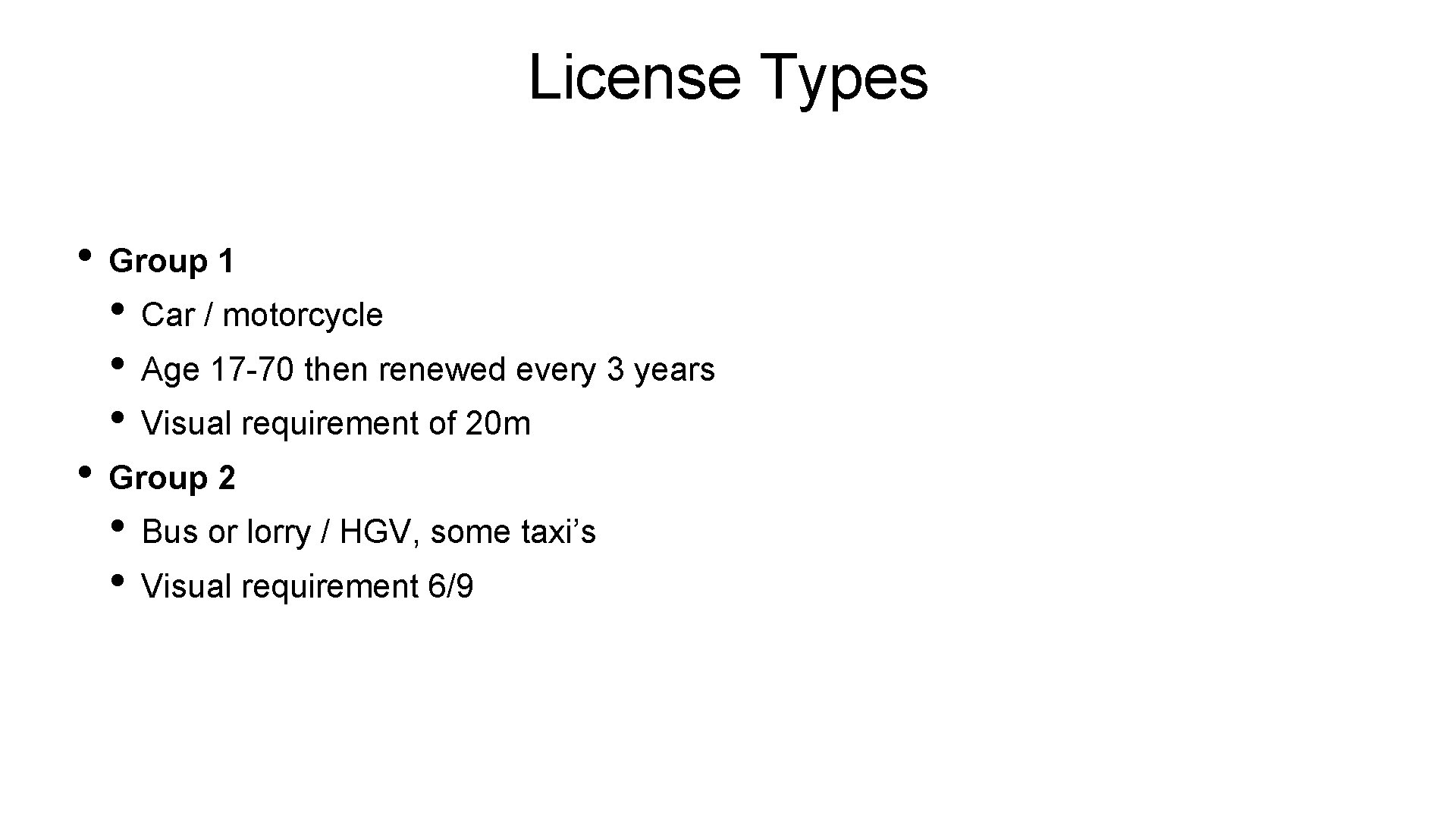
License Types • Group 1 • Car / motorcycle • Age 17 -70 then renewed every 3 years • Visual requirement of 20 m • Group 2 • Bus or lorry / HGV, some taxi’s • Visual requirement 6/9
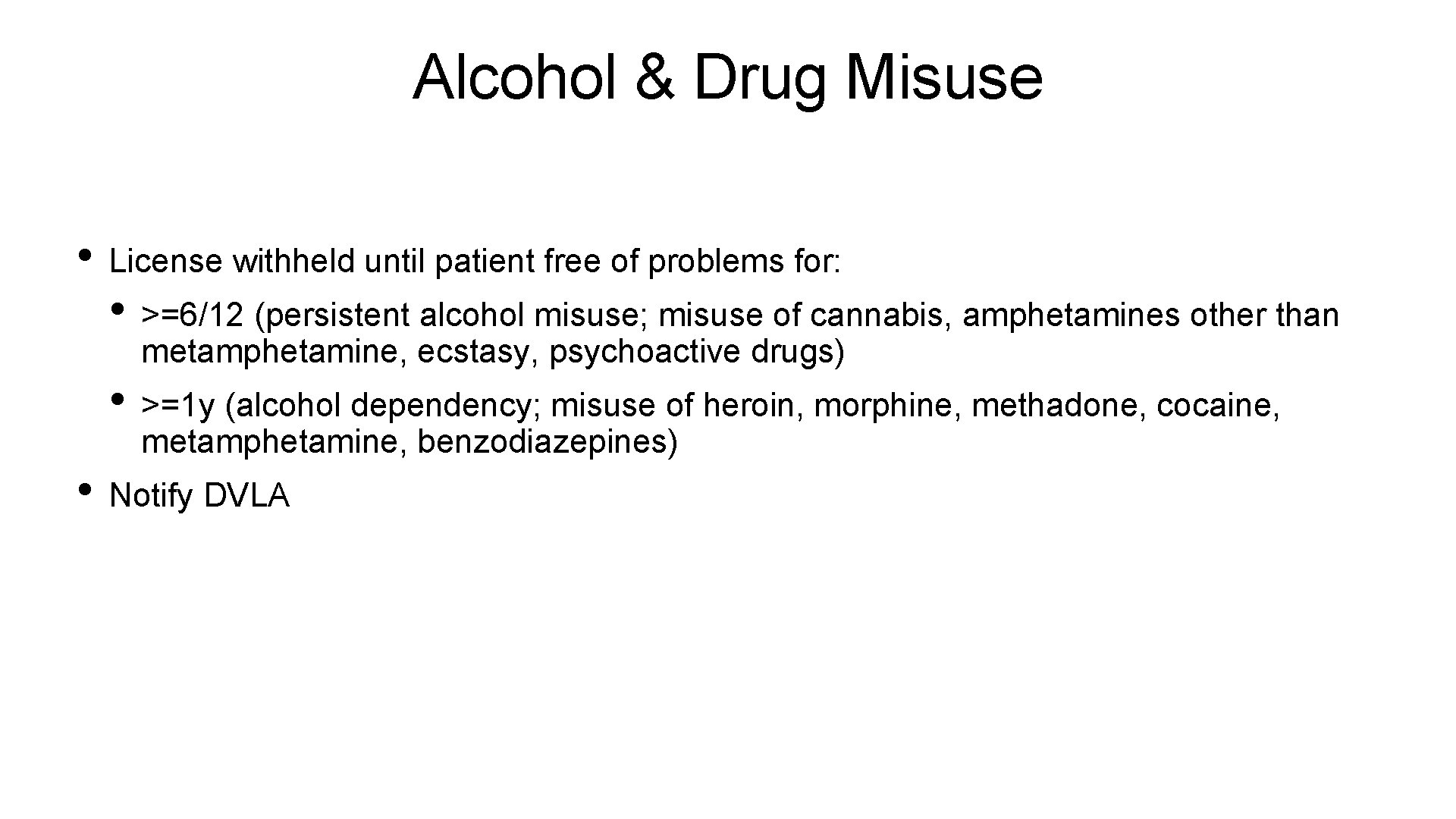
Alcohol & Drug Misuse • License withheld until patient free of problems for: • >=6/12 (persistent alcohol misuse; misuse of cannabis, amphetamines other than metamphetamine, ecstasy, psychoactive drugs) • >=1 y (alcohol dependency; misuse of heroin, morphine, methadone, cocaine, metamphetamine, benzodiazepines) • Notify DVLA
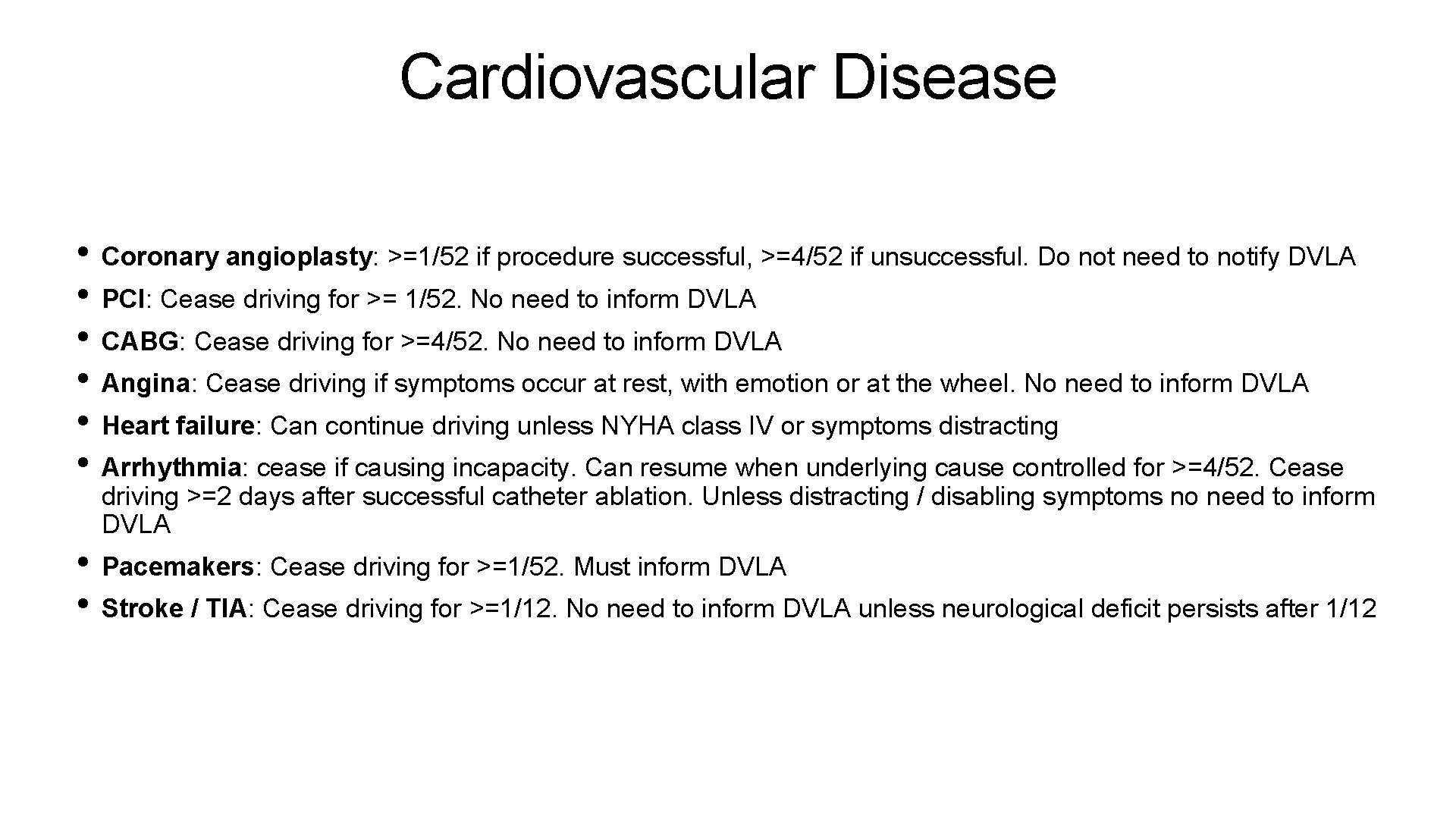
Cardiovascular Disease • Coronary angioplasty: >=1/52 if procedure successful, >=4/52 if unsuccessful. Do not need to notify DVLA • PCI: Cease driving for >= 1/52. No need to inform DVLA • CABG: Cease driving for >=4/52. No need to inform DVLA • Angina: Cease driving if symptoms occur at rest, with emotion or at the wheel. No need to inform DVLA • Heart failure: Can continue driving unless NYHA class IV or symptoms distracting • Arrhythmia: cease if causing incapacity. Can resume when underlying cause controlled for >=4/52. Cease driving >=2 days after successful catheter ablation. Unless distracting / disabling symptoms no need to inform DVLA • Pacemakers: Cease driving for >=1/52. Must inform DVLA • Stroke / TIA: Cease driving for >=1/12. No need to inform DVLA unless neurological deficit persists after 1/12
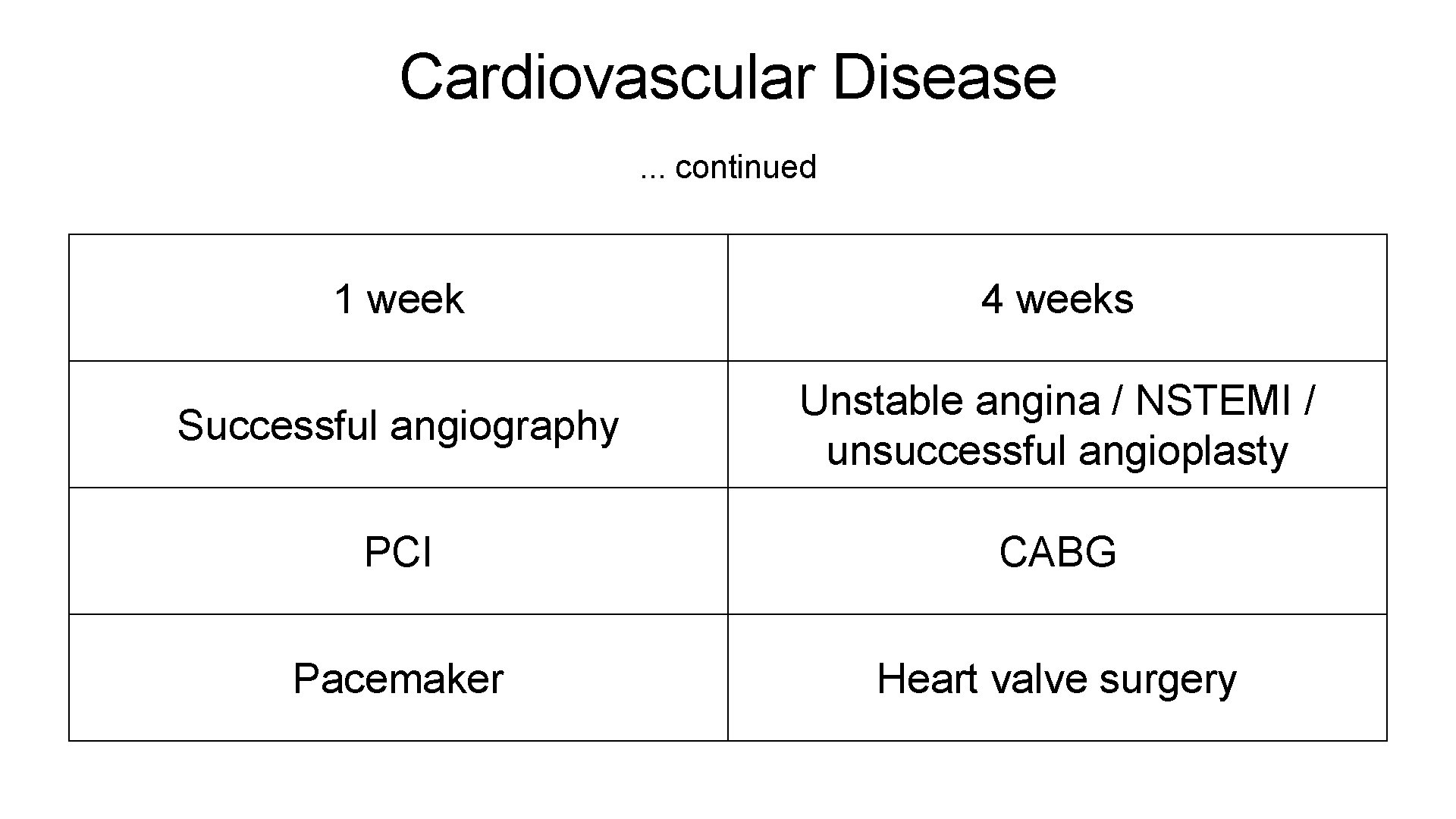
Cardiovascular Disease. . . continued 1 week 4 weeks Successful angiography Unstable angina / NSTEMI / unsuccessful angioplasty PCI CABG Pacemaker Heart valve surgery
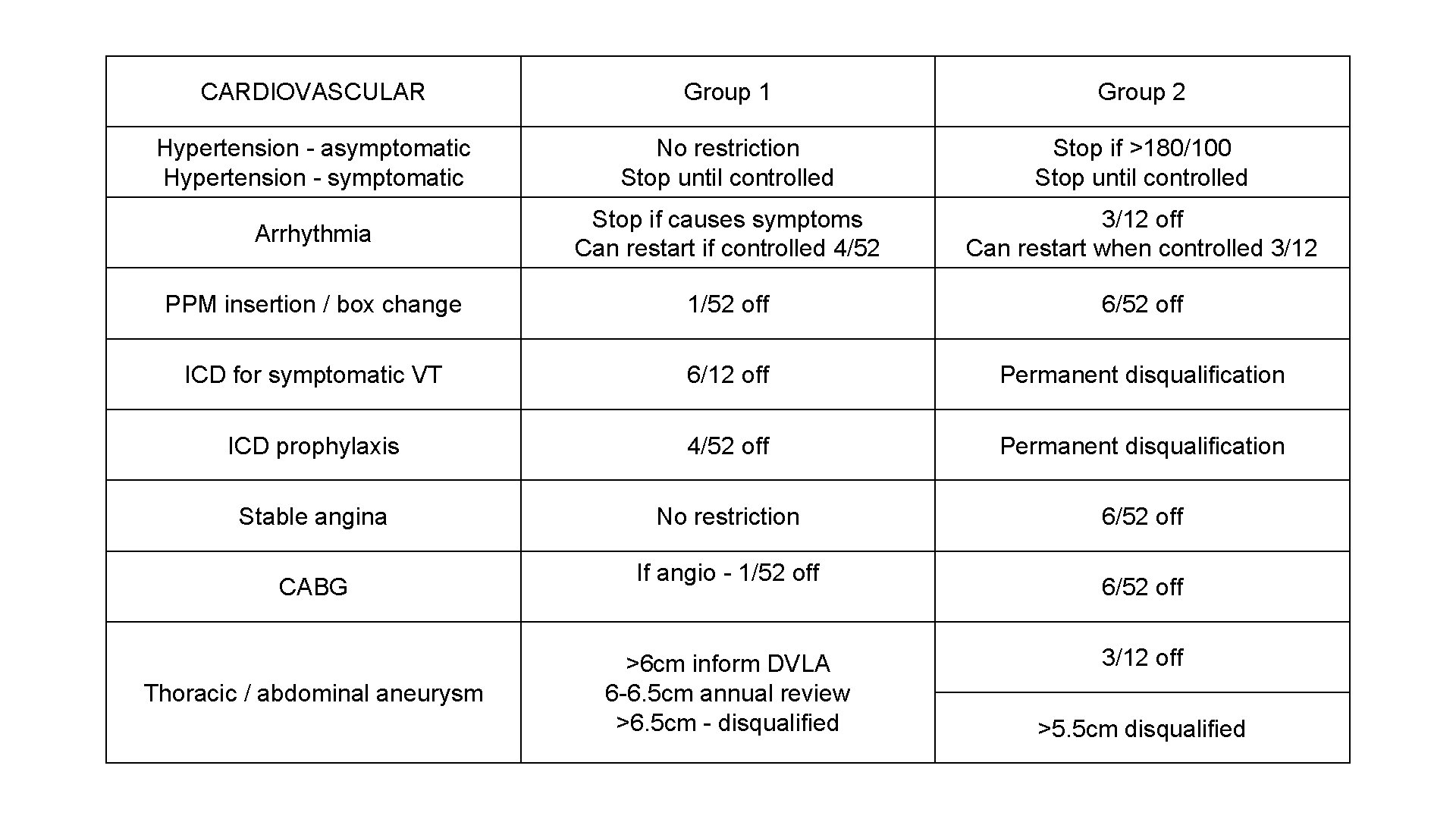
CARDIOVASCULAR Group 1 Group 2 Hypertension - asymptomatic Hypertension - symptomatic No restriction Stop until controlled Stop if >180/100 Stop until controlled Arrhythmia Stop if causes symptoms Can restart if controlled 4/52 3/12 off Can restart when controlled 3/12 PPM insertion / box change 1/52 off 6/52 off ICD for symptomatic VT 6/12 off Permanent disqualification ICD prophylaxis 4/52 off Permanent disqualification Stable angina No restriction 6/52 off CABG Thoracic / abdominal aneurysm If angio - 1/52 off >6 cm inform DVLA 6 -6. 5 cm annual review >6. 5 cm - disqualified 6/52 off 3/12 off >5. 5 cm disqualified
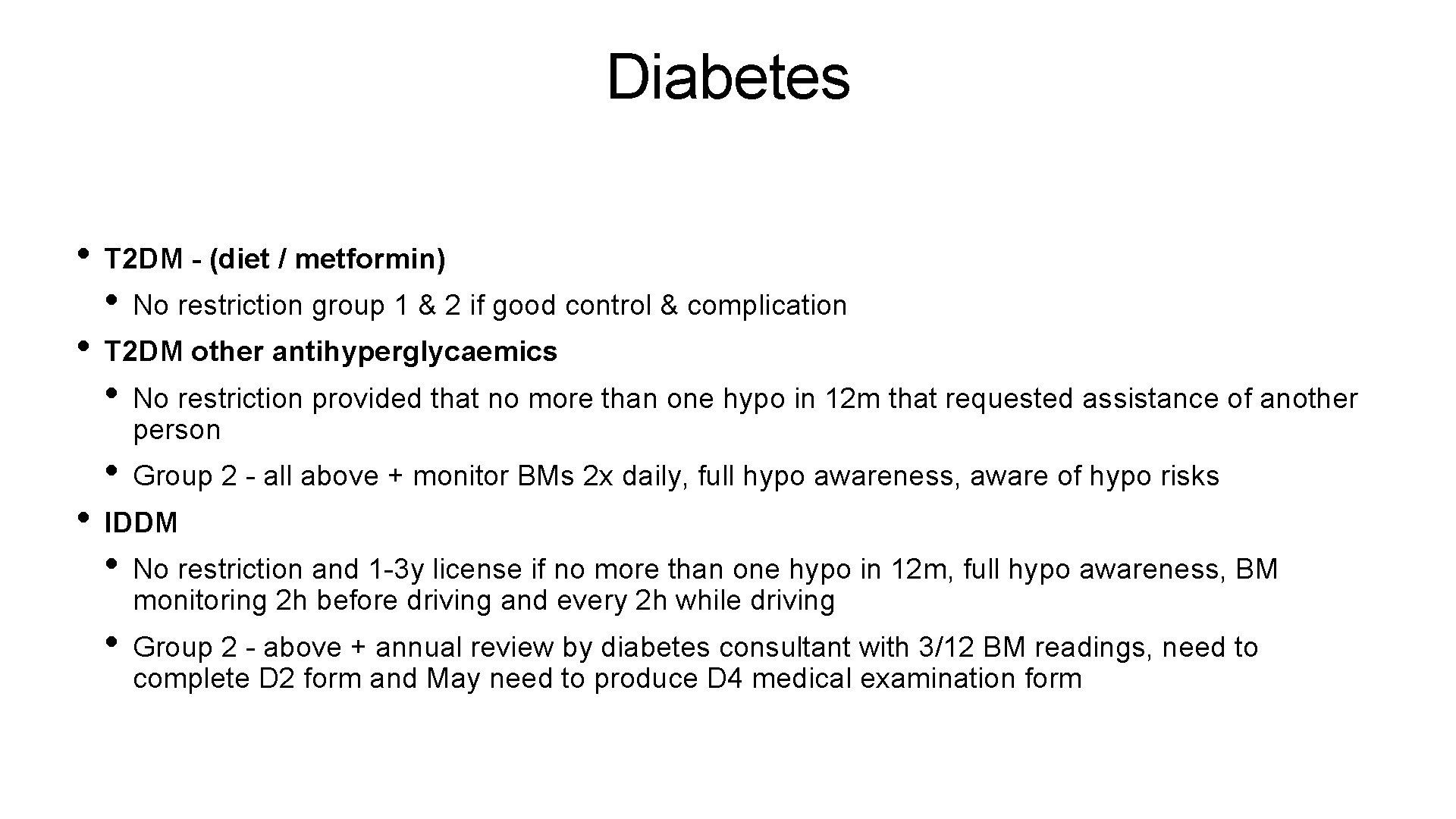
Diabetes • T 2 DM - (diet / metformin) • No restriction group 1 & 2 if good control & complication • T 2 DM other antihyperglycaemics • No restriction provided that no more than one hypo in 12 m that requested assistance of another person • Group 2 - all above + monitor BMs 2 x daily, full hypo awareness, aware of hypo risks • IDDM • No restriction and 1 -3 y license if no more than one hypo in 12 m, full hypo awareness, BM monitoring 2 h before driving and every 2 h while driving • Group 2 - above + annual review by diabetes consultant with 3/12 BM readings, need to complete D 2 form and May need to produce D 4 medical examination form
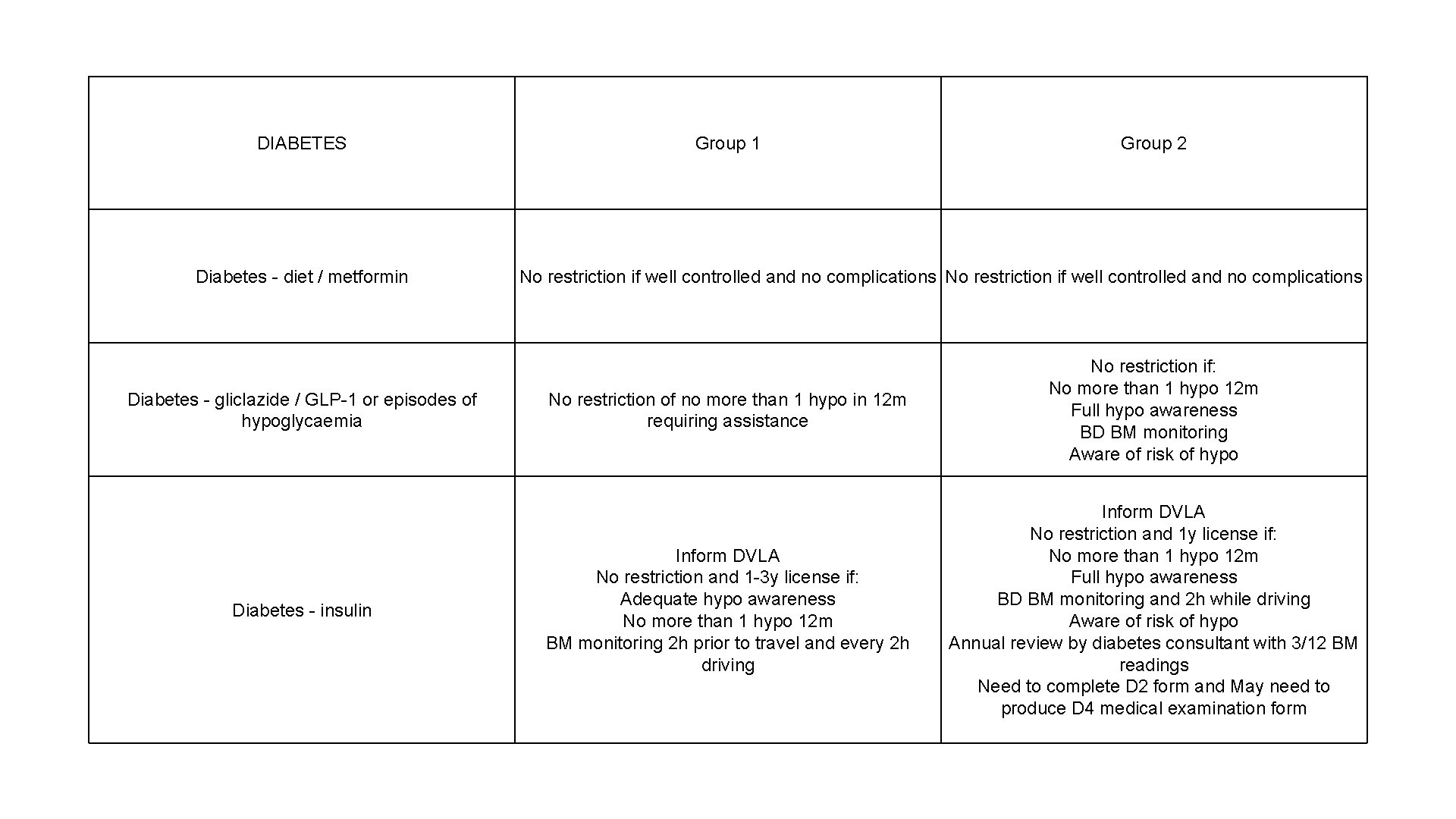
DIABETES Diabetes - diet / metformin Diabetes - gliclazide / GLP-1 or episodes of hypoglycaemia Diabetes - insulin Group 1 Group 2 No restriction if well controlled and no complications No restriction of no more than 1 hypo in 12 m requiring assistance No restriction if: No more than 1 hypo 12 m Full hypo awareness BD BM monitoring Aware of risk of hypo Inform DVLA No restriction and 1 -3 y license if: Adequate hypo awareness No more than 1 hypo 12 m BM monitoring 2 h prior to travel and every 2 h driving Inform DVLA No restriction and 1 y license if: No more than 1 hypo 12 m Full hypo awareness BD BM monitoring and 2 h while driving Aware of risk of hypo Annual review by diabetes consultant with 3/12 BM readings Need to complete D 2 form and May need to produce D 4 medical examination form
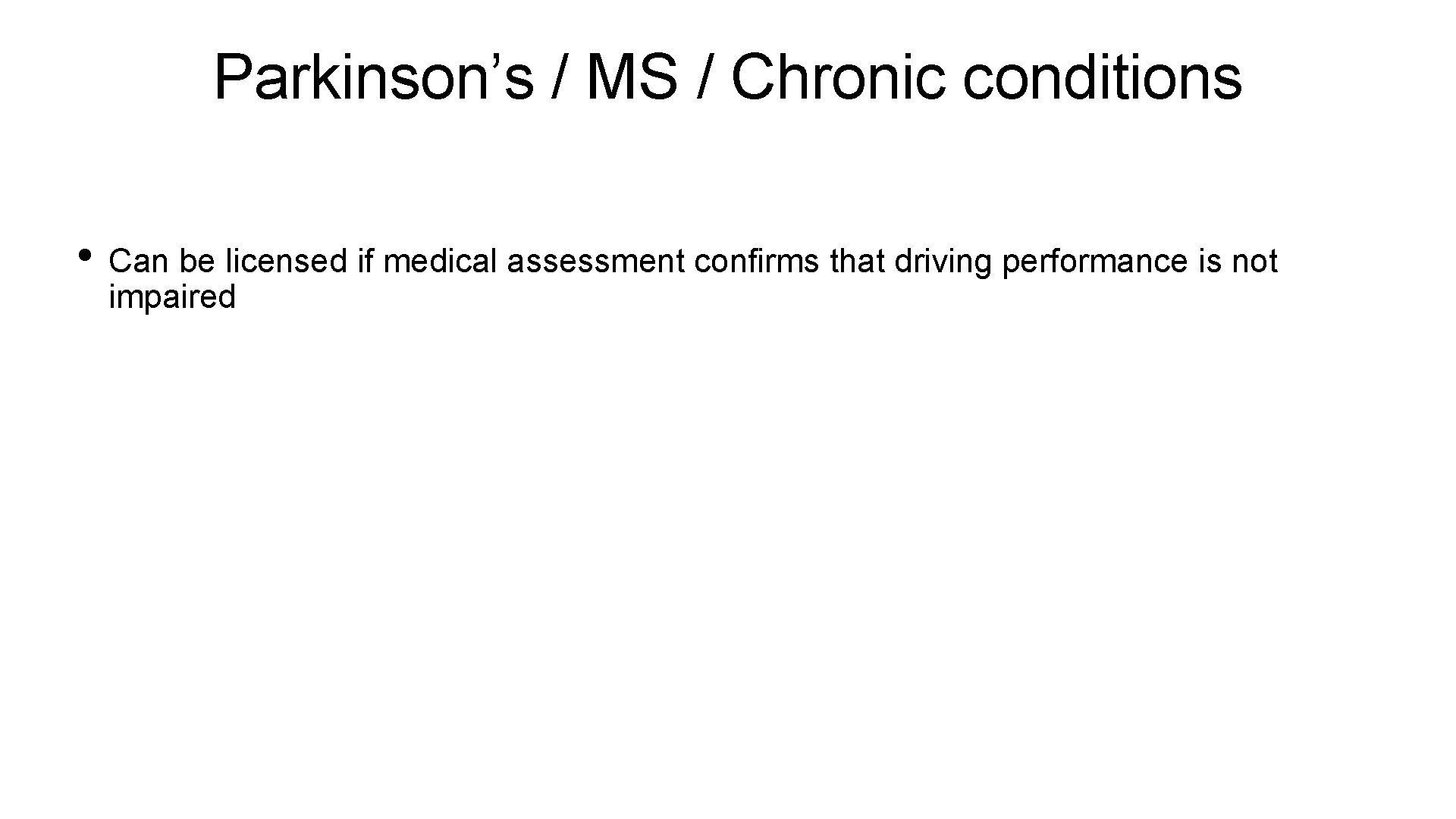
Parkinson’s / MS / Chronic conditions • Can be licensed if medical assessment confirms that driving performance is not impaired
Epilepsy • From a licensing perspective, epilepsy means 2 or more unprovoked seizures over a period which exceeds 24 h • Withdrawing medication • Should not drive for 6 m after stopping • If have a seizure, one year minimum period without driving • The following indicate a good prognosis following a first unprovoked or isolated epileptic seizure • No relevant structural abnormalities on brain imaging • No definite epileptiform activity on EEG • Support of a neurologist • Annual risk of seizure considered to be 2% of lower for bus and lorry drivers
Epilepsy. . . continued • Seizure whilst awake • First attack / solitary fit & specialist assessment completed with no abnormality detected: 6/12 no driving • Otherwise: cease driving 1 y • Seizure whilst asleep • Cease driving for 1 y • Can be licensed if original attack occurred over 3 y ago and no awake attacks occurred since • Seizure whilst treatment withdrawn / changed
DVLA Psychiatric Disorders - Group 1 only • Severe anxiety or depression with any of the following: significant memory problems, significant concentration problems, agitation, behavioural disturbance or suicidal thoughts: must not drive and must notify the DVLA • Acute psychotic disorder: must not drive during acute illness and must notify the DVLA • Hypomania or mania: must not drive during acute illness and must notify the DVLA • Schizophrenia: must not drive during acute illness and must notify the DVLA • Pervasive developmental disorders and ADHD: may be able to drive but must inform the DVLA • Mild cognitive impairment: may drive and need not inform the DVLA • Dementia: may be able to drive but must inform the DVLA • Mild learning disability: may be able to drive but must inform the DVLA • Severe disability: must not drive and must notify the DVLA • Personality disorders: may be able to drive but must inform the DVLA
Visual Disorders Group 1 • Visual field defects • Driving must cease unless confirmed able to meet recommended national guidelines for visual field • Monocular vision • Must notify DVLA • May drive if acuity and visual field is normal in remaining eye • Blepharospasm • Consultant opinion required
Fitness to Fly Cardiovascular Disease - www. caa. co. uk • Unstable angina, uncontrolled hypertension, uncontrolled cardiac arrhythmia, decompensated heart failure, severe symptomatic valvular disease: Should not fly • Uncomplicated MI: 7 -10 days • Complicated MI: 4 -6 weeks • CABG: 10 -14 days • Percutaneous coronary intervention: 5 days • Stroke: Patients are advised to wait 10 days following an event, although if stable may be carried within 3 days of the event. The CAA guidance does not give any definition for what they consider 'stable', and therefore it would be appropriate to seek advice from secondary care if a patient wanted to fly before 10 days following a cerebrovascular accident
Fitness to Fly Respiratory Disease - www. caa. co. uk • Pneumonia: should be 'clinically improved with no residual infection' • Pneumothorax: absolute contraindication, the CAA suggest patients may travel 2 weeks after successful drainage if there is no residual air. The British Thoracic Society used to recommend not travelling by air for a period of 6 weeks but this has now been changed to 1 week post check x-ray
Fitness to Fly Pregnancy - www. caa. co. uk • Most airlines do not allow travel after 36 weeks for a single pregnancy and after 32 weeks for a multiple pregnancy • Most airlines require a certificate after 28 weeks confirming that the pregnancy is progressing normally
Fitness to Fly Procedures - www. caa. co. uk • Abdominal surgery - avoided for 10 days following • Laparoscopic surgery: after 24 hours • Colonoscopy: after 24 hours • Plaster casts - Following the application of a plaster cast, the majority of airlines restrict flying for 24 h on flights of <2 h or 48 h for longer flights. IATA guidelines advise patients that after application of a cast they should not fly for 24 h for short haul flights (<2 hours) or 48 h if the flight is longer. An exception is made if the patient has a bivalved cast fitted. Consult the IATA medical manual and refer to a physician with aviation medicine experience if needed
Fitness to Fly Haematological Disorders - www. caa. co. uk • Patients with a Hb of >8 g/dl may travel without problems (assuming there is no coexisting condition such as cardiovascular or respiratory disease)

Medicine Management and Prescribing
Controlled Drugs 2001 Misuse of Drugs Regulations • Schedule 1 - Cannabis, lysergide • Schedule 2 - Diamorphine, pethidine, amphetamine, cocaine • Schedule 3 - Barbiturates, buprenorphine, midazolam, temazepam, tramado, gabapentin, pregabalin • Schedule 4 - Part 1: Benzodiazepines (except midazolam and temazepam) and zolpidem, zopiclone. Part 2: Androgenic and anabolic steroids, h. CG, somatropin. Controlled drug prescription requirements do not apply and Schedule 4 controlled drugs are not subject to safe custody requirements • Schedule 5 - Includes preparations which because of their strength are exempt from the vast majority of Controlled Drug requirements other than retention of invoices (e. g. codeine, pholcodine, Oramorph 10 mg/5 ml)
Controlled Drugs. . . continued • When prescribing a controlled drug the following must be present on the prescription: • Name and address of the patient • The form, and where appropriate the strength, of the preparation • Either the total quantity (in both words and figures) of the preparation, or the number (in both words and figures) of dosage units to be supplied • The dose (cannot write 'as directed') • Prescribers name, signature, address and current date • Schedule 2 and 3 drugs are marked 'CD' in the BNF • A prescription for controlled drugs in Schedules 2, 3 & 4 is valid for 28 days • A pharmacist is generally not allowed to dispense unless all the information required by law is given. With Schedule 2 and 3 drugs a pharmacist is allowed to amend the prescription if 'it specifies the total quantity only in words or in figures or if it contains minor typographical errors, provided that such amendments are indelible and clearly attributable to the pharmacist making them'
Controlled Drugs Storage • In the surgery controlled drugs (CDs) should be stored in a locked cabinet • Controlled drugs outside of the surgery must be stored in a locked receptacle (combination lock or key) • A doctor's bag with a lock is acceptable • Storing a controlled drug in a locked car boot is not acceptable
Controlled Drugs The register • A register must be kept for the supply of Schedule 2 drugs • Specific requirements: • Must be bound. Computerised records are acceptable as long as they are secure and auditable • Each drug should have its own individual section • Entries should be chronological and made in indelible ink • When receiving CDs record: Date, name and address of the supplier, quantity received, name, form and strength • When supplying CDs (either to patients or practitioners) record: Date, name and address of the person receiving the CD, person who prescribed or ordered the CD, quantity supplied, name, form and strength • Must be kept for a minimum of 2 y after the date of the last entry • For doctor's bags a separate CD register should be kept for the CD stock held within that bag. The individual doctor is responsible for the receipt and supply of CDs from their own bag

Controlled Drugs
Drug Calculations • Opioids in palliative care • S/C dose of morphine is half oral dose • S/C diamorphine is 1/3 of the oral dose of morphine • Breakthrough dose of opioids is 1/6 of the 24 h intake of MR opioid
Drug Monitoring • DMARDS • Methotrexate - FBC, LFTs, U&Es - 1 -2/52 when initiating then 2 -3/12 • Azathioprine - FBC, LFT before Rx, FBC weekly for 1 st 4 weeks • Levothyroxine • Annual TSH • Statins • LFTs at baseline, 3/12 and 12/12 • Lithium • Level 3/12 if stable • Aim for level 0. 6 - 1. 0 (beware >0. 8 in elderly) and U+Es / TFTs every 6/12
Drug monitoring. . . continued • ACE Inhibitors • U+Es prior to Rx • 1 -2/52 after starting and after each dose increase • U+Es at least annually • Amiodarone • LFTs / TFTs, U+Es, CXR before starting • TFTs, LFT every 6/12. CXR annually • Also think about blurred vision (optic neuritis)
Emergency Supply of Medication www. nhs. uk • Pharmacist usually needs to see face-to-face, needs to agree immediate treatment necessary, requires evidence of previous prescribing and must be satisfied dose is appropriate • May supply up to 30 days with the following exceptions: • Insulin, an ointment or cream, or an asthma inhaler - only smallest pack size can be supplied • An oral contraceptive when a full cycle may be supplied • An antibiotic in liquid form for oral administration when the smallest quantity that will provide a full course of treatment can be supplied
Prescription charges • England charges. Wales and Scotland don’t • In England, there is no prescription charge applied to: • Contraceptives • STI treatments • Hospital prescriptions • GP administered medications
Prescription charges Prescription exemption certificate (FP 92 A) • Permanent fistula requiring continuous surgical dressing or requiring an appliance • Epilepsy requiring continuous anti-convulsive therapy • Diabetes mellitus except where treatment is by diet alone • Hypothyroidism requiring thyroid hormone replacement • Hypoparathyroidism • Diabetes insipidus and other forms of hypopituitarism • Hypoadrenalism for which specific substitution therapy is essential (e. g. Addison's Disease) • Myasthenia gravis • A continuing physical disability requiring help to go out from someone else • Undergoing cancer treatment. This includes treatment for the effects of cancer or for the effects of cancer treatments
Prescription charges Exemptions • Under 16 y • 16 -18 y in full-time education • 60 y or over • Valid maternity exemption certificate • Valid prescription pre-payment certificate • Valid war pension exemption certificate • Named on a current HC 2 charges certificate • Prescribed free of charge contraceptives • Certain benefits - Income support, income related ESA, income based JSA
PACT • Prescribing Analysis and Cost Tabulation or Prescribing Analysis and Cos. T. It is a document issued to each GP practice giving a summary of prescribing patterns • Generic vs. brand prescribing • Number of items dispensed (categorised as per BNF) • Information available at individual practice level, health authority level, and national level, allowing different analyses • Generated by the Prescription Pricing Authority (PPA)
Part XVIIIA of the Drug Tariff - The Blacklist • Theoretically any food, drug, toiletry or cosmetic may be prescribed on an NHS prescription unless the product is listed in Part XVIIIA of the Drug Tariff ('the blacklist') • Medical devices (appliances) can only be prescribed on NHS prescriptions if the product is listed in Part IX of the Drug Tariff. • If a proprietary product is listed in 'the blacklist', it cannot be dispensed on the NHS. The only exception to this is if the prescription is issued using a generic name and the generic name is not itself included in the blacklist • Some examples of 'blacklisted' products: • Propecia (finasteride for male-pattern alopecia) • Regaine (topical minoxidil for male-pattern alopecia) • Calpol (see above, paracetamol suspension may be prescribed)
The Selected List • Part XVIIIB of the Drug Tariff lists items that may only be prescribed for the patient groups and for the purpose listed in the Drug Tariff. Prescribers must endorse prescriptions for these products 'SLS'. Please note that sildenafil was taken off the list in 2014 and can now be prescribed freely • For example: • Niferex Elixir 30 ml Paediatric Dropper Bottle - infants born prematurely - prophylaxis in treatment of iron deficiency
- Slides: 88