
AJCC Staging Moments AJCC TNM Staging 7 th
- Slides: 22
AJCC Staging Moments AJCC TNM Staging 7 th Edition Lung Case #1 Contributors: Valerie W. Rusch, MD Memorial Sloan-Kettering Cancer Center, New York Peter Goldstraw, MD Royal Brompton Hospital, London, England Kelly J. Butnor, MD University of Vermont Medical Center, Burlington, Vermot Thomas W. Rice, MD Cleveland Clinic, Cleveland, Ohio
Lung Case # 1 Presentation of New Case • Newly diagnosed lung cancer patient • Presentation at Cancer Conference for treatment recommendations and clinical staging
Lung Case # 1 History & Physical • 75 yr old male who presented with an abnormal CXR during workup for another condition, no symptoms • 50 yr smoking history
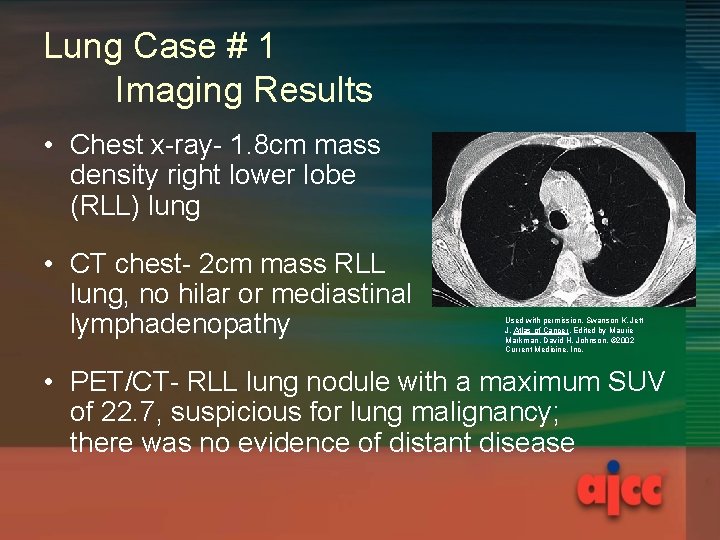
Lung Case # 1 Imaging Results • Chest x-ray- 1. 8 cm mass density right lower lobe (RLL) lung • CT chest- 2 cm mass RLL lung, no hilar or mediastinal lymphadenopathy Used with permission. Swanson K, Jett J. Atlas of Cancer. Edited by Maurie Markman, David H. Johnson. © 2002 Current Medicine, Inc. • PET/CT- RLL lung nodule with a maximum SUV of 22. 7, suspicious for lung malignancy; there was no evidence of distant disease
Lung Case # 1 Diagnostic Procedure • Procedure – CT guided biopsy RLL lung • Pathology Report – Adenocarcinoma – Grade 2
Lung Case # 1 Clinical Staging • Clinical staging – Uses information from the physical exam, imaging, and diagnostic biopsy • Purpose – Select appropriate treatment – Estimate prognosis
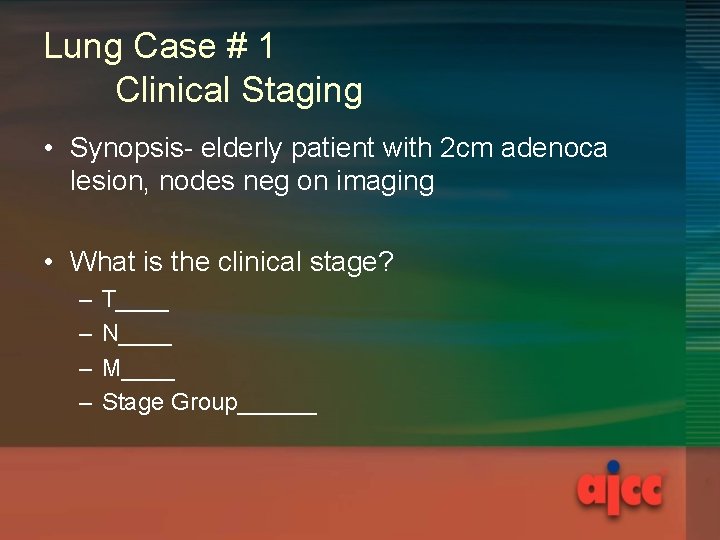
Lung Case # 1 Clinical Staging • Synopsis- elderly patient with 2 cm adenoca lesion, nodes neg on imaging • What is the clinical stage? – – T____ N____ M____ Stage Group______
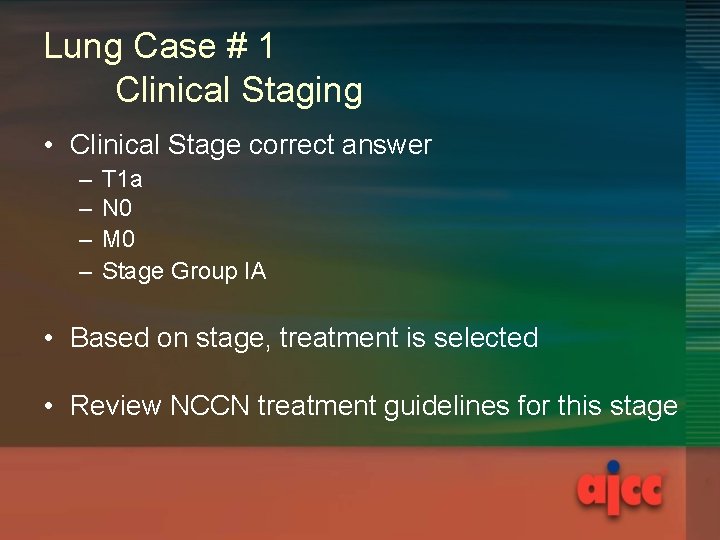
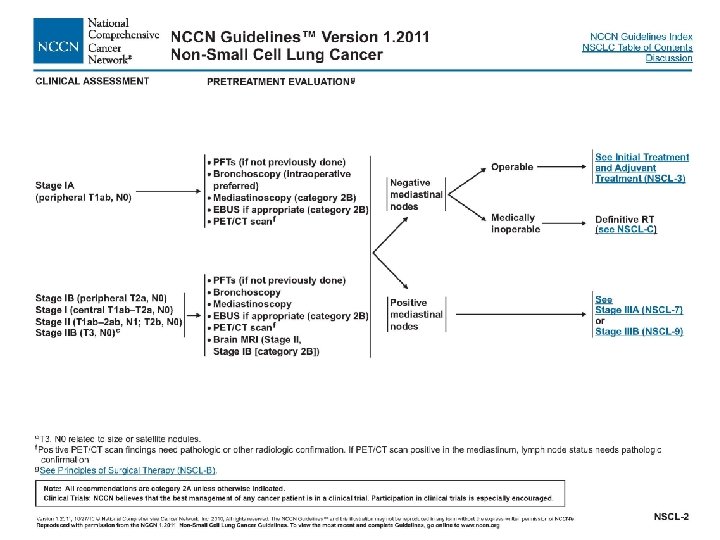
Lung Case # 1 Clinical Staging • Clinical Stage correct answer – – T 1 a N 0 M 0 Stage Group IA • Based on stage, treatment is selected • Review NCCN treatment guidelines for this stage
Lung Case # 1 Clinical Staging • Rationale for staging choices – T 1 a for ca <2 cm – N 0 because nodes were clinically negative on imaging – M 0 because there was nothing to suggest distant metastases; if there was, appropriate tests would be performed before developing a treatment plan
Prognostic Factors Clinically Significant • Applicable to this case – Separate tumor nodules: none • There are no prognostic factors required for staging
Lung Case # 1 Presentation after Surgery • The procedure chosen based on the small lesion and clinically negative nodes in an elderly patient, Stage IA, is resection and node sampling • Presentation at Cancer Conference for adjuvant treatment recommendations and pathologic staging
Lung Case # 1 Surgery & Findings • Procedure – RLL lobectomy – Hilar & mediastinal node resection • Operative findings – No additional information
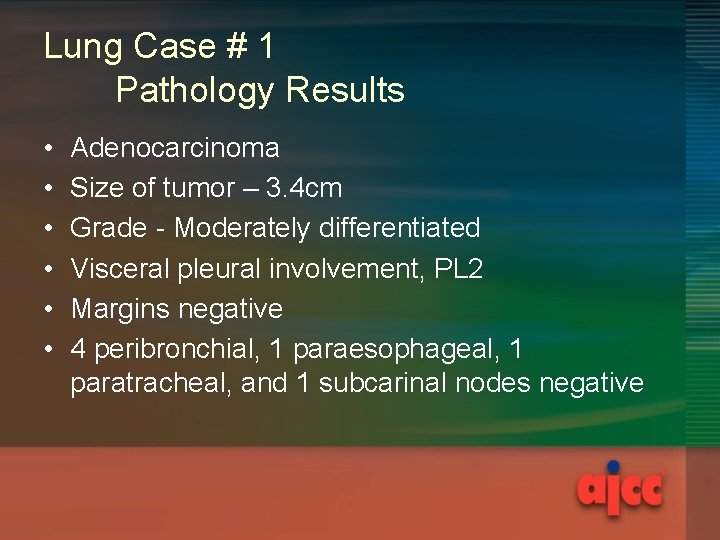
Lung Case # 1 Pathology Results • • • Adenocarcinoma Size of tumor – 3. 4 cm Grade - Moderately differentiated Visceral pleural involvement, PL 2 Margins negative 4 peribronchial, 1 paraesophageal, 1 paratracheal, and 1 subcarinal nodes negative
Lung Case # 1 Pathologic Staging • Pathologic staging – Uses information from the clinical staging supplemented or modified by information from surgery and the pathology report • Purpose – Additional precise data for estimating prognosis – Calculating end results (survival data)
Lung Case # 1 Pathologic Staging • Synopsis- patient with 3. 4 cm adenoca into visceral pleura, PL 2, intrapulmonary and mediastinal nodes negative • What is the pathologic stage? (remember, clinical M may be used in pathologic staging) – – T____ N____ M____ Stage Group______
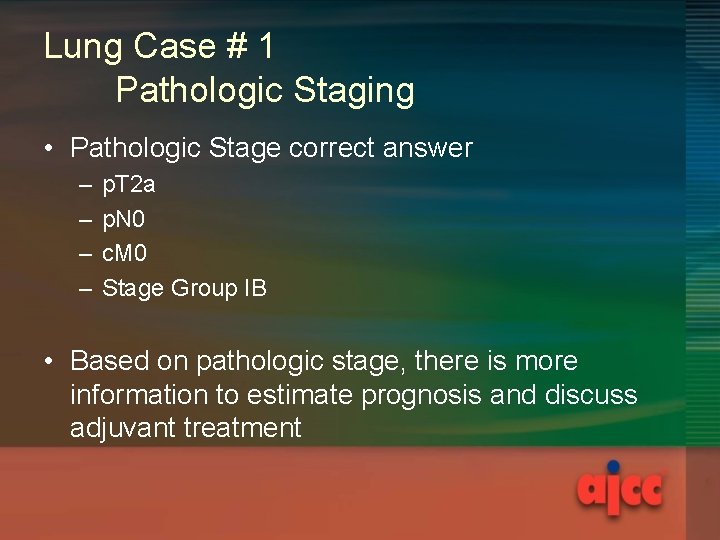
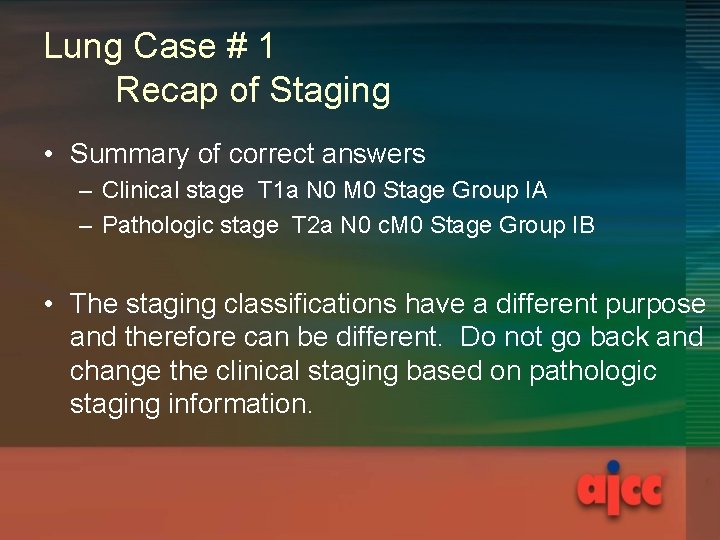
Lung Case # 1 Pathologic Staging • Pathologic Stage correct answer – – p. T 2 a p. N 0 c. M 0 Stage Group IB • Based on pathologic stage, there is more information to estimate prognosis and discuss adjuvant treatment
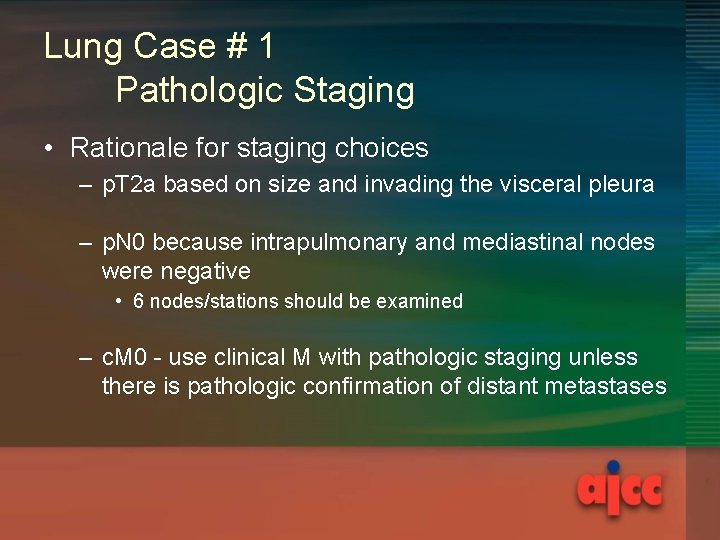
Lung Case # 1 Pathologic Staging • Rationale for staging choices – p. T 2 a based on size and invading the visceral pleura – p. N 0 because intrapulmonary and mediastinal nodes were negative • 6 nodes/stations should be examined – c. M 0 - use clinical M with pathologic staging unless there is pathologic confirmation of distant metastases
Prognostic Factors Clinically Significant • Applicable to this case – Separate tumor nodules: none – Pleural/elastic layer invasion: PL 2 • There are no prognostic factors required for staging
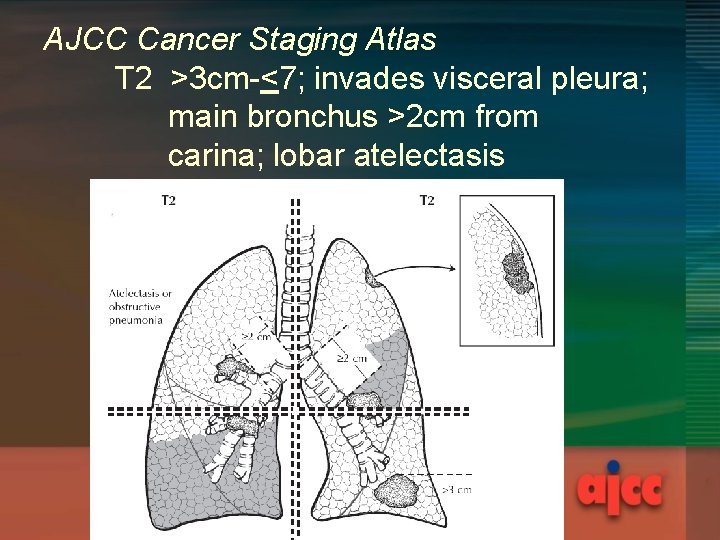
AJCC Cancer Staging Atlas T 2 >3 cm-<7; invades visceral pleura; main bronchus >2 cm from carina; lobar atelectasis
Lung Case # 1 Recap of Staging • Summary of correct answers – Clinical stage T 1 a N 0 M 0 Stage Group IA – Pathologic stage T 2 a N 0 c. M 0 Stage Group IB • The staging classifications have a different purpose and therefore can be different. Do not go back and change the clinical staging based on pathologic staging information.
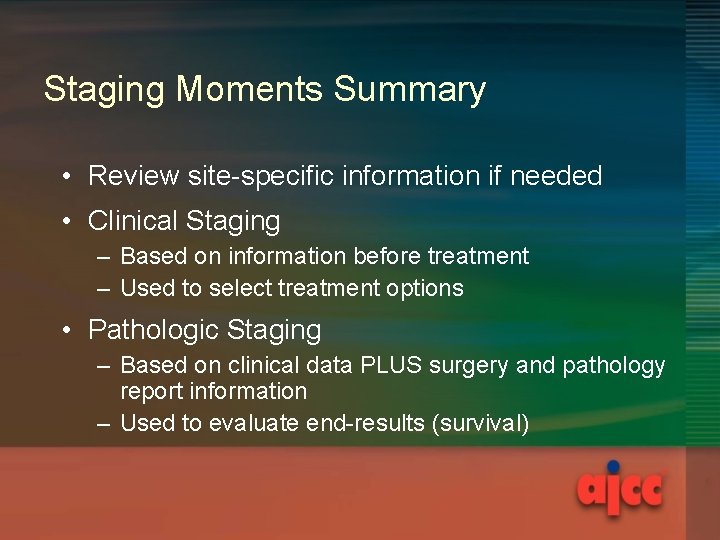
Staging Moments Summary • Review site-specific information if needed • Clinical Staging – Based on information before treatment – Used to select treatment options • Pathologic Staging – Based on clinical data PLUS surgery and pathology report information – Used to evaluate end-results (survival)