
Aisaac Klarence E Anunciacion Basic Food Groups GO
Aisaac Klarence E. Anunciacion
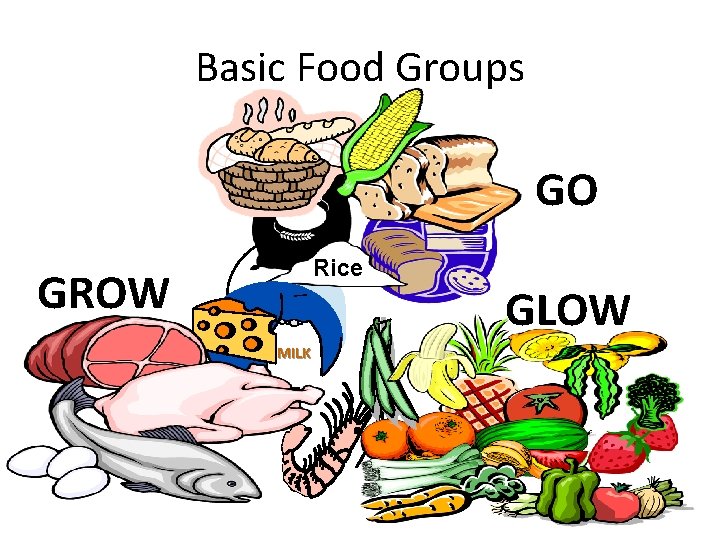
Basic Food Groups GO Rice GROW MILK GLOW
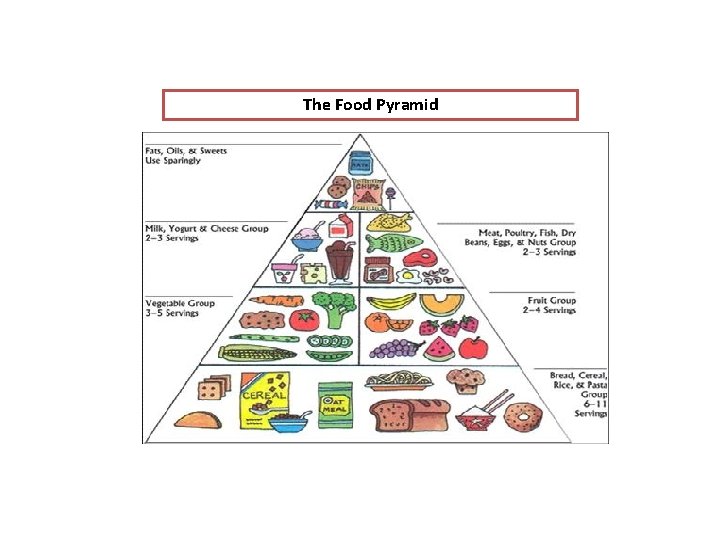
The Food Pyramid
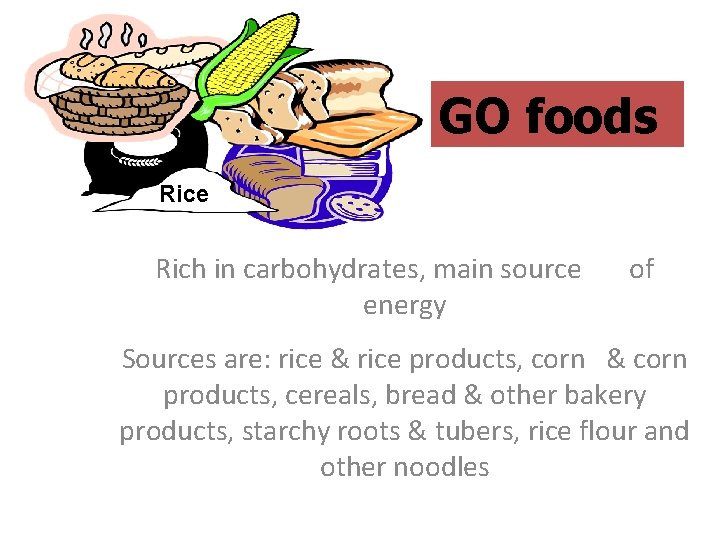
GO foods Rice Rich in carbohydrates, main source energy of Sources are: rice & rice products, corn & corn products, cereals, bread & other bakery products, starchy roots & tubers, rice flour and other noodles
GO foods Lack of carbohydrates may result in: • Underweight and/or loss of weight • General weakness • Poor physical performance • Fainting or collapse, in severe deficiency
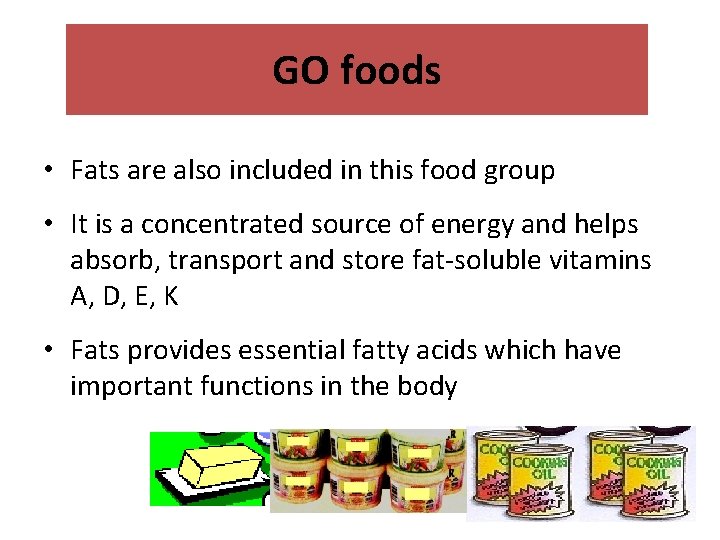
GO foods • Fats are also included in this food group • It is a concentrated source of energy and helps absorb, transport and store fat-soluble vitamins A, D, E, K • Fats provides essential fatty acids which have important functions in the body
Rice Substitutes • Camote • Cassava (kamoteng kahoy) • Gabi • Saging Saba
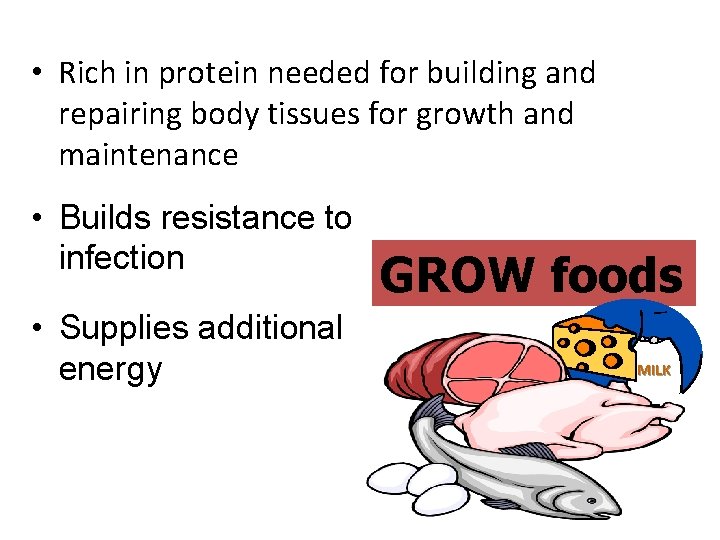
• Rich in protein needed for building and repairing body tissues for growth and maintenance • Builds resistance to infection • Supplies additional energy GROW foods MILK
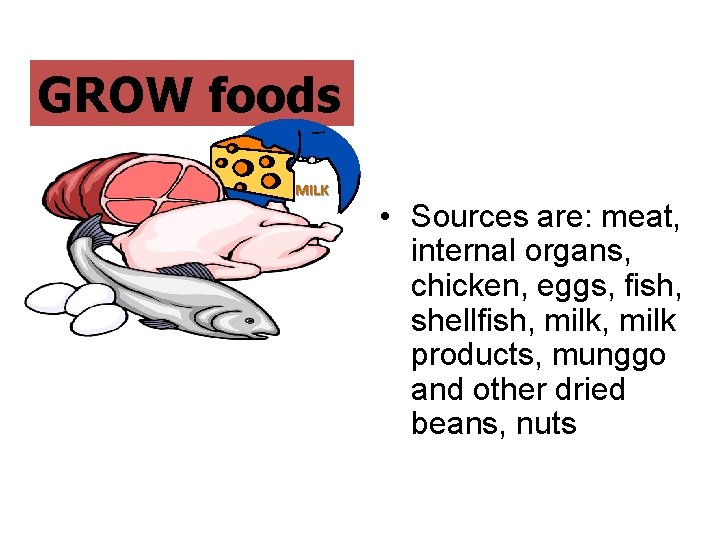
GROW foods MILK • Sources are: meat, internal organs, chicken, eggs, fish, shellfish, milk products, munggo and other dried beans, nuts
GROW foods Lack of protein results in: • Retarded growth in children • Low resistance to infection at any age • Slow recovery from illness • Low birth weight • Anemia • Loss of weight • Edema, skin lesions, mental sluggishness
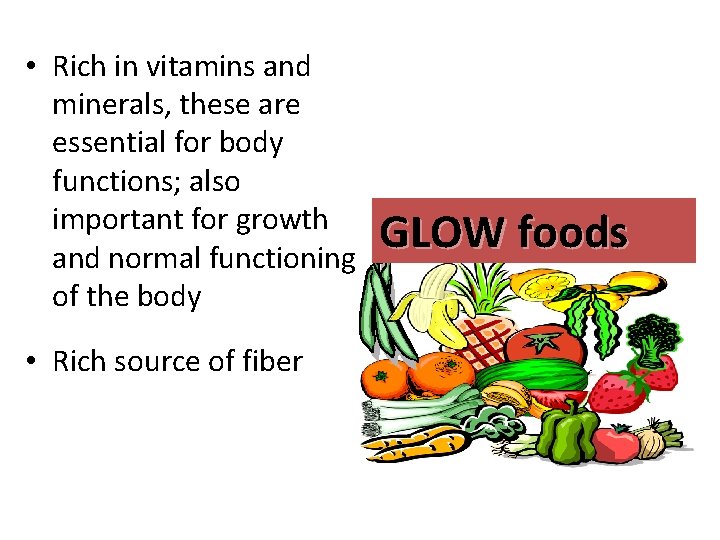
• Rich in vitamins and minerals, these are essential for body functions; also important for growth and normal functioning of the body • Rich source of fiber GLOW foods
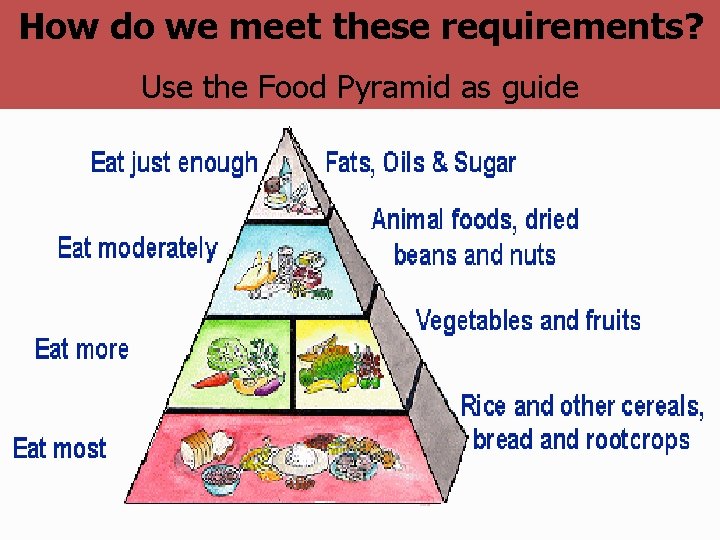
How do we meet these requirements? Use the Food Pyramid as guide
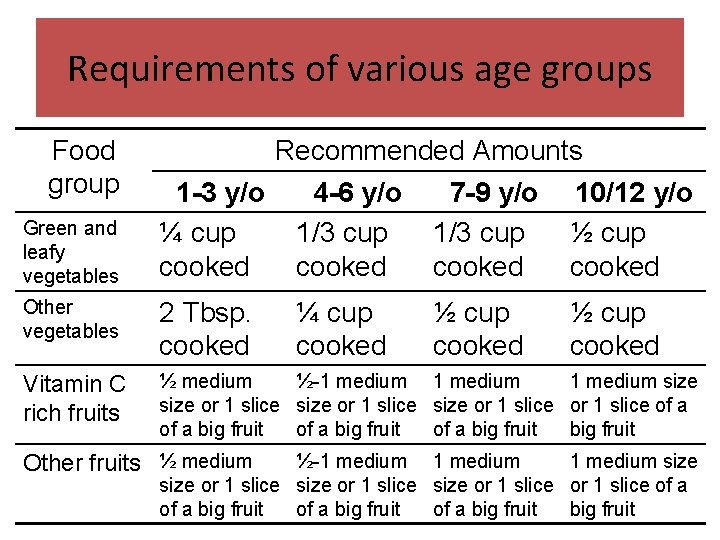
Requirements of various age groups Food group Green and leafy vegetables Recommended Amounts 1 -3 y/o 4 -6 y/o 7 -9 y/o 10/12 y/o ¼ cup 1/3 cup ½ cup cooked Other vegetables 2 Tbsp. cooked Vitamin C rich fruits ½ medium ½-1 medium size or 1 slice of a big fruit Other fruits ½ medium ¼ cup cooked ½-1 medium size or 1 slice of a big fruit
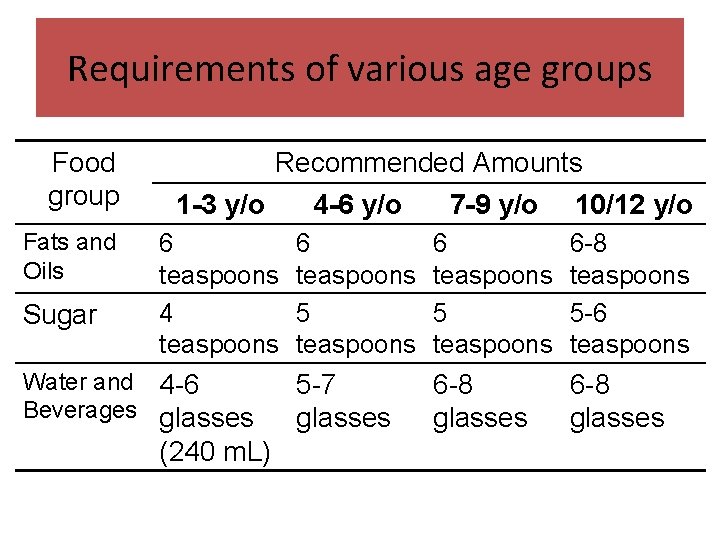
Requirements of various age groups Food group Fats and Oils Sugar Recommended Amounts 1 -3 y/o 4 -6 y/o 7 -9 y/o 10/12 y/o 6 teaspoons 4 teaspoons Water and 4 -6 Beverages glasses (240 m. L) 6 teaspoons 5 teaspoons 6 -8 teaspoons 5 -6 teaspoons 5 -7 glasses 6 -8 glasses
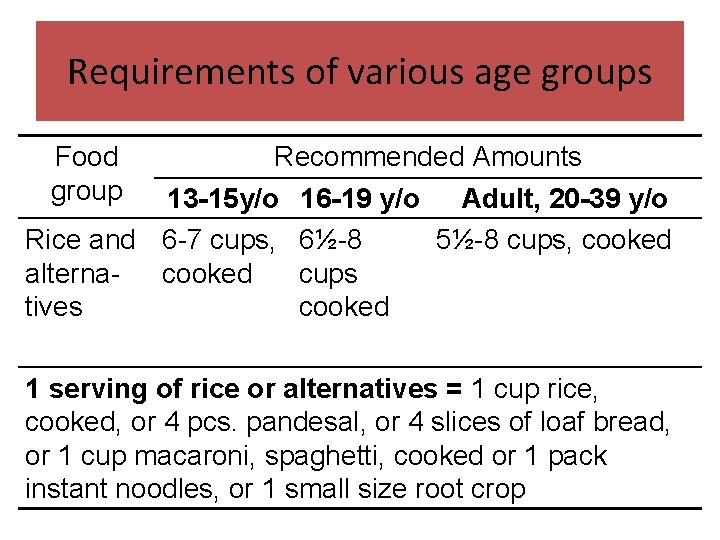
Requirements of various age groups Food group Recommended Amounts 13 -15 y/o 16 -19 y/o Adult, 20 -39 y/o Rice and 6 -7 cups, 6½-8 5½-8 cups, cooked alterna- cooked cups tives cooked 1 serving of rice or alternatives = 1 cup rice, cooked, or 4 pcs. pandesal, or 4 slices of loaf bread, or 1 cup macaroni, spaghetti, cooked or 1 pack instant noodles, or 1 small size root crop
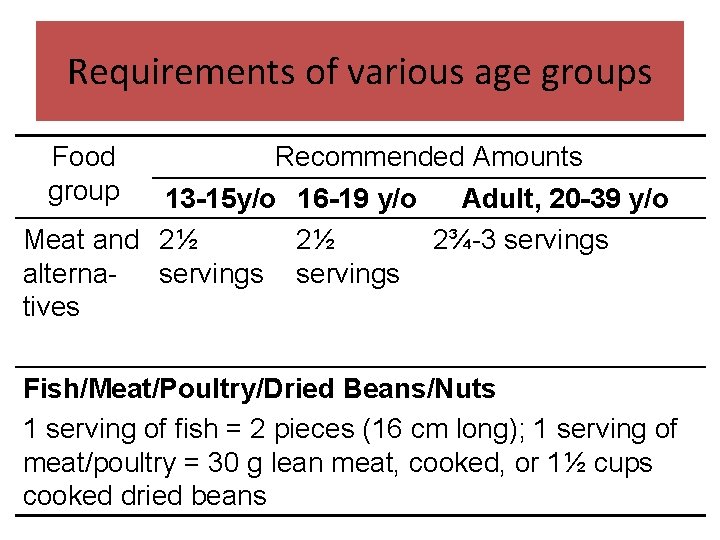
Requirements of various age groups Food group Recommended Amounts 13 -15 y/o 16 -19 y/o Adult, 20 -39 y/o Meat and 2½ 2½ 2¾-3 servings alterna- servings tives Fish/Meat/Poultry/Dried Beans/Nuts 1 serving of fish = 2 pieces (16 cm long); 1 serving of meat/poultry = 30 g lean meat, cooked, or 1½ cups cooked dried beans
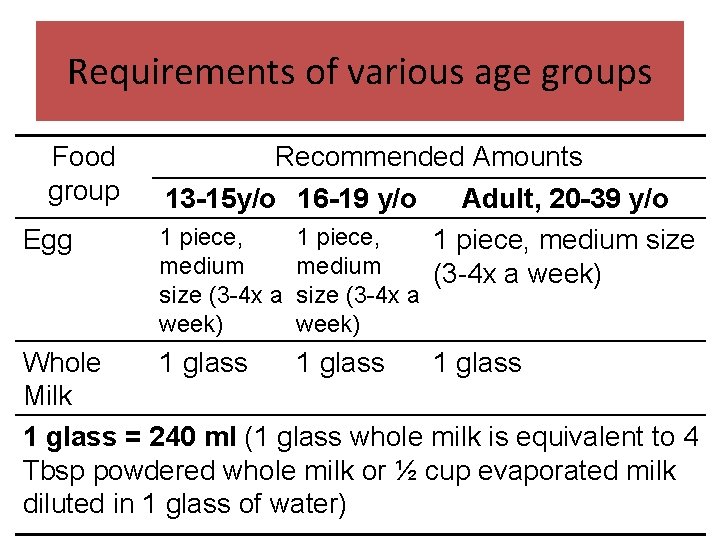
Requirements of various age groups Food group Egg Recommended Amounts 13 -15 y/o 16 -19 y/o 1 piece, medium size (3 -4 x a week) Adult, 20 -39 y/o 1 piece, medium size (3 -4 x a week) Whole 1 glass Milk 1 glass = 240 ml (1 glass whole milk is equivalent to 4 Tbsp powdered whole milk or ½ cup evaporated milk diluted in 1 glass of water)
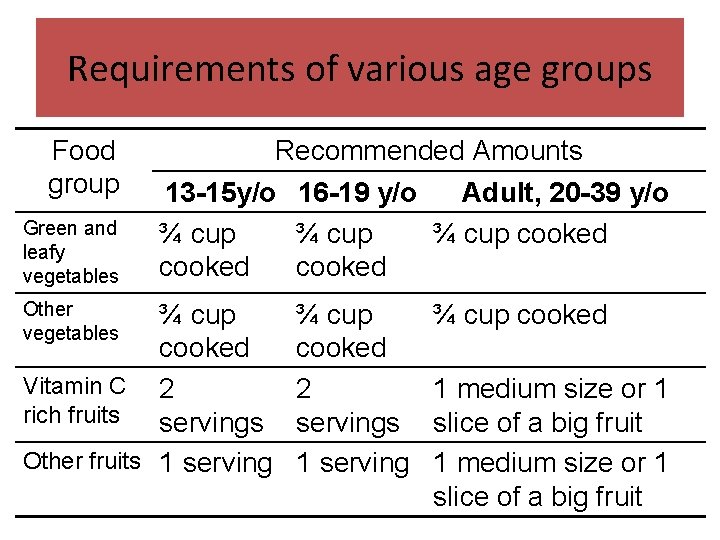
Requirements of various age groups Food group Green and leafy vegetables Other vegetables Recommended Amounts 13 -15 y/o 16 -19 y/o Adult, 20 -39 y/o ¾ cup cooked ¾ cup cooked Vitamin C 2 rich fruits servings Other fruits 1 serving ¾ cup cooked 2 servings 1 serving ¾ cup cooked 1 medium size or 1 slice of a big fruit
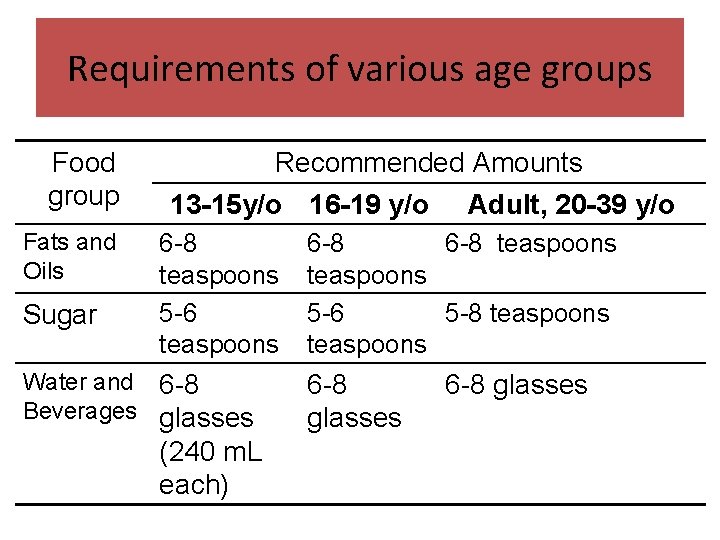
Requirements of various age groups Food group Fats and Oils Sugar Recommended Amounts 13 -15 y/o 16 -19 y/o 6 -8 teaspoons 5 -6 teaspoons Water and 6 -8 Beverages glasses (240 m. L each) Adult, 20 -39 y/o 6 -8 teaspoons 5 -6 5 -8 teaspoons 6 -8 glasses
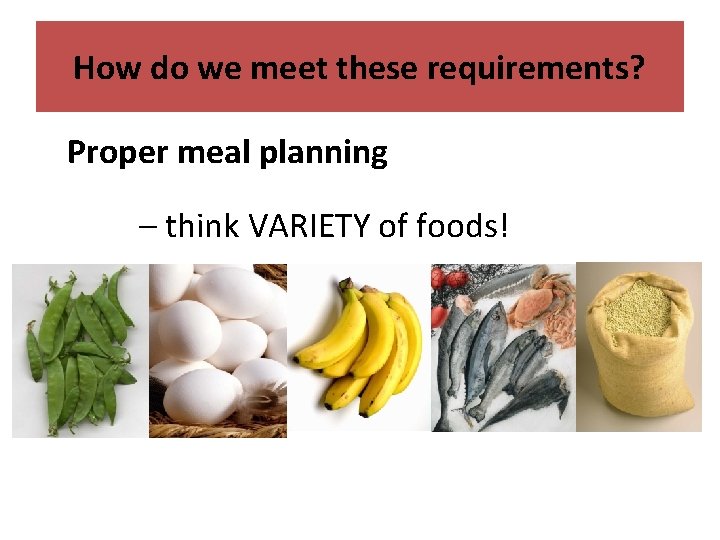
How do we meet these requirements? Proper meal planning – think VARIETY of foods!
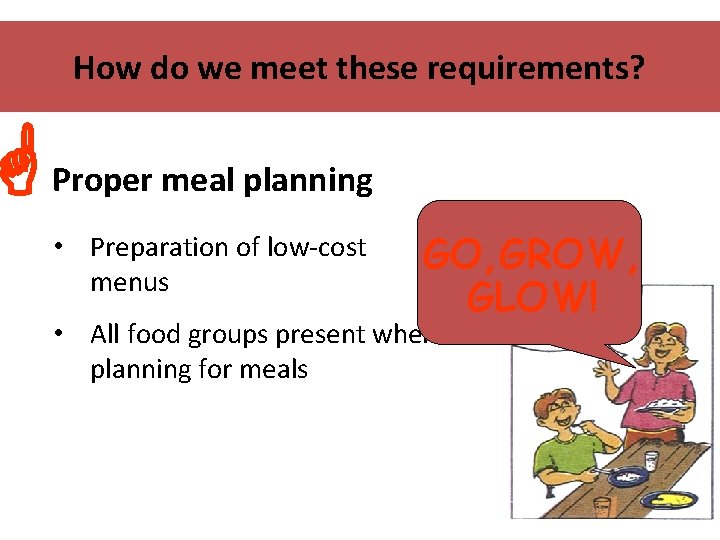
How do we meet these requirements? Proper meal planning • Preparation of low-cost menus GO, GROW, GLOW! • All food groups present when planning for meals
Guides for planning meals 1. Select food that meets the nutritional needs of those who will eat. 2. Consider food for each meal in relation to food plans for the day. 3. Keep the food value of any given meal essentially the same, day after day.
Guides for planning meals 4. Select food suitable for the meal. 5. Consider the personal likes and dislikes of the group. 6. Select foods that combine pleasingly. 7. Have contrast in the food in color, texture, form and temperature.
Guides for planning meals 8. Have daily variety. 9. Select foods in season when possible. 10. Avoid serving more than two dishes of concentrated food in any one meal. 11. Select food that is easily prepared.
Guides for planning meals 12. Select food that is easily served. 13. Select foods after due consideration of the equipment on hand. 14. Consider the cost in relation to the food allowance for the day.
Low-cost menus • Use of available resources • Use of indigenous fruits and vegetables • Example of a low-cost menu: Breakfast Hard cooked egg Rice Fresh fruit Lunch Nilagang Manok Rice Fresh fruit Dinner Fried galunggong Pinakbet Rice Fresh fruit
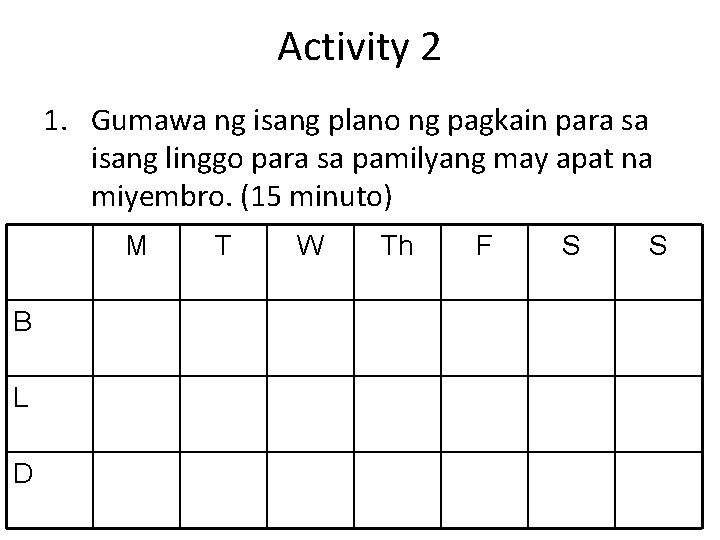
Activity 2 1. Gumawa ng isang plano ng pagkain para sa isang linggo para sa pamilyang may apat na miyembro. (15 minuto) M B L D T W Th F S S
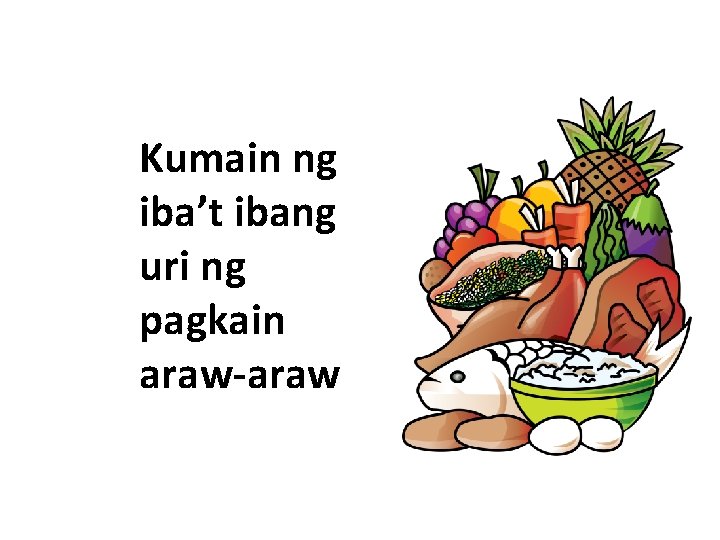
Kumain ng iba’t ibang uri ng pagkain araw-araw
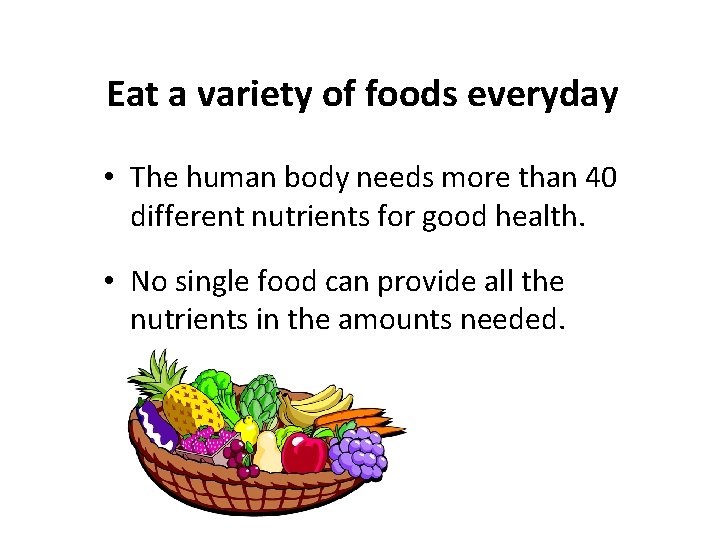
Eat a variety of foods everyday • The human body needs more than 40 different nutrients for good health. • No single food can provide all the nutrients in the amounts needed.
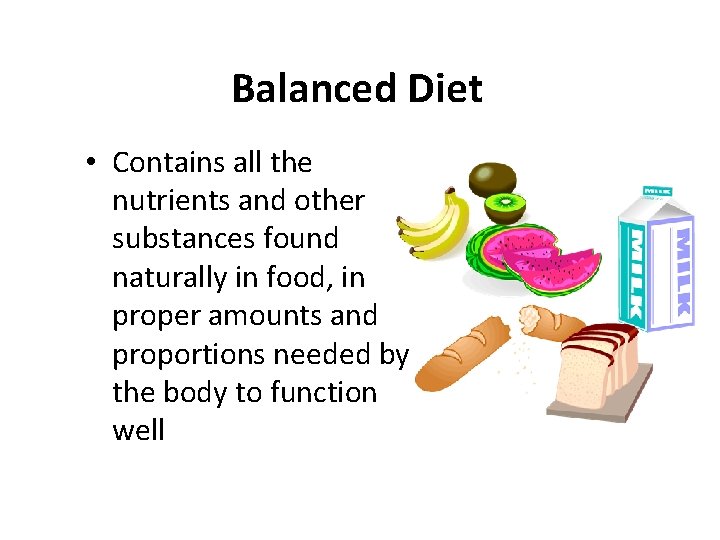
Balanced Diet • Contains all the nutrients and other substances found naturally in food, in proper amounts and proportions needed by the body to function well
Benefits of eating a balanced diet • Full mental development • Better concentration • Feel better
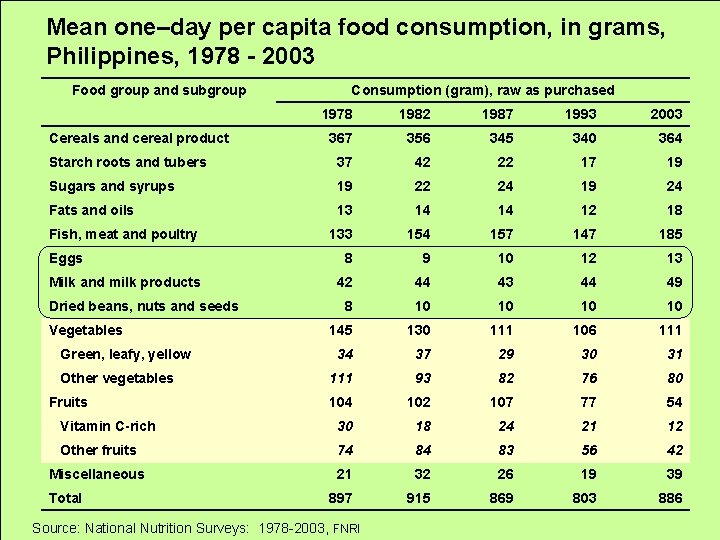
Mean one–day per capita food consumption, in grams, Philippines, 1978 - 2003 Food group and subgroup Consumption (gram), raw as purchased 1978 1982 1987 1993 2003 367 356 345 340 364 Starch roots and tubers 37 42 22 17 19 Sugars and syrups 19 22 24 19 24 Fats and oils 13 14 14 12 18 133 154 157 147 185 8 9 10 12 13 42 44 43 44 49 8 10 10 145 130 111 106 111 34 37 29 30 31 111 93 82 76 80 104 102 107 77 54 Vitamin C-rich 30 18 24 21 12 Other fruits 74 84 83 56 42 Miscellaneous 21 32 26 19 39 897 915 869 803 886 Cereals and cereal product Fish, meat and poultry Eggs Milk and milk products Dried beans, nuts and seeds Vegetables Green, leafy, yellow Other vegetables Fruits Total Source: National Nutrition Surveys: 1978 -2003, FNRI
Provide adequate diet to an active child that will promote good health and normal growth

Kumain ng isda, karne, manok o tuyong butong gulay
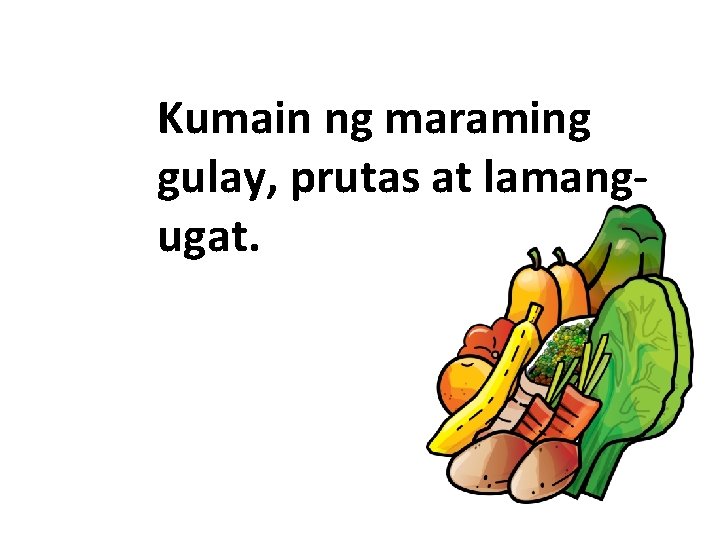
Kumain ng maraming gulay, prutas at lamangugat.
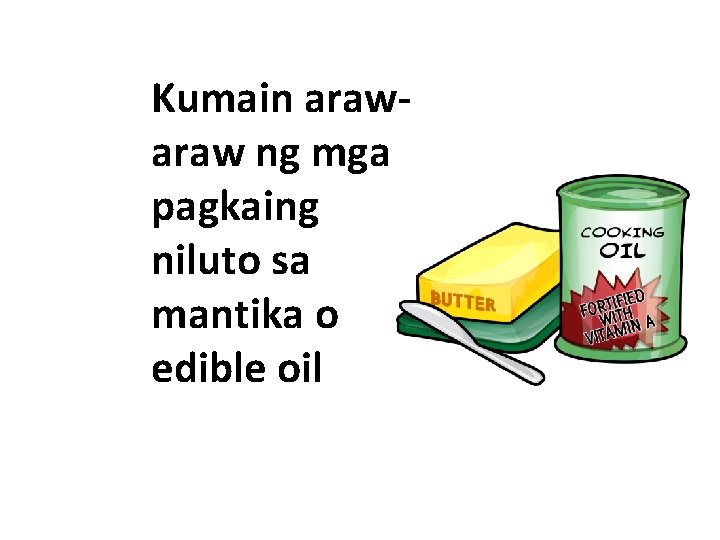
Kumain araw ng mga pagkaing niluto sa mantika o edible oil
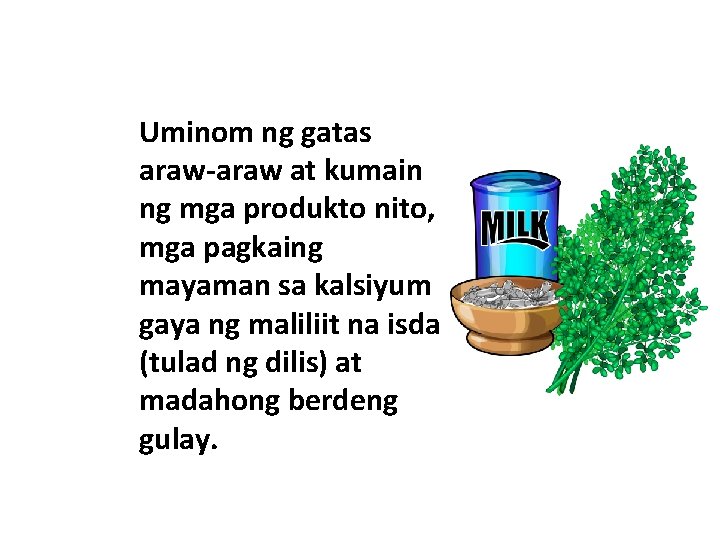
Uminom ng gatas araw-araw at kumain ng mga produkto nito, mga pagkaing mayaman sa kalsiyum gaya ng maliliit na isda (tulad ng dilis) at madahong berdeng gulay.
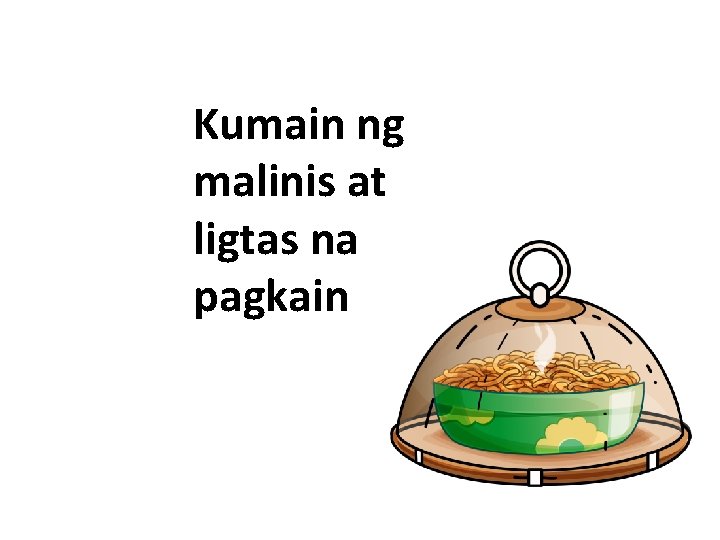
Kumain ng malinis at ligtas na pagkain
Food safety “All conditions and measures that are necessary during the production, processing, storage, distribution and preparation of food to ensure that food is safe, sound, wholesome and fit for human consumption. ” - WHO-FAO
Clean and safe food • Buy food that are safe – Purchase from reliable sources • Food should be kept clean at all stages – from production to consumption • Practice food safety
Preventing food-borne diseases 1. Practice good personal hygiene. 2. Drink safe water. 3. Practice good housekeeping 4. Clean and sanitize environment. Practice pest control. 5. Handle food safely. 6. Read food labels.
Proper Handling and Preparation of Foods
Mga Ginintuang Alituntunin ng World Health Organization Para sa Ligtas na Paghahanda ng Pagkain 1. Piliin ang pagkain na pinoproseso para matiyak na ito ay ligtas. 2. Lutuing mabuti ang pagkain. 3. Kainin kaagad ang mga nilutong pagkain. 4. Iimbak nang mabuti ang nilutong pagkain. 5. Muling initin nang lubos ang mga nilutong pagkain.
Mga Ginintuang Alituntunin ng World Health Organization Para sa Ligtas na Paghahanda ng Pagkain 6. Iwasang masagi ng hilaw na pagkain ang mga nilutong pagkain. 7. Maghugas ng kamay nang madalas. 8. Panatilihing malinis ang mga lugar na pinaghahandaan ng pagkain. 9. Pangalagaan ang mga pagkain laban sa mga insekto, daga at iba pang hayop. 10. Gumamit ng malinis na tubig.

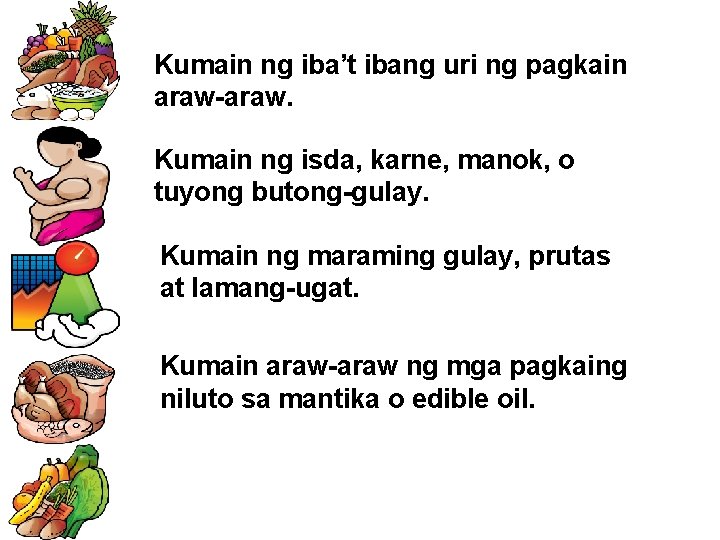
Kumain ng iba’t ibang uri ng pagkain araw-araw. Kumain ng isda, karne, manok, o tuyong butong-gulay. Kumain ng maraming gulay, prutas at lamang-ugat. Kumain araw-araw ng mga pagkaing niluto sa mantika o edible oil.
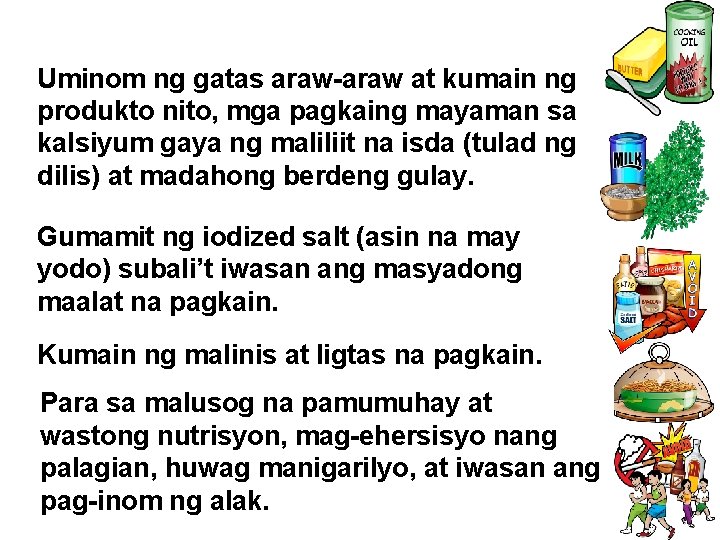
Uminom ng gatas araw-araw at kumain ng produkto nito, mga pagkaing mayaman sa kalsiyum gaya ng maliliit na isda (tulad ng dilis) at madahong berdeng gulay. Gumamit ng iodized salt (asin na may yodo) subali’t iwasan ang masyadong maalat na pagkain. Kumain ng malinis at ligtas na pagkain. Para sa malusog na pamumuhay at wastong nutrisyon, mag-ehersisyo nang palagian, huwag manigarilyo, at iwasan ang pag-inom ng alak.
- Slides: 47