
Airway Management Research Update Calvin A Brown III
Airway Management Research Update Calvin A. Brown III, MD December 5, 2014 Medical Director, Urgent Care Attending Physician, Emergency Medicine Brigham and Women’s Hospital Harvard Medical School Cheryl Lynn Horton, MD Attending Physician Emergency Medicine Kaiser Permanente © 2014 Airway Management Education Center
Welcome • Welcome to the Airway Management Research Update Webinar • Disclosures Faculty Name Company Nature of Financial Relationship Calvin A. Brown III, MD Airway Management Education Center Speaker Cheryl Lynn Horton, MD Airway Management Education Center Speaker • Financial Relationships: Financial relationships are those relationships in which the individual benefits by receiving a salary, royalty, intellectual property rights, consulting fee, honoraria, ownership interest (e. g. , stocks, stock options or other ownership interest, excluding diversified mutual funds), or other financial benefit. Financial benefits are usually associated with roles such as employment, management position, independent contractor (including contracted research), consulting, speaking and teaching, membership on advisory committees or review panels, board membership, and other activities from which remuneration is received, or expected. ACCME considers relationships of the person involved in the CME activity to include financial relationships of a spouse or partner. © 2014 Airway Management Education Center
Accreditation Statement • This activity has been planned and implemented in accordance with the Essential Areas and policies of the Accreditation Council for CME (ACCME) through the joint providership of Hospital Physician Partners and Airway Management Education Center. Hospital Physician Partners is accredited by the ACCME to provide CME for physicians. • Hospital Physician Partners designates this live activity for a maximum of 1. 0 AMA PRA Category 1 Credit. ™ Physicians should claim only the credit commensurate with the extent of their participation in the activity. • This continuing education activity is approved by First Airway LLC, an organization accredited by the Continuing Education Coordinating Board for Emergency Medical Services (CECBEMS). CECBEMS Activity #: 14 -First. Air. F 5 -QAR 0214 CEH Number and Type: 1. 0 Advanced. Provider: First Airway, LLC #: First. Air 6610 © 2014 Airway Management Education Center
Objectives At the conclusion of this webinar, you should be able to: – Describe the latest research in airway management – Apply the findings to your practice © 2014 Airway Management Education Center
Agenda • • • Pre-test Case 1 Case 2 Q&A Post-test Questions Evaluation upon exit from presentation © 2014 Airway Management Education Center
First, A Short Pre-Test © 2014 Airway Management Education Center
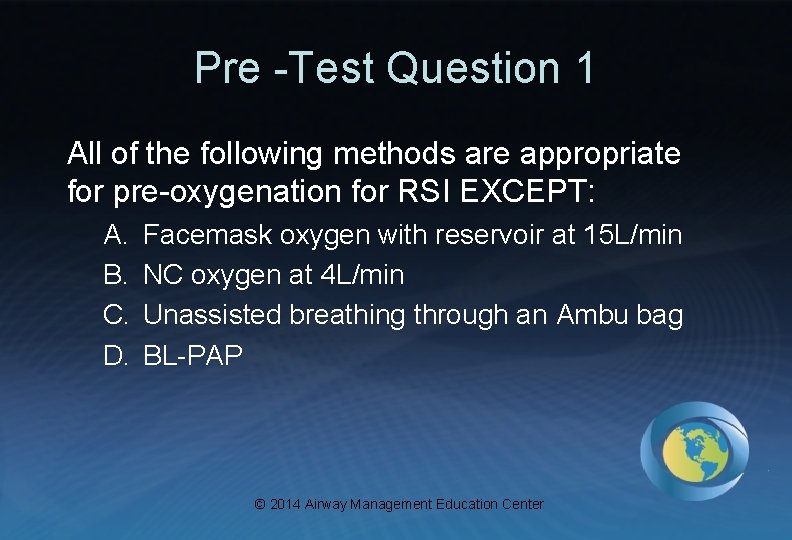
Pre -Test Question 1 All of the following methods are appropriate for pre-oxygenation for RSI EXCEPT: A. B. C. D. Facemask oxygen with reservoir at 15 L/min NC oxygen at 4 L/min Unassisted breathing through an Ambu bag BL-PAP © 2014 Airway Management Education Center
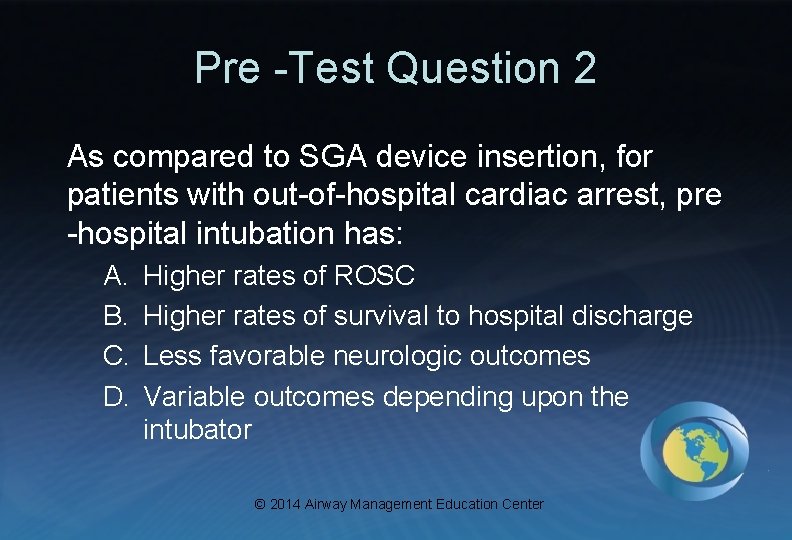
Pre -Test Question 2 As compared to SGA device insertion, for patients with out-of-hospital cardiac arrest, pre -hospital intubation has: A. B. C. D. Higher rates of ROSC Higher rates of survival to hospital discharge Less favorable neurologic outcomes Variable outcomes depending upon the intubator © 2014 Airway Management Education Center
Pre -Test Question 3 Which of the following is true regarding the Glide. Scope: A. The glottic view is usually worse than with DL B. You cannot intubate a patient with airway bleeding C. Trainees improve their first-attempt success with GVL over time D. Time to tube placement is faster compared to DL © 2014 Airway Management Education Center
Pre -Test Question 4 Using ultrasound to confirm correct ETT placement in pediatric patients is: A. B. C. D. Highly sensitive Operator dependent Difficult to perform A poor test and should not be used © 2014 Airway Management Education Center
Let’s get started… • 6 new studies today • Followed by the Airway Article of the Year finalists and winner Now on to Case #1… © 2014 Airway Management Education Center
Case #1 • EMS: 68 yo man with history HTN, HL, DM and prior heart attacks, found unresponsive in bed by wife after taking a nap. 911 called. Wife was advised to feel for a pulse and then start chest compressions. © 2014 Airway Management Education Center
Case continued… • Upon your arrival: – Pulseless & apneic – PEA on the monitor – Chest compressions resumed – Bag-valve mask ventilation is initiated – 1 mg epinephrine administered – Blood glucose: 137 mg/d. L © 2014 Airway Management Education Center
Case continued… • What’s next… – 8 minutes from the hospital – Paramedic is at the patient’s side with: • • Direct laryngoscope and ETT Laryngeal Mask Airway (SGA device) Bag-valve mask Non-rebreather mask How should we manage the airway? © 2014 Airway Management Education Center
How should we manage the airway? A. Intubation using direct laryngoscopy B. Supraglottic airway device insertion C. Bag mask ventilation D. Non-rebreather Are there any studies to help answer this question? © 2014 Airway Management Education Center
Tiah L et al. Does pre-hospital endotracheal intubation improve survival among adults with non- traumatic out-of-hospital cardiac arrest? A systematic review. West J Emerg Med 2014; 15(7): 749. • Literature review • Out-of-hospital cardiac arrests between 19802013 • Compared ETT vs SGA device insertion • 5 studies included: 303, 348 patients – 1 Japanese study: 281, 522 patients © 2014 Airway Management Education Center
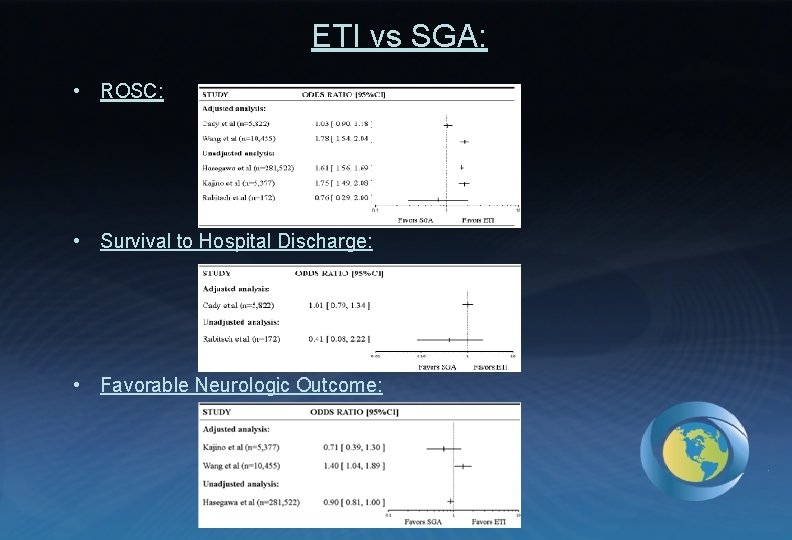
ETI vs SGA: • ROSC: • Survival to Hospital Discharge: • Favorable Neurologic Outcome:
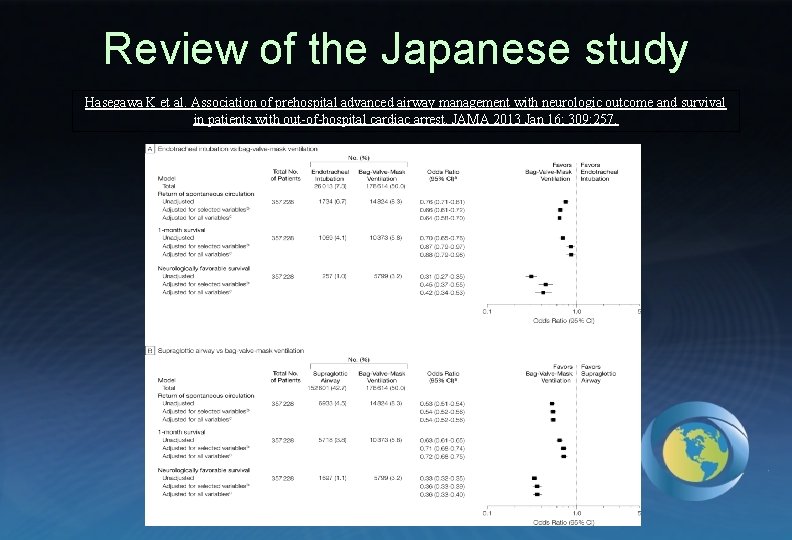
Review of the Japanese study Hasegawa K et al. Association of prehospital advanced airway management with neurologic outcome and survival in patients with out-of-hospital cardiac arrest. JAMA 2013 Jan 16; 309: 257.
How should we manage the airway? A. Intubation using direct laryngoscopy B. Supraglottic airway device insertion C. Bag mask ventilation D. Non-rebreather © 2014 Airway Management Education Center
What if we were in Scotland? Wimalasena YH et al. Comparison of factors associated with desaturation in prehospital emergency anaesthesia in primary and secondary retrievals. Emerg Med J. Published Online First: 12 November 2014 • Scottish emergency medical service • Physicians performing the intubations at the scene or at other medical facilities prior to transfer • 335 rapid sequence intubations performed between 2008 -2012 • Evaluated rates of hypoxia and hypotension © 2014 Airway Management Education Center
Wimalasena YH et al. Emerg Med J. Published Online First: 12 November 2014 • The Results: – Hypoxia: 15. 4% of patients – Hypotension: 7. 9% of patients • Multivariate Analysis: – Only Cormack & Lehane III or IV view was a risk factor for desaturation © 2014 Airway Management Education Center
What does this mean? • Prehospital intubations are technically challenging procedures for any provider • Many studies show no benefit to pre-hospital intubation • Focus: Rapid transport to the hospital and oxygenation by bag-mask ventilation or supraglottic airway device © 2014 Airway Management Education Center
You get to the hospital and bag mask ventilation becomes more difficult…what do you do to confirm proper ETT placement? A. B. C. D. Listen for bilateral breath sounds Place ETCO 2 detector Place patient on an ETCO 2 monitor Direct laryngoscopy to visualize the ETT through the cords © 2014 Airway Management Education Center
Now we can add one more maneuver… Tracheal Rapid Ultrasound Saline Test (TRUST) • 42 children with correct (endotracheal) and incorrect (endobronchial) ETT placement • Linear probe at level suprasternal notch Tube confirmation confirmed by fiberoptic bronchoscopy. Tessaro MO et al. Tracheal rapid ultrasound saline test (T. R. U. S. T. ) for confirming correct endotracheal tube depth in children. Resuscitation 2014 Sep. © 2014 Airway Management Education Center
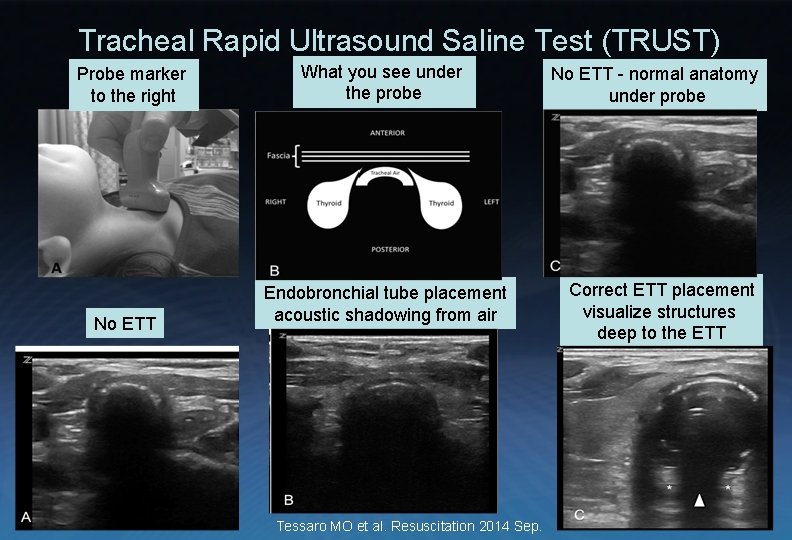
Tracheal Rapid Ultrasound Saline Test (TRUST) Probe marker to the right No ETT What you see under the probe Endobronchial tube placement acoustic shadowing from air Tessaro MO et al. Resuscitation 2014 Sep. No ETT - normal anatomy under probe Correct ETT placement visualize structures deep to the ETT
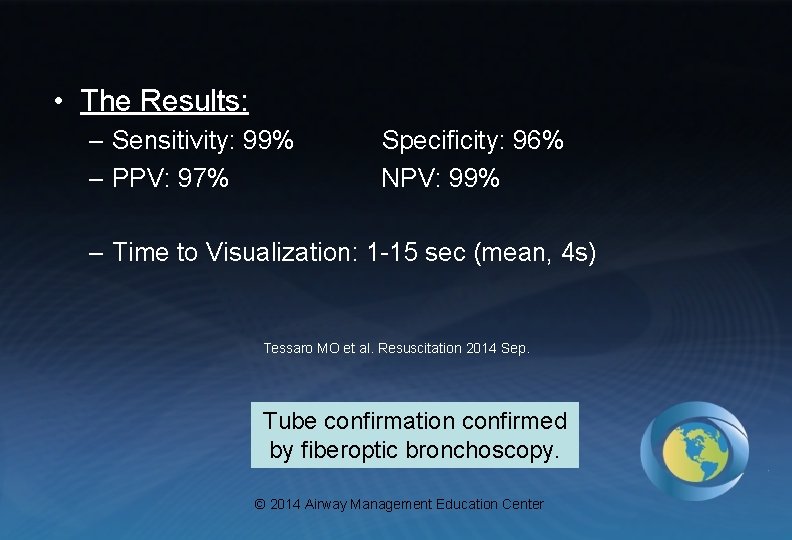
• The Results: – Sensitivity: 99% – PPV: 97% Specificity: 96% NPV: 99% – Time to Visualization: 1 -15 sec (mean, 4 s) Tessaro MO et al. Resuscitation 2014 Sep. Tube confirmation confirmed by fiberoptic bronchoscopy. © 2014 Airway Management Education Center
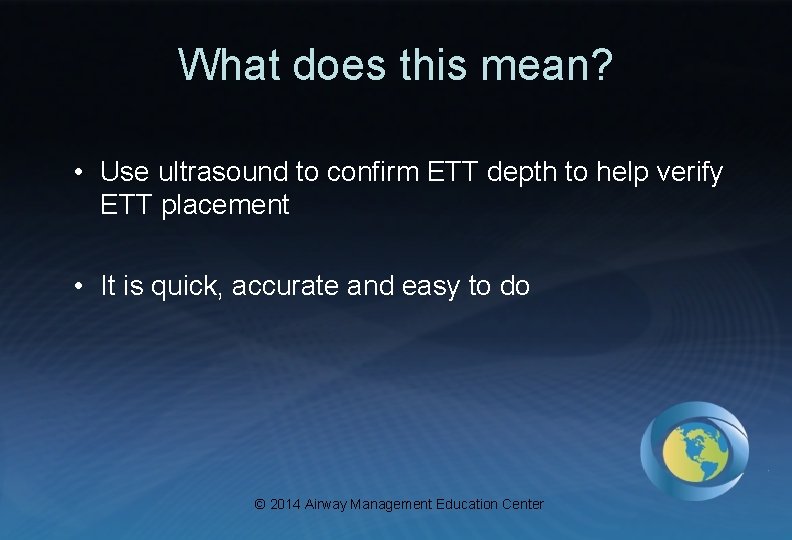
What does this mean? • Use ultrasound to confirm ETT depth to help verify ETT placement • It is quick, accurate and easy to do © 2014 Airway Management Education Center
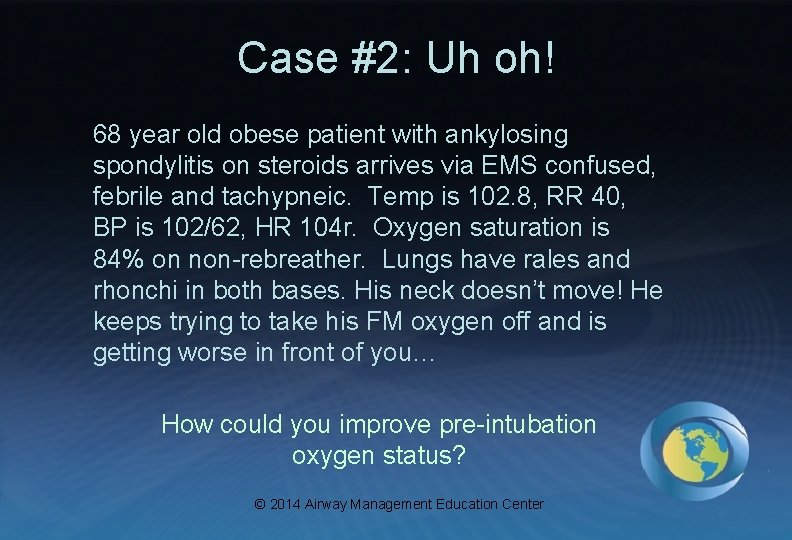
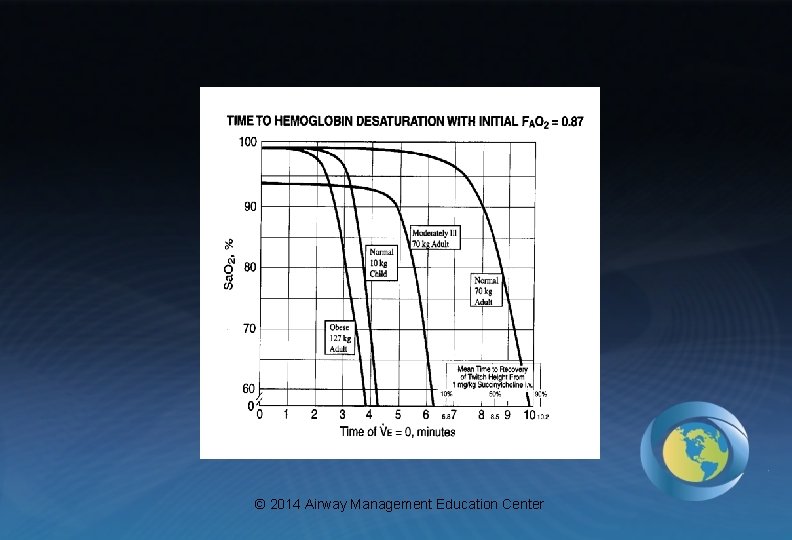
Case #2: Uh oh! 68 year old obese patient with ankylosing spondylitis on steroids arrives via EMS confused, febrile and tachypneic. Temp is 102. 8, RR 40, BP is 102/62, HR 104 r. Oxygen saturation is 84% on non-rebreather. Lungs have rales and rhonchi in both bases. His neck doesn’t move! He keeps trying to take his FM oxygen off and is getting worse in front of you… How could you improve pre-intubation oxygen status? © 2014 Airway Management Education Center
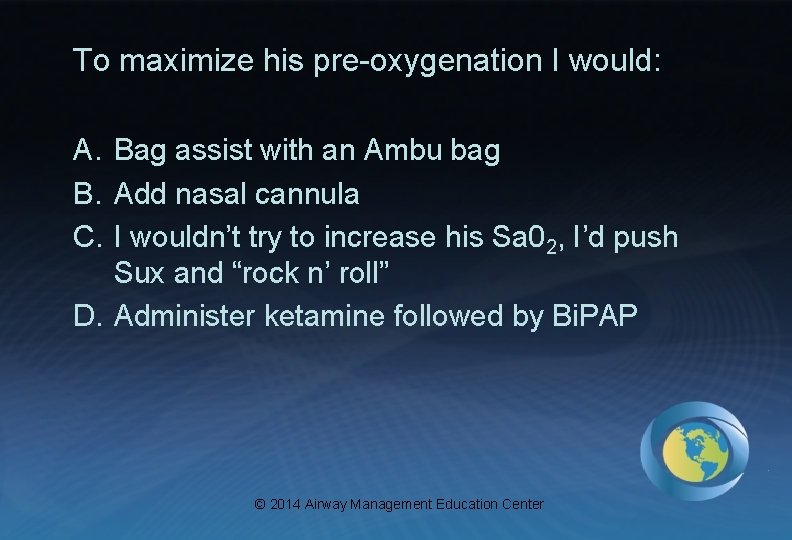
To maximize his pre-oxygenation I would: A. Bag assist with an Ambu bag B. Add nasal cannula C. I wouldn’t try to increase his Sa 02, I’d push Sux and “rock n’ roll” D. Administer ketamine followed by Bi. PAP © 2014 Airway Management Education Center
© 2014 Airway Management Education Center
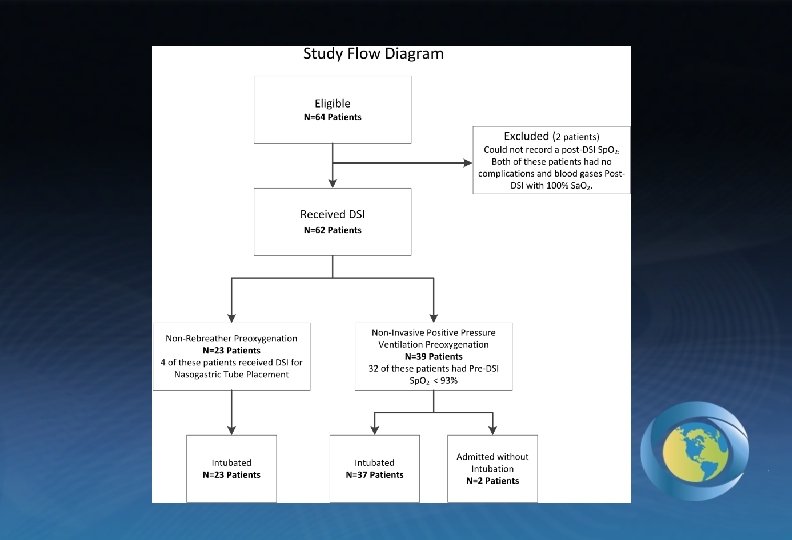
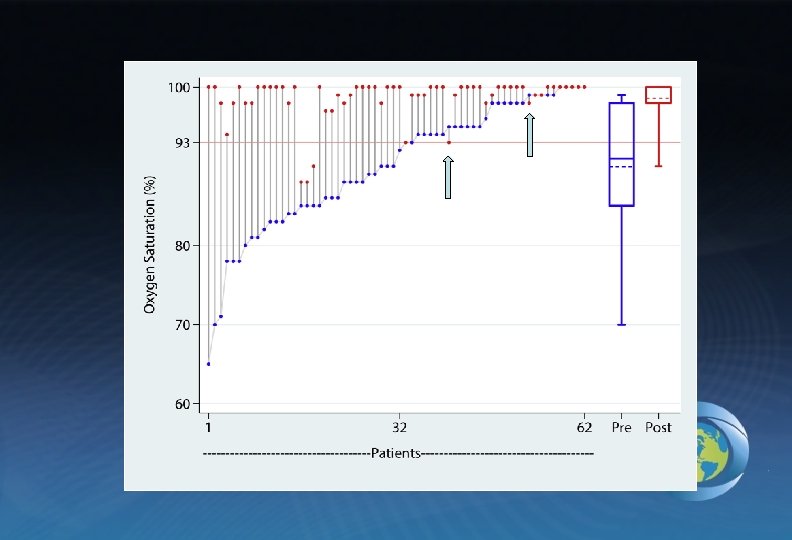
A Dose of Ketamine Can Facilitate Pre-oxygenation Before Emergency Intubation Weingart SD et al. Delayed sequence intubation: A prospective observational study. Ann Emerg Med 2014 Oct 22; [e-pub ahead of print]. • • Prospective multicenter study (ED and ICU pts) 62 patients requiring escalating pre-oxygenation Uncooperative with pre-oxygenation attempts Dissociative dose of Ketamine (1 mg/kg) IV • Pre and post DSI oxygenation • Adverse events © 2014 Airway Management Education Center
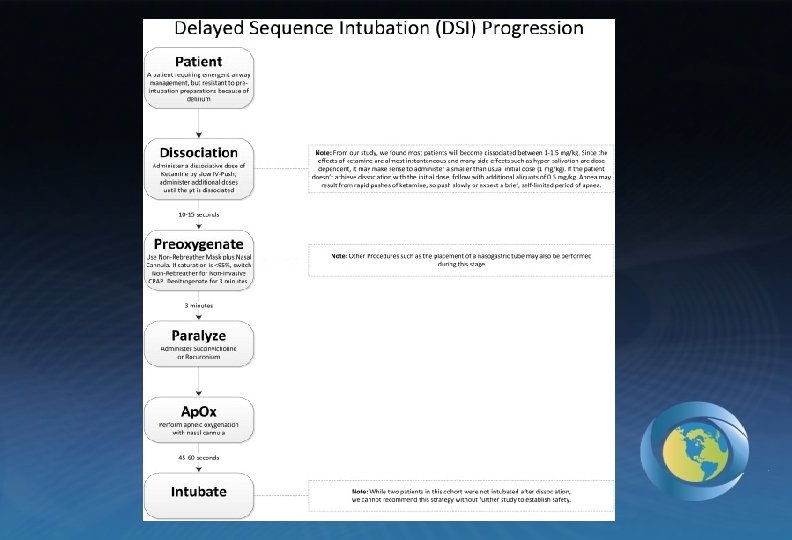
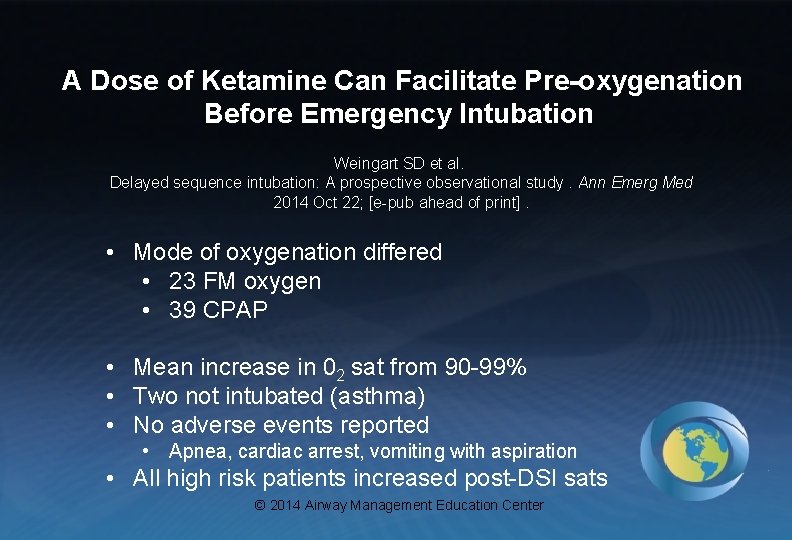
A Dose of Ketamine Can Facilitate Pre-oxygenation Before Emergency Intubation Weingart SD et al. Delayed sequence intubation: A prospective observational study. Ann Emerg Med 2014 Oct 22; [e-pub ahead of print]. • Mode of oxygenation differed • 23 FM oxygen • 39 CPAP • Mean increase in 02 sat from 90 -99% • Two not intubated (asthma) • No adverse events reported • Apnea, cardiac arrest, vomiting with aspiration • All high risk patients increased post-DSI sats © 2014 Airway Management Education Center
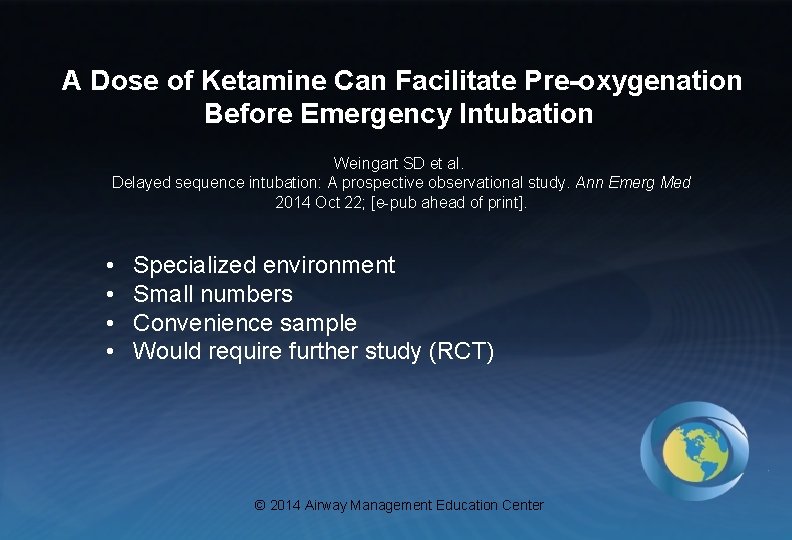
A Dose of Ketamine Can Facilitate Pre-oxygenation Before Emergency Intubation Weingart SD et al. Delayed sequence intubation: A prospective observational study. Ann Emerg Med 2014 Oct 22; [e-pub ahead of print]. • • Specialized environment Small numbers Convenience sample Would require further study (RCT) © 2014 Airway Management Education Center
What does this mean? • Robust pre-oxygenation prolongs safe apnea • Some patients are difficult to fully preoxygenate • In the right setting and with trained providers, ketamine-facilitated pre-oxygenation is an option more to come on this for sure! © 2014 Airway Management Education Center
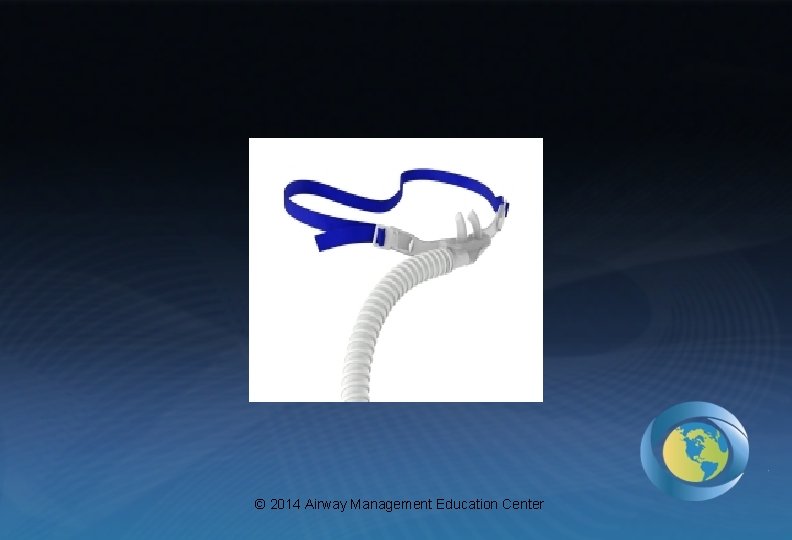
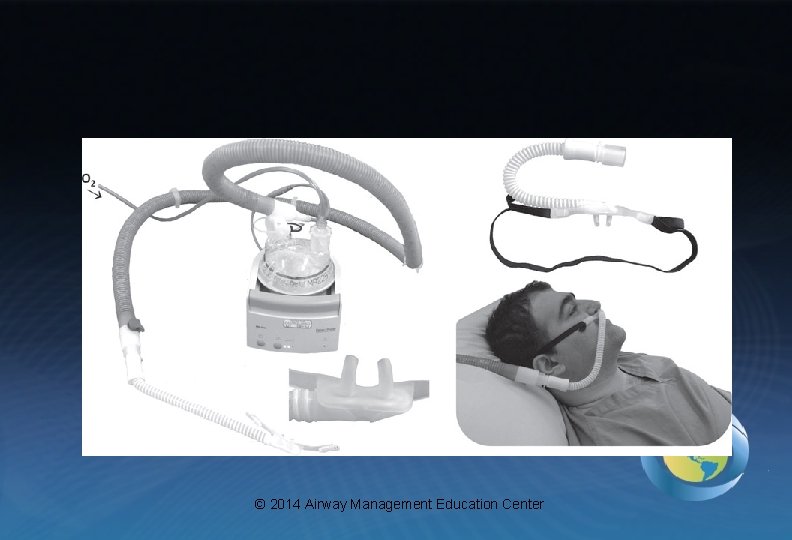
Case #2 continued As you get ready to give Ketamine, the RT says “How are you going to keep him from desaturating after you push the intubation medications? I have this new device which I have heard can help…want to try it? ” © 2014 Airway Management Education Center
© 2014 Airway Management Education Center
You say… A. What the heck is that thing? B. Great idea! The evidence suggests this can be helpful. C. Not sure, never used that before. It looks like an “OR thing” D. No, evidence suggests it’s useless © 2014 Airway Management Education Center
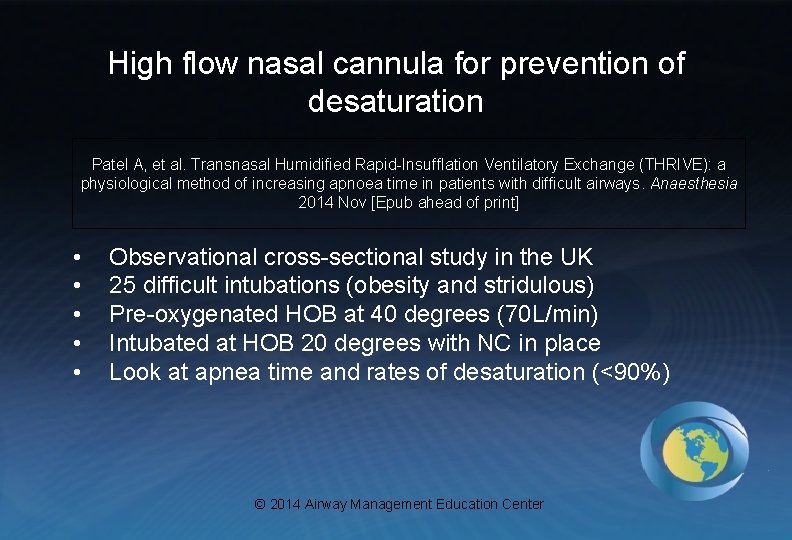
High flow nasal cannula for prevention of desaturation Patel A, et al. Transnasal Humidified Rapid-Insufflation Ventilatory Exchange (THRIVE): a physiological method of increasing apnoea time in patients with difficult airways. Anaesthesia 2014 Nov [Epub ahead of print] • • • Observational cross-sectional study in the UK 25 difficult intubations (obesity and stridulous) Pre-oxygenated HOB at 40 degrees (70 L/min) Intubated at HOB 20 degrees with NC in place Look at apnea time and rates of desaturation (<90%) © 2014 Airway Management Education Center
© 2014 Airway Management Education Center
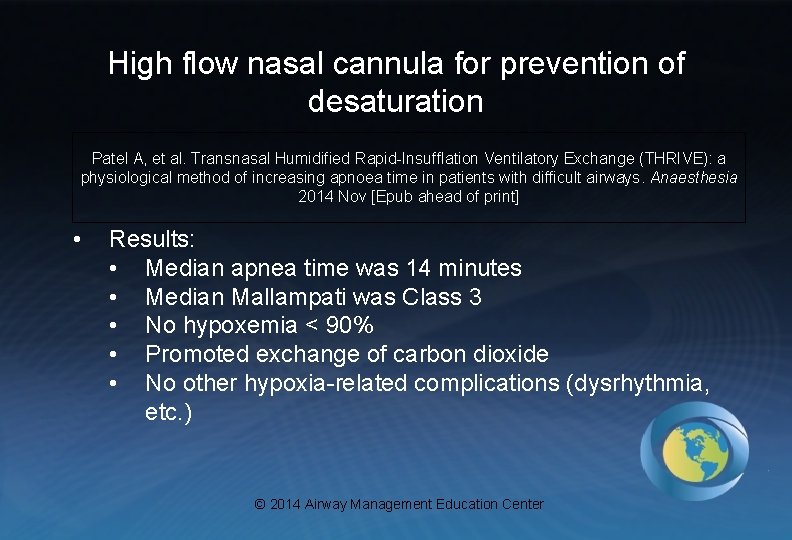
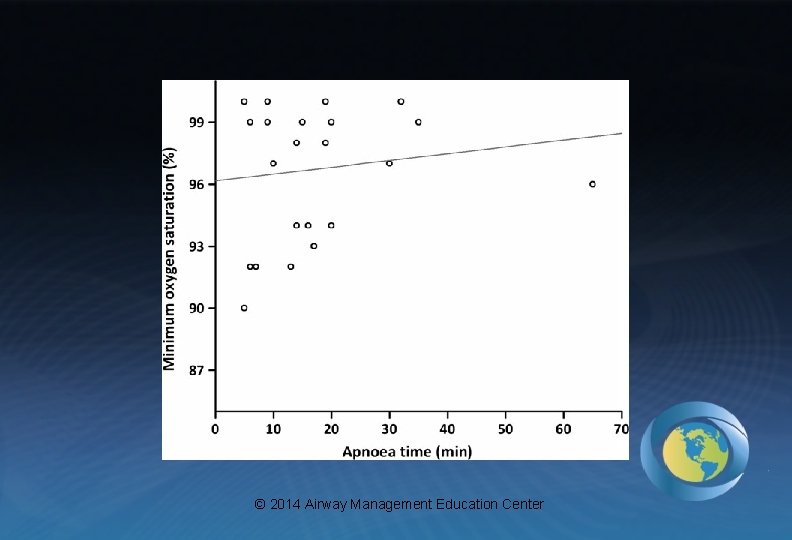
High flow nasal cannula for prevention of desaturation Patel A, et al. Transnasal Humidified Rapid-Insufflation Ventilatory Exchange (THRIVE): a physiological method of increasing apnoea time in patients with difficult airways. Anaesthesia 2014 Nov [Epub ahead of print] • Results: • Median apnea time was 14 minutes • Median Mallampati was Class 3 • No hypoxemia < 90% • Promoted exchange of carbon dioxide • No other hypoxia-related complications (dysrhythmia, etc. ) © 2014 Airway Management Education Center
© 2014 Airway Management Education Center
High flow nasal cannula for prevention of desaturation Patel A, et al. Transnasal Humidified Rapid-Insufflation Ventilatory Exchange (THRIVE): a physiological method of increasing apnoea time in patients with difficult airways. Anaesthesia 2014 Nov [Epub ahead of print] • Limitations: • Tough to translate to ED practice at this point • Would it impede conventional laryngoscopy? © 2014 Airway Management Education Center
What does this mean? • Preventing rapid desaturation is safer for patients • High flow NC stents open airway, flushes gases & provides oxygen • Device may be awkward for emergency airway management. Focus on robust pre and intraprocedural oxygenation. • Routine part of RSI © 2014 Airway Management Education Center
Questions? © 2014 Airway Management Education Center
Case #2 continued You have given ketamine and BL-PAP is started. The third year resident says, hey can I intubate this one. I want to use the Glide. Scope thingy… You can’t mess around with this airway BUT she is a third year resident so she should be good with GVL…. right? © 2014 Airway Management Education Center
You say… A. Sure, you should have a very good FPS rate as a senior resident. B. No, GVL is a fad. I’m old school! C. Sorry, trainee intubators can’t use the Glide. Scope because first attempt success is only 60% D. No, GVL doesn’t work in patients with reduced cervical spine mobility © 2014 Airway Management Education Center
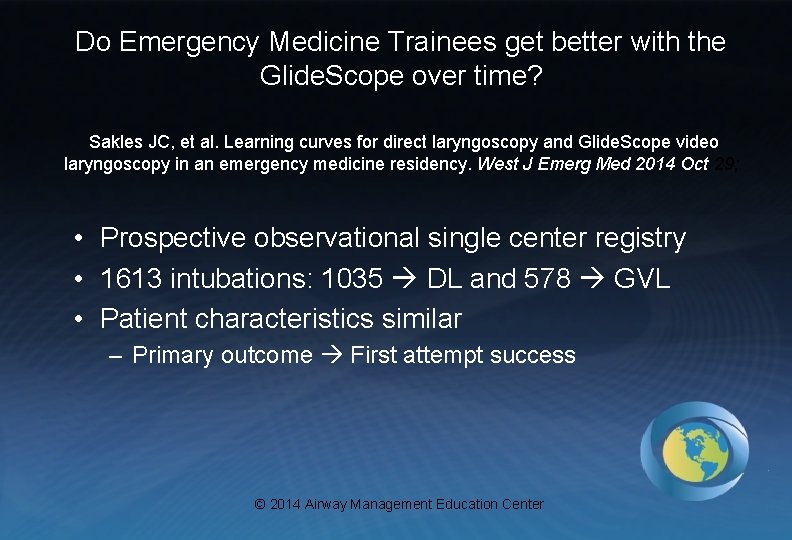
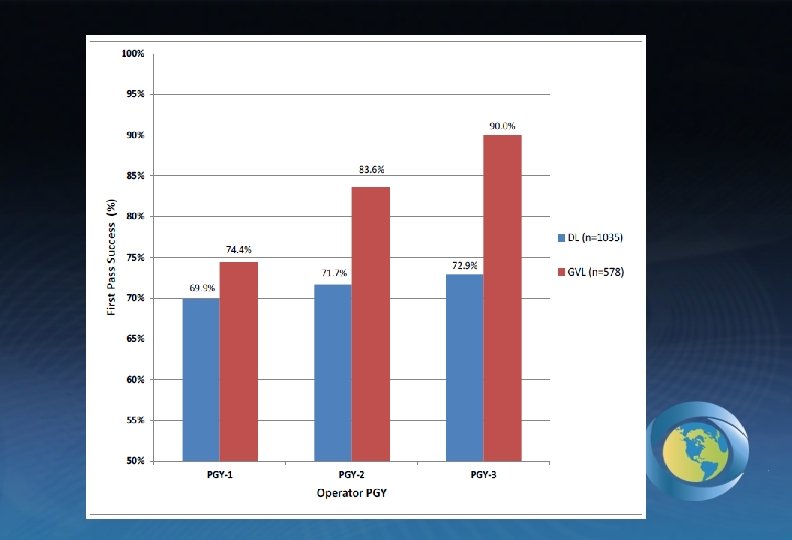
Do Emergency Medicine Trainees get better with the Glide. Scope over time? Sakles JC, et al. Learning curves for direct laryngoscopy and Glide. Scope video laryngoscopy in an emergency medicine residency. West J Emerg Med 2014 Oct 29; • Prospective observational single center registry • 1613 intubations: 1035 DL and 578 GVL • Patient characteristics similar – Primary outcome First attempt success © 2014 Airway Management Education Center
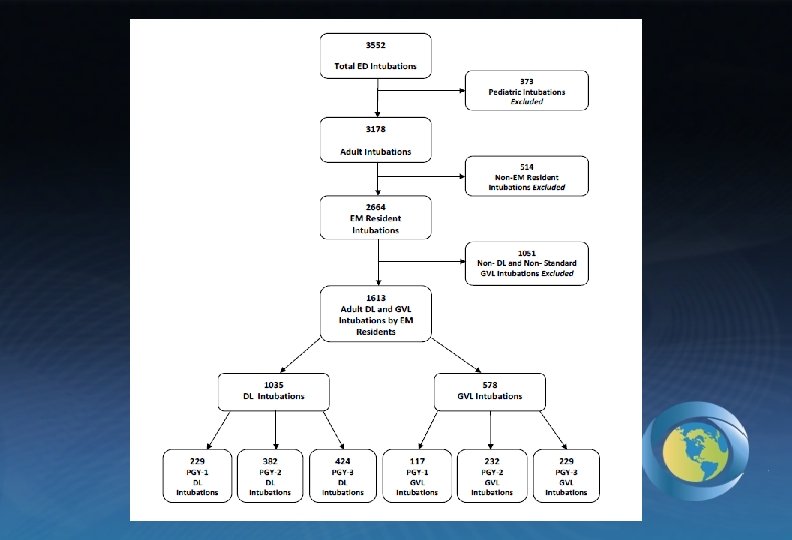
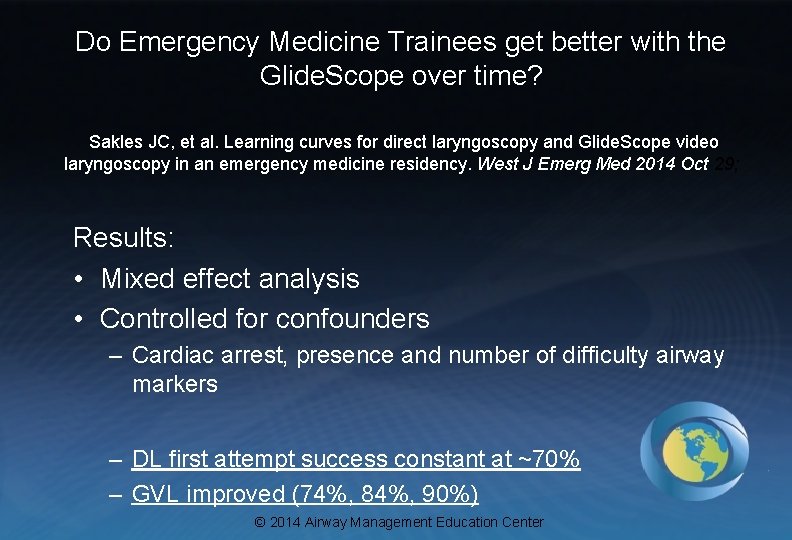
Do Emergency Medicine Trainees get better with the Glide. Scope over time? Sakles JC, et al. Learning curves for direct laryngoscopy and Glide. Scope video laryngoscopy in an emergency medicine residency. West J Emerg Med 2014 Oct 29; Results: • Mixed effect analysis • Controlled for confounders – Cardiac arrest, presence and number of difficulty airway markers – DL first attempt success constant at ~70% – GVL improved (74%, 84%, 90%) © 2014 Airway Management Education Center
Do Emergency Medicine Trainees get better with the Glide. Scope over time? Sakles JC, et al. Learning curves for direct laryngoscopy and Glide. Scope video laryngoscopy in an emergency medicine residency. West J Emerg Med 2014 Oct 29; • Not a randomized trial • Very low FPS with DL – Cultural issues around prolonged DL attempts? – Early recourse to VL? • Academic institution with interest in airway management research – applicability? © 2014 Airway Management Education Center
What does this mean? • Trainees become more comfortable with GVL over time – Tricks to overcome with GVL, but once you know those…BINGO! • DL FPS is low in this study and likely reflects early reliance on VL and may not represent full DL potential • Nevertheless, VL is (at its worst) equivalent to DL and likely better in emergency situations • First attempts should be made with a VL. Pick a system - use it and use it often! © 2014 Airway Management Education Center
Questions? © 2014 Airway Management Education Center

And now, The Post-Test Questions © 2014 Airway Management Education Center
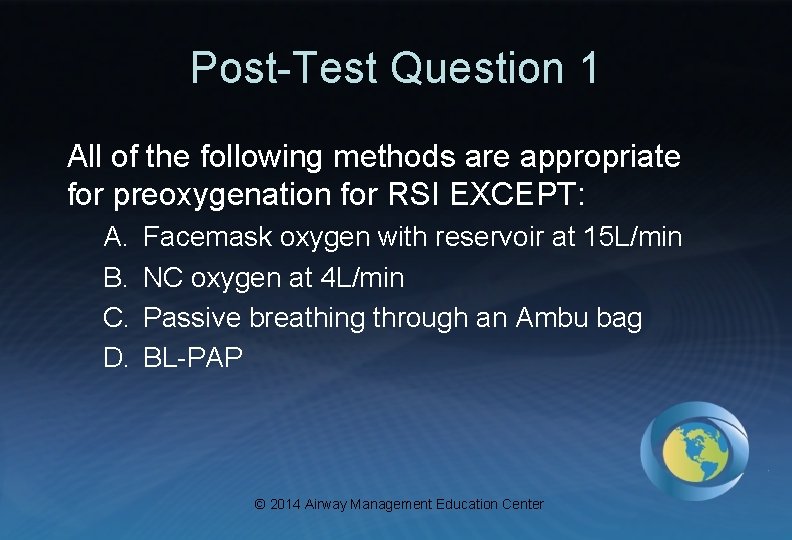
Post-Test Question 1 All of the following methods are appropriate for preoxygenation for RSI EXCEPT: A. B. C. D. Facemask oxygen with reservoir at 15 L/min NC oxygen at 4 L/min Passive breathing through an Ambu bag BL-PAP © 2014 Airway Management Education Center
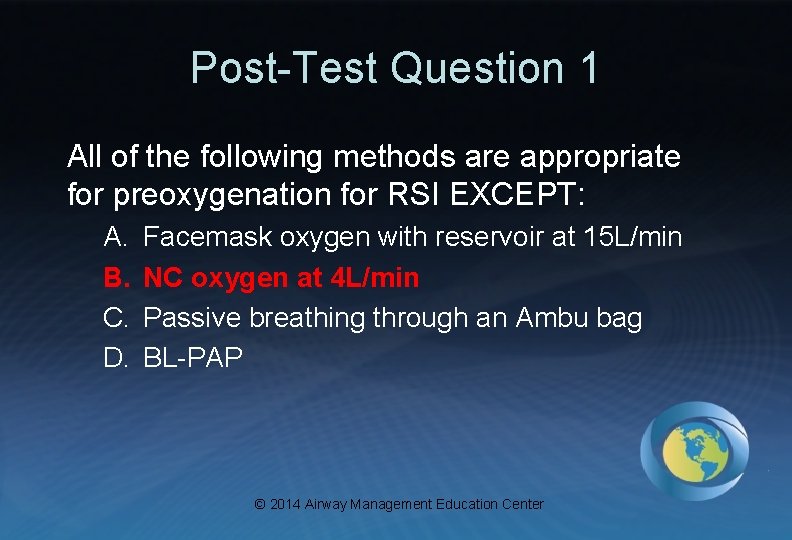
Post-Test Question 1 All of the following methods are appropriate for preoxygenation for RSI EXCEPT: A. B. C. D. Facemask oxygen with reservoir at 15 L/min NC oxygen at 4 L/min Passive breathing through an Ambu bag BL-PAP © 2014 Airway Management Education Center
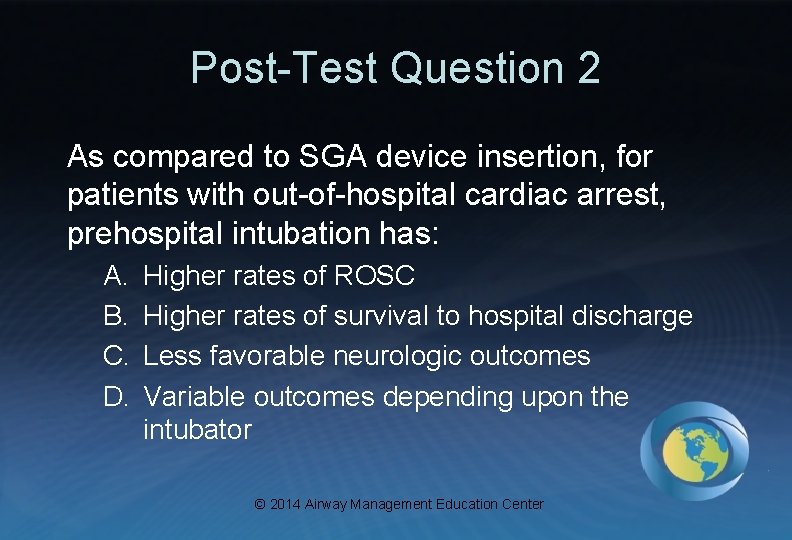
Post-Test Question 2 As compared to SGA device insertion, for patients with out-of-hospital cardiac arrest, prehospital intubation has: A. B. C. D. Higher rates of ROSC Higher rates of survival to hospital discharge Less favorable neurologic outcomes Variable outcomes depending upon the intubator © 2014 Airway Management Education Center
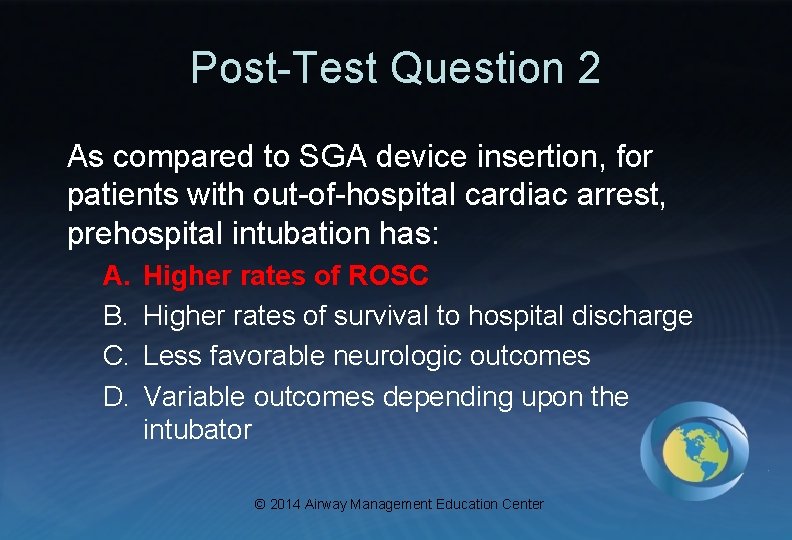
Post-Test Question 2 As compared to SGA device insertion, for patients with out-of-hospital cardiac arrest, prehospital intubation has: A. B. C. D. Higher rates of ROSC Higher rates of survival to hospital discharge Less favorable neurologic outcomes Variable outcomes depending upon the intubator © 2014 Airway Management Education Center
Post-Test Question 3 Which of the following is true regarding the Glide. Scope: A. The glottic view is usually worse than with DL B. You cannot intubate a patient with airway bleeding using a GVL C. Trainees improve their first-attempt success with GVL over time D. Time to tube placement is faster compared to DL © 2014 Airway Management Education Center
Post-Test Question 3 Which of the following is true regarding the Glide. Scope: A. The glottic view is usually worse than with DL B. You cannot intubate a patient with airway bleeding using a GVL C. Trainees improve their first-attempt success with GVL over time D. Time to tube placement is faster compared to DL © 2014 Airway Management Education Center
Post-Test Question 4 Using ultrasound to confirm correct ETT placement in pediatric patients is: A. B. C. D. Highly sensitive Operator dependent Difficult to perform A poor test and should not be used © 2014 Airway Management Education Center
Post-Test Question 4 Using ultrasound to confirm correct ETT placement in pediatric patients is: A. B. C. D. Highly sensitive Operator dependent Difficult to perform A poor test and should not be used © 2014 Airway Management Education Center
Final Questions? © 2014 Airway Management Education Center
Thank you! © 2014 Airway Management Education Center
- Slides: 67