
AIRSPACE MANAGEMENT REFERENCE ICAO doc 4444 CH 1
- Slides: 21
AIRSPACE MANAGEMENT REFERENCE ICAO doc 4444 CH. 1 DEFINITION www. eurocontrol. int/airspace/public/standard_age/1486_Training. html Eurocontrol ASM HBK papavasileiou-atm 18 1
Objectives • Define ASM; • Describe the scope of ASM; • Explain the responsibility for the provision of ASM; • State the methods of managing the airspace (FUA, airspace design). papavasileiou-atm 18 2
Definition • Airspace Management (ASM) is a generic term covering any management activity provided for the purpose of achieving the most efficient use of airspace based on actual needs and, where possible, avoiding permanent airspace segregation. papavasileiou-atm 18 3
Responsibility • States should ensure that military authorities responsible for the planning and conducting activities potentially hazardous to civil aircraft are fully familiar with the area of activity in terms of: Ø type(s) of civil aircraft operations; Ø ATS airspace organisation and responsible controlling/monitoring unit(s); Ø ATS routes and their dimensions, as appropriate; and Ø relevant regulations and special rules in force, including airspace restrictions. papavasileiou-atm 18 4
Advantages • Enhancement of ASM processes and improvement of civil-military co-ordination; • Airspace structure (optimisation of the ATS route network, ATC sectors and terminal airspace); • Airspace classification (development of new or adapted airspace structures and progress towards a uniform airspace organisation leading to a continuum of airspace); • ATM procedures (development of procedures to support operational change); papavasileiou-atm 18 5
. Methods of ASM-F. U. A papavasileiou-atm 18 6
FUA Concept • Airspace should no longer be designated as either purely civil or military airspace, but rather considered as one continuum and allocated according to user requirements • Any necessary airspace segregation should be temporary, temporary based on real-time usage within a specific time period papavasileiou-atm 18 7
• Explain the airspace structures associated with FUA. ØPermanent ATS Routes. ØAirspace Restrictions. ØTemporary Segregated Areas (TSAs). ØCross-Border Areas (CBAs). ØConditional Routes (CDRs). ØReduced Co-ordination Airspace (RCA). ØJoint Airspace. papavasileiou-atm 18 8
FUA Airspace Structures • Permanent ATS Routes. • Airspace Restrictions. • Temporary Segregated Areas (TSAs). • • Cross-Border Areas (CBAs). Conditional Routes (CDRs). Reduced Co-ordination Airspace (RCA). Joint Airspace. papavasileiou-atm 18 9
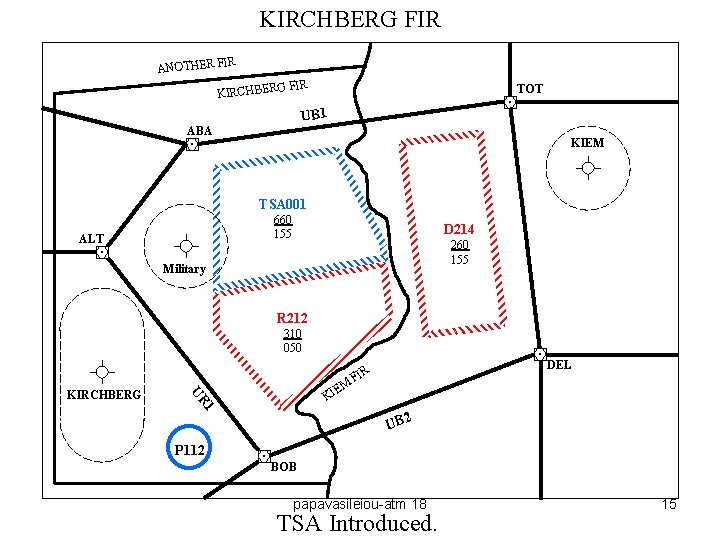
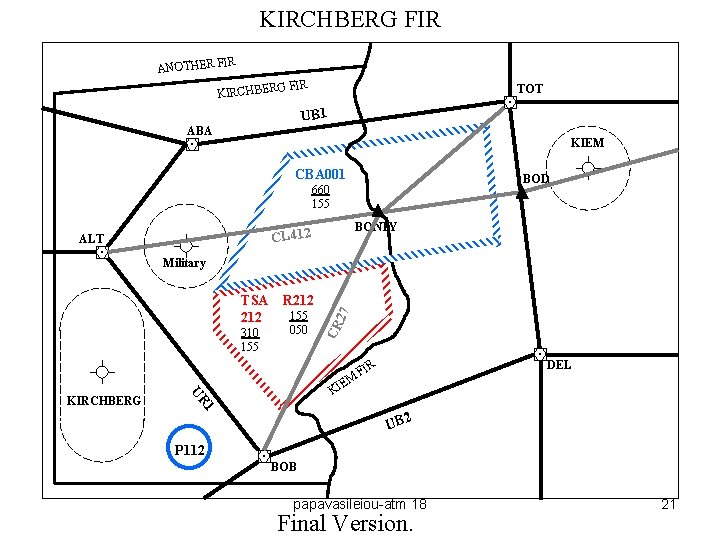
Temporary Segregated Areas (TSAs) • TSA is an airspace of defined dimensions within which activities require the reservation of airspace for the exclusive use of specific users during a determined period of time. • TSAs established at Level 1, allocated at Level 2 by AMCs and activated at Level 3. • TSAs introduce need for prior planning; if not practical, remain Danger or Restricted Area. papavasileiou-atm 18 10
TSA Activation TSAs have 3 levels of activation: • Published Hours. • Planned Hours. • Real Activation Times. papavasileiou-atm 18 11
Published Hours • Identified at Level 1. • Maximum possible time during which the TSA can be used. • Information published in National AIPs. papavasileiou-atm 18 12
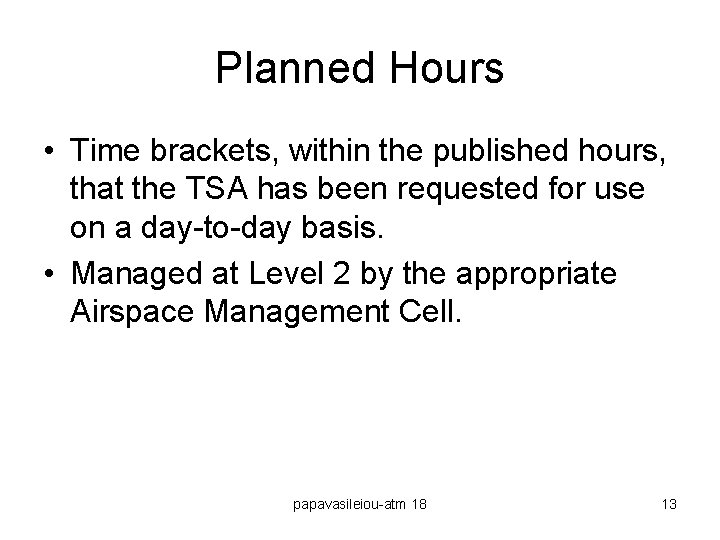
Planned Hours • Time brackets, within the published hours, that the TSA has been requested for use on a day-to-day basis. • Managed at Level 2 by the appropriate Airspace Management Cell. papavasileiou-atm 18 13
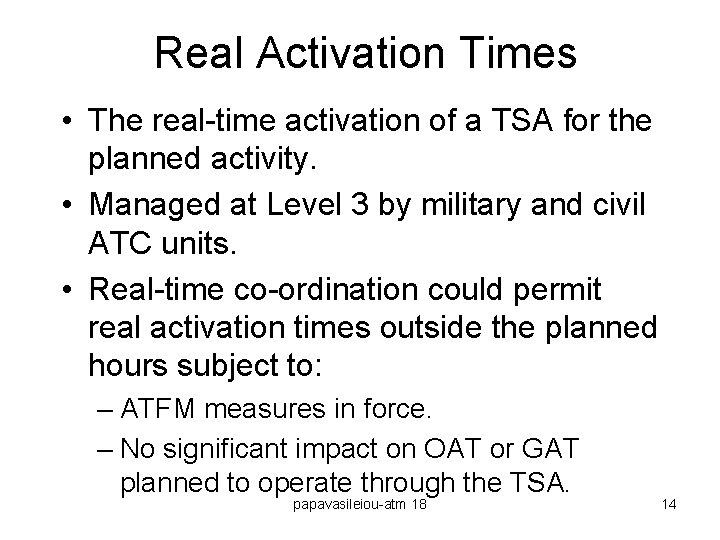
Real Activation Times • The real-time activation of a TSA for the planned activity. • Managed at Level 3 by military and civil ATC units. • Real-time co-ordination could permit real activation times outside the planned hours subject to: – ATFM measures in force. – No significant impact on OAT or GAT planned to operate through the TSA. papavasileiou-atm 18 14
KIRCHBERG FIR ANOTHER FIR G FIR KIRCHBER TOT UB 1 ABA KIEM TSA 001 660 155 ALT D 214 260 155 Military R 212 310 050 EM KI UR KIRCHBERG DEL FIR 1 UB 2 P 112 BOB papavasileiou-atm 18 TSA Introduced. 15
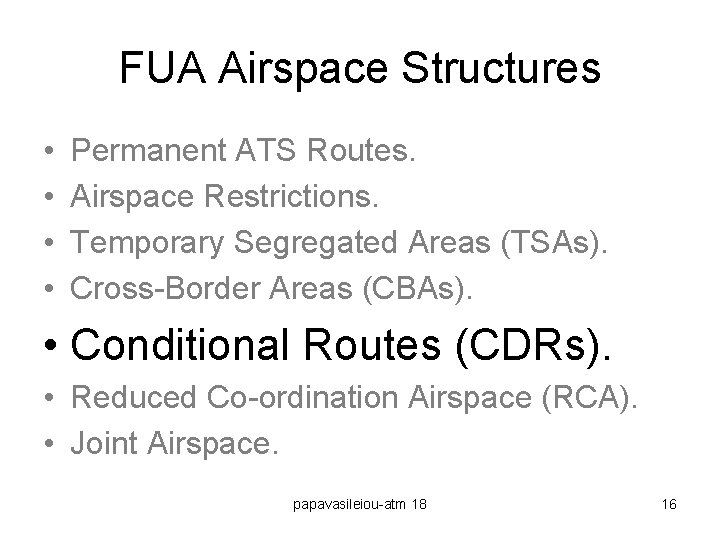
FUA Airspace Structures • • Permanent ATS Routes. Airspace Restrictions. Temporary Segregated Areas (TSAs). Cross-Border Areas (CBAs). • Conditional Routes (CDRs). • Reduced Co-ordination Airspace (RCA). • Joint Airspace. papavasileiou-atm 18 16
Conditional Routes (CDRs) • CDRs are ATS routes that are not permanent. • CDRs are categorised as ØCDR 1 ØCDR 2 or ØCDR 3 depending on availability. papavasileiou-atm 18 17
CDR 1 • Available for specified periods such as night-time or weekends. • Activation periods specified in AIPs. • Always plannable during these times unless notified by NOTAM. • Short-notice closure handled tactically by ATC. papavasileiou-atm 18 18
CDR 2 • Typically routes through TSAs. • Available only when the TSA is not active. • Plannable only in accordance with the availability times notified the day before operations. • Established to maximize one or more of the following: ØBetter traffic distribution. ØIncrease in overall ATC capacity. ØFlight economy. papavasileiou-atm 18 19
CDR 3 • Not plannable. • Routes expected to become available at short notice. • Routes allocated at Level 3 on a tactical basis. papavasileiou-atm 18 20
KIRCHBERG FIR ANOTHER FIR G FIR KIRCHBER TOT UB 1 ABA KIEM CBA 001 BOD 660 155 BONTY CL 412 ALT Military 310 155 050 EM KI UR 1 KIRCHBERG R 212 CR 27 TSA 212 DEL FIR UB 2 P 112 BOB papavasileiou-atm 18 Final Version. 21