
Airport Coverage Movement 1 WWW KAASHIVINFOTEC COM Airport

- Slides: 30
Airport Coverage Movement 1 WWW. KAASHIVINFOTEC. COM
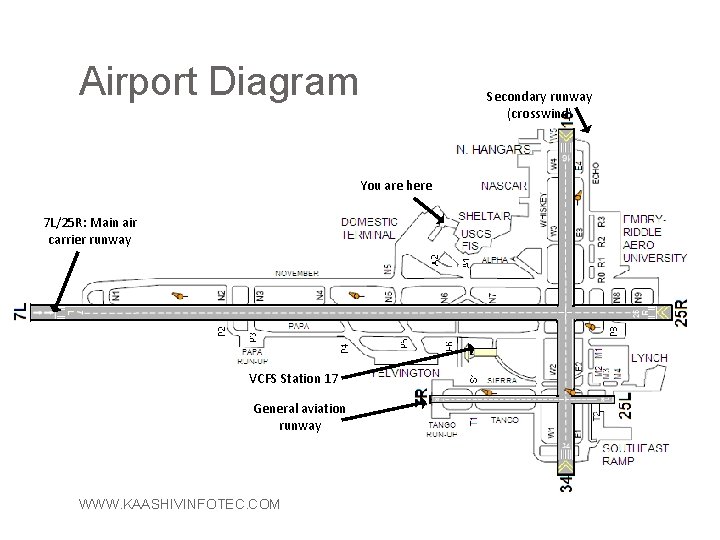
Airport Overview • 880 total acres of land (fenced) • 9. 2 miles of perimeter road • 3 runways: – 7 L/25 R – 10, 500 feet long, primary runway – 7 R/25 L – 3, 195 feet long, general aviation runway – 16/34 – 6, 001 feet long, secondary runway • FAA Class C National Airspace System classification – 2 nd busiest type of airspace by volume of traffic – Terminal Radar Approach Control facility (TRACON) located on field 2 WWW. KAASHIVINFOTEC. COM
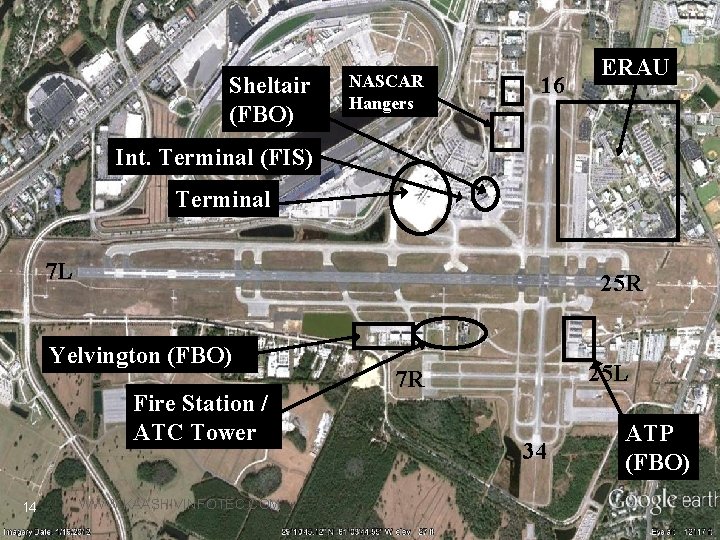
Airport Overview 3 fixed-based operators Yelvington Jet Aviation ATP Jet Center Sheltair Aviation Services Many large flight schools Embry-Riddle Aeronautical University (ERAU) Phoenix East Aviation 300+ flight training activities daily 3 WWW. KAASHIVINFOTEC. COM
Airport Overview Approximately 250, 000 annual operations Two air carriers Delta Air Lines US Airways Heavy traffic during races/special events 150, 000 square foot domestic terminal 6 gates 4 WWW. KAASHIVINFOTEC. COM
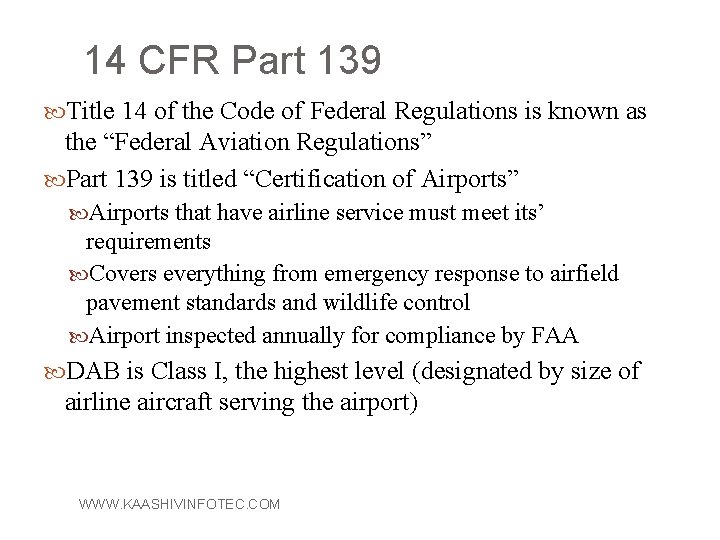
14 CFR Part 139 Title 14 of the Code of Federal Regulations is known as the “Federal Aviation Regulations” Part 139 is titled “Certification of Airports” Airports that have airline service must meet its’ requirements Covers everything from emergency response to airfield pavement standards and wildlife control Airport inspected annually for compliance by FAA DAB is Class I, the highest level (designated by size of airline aircraft serving the airport) 5 WWW. KAASHIVINFOTEC. COM
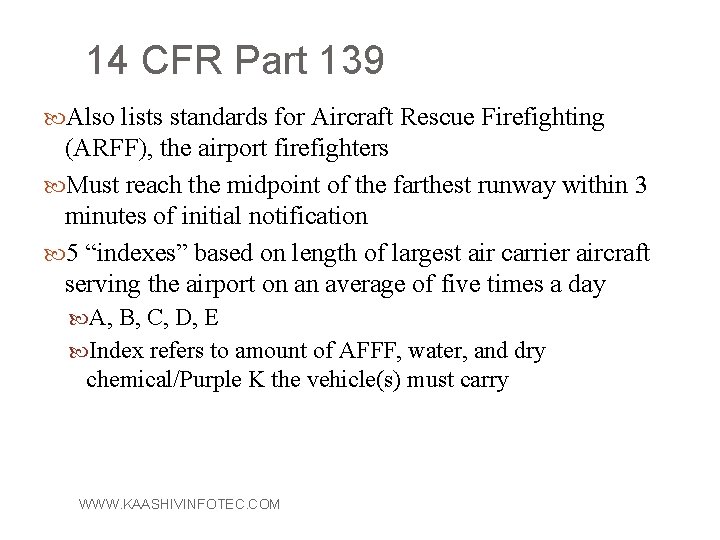
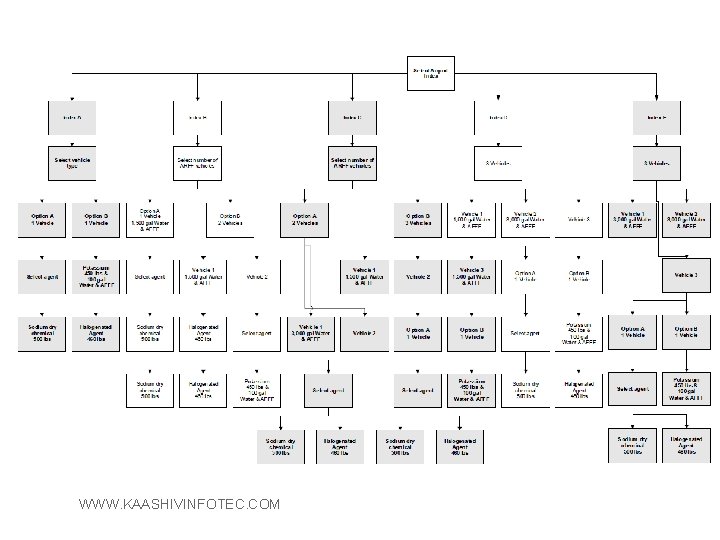
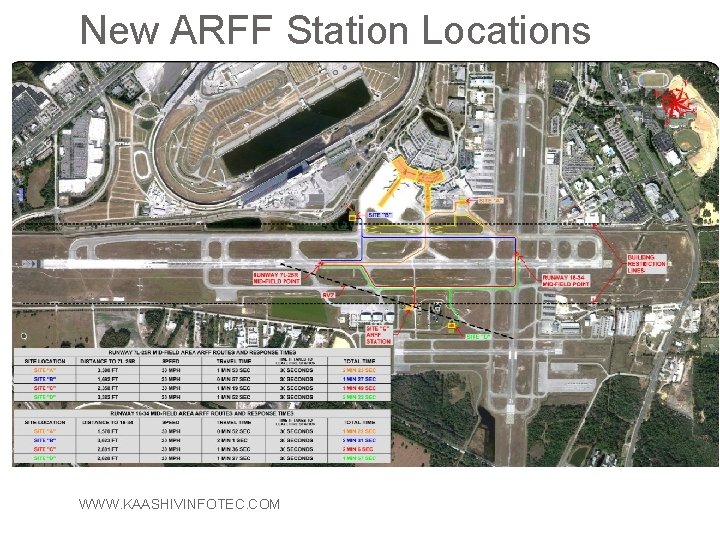
14 CFR Part 139 Also lists standards for Aircraft Rescue Firefighting (ARFF), the airport firefighters Must reach the midpoint of the farthest runway within 3 minutes of initial notification 5 “indexes” based on length of largest air carrier aircraft serving the airport on an average of five times a day A, B, C, D, E Index refers to amount of AFFF, water, and dry chemical/Purple K the vehicle(s) must carry 6 WWW. KAASHIVINFOTEC. COM
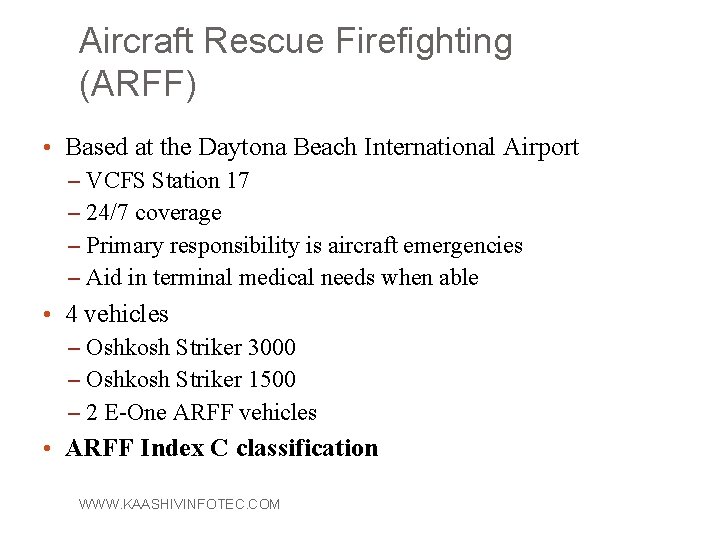
Aircraft Rescue Firefighting (ARFF) • Based at the Daytona Beach International Airport – VCFS Station 17 – 24/7 coverage – Primary responsibility is aircraft emergencies – Aid in terminal medical needs when able • 4 vehicles – Oshkosh Striker 3000 – Oshkosh Striker 1500 – 2 E-One ARFF vehicles • ARFF Index C classification 7 WWW. KAASHIVINFOTEC. COM
ARFF Index C 8 WWW. KAASHIVINFOTEC. COM
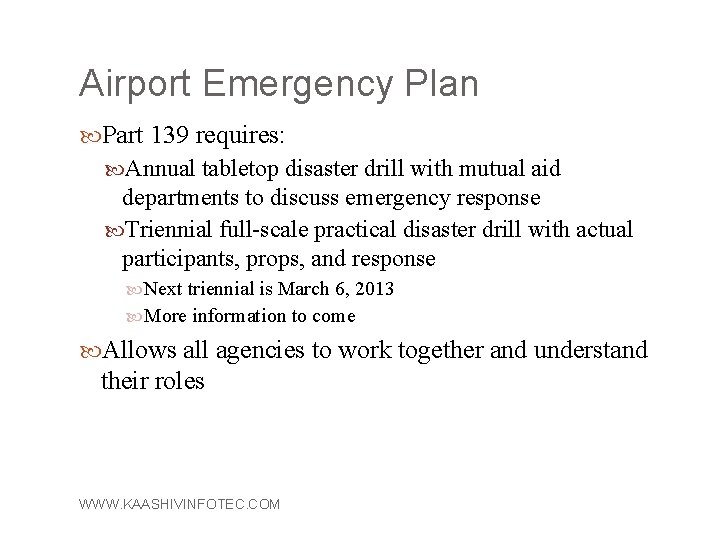
Airport Emergency Plan Part 139 requires: Annual tabletop disaster drill with mutual aid departments to discuss emergency response Triennial full-scale practical disaster drill with actual participants, props, and response Next triennial is March 6, 2013 More information to come Allows all agencies to work together and understand their roles 9 WWW. KAASHIVINFOTEC. COM
Airport Coverage • Airport Operations (staffing 0415 -0015) – Responsible for entire airport – Ensure safety and security of airfield – Enforce regulations/rules/security – Patrol perimeter – Coordinate all airport needs/pop up items – Respond to/coordinate emergencies – Inspect airport surfaces/lighting – Contact point for all airport tenants – Duty phone: (386)-547 -4344 10 WWW. KAASHIVINFOTEC. COM
Airport Coverage Volusia County Sheriff’s Office Airport Unit 2 deputies on duty at the minimum 24/7 staffing Airport law enforcement resource Monitor security system/terminal Patrol airport Close airport terminal at night (2330 -0330) Duty phone: (386)-547 -0028 11 WWW. KAASHIVINFOTEC. COM
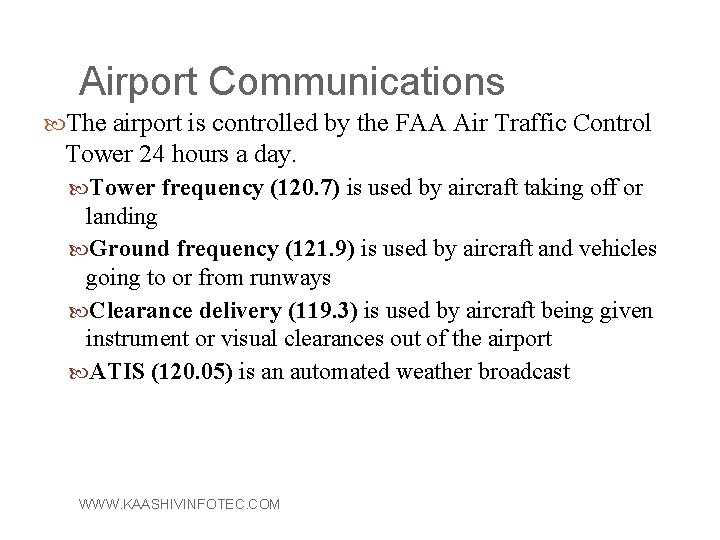
Airport Communications The airport is controlled by the FAA Air Traffic Control Tower 24 hours a day. Tower frequency (120. 7) is used by aircraft taking off or landing Ground frequency (121. 9) is used by aircraft and vehicles going to or from runways Clearance delivery (119. 3) is used by aircraft being given instrument or visual clearances out of the airport ATIS (120. 05) is an automated weather broadcast 12 WWW. KAASHIVINFOTEC. COM
Airport Diagram Secondary runway (crosswind) You are here 7 L/25 R: Main air carrier runway VCFS Station 17 General aviation runway 13 WWW. KAASHIVINFOTEC. COM
Sheltair (FBO) NASCAR Hangers 16 ERAU Int. Terminal (FIS) Terminal 7 L 25 R Yelvington (FBO) Fire Station / ATC Tower 14 WWW. KAASHIVINFOTEC. COM 25 L 7 R 34 ATP (FBO)
New ARFF Station Locations 15 WWW. KAASHIVINFOTEC. COM
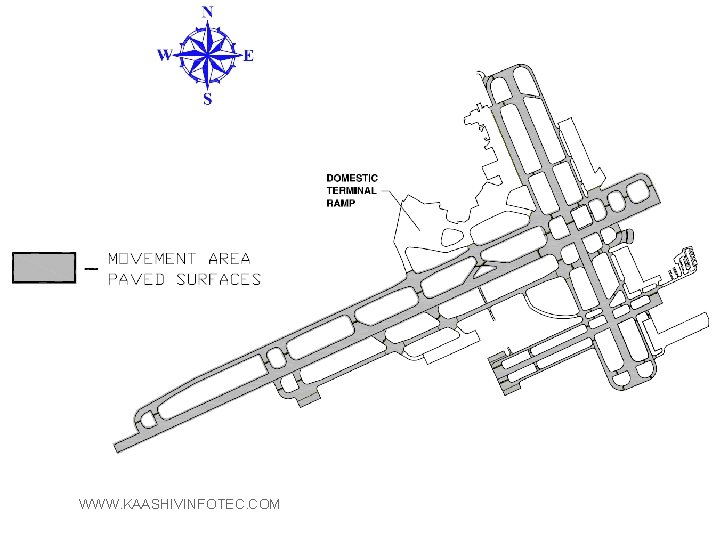
Airfield Familiarization The Airport Operations Area (AOA) is divided into two separate areas: • Movement Area: the areas of the airport that are used for the taxiing, takeoff, and landing of aircraft. These areas consist of the runways and taxiways and are under the control of air traffic control. • Non-Movement Area: these are all other areas of the airport. They include the aircraft parking ramps and Perimeter Road. Useful information for you to reference in an emergency. 16 WWW. KAASHIVINFOTEC. COM
17 WWW. KAASHIVINFOTEC. COM
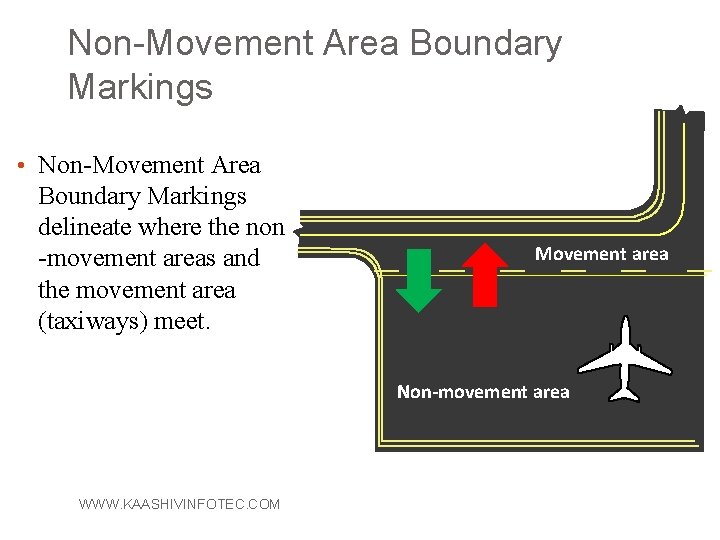
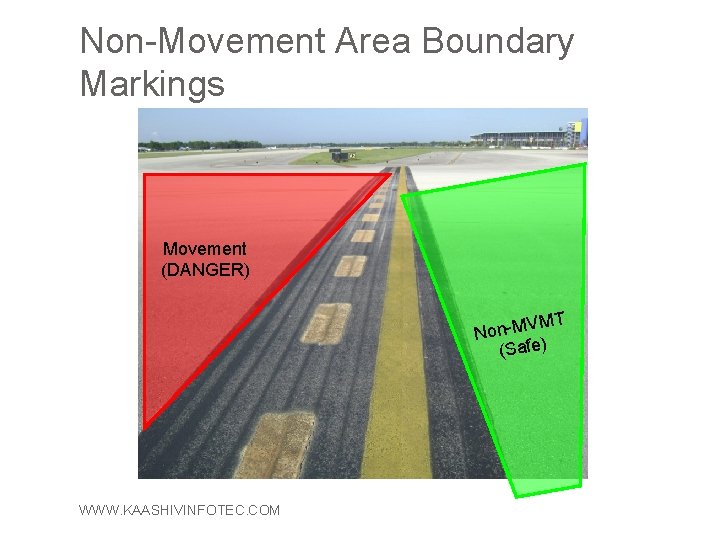
Non-Movement Area Boundary Markings • Non-Movement Area Boundary Markings delineate where the non -movement areas and the movement area (taxiways) meet. Movement area Non-movement area 18 WWW. KAASHIVINFOTEC. COM
Non-Movement Area Boundary Markings Movement (DANGER) VMT Non-M (Safe) 19 WWW. KAASHIVINFOTEC. COM
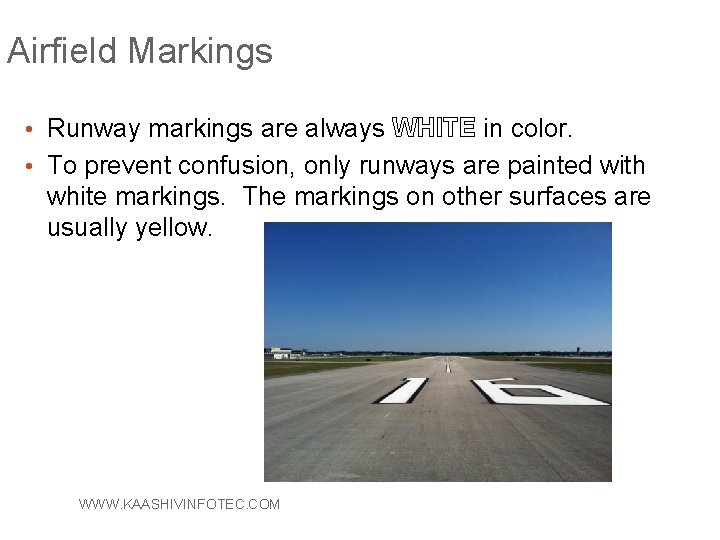
Airfield Markings • Runway markings are always WHITE in color. • To prevent confusion, only runways are painted with white markings. The markings on other surfaces are usually yellow. 20 WWW. KAASHIVINFOTEC. COM
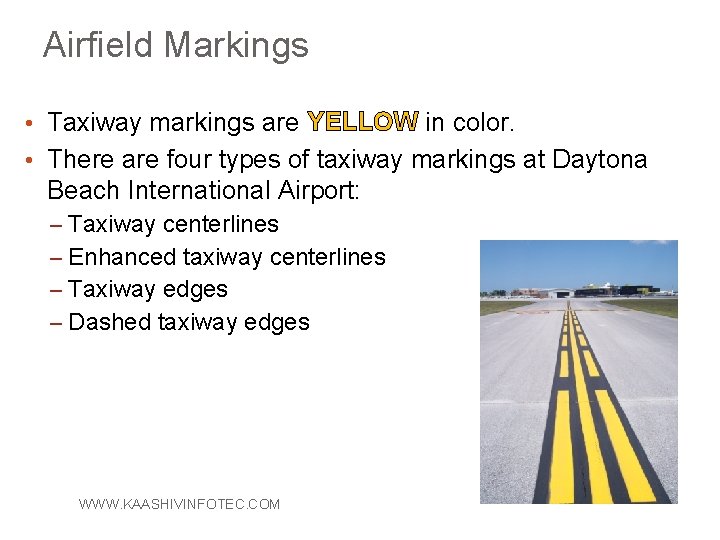
Airfield Markings • Taxiway markings are YELLOW in color. • There are four types of taxiway markings at Daytona Beach International Airport: – Taxiway centerlines – Enhanced taxiway centerlines – Taxiway edges – Dashed taxiway edges 21 WWW. KAASHIVINFOTEC. COM
Aircraft Emergencies Set sequence of events: 1. 2. 3. 4. 5. 22 Air Traffic Control Tower (ATCT) receives notification from pilot and picks up “crash phone. ” Live transmission on TAC 1 800 MHz frequency. ARFF and Operations units proceed to standby positions. When aircraft lands, ARFF will inspect and clear. Operations units will follow aircraft to parking. WWW. KAASHIVINFOTEC. COM
Alerts “Alert 2, Alert 2. Aircraft is a Cessna 172, ten miles from the airport with a rough running engine. ” When ARFF units call into the airport ground frequency, they will be advised of souls onboard and fuel remaining. “Alert” = aircraft emergency situation 23 WWW. KAASHIVINFOTEC. COM
Requests for Assistance Average 80 emergency requests for assistance a year from aircraft 90% of these general aviation (non-airline) Vast majority are non-events Occasional gear-up landing Rare fatal crashes 24 WWW. KAASHIVINFOTEC. COM
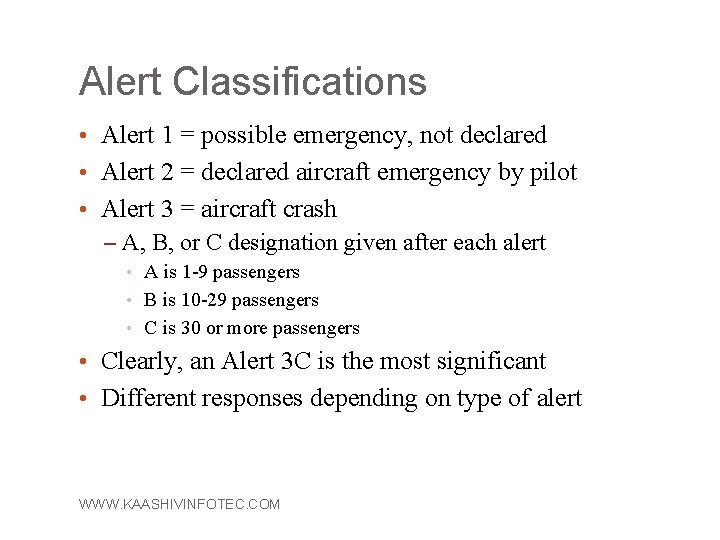
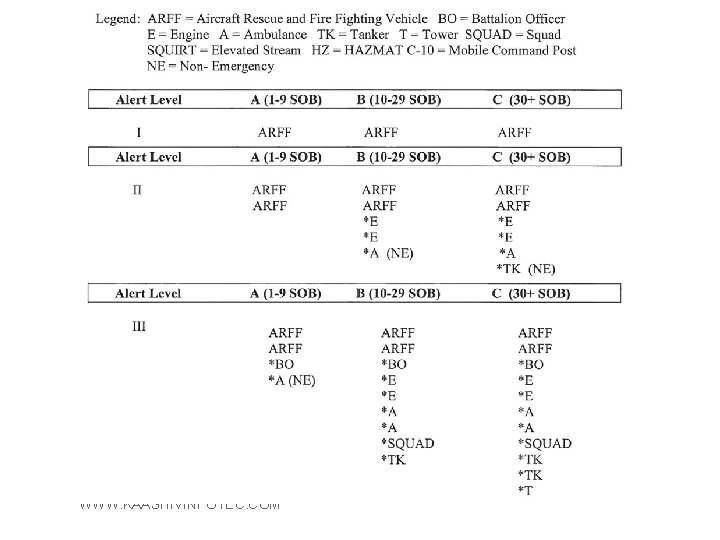
Alert Classifications • Alert 1 = possible emergency, not declared • Alert 2 = declared aircraft emergency by pilot • Alert 3 = aircraft crash – A, B, or C designation given after each alert • A is 1 -9 passengers • B is 10 -29 passengers • C is 30 or more passengers • Clearly, an Alert 3 C is the most significant • Different responses depending on type of alert 25 WWW. KAASHIVINFOTEC. COM
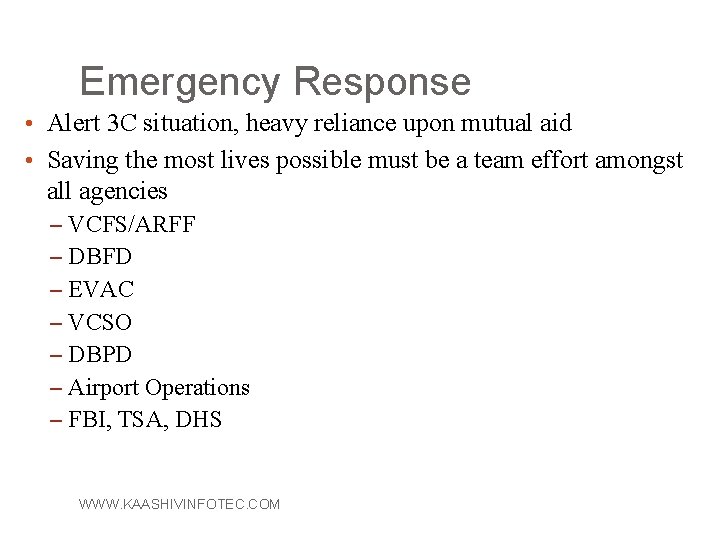
Emergency Response • Alert 3 C situation, heavy reliance upon mutual aid • Saving the most lives possible must be a team effort amongst all agencies – VCFS/ARFF – DBFD – EVAC – VCSO – DBPD – Airport Operations – FBI, TSA, DHS 26 WWW. KAASHIVINFOTEC. COM
27 WWW. KAASHIVINFOTEC. COM
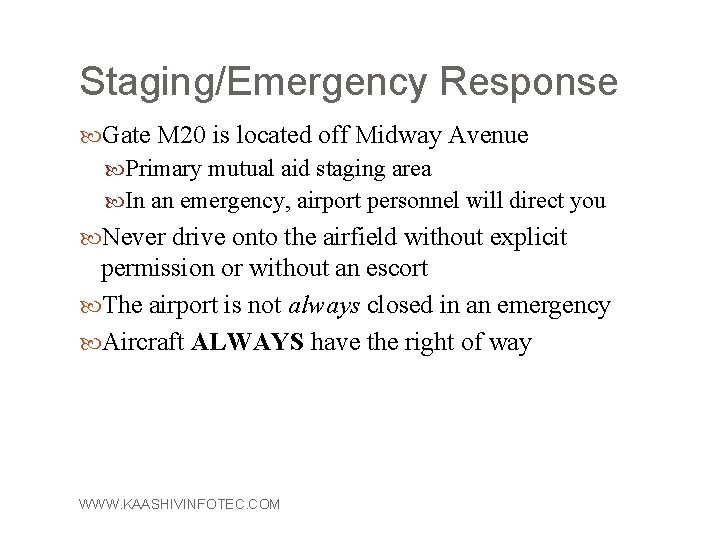
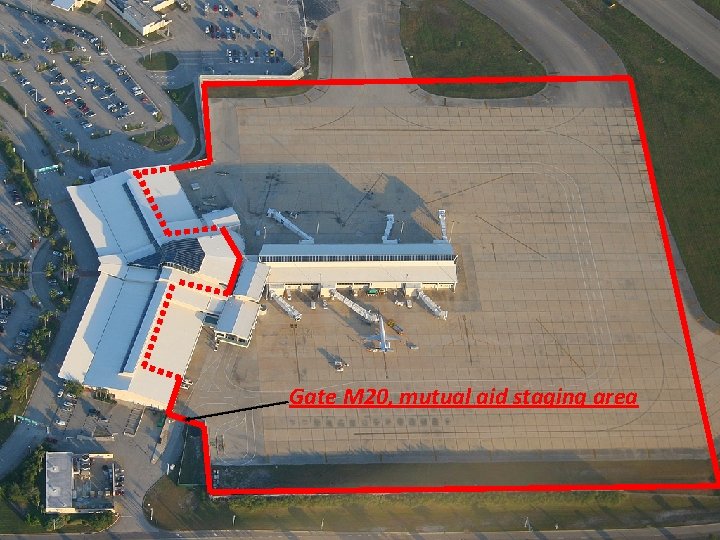
Staging/Emergency Response Gate M 20 is located off Midway Avenue Primary mutual aid staging area In an emergency, airport personnel will direct you Never drive onto the airfield without explicit permission or without an escort The airport is not always closed in an emergency Aircraft ALWAYS have the right of way 28 WWW. KAASHIVINFOTEC. COM
Over head Secured photo Gate M 20, mutual aid staging area 29 WWW. KAASHIVINFOTEC. COM
Thankyou 30 WWW. KAASHIVINFOTEC. COM