
Airline Schedule Optimization Fleet Assignment I Saba Neyshabouri
Airline Schedule Optimization (Fleet Assignment I) Saba Neyshabouri
Agenda • Airline scheduling process • Fleet Assignment problem • Time-Space network concept
Airline Schedule • Single most important indicator of airline’s business strategy. – Markets to be served – Level of service • There are many restrictions that makes the planning very difficult: – – Gates and slots Operational restrictions Airport Restrictions Location of the crew and maintenance plans
Airline’s Goals • Airlines are operating in a competitive market. • The ultimate goal of airlines is maximizing the profit. • There can be some other goals that will lead to profit such as: – Operational goals – Marketing goals – Strategic goals • Airlines are trying to find the best (in terms of profit) schedules that are consistent with their other goals.
Airlines and Decision making • Decision making process in airline industry is a very complicated process due to: – – Numerous airport location with different restrictions Different aircraft types with different operational characteristics Crew scheduling and regulations Large number of O/D routes and markets
Complicating Factors in Decision making • In modeling and solving optimization problems in airline industry, 2 major complicating factor are known: – The huge size of the problem – Inherent uncertainty of the system
Breaking Down the Problems • In order to handle airline’s operational problems, it has been broken down to several hierarchical problems: – – The schedule design problem The fleet assignment problem The maintenance routing problem The crew scheduling problem
Fleet Assignment Problem • The objective: – Finding a profit maximizing assignment of aircrafts to flight legs in airline’s network. • Complicating factors: – – Satisfying passenger demand Fleet composition Fleet balance (flow balance) Other side constraints
The Schedule Design Problem • The goal is to design the airline’s flights schedule specifically: – – Flight legs to be operated by airline Scheduled departure times Estimated scheduled arrivals Frequency plan and the days that on which flight leg is operated
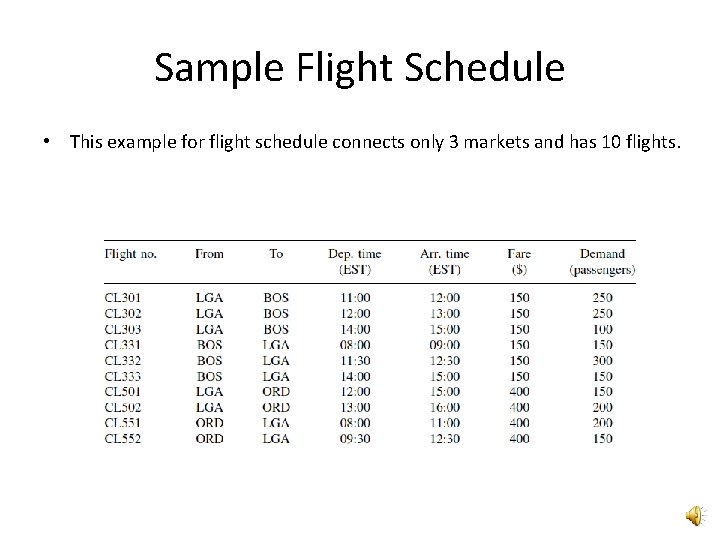
Sample Flight Schedule • This example for flight schedule connects only 3 markets and has 10 flights.
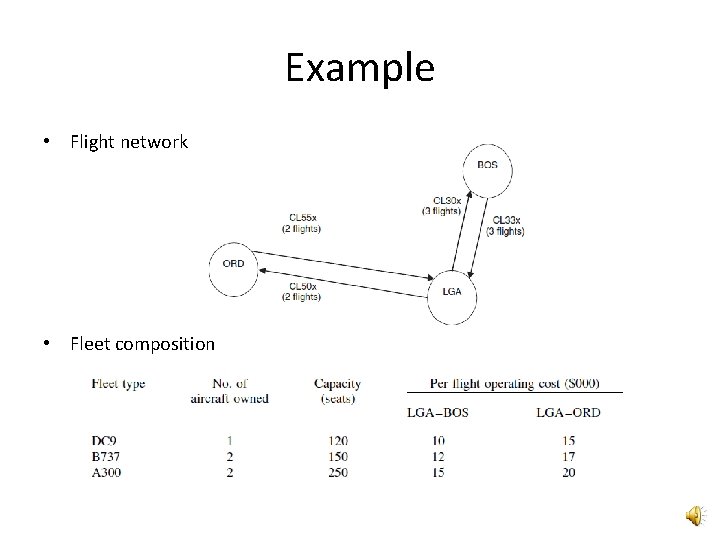
Example • Flight network • Fleet composition
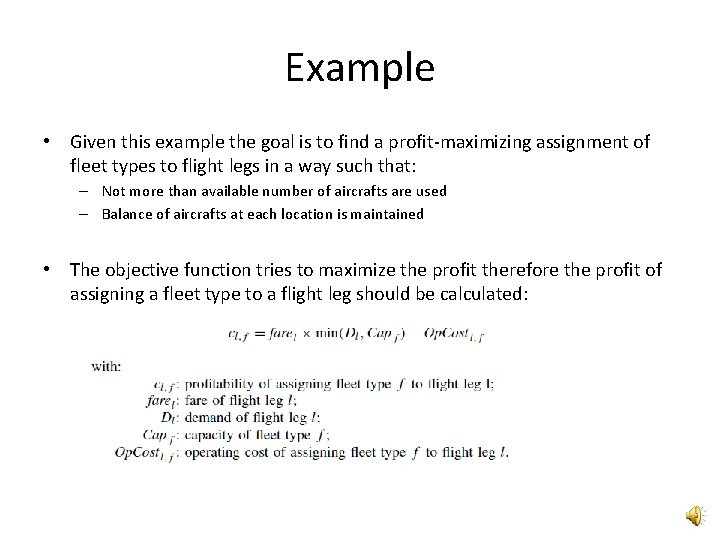
Example • Given this example the goal is to find a profit-maximizing assignment of fleet types to flight legs in a way such that: – Not more than available number of aircrafts are used – Balance of aircrafts at each location is maintained • The objective function tries to maximize the profit therefore the profit of assigning a fleet type to a flight leg should be calculated:
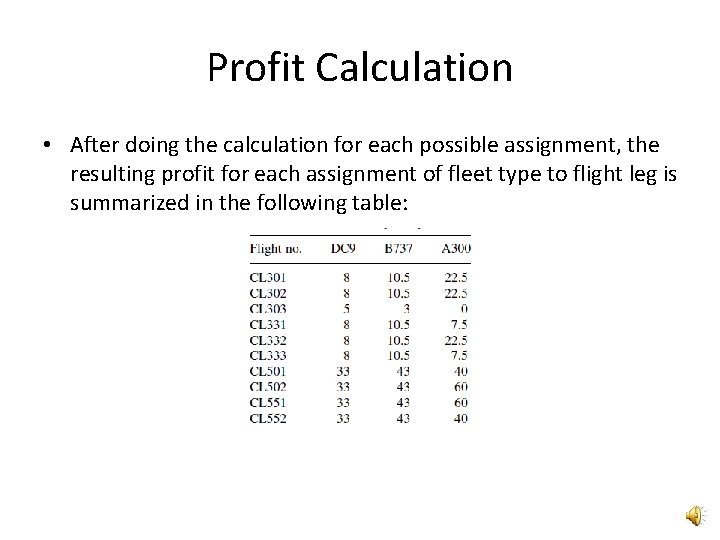
Profit Calculation • After doing the calculation for each possible assignment, the resulting profit for each assignment of fleet type to flight leg is summarized in the following table:

Greedy Solution • Greedy methods: heuristic method to find a solution to a complicated problem which reduces the time of computation however it is not guaranteed to be optimal or even feasible. • The main idea of a greedy algorithm is to be greedy in each step of decision making! – Being greedy is like not considering long-term effects of decisions. – Being greedy in some cases might not even provide any feasible solution.
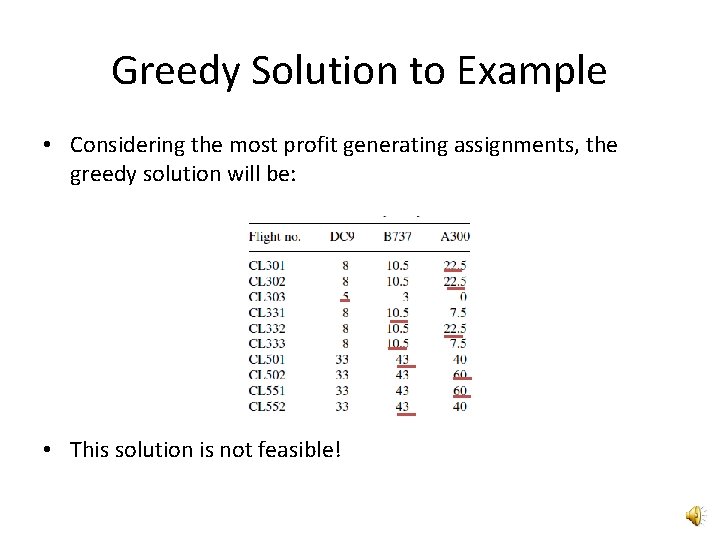
Greedy Solution to Example • Considering the most profit generating assignments, the greedy solution will be: • This solution is not feasible!
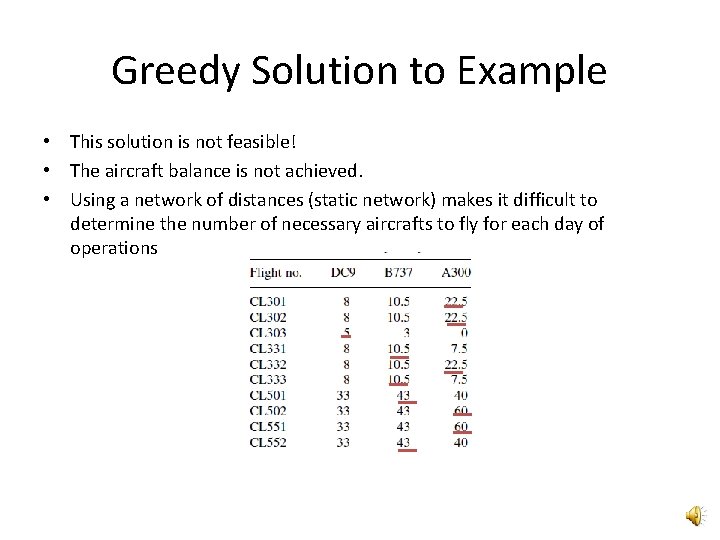
Greedy Solution to Example • This solution is not feasible! • The aircraft balance is not achieved. • Using a network of distances (static network) makes it difficult to determine the number of necessary aircrafts to fly for each day of operations
Time-Space Networks • In many problems in optimization, time is playing an important role in the model. • However having time as a changing parameter in the model, usually increases the complexity of the problem in hand. • Example of the problems that deal with time related constraints: – Job shop scheduling- Minimizing tardiness – Vehicle routing problem with time windows – Flow shop scheduling problems with job availability constraints
Time-Space Network • Decisions that are needed to be made at different times require adding variables that keeps track of time. • Time is a continuous variable! • Adding a continuous variable to an IP problem makes the problem even more complicated to solve. • There has to be an smart way to deal with time in our models.
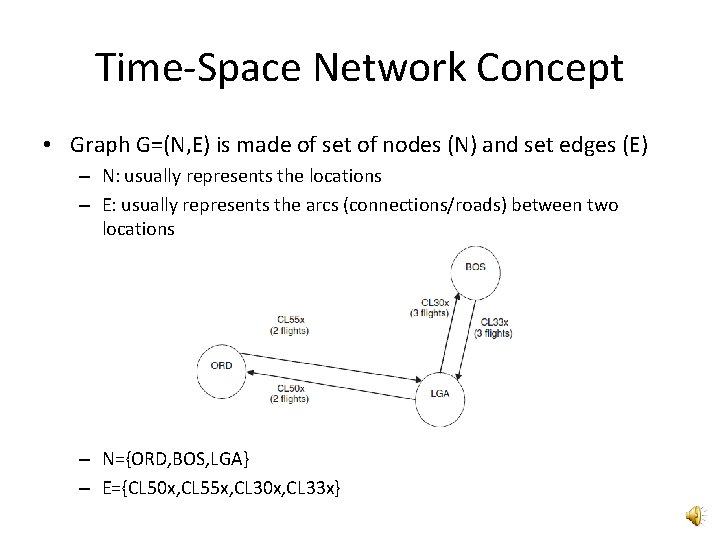
Time-Space Network Concept • Graph G=(N, E) is made of set of nodes (N) and set edges (E) – N: usually represents the locations – E: usually represents the arcs (connections/roads) between two locations – N={ORD, BOS, LGA} – E={CL 50 x, CL 55 x, CL 30 x, CL 33 x}
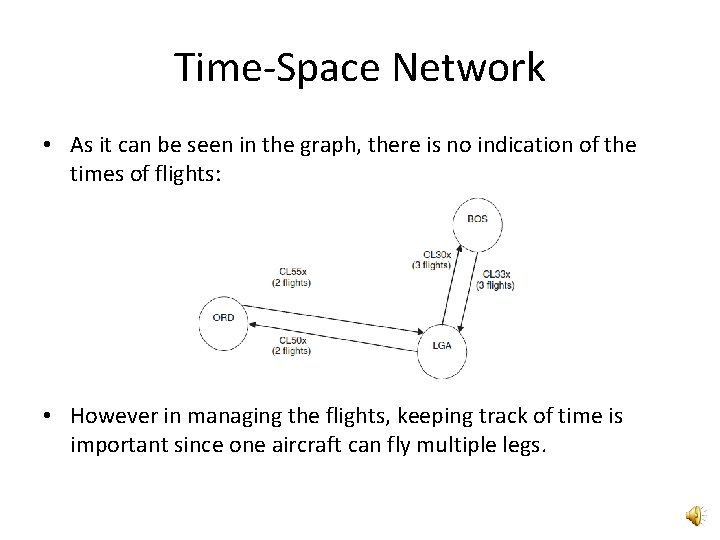
Time-Space Network • As it can be seen in the graph, there is no indication of the times of flights: • However in managing the flights, keeping track of time is important since one aircraft can fly multiple legs.
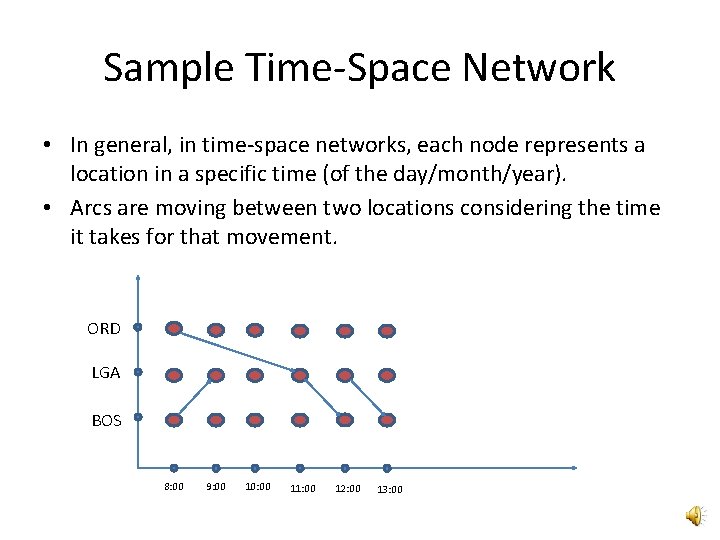
Sample Time-Space Network • In general, in time-space networks, each node represents a location in a specific time (of the day/month/year). • Arcs are moving between two locations considering the time it takes for that movement. ORD LGA BOS 8: 00 9: 00 10: 00 11: 00 12: 00 13: 00
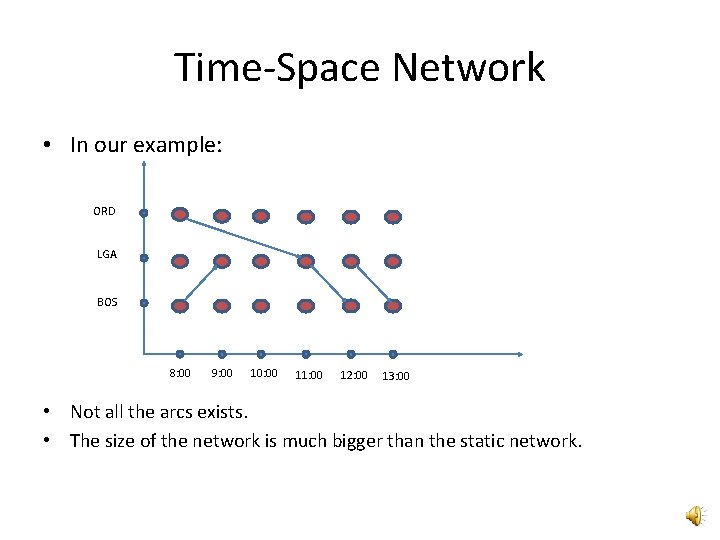
Time-Space Network • In our example: ORD LGA BOS 8: 00 9: 00 10: 00 11: 00 12: 00 13: 00 • Not all the arcs exists. • The size of the network is much bigger than the static network.
Time-Space Networks: Pros & Cons • Time-space networks are used so the optimization problem does not become a mixed-integer programming (MIP) which are generally more difficult to handle. • Using time-space networks, may cause the problem to transform into one of the well-known network problems which can be handled efficiently. • Using time space network will cause the size of the problem to grow very fast – N= Number of locations * Number of time windows (or significant times for each node) – E= Every possible movements between 2 locations throughout the day.
Time-Space Network for our Example • In our example: a time-space flight network is an expansion of the static flight network in which each node represents both a location and a point in time. • In this network, two different arcs are possible: – A flight arc: representing a flight leg with departure location and time represented by the arc’s origin node, and arrival location and arrival plus turn time represented by the arc’s destination node. – A ground arc: representing aircraft on the ground during the period spanned by the times associated with the arc’s end nodes.
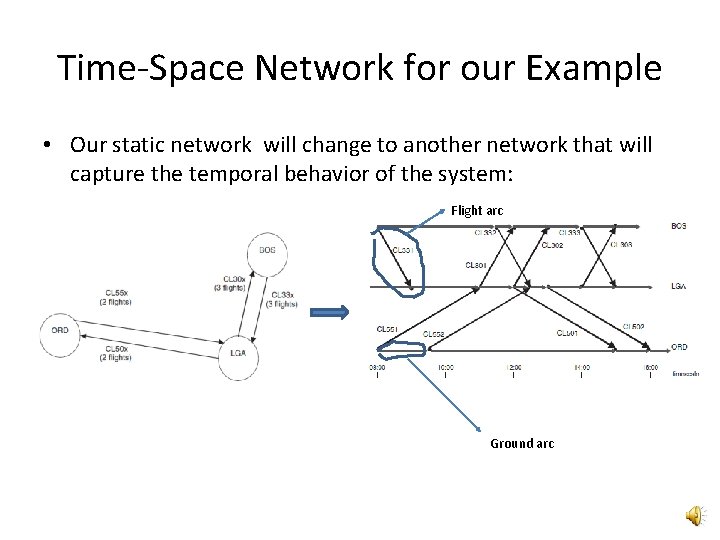
Time-Space Network for our Example • Our static network will change to another network that will capture the temporal behavior of the system: Flight arc Ground arc
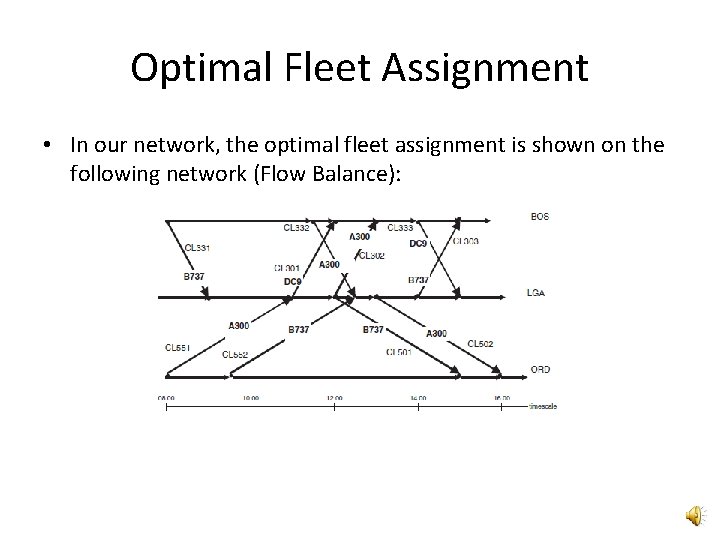
Optimal Fleet Assignment • In our network, the optimal fleet assignment is shown on the following network (Flow Balance):
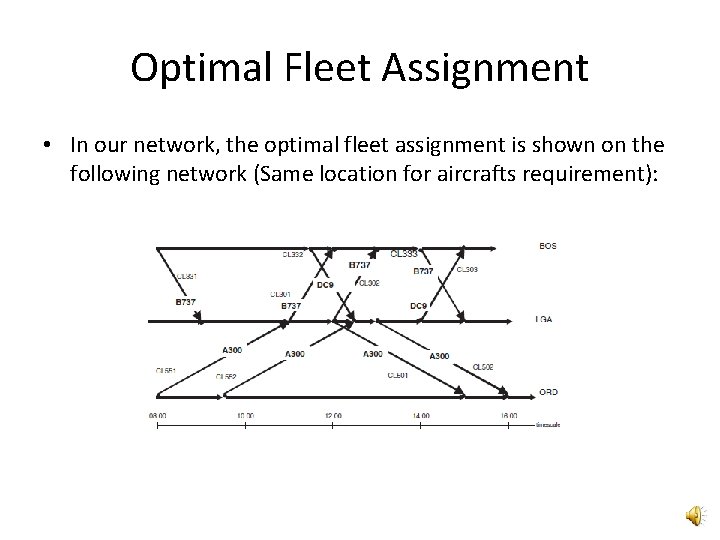
Optimal Fleet Assignment • In our network, the optimal fleet assignment is shown on the following network (Same location for aircrafts requirement):
- Slides: 27