
Airfoils Wings Introduction to Wings Wing design is

- Slides: 14
Airfoils (Wings)
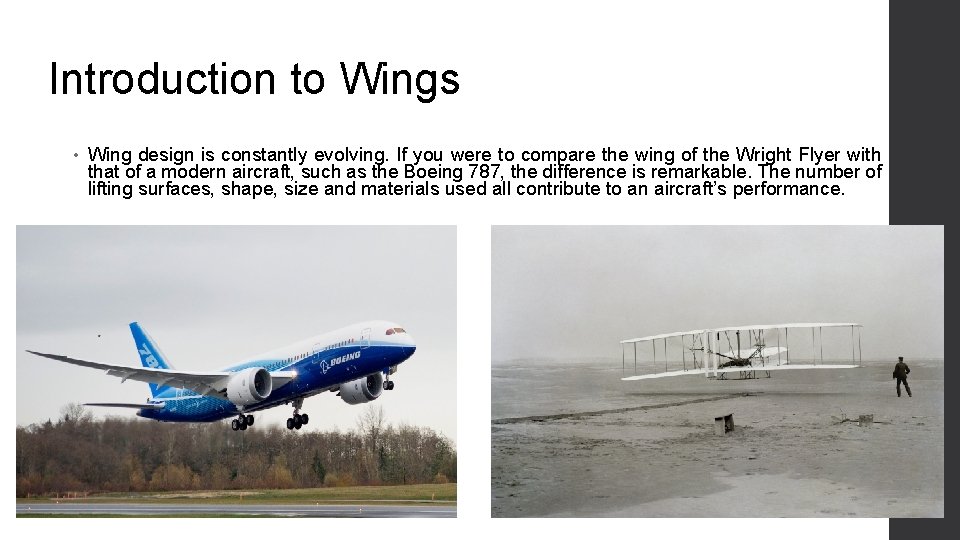
Introduction to Wings • Wing design is constantly evolving. If you were to compare the wing of the Wright Flyer with that of a modern aircraft, such as the Boeing 787, the difference is remarkable. The number of lifting surfaces, shape, size and materials used all contribute to an aircraft’s performance.
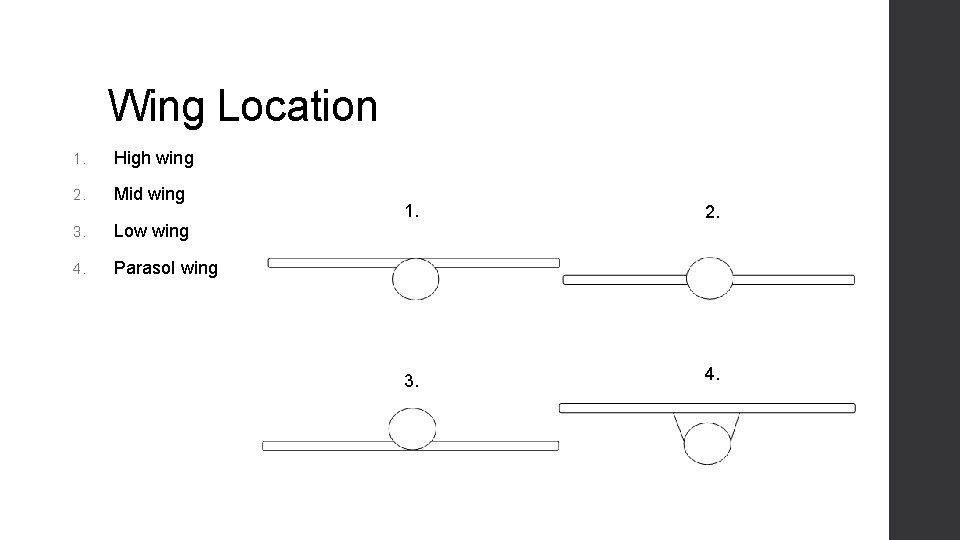
Wing Location 1. High wing 2. Mid wing 3. Low wing 4. Parasol wing 1. 2. 3. 4.
Aerodynamic Forces 1. Thrust The force that moves the aircraft through the air. Generate by the engine 2. Lift This force is generated by the flow of air around the airplane especially to the wing. Amount of lift generated depends on airspeed, angle of attack, airfoil shape, wing area.
More on Lift • In designing an aircraft wing, it is better to get the higher coefficient of lift. • Coefficient of lift is vary with angle of attack. • That’s why by changing the angle of attack, the amount of generated lift can be adjusted.
Aerodynamic Forces 3. Drag • Drag is the force of resistance an aircraft ‘feels’ as it moves through the air. • Wing is designed to be smooth in order to reduce drag. • Drag important during landing in order to slow down the aircraft. 4. Weight • Weight is the earth’s gravity pulls down on objects and gives them weight. • It includes the aircraft itself, the payload and the fuel.
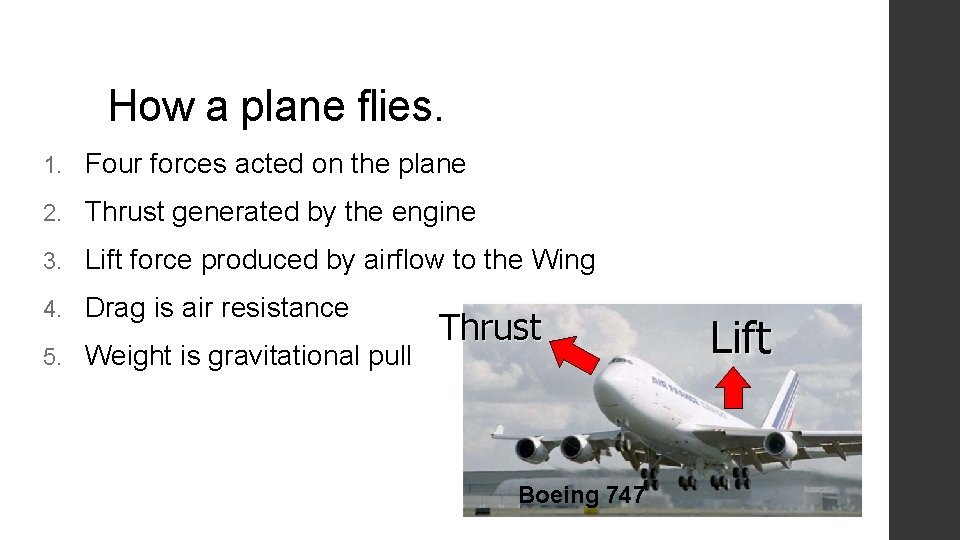
How a plane flies. 1. Four forces acted on the plane 2. Thrust generated by the engine 3. Lift force produced by airflow to the Wing 4. Drag is air resistance 5. Weight is gravitational pull Thrust Boeing 747 Lift
How a plane flies • There actually four forces (thrust, lift, drag and weight) acting on airplane. • When taking off, the plane is moving at high speed on the runway due to the thrust generated by the engine. • As engines are attached to the wing of an airplane, its thrust will be applied to the airplane. • The airflows pass over the wings generate a lift force. • To allow the airplane take-off, Lift force must greater than the plane’s weight and thrust force must greater than the drag force.
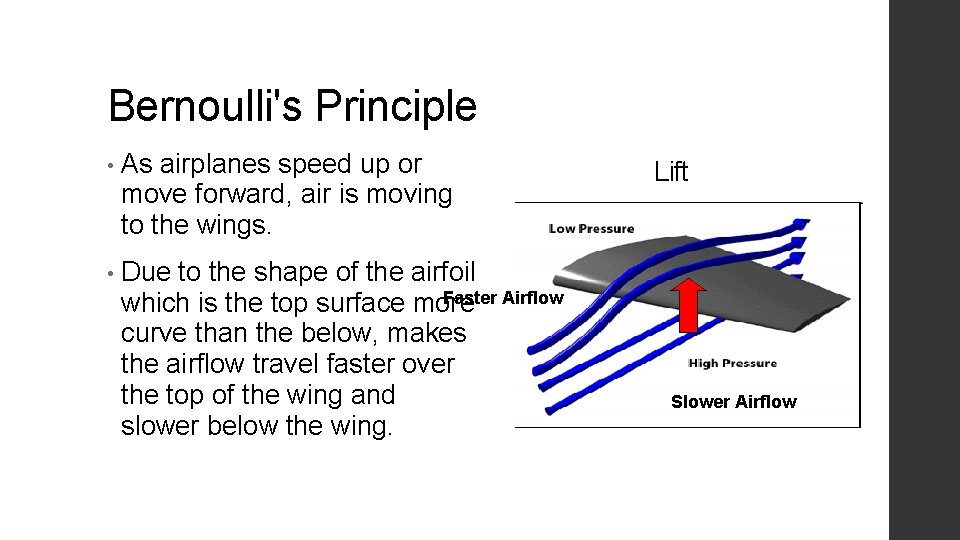
Bernoulli's Principle • As airplanes speed up or move forward, air is moving to the wings. • Due to the shape of the airfoil Faster Airflow which is the top surface more curve than the below, makes the airflow travel faster over the top of the wing and slower below the wing. Lift Slower Airflow
How a plane flies • According to the Bernoulli’s principle, an increase in velocity leads to a decrease in pressure. • So that, the air pressure below the wing is higher meanwhile the air pressure above the wing is lower. • This difference in pressure pushes the wings up. • And as both wings are attached on the fuselage, the whole airplane body also goes up. • If enough lift is created or lift is greater than the plane’s weight, the plane naturally lift into the air.
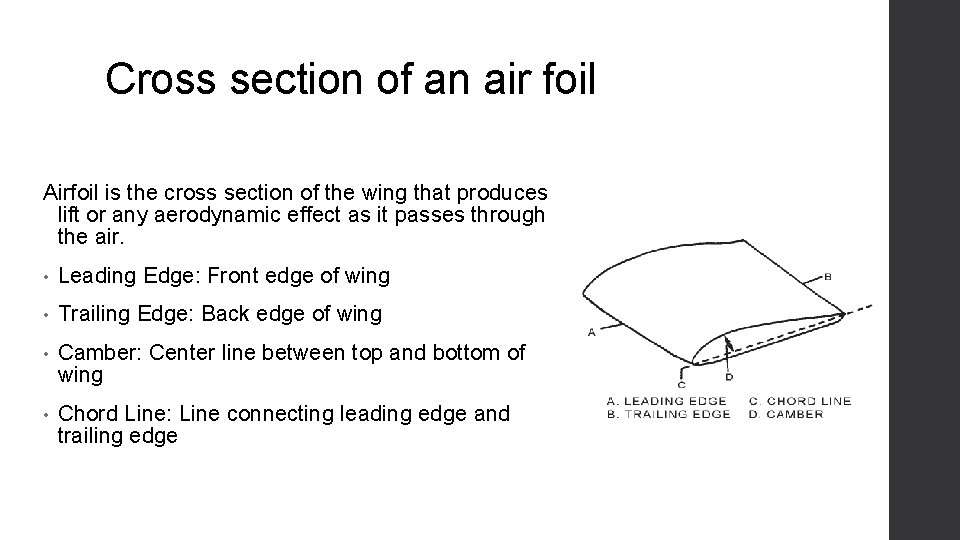
Cross section of an air foil Airfoil is the cross section of the wing that produces lift or any aerodynamic effect as it passes through the air. • Leading Edge: Front edge of wing • Trailing Edge: Back edge of wing • Camber: Center line between top and bottom of wing • Chord Line: Line connecting leading edge and trailing edge
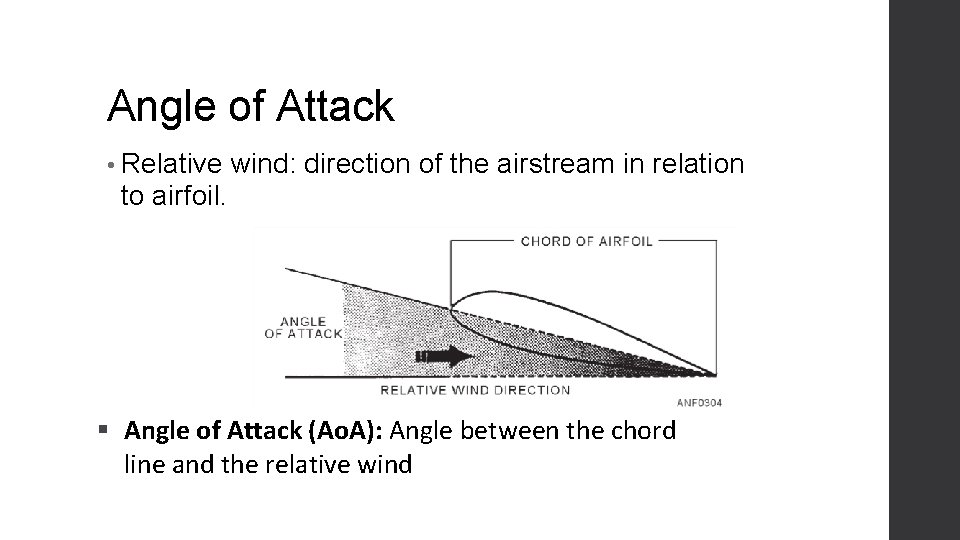
Angle of Attack • Relative wind: direction of the airstream in relation to airfoil. Angle of Attack (Ao. A): Angle between the chord line and the relative wind
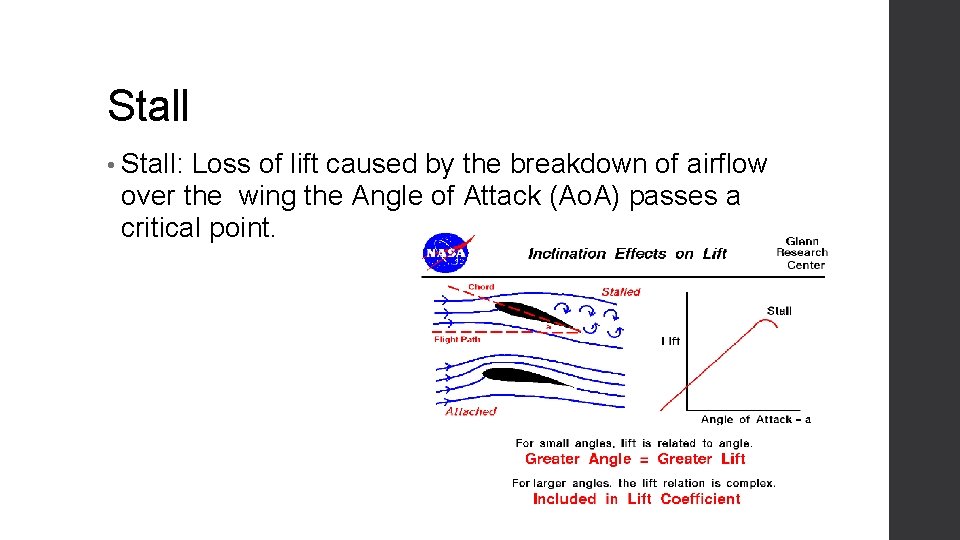
Angle of Attack • The angle of attack (Ao. A) is related to the amount of lift. • Ao. A • It changes during a flight as the pilot changes the direction of the airplane. • Too high an Ao. A (exceed the critical value) can cause the airplane stalls. • Stall means airplane loss of LIFT force, thus the airplane may go down. , Lift
Stall • Stall: Loss of lift caused by the breakdown of airflow over the wing the Angle of Attack (Ao. A) passes a critical point.