
AIRCRAFT WEIGHT AND BALANCE PURPOSESafety is the primary
AIRCRAFT WEIGHT AND BALANCE. • PURPOSE-Safety is the primary reason for concern about an aircraft’s weight and balance. • A secondary reason for concern about weight and balance, but also a very important one, is the efficiency of the aircraft. Need and Requirements for Aircraft Weighing • If the weight and balance report for an aircraft is lost, the aircraft must be weighed and a new report must be created.
• If the airplane has new equipment installed, such as a radio or a global positioning system, a new weight and balance report must be created. • Over a period of time, almost all aircraft have a tendency to gain weight. Examples of how this can happen include an airplane being repainted without the old paint being removed, and the accumulation of dirt, grease, and oil in parts of the aircraft that are not easily accessible for cleaning.
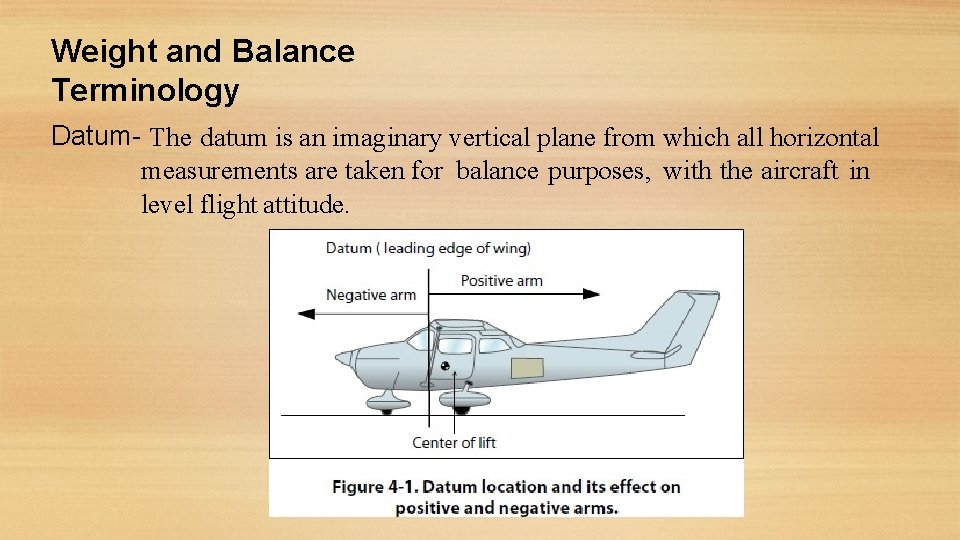
Weight and Balance Terminology Datum- The datum is an imaginary vertical plane from which all horizontal measurements are taken for balance purposes, with the aircraft in level flight attitude.
• The location of the datum is identified in the Aircraft Specifications or Type Certificate Data Sheet Arm The arm is the horizontal distance that a part of the aircraft or a piece of equipment is located from the datum. The arm’s distance is always given or measured in inches, and, except for a location which might be exactly on the datum, it is preceded by the algebraic sign for positive (+) or negative (−). The positive sign indicates an item is located aft of the datum and the negative sign indicates an item is located forward of the datum.
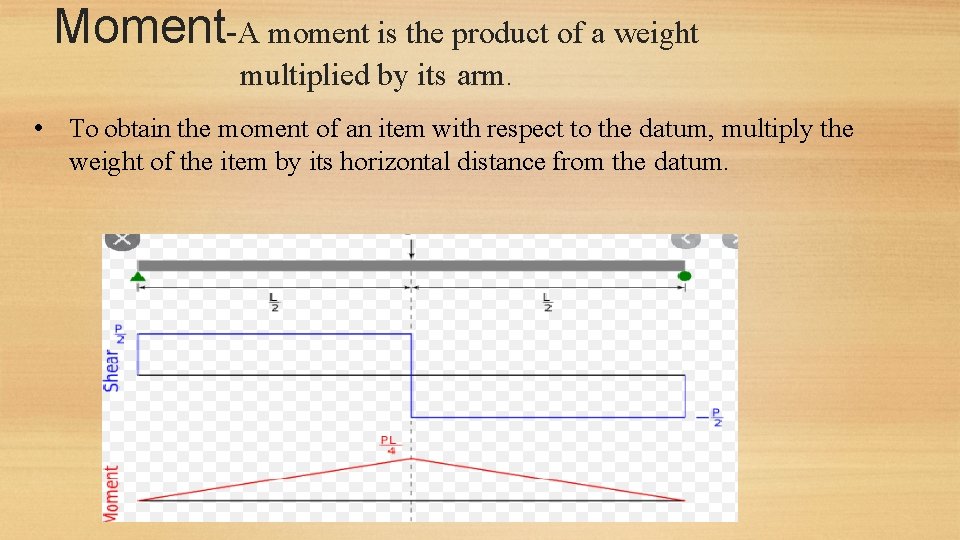
Moment-A moment is the product of a weight multiplied by its arm. • To obtain the moment of an item with respect to the datum, multiply the weight of the item by its horizontal distance from the datum.
• The algebraic sign of the moment, based on the datum location and whether weight is being installed or removed, would be as follows • Weight being added aft of the datum produces a positive moment (+ weight, + arm). • Weight being added forward of the datum produces a negative moment (+ weight, − arm). • Weight being removed aft of the datum produces a negative moment (− weight, + arm). • Weight being removed forward of the datum produces a positive moment (− weight, − arm)

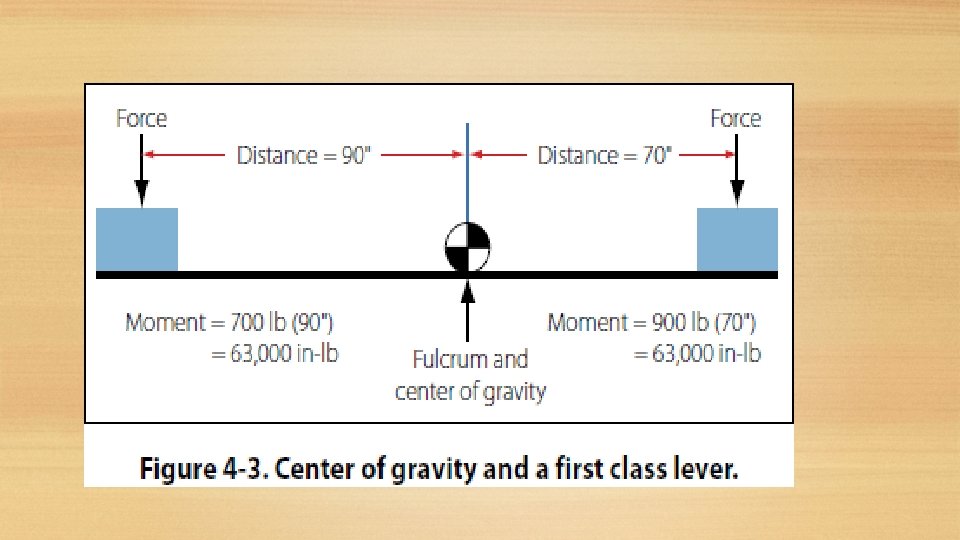
Maximum Weight The maximum weight is the maximum authorized weight of the aircraft and its contents, and is indicated in the Aircraft Specifications or Type Certificate Data Sheet. For many aircraft, there are variations to the maximum allowable weight, depending on the purpose and conditions under which the aircraft is to be Flown • Maximum Ramp Weight—the heaviest weight to which an aircraft can be loaded while it is sitting on the ground. This is sometimes referred to as the maximum taxi weight. • Maximum Takeoff Weight—the heaviest weight an aircraft can have when it starts the take off roll. The difference between this weight and the maximum ramp weight would equal the weight of the fuel that would be consumed prior to takeoff.
• Maximum Landing Weight—the heaviest weight an aircraft can have when it lands. For large wide body commercial airplanes, it can be 100, 000 lb less than maximum takeoff weight, or even more. • Maximum Zero Fuel Weight—the heaviest weight an aircraft can be loaded to without having any usable fuel in the fuel tanks. Any weight loaded above this value must be in the form of fuel.
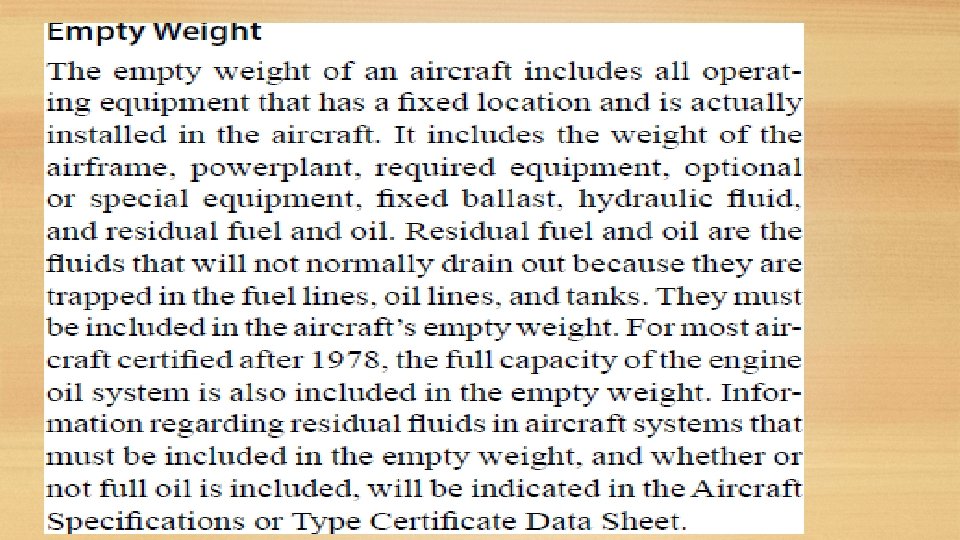
Empty Weight Center of Gravity • The empty weight center of gravity for an aircraft is the point at which it balances when it is in an empty weight condition. • One of the most important reasons for weighing an aircraft is to determine its empty weight center of gravity. Useful Load To determine the useful load of an aircraft, subtract the empty weight from the maximum allowable gross weight. For aircraft certificated in both normal and utility categories, there may be two useful loads listed in the aircraft weight and balance records.
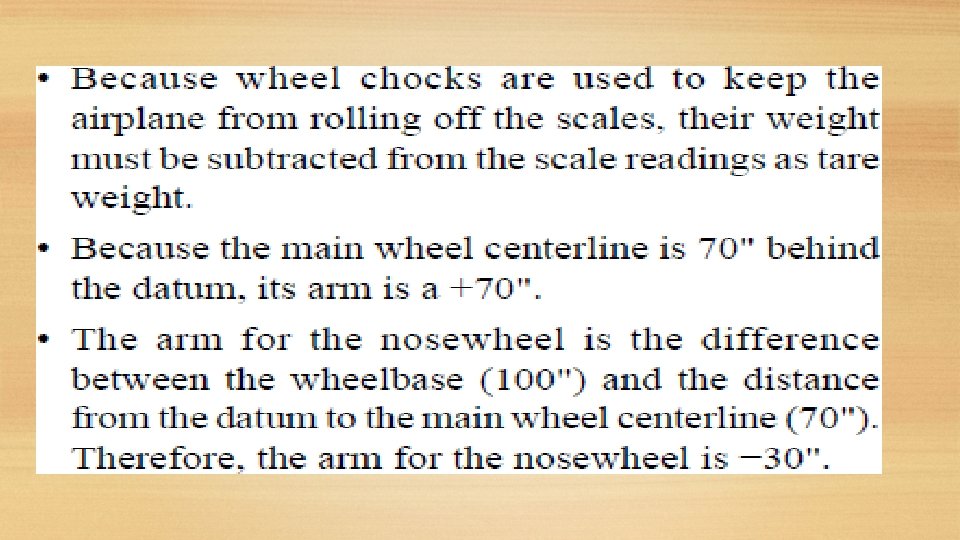
Minimum Fuel • There are times when an aircraft will have a weight and balance calculation done, known as an extreme condition check. • Tare Weight • When aircraft are placed on scales and weighed, it is sometimes necessary to use support equipment to aid in the weighing process. • This extra weight is known as tare weight, and must be subtracted from the scale reading. Other examples of tare weight are wheel chocks placed on the scales and ground locks left in place on
Procedures for Weighing an Aircraft Some of the important weight and balance information found in a Type Certificate Data Sheet is as follows: 1. Center of gravity range 2. Maximum weight 3. Leveling means 4. Number of seats and location 5. Baggage capacity 6. Fuel capacity 7. Datum location 8. Engine horsepower 9. Oil capacity 10. Amount of fuel in empty weight 11. Amount of oil in empty weight

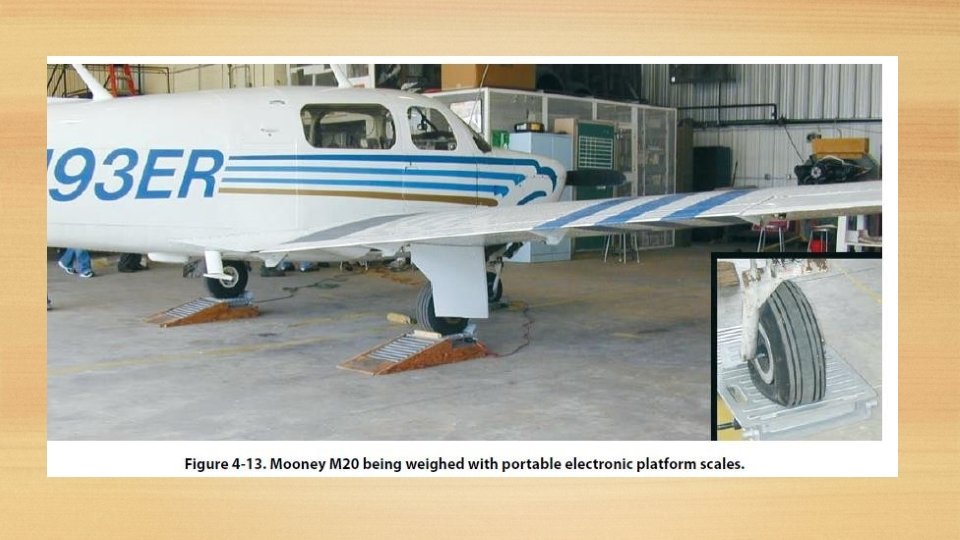
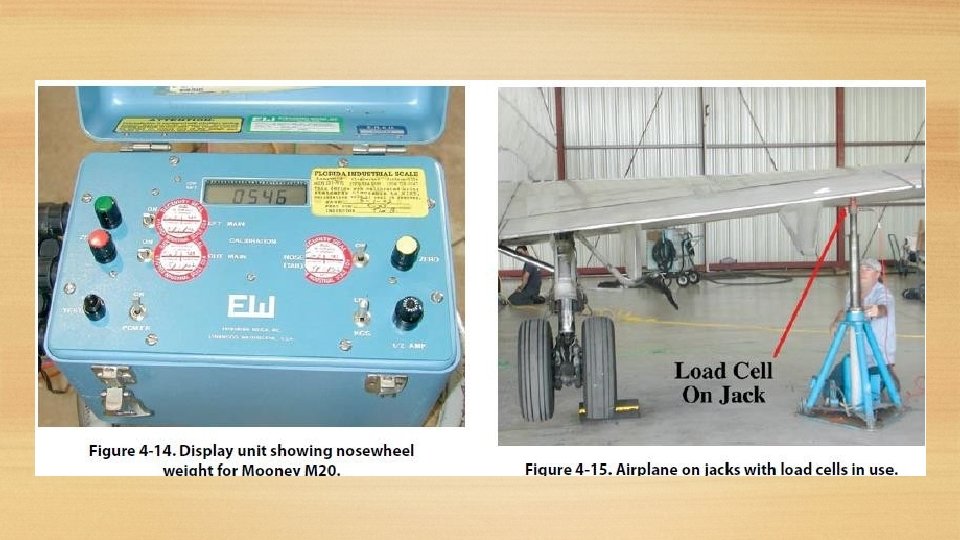
Weight and Balance Equipment 1. Scales • Two types of scales are typically used to weigh aircraft those that operate mechanically with balance weights or springs, and those that operate electronically with what are called load cells
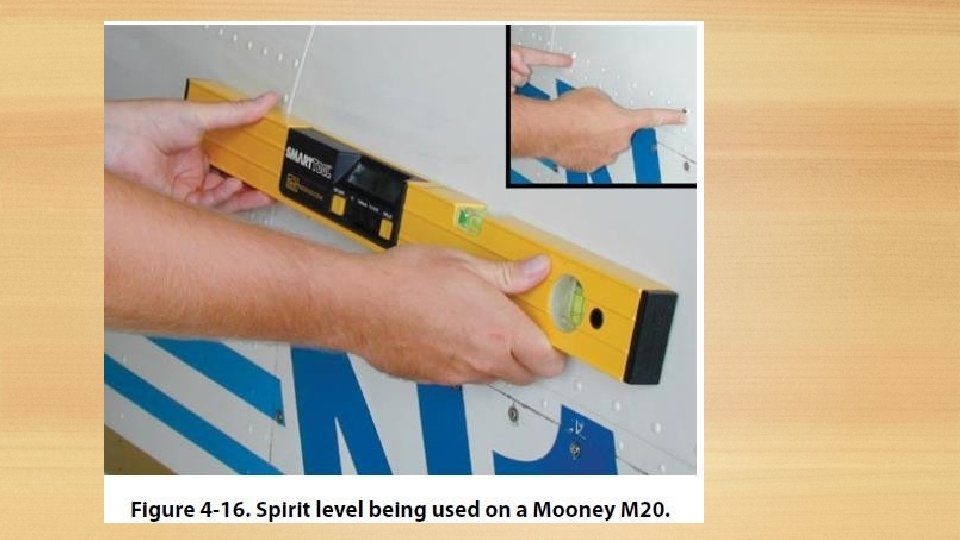
2. Spirit Level Before an aircraft can be weighed and reliable readings obtained, it must be in a level flight attitude. One method that can be used to check for a level condition is to use a spirit level, sometimes thought of as a carpenter’s level, by placing it on or against a specified place on the aircraft. Spirit levels consist of a vial full of liquid, except for a small air bubble. When the air bubble is centered between the two black lines, a level condition is indicated. 3. Hydrometer When an aircraft is weighed with fuel in the tanks, the weight of fuel per gallon should be checked with a hydrometer. A hydrometer consists of a weighted glass tube which is sealed, with a graduated set of markings on the side of the tube. The graduated markings and their corresponding number values represent units of pounds per gallon. When placed in a flask with fuel in it, the glass tube floats at a level dependent on the density of the fuel. Where the fuel intersects the markings on the side of the tube indicates the pounds per gallon.
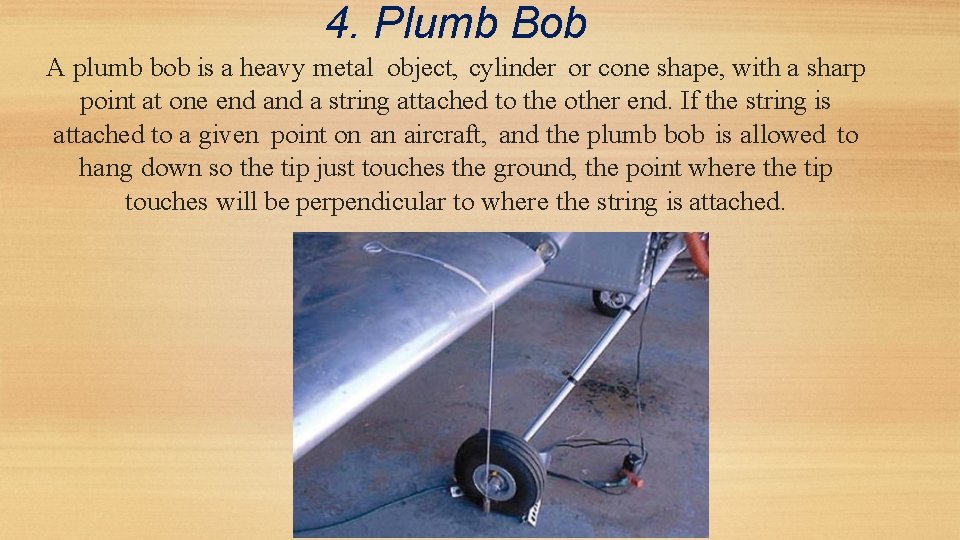
4. Plumb Bob A plumb bob is a heavy metal object, cylinder or cone shape, with a sharp point at one end a string attached to the other end. If the string is attached to a given point on an aircraft, and the plumb bob is allowed to hang down so the tip just touches the ground, the point where the tip touches will be perpendicular to where the string is attached.
Preparing an Aircraft for Weighing an aircraft is a very important and exacting phase of aircraft maintenance, and must be carried out with accuracy and good workmanship. Thoughtful preparation saves time and prevents mistakes. To begin, assemble all the necessary equipment, such as: 1. Scales, hoisting equipment, jacks, and leveling equipment. 2. Blocks, chocks, or sandbags for holding the airplane on the scales. 3. Straightedge, spirit level, plumb bobs, chalk line, and a measuring tape. 4. Applicable Aircraft Specifications and weight and balance computation forms. If possible, aircraft should be weighed in a closed building where there are no air currents to cause incorrect scale readings. An outside weighing is permissible if wind and moisture are negligible.
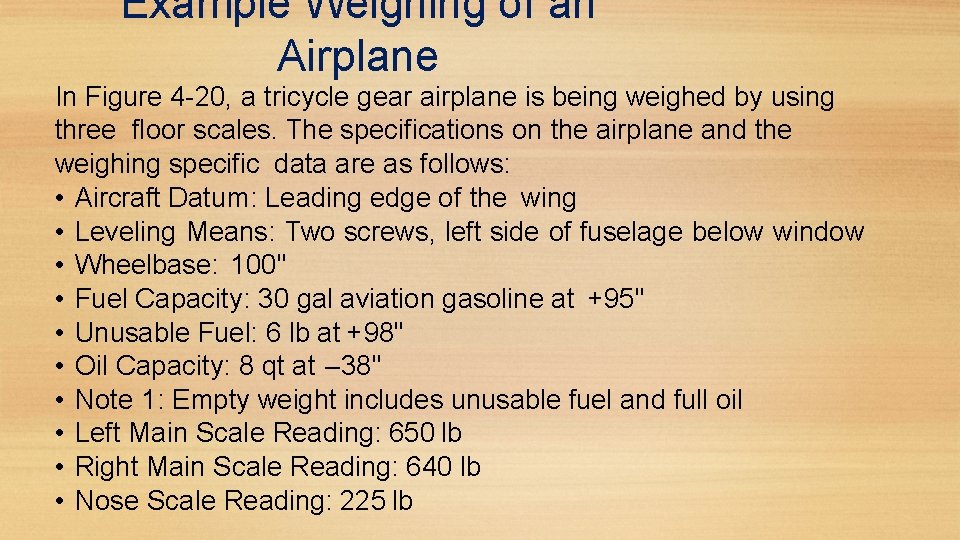
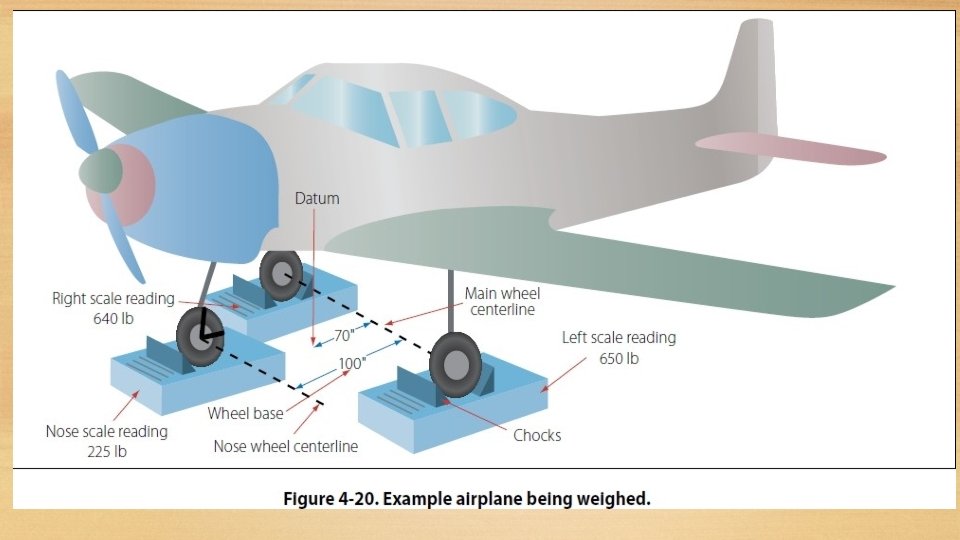
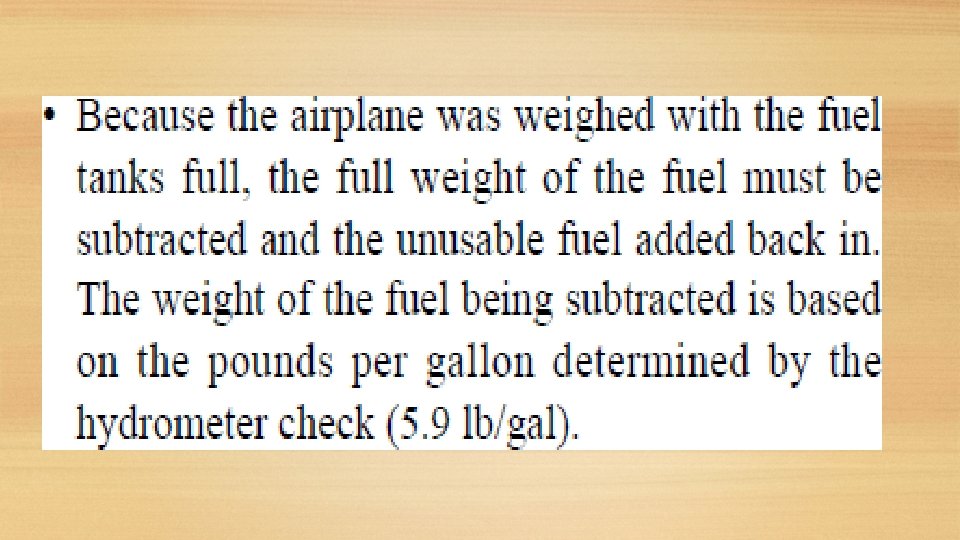
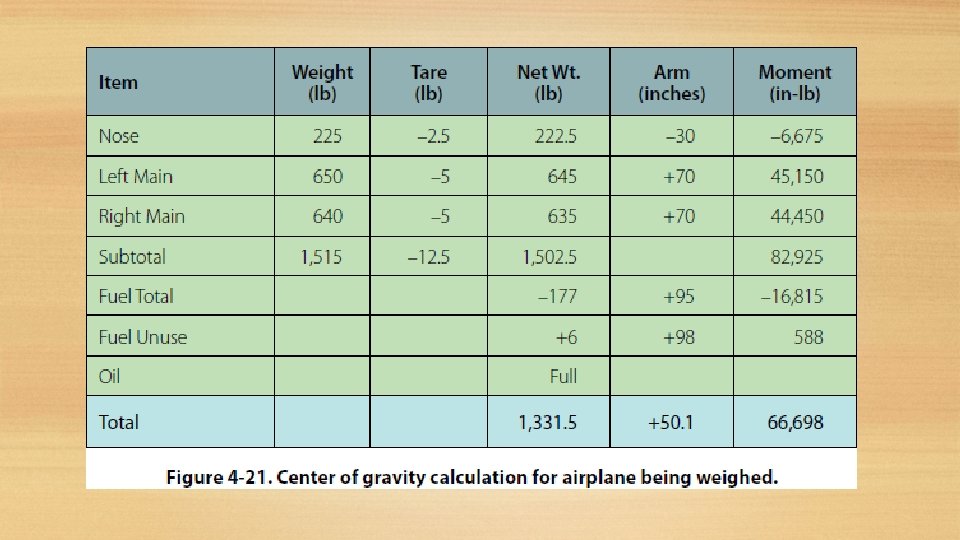
Example Weighing of an Airplane In Figure 4 -20, a tricycle gear airplane is being weighed by using three floor scales. The specifications on the airplane and the weighing specific data are as follows: • Aircraft Datum: Leading edge of the wing • Leveling Means: Two screws, left side of fuselage below window • Wheelbase: 100" • Fuel Capacity: 30 gal aviation gasoline at +95" • Unusable Fuel: 6 lb at +98" • Oil Capacity: 8 qt at – 38" • Note 1: Empty weight includes unusable fuel and full oil • Left Main Scale Reading: 650 lb • Right Main Scale Reading: 640 lb • Nose Scale Reading: 225 lb
- Slides: 30