
Aircraft Noise Metrics Aircraft Noise is the New
- Slides: 43
Aircraft Noise Metrics Aircraft Noise is the New Second Hand Smoke
Aircraft Noise Metrics If your measurements are Inadequate, You don’t have to Take responsibility For doing anything about What you haven’t measured
Where we are and how we got here • The Noise Control Act of 1972 empowered the EPA to determine noise limits to protect the public health and welfare, and to establish a noise control office. • 1973 EPA established community noise levels for aircraft, using A-weighted decibel measures. • At that time EPA acknowledged the measures were inadequate, but convenient for public relations.
What EPA Decided in 1973 – “To perform such analysis, especially for time varying sounds, requires a very complex set of equipment. A frequency-weighted sound pressure level, on the other hand, is a one-number measure of noise that can be obtained with simple equipment…. Although this approach is not satisfactory for detailed analysis for engineering noise control, it provides a satisfactory description of noise from a response viewpoint within the accuracy reasonable for community noiseevaluations. ” p. 3 – – Impact Characterization of Noise Including Implications of Identifying and Achieving Levels of Cumulative Noise Exposure ; EPA Aircraft/Airport Noise Study 27 July 1973 http: //nepis. epa. gov/Exe/Zy. PDF. cgi/9101 DPQN. PDF? Dockey=9101 DPQN. PDF
What EPA Decided in 1973 • “One difficulty in the use of the A-…weighted sound level is that psychoacoustic judgment data indicate that effects of tonal components are sometimes not adequately accounted for by a simple sound level. ” p. 4 – – Impact Characterization of Noise Including Implications of Identifying and Achieving Levels of Cumulative Noise Exposure ; EPA Aircraft/Airport Noise Study 27 July 1973 http: //nepis. epa. gov/Exe/Zy. PDF. cgi/9101 DPQN. PDF ? Dockey=9101 DPQN. PDF
What EPA Decided in 1973 • “An outdoor Ldn of approximately 60 d. B or less is required in order that no more than 23% of the population exposed to noise would be individually highly annoyed…. It therefore appears reasonable to propose an Ldn of 55 to 60 d. B as the long range goal for maximum permissable average sound level with respect to health and welfare. (Note that this level is not considered optimum, merely the upper limit of permissibility. No endorsement is intended of degradation of existing areas having a lower noise level. )” p. 43 – – Impact Characterization of Noise Including Implications of Identifying and Achieving Levels of Cumulative Noise Exposure ; EPA Aircraft/Airport Noise Study 27 July 1973 http: //nepis. epa. gov/Exe/Zy. PDF. cgi/9101 DPQN. PDF? Dockey=9101 DPQN. PDF
OSHA Definitions • Average Level: “The average does not include any sound below the threshold. ” !!! – Example: threshold set to 80 d. B, and exchange or doubling rate is 5 d. B. In 1 -hour noise measurement in office where A-weighted sound level was 50 -70 d. B. If the sound never exceeded 70, there would be no reading. If the sound were exceeded for a few seconds due to a telephone ringing, ONLY those sounds would contribute to the average, resulting in a level of approximately 40 d. B, notably lower than the actual levels in the environment. – LDN Day-night level 24 -hour average
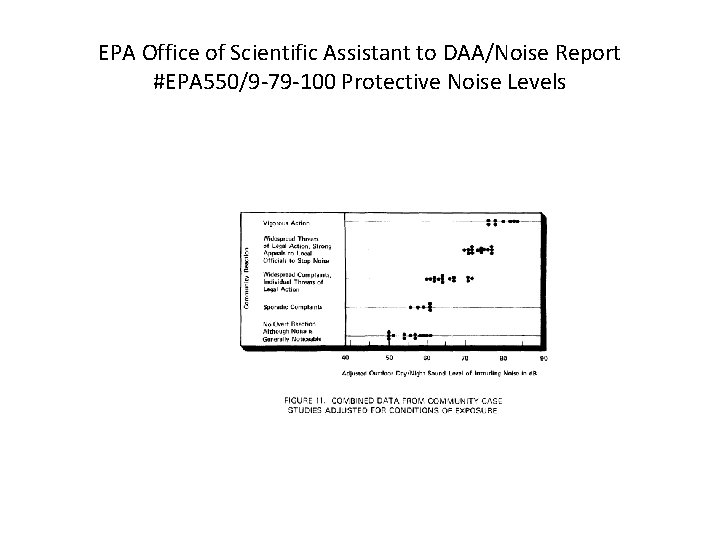
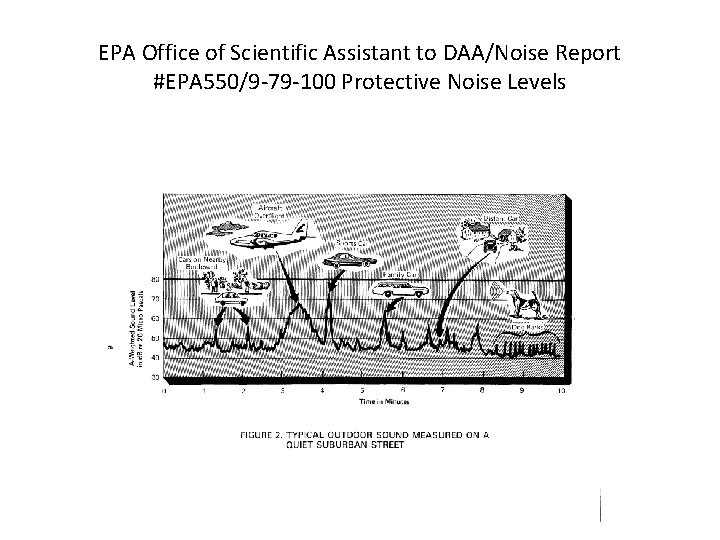
EPA Office of Scientific Assistant to DAA/Noise Report #EPA 550/9 -79 -100 Protective Noise Levels
EPA Office of Scientific Assistant to DAA/Noise Report #EPA 550/9 -79 -100 Protective Noise Levels
What EPA Decided in 1973 • “The disturbance by individual noise events and occasional high noise levels should be controlled by maximum permissible noise levels for individual events established by local authorities. Control over such events should not be attempted by lowering the average sound level. ” p. 44 – – Impact Characterization of Noise Including Implications of Identifying and Achieving Levels of Cumulative Noise Exposure ; EPA Aircraft/Airport Noise Study 27 July 1973 http: //nepis. epa. gov/Exe/Zy. PDF. cgi/9101 DPQN. PDF? Dockey=9101 DPQN. PDF
What EPA Decided in 1973 • “In summary, it is a realistic goal to keep the day/night average sound level below 60 d. B in residential areas, where the average includes a 10 decibel penalty on nighttime noise levels. In conjunction with noise emission standards and local control of individual noise events, such a limit is expected to insure, according to present knowledge, a noise environment without significant effect on public health and welfare. ” p. 44 – – Impact Characterization of Noise Including Implications of Identifying and Achieving Levels of Cumulative Noise Exposure ; EPA Aircraft/Airport Noise Study 27 July 1973 http: //nepis. epa. gov/Exe/Zy. PDF. cgi/9101 DPQN. PDF? Dockey=9101 DPQN. PDF
What EPA Decided in 1973 • “A noise measure must be found that collapses the array of statistical parameters described above into a single useable figure for describing the noise exposure of a neighborhood, even if that simplification entails some compromise with the current standard of highest attainable accuracy. ” Appendix A, “Justification of the use of the average sound level as a measure of community noise” p. A-3 – – Impact Characterization of Noise Including Implications of Identifying and Achieving Levels of Cumulative Noise Exposure ; EPA Aircraft/Airport Noise Study 27 July 1973 http: //nepis. epa. gov/Exe/Zy. PDF. cgi/9101 DPQN. PDF? Dockey=9101 DPQN. PDF
What EPA Decided in 1973 • “The indications that a ‘D-weighting’ might ultimately be more suitable for evaluating the integrated effects of noise on man, than the A-weighting, however, suggests that at such time as a ‘Dweighting’ becomes standardized and available in commercial instrumentation, its value as the weighting for environmental noise should be considered, to determine if a change from the Aweighting is warranted. ” p. 5 – Note: D-weighting has been found not to be as accurate in describing aircraft overflight noise as is C-weighting. See WHO Community Noise Report 2000, Wyle report 2001 and Partnership for Air Transportation Noise and Emissions Reduction FAA/NASA/Transport Canada 2007 – – Impact Characterization of Noise Including Implications of Identifying and Achieving Levels of Cumulative Noise Exposure ; EPA Aircraft/Airport Noise Study 27 July 1973 http: //nepis. epa. gov/Exe/Zy. PDF. cgi/9101 DPQN. PDF? Dockey=9101 DPQN. PDF
After 1973 • In 1982 funding for further research and enforcement was discontinued • States and local governments do not establish their own standards because the 1973 law is still the law of the land, although the 1973 report on Aircraft noise indicates that local governments can set local noise standards.
Decibels for Non-acousticians: It’s Complicated • The terminology is technical and not used consistently across measurement situations • The math gets complex very quickly • EPA and FAA count on most people not being able to slog through the math, the terminology, and the measurement issues • We WILL need experts to guide us
The Basics • The ear perceives different pitch frequencies (Hertz) at different levels. We perceive higher frequencies more easily than lower frequencies BUT…. • Low frequencies can be “felt” more than heard, through bone conduction (Think “Jaws” movie theme—an orienting response-- and how your body vibrates when the bass is turned up) • Airplanes generate sounds across a wide range of frequencies, most of which the FAA does not measure for community noise purposes
What gets measured • Decibel meters are not exactly the same thing as sound spectrum analyzers. • Decibel meters measure sound pressure • Decibel meters use “weighting” to filter out some parts of the sound spectrum • This allows agencies like the FAA to “fudge” their numbers.
What about my experience of noise? • The psychologist John G. Neuhoff found out that for the rising level our hearing is more sensitive than for the declining level. For the same sound level difference the change of loudness from quiet to loud is stronger than from loud to quiet. • John G. Neuhoff, "An adaptive bias in the perception of looming auditory motion", 2001, Ecological Psychology 13 (2) pp. 87 - 110 and John G. Neuhoff, "Perceptual Bias for Rising Tones", 1998, Nature, Volume 395, 10 September • http: //www. sengpielaudio. com/Table. Of. Sound. Pressure. Levels. htm •
How many decibels does it take to double the perception of noise? • There is a constant uncertainty of the answer to the question: "How many decibels (d. B) are doubling a sound"? or "What is twice the sound? " • Answer: Doubling means the "factor 2". What does doubling of a "sound" mean? • Doubling the (sound) intensity is obtained by an increase of the sound intensity level (power) of 3 d. B. Doubling the sound pressure is obtained by an increase of the sound pressure level (voltage) of 6 d. B Doubling the loudness feeling is obtained by an increase of the loudness level (psychoacoustic) of about 10 d. B. • • • Simple rule of thumb: When working with power, 3 d. B means double (twice) the factor and 10 d. B means 10 -fold. When working with voltage or current, 6 d. B means double (twice) the factor and 20 d. B means 10 -fold. • http: //www. sengpielaudio. com/Table. Of. Sound. Pressure. Levels. htm
What is Low Frequency Noise? • Low Frequency Noise (LFN) is noise below the FAA measured pitch frequency of 500 Hz (about the B above middle C on a piano) • It is generated by the exhaust of jet engines at about 20 -200 Hz (approximately G# below middle C to the bottom of the piano range)
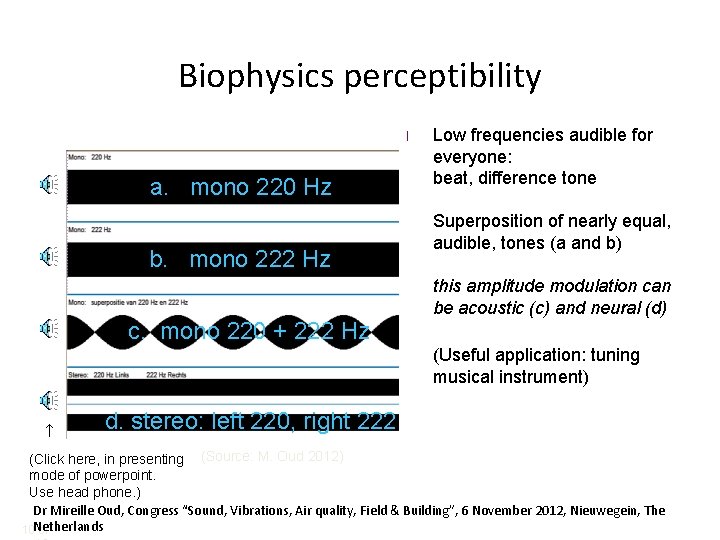
Biophysics perceptibility l a. mono 220 Hz b. mono 222 Hz c. mono 220 + 222 Hz Low frequencies audible for everyone: beat, difference tone Superposition of nearly equal, audible, tones (a and b) this amplitude modulation can be acoustic (c) and neural (d) (Useful application: tuning musical instrument) d. stereo: left 220, right 222 (Click here, in presenting (Source: M. Oud 2012) mode of powerpoint. Use head phone. ) Dr Mireille Oud, Congress “Sound, Vibrations, Air quality, Field & Building”, 6 November 2012, Nieuwegein, The 10 Netherlands of
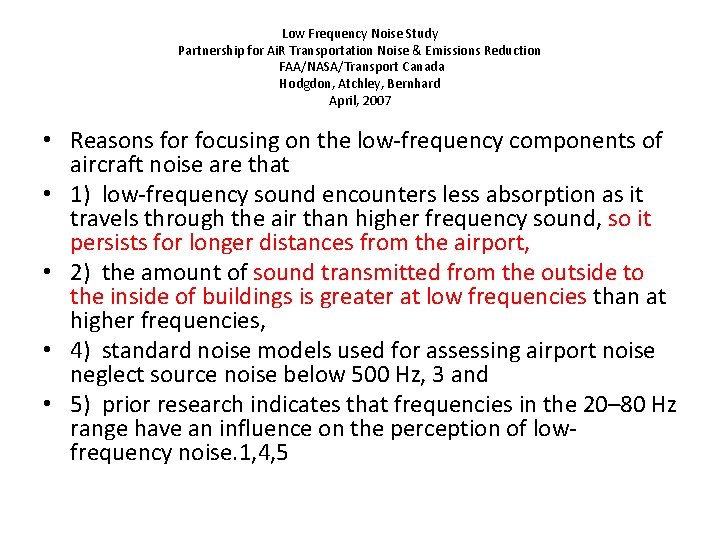
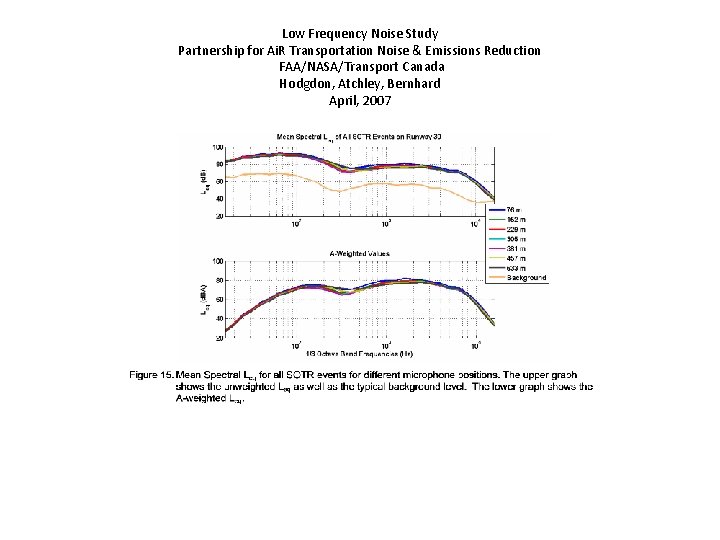
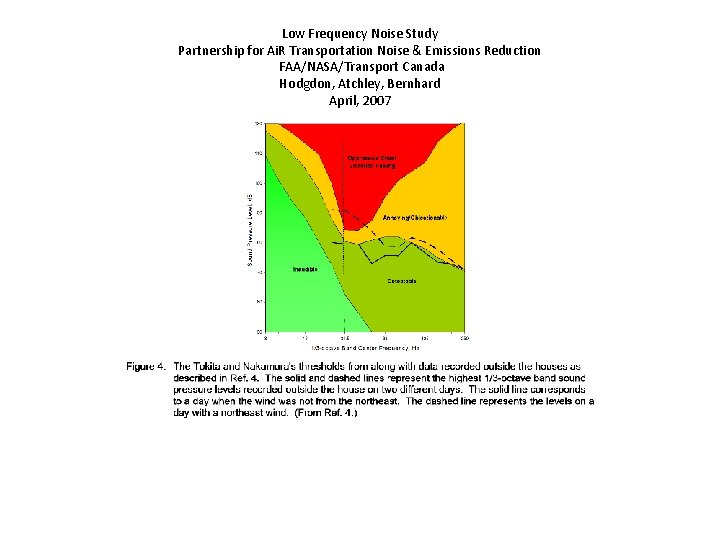
Low Frequency Noise Study Partnership for Ai. R Transportation Noise & Emissions Reduction FAA/NASA/Transport Canada Hodgdon, Atchley, Bernhard April, 2007 • Reasons for focusing on the low-frequency components of aircraft noise are that • 1) low-frequency sound encounters less absorption as it travels through the air than higher frequency sound, so it persists for longer distances from the airport, • 2) the amount of sound transmitted from the outside to the inside of buildings is greater at low frequencies than at higher frequencies, • 4) standard noise models used for assessing airport noise neglect source noise below 500 Hz, 3 and • 5) prior research indicates that frequencies in the 20– 80 Hz range have an influence on the perception of lowfrequency noise. 1, 4, 5
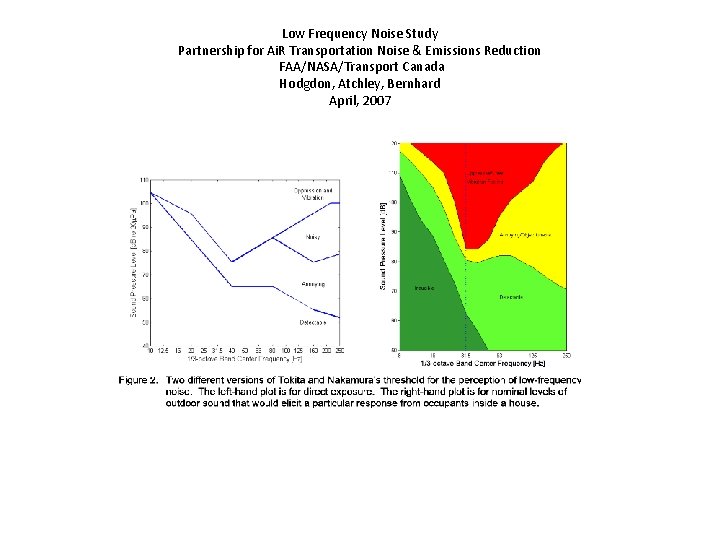
Low Frequency Noise Study Partnership for Ai. R Transportation Noise & Emissions Reduction FAA/NASA/Transport Canada Hodgdon, Atchley, Bernhard April, 2007
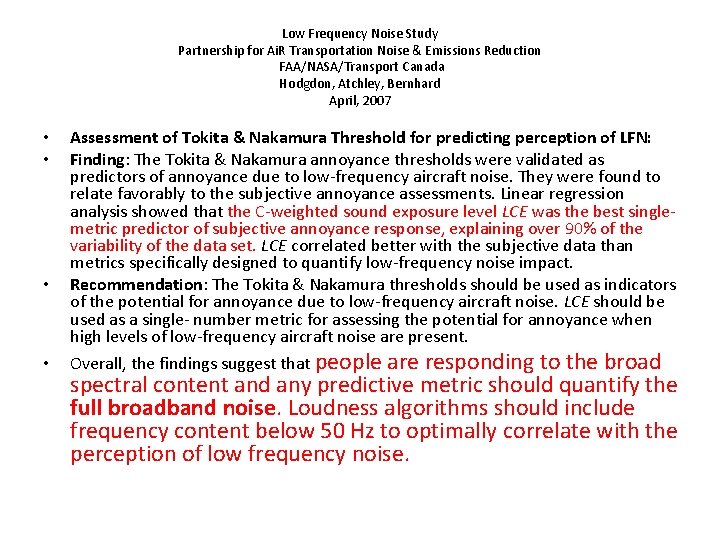
Low Frequency Noise Study Partnership for Ai. R Transportation Noise & Emissions Reduction FAA/NASA/Transport Canada Hodgdon, Atchley, Bernhard April, 2007 • • Assessment of Tokita & Nakamura Threshold for predicting perception of LFN: Finding: The Tokita & Nakamura annoyance thresholds were validated as predictors of annoyance due to low-frequency aircraft noise. They were found to relate favorably to the subjective annoyance assessments. Linear regression analysis showed that the C-weighted sound exposure level LCE was the best singlemetric predictor of subjective annoyance response, explaining over 90% of the variability of the data set. LCE correlated better with the subjective data than metrics specifically designed to quantify low-frequency noise impact. Recommendation: The Tokita & Nakamura thresholds should be used as indicators of the potential for annoyance due to low-frequency aircraft noise. LCE should be used as a single- number metric for assessing the potential for annoyance when high levels of low-frequency aircraft noise are present. Overall, the findings suggest that people are responding to the broad spectral content and any predictive metric should quantify the full broadband noise. Loudness algorithms should include frequency content below 50 Hz to optimally correlate with the perception of low frequency noise.
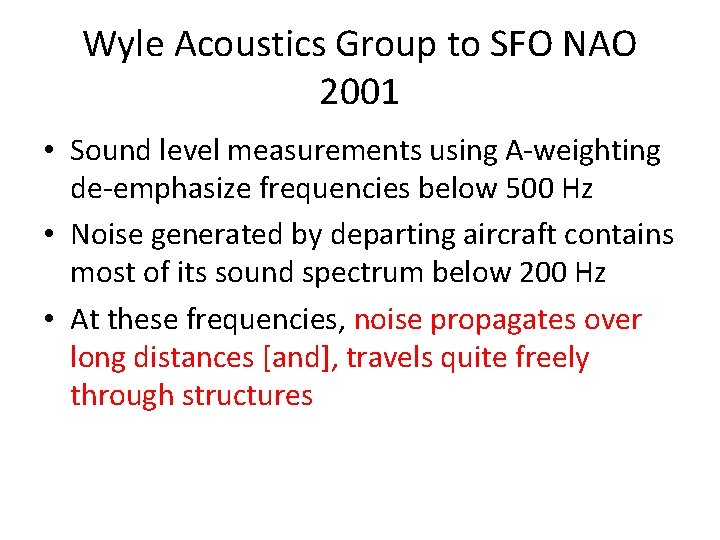
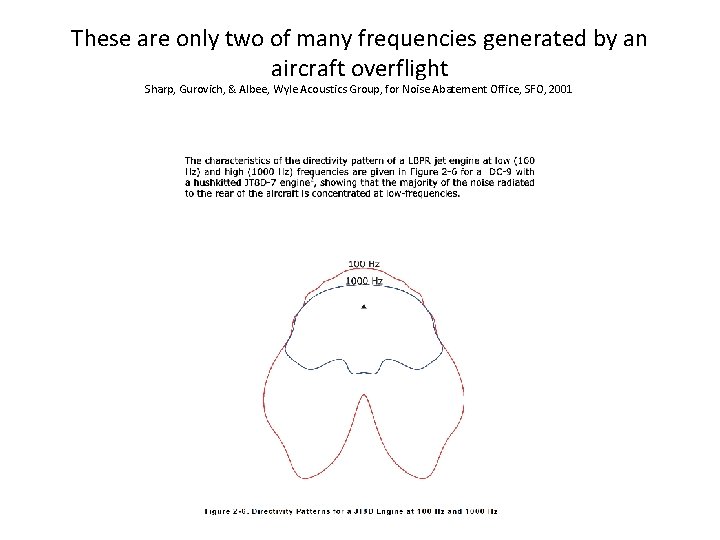
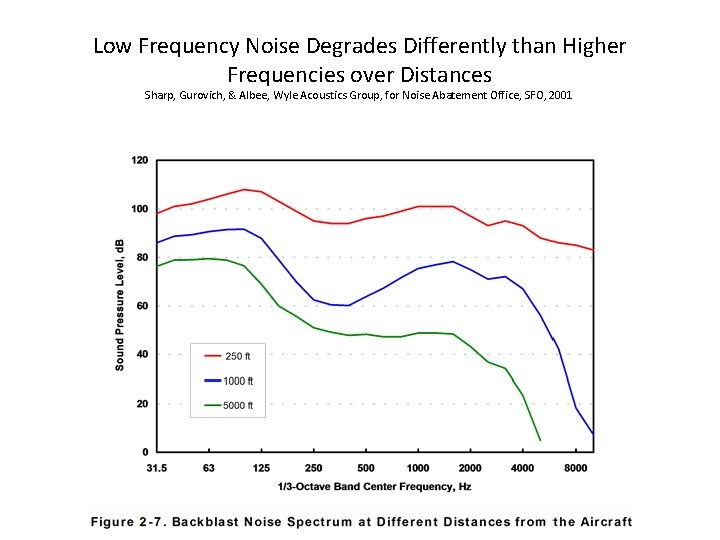
Wyle Acoustics Group to SFO NAO 2001 • Sound level measurements using A-weighting de-emphasize frequencies below 500 Hz • Noise generated by departing aircraft contains most of its sound spectrum below 200 Hz • At these frequencies, noise propagates over long distances [and], travels quite freely through structures
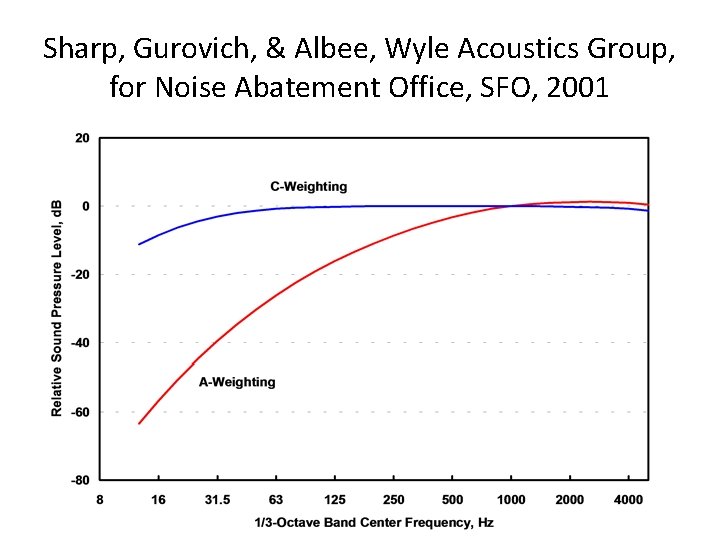
Sharp, Gurovich, & Albee, Wyle Acoustics Group, for Noise Abatement Office, SFO, 2001
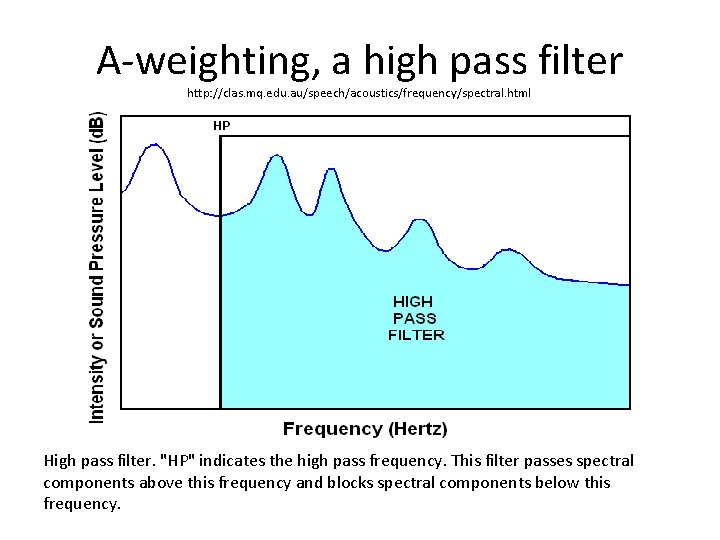
A-weighting, a high pass filter http: //clas. mq. edu. au/speech/acoustics/frequency/spectral. html High pass filter. "HP" indicates the high pass frequency. This filter passes spectral components above this frequency and blocks spectral components below this frequency.
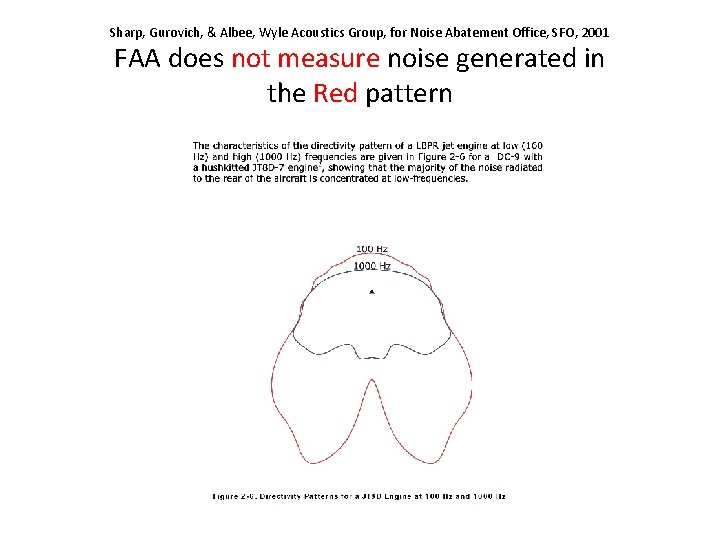
Sharp, Gurovich, & Albee, Wyle Acoustics Group, for Noise Abatement Office, SFO, 2001 FAA does not measure noise generated in the Red pattern
These are only two of many frequencies generated by an aircraft overflight Sharp, Gurovich, & Albee, Wyle Acoustics Group, for Noise Abatement Office, SFO, 2001
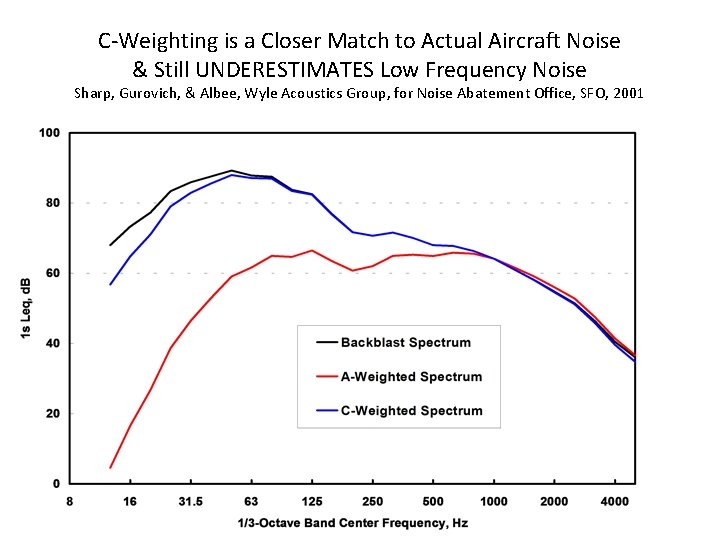
Wyle Acoustics Group to SFO NAO 2001 • C-weighting is easily measured by most sound level meters • C-weighting is preferred over A-weighting to describe backblast noise • Backblast noise contains a significant amount of low frequency energy.
C-Weighting is a Closer Match to Actual Aircraft Noise & Still UNDERESTIMATES Low Frequency Noise Sharp, Gurovich, & Albee, Wyle Acoustics Group, for Noise Abatement Office, SFO, 2001
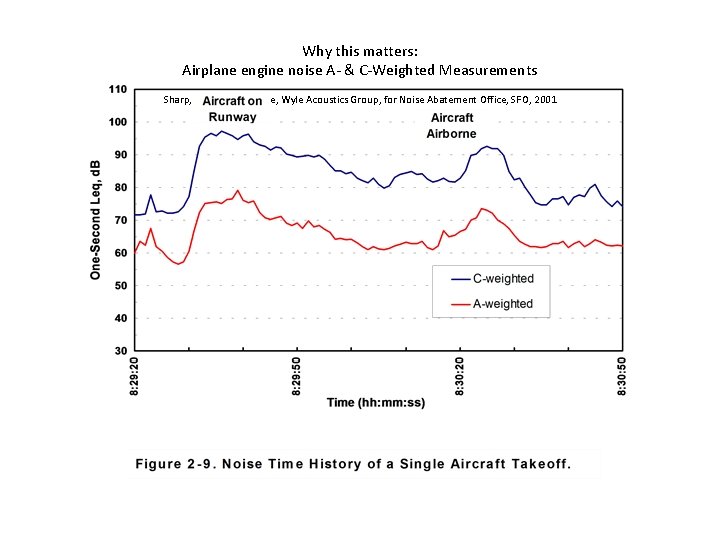
Why this matters: Airplane engine noise A- & C-Weighted Measurements Sharp, Gurovich, & Albee, Wyle Acoustics Group, for Noise Abatement Office, SFO, 2001
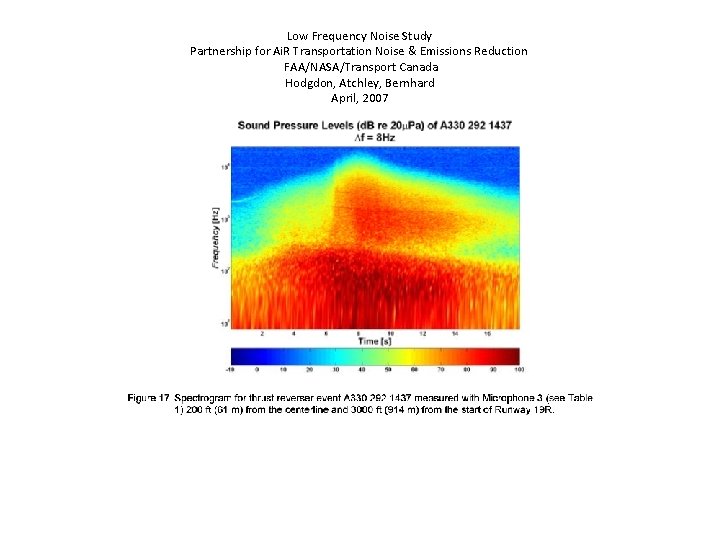
Low Frequency Noise Study Partnership for Ai. R Transportation Noise & Emissions Reduction FAA/NASA/Transport Canada Hodgdon, Atchley, Bernhard April, 2007
Low Frequency Noise Study Partnership for Ai. R Transportation Noise & Emissions Reduction FAA/NASA/Transport Canada Hodgdon, Atchley, Bernhard April, 2007
Low Frequency Noise Degrades Differently than Higher Frequencies over Distances Sharp, Gurovich, & Albee, Wyle Acoustics Group, for Noise Abatement Office, SFO, 2001
World Health Organization publication on Community Noise (Berglund et al. , 2000) • "For noise with a large proportion of low frequency sounds a still lower guideline (than 30 d. BA) is recommended" • "It should be noted that a large proportion of low frequency components in a noise may increase considerably the adverse effects on health" • "The evidence on low frequency noise is sufficiently strong to warrant immediate concern"
Wyle Acoustics Group to SFO NAO 2001 • Meteorological effects are the major factor affecting sound propagation over long distances. Temperature inversions and downwind propagation will increase lowfrequency noise levels.
Low Frequency Noise Study Partnership for Ai. R Transportation Noise & Emissions Reduction FAA/NASA/Transport Canada Hodgdon, Atchley, Bernhard April, 2007
We need new data We can’t convert A- weighted data to C-weighted data • Comparing d. BSPL and d. BA or d. BC: • There is no conversion formula for measured d. BA or d. BC values to sound pressure level d. BSPL or vice versa. That is only possible measuring one single frequency. • • No d. BC measured values can be converted to d. BA values. The frequency composition of the signal is not known. The weighted sound level is neither a physiological nor a physical parameter. • http: //www. sengpielaudio. com/Table. Of. Sound. Pressure. Levels. htm
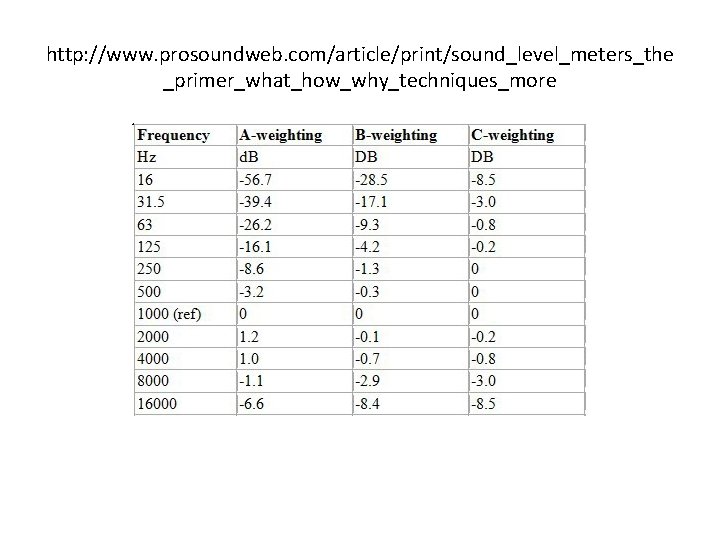
http: //www. prosoundweb. com/article/print/sound_level_meters_the _primer_what_how_why_techniques_more
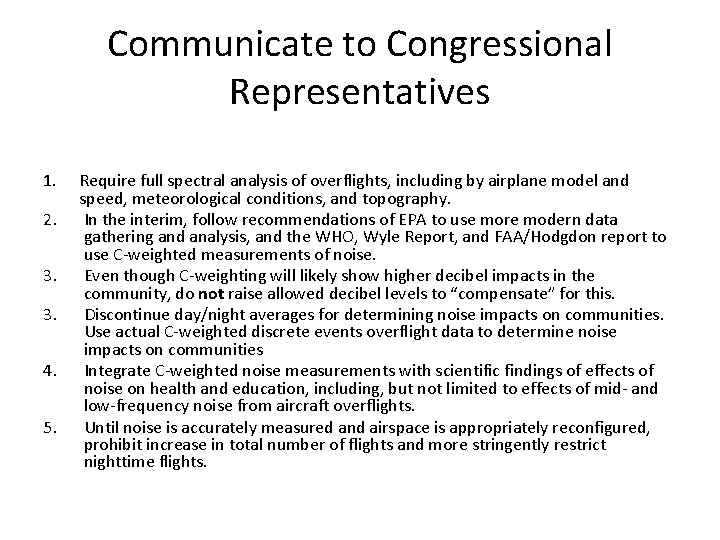
Communicate to Congressional Representatives 1. 2. 3. 3. 4. 5. Require full spectral analysis of overflights, including by airplane model and speed, meteorological conditions, and topography. In the interim, follow recommendations of EPA to use more modern data gathering and analysis, and the WHO, Wyle Report, and FAA/Hodgdon report to use C-weighted measurements of noise. Even though C-weighting will likely show higher decibel impacts in the community, do not raise allowed decibel levels to “compensate” for this. Discontinue day/night averages for determining noise impacts on communities. Use actual C-weighted discrete events overflight data to determine noise impacts on communities Integrate C-weighted noise measurements with scientific findings of effects of noise on health and education, including, but not limited to effects of mid- and low-frequency noise from aircraft overflights. Until noise is accurately measured and airspace is appropriately reconfigured, prohibit increase in total number of flights and more stringently restrict nighttime flights.
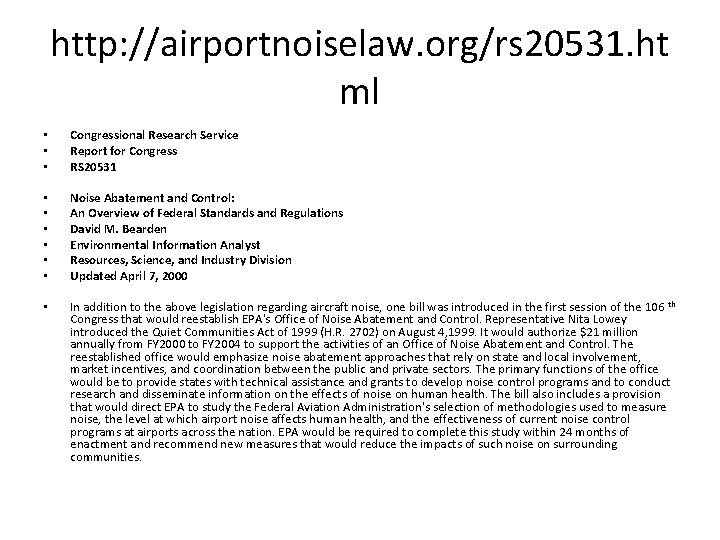
http: //airportnoiselaw. org/rs 20531. ht ml • • • Congressional Research Service Report for Congress RS 20531 • • • Noise Abatement and Control: An Overview of Federal Standards and Regulations David M. Bearden Environmental Information Analyst Resources, Science, and Industry Division Updated April 7, 2000 • In addition to the above legislation regarding aircraft noise, one bill was introduced in the first session of the 106 th Congress that would reestablish EPA's Office of Noise Abatement and Control. Representative Nita Lowey introduced the Quiet Communities Act of 1999 (H. R. 2702) on August 4, 1999. It would authorize $21 million annually from FY 2000 to FY 2004 to support the activities of an Office of Noise Abatement and Control. The reestablished office would emphasize noise abatement approaches that rely on state and local involvement, market incentives, and coordination between the public and private sectors. The primary functions of the office would be to provide states with technical assistance and grants to develop noise control programs and to conduct research and disseminate information on the effects of noise on human health. The bill also includes a provision that would direct EPA to study the Federal Aviation Administration's selection of methodologies used to measure noise, the level at which airport noise affects human health, and the effectiveness of current noise control programs at airports across the nation. EPA would be required to complete this study within 24 months of enactment and recommend new measures that would reduce the impacts of such noise on surrounding communities.
Aircraft Noise Metrics Aircraft Noise is the New Secondhand Smoke Information in this Power. Point presentation Organized by Teresa Bailey, Ph. D Some of this information is copyrighted It is presented for informational/educational purposes only Please respect copyrights and keep citations and source information linked to the information it presents