
AIRCRAFT FUELLING COSCAP SA COSCAP Aircraft Fuelling Operator
- Slides: 14
AIRCRAFT FUELLING COSCAP -SA
COSCAP Aircraft Fuelling Operator must have a procedure for handling and dispensing fuel. n Procedure manual must include: a) Dispensing equipment control procedure b) Electrostatic Protection Procedure c) Contamination protection procedure d) Related record keeping procedure n
COSCAP Aircraft Fuelling n Operator’s responsibility: A) The procedure is conveyed to the fuel vendor and organisation’s rep. B) Ensure that the fuel meets the specification C) Ensure fuel is free from contaminants D) Observing safety measures
COSCAP Aircraft Fuelling n Fuel vendor’s responsibility: A) To ensure that operator’s specific requirement has been understood by the people in the field who will be carrying out refueling. B) The fuel in dispenser meets the specification and purchaser can be satisfied by document on demand.
COSCAP Aircraft Fuelling Fuel vendor’s responsibility contd. C) The fuel in dispenser is free from contaminants D) All standard industry precautions will be observed to ensure safety of aircraft and human lives E) Satisfy the customer in term of quality and quantity
COSCAP Aircraft Fuelling Types of fuel: A) Aviation Gasoline (Avgas ) n B) Jet Fuels
COSCAP Aircraft Fuelling n Type of contaminants : A) Solid contaminants B) Water C) Microbiological growth
COSCAP Aircraft Fuelling n Precautions to be observed: A) Positioning of vehicle B) Strict compliance of No Smoking. C) Positioning Fire extinguishers D) Proper electrical bonding E) Observing limitation of pressure in dispensing
COSCAP Aircraft Fuelling n Precautions contd. E) APU with its exhaust discharge into the fuelling zone shall be started before filler cap is removed or fuelling connection made F) GPU if used should be more than 6 mts away from fuelling zone G) Do not refuel if brakes are very hot.
COSCAP Aircraft Fuelling n Precautions contd. F) Fuelling should cease when I) An aircraft maneuvers to bring its jet exhaust within 43 Meters of fueling zone II) During severe lightening disturbances III) During heavy rain if over wing fuelling is used IV) In case of fuel spillage.
COSCAP Aircraft Fuelling Precautions contd. Do not operate any electrical switches when the fuelling is on. Do not operate weather radar Do not use any tool which can generate spark Use special care when refueling with passenger on board
COSCAP Aircraft Fuelling n Training of personnel Personnel both at the vendor’s establishment and operator’s must be fully conversant with requirements of the aircraft, Safety precautions, Fire fighting, how to summon Airport Fire tenders, disposal of spilled fuel etc. This training should be documented and refreshed at agreed regular interval.
COSCAP Aircraft Fuelling THANK YOU
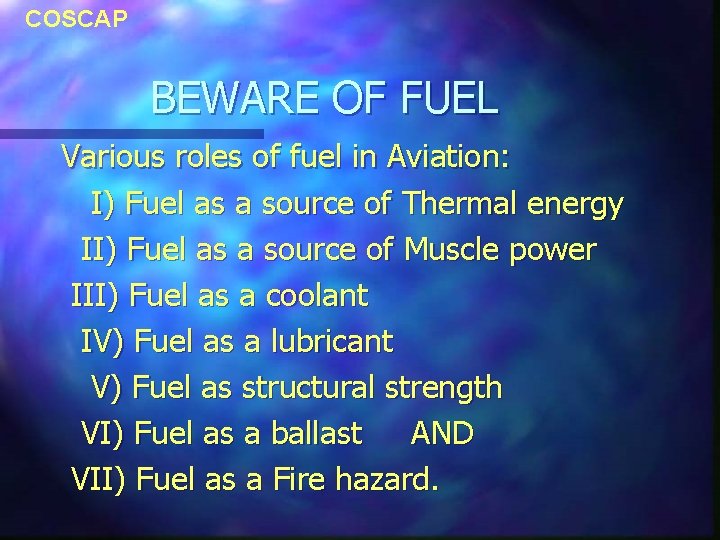
COSCAP BEWARE OF FUEL Various roles of fuel in Aviation: I) Fuel as a source of Thermal energy II) Fuel as a source of Muscle power III) Fuel as a coolant IV) Fuel as a lubricant V) Fuel as structural strength VI) Fuel as a ballast AND VII) Fuel as a Fire hazard.