
Airborne gammaray spectrometry as predictor of indoor radon
Airborne gamma-ray spectrometry as predictor of indoor radon concentration and radon priority areas Bossew P. 1, Elío J. 2, Crowley Q. 2 Hodgson J. 3 1 German Federal Office for Radiation Protection (Bf. S), Berlin 2 School of Natural Sciences, Trinity College, Dublin, Ireland 3 Geological Survey, Ireland Session GI 1. 1/EMRP 4. 3/ESSI 2. 10/SSS 13. 15 - Applications of Data, Methods and Models in Geoscience v. 4. 4. 18 EGU 2018, 8 – 13 April 2018, Vienna, Austria
Content • • Introduction: Motivation - Radon and the problems it causes - Airborne gamma-ray spectrometry - Rn regulation & legislation Relating Rn and aerogamma data - regression, cross-classification - support issues Example: data from Ireland - TELLUS airborne gamma survey - EPA indoor Rn database - results Conclusions slide 2 of 15
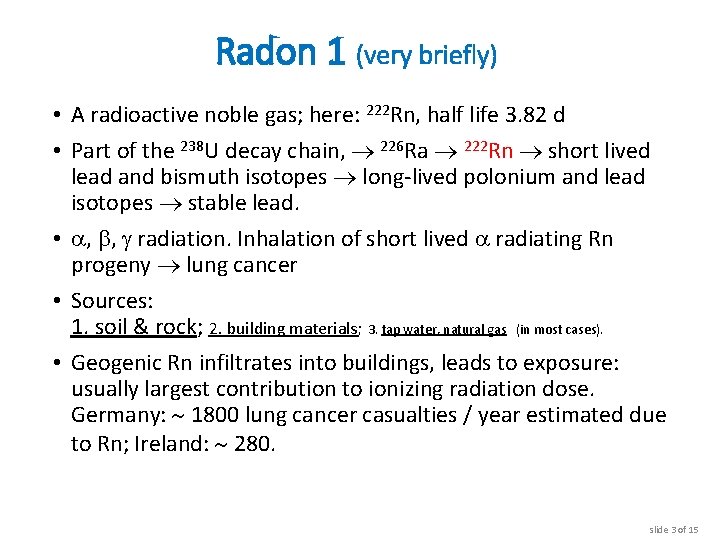
Radon 1 (very briefly) • A radioactive noble gas; here: 222 Rn, half life 3. 82 d • Part of the 238 U decay chain, 226 Ra 222 Rn short lived lead and bismuth isotopes long-lived polonium and lead isotopes stable lead. • , , radiation. Inhalation of short lived radiating Rn progeny lung cancer • Sources: 1. soil & rock; 2. building materials; 3. tap water, natural gas (in most cases). • Geogenic Rn infiltrates into buildings, leads to exposure: usually largest contribution to ionizing radiation dose. Germany: 1800 lung cancer casualties / year estimated due to Rn; Ireland: 280. slide 3 of 15
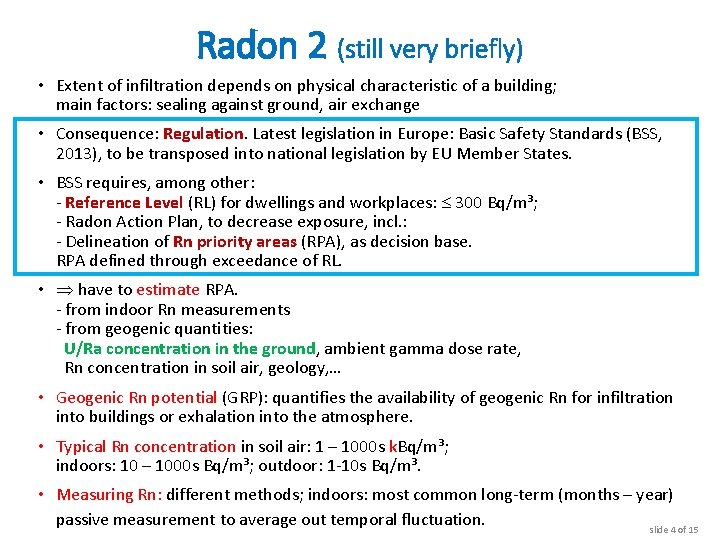
Radon 2 (still very briefly) • Extent of infiltration depends on physical characteristic of a building; main factors: sealing against ground, air exchange • Consequence: Regulation. Latest legislation in Europe: Basic Safety Standards (BSS, 2013), to be transposed into national legislation by EU Member States. • BSS requires, among other: - Reference Level (RL) for dwellings and workplaces: 300 Bq/m³; - Radon Action Plan, to decrease exposure, incl. : - Delineation of Rn priority areas (RPA), as decision base. RPA defined through exceedance of RL. • have to estimate RPA. - from indoor Rn measurements - from geogenic quantities: U/Ra concentration in the ground, ambient gamma dose rate, Rn concentration in soil air, geology, … • Geogenic Rn potential (GRP): quantifies the availability of geogenic Rn for infiltration into buildings or exhalation into the atmosphere. • Typical Rn concentration in soil air: 1 – 1000 s k. Bq/m³; indoors: 10 – 1000 s Bq/m³; outdoor: 1 -10 s Bq/m³. • Measuring Rn: different methods; indoors: most common long-term (months – year) passive measurement to average out temporal fluctuation. slide 4 of 15
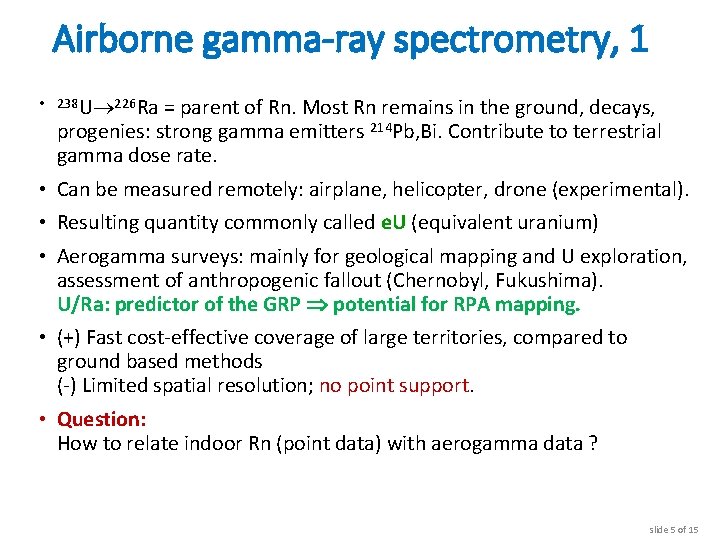
Airborne gamma-ray spectrometry, 1 • 238 U 226 Ra = parent of Rn. Most Rn remains in the ground, decays, progenies: strong gamma emitters 214 Pb, Bi. Contribute to terrestrial gamma dose rate. • Can be measured remotely: airplane, helicopter, drone (experimental). • Resulting quantity commonly called e. U (equivalent uranium) • Aerogamma surveys: mainly for geological mapping and U exploration, assessment of anthropogenic fallout (Chernobyl, Fukushima). U/Ra: predictor of the GRP potential for RPA mapping. • (+) Fast cost-effective coverage of large territories, compared to ground based methods (-) Limited spatial resolution; no point support. • Question: How to relate indoor Rn (point data) with aerogamma data ? slide 5 of 15
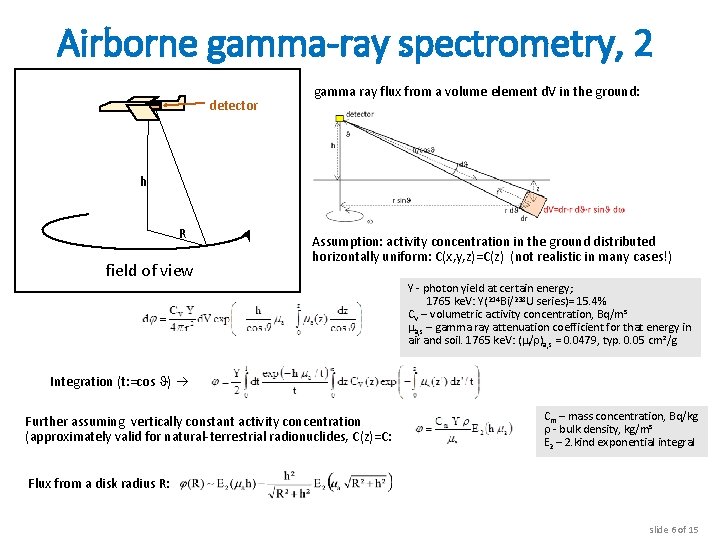
Airborne gamma-ray spectrometry, 2 detector gamma ray flux from a volume element d. V in the ground: h R field of view Assumption: activity concentration in the ground distributed horizontally uniform: C(x, y, z)=C(z) (not realistic in many cases!) Y - photon yield at certain energy; 1765 ke. V: Y( 214 Bi/238 U series)= 15. 4% CV – volumetric activity concentration, Bq/m³ a, s – gamma ray attenuation coefficient for that energy in air and soil. 1765 ke. V: ( / )a, s = 0. 0479, typ. 0. 05 cm²/g Integration (t: =cos ) Further assuming vertically constant activity concentration (approximately valid for natural-terrestrial radionuclides, C(z)=C: Cm – mass concentration, Bq/kg - bulk density, kg/m³ E 2 – 2. kind exponential integral Flux from a disk radius R: slide 6 of 15
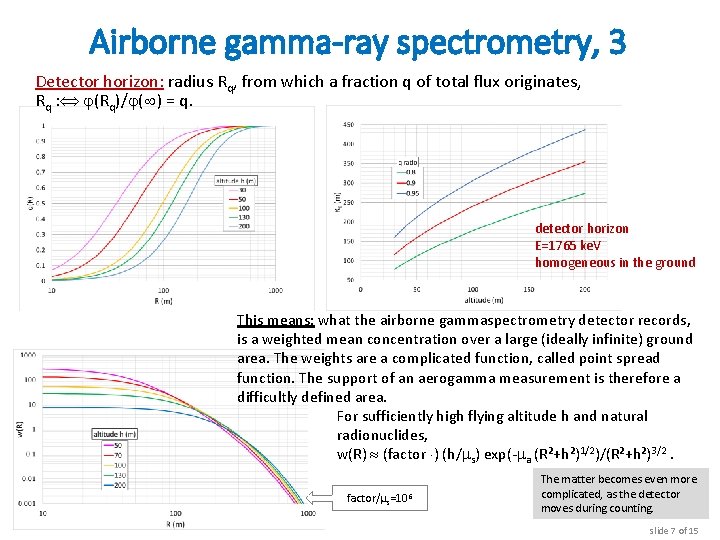
Airborne gamma-ray spectrometry, 3 Detector horizon: radius Rq, from which a fraction q of total flux originates, Rq : (Rq)/ ( ) = q. detector horizon E=1765 ke. V homogeneous in the ground This means: what the airborne gammaspectrometry detector records, is a weighted mean concentration over a large (ideally infinite) ground area. The weights are a complicated function, called point spread function. The support of an aerogamma measurement is therefore a difficultly defined area. For sufficiently high flying altitude h and natural radionuclides, w(R) (factor ) (h/ s) exp(- a (R²+h²)1/2)/(R²+h²)3/2. factor/µs=106 The matter becomes even more complicated, as the detector moves during counting. slide 7 of 15
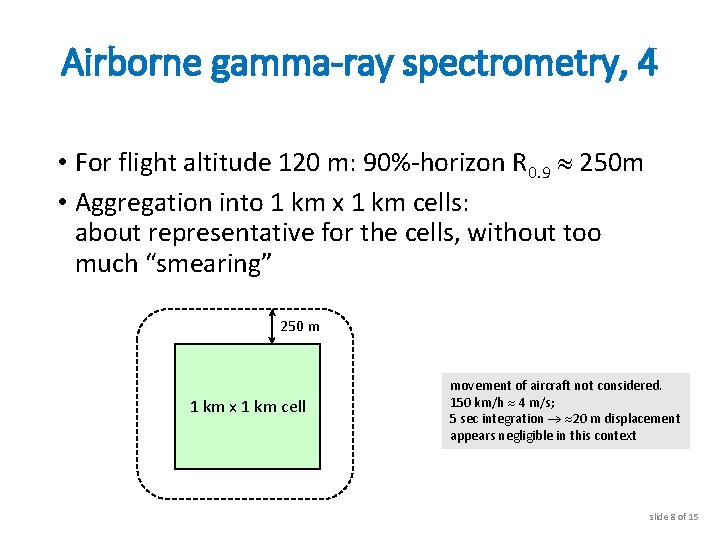
Airborne gamma-ray spectrometry, 4 • For flight altitude 120 m: 90%-horizon R 0. 9 250 m • Aggregation into 1 km x 1 km cells: about representative for the cells, without too much “smearing” 250 m 1 km x 1 km cell movement of aircraft not considered. 150 km/h 4 m/s; 5 sec integration 20 m displacement appears negligible in this context slide 8 of 15
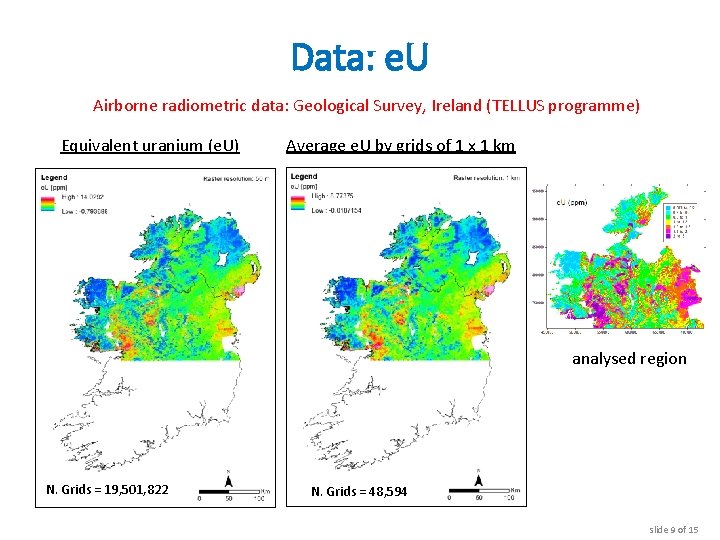
Data: e. U Airborne radiometric data: Geological Survey, Ireland (TELLUS programme) Equivalent uranium (e. U) Average e. U by grids of 1 x 1 km analysed region N. Grids = 19, 501, 822 N. Grids = 48, 594 slide 9 of 15
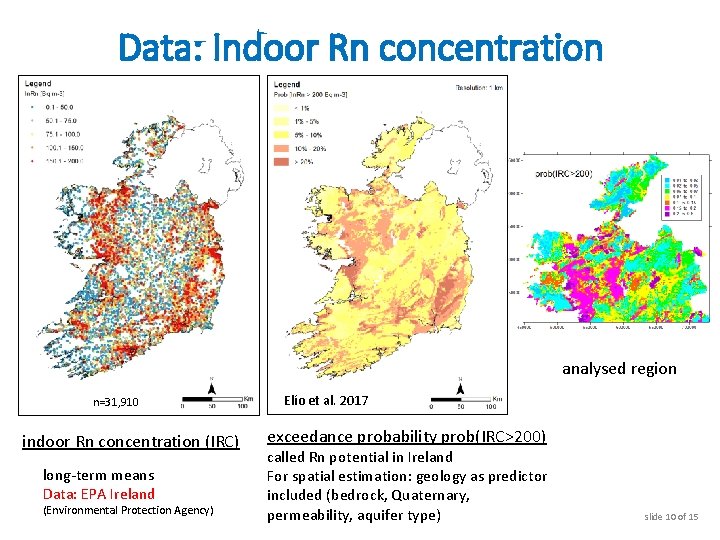
Data: Indoor Rn concentration analysed region n=31, 910 indoor Rn concentration (IRC) long-term means Data: EPA Ireland (Environmental Protection Agency) Elío et al. 2017 exceedance probability prob(IRC>200) called Rn potential in Ireland For spatial estimation: geology as predictor included (bedrock, Quaternary, permeability, aquifer type) slide 10 of 15
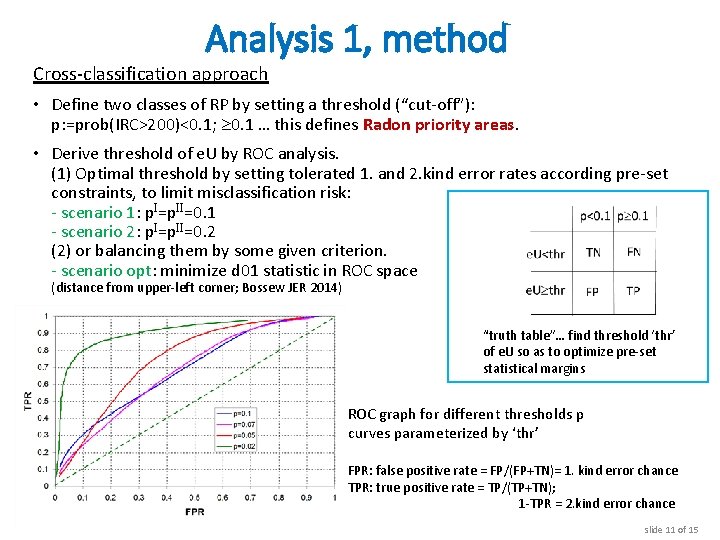
Analysis 1, method Cross-classification approach • Define two classes of RP by setting a threshold (“cut-off”): p: =prob(IRC>200)<0. 1; 0. 1 … this defines Radon priority areas. • Derive threshold of e. U by ROC analysis. (1) Optimal threshold by setting tolerated 1. and 2. kind error rates according pre-set constraints, to limit misclassification risk: - scenario 1: p. I=p. II=0. 1 - scenario 2: p. I=p. II=0. 2 (2) or balancing them by some given criterion. - scenario opt: minimize d 01 statistic in ROC space (distance from upper-left corner; Bossew JER 2014) “truth table”… find threshold ‘thr’ of e. U so as to optimize pre-set statistical margins ROC graph for different thresholds p curves parameterized by ‘thr’ FPR: false positive rate = FP/(FP+TN)= 1. kind error chance TPR: true positive rate = TP/(TP+TN); 1 -TPR = 2. kind error chance slide 11 of 15
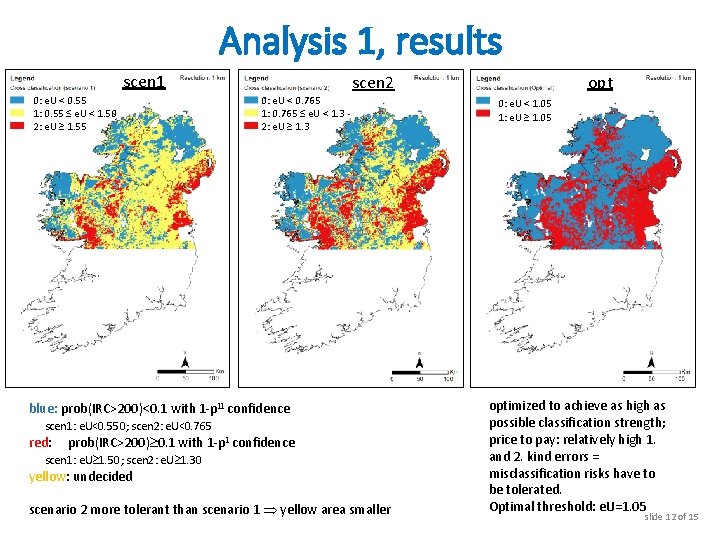
Analysis 1, results scen 1 0: e. U < 0. 55 1: 0. 55 ≤ e. U < 1. 50 2: e. U ≥ 1. 55 0: e. U < 0. 765 1: 0. 765 ≤ e. U < 1. 3 2: e. U ≥ 1. 3 blue: prob(IRC>200)<0. 1 with 1 -p. II confidence scen 1: e. U<0. 550; scen 2: e. U<0. 765 red: opt scen 2 prob(IRC>200) 0. 1 with 1 -p. I confidence scen 1: e. U 1. 50; scen 2: e. U 1. 30 yellow: undecided scenario 2 more tolerant than scenario 1 yellow area smaller 0: e. U < 1. 05 1: e. U ≥ 1. 05 optimized to achieve as high as possible classification strength; price to pay: relatively high 1. and 2. kind errors = misclassification risks have to be tolerated. Optimal threshold: e. U=1. 05 slide 12 of 15
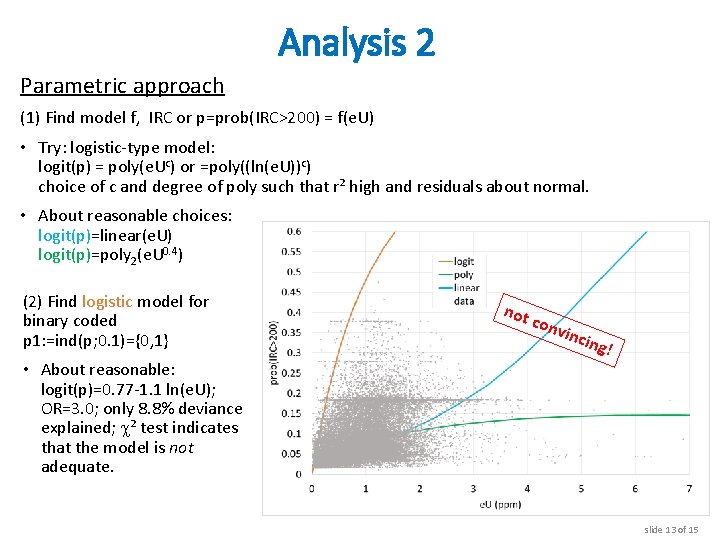
Analysis 2 Parametric approach (1) Find model f, IRC or p=prob(IRC>200) = f(e. U) • Try: logistic-type model: logit(p) = poly(e. Uc) or =poly((ln(e. U))c) choice of c and degree of poly such that r² high and residuals about normal. • About reasonable choices: logit(p)=linear(e. U) logit(p)=poly 2(e. U 0. 4) (2) Find logistic model for binary coded p 1: =ind(p; 0. 1)={0, 1} • About reasonable: logit(p)=0. 77 -1. 1 ln(e. U); OR=3. 0; only 8. 8% deviance explained; ² test indicates that the model is not adequate. not con v inci ng! slide 13 of 15
Conclusions • Aggregating the data into the same spatial unit relaxes the problem of different supports and makes them comparable. • Drawback: some loss of spatial information. • Prediction of Rn priority areas by cross-classification: leads to acceptable results in term of misclassification risk. Aerogamma can be used for predicting Rn priority areas. • Prediction of IRC or prob(IRC>200) by parametric model: questionable; better model still to be found. • To-do: - try different cell sizes; perhaps 1 x 1 km too small for the purpose - investigate residuals … other relevant factors which control IRC! - better parametric models? slide 14 of 15
Thank you! Supported by: Irish Research Council (EPSPD/2015/46) Geological Survey, Ireland (Short call 2017) H 2020 / EURAMET - Metro Radon project slide 15 of 15
- Slides: 15